


Polymerase Chain Reaction
(PCR) and Its Applications
Dr. Dinesh Jain
Associate Professor
SMS Medical College Jaipur
What is PCR?
It was invented in 1983 by Dr. Kary
Mullis, for which he received the Nobel
Prize in Chemistry in 1993.
PCR is an exponentially progressing
synthesis of the defined target DNA
sequences in vitro.
What is PCR? :
Why “Chain”?
It is called “chain” because the
products of the first reaction become
substrates of the following one, and
so on.
What is PCR? :
The “Reaction” Components
1) Target DNA - contains the sequence to be amplified.
2) Pair of Primers - oligonucleotides that define the sequence
to be amplified.
3) dNTPs - deoxynucleotidetriphosphates: DNA building blocks.
4) Thermostable DNA Polymerase - enzyme that
catalyzes the reaction
5) Mg++ ions - cofactor of the enzyme
6) Buffer solution – maintains pH and ionic strength
of the reaction solution suitable for the activity of
the enzyme
1. Hot-Start PCR
2. Inverse PCR
3. Multiplex PCR
4. Nested PCR
5. Ligation-Mediated PCR
6. Methylation-Specific PCR (MSP)
7. Multiplex Ligation-Dependent
Probe Amplification (MLPA)
8. Thermal Asymmetric Interlaced
PCR (Tail- PCR)
9. Assembly PCR
10. Asymmetric PCR
11. Colony PCR
12. Helicase-dependent amplification
13. In Situ PCR (ISH)
14. Intersequence-specific PCR (ISSR)
15. Ligation-mediated PCR
16. Methylation-specific PCR (MSP)
17. Long PCR
18. Miniprimer PCR
19. Overlap-extension PCR
20. Quantitative PCR (Q-PCR)
21. Reverse Transcription PCR (RT-
PCR
22. Solid Phase PCR
23. Touchdown PCR (Step-down PCR)
24. Universal Fast Walking
25. Variable Number of Tandem
Repeats (VNTR) PCR
26. InterSequence-Specific PCR (or
ISSR-PCR)
Types of PCR
The Reaction
THERMOCYCLER
PCR tube
DNA copies vs Cycle number
0
500000
1000000
1500000
2000000
2500000
0 1 2 3 4 5 6 7 8 9 10 11 12 13 14 15 16 17 18 19 20 21 22 23
Cycle number
DNA
copies
Applications of PCR
• Classification
of organisms
• Genotyping
• Molecular
archaeology
• Mutagenesis
• Mutation
detection
• Sequencing
• Cancer research
• Detection of
pathogens
• DNA
fingerprinting
• Drug discovery
• Genetic
matching
• Genetic
engineering
• Pre-natal
diagnosis
Applications of PCR
Basic Research Applied Research
• Genetic matching
• Detection of pathogens
• Pre-natal diagnosis
• DNA fingerprinting
• Gene therapy
• Mutation screening
• Drug discovery
• Classification of organisms
• Genotyping
• Molecular Archaeology
• Molecular Epidemiology
• Molecular Ecology
• Bioinformatics
• Genomic cloning
• Site-directed mutagenesis
• Gene expression studies
Applications of PCR
Molecular Identification Sequencing Genetic Engineering
• Molecular Archaeology
• Molecular Epidemiology
• Molecular Ecology
• DNA fingerprinting
• Classification of organisms
• Genotyping
• Pre-natal diagnosis
• Mutation screening
• Drug discovery
• Genetic matching
• Detection of pathogens
• Bioinformatics
• Genomic cloning
• Human Genome Project
• Site-directed mutagenesis
• Gene expression studies
Steps in PCR
Initialization
Denaturation
Annealing
Extension / Elongation
Final elongation
Final hold
Initialization step
Heating the reaction to a temperature of
 94-96°C for 1-9 minutes.
 Denaturation step
 94-98°C for 20-30 seconds.
 Denaturation of DNA template by disrupting the hydrogen
bonds between complementary bases of the DNA strands,
yielding single strands of DNA.
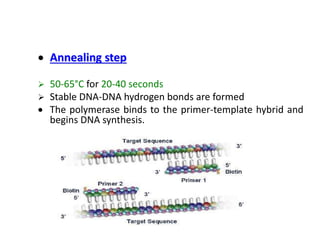
 Annealing step
 50-65°C for 20-40 seconds
 Stable DNA-DNA hydrogen bonds are formed
 The polymerase binds to the primer-template hybrid and
begins DNA synthesis.
Extension/elongation step
 75-80°C
 At this step the DNA polymerase synthesizes a new DNA
strand complementary to the DNA template by adding
dNTPs in 5' to 3' direction.
Final elongation
 70-74°C for 5-15 minutes
 To ensure that any remaining single-stranded DNA is
fully extended.
Final hold
 4-15°C for an indefinite time
 short-term storage of the reaction
Allele- Specific PCR
• Selective PCR amplification of the alleles to detect single
nucleotide polymorphism (SNP)
• Selective amplification is usually achieved by designing a
primer such that the primer will match or mismatch one of
the alleles at the 3’ end of the primer.
Asymmetric PCR
• It is used for DNA sequencing
• The two primers are used in the 100:1 ratio so that after
20-25 cycles of amplification one primer is exhausted thus
single stranded DNA is produced in the next 5-10 cycles
Real Time PCR
• Quantitative real time PCR (Q-RT PCR)
• It is used to amplify and simultaneously quantify a target
target DNA molecule
 Real time PCR using DNA dyes
 Fluorescent reporter probe method
Real Time PCR
Helicase-dependent amplification
 Constant temperature is used rather than cycling through
denaturation and annealing/extension cycles.
 DNA Helicase, an enzyme that unwinds DNA, is used in
place of thermal denaturation.
Intersequence-specific PCR (ISSR):
A PCR method for DNA fingerprinting that amplifies
regions between some simple sequence repeats to
produce a unique fingerprint of amplified fragment
lengths.
Inverse PCR
 A method used to allow PCR when only one internal
sequence is known.
 This is especially useful in identifying flanking sequences
of various genomic inserts.
Anchored PCR
• When sequence of only one end of the desired segment of
gene is known,the primer complimentary to the 3' strand of
this end is used to produce several copies of only one
strand of the gene.
RT-PCR (Reverse Transcription PCR)
 It is used to amplify, isolate or identify a known sequence
from a cellular or tissue RNA.
 RT-PCR is widely used in expression profiling, to
determine the expression of a gene or to identify the
sequence of an RNA transcript.
RACE-PCR
 Used to obtain 3' and 5' end sequence of cDNA transcripts
Parameter PCR Gene cloning
1. Final result Selective amplification of
specific sequence
Selective amplification of
specific sequence
2. Manipulation In vitro In vitro and in vivo
3. Selectivity of the specific
segment from complex DNA
First step Last step
4. Quantity of starting material Nanogram (ng) Microgram (m)
5. Biological reagents required DNA polymerase
(Taq polymerase)
Restriction enzymes,
Ligase, vector. bacteria
6. Automation Yes No
7. Labour intensive No Yes
8. Error probability Less More
9. Applications More Less
10. Cost Less More
11. User’s skill Not required Required
12. Time for a typical experiment Four hours Two to four days
Comparison PCR - Polymerase Chain Reaction and Gene Cloning
Application of PCR
Cloning a Gene encoding a known protein
Amplification of old DNA
Amplifying cloned DNA from Vectors
Rapid Amplification of cDNA ends
Detecting Bacterial or Viral Infection
● AIDS infection
●Tuberculosis (Mycobacterium tuberculosis)
Genetics Diagnosis
Diagnosing inherited disorders
 Cystic fibrosis
 Muscular dystrophy
 Haemophilia A and B
 Sickle cell anaemia
Diagnosing cancer
Blood group typing.
Problems with PCR
• Polymerase errors
Polymerase lacks exonuclease activity
• Size limitations
PCR works readily with DNA of lengths two to three
thousand basepairs
• Non specific priming
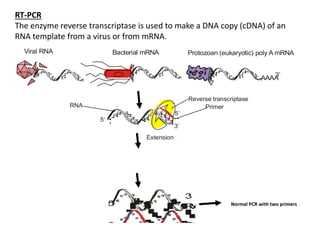
RT-PCR
The enzyme reverse transcriptase is used to make a DNA copy (cDNA) of an
RNA template from a virus or from mRNA.
Viral RNA Bacterial mRNA
AAAA
3’
Protozoan (eukaryotic) poly A mRNA
Primer
Reverse transcriptase
RNA
3’
5’
5’
Extension
c
D
N
A
R
N
A
3
’
3
’
5
’
5
’
Normal PCR with two primers
Multiplex PCR
Use of multiple sets of primers to detect more than one organism or to detect
multiple genes in one organism. Remember, the PCR reaction is inherently biased
depending on the G+C content of the target and primer DNA. So performing
multiplex PCR can be tricky.
E. Coli
genome
Salmonella sp.
genome
or
Seminested PCR
Three primers are required, the normal upstream and downstream primers as well
as a third, internal primer. Two rounds of PCR are performed, a normal PCR with the
upstream and downstream primer, and then a second round of PCR with the
downstream and internal primer. A second smaller product is the result of the
second round of PCR.
Internal primer
Downstream primer
Upstream primer
ICC-PCR
Integrated cell culture PCR is used for virus detection. Cell culture takes 10 – 15 days.
PCR alone detects both infectious and noninfectious particles. So use a combination of
these techniques: grow the sample in cell culture 2 – 3 days, release virus from cells
and perform PCR. This results in the detection of infectious virus in a shorter time with
a 50% cost savings. It also allows use of dilute samples which reduces PCR inhibitory
substances.
SYBR Green I
hn
ssDNA -- unbound dye
minimal fluorescence
hn
dsDNA -- bound dye >100
fold increase fluorescence
TaqM an -- Hydrolysis Probe
M onitor acceptor fluorescence
hn
Hybridization probes
FRET
hn
donor acceptor
hn
fluor quencher
hn
Extension continues
Figure 2. Figure X. Schematic of SYBR Green I, TaqMan, and hybridization probe
Labelling approaches
CYBR green
Real-Time PCR
This technique allows quantitation of DNA
and RNA. Reactions are characterized by
the point in time during cycling when
amplification of a PCR product is first
detected rather than the amount of PCR
product accumulated after a fixed number
of cycles. The higher the starting copy
number of the nucleic acid target, the
sooner a significant increase in
fluorescence is observed.
TAQ-man probes
FRET probes
PCR fingerprinting
AP-PCR (arbitrarily primed PCR), 1 primer required, 10-20 bp, no sequence
information required
REP-PCR (repetitive extragenic palindromic sequences) 2 primers insert
randomly into the REP sites
ERIC-PCR (enterobacterial repetitive intergenic consensus sequences), 2
primers insert randomly into the ERIC sites, best for Gram Negative microbes
All of these fingerprinting techniques tell one if two isolates are the same or
different. They do not provide information about the identity or relatedness
of the organisms
RT-PCR lab
You have a cell…is a certain gene on
(by “on,” we mean active and
producing mRNA?)?
If a certain gene is on when the cell
divides, the gene might produce a
protein that causes cell division….
Central Dogma:
• DNA has genes and is in nucleus
• TRANSCRIPTION: Double strands of DNA unwind
to allow synthesis of messenger RNA (mRNA)
from one strand (the coding strand)
• The mRNA moves out of the nucleus to the
cytoplasm
• mRNA binds to Ribosomes to code for a protein-
protein made (translation)
• Protein carries out intent of gene (red hair
protein = hair gene)
DNA Structure
Unwind, mRNA is
made off DNA
template- similar to
this picture of DNA
made off of DNA.
Nucleotides pair up:
G always pairs with C,
T pairs with A. Except
in RNA, T is replaced
with U.
Transcription:
RNA synthesis
(note coding and
template strands)
(ch.21)
Making mRNA off DNA:
So, first step of RT PCR is:
• ISOLATE THE mRNA from the cell
• Next, make DNA from the mRNA
• This is reversing “transcription”– so use an
enzyme originally obtained from viruses–
ENZYME IS CALLED REVERSE TRANSCRIPTASE
(THE RT OF RT PCR)
• Last slide: this is the RT part of RT PCR
PCR part:
• After RT, you now have a tiny, trace amount
of what is called complimentary DNA (cDNA).
This tiny trace amount is not enough to
sequence.
• Next, you have to make enough copies of the
tiny trace amount of cDNA to sequence
PCR.pptx
PCR.pptx
PCR.pptx
PCR.pptx
PCR.pptx

PCR.pptx

  • 1.
    Polymerase Chain Reaction (PCR)and Its Applications Dr. Dinesh Jain Associate Professor SMS Medical College Jaipur
  • 3.
    What is PCR? Itwas invented in 1983 by Dr. Kary Mullis, for which he received the Nobel Prize in Chemistry in 1993. PCR is an exponentially progressing synthesis of the defined target DNA sequences in vitro.
  • 4.
    What is PCR?: Why “Chain”? It is called “chain” because the products of the first reaction become substrates of the following one, and so on.
  • 5.
    What is PCR?: The “Reaction” Components 1) Target DNA - contains the sequence to be amplified. 2) Pair of Primers - oligonucleotides that define the sequence to be amplified. 3) dNTPs - deoxynucleotidetriphosphates: DNA building blocks. 4) Thermostable DNA Polymerase - enzyme that catalyzes the reaction 5) Mg++ ions - cofactor of the enzyme 6) Buffer solution – maintains pH and ionic strength of the reaction solution suitable for the activity of the enzyme
  • 6.
    1. Hot-Start PCR 2.Inverse PCR 3. Multiplex PCR 4. Nested PCR 5. Ligation-Mediated PCR 6. Methylation-Specific PCR (MSP) 7. Multiplex Ligation-Dependent Probe Amplification (MLPA) 8. Thermal Asymmetric Interlaced PCR (Tail- PCR) 9. Assembly PCR 10. Asymmetric PCR 11. Colony PCR 12. Helicase-dependent amplification 13. In Situ PCR (ISH) 14. Intersequence-specific PCR (ISSR) 15. Ligation-mediated PCR 16. Methylation-specific PCR (MSP) 17. Long PCR 18. Miniprimer PCR 19. Overlap-extension PCR 20. Quantitative PCR (Q-PCR) 21. Reverse Transcription PCR (RT- PCR 22. Solid Phase PCR 23. Touchdown PCR (Step-down PCR) 24. Universal Fast Walking 25. Variable Number of Tandem Repeats (VNTR) PCR 26. InterSequence-Specific PCR (or ISSR-PCR) Types of PCR
  • 7.
  • 9.
    DNA copies vsCycle number 0 500000 1000000 1500000 2000000 2500000 0 1 2 3 4 5 6 7 8 9 10 11 12 13 14 15 16 17 18 19 20 21 22 23 Cycle number DNA copies
  • 10.
    Applications of PCR •Classification of organisms • Genotyping • Molecular archaeology • Mutagenesis • Mutation detection • Sequencing • Cancer research • Detection of pathogens • DNA fingerprinting • Drug discovery • Genetic matching • Genetic engineering • Pre-natal diagnosis
  • 11.
    Applications of PCR BasicResearch Applied Research • Genetic matching • Detection of pathogens • Pre-natal diagnosis • DNA fingerprinting • Gene therapy • Mutation screening • Drug discovery • Classification of organisms • Genotyping • Molecular Archaeology • Molecular Epidemiology • Molecular Ecology • Bioinformatics • Genomic cloning • Site-directed mutagenesis • Gene expression studies
  • 12.
    Applications of PCR MolecularIdentification Sequencing Genetic Engineering • Molecular Archaeology • Molecular Epidemiology • Molecular Ecology • DNA fingerprinting • Classification of organisms • Genotyping • Pre-natal diagnosis • Mutation screening • Drug discovery • Genetic matching • Detection of pathogens • Bioinformatics • Genomic cloning • Human Genome Project • Site-directed mutagenesis • Gene expression studies
  • 13.
    Steps in PCR Initialization Denaturation Annealing Extension/ Elongation Final elongation Final hold Initialization step Heating the reaction to a temperature of  94-96°C for 1-9 minutes.
  • 14.
     Denaturation step 94-98°C for 20-30 seconds.  Denaturation of DNA template by disrupting the hydrogen bonds between complementary bases of the DNA strands, yielding single strands of DNA.
  • 17.
     Annealing step 50-65°C for 20-40 seconds  Stable DNA-DNA hydrogen bonds are formed  The polymerase binds to the primer-template hybrid and begins DNA synthesis.
  • 19.
    Extension/elongation step  75-80°C At this step the DNA polymerase synthesizes a new DNA strand complementary to the DNA template by adding dNTPs in 5' to 3' direction.
  • 20.
    Final elongation  70-74°Cfor 5-15 minutes  To ensure that any remaining single-stranded DNA is fully extended. Final hold  4-15°C for an indefinite time  short-term storage of the reaction
  • 23.
    Allele- Specific PCR •Selective PCR amplification of the alleles to detect single nucleotide polymorphism (SNP) • Selective amplification is usually achieved by designing a primer such that the primer will match or mismatch one of the alleles at the 3’ end of the primer.
  • 24.
    Asymmetric PCR • Itis used for DNA sequencing • The two primers are used in the 100:1 ratio so that after 20-25 cycles of amplification one primer is exhausted thus single stranded DNA is produced in the next 5-10 cycles
  • 25.
    Real Time PCR •Quantitative real time PCR (Q-RT PCR) • It is used to amplify and simultaneously quantify a target target DNA molecule  Real time PCR using DNA dyes  Fluorescent reporter probe method
  • 26.
  • 27.
    Helicase-dependent amplification  Constanttemperature is used rather than cycling through denaturation and annealing/extension cycles.  DNA Helicase, an enzyme that unwinds DNA, is used in place of thermal denaturation.
  • 28.
    Intersequence-specific PCR (ISSR): APCR method for DNA fingerprinting that amplifies regions between some simple sequence repeats to produce a unique fingerprint of amplified fragment lengths.
  • 29.
    Inverse PCR  Amethod used to allow PCR when only one internal sequence is known.  This is especially useful in identifying flanking sequences of various genomic inserts.
  • 31.
    Anchored PCR • Whensequence of only one end of the desired segment of gene is known,the primer complimentary to the 3' strand of this end is used to produce several copies of only one strand of the gene.
  • 33.
    RT-PCR (Reverse TranscriptionPCR)  It is used to amplify, isolate or identify a known sequence from a cellular or tissue RNA.  RT-PCR is widely used in expression profiling, to determine the expression of a gene or to identify the sequence of an RNA transcript. RACE-PCR  Used to obtain 3' and 5' end sequence of cDNA transcripts
  • 35.
    Parameter PCR Genecloning 1. Final result Selective amplification of specific sequence Selective amplification of specific sequence 2. Manipulation In vitro In vitro and in vivo 3. Selectivity of the specific segment from complex DNA First step Last step 4. Quantity of starting material Nanogram (ng) Microgram (m) 5. Biological reagents required DNA polymerase (Taq polymerase) Restriction enzymes, Ligase, vector. bacteria 6. Automation Yes No 7. Labour intensive No Yes 8. Error probability Less More 9. Applications More Less 10. Cost Less More 11. User’s skill Not required Required 12. Time for a typical experiment Four hours Two to four days Comparison PCR - Polymerase Chain Reaction and Gene Cloning
  • 36.
    Application of PCR Cloninga Gene encoding a known protein Amplification of old DNA Amplifying cloned DNA from Vectors Rapid Amplification of cDNA ends Detecting Bacterial or Viral Infection ● AIDS infection ●Tuberculosis (Mycobacterium tuberculosis)
  • 37.
    Genetics Diagnosis Diagnosing inheriteddisorders  Cystic fibrosis  Muscular dystrophy  Haemophilia A and B  Sickle cell anaemia Diagnosing cancer Blood group typing.
  • 38.
    Problems with PCR •Polymerase errors Polymerase lacks exonuclease activity • Size limitations PCR works readily with DNA of lengths two to three thousand basepairs • Non specific priming
  • 39.
    RT-PCR The enzyme reversetranscriptase is used to make a DNA copy (cDNA) of an RNA template from a virus or from mRNA. Viral RNA Bacterial mRNA AAAA 3’ Protozoan (eukaryotic) poly A mRNA Primer Reverse transcriptase RNA 3’ 5’ 5’ Extension c D N A R N A 3 ’ 3 ’ 5 ’ 5 ’ Normal PCR with two primers
  • 40.
    Multiplex PCR Use ofmultiple sets of primers to detect more than one organism or to detect multiple genes in one organism. Remember, the PCR reaction is inherently biased depending on the G+C content of the target and primer DNA. So performing multiplex PCR can be tricky. E. Coli genome Salmonella sp. genome or
  • 41.
    Seminested PCR Three primersare required, the normal upstream and downstream primers as well as a third, internal primer. Two rounds of PCR are performed, a normal PCR with the upstream and downstream primer, and then a second round of PCR with the downstream and internal primer. A second smaller product is the result of the second round of PCR. Internal primer Downstream primer Upstream primer
  • 42.
    ICC-PCR Integrated cell culturePCR is used for virus detection. Cell culture takes 10 – 15 days. PCR alone detects both infectious and noninfectious particles. So use a combination of these techniques: grow the sample in cell culture 2 – 3 days, release virus from cells and perform PCR. This results in the detection of infectious virus in a shorter time with a 50% cost savings. It also allows use of dilute samples which reduces PCR inhibitory substances.
  • 43.
    SYBR Green I hn ssDNA-- unbound dye minimal fluorescence hn dsDNA -- bound dye >100 fold increase fluorescence TaqM an -- Hydrolysis Probe M onitor acceptor fluorescence hn Hybridization probes FRET hn donor acceptor hn fluor quencher hn Extension continues Figure 2. Figure X. Schematic of SYBR Green I, TaqMan, and hybridization probe Labelling approaches CYBR green Real-Time PCR This technique allows quantitation of DNA and RNA. Reactions are characterized by the point in time during cycling when amplification of a PCR product is first detected rather than the amount of PCR product accumulated after a fixed number of cycles. The higher the starting copy number of the nucleic acid target, the sooner a significant increase in fluorescence is observed. TAQ-man probes FRET probes
  • 44.
    PCR fingerprinting AP-PCR (arbitrarilyprimed PCR), 1 primer required, 10-20 bp, no sequence information required REP-PCR (repetitive extragenic palindromic sequences) 2 primers insert randomly into the REP sites ERIC-PCR (enterobacterial repetitive intergenic consensus sequences), 2 primers insert randomly into the ERIC sites, best for Gram Negative microbes All of these fingerprinting techniques tell one if two isolates are the same or different. They do not provide information about the identity or relatedness of the organisms
  • 45.
    RT-PCR lab You havea cell…is a certain gene on (by “on,” we mean active and producing mRNA?)? If a certain gene is on when the cell divides, the gene might produce a protein that causes cell division….
  • 46.
    Central Dogma: • DNAhas genes and is in nucleus • TRANSCRIPTION: Double strands of DNA unwind to allow synthesis of messenger RNA (mRNA) from one strand (the coding strand) • The mRNA moves out of the nucleus to the cytoplasm • mRNA binds to Ribosomes to code for a protein- protein made (translation) • Protein carries out intent of gene (red hair protein = hair gene)
  • 47.
  • 48.
    Unwind, mRNA is madeoff DNA template- similar to this picture of DNA made off of DNA. Nucleotides pair up: G always pairs with C, T pairs with A. Except in RNA, T is replaced with U.
  • 49.
    Transcription: RNA synthesis (note codingand template strands) (ch.21)
  • 50.
  • 51.
    So, first stepof RT PCR is: • ISOLATE THE mRNA from the cell • Next, make DNA from the mRNA • This is reversing “transcription”– so use an enzyme originally obtained from viruses– ENZYME IS CALLED REVERSE TRANSCRIPTASE (THE RT OF RT PCR)
  • 52.
    • Last slide:this is the RT part of RT PCR PCR part: • After RT, you now have a tiny, trace amount of what is called complimentary DNA (cDNA). This tiny trace amount is not enough to sequence. • Next, you have to make enough copies of the tiny trace amount of cDNA to sequence