
Prepared By: Vipin Kumar Shukla
Assistant Lecturer.
POLYMERASE CHAIN REACTION(PCR)
What is PCR:?
 PCR is a technique that takes specific sequence of
DNA of small amount and amplifies it to be used for
further testing.
 In vitro technique
 As is the photo copier a basic requirement in an office,
so is the PCR machine in a molecular biology
Laboratory !!!!!!!!!
 PCR is DNA replication in a test tube……..
Short History of PCR:
 1983: Dr. Kary Mullis developed PCR
 1985: First publication of PCR by Cetus Corporation
appears in Science.
 1986: Purified Taq polymerase is first used in PCR
 1988: PerkinElmer introduces the automated thermal
cycler.
 1989: Science declares Taq polymerase "molecule of the
year.
Continued…….
 1990: amplification and detection of specific DNA
sequences using a fluorescent DNA-binding dye, laying the
foundation for future "real-time" or "kinetic" PCR.
 1991: RT-PCR is developed using a single thermo stable
polymerase, rTth, facilitating diagnostic tests for RNA
viruses.
 1993:Dr. Kary Mullis shares Nobel Prize in Chemistry for
conceiving PCR technology.
Continued…..
 1999: Dynal launches DRB-36 HLA-typing kit for tissue
typing.
 2003: HIV-1 MONITOR Test, version 1.5 Product Family
 AMPLICOR® CT/NG Test for Chlamydia trachomatis,
 AMPLICOR® CT/NG Test for Neisseria gonorrhea
Principle of PCR:
 Purpose:
 Condition:
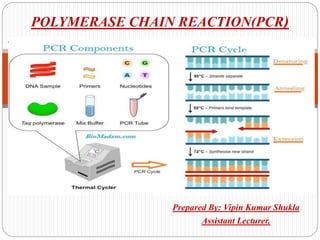
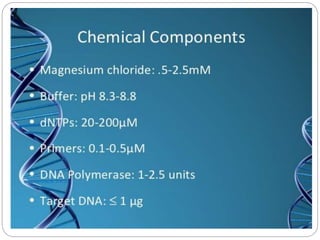
 Components:
Purpose of PCR:
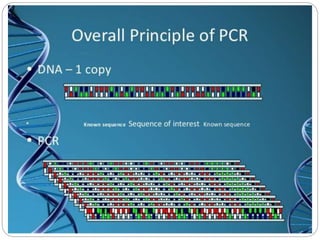
 To amplify a lot of double-stranded DNA
molecules (fragments) with same (identical) size
and sequence by enzymatic method and cycling
condition.
Condition:
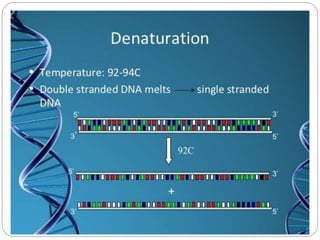
 1. Denaturation of double stranded DNA
template
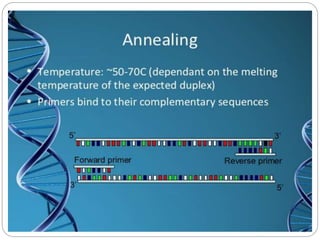
 2. Annealing of primers
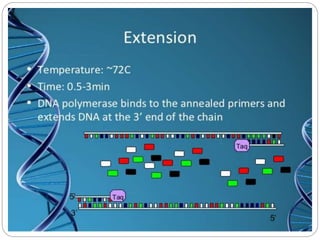
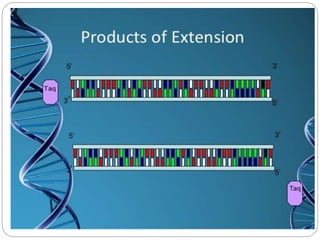
 3. Extension of double stranded DNA molecules
Basic requirements for PCR
reaction :
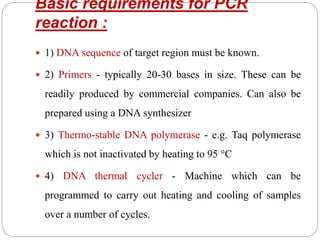
 1) DNA sequence of target region must be known.
 2) Primers - typically 20-30 bases in size. These can be
readily produced by commercial companies. Can also be
prepared using a DNA synthesizer
 3) Thermo-stable DNA polymerase - e.g. Taq polymerase
which is not inactivated by heating to 95 °C
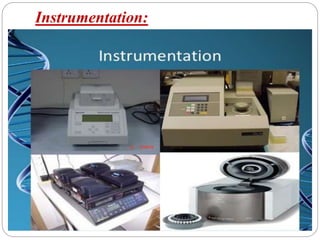
 4) DNA thermal cycler - Machine which can be
programmed to carry out heating and cooling of samples
over a number of cycles.
Instrumentation:
Three Aspects of PCR:
 Specificity:
 Efficiency:
 Fidelity:
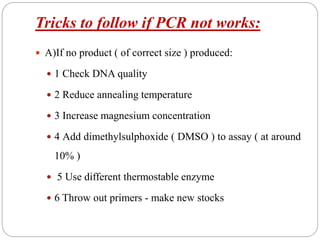
Tricks to follow if PCR not works:
 A)If no product ( of correct size ) produced:
 1 Check DNA quality
 2 Reduce annealing temperature
 3 Increase magnesium concentration
 4 Add dimethylsulphoxide ( DMSO ) to assay ( at around
10% )
 5 Use different thermostable enzyme
 6 Throw out primers - make new stocks
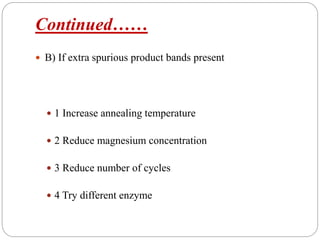
Continued……
 B) If extra spurious product bands present
 1 Increase annealing temperature
 2 Reduce magnesium concentration
 3 Reduce number of cycles
 4 Try different enzyme
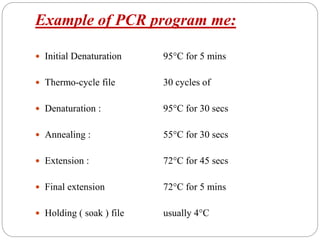
Example of PCR program me:
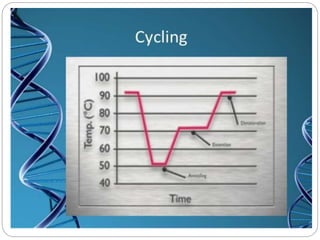
 Initial Denaturation 95°C for 5 mins
 Thermo-cycle file 30 cycles of
 Denaturation : 95°C for 30 secs
 Annealing : 55°C for 30 secs
 Extension : 72°C for 45 secs
 Final extension 72°C for 5 mins
 Holding ( soak ) file usually 4°C
Advantages of PCR:
 Small amount of DNA is required per test
 Result obtained more quickly - usually within 1 day for PCR
 Usually not necessary to use radioactive material (32P) for PCR.
 PCR is much more precise in determining the sizes of alleles -
essential for some disorders.
 PCR can be used to detect point mutations.
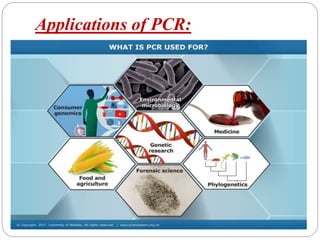
Applications of PCR:
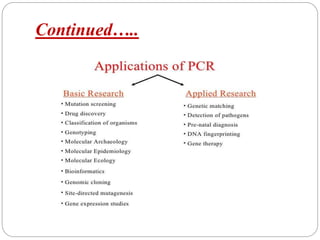
Continued…..
Polymerase chain reaction(pcr)

Polymerase chain reaction(pcr)

  • 1.
    Prepared By: VipinKumar Shukla Assistant Lecturer. POLYMERASE CHAIN REACTION(PCR)
  • 2.
    What is PCR:? PCR is a technique that takes specific sequence of DNA of small amount and amplifies it to be used for further testing.  In vitro technique  As is the photo copier a basic requirement in an office, so is the PCR machine in a molecular biology Laboratory !!!!!!!!!  PCR is DNA replication in a test tube……..
  • 3.
    Short History ofPCR:  1983: Dr. Kary Mullis developed PCR  1985: First publication of PCR by Cetus Corporation appears in Science.  1986: Purified Taq polymerase is first used in PCR  1988: PerkinElmer introduces the automated thermal cycler.  1989: Science declares Taq polymerase "molecule of the year.
  • 4.
    Continued…….  1990: amplificationand detection of specific DNA sequences using a fluorescent DNA-binding dye, laying the foundation for future "real-time" or "kinetic" PCR.  1991: RT-PCR is developed using a single thermo stable polymerase, rTth, facilitating diagnostic tests for RNA viruses.  1993:Dr. Kary Mullis shares Nobel Prize in Chemistry for conceiving PCR technology.
  • 5.
    Continued…..  1999: Dynallaunches DRB-36 HLA-typing kit for tissue typing.  2003: HIV-1 MONITOR Test, version 1.5 Product Family  AMPLICOR® CT/NG Test for Chlamydia trachomatis,  AMPLICOR® CT/NG Test for Neisseria gonorrhea
  • 6.
    Principle of PCR: Purpose:  Condition:  Components:
  • 7.
    Purpose of PCR: To amplify a lot of double-stranded DNA molecules (fragments) with same (identical) size and sequence by enzymatic method and cycling condition.
  • 8.
    Condition:  1. Denaturationof double stranded DNA template  2. Annealing of primers  3. Extension of double stranded DNA molecules
  • 16.
    Basic requirements forPCR reaction :  1) DNA sequence of target region must be known.  2) Primers - typically 20-30 bases in size. These can be readily produced by commercial companies. Can also be prepared using a DNA synthesizer  3) Thermo-stable DNA polymerase - e.g. Taq polymerase which is not inactivated by heating to 95 °C  4) DNA thermal cycler - Machine which can be programmed to carry out heating and cooling of samples over a number of cycles.
  • 17.
  • 18.
    Three Aspects ofPCR:  Specificity:  Efficiency:  Fidelity:
  • 19.
    Tricks to followif PCR not works:  A)If no product ( of correct size ) produced:  1 Check DNA quality  2 Reduce annealing temperature  3 Increase magnesium concentration  4 Add dimethylsulphoxide ( DMSO ) to assay ( at around 10% )  5 Use different thermostable enzyme  6 Throw out primers - make new stocks
  • 20.
    Continued……  B) Ifextra spurious product bands present  1 Increase annealing temperature  2 Reduce magnesium concentration  3 Reduce number of cycles  4 Try different enzyme
  • 21.
    Example of PCRprogram me:  Initial Denaturation 95°C for 5 mins  Thermo-cycle file 30 cycles of  Denaturation : 95°C for 30 secs  Annealing : 55°C for 30 secs  Extension : 72°C for 45 secs  Final extension 72°C for 5 mins  Holding ( soak ) file usually 4°C
  • 22.
    Advantages of PCR: Small amount of DNA is required per test  Result obtained more quickly - usually within 1 day for PCR  Usually not necessary to use radioactive material (32P) for PCR.  PCR is much more precise in determining the sizes of alleles - essential for some disorders.  PCR can be used to detect point mutations.
  • 23.
  • 24.