What is sequencing??
• Deciphering the code hidden in biological
sequences like DNA, polypeptides etc.
• Method and technologies that enables us to
determine the order of nucleotides and amino
acids in DNA and Polypeptide respectively.
Traditional methods of Sequencing and
its limitations
• Maxam-Gilbert Method
 Use of radioactive labels.
 Sanger Method
 It utilize the fluorescent dye for labeling.
 separation of extended fragments of DNA with the
addition of di-deoxynucleotides (lack a 3’-OH group)
Thus, chain termination.
Limitation
Slow
High cost per run.
Automated Sanger method
1. Bacterial cloning or PCR
template purification
2. labelling of DNA
fragments using the chain
termination method with
energy transfer
3. dye-labelled di-de
oxynucleotides and a DNA
polymerase
4. capillary electrophoresis
5. fluorescence detection that
provides four-colour plots
to reveal the DNA
sequence.
NEXT GENERATION SEQUENCING
•Also known as
▫High throughput sequencing or
▫ultra-deep sequencing or
▫massively parallel sequencing.
What is next generation sequencing ??
• Automated Sanger method (1st generation)
• Technologies developed after that are known as
next generation sequencing.
• NGS enables the sequencing of biological codes
at a very rapid pace with low cost per operation.
• This is the primary advantage over conventional
methods.
• For example Billions of short reads can be
sequenced in one operation.
Major Platforms for NGS
•454 ( By Roche)
•SOLiD (By Applied Biosystems)
•Solexa (By Illumina)
• Above mentioned platform varies in
strategies, application and type of
data generated.
• However, all technologies are
common in
▫ That they generate sequences on an
unprecedented scale
▫ DNA cloning is not required
▫ and very low operation cost.
What NGS Consists of
Next generation technologies for
sequencing is combination of strategies
for
• template preparation
• sequencing and imaging
• genome alignment
• assembly methods
Template preparation
As even most sensitive imaging technique
is not able to detect single
molecule, amplification of templates is
inevitable.
• Clonally amplified templates
▫ By emulsion PCR (emPCR) e.g. 454 and
SOLiD
▫ Solid phase amplification e.g. illumina
• Single-molecule templates
Template preparation: Traditional vs. NGS
• Immobilization of templates fragments over
bead /glass plate allows billions of the
sequencing reaction run simultaneously.
sequencing and imaging
• Sequencing
▫ cyclic reversible termination(CRT) e.g.
illumina/solexa
▫ single-nucleotide addition (SNA) e.g.
454/roche
▫ real-time sequencing: R&D going on
(pacific Bioscience)
▫ Sequencing by ligation (SBL) e.g. SOLiD
• Imaging
▫ measuring bioluminescent signals
▫ four-colour imaging of single molecular
events e.g. illumina/solexa.
Genome alignment and assembly
After NGS reads have been generated, they are
aligned to either
• a known reference sequence
or
• assembled de novo
454 (Pyrosequencing)
• DNA is
fragmented, joined to
adapters at either end of
the fragmented DNA
• amplified in an emulsion
PCR (includes agarose
bead with complimentary
adaptors to fragmented
DNA)
• PCR amplified allowing
up to 1 million identical
fragments around one
bead and finally dropped
into a PicoTitreTube
(PTT)
PCR amplification
Pico Titre Tube
• Adapter containing the
universal priming site
are ligated to target
ends
• Same primer can be
used for amplification
• In Pico titre tube reaction
of fluorescence occurs
with the addition of
nucleotides
Nucleotide addition
Nucleotide addition
Output
SOLiD
(support oligonucleotide ligation detection)
• Sequencing by Oligo/Ligation
and Detection.
• Steps
▫ Library Preparation
 two types of libraries
sequencing-fragment or
mate-paired are prepared.
▫ Emulsion PCR/Bead
Enrichment
 amplification of template
fragments is done in same
manner as 454.
▫ Bead Deposition
Deposit 3’ modified beads
onto a glass slide.
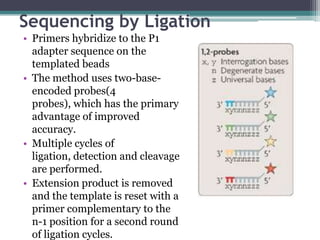
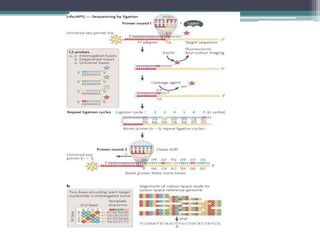
Sequencing by Ligation
• Primers hybridize to the P1
adapter sequence on the
templated beads
• The method uses two-base-
encoded probes(4
probes), which has the primary
advantage of improved
accuracy.
• Multiple cycles of
ligation, detection and cleavage
are performed.
• Extension product is removed
and the template is reset with a
primer complementary to the
n-1 position for a second round
of ligation cycles.
Illumina
• Breaking up DNA
• Adding adaptors, but
in this case attach not
to a bead but to a
slide
• Fold-back PCR is
then used to amplify
the fragmented DNA
into a cluster
Sequential
addition of
nucleotides
are added
using a
polymerase
NGS and Bioinformatics
• Alignment of sequence reads to a
reference
BLAST doesn’t blast here
Short read aligners side-lines BLAST
Software
• Bowtie
• MAQ
• BWA
• Above strategy works if reference genome exist.
• de novo assembly from paired or unpaired reads
• base-calling and/or polymorphism detection
• structural variant detection
• genome browsing.
Application of NGS
• Variants discovery in targeted region or whole
genome by re-sequencing
• Reassembling genome of lower organism by de
novo method.
• Cost-effective sequencing of complex samples at
remarkable scale and speed.
• Sequencing entire transcriptome.
• In Meta genomics : Sequencing genome of entire
biological communities
• Replacing ChIP-on-chip with ChIP-seq in case of
multicellular eukaryotes.
• Personalized genome for personalized medicine
• Further Readings
1. Branton, D. et al. The potential and challenges
of nanopore sequencing. Nature Biotech. 26
1146–1153 (2008).
2. Wang, Z., Gerstein, M. & Snyder, M. RNA-Seq: a
revolutionary tool for transcriptomics. Nature
Rev. Genet. 10, 57–63 (2009).
3. Petrosino, J. F., Highlander, S., Luna, R.
A., Gibbs, R. A. & Versalovic, J. Metagenomic
pyrosequencing and microbial identification.
Clin. Chem. 55, 856–866 (2009).
4. Park, P. J. ChIP–seq: advantages and challenges
of a maturing technology. Nature Rev. Genet.
10, 669–680 (2009).
NEXT GENERATION SEQUENCING

NEXT GENERATION SEQUENCING

  • 1.
    What is sequencing?? •Deciphering the code hidden in biological sequences like DNA, polypeptides etc. • Method and technologies that enables us to determine the order of nucleotides and amino acids in DNA and Polypeptide respectively.
  • 2.
    Traditional methods ofSequencing and its limitations • Maxam-Gilbert Method  Use of radioactive labels.  Sanger Method  It utilize the fluorescent dye for labeling.  separation of extended fragments of DNA with the addition of di-deoxynucleotides (lack a 3’-OH group) Thus, chain termination. Limitation Slow High cost per run.
  • 3.
    Automated Sanger method 1.Bacterial cloning or PCR template purification 2. labelling of DNA fragments using the chain termination method with energy transfer 3. dye-labelled di-de oxynucleotides and a DNA polymerase 4. capillary electrophoresis 5. fluorescence detection that provides four-colour plots to reveal the DNA sequence.
  • 4.
    NEXT GENERATION SEQUENCING •Alsoknown as ▫High throughput sequencing or ▫ultra-deep sequencing or ▫massively parallel sequencing.
  • 5.
    What is nextgeneration sequencing ?? • Automated Sanger method (1st generation) • Technologies developed after that are known as next generation sequencing. • NGS enables the sequencing of biological codes at a very rapid pace with low cost per operation. • This is the primary advantage over conventional methods. • For example Billions of short reads can be sequenced in one operation.
  • 6.
    Major Platforms forNGS •454 ( By Roche) •SOLiD (By Applied Biosystems) •Solexa (By Illumina)
  • 7.
    • Above mentionedplatform varies in strategies, application and type of data generated. • However, all technologies are common in ▫ That they generate sequences on an unprecedented scale ▫ DNA cloning is not required ▫ and very low operation cost.
  • 8.
    What NGS Consistsof Next generation technologies for sequencing is combination of strategies for • template preparation • sequencing and imaging • genome alignment • assembly methods
  • 9.
    Template preparation As evenmost sensitive imaging technique is not able to detect single molecule, amplification of templates is inevitable. • Clonally amplified templates ▫ By emulsion PCR (emPCR) e.g. 454 and SOLiD ▫ Solid phase amplification e.g. illumina • Single-molecule templates
  • 10.
    Template preparation: Traditionalvs. NGS • Immobilization of templates fragments over bead /glass plate allows billions of the sequencing reaction run simultaneously.
  • 11.
    sequencing and imaging •Sequencing ▫ cyclic reversible termination(CRT) e.g. illumina/solexa ▫ single-nucleotide addition (SNA) e.g. 454/roche ▫ real-time sequencing: R&D going on (pacific Bioscience) ▫ Sequencing by ligation (SBL) e.g. SOLiD • Imaging ▫ measuring bioluminescent signals ▫ four-colour imaging of single molecular events e.g. illumina/solexa.
  • 12.
    Genome alignment andassembly After NGS reads have been generated, they are aligned to either • a known reference sequence or • assembled de novo
  • 13.
    454 (Pyrosequencing) • DNAis fragmented, joined to adapters at either end of the fragmented DNA • amplified in an emulsion PCR (includes agarose bead with complimentary adaptors to fragmented DNA) • PCR amplified allowing up to 1 million identical fragments around one bead and finally dropped into a PicoTitreTube (PTT)
  • 14.
    PCR amplification Pico TitreTube • Adapter containing the universal priming site are ligated to target ends • Same primer can be used for amplification
  • 15.
    • In Picotitre tube reaction of fluorescence occurs with the addition of nucleotides Nucleotide addition
  • 16.
  • 18.
    SOLiD (support oligonucleotide ligationdetection) • Sequencing by Oligo/Ligation and Detection. • Steps ▫ Library Preparation  two types of libraries sequencing-fragment or mate-paired are prepared. ▫ Emulsion PCR/Bead Enrichment  amplification of template fragments is done in same manner as 454. ▫ Bead Deposition Deposit 3’ modified beads onto a glass slide.
  • 19.
    Sequencing by Ligation •Primers hybridize to the P1 adapter sequence on the templated beads • The method uses two-base- encoded probes(4 probes), which has the primary advantage of improved accuracy. • Multiple cycles of ligation, detection and cleavage are performed. • Extension product is removed and the template is reset with a primer complementary to the n-1 position for a second round of ligation cycles.
  • 21.
    Illumina • Breaking upDNA • Adding adaptors, but in this case attach not to a bead but to a slide • Fold-back PCR is then used to amplify the fragmented DNA into a cluster
  • 22.
  • 23.
    NGS and Bioinformatics •Alignment of sequence reads to a reference BLAST doesn’t blast here Short read aligners side-lines BLAST Software • Bowtie • MAQ • BWA
  • 24.
    • Above strategyworks if reference genome exist. • de novo assembly from paired or unpaired reads • base-calling and/or polymorphism detection • structural variant detection • genome browsing.
  • 25.
    Application of NGS •Variants discovery in targeted region or whole genome by re-sequencing • Reassembling genome of lower organism by de novo method. • Cost-effective sequencing of complex samples at remarkable scale and speed. • Sequencing entire transcriptome. • In Meta genomics : Sequencing genome of entire biological communities • Replacing ChIP-on-chip with ChIP-seq in case of multicellular eukaryotes. • Personalized genome for personalized medicine
  • 26.
    • Further Readings 1.Branton, D. et al. The potential and challenges of nanopore sequencing. Nature Biotech. 26 1146–1153 (2008). 2. Wang, Z., Gerstein, M. & Snyder, M. RNA-Seq: a revolutionary tool for transcriptomics. Nature Rev. Genet. 10, 57–63 (2009). 3. Petrosino, J. F., Highlander, S., Luna, R. A., Gibbs, R. A. & Versalovic, J. Metagenomic pyrosequencing and microbial identification. Clin. Chem. 55, 856–866 (2009). 4. Park, P. J. ChIP–seq: advantages and challenges of a maturing technology. Nature Rev. Genet. 10, 669–680 (2009).