PCR
(Polymerase chain reaction)
Presented by
B. Tarun Reddy
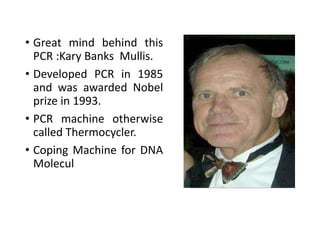
• Great mind behind this
PCR :Kary Banks Mullis.
• Developed PCR in 1985
and was awarded Nobel
prize in 1993.
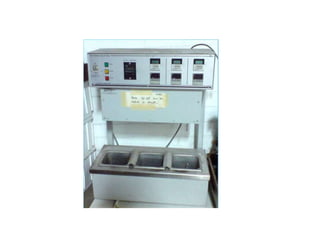
• PCR machine otherwise
called Thermocycler.
• Coping Machine for DNA
Molecul
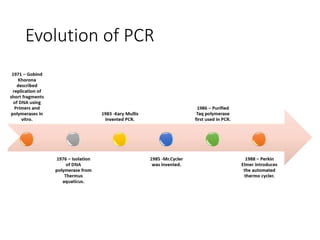
Evolution of PCR
Polymerase Chain Reaction(PCR)
• PCR targets and amplifies a specific region of a DNA
strand.
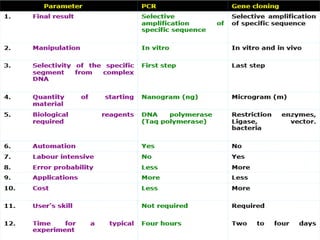
• It is an invitro technique to generate large
quantities of a specified DNA.
• Two methods currently exist for amplifying the DNA
or making copies.
• Cloning—takes a long time for enough clones to
reach maturity.
• PCR—works on even a single molecule quickly
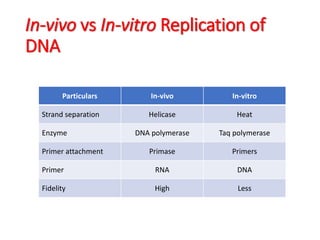
In-vivo vs In-vitro Replication of
DNA
Particulars In-vivo In-vitro
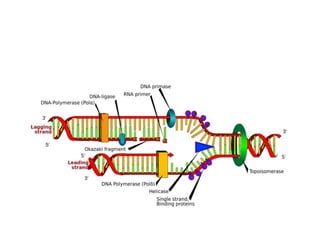
Strand separation Helicase Heat
Enzyme DNA polymerase Taq polymerase
Primer attachment Primase Primers
Primer RNA DNA
Fidelity High Less
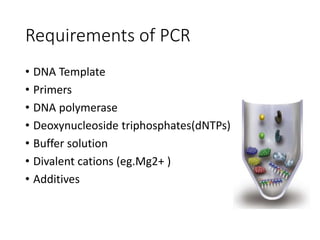
Requirements of PCR
• DNA Template
• Primers
• DNA polymerase
• Deoxynucleoside triphosphates(dNTPs)
• Buffer solution
• Divalent cations (eg.Mg2+ )
• Additives
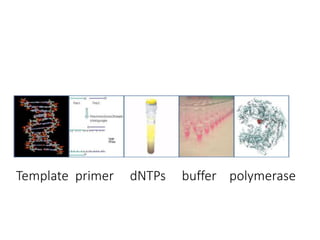
Template primer dNTPs buffer polymerase
Primer
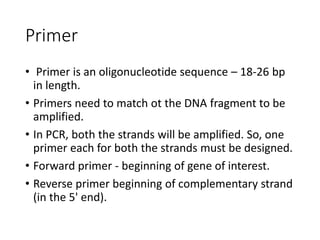
• Primer is an oligonucleotide sequence – 18-26 bp
in length.
• Primers need to match ot the DNA fragment to be
amplified.
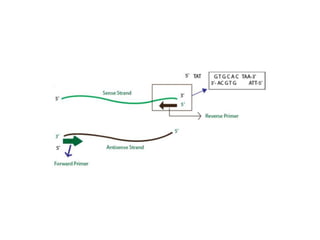
• In PCR, both the strands will be amplified. So, one
primer each for both the strands must be designed.
• Forward primer - beginning of gene of interest.
• Reverse primer beginning of complementary strand
(in the 5' end).
Primer length
• Optimal length of PCR primers is 18-26 bp.
• Long enough for adequate specificity and short
enough for primers to bind easily to the template.
Primer melting temperature
• Temperature at which one half of the DNA duplex
will dissociate to become single stranded.
• Primers with melting temperatures in the range of
52-58oC produce the best results.
Four Normal Deoxynucleosides
Triphosphate
• Deoxynucleoside triphosphates, or dNTPs
(sometimes called "deoxynucleotide
triphosphates"; nucleotides containing
triphosphate groups), the building blocks from
which the DNA polymerase synthesizes a new DNA
strand
Divalent cations
KCL
• Promotes primer-template annealing.
• High concentrations – Stabilizes primers annealed
to non target sites.
Mg2+
• Taq DNA polymerase dependent on Mg2+
• Taq DNA polymerase shows its highest activity
around 1.2–1.3 mM free Mg2+.
• Magnesium concentration can also affect the
fidelity (error rate) of DNA polymerases.
Additives
BSA (usually at 0.1 to 0.8 µg/µL final concentration)
• Stabilize Taq polymerase & overcome PCR inhibitors
Glycerol (usually at 5-10% v/v)
• Increases apparent concentration of primer/template
mix, and often increases PCR efficiency at high
temperatures.
Stringency enhancers (Formamide, Betaine, TMAC)
• Enhances yield and reduces non-specific priming
Non-ionic detergents (Triton X, Tween 20 or Nonidet P-
40) (0.1–1%)
• Stabilize Taq polymerase & suppress formation of 2º
structure
DNA Polymerase
• Initially the PCR used the Kienow fragment of E. coli
DNA polymerase to extend the annealed primers in
a rather tedious procedure.
• This enzyme was inactivated by the high
temperature required to separate the two DNA
strands at the outset of each PCR cycle, hence
necessitating the addition of this enzyme at the
end of every cycle.
Taq polymerase
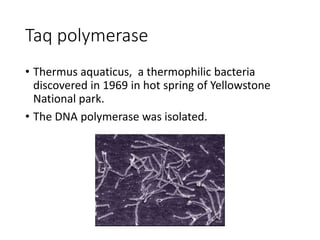
• Thermus aquaticus, a thermophilic bacteria
discovered in 1969 in hot spring of Yellowstone
National park.
• The DNA polymerase was isolated.
Pfu DNA Polymerase
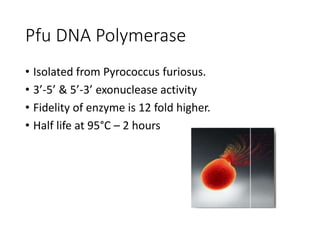
• Isolated from Pyrococcus furiosus.
• 3’-5’ & 5’-3’ exonuclease activity
• Fidelity of enzyme is 12 fold higher.
• Half life at 95°C – 2 hours
Super III Reverse Transcriptase
• Purified from E. coli expressing the pol gene of
M-MLV
• Half-life of 220 minutes at 50°C
• Super III RT is genetically engineered by the
introduction of point mutations that increase half-
life, reduce RNase activity, and increase thermal
stability.
T th DNA polymerase
• Isolated from Thermus thermophilus.
• Does not possess a proofreading activity.
• Possess reverse transcriptase (RT) activity.
• RT activity is dependent upon presence of 1–2 mM
manganese ions while the DNA polymerase
functions best in the presence of magnesium ions.
• Optimum temperature is 70°C
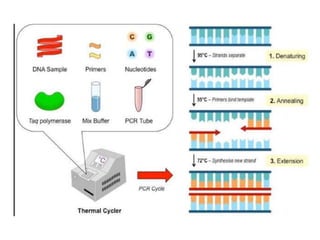
STEPS INVOLVED
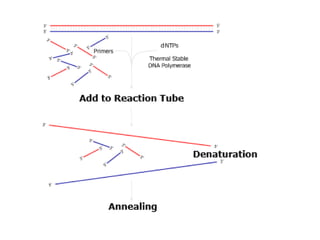
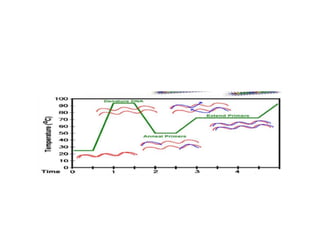
DENATURATION:
• The reaction mixture is heated to a temperature
between 94-96° C so that the ds DNA is denatured
into single strands by disrupting the hydrogen
bonds between complementary bases.
• Duration of this step is 30 sec-1 mins.
ANNEALING
• Reaction temperature is lowered to 50–65°C for
20 – 40 seconds.
• Primer anneals to the complementary bases on
flanking region of template DNA.
• Low temperature - primer could bind imperfectly.
• High temperature - primer might not bind
• Annealing temperature 3–5 °C below the Tm of the
primers used.
Annealing Temperature
• If annealing temperature is too high, pairing
between primer and template DNA will not take
place then PCR will fail.
• Ideal Annealing temperature must be low enough
to enable hybridization between primer and
template .
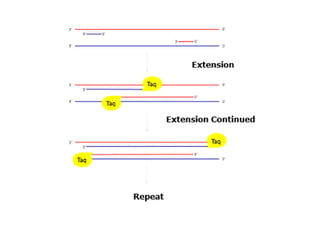
EXTENSION
• Polymerase has its optimum activity temperature at 75–80 °C.
• DNA polymerase synthesizes new DNA strand complementary to
the DNA template strand by adding dNTPs.
• Extension time depends on DNA polymerase used as well as
length of the DNA fragment to amplify.
• At its optimum temperature, the DNA polymerase polymerizes a
thousand bases per minute.
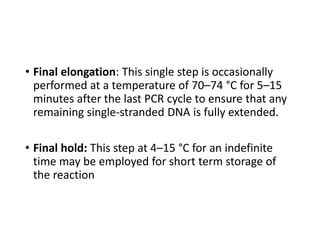
• Final elongation: This single step is occasionally
performed at a temperature of 70–74 °C for 5–15
minutes after the last PCR cycle to ensure that any
remaining single-stranded DNA is fully extended.
• Final hold: This step at 4–15 °C for an indefinite
time may be employed for short term storage of
the reaction
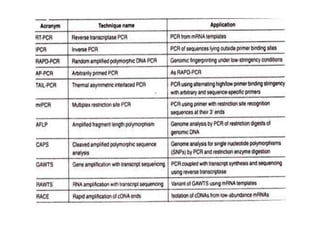
Types of PCR
PCR is highly versatile technique and has been
modified in variety of way to suit specific
applications.
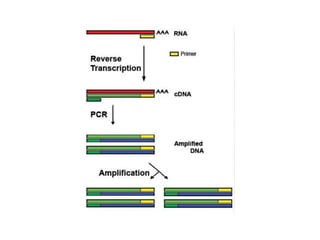
Reverse transcriptase PCR
• Reverse transcriptase reverse transcribes RNA into
cDNA, which is then amplified by PCR.
• RT-PCR is widely used in expression profiling, to
determine the expression of a gene or to identify
the sequence of an RNA transcript, including
transcription start and termination sites.
• If the genomic DNA sequence of a gene is known,
RT-PCR can be used to map the location of exons
and introns in the gene.
Miniprimer PCR
• Uses a thermostable polymerase that can extend
from short primers as short as 9 or 10 nucleotides.
• This method permits PCR targeting to smaller
primer binding regions, and is used to amplify
conserved DNA sequences, such as the 16S (or
eukaryotic 18S) rRNA gene.
Quantitative PCR/ Real time PCR
• It is used to measure the quantity of a PCR product.
• It quantitatively measures starting amounts of
DNA, cDNA, or RNA.
• Q-PCR is commonly used to determine whether a
DNA sequence is present in a sample and the
number of its copies in the sample.
• Quantitative real-time PCR has a very high degree
of precision.
Detection systems
Non-Specific Detection
• SyBr green, BEBO, BOXTO, Eva Green.
Specific Detection
• Taqman probe, Molecular Beacon, Light-up probes
& Hybridization Probes.
Primer Based Detection
• Scorpion primers, Qzyme & Lux primers.
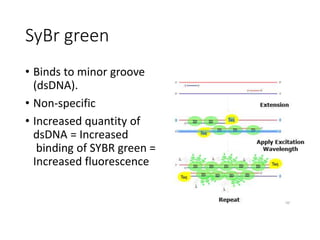
SyBr green
• Binds to minor groove
(dsDNA).
• Non-specific
• Increased quantity of
dsDNA = Increased
binding of SYBR green =
Increased fluorescence
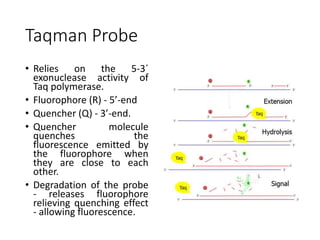
Taqman Probe
• Relies on the 5-3´
exonuclease activity of
Taq polymerase.
• Fluorophore (R) - 5’-end
• Quencher (Q) - 3’-end.
• Quencher molecule
quenches the
fluorescence emitted by
the fluorophore when
they are close to each
other.
• Degradation of the probe
- releases fluorophore
relieving quenching effect
- allowing fluorescence.
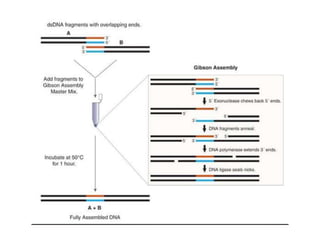
Assembly PCR
• Formation of large oligo nucleotides of DNA from
short segments
• Each cycle thus increases the length of various
fragments randomly depending on which
oligonucleotides find each other.
• Production of synthetic genes.
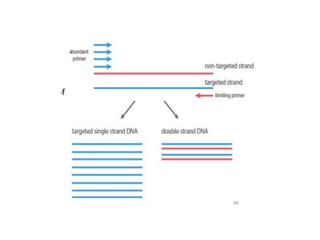
Asymmetric PCR
• It is used for synthesis of Single stranded DNA
molecules useful for DNA sequencing.
• The two primers are used in the 100:1 ratio so that
after 20-25 cycles of amplification one primer is
exhausted thus single stranded DNA is produced in
the next 5-10 cycles.
• Used in sequencing and hybridization probing -
amplification of only one of the two
complementary strands is required.
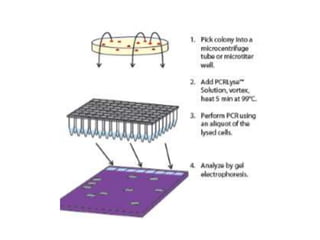
Colony PCR
• Screening of bacteria (E.coli) or yeast clones for
correct ligation or Plasmid products.
• Individual transformants can either be lysed in
water with a short heating step or added directly to
the PCR reaction and lysed during the initial heating
step.
• Initial heating step causes the release of the
plasmid DNA from the cell, so it can serve as
template for the amplification reaction.
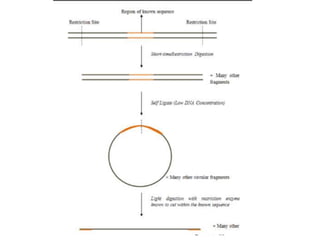
Inverse PCR
• In this method amplification of DNA of unknown
sequence is carried out from known sequence.
• This is especially useful in identifying flanking
sequences to various genomic inserts.
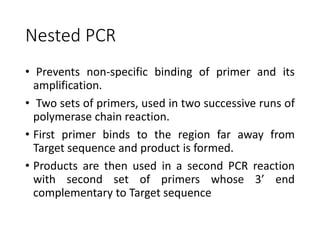
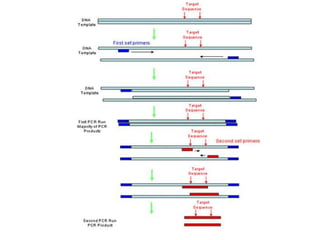
Nested PCR
• Prevents non-specific binding of primer and its
amplification.
• Two sets of primers, used in two successive runs of
polymerase chain reaction.
• First primer binds to the region far away from
Target sequence and product is formed.
• Products are then used in a second PCR reaction
with second set of primers whose 3’ end
complementary to Target sequence
Helicase-dependent amplification
• Similar to traditional PCR, but uses a constant
temperature rather than cycling through
denaturation and annealing/extension cycles.
• DNA helicase, an enzyme that unwinds DNA, is
used in place of thermal denaturation.
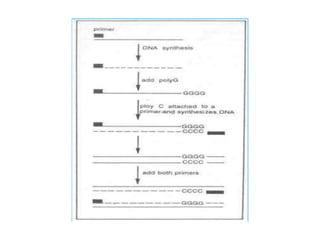
Anchored PCR
• A small sequence of nucleotides can be attached or
tagged to target DNA.
• The anchor is frequently a poly G to which a poly C
primer is used.
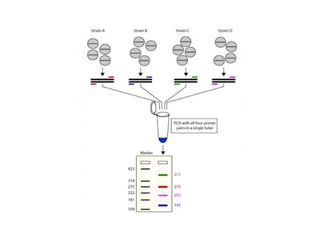
Multiplex-PCR
• Multiple primer sets within a single PCR mixture to
produce amplicons of varying sizes of different DNA
sequences.
• By targeting multiple genes at once, additional
information may be gained from a single test-run
that otherwise would require several times the
reagents and more time to perform.
• Their base pair length should be different enough
to form distinct bands when visualized by gel
electrophoresis.
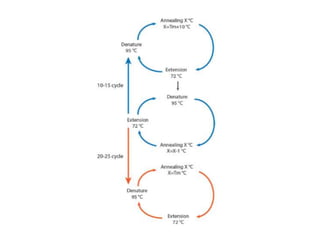
Touchdown PCR
• Aims to reduce nonspecific background by
gradually lowering the annealing temperature as
PCR cycling progresses.
• The annealing temperature at the initial cycles is
usually a few degrees (3-5°C) above the Tm of the
primers used, while at the later cycles, it is a few
degrees (3-5°C) below the primer Tm.
• The higher temperatures give greater specificity for
primer binding, and the lower temperatures permit
more efficient amplification from the specific
products formed during the initial cycles.
Methylation-specific PCR (MSP)
• Used to identify patterns of DNA methylation in
genomic DNA.
• Target DNA is first treated with sodium bisulfite,
which converts unmethylated cytosine bases to
uracil, which is complementary to adenosine in PCR
primers.
• Two amplifications are then carried out on the
bisulfite-treated DNA.
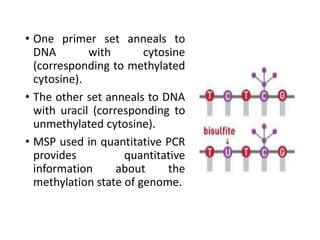
• One primer set anneals to
DNA with cytosine
(corresponding to methylated
cytosine).
• The other set anneals to DNA
with uracil (corresponding to
unmethylated cytosine).
• MSP used in quantitative PCR
provides quantitative
information about the
methylation state of genome.
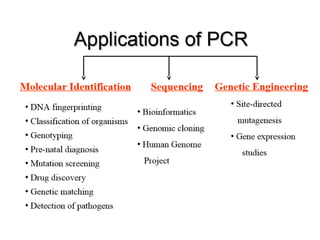
Applications
• Direct sequencing of in vitro amplified DNA.
• Engineering DNA to meet specific needs.
• Detection of mutation.
• Detection of gene expression.
• Specific amplification of a DNA species.
• Geometric amplification of unknown DNA
sequence through inverse PCR.
• Analysis of DNA sequences in individual gametes.
• Evolutionary analysis.
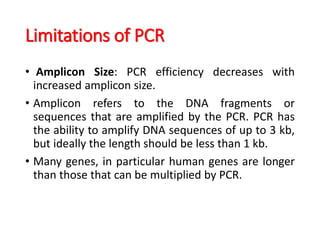
Limitations of PCR
• Amplicon Size: PCR efficiency decreases with
increased amplicon size.
• Amplicon refers to the DNA fragments or
sequences that are amplified by the PCR. PCR has
the ability to amplify DNA sequences of up to 3 kb,
but ideally the length should be less than 1 kb.
• Many genes, in particular human genes are longer
than those that can be multiplied by PCR.
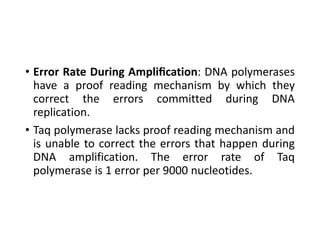
• Error Rate During Amplification: DNA polymerases
have a proof reading mechanism by which they
correct the errors committed during DNA
replication.
• Taq polymerase lacks proof reading mechanism and
is unable to correct the errors that happen during
DNA amplification. The error rate of Taq
polymerase is 1 error per 9000 nucleotides.
• Contamination: PCR technique is extremely
sensitive and prone to erroneous results due to
contaminated DNA.
• Contaminated DNA may originate from
contaminant organisms found in the biological
source, airborne cellular debris, products of
previous PCR reactions.
• Contamination can be prevented by using good
laboratory technique and taking adequate control
measures.
Summery
• Polymerase chain reaction - amplify Known sequence
of DNA to several orders of magnitude.
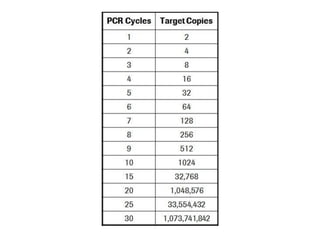
• PCR consists of a series of 20–40 cycles consisting of 3
steps Denaturation, Annealing & Extension.
• Primer provides free 3’OH for the attachment of
nucleotide bases by Polymerase.
• Heat resistant DNA polymerase – Taq Polymerase, Pfu
Polymerase.
• PCR additives & Buffers increases the binding affinity of
primers to the template strand and also increases
polymerase activity.
• Reverse transcriptase PCR – converts RNA to cDNA –
One step & Two step.
• Real time PCR – Process of DNA amplification is
monitored in real time – used to quantitate DNA in
the samples.
• Assymetric PCR – Amplifies one strand of target
DNA.
• Hot start PCR - prevents non-specific amplification
& primer-dimer formation by inactivating the
activity of Polymerase.
• Nested PCR – Prevents non-specific binding of
primer and its amplification by using two sets of
primers.
Pcr

Pcr

  • 1.
  • 2.
    • Great mindbehind this PCR :Kary Banks Mullis. • Developed PCR in 1985 and was awarded Nobel prize in 1993. • PCR machine otherwise called Thermocycler. • Coping Machine for DNA Molecul
  • 3.
  • 4.
    Polymerase Chain Reaction(PCR) •PCR targets and amplifies a specific region of a DNA strand. • It is an invitro technique to generate large quantities of a specified DNA. • Two methods currently exist for amplifying the DNA or making copies. • Cloning—takes a long time for enough clones to reach maturity. • PCR—works on even a single molecule quickly
  • 7.
    In-vivo vs In-vitroReplication of DNA Particulars In-vivo In-vitro Strand separation Helicase Heat Enzyme DNA polymerase Taq polymerase Primer attachment Primase Primers Primer RNA DNA Fidelity High Less
  • 8.
    Requirements of PCR •DNA Template • Primers • DNA polymerase • Deoxynucleoside triphosphates(dNTPs) • Buffer solution • Divalent cations (eg.Mg2+ ) • Additives
  • 9.
    Template primer dNTPsbuffer polymerase
  • 10.
    Primer • Primer isan oligonucleotide sequence – 18-26 bp in length. • Primers need to match ot the DNA fragment to be amplified. • In PCR, both the strands will be amplified. So, one primer each for both the strands must be designed. • Forward primer - beginning of gene of interest. • Reverse primer beginning of complementary strand (in the 5' end).
  • 12.
    Primer length • Optimallength of PCR primers is 18-26 bp. • Long enough for adequate specificity and short enough for primers to bind easily to the template. Primer melting temperature • Temperature at which one half of the DNA duplex will dissociate to become single stranded. • Primers with melting temperatures in the range of 52-58oC produce the best results.
  • 13.
    Four Normal Deoxynucleosides Triphosphate •Deoxynucleoside triphosphates, or dNTPs (sometimes called "deoxynucleotide triphosphates"; nucleotides containing triphosphate groups), the building blocks from which the DNA polymerase synthesizes a new DNA strand
  • 14.
    Divalent cations KCL • Promotesprimer-template annealing. • High concentrations – Stabilizes primers annealed to non target sites. Mg2+ • Taq DNA polymerase dependent on Mg2+ • Taq DNA polymerase shows its highest activity around 1.2–1.3 mM free Mg2+. • Magnesium concentration can also affect the fidelity (error rate) of DNA polymerases.
  • 15.
    Additives BSA (usually at0.1 to 0.8 µg/µL final concentration) • Stabilize Taq polymerase & overcome PCR inhibitors Glycerol (usually at 5-10% v/v) • Increases apparent concentration of primer/template mix, and often increases PCR efficiency at high temperatures. Stringency enhancers (Formamide, Betaine, TMAC) • Enhances yield and reduces non-specific priming Non-ionic detergents (Triton X, Tween 20 or Nonidet P- 40) (0.1–1%) • Stabilize Taq polymerase & suppress formation of 2º structure
  • 16.
  • 17.
    • Initially thePCR used the Kienow fragment of E. coli DNA polymerase to extend the annealed primers in a rather tedious procedure. • This enzyme was inactivated by the high temperature required to separate the two DNA strands at the outset of each PCR cycle, hence necessitating the addition of this enzyme at the end of every cycle.
  • 19.
    Taq polymerase • Thermusaquaticus, a thermophilic bacteria discovered in 1969 in hot spring of Yellowstone National park. • The DNA polymerase was isolated.
  • 20.
    Pfu DNA Polymerase •Isolated from Pyrococcus furiosus. • 3’-5’ & 5’-3’ exonuclease activity • Fidelity of enzyme is 12 fold higher. • Half life at 95°C – 2 hours
  • 21.
    Super III ReverseTranscriptase • Purified from E. coli expressing the pol gene of M-MLV • Half-life of 220 minutes at 50°C • Super III RT is genetically engineered by the introduction of point mutations that increase half- life, reduce RNase activity, and increase thermal stability.
  • 22.
    T th DNApolymerase • Isolated from Thermus thermophilus. • Does not possess a proofreading activity. • Possess reverse transcriptase (RT) activity. • RT activity is dependent upon presence of 1–2 mM manganese ions while the DNA polymerase functions best in the presence of magnesium ions. • Optimum temperature is 70°C
  • 24.
  • 25.
    DENATURATION: • The reactionmixture is heated to a temperature between 94-96° C so that the ds DNA is denatured into single strands by disrupting the hydrogen bonds between complementary bases. • Duration of this step is 30 sec-1 mins.
  • 26.
    ANNEALING • Reaction temperatureis lowered to 50–65°C for 20 – 40 seconds. • Primer anneals to the complementary bases on flanking region of template DNA. • Low temperature - primer could bind imperfectly. • High temperature - primer might not bind • Annealing temperature 3–5 °C below the Tm of the primers used.
  • 27.
    Annealing Temperature • Ifannealing temperature is too high, pairing between primer and template DNA will not take place then PCR will fail. • Ideal Annealing temperature must be low enough to enable hybridization between primer and template .
  • 28.
    EXTENSION • Polymerase hasits optimum activity temperature at 75–80 °C. • DNA polymerase synthesizes new DNA strand complementary to the DNA template strand by adding dNTPs. • Extension time depends on DNA polymerase used as well as length of the DNA fragment to amplify. • At its optimum temperature, the DNA polymerase polymerizes a thousand bases per minute.
  • 32.
    • Final elongation:This single step is occasionally performed at a temperature of 70–74 °C for 5–15 minutes after the last PCR cycle to ensure that any remaining single-stranded DNA is fully extended. • Final hold: This step at 4–15 °C for an indefinite time may be employed for short term storage of the reaction
  • 35.
    Types of PCR PCRis highly versatile technique and has been modified in variety of way to suit specific applications.
  • 36.
    Reverse transcriptase PCR •Reverse transcriptase reverse transcribes RNA into cDNA, which is then amplified by PCR. • RT-PCR is widely used in expression profiling, to determine the expression of a gene or to identify the sequence of an RNA transcript, including transcription start and termination sites. • If the genomic DNA sequence of a gene is known, RT-PCR can be used to map the location of exons and introns in the gene.
  • 38.
    Miniprimer PCR • Usesa thermostable polymerase that can extend from short primers as short as 9 or 10 nucleotides. • This method permits PCR targeting to smaller primer binding regions, and is used to amplify conserved DNA sequences, such as the 16S (or eukaryotic 18S) rRNA gene.
  • 39.
    Quantitative PCR/ Realtime PCR • It is used to measure the quantity of a PCR product. • It quantitatively measures starting amounts of DNA, cDNA, or RNA. • Q-PCR is commonly used to determine whether a DNA sequence is present in a sample and the number of its copies in the sample. • Quantitative real-time PCR has a very high degree of precision.
  • 40.
    Detection systems Non-Specific Detection •SyBr green, BEBO, BOXTO, Eva Green. Specific Detection • Taqman probe, Molecular Beacon, Light-up probes & Hybridization Probes. Primer Based Detection • Scorpion primers, Qzyme & Lux primers.
  • 41.
    SyBr green • Bindsto minor groove (dsDNA). • Non-specific • Increased quantity of dsDNA = Increased binding of SYBR green = Increased fluorescence
  • 42.
    Taqman Probe • Relieson the 5-3´ exonuclease activity of Taq polymerase. • Fluorophore (R) - 5’-end • Quencher (Q) - 3’-end. • Quencher molecule quenches the fluorescence emitted by the fluorophore when they are close to each other. • Degradation of the probe - releases fluorophore relieving quenching effect - allowing fluorescence.
  • 43.
    Assembly PCR • Formationof large oligo nucleotides of DNA from short segments • Each cycle thus increases the length of various fragments randomly depending on which oligonucleotides find each other. • Production of synthetic genes.
  • 45.
    Asymmetric PCR • Itis used for synthesis of Single stranded DNA molecules useful for DNA sequencing. • The two primers are used in the 100:1 ratio so that after 20-25 cycles of amplification one primer is exhausted thus single stranded DNA is produced in the next 5-10 cycles. • Used in sequencing and hybridization probing - amplification of only one of the two complementary strands is required.
  • 47.
    Colony PCR • Screeningof bacteria (E.coli) or yeast clones for correct ligation or Plasmid products. • Individual transformants can either be lysed in water with a short heating step or added directly to the PCR reaction and lysed during the initial heating step. • Initial heating step causes the release of the plasmid DNA from the cell, so it can serve as template for the amplification reaction.
  • 49.
    Inverse PCR • Inthis method amplification of DNA of unknown sequence is carried out from known sequence. • This is especially useful in identifying flanking sequences to various genomic inserts.
  • 51.
    Nested PCR • Preventsnon-specific binding of primer and its amplification. • Two sets of primers, used in two successive runs of polymerase chain reaction. • First primer binds to the region far away from Target sequence and product is formed. • Products are then used in a second PCR reaction with second set of primers whose 3’ end complementary to Target sequence
  • 53.
    Helicase-dependent amplification • Similarto traditional PCR, but uses a constant temperature rather than cycling through denaturation and annealing/extension cycles. • DNA helicase, an enzyme that unwinds DNA, is used in place of thermal denaturation.
  • 54.
    Anchored PCR • Asmall sequence of nucleotides can be attached or tagged to target DNA. • The anchor is frequently a poly G to which a poly C primer is used.
  • 56.
    Multiplex-PCR • Multiple primersets within a single PCR mixture to produce amplicons of varying sizes of different DNA sequences. • By targeting multiple genes at once, additional information may be gained from a single test-run that otherwise would require several times the reagents and more time to perform. • Their base pair length should be different enough to form distinct bands when visualized by gel electrophoresis.
  • 58.
    Touchdown PCR • Aimsto reduce nonspecific background by gradually lowering the annealing temperature as PCR cycling progresses. • The annealing temperature at the initial cycles is usually a few degrees (3-5°C) above the Tm of the primers used, while at the later cycles, it is a few degrees (3-5°C) below the primer Tm. • The higher temperatures give greater specificity for primer binding, and the lower temperatures permit more efficient amplification from the specific products formed during the initial cycles.
  • 60.
    Methylation-specific PCR (MSP) •Used to identify patterns of DNA methylation in genomic DNA. • Target DNA is first treated with sodium bisulfite, which converts unmethylated cytosine bases to uracil, which is complementary to adenosine in PCR primers. • Two amplifications are then carried out on the bisulfite-treated DNA.
  • 61.
    • One primerset anneals to DNA with cytosine (corresponding to methylated cytosine). • The other set anneals to DNA with uracil (corresponding to unmethylated cytosine). • MSP used in quantitative PCR provides quantitative information about the methylation state of genome.
  • 63.
    Applications • Direct sequencingof in vitro amplified DNA. • Engineering DNA to meet specific needs. • Detection of mutation. • Detection of gene expression. • Specific amplification of a DNA species. • Geometric amplification of unknown DNA sequence through inverse PCR. • Analysis of DNA sequences in individual gametes. • Evolutionary analysis.
  • 64.
    Limitations of PCR •Amplicon Size: PCR efficiency decreases with increased amplicon size. • Amplicon refers to the DNA fragments or sequences that are amplified by the PCR. PCR has the ability to amplify DNA sequences of up to 3 kb, but ideally the length should be less than 1 kb. • Many genes, in particular human genes are longer than those that can be multiplied by PCR.
  • 65.
    • Error RateDuring Amplification: DNA polymerases have a proof reading mechanism by which they correct the errors committed during DNA replication. • Taq polymerase lacks proof reading mechanism and is unable to correct the errors that happen during DNA amplification. The error rate of Taq polymerase is 1 error per 9000 nucleotides.
  • 66.
    • Contamination: PCRtechnique is extremely sensitive and prone to erroneous results due to contaminated DNA. • Contaminated DNA may originate from contaminant organisms found in the biological source, airborne cellular debris, products of previous PCR reactions. • Contamination can be prevented by using good laboratory technique and taking adequate control measures.
  • 67.
    Summery • Polymerase chainreaction - amplify Known sequence of DNA to several orders of magnitude. • PCR consists of a series of 20–40 cycles consisting of 3 steps Denaturation, Annealing & Extension. • Primer provides free 3’OH for the attachment of nucleotide bases by Polymerase. • Heat resistant DNA polymerase – Taq Polymerase, Pfu Polymerase. • PCR additives & Buffers increases the binding affinity of primers to the template strand and also increases polymerase activity. • Reverse transcriptase PCR – converts RNA to cDNA – One step & Two step.
  • 68.
    • Real timePCR – Process of DNA amplification is monitored in real time – used to quantitate DNA in the samples. • Assymetric PCR – Amplifies one strand of target DNA. • Hot start PCR - prevents non-specific amplification & primer-dimer formation by inactivating the activity of Polymerase. • Nested PCR – Prevents non-specific binding of primer and its amplification by using two sets of primers.