DIFFERENT TYPES
OF PCR
polymerase chain reaction (PCR):
 It is a molecular technology aim to amplify a single or few
copies of the DNA to thousands or millions of copies.
 Developed in 1983 by Kary Mullis, PCR is now a common and
often indispensable technique used in medical and
biological research labs for a variety of applications. These
include diagnosis of infectious diseases, DNA sequencing
and DNA-based phylogeny.
 In 1993, Mullis was awarded the Nobel prize in Chemistry
along with Michael Smith for his work on PCR.
Types of PCR ??
• Conventional (Qualitative)PCR.
• Multiplex PCR.
• Nested PCR.
• RT-PCR and qRT-PCR.
• Quantitative PCR.
• Hot-start PCR.
• Touchdown PCR.
• Assembly PCR.
• Colony PCR.
• Methylation-specific PCR.
• LAMP assay.
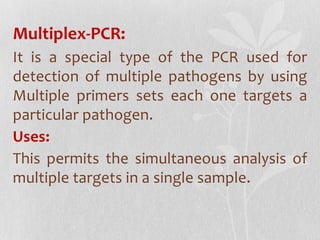
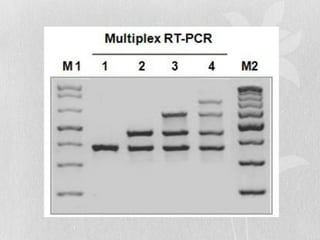
Multiplex-PCR:
It is a special type of the PCR used for
detection of multiple pathogens by using
Multiple primers sets each one targets a
particular pathogen.
Uses:
This permits the simultaneous analysis of
multiple targets in a single sample.
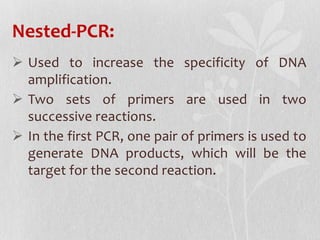
Nested-PCR:
 Used to increase the specificity of DNA
amplification.
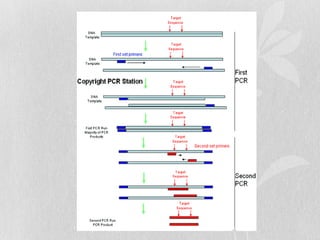
 Two sets of primers are used in two
successive reactions.
 In the first PCR, one pair of primers is used to
generate DNA products, which will be the
target for the second reaction.
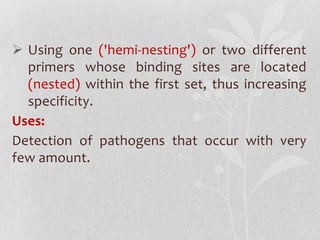
 Using one ('hemi-nesting') or two different
primers whose binding sites are located
(nested) within the first set, thus increasing
specificity.
Uses:
Detection of pathogens that occur with very
few amount.
RT-PCR (Reverse Transcription PCR, Real
Time - PCR)
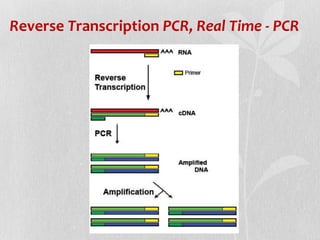
 Used to reverse-transcribe and amplify RNA to
cDNA.
 PCR is preceded by a reaction using reverse
transcriptase, an enzyme that converts RNA
into cDNA.
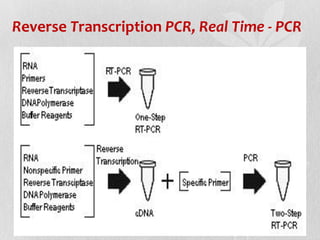
 The two reactions may be combined in a tube.
Uses:
1-Detection of RNA virus like (HCV).
2-Detection of other M.O. through targeting of
their Ribosomal RNA.
Reverse Transcription PCR, Real Time - PCR
Quantitative Real-Time PCR (qRT-PCR)
•Method use fluorescent dyes, such as Sybr
Green, or fluorescence-containing DNA
probes, such as TaqMan, to measure the
amount of amplified product as the
amplification progresses.
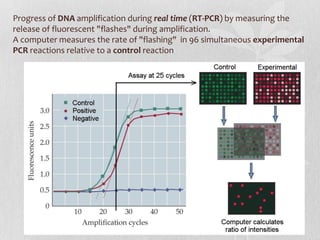
Progress of DNA amplification during real time (RT-PCR) by measuring the
release of fluorescent "flashes" during amplification.
A computer measures the rate of "flashing" in 96 simultaneous experimental
PCR reactions relative to a control reaction
Quantitative – PCR:
Used to measure the specific amount of
target DNA (or RNA) in a sample.
By measuring amplification only within the
phase of true exponential increase, the
amount of measured product more accurately
reflects the initial amount of target.
Special thermal cyclers are used that monitor
the amount of product during the
amplification.
Hot-start PCR:
 It is a technique performed manually by
heating the reaction components to the
DNA melting temperature (e.g. 95°C)
before adding the polymerase.
Touchdown PCR:
In this type the annealing temperature is
gradually decreased in later cycles.
The annealing temperature in the early cycles
is usually 3-5°C above the standard Tm of the
primers used, while in the later cycles it is a
similar amount below the Tm.
 The initial higher annealing temperature
leads to greater specificity for primer binding,
while the lower temperatures permit more
efficient amplification at the end of the
reaction.
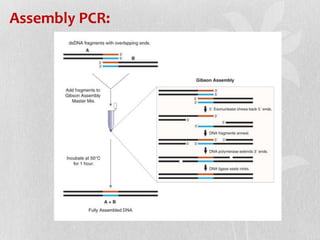
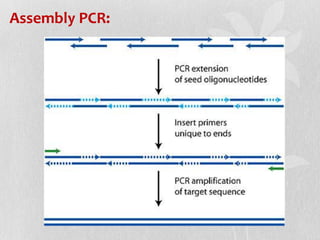
Assembly-PCR
(also known as Polymerase Cycling Assembly or PCA)
 In this type synthesis of long DNA structures by
performing PCR on a pool of long oligonucleotides
with short overlapping segments, to assemble two
or more pieces of DNA into one piece.
 It involves an initial PCR with primers that have an
overlap and a second PCR using the products as the
template that generates the final full-length
product.
 This technique may substitute for Ligation-based
assembly
Assembly PCR:
Assembly PCR:
Colony PCR
 Bacterial colonies are screened directly by
PCR, for example, the screen for correct DNA-
vector constructs.
 Colonies are sampled with a sterile pipette tip
and a small quantity of cells transferred into a
PCR mix.
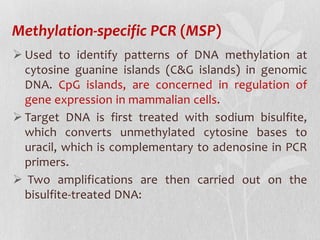
Methylation-specific PCR (MSP)
 Used to identify patterns of DNA methylation at
cytosine guanine islands (C&G islands) in genomic
DNA. CpG islands, are concerned in regulation of
gene expression in mammalian cells.
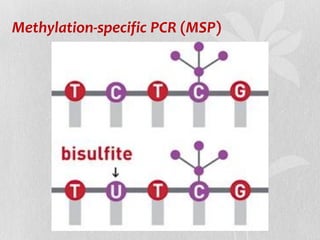
 Target DNA is first treated with sodium bisulfite,
which converts unmethylated cytosine bases to
uracil, which is complementary to adenosine in PCR
primers.
 Two amplifications are then carried out on the
bisulfite-treated DNA:
One primer set anneals to DNA with cytosine
(corresponding to methylated cytosine),
The other set anneals to DNA with uracil
(corresponding to unmethylated cytosine).
 MSP used in quantitative PCR provides
quantitative information about the
methylation state of a given CpG island.
Methylation-specific PCR (MSP)
LAMP assay:
(Loop-mediated isothermal amplification)
 It is a Modified type of the PCR using 3:6
primers sets one of them is loop like primer.
 This test use Bst- polymerase enzyme
(Bacillus stearothermophilus DNA Polymerase).
 Using only two temperatures (63°C for 45
min. then 85°C for 5 min.), may be carry out
in water path.
Thanks a lotwith my Best Regards and My Best wishes
Amira A. AL-Hosary
E-mail: Amiraelhosary @yahoo.com
Mob. (002) 01004477501

Types of PCR

  • 1.
  • 2.
    polymerase chain reaction(PCR):  It is a molecular technology aim to amplify a single or few copies of the DNA to thousands or millions of copies.  Developed in 1983 by Kary Mullis, PCR is now a common and often indispensable technique used in medical and biological research labs for a variety of applications. These include diagnosis of infectious diseases, DNA sequencing and DNA-based phylogeny.  In 1993, Mullis was awarded the Nobel prize in Chemistry along with Michael Smith for his work on PCR.
  • 3.
    Types of PCR?? • Conventional (Qualitative)PCR. • Multiplex PCR. • Nested PCR. • RT-PCR and qRT-PCR. • Quantitative PCR. • Hot-start PCR. • Touchdown PCR. • Assembly PCR. • Colony PCR. • Methylation-specific PCR. • LAMP assay.
  • 4.
    Multiplex-PCR: It is aspecial type of the PCR used for detection of multiple pathogens by using Multiple primers sets each one targets a particular pathogen. Uses: This permits the simultaneous analysis of multiple targets in a single sample.
  • 6.
    Nested-PCR:  Used toincrease the specificity of DNA amplification.  Two sets of primers are used in two successive reactions.  In the first PCR, one pair of primers is used to generate DNA products, which will be the target for the second reaction.
  • 7.
     Using one('hemi-nesting') or two different primers whose binding sites are located (nested) within the first set, thus increasing specificity. Uses: Detection of pathogens that occur with very few amount.
  • 9.
    RT-PCR (Reverse TranscriptionPCR, Real Time - PCR)  Used to reverse-transcribe and amplify RNA to cDNA.  PCR is preceded by a reaction using reverse transcriptase, an enzyme that converts RNA into cDNA.  The two reactions may be combined in a tube. Uses: 1-Detection of RNA virus like (HCV). 2-Detection of other M.O. through targeting of their Ribosomal RNA.
  • 10.
  • 11.
  • 12.
    Quantitative Real-Time PCR(qRT-PCR) •Method use fluorescent dyes, such as Sybr Green, or fluorescence-containing DNA probes, such as TaqMan, to measure the amount of amplified product as the amplification progresses.
  • 13.
    Progress of DNAamplification during real time (RT-PCR) by measuring the release of fluorescent "flashes" during amplification. A computer measures the rate of "flashing" in 96 simultaneous experimental PCR reactions relative to a control reaction
  • 14.
    Quantitative – PCR: Usedto measure the specific amount of target DNA (or RNA) in a sample. By measuring amplification only within the phase of true exponential increase, the amount of measured product more accurately reflects the initial amount of target. Special thermal cyclers are used that monitor the amount of product during the amplification.
  • 15.
    Hot-start PCR:  Itis a technique performed manually by heating the reaction components to the DNA melting temperature (e.g. 95°C) before adding the polymerase.
  • 16.
    Touchdown PCR: In thistype the annealing temperature is gradually decreased in later cycles. The annealing temperature in the early cycles is usually 3-5°C above the standard Tm of the primers used, while in the later cycles it is a similar amount below the Tm.  The initial higher annealing temperature leads to greater specificity for primer binding, while the lower temperatures permit more efficient amplification at the end of the reaction.
  • 17.
    Assembly-PCR (also known asPolymerase Cycling Assembly or PCA)  In this type synthesis of long DNA structures by performing PCR on a pool of long oligonucleotides with short overlapping segments, to assemble two or more pieces of DNA into one piece.  It involves an initial PCR with primers that have an overlap and a second PCR using the products as the template that generates the final full-length product.  This technique may substitute for Ligation-based assembly
  • 18.
  • 19.
  • 20.
    Colony PCR  Bacterialcolonies are screened directly by PCR, for example, the screen for correct DNA- vector constructs.  Colonies are sampled with a sterile pipette tip and a small quantity of cells transferred into a PCR mix.
  • 21.
    Methylation-specific PCR (MSP) Used to identify patterns of DNA methylation at cytosine guanine islands (C&G islands) in genomic DNA. CpG islands, are concerned in regulation of gene expression in mammalian cells.  Target DNA is first treated with sodium bisulfite, which converts unmethylated cytosine bases to uracil, which is complementary to adenosine in PCR primers.  Two amplifications are then carried out on the bisulfite-treated DNA:
  • 22.
    One primer setanneals to DNA with cytosine (corresponding to methylated cytosine), The other set anneals to DNA with uracil (corresponding to unmethylated cytosine).  MSP used in quantitative PCR provides quantitative information about the methylation state of a given CpG island. Methylation-specific PCR (MSP)
  • 23.
  • 24.
    LAMP assay: (Loop-mediated isothermalamplification)  It is a Modified type of the PCR using 3:6 primers sets one of them is loop like primer.  This test use Bst- polymerase enzyme (Bacillus stearothermophilus DNA Polymerase).  Using only two temperatures (63°C for 45 min. then 85°C for 5 min.), may be carry out in water path.
  • 26.
    Thanks a lotwithmy Best Regards and My Best wishes Amira A. AL-Hosary E-mail: Amiraelhosary @yahoo.com Mob. (002) 01004477501