A
Presentation
on
Asymmetric PCR
Presented by…..
Md. Afzalur Rahman
Asraful Islam Rayhan
Md. Shaharul Islam
Shamsun Nahar Lipa
Dept. of Pharmacy
Jessore University Of Science & Technology..
Contents
 What is PCR
 Basic Requirements
 Types of PCR
 Asymmetric PCR
 Applications of PCR
 Advantages of PCR
 Limitations of PCR
Two methods currently exist for
amplifying the DNA or making copies
 Cloning—takes a long time for enough
clones to reach maturity
 PCR—works on even a single molecule
quickly
PCR: stands for Polymerase Chain Reaction
A technique that allows the production of million of
copies of a single Target DNA fragment.
PCR is an in vitro technique that uses a few basic
everyday molecular biology reagents to make large
numbers of copies of a specific DNA fragment or a
specific region of a DNA strand in a test-tube.
The nature of the primers allow the addition of any sequence or molecule to
the 5’ end of the primer.
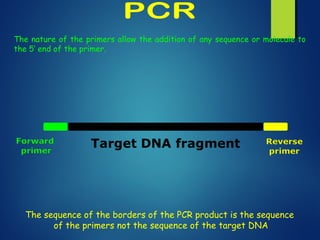
The sequence of the borders of the PCR product is the sequence
of the primers not the sequence of the target DNA
The nature of the primers allow the addition of any sequence or molecule to
the 5’ end of the primer.
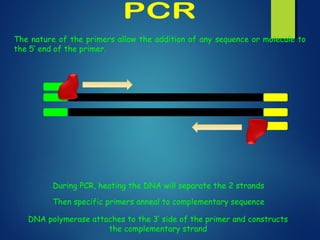
During PCR, heating the DNA will separate the 2 strands
Then specific primers anneal to complementary sequence
DNA polymerase attaches to the 3’ side of the primer and constructs
the complementary strand
The nature of the primers allow the addition of any sequence or molecule to
the 5’ end of the primer.
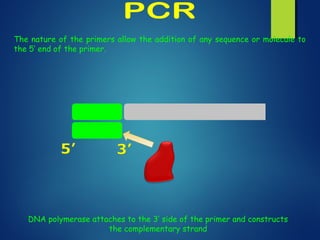
DNA polymerase attaches to the 3’ side of the primer and constructs
the complementary strand
The nature of the primers allow the addition of any sequence or molecule to
the 5’ end of the primer.
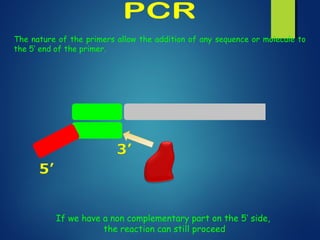
If we have a non complementary part on the 5’ side,
the reaction can still proceed
The nature of the primers allow the addition of any sequence or molecule to
the 5’ end of the primer.
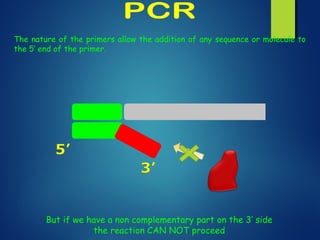
But if we have a non complementary part on the 3’ side
the reaction CAN NOT proceed
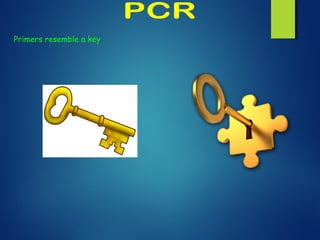
Primers resemble a key
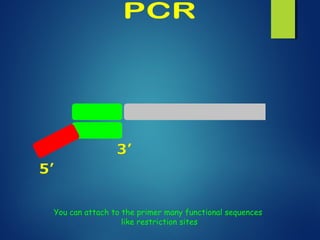
You can attach to the primer many functional sequences
like restriction sites
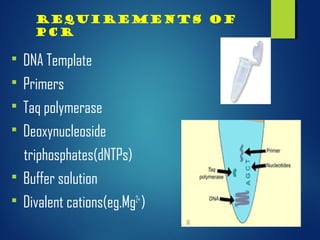
 DNA Template
 Primers
 Taq polymerase
 Deoxynucleoside
triphosphates(dNTPs)
 Buffer solution
 Divalent cations(eg.Mg2+
)
Requirements of
PCR
Variations of PCR...
 Nested PCR
 Inverse PCR
 Anchored PCR
 Reverse transcription PCR (RT-PCR)
 Asymmetric PCR
 Real-time quantitative PCR
 Random amplified polymorphic DNA (RAPD)
 Amplified fragment length polymorphism (AFLP)
 Rapid amplification of cDNA ends (RACE)
What
is
Asymmetric PCR
 Asymmetric PCR is used to
preferentially amplify one strand of the
original DNA more than the other.
 It finds use in some types of sequencing
and hybridization probing where having
only one of the two complementary
stands is ideal.
 PCR is carried out as usual, but with a
great excess of one primers for the
chosen strand.
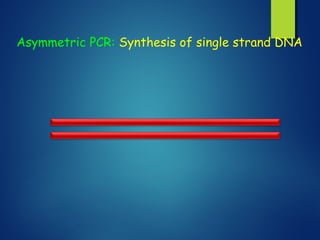
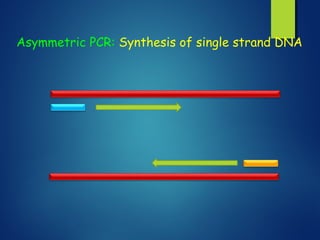
Asymmetric PCR: Synthesis of single strand DNA
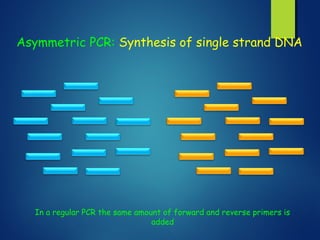
In a regular PCR the same amount of forward and reverse primers is
added
Asymmetric PCR: Synthesis of single strand DNA
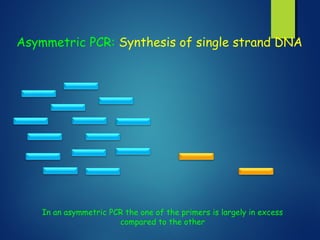
In an asymmetric PCR the one of the primers is largely in excess
compared to the other
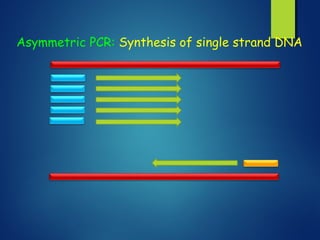
Asymmetric PCR: Synthesis of single strand DNA
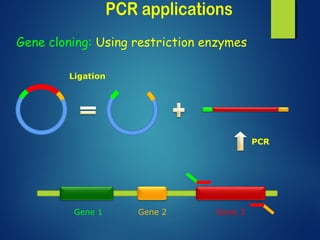
Gene cloning: Using restriction enzymes
Gene 1 Gene 2 Gene 3
PCR
Ligation
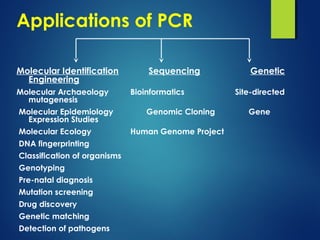
Applications of PCR
Molecular Identification Sequencing Genetic
Engineering
Molecular Archaeology Bioinformatics Site-directed
mutagenesis
Molecular Epidemiology Genomic Cloning Gene
Expression Studies
Molecular Ecology Human Genome Project
DNA fingerprinting
Classification of organisms
Genotyping
Pre-natal diagnosis
Mutation screening
Drug discovery
Genetic matching
Detection of pathogens
Advantages:
PCR IN CLINICAL DIAGNOSIS
PCR IN DNA SEQUENCING
PCR IN FORSENIC MEDICINE
PCR IN GENE MANIPULATION AND EXPRESSION
STUDIES
PCR IN COMPARATIVE STUDY OF GENOMICS
PCR IN COMPARISON WITH GENE CLONING
Limitations
SEQUENCE INFORMATION
AMPLICON SIZE
 ERROR RATE DURING AMPLIFICATION
SENSITIVITY TO INHIBITORS
CONTAMINATION
ARTEFACTS
27

Asymetric -PCR

  • 2.
  • 3.
    Presented by….. Md. AfzalurRahman Asraful Islam Rayhan Md. Shaharul Islam Shamsun Nahar Lipa Dept. of Pharmacy Jessore University Of Science & Technology..
  • 4.
    Contents  What isPCR  Basic Requirements  Types of PCR  Asymmetric PCR  Applications of PCR  Advantages of PCR  Limitations of PCR
  • 5.
    Two methods currentlyexist for amplifying the DNA or making copies  Cloning—takes a long time for enough clones to reach maturity  PCR—works on even a single molecule quickly
  • 6.
    PCR: stands forPolymerase Chain Reaction A technique that allows the production of million of copies of a single Target DNA fragment. PCR is an in vitro technique that uses a few basic everyday molecular biology reagents to make large numbers of copies of a specific DNA fragment or a specific region of a DNA strand in a test-tube.
  • 7.
    The nature ofthe primers allow the addition of any sequence or molecule to the 5’ end of the primer. The sequence of the borders of the PCR product is the sequence of the primers not the sequence of the target DNA
  • 8.
    The nature ofthe primers allow the addition of any sequence or molecule to the 5’ end of the primer. During PCR, heating the DNA will separate the 2 strands Then specific primers anneal to complementary sequence DNA polymerase attaches to the 3’ side of the primer and constructs the complementary strand
  • 9.
    The nature ofthe primers allow the addition of any sequence or molecule to the 5’ end of the primer. DNA polymerase attaches to the 3’ side of the primer and constructs the complementary strand
  • 10.
    The nature ofthe primers allow the addition of any sequence or molecule to the 5’ end of the primer. If we have a non complementary part on the 5’ side, the reaction can still proceed
  • 11.
    The nature ofthe primers allow the addition of any sequence or molecule to the 5’ end of the primer. But if we have a non complementary part on the 3’ side the reaction CAN NOT proceed
  • 12.
  • 13.
    You can attachto the primer many functional sequences like restriction sites
  • 14.
     DNA Template Primers  Taq polymerase  Deoxynucleoside triphosphates(dNTPs)  Buffer solution  Divalent cations(eg.Mg2+ ) Requirements of PCR
  • 15.
    Variations of PCR... Nested PCR  Inverse PCR  Anchored PCR  Reverse transcription PCR (RT-PCR)  Asymmetric PCR  Real-time quantitative PCR  Random amplified polymorphic DNA (RAPD)  Amplified fragment length polymorphism (AFLP)  Rapid amplification of cDNA ends (RACE)
  • 16.
  • 17.
     Asymmetric PCRis used to preferentially amplify one strand of the original DNA more than the other.  It finds use in some types of sequencing and hybridization probing where having only one of the two complementary stands is ideal.  PCR is carried out as usual, but with a great excess of one primers for the chosen strand.
  • 18.
    Asymmetric PCR: Synthesisof single strand DNA
  • 19.
    Asymmetric PCR: Synthesisof single strand DNA
  • 20.
    Asymmetric PCR: Synthesisof single strand DNA In a regular PCR the same amount of forward and reverse primers is added
  • 21.
    Asymmetric PCR: Synthesisof single strand DNA In an asymmetric PCR the one of the primers is largely in excess compared to the other
  • 22.
    Asymmetric PCR: Synthesisof single strand DNA
  • 23.
    Gene cloning: Usingrestriction enzymes Gene 1 Gene 2 Gene 3 PCR Ligation
  • 24.
    Applications of PCR MolecularIdentification Sequencing Genetic Engineering Molecular Archaeology Bioinformatics Site-directed mutagenesis Molecular Epidemiology Genomic Cloning Gene Expression Studies Molecular Ecology Human Genome Project DNA fingerprinting Classification of organisms Genotyping Pre-natal diagnosis Mutation screening Drug discovery Genetic matching Detection of pathogens
  • 25.
    Advantages: PCR IN CLINICALDIAGNOSIS PCR IN DNA SEQUENCING PCR IN FORSENIC MEDICINE PCR IN GENE MANIPULATION AND EXPRESSION STUDIES PCR IN COMPARATIVE STUDY OF GENOMICS PCR IN COMPARISON WITH GENE CLONING
  • 26.
    Limitations SEQUENCE INFORMATION AMPLICON SIZE ERROR RATE DURING AMPLIFICATION SENSITIVITY TO INHIBITORS CONTAMINATION ARTEFACTS
  • 27.