Reverse transcription polymerase chain
reaction (RT-PCR)
"The amount of the RNA present in a sample can be
quantified by using either fluorescent dye or probe by
synthesizing cDNA from RNA using the reverse
transcriptase enzyme."
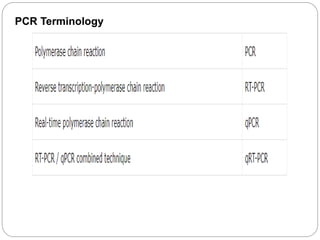
PCR Terminology
INTRODUCITON:-
It is a technique used to monitor the progress of a PCR reaction in real-
time.
At the same time, a relatively small amount of PCR product (DNA, cDNA
or RNA) can be quantified.
It is based on the detection of the fluorescence produced by a reporter
molecule which increases, as the reaction proceeds.
It is also known as a quantitative polymerase chain reaction (qPCR),
which is a laboratory technique of molecular biology based on
the polymerase chain reaction (PCR).
qPCR is a powerful technique that allows exponential amplification of
DNA sequences.
A PCR reaction needs a pair of primers that are complementary to the
sequence of interest. Primers are extended by the DNA polymerase.
The copies produced after the extension, so-called
amplicons, are re-amplified with the same primers leading
thus to exponential amplification of the DNA molecules.
After amplification, however, gel electrophoresis is used to
analyze the amplified PCR products and this makes
conventional PCR time consuming; since the reaction must
finish before proceeding with the post-PCR analysis. Real-
Time PCR overcomes this problem.
The term “real-time” denotes that it can monitor the
progress of the amplification when the process is going on in
contrast to the conventional PCR method where analysis is
possible only after the process is completed.
Principle of Real Time PCR
From the template RNA, the cDNA is synthesized using the
reverse transcriptase. the process is divided into two broad
steps; first, reverse transcription, and second, amplification as
well as quantification.
As we said, the enzyme governs the process of cDNA
synthesize while using probes and primer, the template is
amplified and quantified.
OR
Quantitative reverse transcription PCR (RT-qPCR) is used
when the starting material is RNA.
In this method, RNA is first transcribed into complementary
DNA (cDNA) by reverse transcriptase from total RNA or
messenger RNA (mRNA). The cDNA is then used as the
template for the qPCR reaction
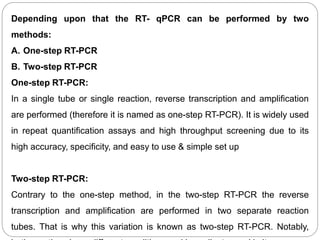
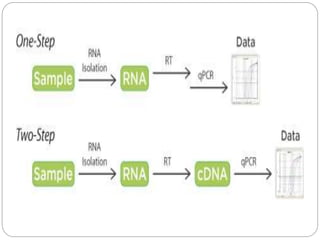
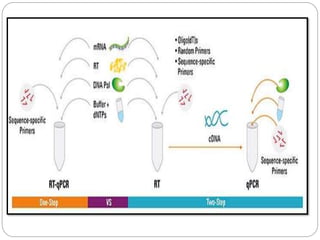
Depending upon that the RT- qPCR can be performed by two
methods:
A. One-step RT-PCR
B. Two-step RT-PCR
One-step RT-PCR:
In a single tube or single reaction, reverse transcription and amplification
are performed (therefore it is named as one-step RT-PCR). It is widely used
in repeat quantification assays and high throughput screening due to its
high accuracy, specificity, and easy to use & simple set up
Two-step RT-PCR:
Contrary to the one-step method, in the two-step RT-PCR the reverse
transcription and amplification are performed in two separate reaction
tubes. That is why this variation is known as two-step RT-PCR. Notably,
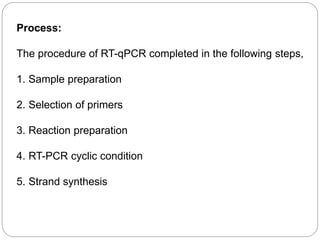
Process:
The procedure of RT-qPCR completed in the following steps,
1. Sample preparation
2. Selection of primers
3. Reaction preparation
4. RT-PCR cyclic condition
5. Strand synthesis
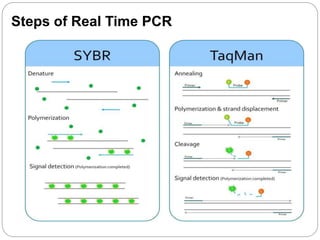
Steps of Real Time PCR
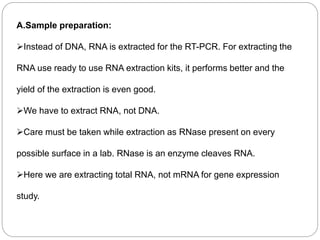
A.Sample preparation:
Instead of DNA, RNA is extracted for the RT-PCR. For extracting the
RNA use ready to use RNA extraction kits, it performs better and the
yield of the extraction is even good.
We have to extract RNA, not DNA.
Care must be taken while extraction as RNase present on every
possible surface in a lab. RNase is an enzyme cleaves RNA.
Here we are extracting total RNA, not mRNA for gene expression
study.
B.Selection of primers:
In the next step select the primer for the experiments.
Three types of primers can be used in the reverse transcription PCR.
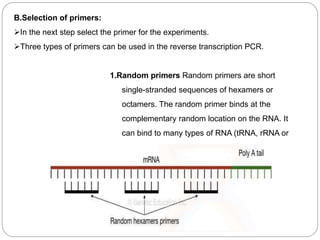
1.Random primers Random primers are short
single-stranded sequences of hexamers or
octamers. The random primer binds at the
complementary random location on the RNA. It
can bind to many types of RNA (tRNA, rRNA or
mRNA) and synthesizes the cDNA.
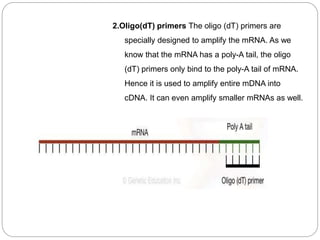
2.Oligo(dT) primers The oligo (dT) primers are
specially designed to amplify the mRNA. As we
know that the mRNA has a poly-A tail, the oligo
(dT) primers only bind to the poly-A tail of mRNA.
Hence it is used to amplify entire mDNA into
cDNA. It can even amplify smaller mRNAs as well.
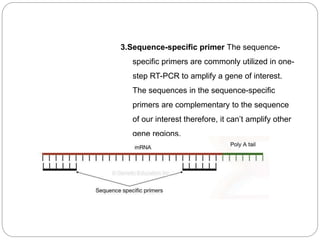
3.Sequence-specific primer The sequence-
specific primers are commonly utilized in one-
step RT-PCR to amplify a gene of interest.
The sequences in the sequence-specific
primers are complementary to the sequence
of our interest therefore, it can’t amplify other
gene regions.
Components used in the RT-qPCR:
The major components are,
1) DNA primers
2) dNTPs
3) Reverse transcriptase enzyme with RNase activity
4) RNase H (if the reverse transcriptase does not have it)
5) DNA polymerase
6) RT-qPCR buffer with RNase inhibitors and PCR enhancers
7) DEPC treated nuclease-free water
8) DNA ligase
Temperature conditions for RT-qPCR
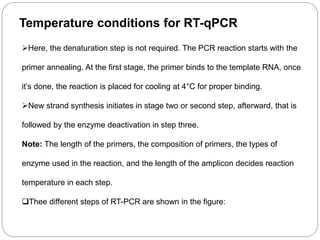
Here, the denaturation step is not required. The PCR reaction starts with the
primer annealing. At the first stage, the primer binds to the template RNA, once
it’s done, the reaction is placed for cooling at 4°C for proper binding.
New strand synthesis initiates in stage two or second step, afterward, that is
followed by the enzyme deactivation in step three.
Note: The length of the primers, the composition of primers, the types of
enzyme used in the reaction, and the length of the amplicon decides reaction
temperature in each step.
Thee different steps of RT-PCR are shown in the figure:
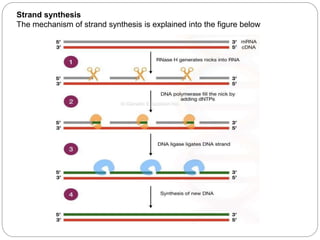
Strand synthesis
The mechanism of strand synthesis is explained into the figure below
PROCESS IN RT-PCR
A. Amplification
Denaturation
High temperature incubation is used to “melt” double- stranded
DNA into single strands and loosen secondary structure in single-
stranded DNA.
The highest temperature that the DNA polymerase can withstand
is typically used (usually 95°C). The denaturation time can be
increased if template GC content is high.
Annealing
During annealing, complementary sequences have an opportunity
to hybridize, so an appropriate temperature is used that is based on
the calculated melting temperature (Tm) of the primers(5°C below
the Tm of the primer).
Extension
At 70-72°C, the activity of the DNA polymerase is optimal,
and primer extension occurs at rates of up to 100 bases per
second. When an amplicon in real-time PCR is small, this step
is often combined with the annealing step using 60°C as the
temperature
At 70-72°C, the activity of the DNA polymerase is optimal,
and primer extension occurs at rates of up to 100 bases per
second.
When an amplicon in real-time PCR is small, this step is
often combined with the annealing step using 60°C as the
B. Detection
The detection is based on fluorescence technology.
The specimen is first kept in proper well and subjected to thermal cycle
like in the normal PCR.
The machine, however, in the Real Time PCR is subjected to tungsten
or halogen source that lead to fluoresce the marker added to the sample
and the signal is amplified with the amplification of copy number of sample
DNA.
The emitted signal is detected by an detector and sent to computer after
conversion into digital signal that is displayed on screen.
The signal can be detected when it comes up the threshold level (lowest
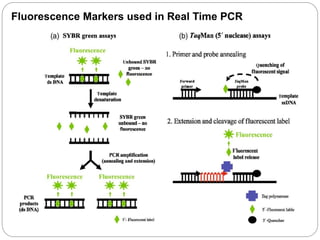
Fluorescence Markers used in Real Time PCR
There are many different markers used in Real Time PCR but the
most common of them include:
Taqman probe.
It is a hydrolysis probe which bear a reporter dye, often fluorescein (FAM)
at its 5’ end and a quencher tetramethylrhodamine (TAMRA), attached to
the 3’ end of the oligonucleotide.
SYBR Green.
This is a dye that emits prominent fluorescent signal when it binds at the
minor groove of DNA, nonspecifically.
Other fluorescent dyes like Ethidium Bromide or Acridine Orange can also
be used but SYBR Green is better used for its higher signal intensity.
Advantages
1. It has many advantages over the normal PCR:
2. It gives a look in to the reaction that is help to decide which reactions have
worked well and which have failed.
3. The efficiency of the reaction can be precisely calculated.
4. There is no need to run the PCR product out on a gel after the reaction as the
melt curve analysis serve the purpose.
5. The real-time PCR data can be used to perform truly quantitative analysis of
gene expression. In comparison, old fashioned PCR was only ever semi-
quantitative at best.
6. Faster than normal PCR.
7. Less complexity at the quantification of sample.etc.
Thus, unlike the ordinary preparative PCR, Real Time PCR allows the success of
multiple PCR reaction to be determined automatically after only a few cycles,
without separate analysis of each reaction, and avoids the problem of “false
Disadvantages:
The method is extremely sensitive, even a small amount of
DNA contamination can lead to false results.
The method is restricted for some of the assays as higher
expertise and experimentation are required to develop new
assays.
Applications
Gene expression analysis
Cancer research
Drug research
Disease diagnosis and management
Viral quantification
Food testing
GMO food
Animal and plant breeding
Gene copy number
THANK YOU

Rt pcr

  • 1.
    Reverse transcription polymerasechain reaction (RT-PCR)
  • 2.
    "The amount ofthe RNA present in a sample can be quantified by using either fluorescent dye or probe by synthesizing cDNA from RNA using the reverse transcriptase enzyme."
  • 3.
  • 4.
    INTRODUCITON:- It is atechnique used to monitor the progress of a PCR reaction in real- time. At the same time, a relatively small amount of PCR product (DNA, cDNA or RNA) can be quantified. It is based on the detection of the fluorescence produced by a reporter molecule which increases, as the reaction proceeds. It is also known as a quantitative polymerase chain reaction (qPCR), which is a laboratory technique of molecular biology based on the polymerase chain reaction (PCR). qPCR is a powerful technique that allows exponential amplification of DNA sequences. A PCR reaction needs a pair of primers that are complementary to the sequence of interest. Primers are extended by the DNA polymerase.
  • 5.
    The copies producedafter the extension, so-called amplicons, are re-amplified with the same primers leading thus to exponential amplification of the DNA molecules. After amplification, however, gel electrophoresis is used to analyze the amplified PCR products and this makes conventional PCR time consuming; since the reaction must finish before proceeding with the post-PCR analysis. Real- Time PCR overcomes this problem. The term “real-time” denotes that it can monitor the progress of the amplification when the process is going on in contrast to the conventional PCR method where analysis is possible only after the process is completed.
  • 6.
    Principle of RealTime PCR From the template RNA, the cDNA is synthesized using the reverse transcriptase. the process is divided into two broad steps; first, reverse transcription, and second, amplification as well as quantification. As we said, the enzyme governs the process of cDNA synthesize while using probes and primer, the template is amplified and quantified. OR Quantitative reverse transcription PCR (RT-qPCR) is used when the starting material is RNA. In this method, RNA is first transcribed into complementary DNA (cDNA) by reverse transcriptase from total RNA or messenger RNA (mRNA). The cDNA is then used as the template for the qPCR reaction
  • 7.
    Depending upon thatthe RT- qPCR can be performed by two methods: A. One-step RT-PCR B. Two-step RT-PCR One-step RT-PCR: In a single tube or single reaction, reverse transcription and amplification are performed (therefore it is named as one-step RT-PCR). It is widely used in repeat quantification assays and high throughput screening due to its high accuracy, specificity, and easy to use & simple set up Two-step RT-PCR: Contrary to the one-step method, in the two-step RT-PCR the reverse transcription and amplification are performed in two separate reaction tubes. That is why this variation is known as two-step RT-PCR. Notably,
  • 10.
    Process: The procedure ofRT-qPCR completed in the following steps, 1. Sample preparation 2. Selection of primers 3. Reaction preparation 4. RT-PCR cyclic condition 5. Strand synthesis
  • 11.
    Steps of RealTime PCR
  • 12.
    A.Sample preparation: Instead ofDNA, RNA is extracted for the RT-PCR. For extracting the RNA use ready to use RNA extraction kits, it performs better and the yield of the extraction is even good. We have to extract RNA, not DNA. Care must be taken while extraction as RNase present on every possible surface in a lab. RNase is an enzyme cleaves RNA. Here we are extracting total RNA, not mRNA for gene expression study.
  • 13.
    B.Selection of primers: Inthe next step select the primer for the experiments. Three types of primers can be used in the reverse transcription PCR. 1.Random primers Random primers are short single-stranded sequences of hexamers or octamers. The random primer binds at the complementary random location on the RNA. It can bind to many types of RNA (tRNA, rRNA or mRNA) and synthesizes the cDNA.
  • 14.
    2.Oligo(dT) primers Theoligo (dT) primers are specially designed to amplify the mRNA. As we know that the mRNA has a poly-A tail, the oligo (dT) primers only bind to the poly-A tail of mRNA. Hence it is used to amplify entire mDNA into cDNA. It can even amplify smaller mRNAs as well.
  • 15.
    3.Sequence-specific primer Thesequence- specific primers are commonly utilized in one- step RT-PCR to amplify a gene of interest. The sequences in the sequence-specific primers are complementary to the sequence of our interest therefore, it can’t amplify other gene regions.
  • 16.
    Components used inthe RT-qPCR: The major components are, 1) DNA primers 2) dNTPs 3) Reverse transcriptase enzyme with RNase activity 4) RNase H (if the reverse transcriptase does not have it) 5) DNA polymerase 6) RT-qPCR buffer with RNase inhibitors and PCR enhancers 7) DEPC treated nuclease-free water 8) DNA ligase
  • 17.
    Temperature conditions forRT-qPCR Here, the denaturation step is not required. The PCR reaction starts with the primer annealing. At the first stage, the primer binds to the template RNA, once it’s done, the reaction is placed for cooling at 4°C for proper binding. New strand synthesis initiates in stage two or second step, afterward, that is followed by the enzyme deactivation in step three. Note: The length of the primers, the composition of primers, the types of enzyme used in the reaction, and the length of the amplicon decides reaction temperature in each step. Thee different steps of RT-PCR are shown in the figure:
  • 18.
    Strand synthesis The mechanismof strand synthesis is explained into the figure below
  • 19.
  • 20.
    A. Amplification Denaturation High temperatureincubation is used to “melt” double- stranded DNA into single strands and loosen secondary structure in single- stranded DNA. The highest temperature that the DNA polymerase can withstand is typically used (usually 95°C). The denaturation time can be increased if template GC content is high. Annealing During annealing, complementary sequences have an opportunity to hybridize, so an appropriate temperature is used that is based on the calculated melting temperature (Tm) of the primers(5°C below the Tm of the primer).
  • 21.
    Extension At 70-72°C, theactivity of the DNA polymerase is optimal, and primer extension occurs at rates of up to 100 bases per second. When an amplicon in real-time PCR is small, this step is often combined with the annealing step using 60°C as the temperature At 70-72°C, the activity of the DNA polymerase is optimal, and primer extension occurs at rates of up to 100 bases per second. When an amplicon in real-time PCR is small, this step is often combined with the annealing step using 60°C as the
  • 22.
    B. Detection The detectionis based on fluorescence technology. The specimen is first kept in proper well and subjected to thermal cycle like in the normal PCR. The machine, however, in the Real Time PCR is subjected to tungsten or halogen source that lead to fluoresce the marker added to the sample and the signal is amplified with the amplification of copy number of sample DNA. The emitted signal is detected by an detector and sent to computer after conversion into digital signal that is displayed on screen. The signal can be detected when it comes up the threshold level (lowest
  • 23.
    Fluorescence Markers usedin Real Time PCR
  • 24.
    There are manydifferent markers used in Real Time PCR but the most common of them include: Taqman probe. It is a hydrolysis probe which bear a reporter dye, often fluorescein (FAM) at its 5’ end and a quencher tetramethylrhodamine (TAMRA), attached to the 3’ end of the oligonucleotide. SYBR Green. This is a dye that emits prominent fluorescent signal when it binds at the minor groove of DNA, nonspecifically. Other fluorescent dyes like Ethidium Bromide or Acridine Orange can also be used but SYBR Green is better used for its higher signal intensity.
  • 25.
    Advantages 1. It hasmany advantages over the normal PCR: 2. It gives a look in to the reaction that is help to decide which reactions have worked well and which have failed. 3. The efficiency of the reaction can be precisely calculated. 4. There is no need to run the PCR product out on a gel after the reaction as the melt curve analysis serve the purpose. 5. The real-time PCR data can be used to perform truly quantitative analysis of gene expression. In comparison, old fashioned PCR was only ever semi- quantitative at best. 6. Faster than normal PCR. 7. Less complexity at the quantification of sample.etc. Thus, unlike the ordinary preparative PCR, Real Time PCR allows the success of multiple PCR reaction to be determined automatically after only a few cycles, without separate analysis of each reaction, and avoids the problem of “false
  • 26.
    Disadvantages: The method isextremely sensitive, even a small amount of DNA contamination can lead to false results. The method is restricted for some of the assays as higher expertise and experimentation are required to develop new assays.
  • 27.
    Applications Gene expression analysis Cancerresearch Drug research Disease diagnosis and management Viral quantification Food testing GMO food Animal and plant breeding Gene copy number
  • 29.