Phase Noise and
Jitter Measurements
Phase Noise and Jitter Measurements
Introduction


     Rick Daniel
     Application Engineer
     Rohde & Schwarz
     Colorado Springs, CO


                   DesignCon 2013 | Phase Noise and Jitter | 2
Agenda

• Jitter Review
• Time-Domain and Frequency-Domain Jitter Measurements
• Phase Noise Concept and Measurement
• Deriving Random and Deterministic Jitter from Phase Noise
• PLL/Filter Weighting of Jitter Spectrum
• Calculating Peak-to-Peak Jitter from RMS Jitter


                  DesignCon 2013 | Phase Noise and Jitter | 3
What is J ii tt tt e rr ?
        J          e

 • Jitter is the short-term time-domain
   variations in clock or data signal timing
 • Jitter includes instability in signal period, frequency, phase,
   duty cycle or some other timing characteristic
 • Jitter is of interest from cycle to cycle, over many
   consecutive cycle, or as a longer term variation
 • Jitter is equivalent to Phase Noise in the frequency domain
 • Variations with frequency components >10Hz are Jitter
 • Variations with frequency components <10Hz are Wander


                   DesignCon 2013 | Phase Noise and Jitter | 4
Types of Jitter
• Time Interval Error (TIE)
  • Fundamental measurement of jitter
  • Time difference between measured
    signal edge and ideal edge
  • Instantaneous phase of signal

• Period Jitter
  • Short-term stability, basic parameter for clocks

• Cycle to Cycle
  • Important for parallel data transfer

• N-Cycle
  • Important when clock and data routing differ

                   DesignCon 2013 | Phase Noise and Jitter | 5
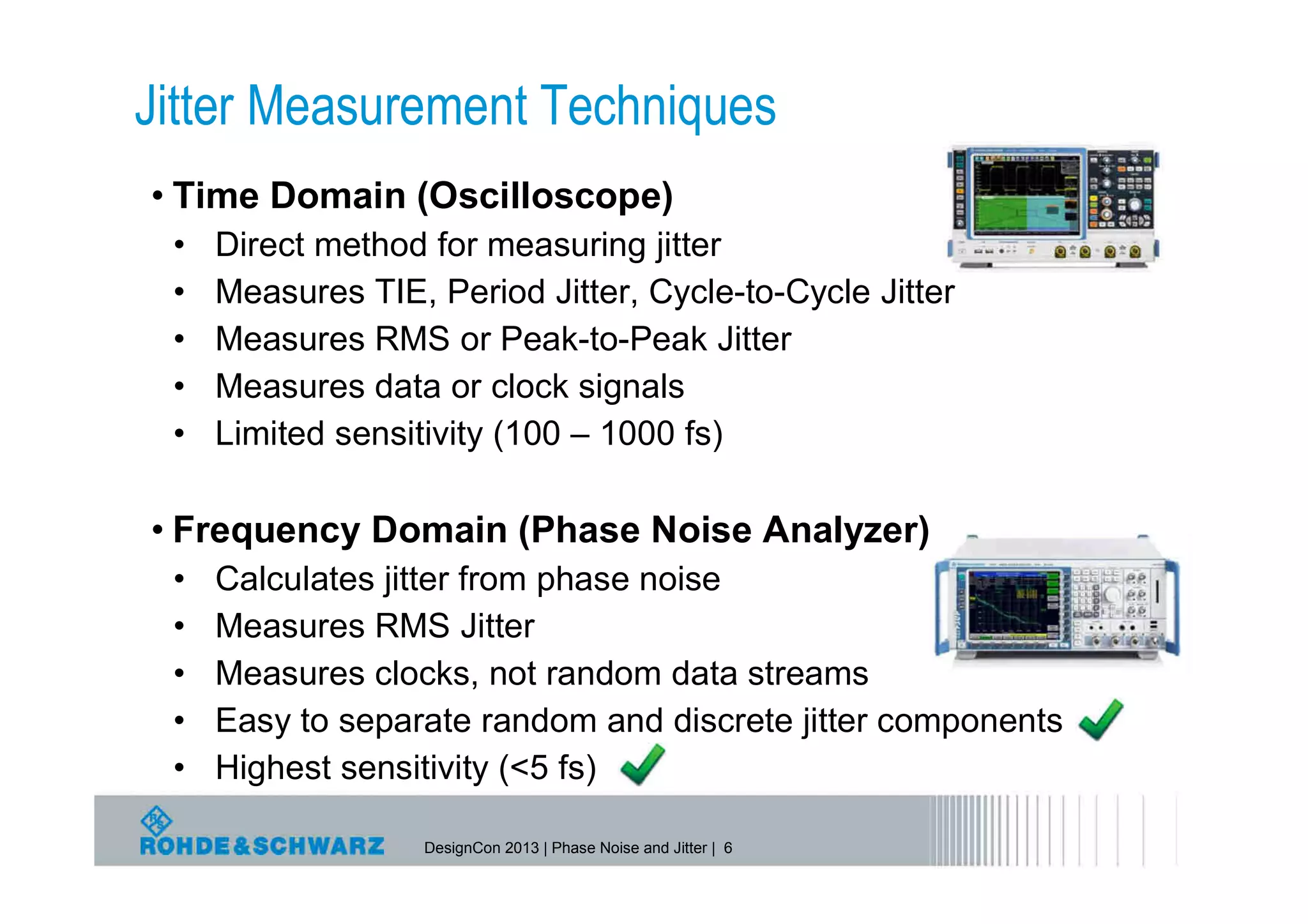
Jitter Measurement Techniques
• Time Domain (Oscilloscope)
 •   Direct method for measuring jitter
 •   Measures TIE, Period Jitter, Cycle-to-Cycle Jitter
 •   Measures RMS or Peak-to-Peak Jitter
 •   Measures data or clock signals
 •   Limited sensitivity (100 – 1000 fs)

• Frequency Domain (Phase Noise Analyzer)
 •   Calculates jitter from phase noise
 •   Measures RMS Jitter
 •   Measures clocks, not random data streams
 •   Easy to separate random and discrete jitter components
 •   Highest sensitivity (<5 fs)

                   DesignCon 2013 | Phase Noise and Jitter | 6
What is Phase Noise?
 • Ideal Signal (noiseless)
    V(t) = A sin(2t)                                                      Level


  where                                                                 t

          A = nominal amplitude                                                                        f
           = nominal frequency
                                                          Time Domain               Frequency Domain
 • Real Signal
    V(t) = [A + E(t)] sin(2t + (t))
                                                                            Level
  where
       E(t) = amplitude fluctuations                                    t

       (t) = phase fluctuations                                                                       f


       Phase Noise is unintentional phase modulation that spreads the
       signal spectrum in the frequency domain.
       Phase Noise is equivalent to jitter in the time domain.

                     DesignCon 2013 | Phase Noise and Jitter | 7
Phase Noise – Unit of Measure
 • Phase Noise is expressed as L(f)
 • L(f) is defined as single sideband power due to
   phase fluctuations in a rectangular 1Hz bandwidth
   at a specified offset, f, from the carrier
 • L(f) has units of dBc/Hz
                                                                   LOG A


                       AMPLITUDE                      L (f)
                                                                                       LOG f


                                                        1 Hz


                                             fc                 fc+f       FREQUENCY


                  DesignCon 2013 | Phase Noise and Jitter | 8
Phase Noise Measurement Setup


     Clock
     Under
      Test


             DesignCon 2013 | Phase Noise and Jitter | 9
Example Phase Noise Measurement Plot
  Phase Noise (dBc/Hz) 


                                                             Discrete Spurs


                           Offset from Fundamental Frequency 


                             DesignCon 2013 | Phase Noise and Jitter | 10
Phase Noise Measurement
• Shows phase noise over a
  range of offset frequencies: L (f)

                  1
• RMS Jitter =           2  L ( f )df
                 2f c
• Phase noise including spurs
  yields total jitter (random plus
  deterministic)

• Phase noise without spurs
  yields random jitter


                         DesignCon 2013 | Phase Noise and Jitter | 11
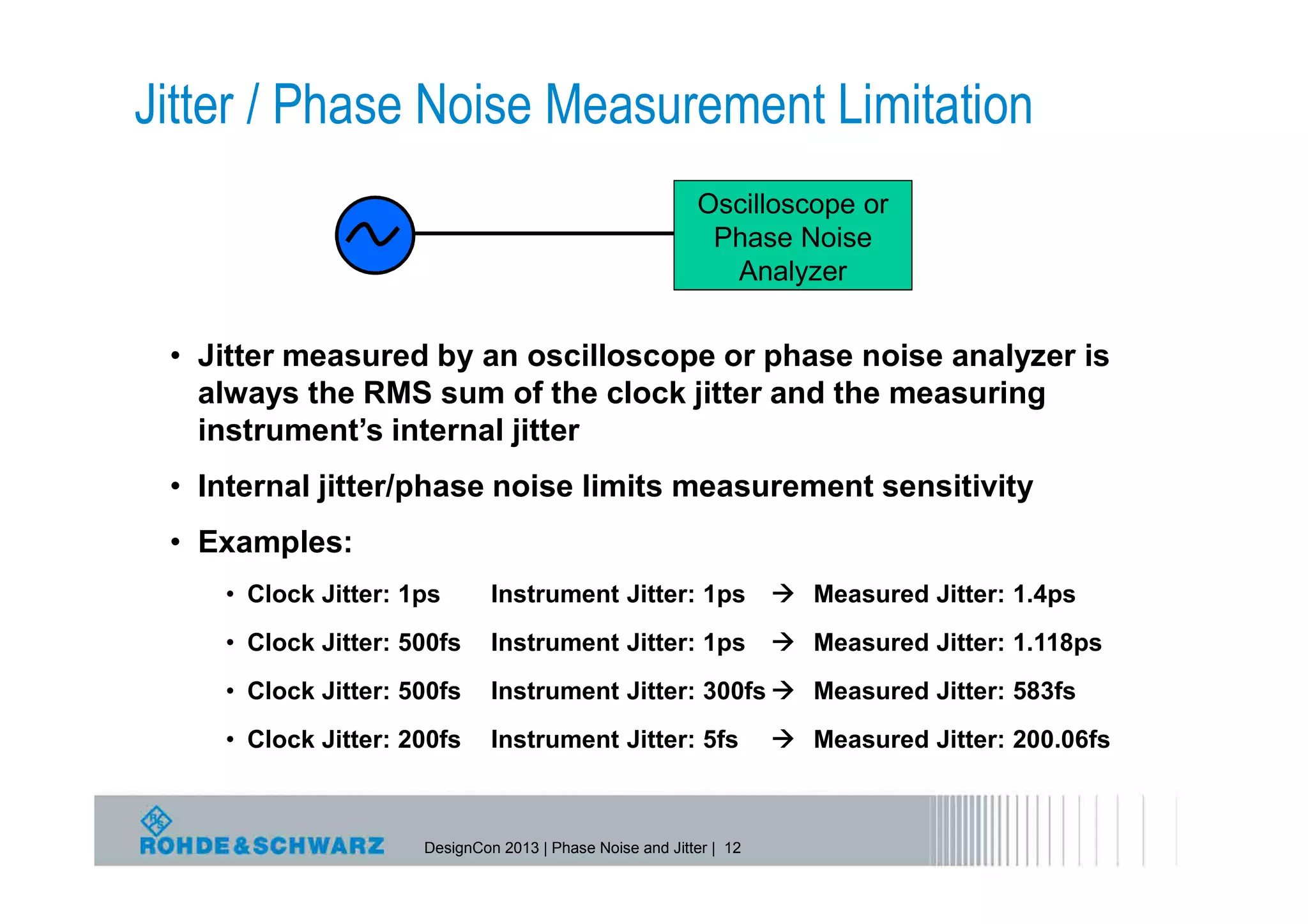
Jitter / Phase Noise Measurement Limitation
                                                          Oscilloscope or
                                                           Phase Noise
                                                            Analyzer


 • Jitter measured by an oscilloscope or phase noise analyzer is
   always the RMS sum of the clock jitter and the measuring
   instrument’s internal jitter
 • Internal jitter/phase noise limits measurement sensitivity
 • Examples:
    • Clock Jitter: 1ps       Instrument Jitter: 1ps                 Measured Jitter: 1.4ps
    • Clock Jitter: 500fs     Instrument Jitter: 1ps                 Measured Jitter: 1.118ps
    • Clock Jitter: 500fs     Instrument Jitter: 300fs  Measured Jitter: 583fs
    • Clock Jitter: 200fs     Instrument Jitter: 5fs                 Measured Jitter: 200.06fs


                     DesignCon 2013 | Phase Noise and Jitter | 12
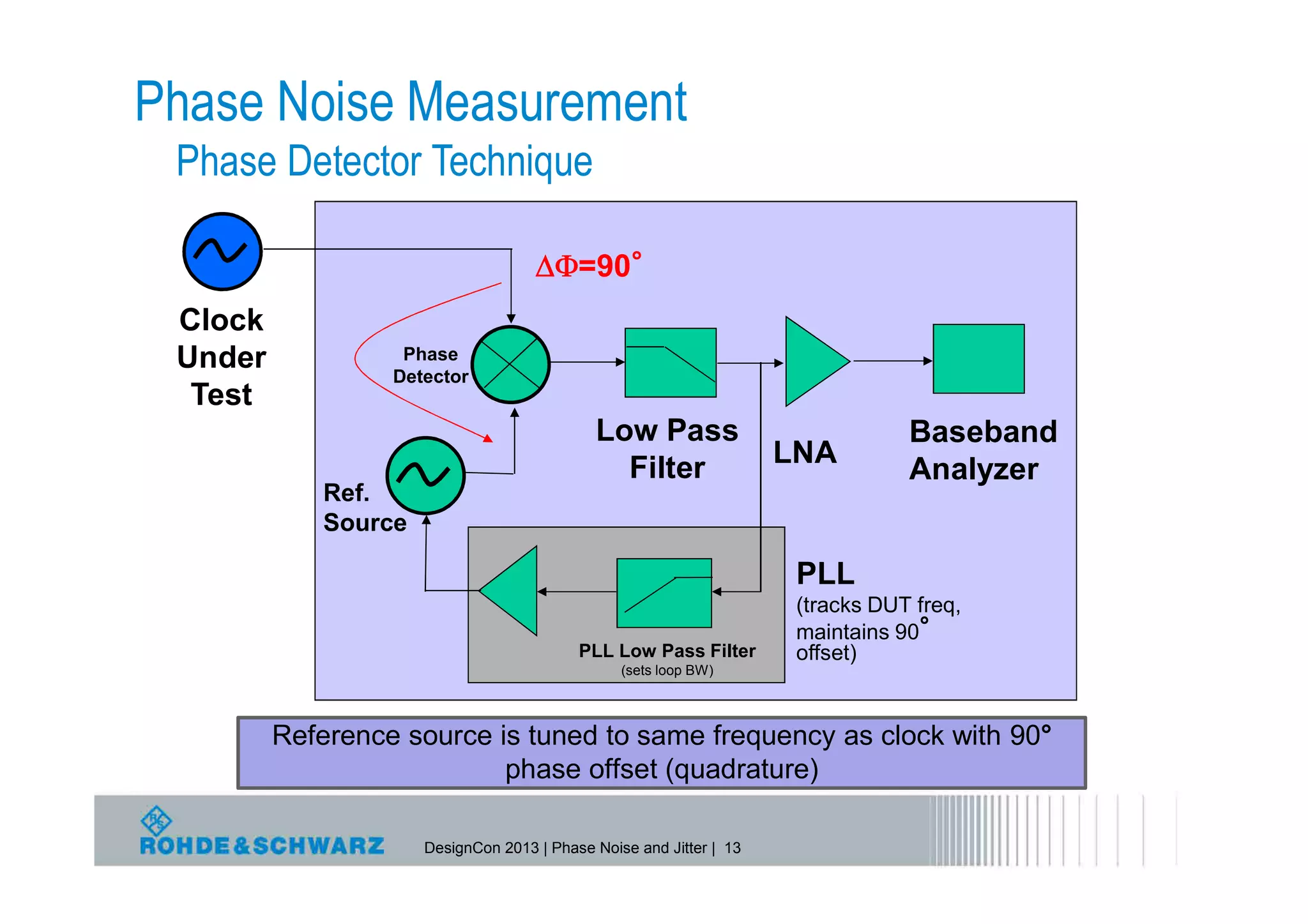
Phase Noise Measurement
 Phase Detector Technique

                                     DF=90°
                                          °
 Clock
 Under             Phase
                  Detector
  Test
                                             Low Pass                            Baseband
                                               Filter                LNA
                                                                                 Analyzer
             Ref.
             Source

                                                                      PLL
                                                                      (tracks DUT freq,
                                                                      maintains 90°
                                           PLL Low Pass Filter        offset)
                                                 (sets loop BW)


         Reference source is tuned to same frequency as clock with 90°
                           phase offset (quadrature)

                      DesignCon 2013 | Phase Noise and Jitter | 13
Phase Detector with Cross-Correlation
                                     PLL
                Noise 2
                                        Low Pass
        Ref 2    DF=90°
                      °                   Filter                  LNA
                                                                               Noise 2
                                                                               Noise DUT
                   PD                                                    ADC
Clock
                                                                                Correlation
Under
Test
                   PD                                                    ADC   Noise 1
                                                                               Noise DUT
        Ref 1                           Low Pass
                 DF=90°
                      °                                           LNA
                                          Filter
                Noise 1

                                      PLL
          Cross-correlating both measurements effectively reduces
         reference source noise – improves measurement sensitivity

                          DesignCon 2013 | Phase Noise and Jitter | 14
Jitter Measurement Instruments
                                                                   High
              Real time (Oscilloscope)                             Flexibility
               Single-shot or repetitive events (clock or data)
               Bandwidths typically 60 MHz to >30 GHz
               Lowest sensitivity (highest jitter noise floor)
               Measures adjacent cycles
              Repetitive (Sampling Oscilloscope)
               Repetitive events only (clock or data)
               Bandwidths typically 20 GHz to 100 GHz
               Generally can not discriminate based on jitter frequency
               Cannot measure adjacent cycles
              Phase noise (Phase noise test set)
               Clock signals only (50% duty cycle)
               Integrate phase noise over frequency to measure jitter
High           Highest sensitivity (lowest jitter noise floor)
               Cannot measure adjacent cycles
Sensitivity

                    DesignCon 2013 | Phase Noise and Jitter | 15
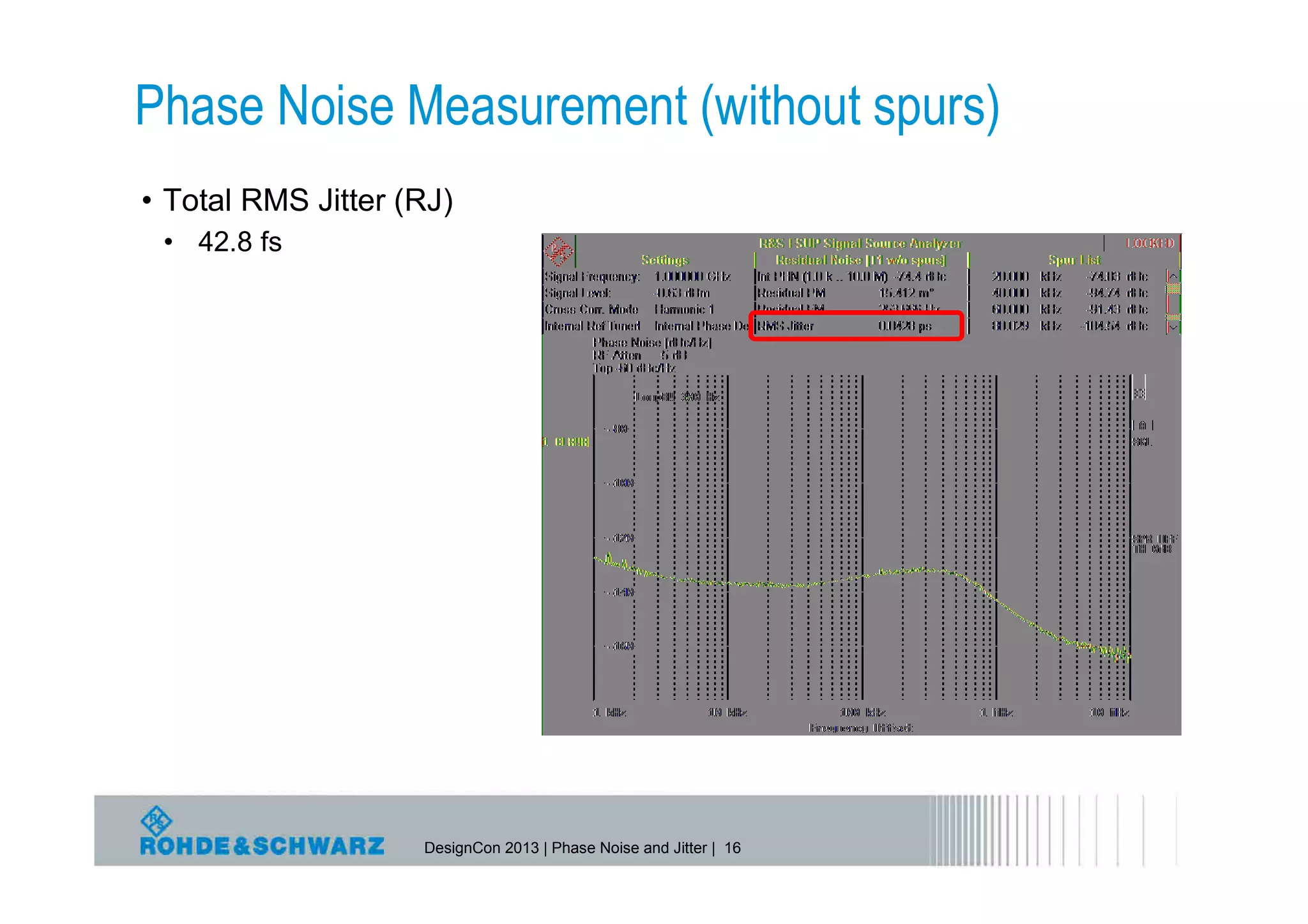
Phase Noise Measurement (without spurs)
• Total RMS Jitter (RJ)
 • 42.8 fs


                    DesignCon 2013 | Phase Noise and Jitter | 16
Phase Noise Measurement (with discrete spurs)
• Total RMS Jitter (RJ & DJ)
 • 59.9 fs


• Total Jitter (TJ) is RMS
  sum of RJ and DJ:
    TJ  RJ 2  DJ 2
• DJ can be calculated as:
    DJ  TJ 2  RJ 2

• TJ = 59.9 fs, RJ = 42.8 fs
 • Calculated DJ = 41.9 fs


                     DesignCon 2013 | Phase Noise and Jitter | 17
Measurement of DJ from Individual Contributors
• Isolate individual discrete components and evaluate their
  contribution to total RMS Jitter


                    DesignCon 2013 | Phase Noise and Jitter | 18
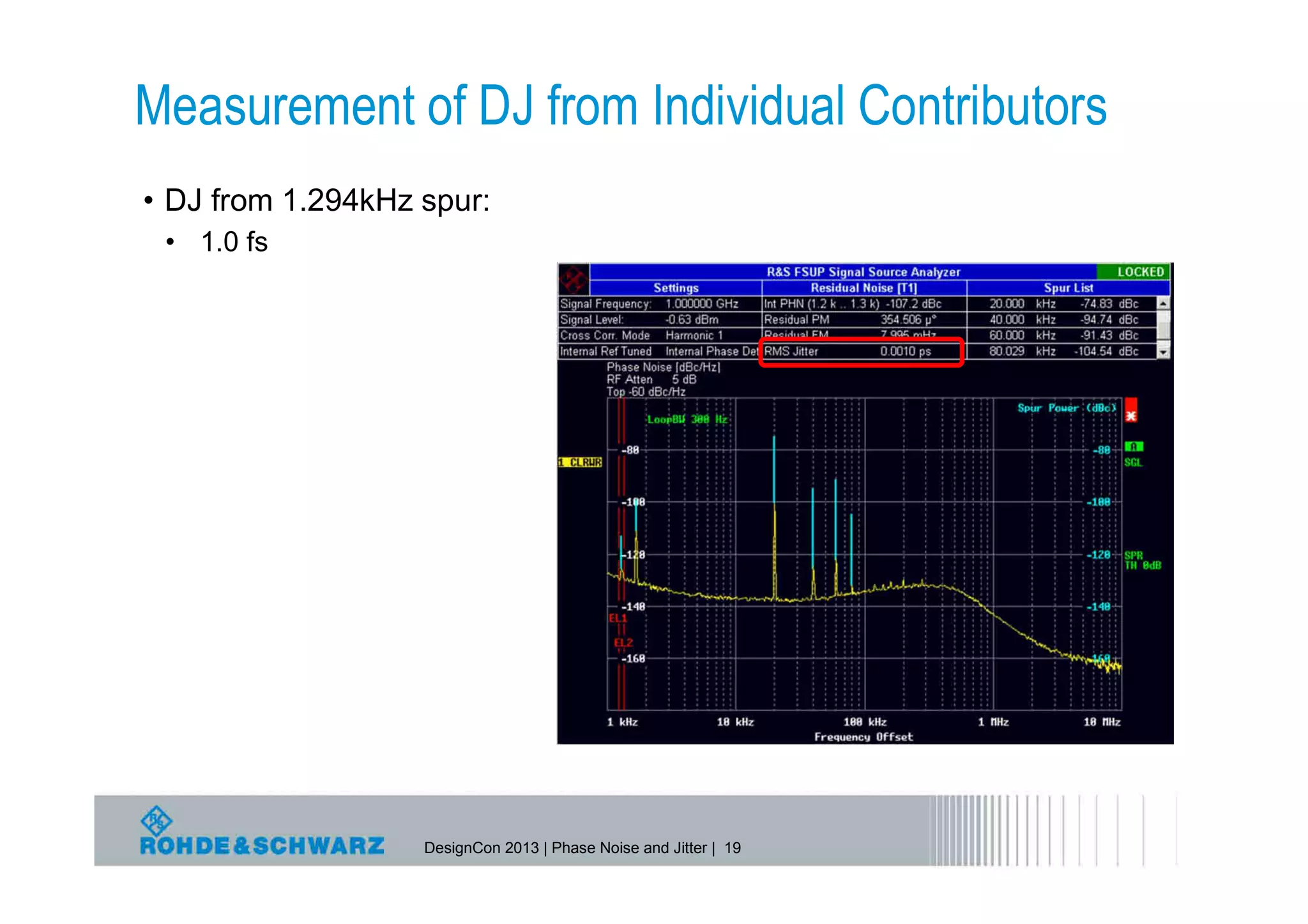
Measurement of DJ from Individual Contributors
• DJ from 1.294kHz spur:
 • 1.0 fs


                   DesignCon 2013 | Phase Noise and Jitter | 19
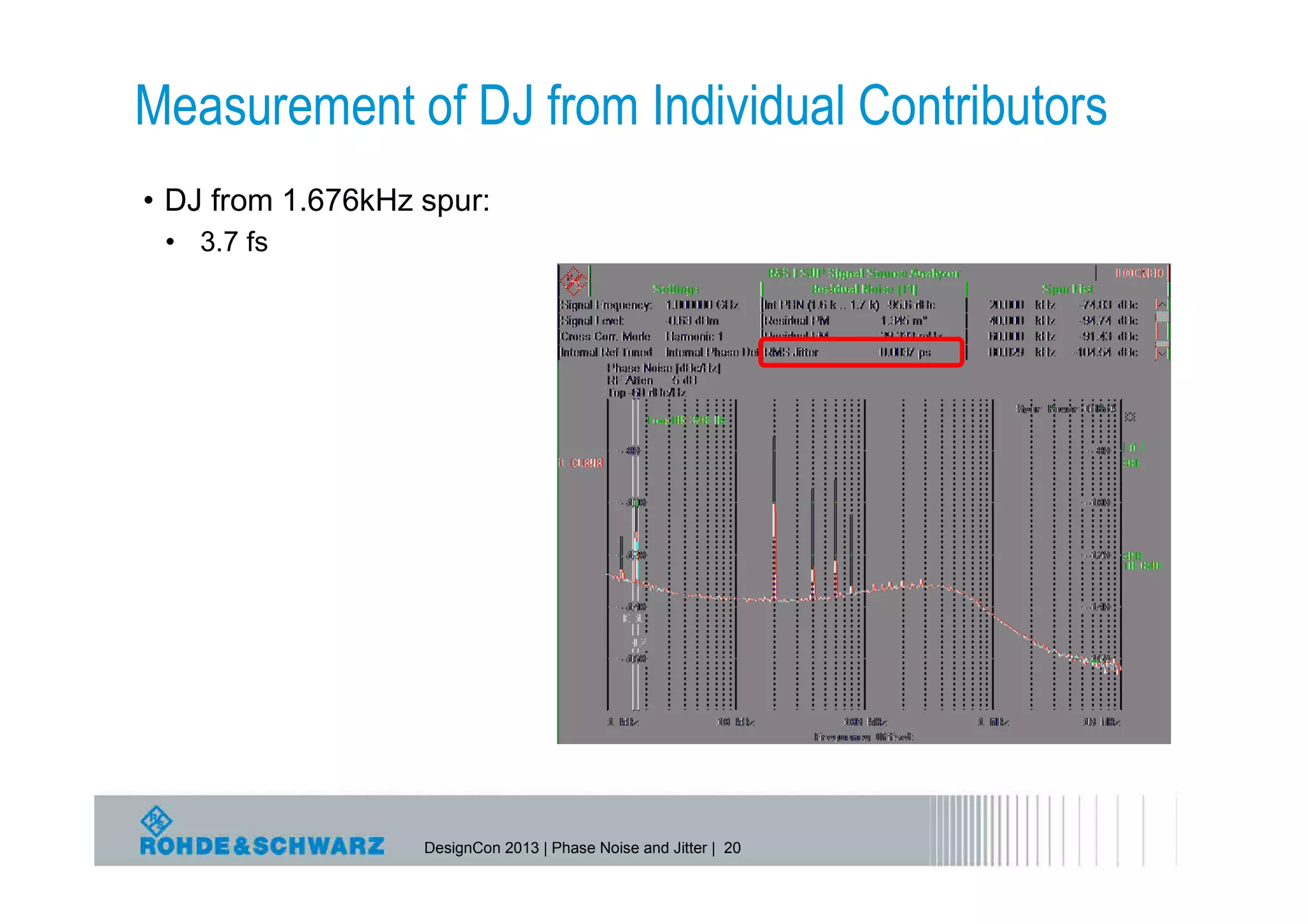
Measurement of DJ from Individual Contributors
• DJ from 1.676kHz spur:
 • 3.7 fs


                   DesignCon 2013 | Phase Noise and Jitter | 20
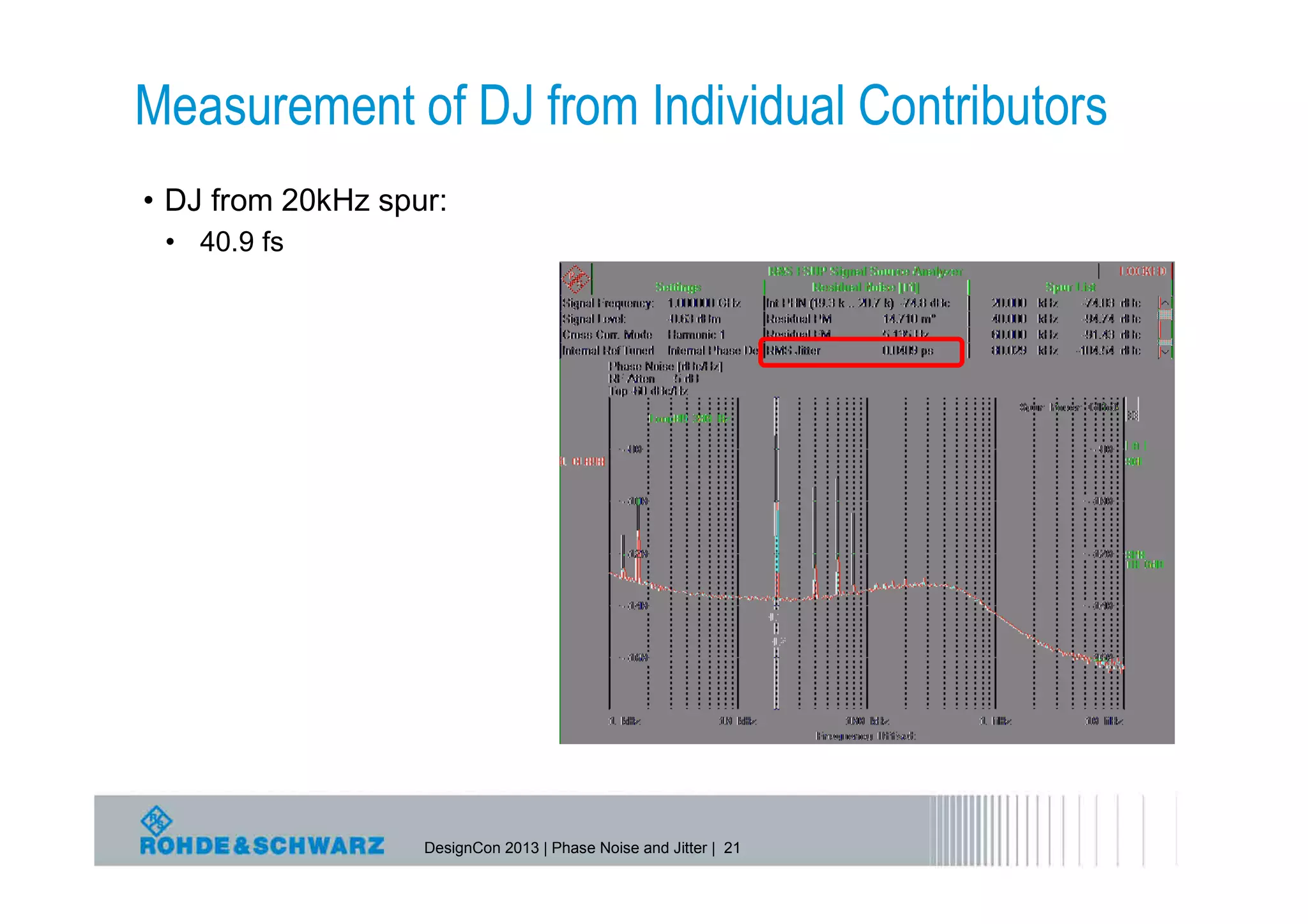
Measurement of DJ from Individual Contributors
• DJ from 20kHz spur:
 • 40.9 fs


                   DesignCon 2013 | Phase Noise and Jitter | 21
Measurement of DJ from Individual Contributors
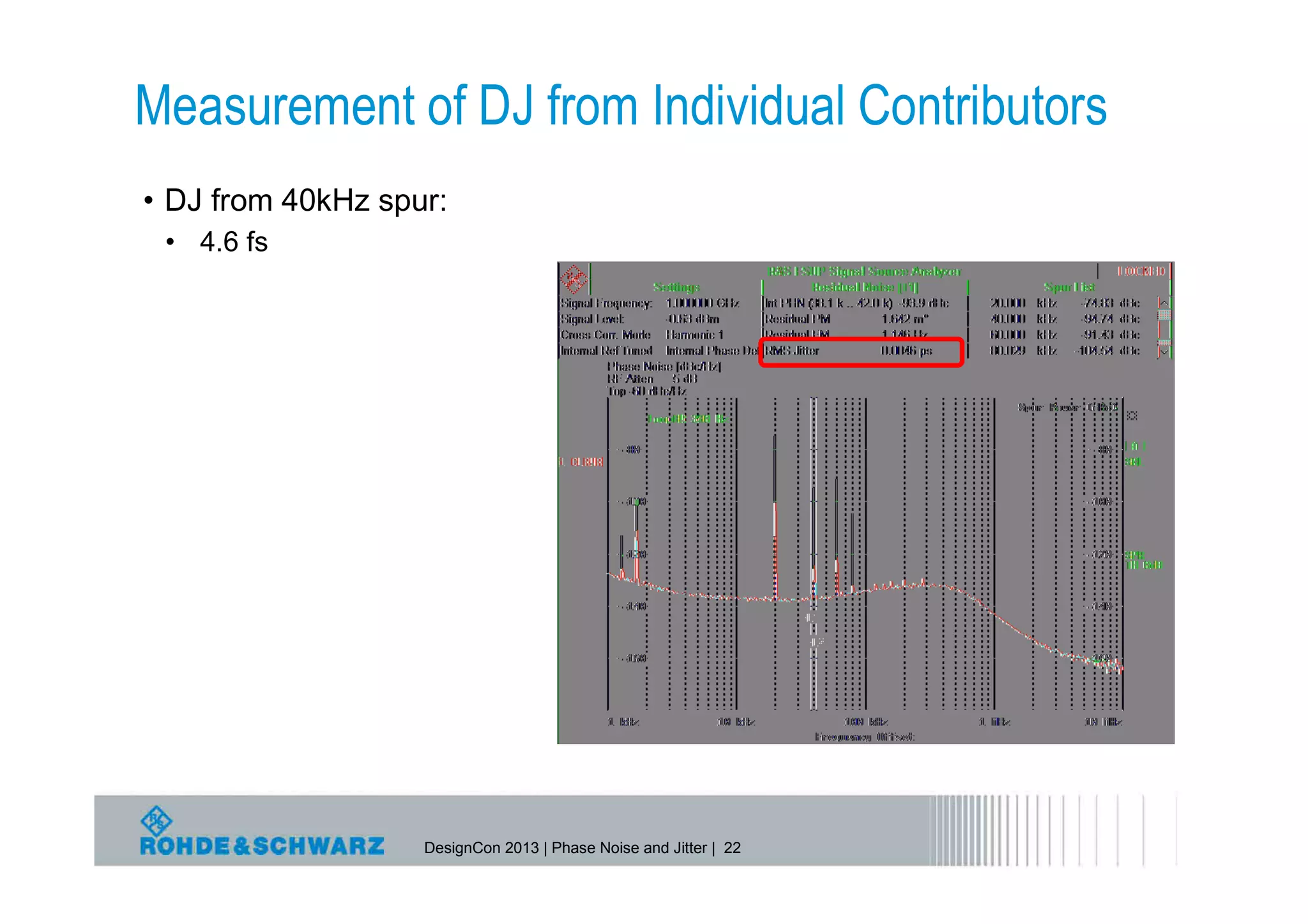
• DJ from 40kHz spur:
 • 4.6 fs


                   DesignCon 2013 | Phase Noise and Jitter | 22
Measurement of DJ from Individual Contributors
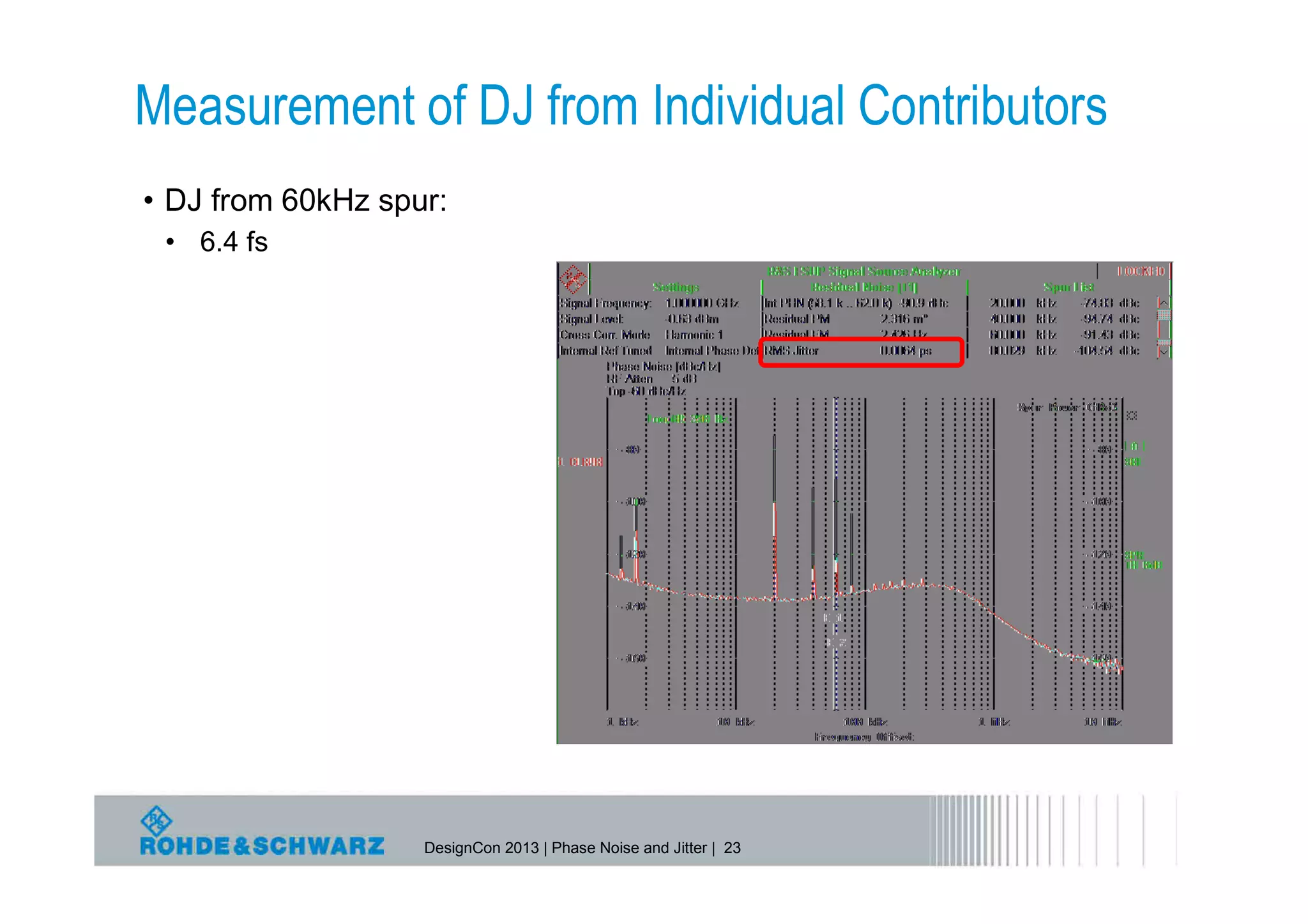
• DJ from 60kHz spur:
 • 6.4 fs


                   DesignCon 2013 | Phase Noise and Jitter | 23
Measurement of DJ from Individual Contributors
• DJ from 80kHz spur:
 • 2.8 fs


                   DesignCon 2013 | Phase Noise and Jitter | 24
Summary of Total Jitter
• TJ is RSS of all contributors
            2       2             2             2            2                  2
 TJ  DJ1  DJ 2  DJ 3  DJ 4  DJ 5  DJ 6  RJ 2

       12  3.7 2  40.9 2  4.6 2  6.4 2  2.82  42.82  59.9 fs


                                                                       40.9fs
                                                                                6.4fs
                                                                            4.6fs
                                                     3.7fs
                                                                                    2.8fs
                                                    1fs


                                                                                            42.8fs


                        DesignCon 2013 | Phase Noise and Jitter | 25
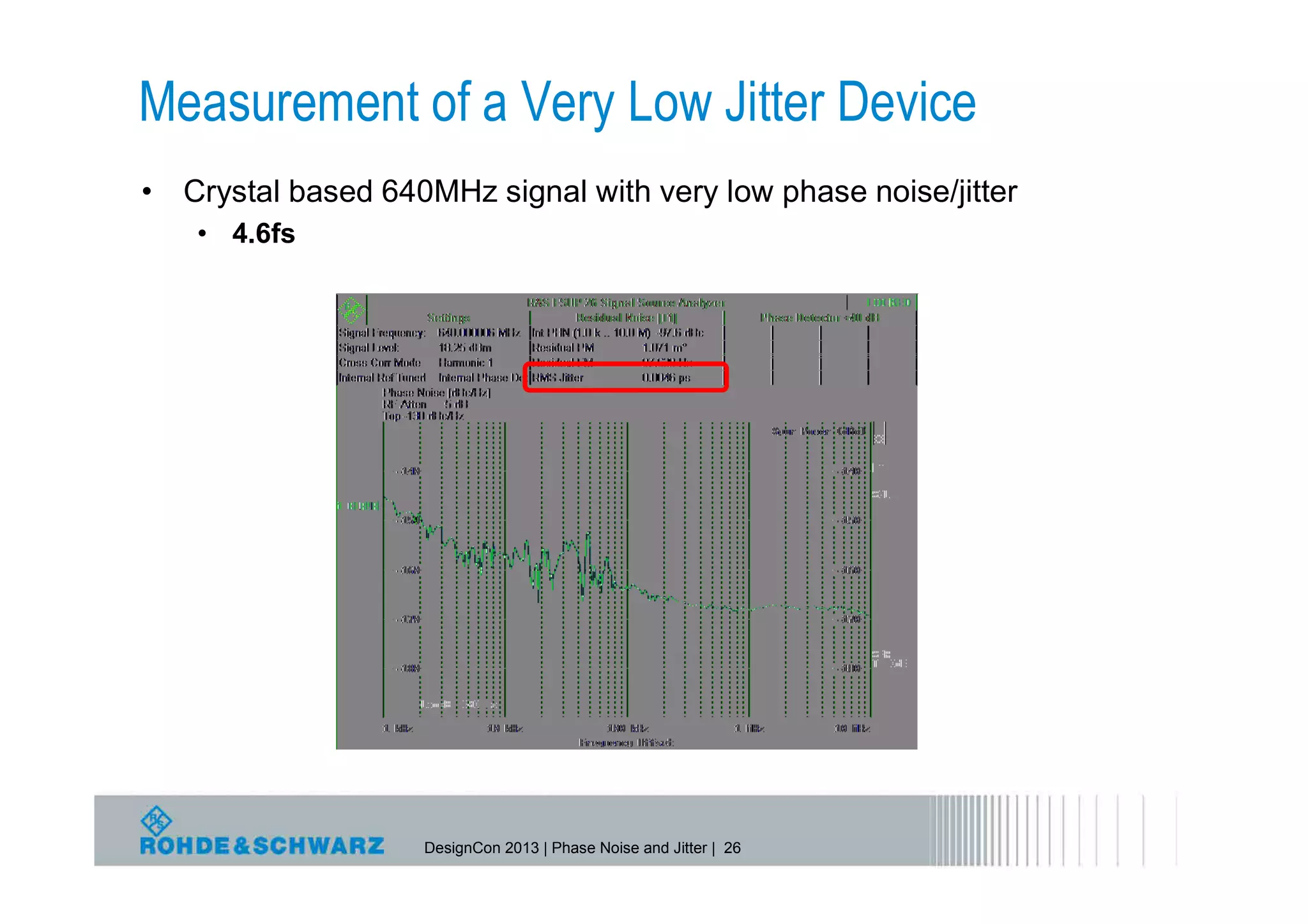
Measurement of a Very Low Jitter Device
• Crystal based 640MHz signal with very low phase noise/jitter
   • 4.6fs


                    DesignCon 2013 | Phase Noise and Jitter | 26
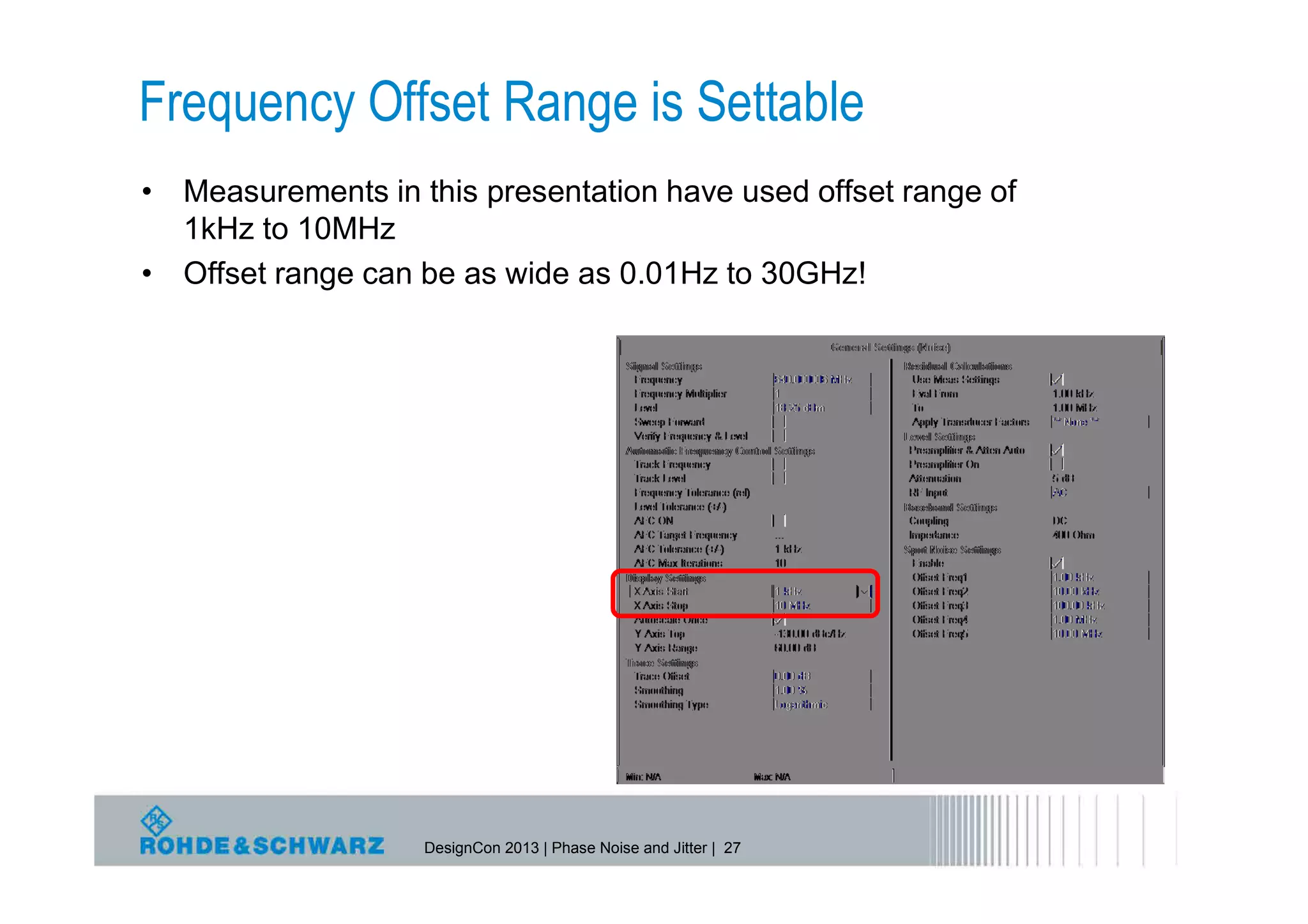
Frequency Offset Range is Settable
• Measurements in this presentation have used offset range of
  1kHz to 10MHz
• Offset range can be as wide as 0.01Hz to 30GHz!


                   DesignCon 2013 | Phase Noise and Jitter | 27
Jitter Calculation over Subset of Offsets
• By default, jitter is calculated over entire measured offset range
• A subset of the offset range may be specified for the jitter
  calculation


• Jitter calculated over full
  measured range of 1kHz
  to 10MHz is 4.6fs
• For reduced range of 10kHz
  to 3MHz it is 2.8fs


                     DesignCon 2013 | Phase Noise and Jitter | 28
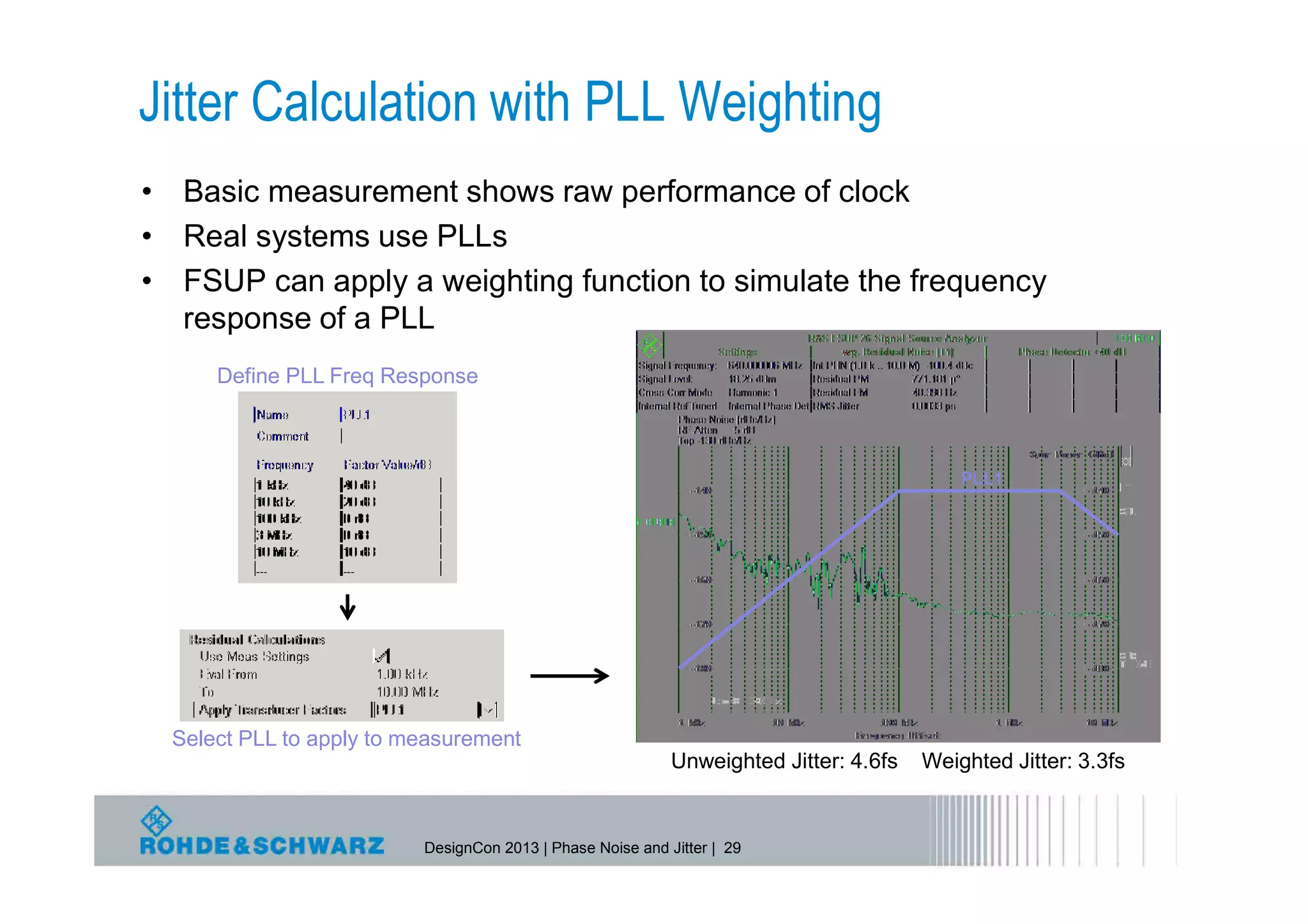
Jitter Calculation with PLL Weighting
• Basic measurement shows raw performance of clock
• Real systems use PLLs
• FSUP can apply a weighting function to simulate the frequency
  response of a PLL
      Define PLL Freq Response


                                                                                           PLL1


  Select PLL to apply to measurement
                                                            Unweighted Jitter: 4.6fs   Weighted Jitter: 3.3fs


                          DesignCon 2013 | Phase Noise and Jitter | 29
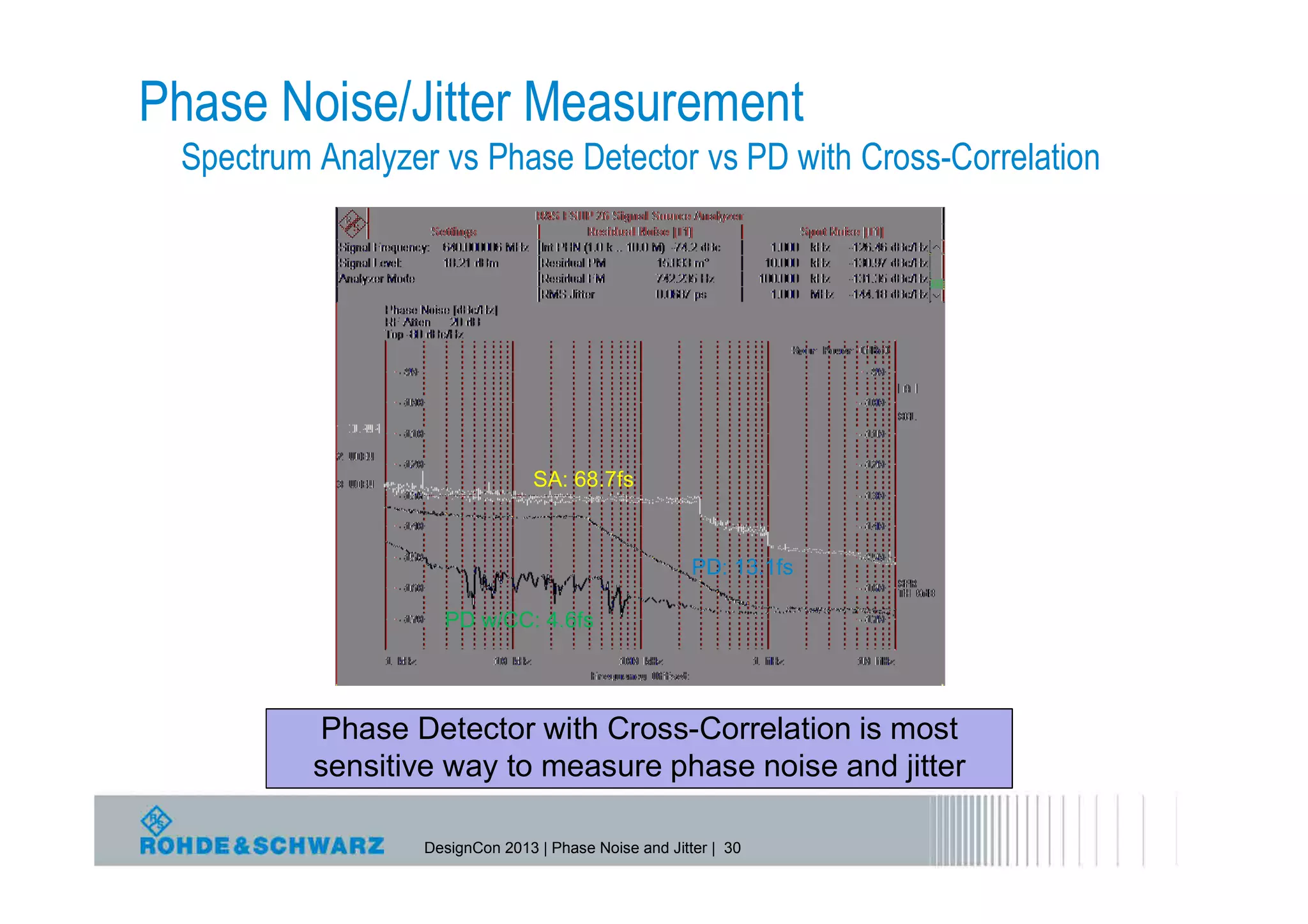
Phase Noise/Jitter Measurement
 Spectrum Analyzer vs Phase Detector vs PD with Cross-Correlation


                                 SA: 68.7fs


                                                       PD: 13.1fs

                    PD w/CC: 4.6fs


          Phase Detector with Cross-Correlation is most
          sensitive way to measure phase noise and jitter

                  DesignCon 2013 | Phase Noise and Jitter | 30
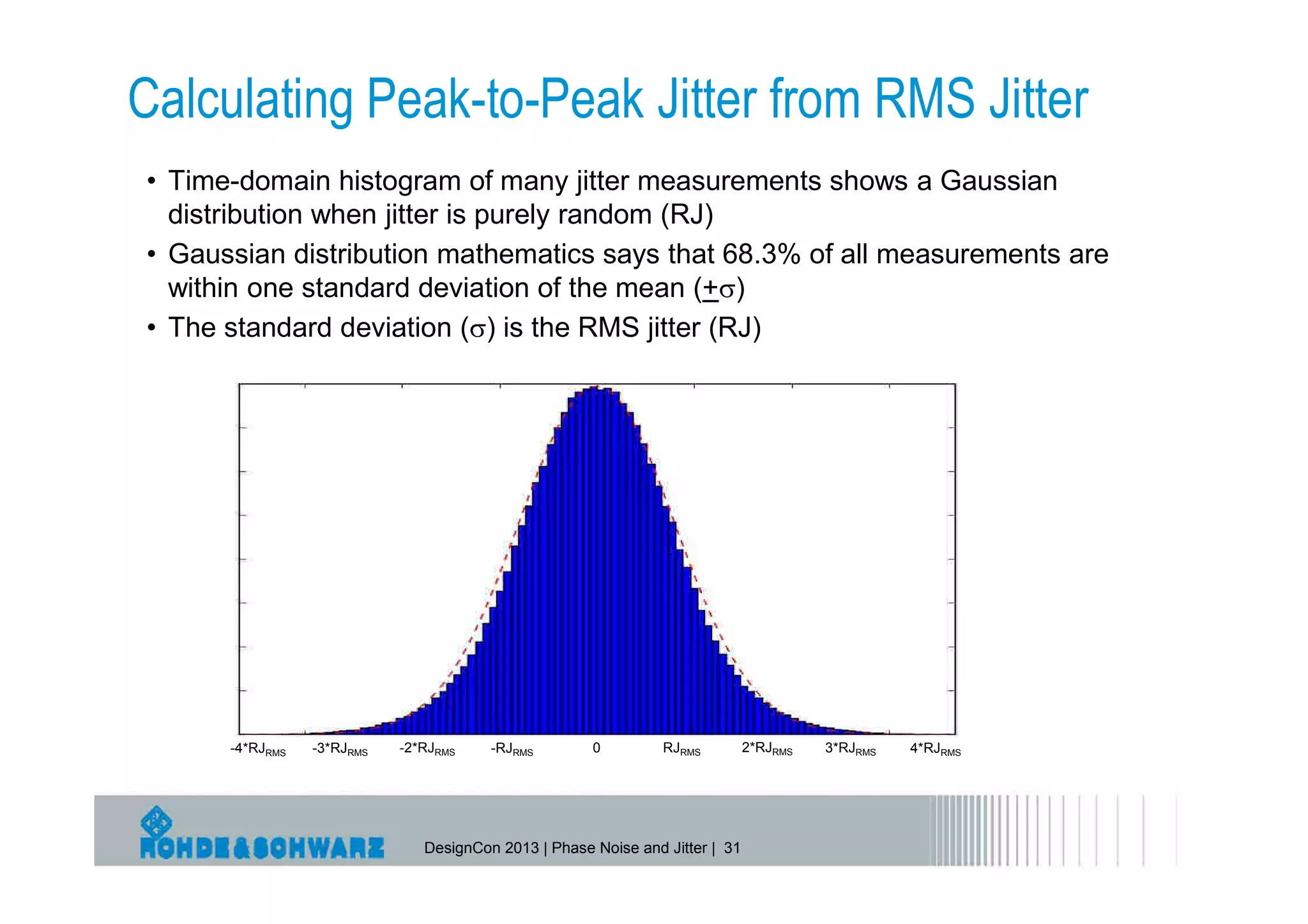
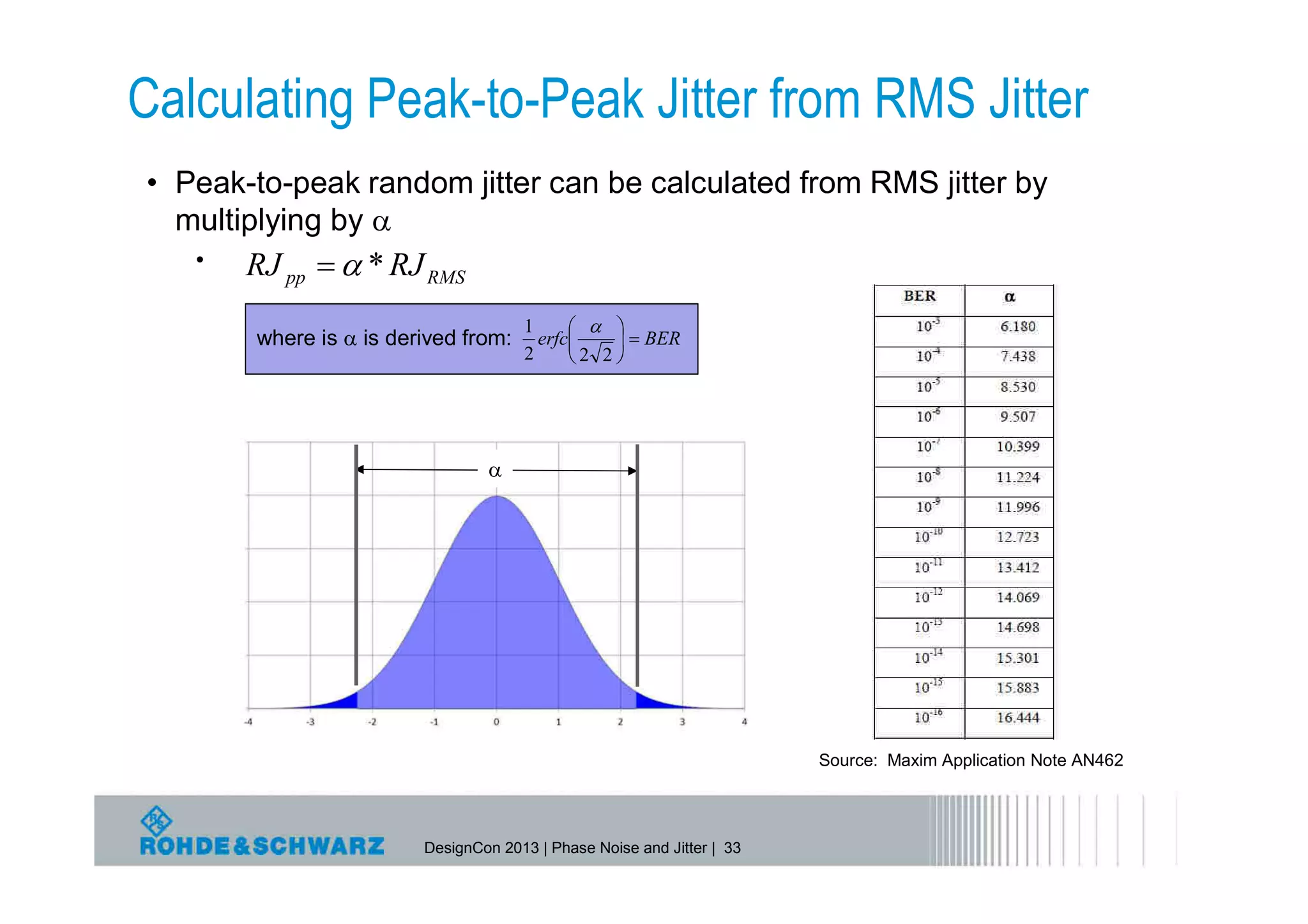
Calculating Peak-to-Peak Jitter from RMS Jitter
• Time-domain histogram of many jitter measurements shows a Gaussian
  distribution when jitter is purely random (RJ)
• Gaussian distribution mathematics says that 68.3% of all measurements are
  within one standard deviation of the mean (+s)
• The standard deviation (s) is the RMS jitter (RJ)


      -4*RJRMS   -3*RJRMS   -2*RJRMS    -RJRMS        0         RJRMS         2*RJRMS   3*RJRMS   4*RJRMS


                               DesignCon 2013 | Phase Noise and Jitter | 31
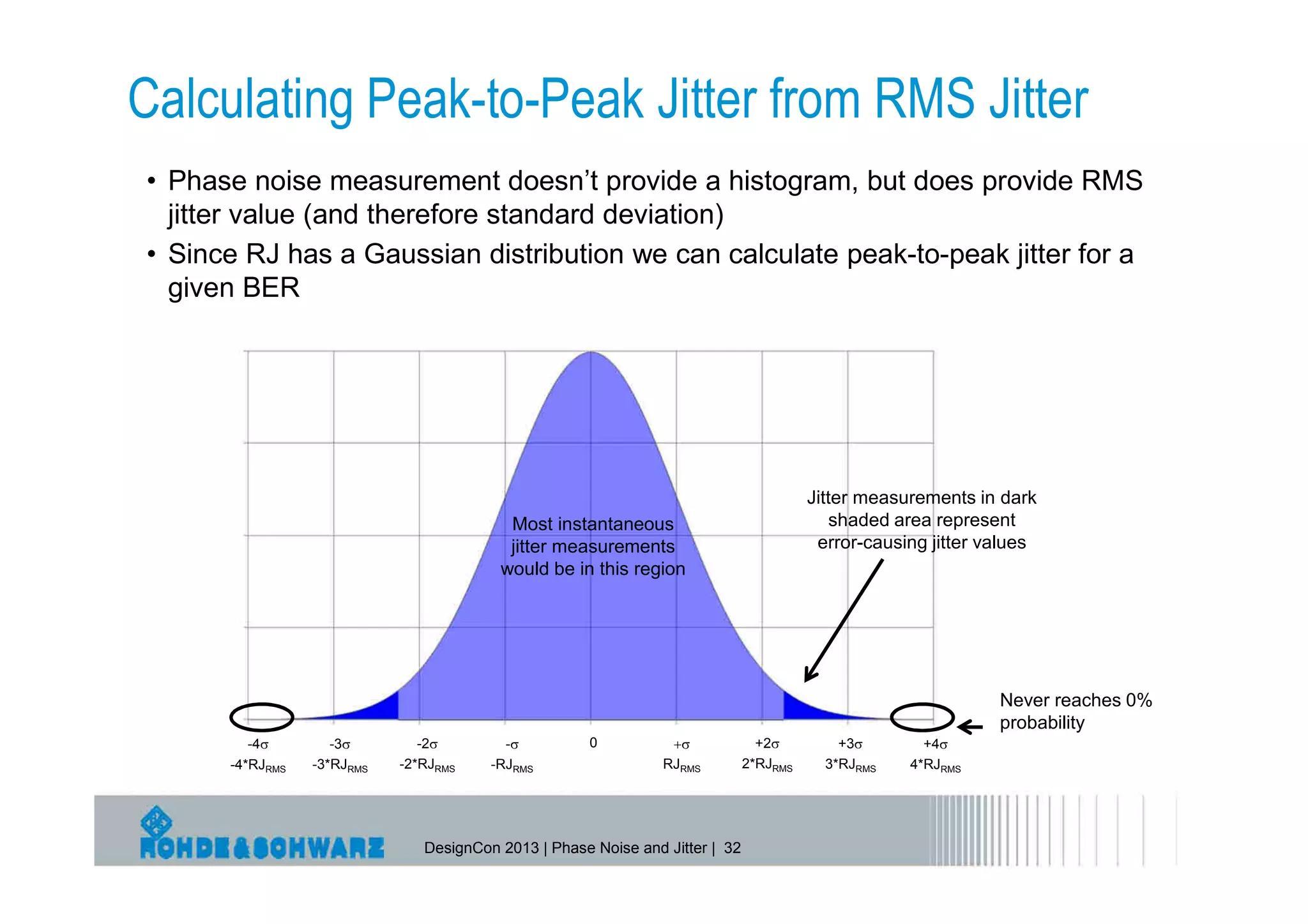
Calculating Peak-to-Peak Jitter from RMS Jitter
• Phase noise measurement doesn’t provide a histogram, but does provide RMS
  jitter value (and therefore standard deviation)
• Since RJ has a Gaussian distribution we can calculate peak-to-peak jitter for a
  given BER


                                                                                        Jitter measurements in dark
                                          Most instantaneous                                shaded area represent
                                          jitter measurements                            error-causing jitter values
                                         would be in this region


                                                                                                               Never reaches 0%
                                                                                                               probability
         -4s        -3s        -2s        -s         0           +s             +2s         +3s       +4s
      -4*RJRMS   -3*RJRMS   -2*RJRMS    -RJRMS                  RJRMS         2*RJRMS     3*RJRMS   4*RJRMS


                               DesignCon 2013 | Phase Noise and Jitter | 32
Calculating Peak-to-Peak Jitter from RMS Jitter
• Peak-to-peak random jitter can be calculated from RMS jitter by
  multiplying by a
   •   RJ pp  a * RJ RMS
                                     1      a 
       where is a is derived from:     erfc     BER
                                     2     2 2


                                a


                                                                       Source: Maxim Application Note AN462


                        DesignCon 2013 | Phase Noise and Jitter | 33
a vs. BER
• Factors to calculate RJpp from RJRMS based on BER
   • Example: RJpp = 9.507*RJRMS for BER = 10-6


                                  14.069*RJRMS (BER=10-12)

                                  11.996*RJRMS (BER=10-9)

                                   9.507*RJRMS (BER=10-6)

                                   6.180*RJRMS(BER=10-3)


                   DesignCon 2013 | Phase Noise and Jitter | 34
Useful References
• “Analysis of Jitter with the R&S FSUP Signal Source Analyzer”
   Rohde & Schwarz Application Note 1EF71

• “Converting Between RMS and Peak-to-Peak Jitter at a Specified BER”
   Maxim Integrated Application Note HFAN-4.0.2

• “Clock Jitter and Measurement”
   SiTime Application Note SiT-AN10007

• “A Primer on Jitter, Jitter Measurement and Phase-Locked Loops”
   Silicon Labs Application Note AN687

• “Determining Peak to Peak Frequency Jitter”
   Pletronics White Paper


                   DesignCon 2013 | Phase Noise and Jitter | 35
DesignCon 2013 | Phase Noise and Jitter | 36

Phase Noise and Jitter Measurements

  • 1.
  • 2.
    Phase Noise andJitter Measurements Introduction Rick Daniel Application Engineer Rohde & Schwarz Colorado Springs, CO DesignCon 2013 | Phase Noise and Jitter | 2
  • 3.
    Agenda • Jitter Review •Time-Domain and Frequency-Domain Jitter Measurements • Phase Noise Concept and Measurement • Deriving Random and Deterministic Jitter from Phase Noise • PLL/Filter Weighting of Jitter Spectrum • Calculating Peak-to-Peak Jitter from RMS Jitter DesignCon 2013 | Phase Noise and Jitter | 3
  • 4.
    What is Jii tt tt e rr ? J e • Jitter is the short-term time-domain variations in clock or data signal timing • Jitter includes instability in signal period, frequency, phase, duty cycle or some other timing characteristic • Jitter is of interest from cycle to cycle, over many consecutive cycle, or as a longer term variation • Jitter is equivalent to Phase Noise in the frequency domain • Variations with frequency components >10Hz are Jitter • Variations with frequency components <10Hz are Wander DesignCon 2013 | Phase Noise and Jitter | 4
  • 5.
    Types of Jitter •Time Interval Error (TIE) • Fundamental measurement of jitter • Time difference between measured signal edge and ideal edge • Instantaneous phase of signal • Period Jitter • Short-term stability, basic parameter for clocks • Cycle to Cycle • Important for parallel data transfer • N-Cycle • Important when clock and data routing differ DesignCon 2013 | Phase Noise and Jitter | 5
  • 6.
    Jitter Measurement Techniques •Time Domain (Oscilloscope) • Direct method for measuring jitter • Measures TIE, Period Jitter, Cycle-to-Cycle Jitter • Measures RMS or Peak-to-Peak Jitter • Measures data or clock signals • Limited sensitivity (100 – 1000 fs) • Frequency Domain (Phase Noise Analyzer) • Calculates jitter from phase noise • Measures RMS Jitter • Measures clocks, not random data streams • Easy to separate random and discrete jitter components • Highest sensitivity (<5 fs) DesignCon 2013 | Phase Noise and Jitter | 6
  • 7.
    What is PhaseNoise? • Ideal Signal (noiseless) V(t) = A sin(2t) Level where t A = nominal amplitude f  = nominal frequency Time Domain Frequency Domain • Real Signal V(t) = [A + E(t)] sin(2t + (t)) Level where E(t) = amplitude fluctuations t (t) = phase fluctuations f Phase Noise is unintentional phase modulation that spreads the signal spectrum in the frequency domain. Phase Noise is equivalent to jitter in the time domain. DesignCon 2013 | Phase Noise and Jitter | 7
  • 8.
    Phase Noise –Unit of Measure • Phase Noise is expressed as L(f) • L(f) is defined as single sideband power due to phase fluctuations in a rectangular 1Hz bandwidth at a specified offset, f, from the carrier • L(f) has units of dBc/Hz LOG A AMPLITUDE L (f) LOG f 1 Hz fc fc+f FREQUENCY DesignCon 2013 | Phase Noise and Jitter | 8
  • 9.
    Phase Noise MeasurementSetup Clock Under Test DesignCon 2013 | Phase Noise and Jitter | 9
  • 10.
    Example Phase NoiseMeasurement Plot Phase Noise (dBc/Hz)  Discrete Spurs Offset from Fundamental Frequency  DesignCon 2013 | Phase Noise and Jitter | 10
  • 11.
    Phase Noise Measurement •Shows phase noise over a range of offset frequencies: L (f) 1 • RMS Jitter = 2  L ( f )df 2f c • Phase noise including spurs yields total jitter (random plus deterministic) • Phase noise without spurs yields random jitter DesignCon 2013 | Phase Noise and Jitter | 11
  • 12.
    Jitter / PhaseNoise Measurement Limitation Oscilloscope or Phase Noise Analyzer • Jitter measured by an oscilloscope or phase noise analyzer is always the RMS sum of the clock jitter and the measuring instrument’s internal jitter • Internal jitter/phase noise limits measurement sensitivity • Examples: • Clock Jitter: 1ps Instrument Jitter: 1ps  Measured Jitter: 1.4ps • Clock Jitter: 500fs Instrument Jitter: 1ps  Measured Jitter: 1.118ps • Clock Jitter: 500fs Instrument Jitter: 300fs  Measured Jitter: 583fs • Clock Jitter: 200fs Instrument Jitter: 5fs  Measured Jitter: 200.06fs DesignCon 2013 | Phase Noise and Jitter | 12
  • 13.
    Phase Noise Measurement Phase Detector Technique DF=90° ° Clock Under Phase Detector Test Low Pass Baseband Filter LNA Analyzer Ref. Source PLL (tracks DUT freq, maintains 90° PLL Low Pass Filter offset) (sets loop BW) Reference source is tuned to same frequency as clock with 90° phase offset (quadrature) DesignCon 2013 | Phase Noise and Jitter | 13
  • 14.
    Phase Detector withCross-Correlation PLL Noise 2 Low Pass Ref 2 DF=90° ° Filter LNA Noise 2 Noise DUT PD ADC Clock Correlation Under Test PD ADC Noise 1 Noise DUT Ref 1 Low Pass DF=90° ° LNA Filter Noise 1 PLL Cross-correlating both measurements effectively reduces reference source noise – improves measurement sensitivity DesignCon 2013 | Phase Noise and Jitter | 14
  • 15.
    Jitter Measurement Instruments High Real time (Oscilloscope) Flexibility Single-shot or repetitive events (clock or data) Bandwidths typically 60 MHz to >30 GHz Lowest sensitivity (highest jitter noise floor) Measures adjacent cycles Repetitive (Sampling Oscilloscope) Repetitive events only (clock or data) Bandwidths typically 20 GHz to 100 GHz Generally can not discriminate based on jitter frequency Cannot measure adjacent cycles Phase noise (Phase noise test set) Clock signals only (50% duty cycle) Integrate phase noise over frequency to measure jitter High Highest sensitivity (lowest jitter noise floor) Cannot measure adjacent cycles Sensitivity DesignCon 2013 | Phase Noise and Jitter | 15
  • 16.
    Phase Noise Measurement(without spurs) • Total RMS Jitter (RJ) • 42.8 fs DesignCon 2013 | Phase Noise and Jitter | 16
  • 17.
    Phase Noise Measurement(with discrete spurs) • Total RMS Jitter (RJ & DJ) • 59.9 fs • Total Jitter (TJ) is RMS sum of RJ and DJ: TJ  RJ 2  DJ 2 • DJ can be calculated as: DJ  TJ 2  RJ 2 • TJ = 59.9 fs, RJ = 42.8 fs • Calculated DJ = 41.9 fs DesignCon 2013 | Phase Noise and Jitter | 17
  • 18.
    Measurement of DJfrom Individual Contributors • Isolate individual discrete components and evaluate their contribution to total RMS Jitter DesignCon 2013 | Phase Noise and Jitter | 18
  • 19.
    Measurement of DJfrom Individual Contributors • DJ from 1.294kHz spur: • 1.0 fs DesignCon 2013 | Phase Noise and Jitter | 19
  • 20.
    Measurement of DJfrom Individual Contributors • DJ from 1.676kHz spur: • 3.7 fs DesignCon 2013 | Phase Noise and Jitter | 20
  • 21.
    Measurement of DJfrom Individual Contributors • DJ from 20kHz spur: • 40.9 fs DesignCon 2013 | Phase Noise and Jitter | 21
  • 22.
    Measurement of DJfrom Individual Contributors • DJ from 40kHz spur: • 4.6 fs DesignCon 2013 | Phase Noise and Jitter | 22
  • 23.
    Measurement of DJfrom Individual Contributors • DJ from 60kHz spur: • 6.4 fs DesignCon 2013 | Phase Noise and Jitter | 23
  • 24.
    Measurement of DJfrom Individual Contributors • DJ from 80kHz spur: • 2.8 fs DesignCon 2013 | Phase Noise and Jitter | 24
  • 25.
    Summary of TotalJitter • TJ is RSS of all contributors 2 2 2 2 2 2 TJ  DJ1  DJ 2  DJ 3  DJ 4  DJ 5  DJ 6  RJ 2  12  3.7 2  40.9 2  4.6 2  6.4 2  2.82  42.82  59.9 fs 40.9fs 6.4fs 4.6fs 3.7fs 2.8fs 1fs 42.8fs DesignCon 2013 | Phase Noise and Jitter | 25
  • 26.
    Measurement of aVery Low Jitter Device • Crystal based 640MHz signal with very low phase noise/jitter • 4.6fs DesignCon 2013 | Phase Noise and Jitter | 26
  • 27.
    Frequency Offset Rangeis Settable • Measurements in this presentation have used offset range of 1kHz to 10MHz • Offset range can be as wide as 0.01Hz to 30GHz! DesignCon 2013 | Phase Noise and Jitter | 27
  • 28.
    Jitter Calculation overSubset of Offsets • By default, jitter is calculated over entire measured offset range • A subset of the offset range may be specified for the jitter calculation • Jitter calculated over full measured range of 1kHz to 10MHz is 4.6fs • For reduced range of 10kHz to 3MHz it is 2.8fs DesignCon 2013 | Phase Noise and Jitter | 28
  • 29.
    Jitter Calculation withPLL Weighting • Basic measurement shows raw performance of clock • Real systems use PLLs • FSUP can apply a weighting function to simulate the frequency response of a PLL Define PLL Freq Response PLL1 Select PLL to apply to measurement Unweighted Jitter: 4.6fs Weighted Jitter: 3.3fs DesignCon 2013 | Phase Noise and Jitter | 29
  • 30.
    Phase Noise/Jitter Measurement Spectrum Analyzer vs Phase Detector vs PD with Cross-Correlation SA: 68.7fs PD: 13.1fs PD w/CC: 4.6fs Phase Detector with Cross-Correlation is most sensitive way to measure phase noise and jitter DesignCon 2013 | Phase Noise and Jitter | 30
  • 31.
    Calculating Peak-to-Peak Jitterfrom RMS Jitter • Time-domain histogram of many jitter measurements shows a Gaussian distribution when jitter is purely random (RJ) • Gaussian distribution mathematics says that 68.3% of all measurements are within one standard deviation of the mean (+s) • The standard deviation (s) is the RMS jitter (RJ) -4*RJRMS -3*RJRMS -2*RJRMS -RJRMS 0 RJRMS 2*RJRMS 3*RJRMS 4*RJRMS DesignCon 2013 | Phase Noise and Jitter | 31
  • 32.
    Calculating Peak-to-Peak Jitterfrom RMS Jitter • Phase noise measurement doesn’t provide a histogram, but does provide RMS jitter value (and therefore standard deviation) • Since RJ has a Gaussian distribution we can calculate peak-to-peak jitter for a given BER Jitter measurements in dark Most instantaneous shaded area represent jitter measurements error-causing jitter values would be in this region Never reaches 0% probability -4s -3s -2s -s 0 +s +2s +3s +4s -4*RJRMS -3*RJRMS -2*RJRMS -RJRMS RJRMS 2*RJRMS 3*RJRMS 4*RJRMS DesignCon 2013 | Phase Noise and Jitter | 32
  • 33.
    Calculating Peak-to-Peak Jitterfrom RMS Jitter • Peak-to-peak random jitter can be calculated from RMS jitter by multiplying by a • RJ pp  a * RJ RMS 1  a  where is a is derived from: erfc   BER 2 2 2 a Source: Maxim Application Note AN462 DesignCon 2013 | Phase Noise and Jitter | 33
  • 34.
    a vs. BER •Factors to calculate RJpp from RJRMS based on BER • Example: RJpp = 9.507*RJRMS for BER = 10-6 14.069*RJRMS (BER=10-12) 11.996*RJRMS (BER=10-9) 9.507*RJRMS (BER=10-6) 6.180*RJRMS(BER=10-3) DesignCon 2013 | Phase Noise and Jitter | 34
  • 35.
    Useful References • “Analysisof Jitter with the R&S FSUP Signal Source Analyzer” Rohde & Schwarz Application Note 1EF71 • “Converting Between RMS and Peak-to-Peak Jitter at a Specified BER” Maxim Integrated Application Note HFAN-4.0.2 • “Clock Jitter and Measurement” SiTime Application Note SiT-AN10007 • “A Primer on Jitter, Jitter Measurement and Phase-Locked Loops” Silicon Labs Application Note AN687 • “Determining Peak to Peak Frequency Jitter” Pletronics White Paper DesignCon 2013 | Phase Noise and Jitter | 35
  • 36.
    DesignCon 2013 |Phase Noise and Jitter | 36