Troubleshooting Switched Mode
Power Supplies
SMPS | 2
Agenda
l Switched mode power supply background
l Measurement points
l Voltage and current waveforms
l Maximizing measurement accuracy
l Averaging, high resolution decimation
l Sampling rate
l Analyzing common issues
l Improper inductor size
l EMI
l Load transient behavior
Modern Power Supplies:
Inductors, Capacitors and Fast Switches
ı Use ‘Lossless’ Components, In ‘Switching’ Operation
 Inductors store energy, and can deliver the energy at higher or lower
voltage than input
 Capacitors store energy between ‘pumping’ operations of inductors
ı Replace Linear Series Pass And Shunt Regulators
 Linear regulators turn excess voltage into thermal energy
 Efficiencies can be very high – as little as 2% to 3% “wasted” energy
ı Effectively ‘Variable Transformer’ Operation
 Able To Provide Increase/Decrease, Or Both, In Voltage
 Able To Operate Over Wide Ranges Of Input Voltage
01.04.2014 3
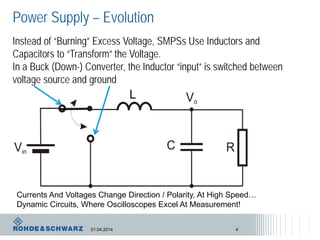
Power Supply – Evolution
Instead of “Burning” Excess Voltage, SMPSs Use Inductors and
Capacitors to “Transform” the Voltage.
In a Buck (Down-) Converter, the Inductor “input” is switched between
voltage source and ground
01.04.2014 4
Currents And Voltages Change Direction / Polarity, At High Speed…
Dynamic Circuits, Where Oscilloscopes Excel At Measurement!
Understanding What to Measure
ı Understanding Power Flow and Topology
 The Basic SMPS - Buck Converter Topology – Current Flow
01.04.2014 5
A diode or transistor may replace
one switch
Understanding What to Measure
ı The Basic SMPS - Buck Converter Topology
 The “Switches” are typically implemented as internal, or external, FET’s, or
IGBT’s in high-power applications.
01.04.2014 6
Shunt resistor
Power Flow and Topology
01.04.2014 7
Vswitch
Iinductor
Vout
Note the slope in
Vswitch
Related to the slope
in inductor current
Proportional to the
internal switch and
current-sense
resistance
Measure V1 and I1 Measure V2 and I2
Use V1 -V2 / I2-I1
To calculate switch resistance
SMPS | 8
Maximizing measurement accuracy
l Large dynamic range required for accurately measuring
switching voltage and current
l On state is tens to hundreds (even thousands) of volts
l Off state is often only several mV to a few volts
l Typical 8-bit A/D provides approximately 39 mV on a 10 V scale
l Three possibilities to improve signal to noise
l Use waveform averaging
l High resolution decimation (trade off sample rate and bandwidth for
S/N)
l Overdrive instrument front end
Resolution enhancement (B = bits)
due to averaging
SMPS | 9
Noise reduction using averaging
1 mV on 10 V
scale (13.3 bits)
50 averages
Zoom of this
segment
SMPS | 10
High Resolution Mode
l Combine consecutive
samples from A/D
converter with
weighting
l Preserves real time
sampling – no smearing
of dynamic signals
l Reduces bandwidth
based on decimated
sampling rate
l Compatible with
segmented memory so
that each cycle can be
analyzed
Combine
samples for
each point
SMPS | 11
High Resolution Decimation Mode
Decimate 10
Gs/s to 1 Gs/s
~ 500 MHz BW
4.6 mV on 10 V
scale (11.1 bits)
SMPS | 12
Combining averaging and high resolution mode
Decimate 10
Gs/s to 1 Gs/s
50 averages
~ 500 MHz BW
500 uV on 10 V
scale (14.3 bits)
SMPS | 13
Slew Rate and Vertical Resolution
N bits
2N levels
Sampling rate = F
Resolution = 1/F
SMPS | 14
Slew Rate and Vertical Resolution
N bits
2N levels
Sampling rate = F
Resolution = 1/F
SMPS | 15
Slew Rate and Vertical Resolution
l Both vertical and horizontal resolution are critical
l High slew rates
l Measuring short, high amplitude peaks that could damage active
components
l 10 V/ns = 1 V per sample @ 10 Gs/s
l 10 V/ns = 5 V sample @ 2 Gs/s
l Compare to digitizer range
l 39 mV @ 8 bits
l 9.7 mV @ 10 bits
l Measurement resolution can be limited by the sampling rate
SMPS | 16
Viewing Multiple Waveforms
SMPS | 17
But the Resolution is Reduced by Half…
Full scale waveform
Half scale waveform
SMPS | 18
Using Multiple Grids
SMPS | 19
Current Measurements
Shunt resistor
SMPS | 20
Current Measurements
Current probe
Shunt resistor
SMPS | 21SMPS | 4
Inductor Current Waveform
Vg = Vin
V = Vout
SMPS | 22SMPS | 4
Inductor Current Waveform
Vg = Vin
V = Vout
SMPS | 23
Analyzing the Inductor Current
Ts = 950 ns
D = 0.35
L = 2.2 µH
Vin – Vout = 3.2V
2*∆I = 3.2*950e-9*0.35
(2.2e-6)
= 484 mA
Predicted current ripple:
20 ohm resistive load (90 mA load current)
SMPS | 24
Analyzing the Inductor Current
Measured current ripple:
2*∆I = 680 mA
Equivalent Inductance:
L = 950e-9*.35*3.2/0.680
= 1.56 uH
5 ohm resistive load (360 mA load current)
SMPS | 25
Using Math Waveforms to Identify Saturation
l Create math waveform = integral(VL/L)
l Ideal current ripple is linear
Measured I(t)
Computed I(t)
Output Voltage Ripple
The Basic SMPS – 1.4 MHz Buck Converter – Vout Ripple Spectrum
01.04.2014 26
Iinductor
Vout
Spikes at multiples of Fswitch
Output Voltage Ripple – No Load
01.04.2014 27
Output Voltage Ripple – Small Load
01.04.2014 28
Output Voltage Ripple – Large Load
01.04.2014 29
EMI – Large Load
01.04.2014 30
Vout
Near field probe
Understanding Power Flow and Topology
The Basic SMPS - Buck Converter – Load Transient – Well-Damped Response, Little Overshoot
01.04.2014 31
ILoad
Vout
Load Transient Response
inductor current linearity and output voltage ripple
01.04.2014 32
Red = Vout
Blue = IL
Load Transient Response
ı 1% to 100% load shift with 5 V input
ı 4 µs recovery time
ı Higher Vin-Vout delivers more current to load
01.04.2014 33
Red = Vout
Blue = IL
Load Transient Response
ı 1% to 100% load transient with 3.3 V input
ı 9 µs recovery
ı Smaller Vin – Vout slows down response
01.04.2014 34
Red = Vout
Blue = IL
SMPS | 35
Summary
l Switched mode power supply voltages are dynamic with very
high voltage swings
l Oscilloscope performance is critical for making accurate
measurements
l Both sampling rate (bandwidth) and resolution are important
l Averaging techniques are used to enhance resolution when required
l Trouble shooting techniques
l Analyzing output ripple voltage and EMI
l Observing inductor current
l Using spectrum analysis

Troubleshooting Switched Mode Power Supplies (Presented at EELive!)

  • 1.
  • 2.
    SMPS | 2 Agenda lSwitched mode power supply background l Measurement points l Voltage and current waveforms l Maximizing measurement accuracy l Averaging, high resolution decimation l Sampling rate l Analyzing common issues l Improper inductor size l EMI l Load transient behavior
  • 3.
    Modern Power Supplies: Inductors,Capacitors and Fast Switches ı Use ‘Lossless’ Components, In ‘Switching’ Operation  Inductors store energy, and can deliver the energy at higher or lower voltage than input  Capacitors store energy between ‘pumping’ operations of inductors ı Replace Linear Series Pass And Shunt Regulators  Linear regulators turn excess voltage into thermal energy  Efficiencies can be very high – as little as 2% to 3% “wasted” energy ı Effectively ‘Variable Transformer’ Operation  Able To Provide Increase/Decrease, Or Both, In Voltage  Able To Operate Over Wide Ranges Of Input Voltage 01.04.2014 3
  • 4.
    Power Supply –Evolution Instead of “Burning” Excess Voltage, SMPSs Use Inductors and Capacitors to “Transform” the Voltage. In a Buck (Down-) Converter, the Inductor “input” is switched between voltage source and ground 01.04.2014 4 Currents And Voltages Change Direction / Polarity, At High Speed… Dynamic Circuits, Where Oscilloscopes Excel At Measurement!
  • 5.
    Understanding What toMeasure ı Understanding Power Flow and Topology  The Basic SMPS - Buck Converter Topology – Current Flow 01.04.2014 5 A diode or transistor may replace one switch
  • 6.
    Understanding What toMeasure ı The Basic SMPS - Buck Converter Topology  The “Switches” are typically implemented as internal, or external, FET’s, or IGBT’s in high-power applications. 01.04.2014 6 Shunt resistor
  • 7.
    Power Flow andTopology 01.04.2014 7 Vswitch Iinductor Vout Note the slope in Vswitch Related to the slope in inductor current Proportional to the internal switch and current-sense resistance Measure V1 and I1 Measure V2 and I2 Use V1 -V2 / I2-I1 To calculate switch resistance
  • 8.
    SMPS | 8 Maximizingmeasurement accuracy l Large dynamic range required for accurately measuring switching voltage and current l On state is tens to hundreds (even thousands) of volts l Off state is often only several mV to a few volts l Typical 8-bit A/D provides approximately 39 mV on a 10 V scale l Three possibilities to improve signal to noise l Use waveform averaging l High resolution decimation (trade off sample rate and bandwidth for S/N) l Overdrive instrument front end Resolution enhancement (B = bits) due to averaging
  • 9.
    SMPS | 9 Noisereduction using averaging 1 mV on 10 V scale (13.3 bits) 50 averages Zoom of this segment
  • 10.
    SMPS | 10 HighResolution Mode l Combine consecutive samples from A/D converter with weighting l Preserves real time sampling – no smearing of dynamic signals l Reduces bandwidth based on decimated sampling rate l Compatible with segmented memory so that each cycle can be analyzed Combine samples for each point
  • 11.
    SMPS | 11 HighResolution Decimation Mode Decimate 10 Gs/s to 1 Gs/s ~ 500 MHz BW 4.6 mV on 10 V scale (11.1 bits)
  • 12.
    SMPS | 12 Combiningaveraging and high resolution mode Decimate 10 Gs/s to 1 Gs/s 50 averages ~ 500 MHz BW 500 uV on 10 V scale (14.3 bits)
  • 13.
    SMPS | 13 SlewRate and Vertical Resolution N bits 2N levels Sampling rate = F Resolution = 1/F
  • 14.
    SMPS | 14 SlewRate and Vertical Resolution N bits 2N levels Sampling rate = F Resolution = 1/F
  • 15.
    SMPS | 15 SlewRate and Vertical Resolution l Both vertical and horizontal resolution are critical l High slew rates l Measuring short, high amplitude peaks that could damage active components l 10 V/ns = 1 V per sample @ 10 Gs/s l 10 V/ns = 5 V sample @ 2 Gs/s l Compare to digitizer range l 39 mV @ 8 bits l 9.7 mV @ 10 bits l Measurement resolution can be limited by the sampling rate
  • 16.
    SMPS | 16 ViewingMultiple Waveforms
  • 17.
    SMPS | 17 Butthe Resolution is Reduced by Half… Full scale waveform Half scale waveform
  • 18.
    SMPS | 18 UsingMultiple Grids
  • 19.
    SMPS | 19 CurrentMeasurements Shunt resistor
  • 20.
    SMPS | 20 CurrentMeasurements Current probe Shunt resistor
  • 21.
    SMPS | 21SMPS| 4 Inductor Current Waveform Vg = Vin V = Vout
  • 22.
    SMPS | 22SMPS| 4 Inductor Current Waveform Vg = Vin V = Vout
  • 23.
    SMPS | 23 Analyzingthe Inductor Current Ts = 950 ns D = 0.35 L = 2.2 µH Vin – Vout = 3.2V 2*∆I = 3.2*950e-9*0.35 (2.2e-6) = 484 mA Predicted current ripple: 20 ohm resistive load (90 mA load current)
  • 24.
    SMPS | 24 Analyzingthe Inductor Current Measured current ripple: 2*∆I = 680 mA Equivalent Inductance: L = 950e-9*.35*3.2/0.680 = 1.56 uH 5 ohm resistive load (360 mA load current)
  • 25.
    SMPS | 25 UsingMath Waveforms to Identify Saturation l Create math waveform = integral(VL/L) l Ideal current ripple is linear Measured I(t) Computed I(t)
  • 26.
    Output Voltage Ripple TheBasic SMPS – 1.4 MHz Buck Converter – Vout Ripple Spectrum 01.04.2014 26 Iinductor Vout Spikes at multiples of Fswitch
  • 27.
    Output Voltage Ripple– No Load 01.04.2014 27
  • 28.
    Output Voltage Ripple– Small Load 01.04.2014 28
  • 29.
    Output Voltage Ripple– Large Load 01.04.2014 29
  • 30.
    EMI – LargeLoad 01.04.2014 30 Vout Near field probe
  • 31.
    Understanding Power Flowand Topology The Basic SMPS - Buck Converter – Load Transient – Well-Damped Response, Little Overshoot 01.04.2014 31 ILoad Vout
  • 32.
    Load Transient Response inductorcurrent linearity and output voltage ripple 01.04.2014 32 Red = Vout Blue = IL
  • 33.
    Load Transient Response ı1% to 100% load shift with 5 V input ı 4 µs recovery time ı Higher Vin-Vout delivers more current to load 01.04.2014 33 Red = Vout Blue = IL
  • 34.
    Load Transient Response ı1% to 100% load transient with 3.3 V input ı 9 µs recovery ı Smaller Vin – Vout slows down response 01.04.2014 34 Red = Vout Blue = IL
  • 35.
    SMPS | 35 Summary lSwitched mode power supply voltages are dynamic with very high voltage swings l Oscilloscope performance is critical for making accurate measurements l Both sampling rate (bandwidth) and resolution are important l Averaging techniques are used to enhance resolution when required l Trouble shooting techniques l Analyzing output ripple voltage and EMI l Observing inductor current l Using spectrum analysis