Introduction 
 What is a PLL? 
 Parts of a PLL. 
 Working of PLL.
What is a PLL? 
 Digital frequency control system 
 Generate high speed oscillations 
 Acquire and track signals 
• Radio Frequency Demodulation 
• DX-ing 
• RF communications
Control system representation
Modeling a PLL
PLL Control System
Parts of a PLL 
 Phase Detector 
 Filter 
 Voltage Controlled Oscillator 
 Programmable Counter
Parts of a PLL 
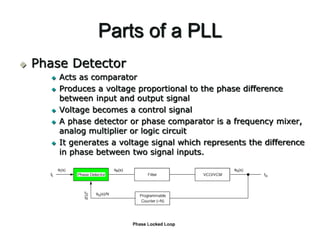
 Phase Detector 
 Acts as comparator 
 Produces a voltage proportional to the phase difference 
between input and output signal 
 Voltage becomes a control signal 
 A phase detector or phase comparator is a frequency mixer, 
analog multiplier or logic circuit 
 It generates a voltage signal which represents the difference 
in phase between two signal inputs.
Parts of a PLL 
 Filter 
 Determines dynamic characteristics of PLL 
 Specify Capture Range (bandwidth) 
 Specify Tracking Range 
 Receives signal from Phase Detector and filters 
accordingly
Parts of a PLL 
 Filter (Cont.) 
 It provides a smoother form of a signal, removing 
the short-term fluctuations, and leaving the 
longer-term trend. 
 PLL loop filter (usually a low pass filter) generally 
has two distinct functions. 
 The primary function is to determine loop 
dynamics, also called stability. This is how the 
loop responds to disturbances, such as changes in 
the reference frequency.
Parts of a PLL 
 Filter (Cont.) 
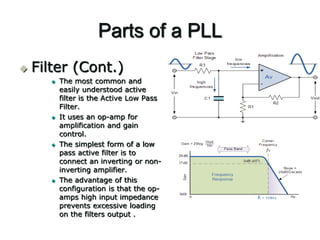
 The most common and 
easily understood active 
filter is the Active Low Pass 
Filter. 
 It uses an op-amp for 
amplification and gain 
control. 
 The simplest form of a low 
pass active filter is to 
connect an inverting or non-inverting 
amplifier. 
 The advantage of this 
configuration is that the op-amps 
high input impedance 
prevents excessive loading 
on the filters output .
Parts of a PLL 
 Voltage Controlled Oscillator 
 Changes a DC input voltage into a pulsed waveform. 
 The output frequency is proportional to the 
magnitude of input control voltage. 
 Its output can be of any waveshape.
Parts of a PLL 
 Voltage Controlled Oscillator (Cont.) 
 The ouput frequency of a VCO is given by: 
fout = fmin + KVCOVin 
where fmin = output frequency when Vin=0 
KVCO = VCO conversion gain, Hz/V 
 In PLL, the VCO output frequency (fo) is fed to one 
input of the phase detector. 
 Phase detector compares it with the frequency of 
input signal (fi) which is at its other input.
Parts of a PLL 
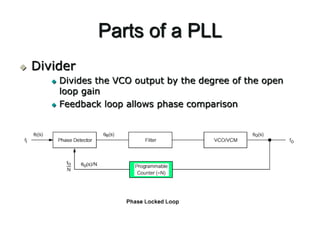
 Divider 
 Divides the VCO output by the degree of the open 
loop gain 
 Feedback loop allows phase comparison
Parts of a PLL 
 Divider (Cont.) 
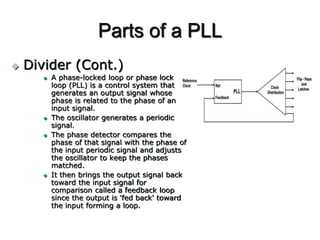
 A phase-locked loop or phase lock 
loop (PLL) is a control system that 
generates an output signal whose 
phase is related to the phase of an 
input signal. 
 The oscillator generates a periodic 
signal. 
 The phase detector compares the 
phase of that signal with the phase of 
the input periodic signal and adjusts 
the oscillator to keep the phases 
matched. 
 It then brings the output signal back 
toward the input signal for 
comparison called a feedback loop 
since the output is 'fed back' toward 
the input forming a loop.

Phase locked loop design

  • 1.
    Introduction  Whatis a PLL?  Parts of a PLL.  Working of PLL.
  • 2.
    What is aPLL?  Digital frequency control system  Generate high speed oscillations  Acquire and track signals • Radio Frequency Demodulation • DX-ing • RF communications
  • 3.
  • 4.
  • 5.
  • 6.
    Parts of aPLL  Phase Detector  Filter  Voltage Controlled Oscillator  Programmable Counter
  • 7.
    Parts of aPLL  Phase Detector  Acts as comparator  Produces a voltage proportional to the phase difference between input and output signal  Voltage becomes a control signal  A phase detector or phase comparator is a frequency mixer, analog multiplier or logic circuit  It generates a voltage signal which represents the difference in phase between two signal inputs.
  • 8.
    Parts of aPLL  Filter  Determines dynamic characteristics of PLL  Specify Capture Range (bandwidth)  Specify Tracking Range  Receives signal from Phase Detector and filters accordingly
  • 9.
    Parts of aPLL  Filter (Cont.)  It provides a smoother form of a signal, removing the short-term fluctuations, and leaving the longer-term trend.  PLL loop filter (usually a low pass filter) generally has two distinct functions.  The primary function is to determine loop dynamics, also called stability. This is how the loop responds to disturbances, such as changes in the reference frequency.
  • 10.
    Parts of aPLL  Filter (Cont.)  The most common and easily understood active filter is the Active Low Pass Filter.  It uses an op-amp for amplification and gain control.  The simplest form of a low pass active filter is to connect an inverting or non-inverting amplifier.  The advantage of this configuration is that the op-amps high input impedance prevents excessive loading on the filters output .
  • 11.
    Parts of aPLL  Voltage Controlled Oscillator  Changes a DC input voltage into a pulsed waveform.  The output frequency is proportional to the magnitude of input control voltage.  Its output can be of any waveshape.
  • 12.
    Parts of aPLL  Voltage Controlled Oscillator (Cont.)  The ouput frequency of a VCO is given by: fout = fmin + KVCOVin where fmin = output frequency when Vin=0 KVCO = VCO conversion gain, Hz/V  In PLL, the VCO output frequency (fo) is fed to one input of the phase detector.  Phase detector compares it with the frequency of input signal (fi) which is at its other input.
  • 13.
    Parts of aPLL  Divider  Divides the VCO output by the degree of the open loop gain  Feedback loop allows phase comparison
  • 14.
    Parts of aPLL  Divider (Cont.)  A phase-locked loop or phase lock loop (PLL) is a control system that generates an output signal whose phase is related to the phase of an input signal.  The oscillator generates a periodic signal.  The phase detector compares the phase of that signal with the phase of the input periodic signal and adjusts the oscillator to keep the phases matched.  It then brings the output signal back toward the input signal for comparison called a feedback loop since the output is 'fed back' toward the input forming a loop.