06/2009 | Fundamentals of DSOs | 1Nov 2010 | Scope Seminar – Signal Fidelity | 1
1
Debugging EMI Using a Digital
Oscilloscope
Dave Rishavy
Product Manager - Oscilloscopes
Debugging EMI Using a Digital Oscilloscope
2
l Background – radiated emissions
l Basics of near field probing
l Frequency domain analysis using an oscilloscope
l FFT computation
l Dynamic range and sensitivity
l Time gating
l Frequency domain triggering
l EMI debugging process
l Measurement example
Background – radiated emissions
Basic Principles: Radiated Emissions
The following conditions must exist
ı An Interference source
 A sufficiently high enough disturbance level
 in a frequency range that is relevant for RF emissions
ı A Coupling mechanism
 transmits disturbance signals from the interference source to the emitting
element
ı An Emitting element (Antenna)
 capable of radiating the energy produced by the source into the far field
4
Basic Principles: Radiated Emissions
The following conditions must exist
ı An Interference source
 A sufficiently high enough disturbance level
 in a frequency range that is relevant for RF emissions
ı A Coupling mechanism
 transmits disturbance signals from the interference source to the emitting
element
ı An Emitting element (Antenna)
 capable of radiating the energy produced by the source into the far field
5
Interference sources
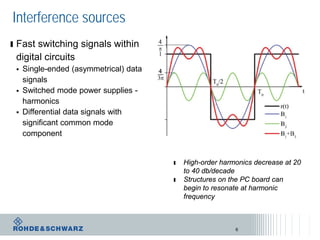
ı Fast switching signals within
digital circuits
 Single-ended (asymmetrical) data
signals
 Switched mode power supplies -
harmonics
 Differential data signals with
significant common mode
component
6
ı High-order harmonics decrease at 20
to 40 db/decade
ı Structures on the PC board can
begin to resonate at harmonic
frequency
Inference Sources:
Differential Mode RF Emissions
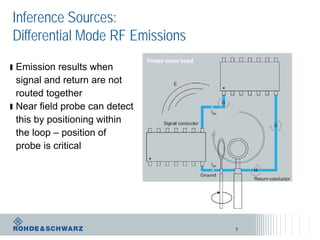
ı Emission results when
signal and return are not
routed together
ı Near field probe can detect
this by positioning within
the loop – position of
probe is critical
7
General steps to help reduce Differential Mode RF
emissions
ı Reduction of the loop area (i.e. closer routing of the forward and
return conductors)
ı Reduction of the current in the conductor loop (if possible without
impacting the circuit operation.)
ı Reduce the rise/fall times for the transmitted data signals
ı Use filtering to eliminate higher-frequency signal components
(limit the disturbance spectrum.)
8
Inference Sources:
Common Mode RF Emissions
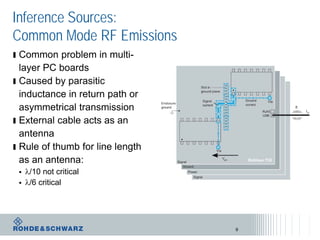
ı Common problem in multi-
layer PC boards
ı Caused by parasitic
inductance in return path or
asymmetrical transmission
ı External cable acts as an
antenna
ı Rule of thumb for line length
as an antenna:
 λ/10 not critical
 λ/6 critical
9
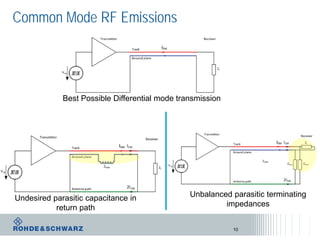
Common Mode RF Emissions
10
Best Possible Differential mode transmission
Undesired parasitic capacitance in
return path
Unbalanced parasitic terminating
impedances
General steps to help reduce common-mode RF
emissions
ı Reduce the RFI current ICM by optimizing the layout, reducing the
ground plane impedances or rearranging components
ı Reduce higher-frequency signal components through filtering or
by reducing the rise and fall times of digital signals
ı Use shielding (lines, enclosures, etc.)
ı Optimize the signal integrity to reduce unwanted overshoots
(ringing)
11
Basic Principles: Radiated Emissions
The following conditions must exist
ı An Interference source
 A sufficiently high enough disturbance level
 in a frequency range that is relevant for RF emissions
ı A Coupling mechanism
 transmits disturbance signals from the interference source to the emitting
element
ı An Emitting element (Antenna)
 capable of radiating the energy produced by the source into the far field
12
Coupling Mechanisms
ı Three coupling paths:
 Direct RF emissions from the source, e.g. from a trace or an individual
component
 RF emissions via connected power supply, data or signal lines
 Conducted emission via connected power supply, data or signal lines
ı Coupling Mechanisms
 Coupling via a common impedance
 Electric field coupling – parasitic capacitance between source and antenna
 Magnetic field coupling – parasitic inductance between source and antenna
 Electromagnetic coupling – far field coupling (greater than 1 wavelength)
13
Basic Principles: Radiated Emissions
The following conditions must exist
ı An Interference source
 A sufficiently high enough disturbance level
 in a frequency range that is relevant for RF emissions
ı A Coupling mechanism
 transmits disturbance signals from the interference source to the emitting
element
ı An Emitting element (Antenna)
 capable of radiating the energy produced by the source into the far field
14
Emitting Elements (Antennas)
ı Unintentional antennas in electronic equipment
 Connected lines (power supply, data/signal/control lines)
 Printed circuit board tracks and planes
 Internal cables between system components
 Components and heat sinks
 Slots and openings in enclosures
ı Main factor is the length of the antenna with respect to the
wavelength of the interference.
Rule of thumb – antennas with length less than λ/10 are not critical
15
Basics of near field probing
17
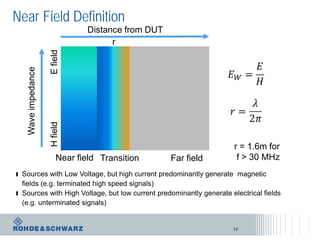
Near Field Definition
ı Sources with Low Voltage, but high current predominantly generate magnetic
fields (e.g. terminated high speed signals)
ı Sources with High Voltage, but low current predominantly generate electrical fields
(e.g. unterminated signals)
Near field Transition Far field
EfieldHfield
Distance from DUT
r
Waveimpedance
r = 1.6m for
f > 30 MHz
18
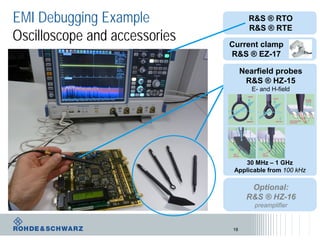
EMI Debugging Example
Oscilloscope and accessories
R&S ® RTO
R&S ® RTE
Nearfield probes
R&S ® HZ-15
E- and H-field
30 MHz – 1 GHz
Applicable from 100 kHz
Optional:
R&S ® HZ-16
preamplifier
Current clamp
R&S ® EZ-17
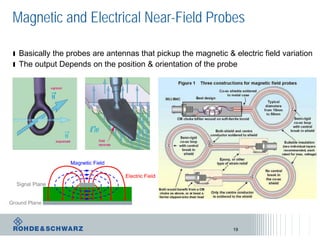
Magnetic and Electrical Near-Field Probes
19
ı Basically the probes are antennas that pickup the magnetic & electric field variation
ı The output Depends on the position & orientation of the probe
20
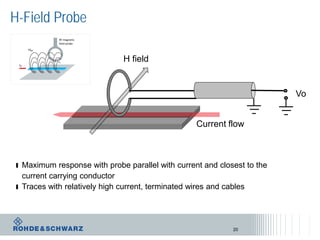
H-Field Probe
ı Maximum response with probe parallel with current and closest to the
current carrying conductor
ı Traces with relatively high current, terminated wires and cables
Current flow
H field
Vo
21
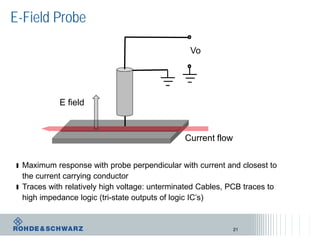
E-Field Probe
ı Maximum response with probe perpendicular with current and closest to
the current carrying conductor
ı Traces with relatively high voltage: unterminated Cables, PCB traces to
high impedance logic (tri-state outputs of logic IC’s)
Current flow
E field
Vo
Frequency domain analysis using an
oscilloscope
Using an Oscilloscope for EMI Debugging
ıBenefits
 Wide instantaneous frequency coverage
 Overlapping FFT computation with color grading
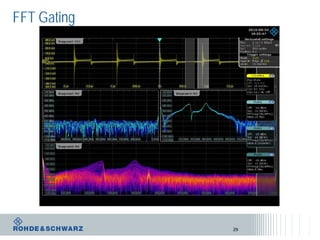
 Gates FFT analysis for correlated time-frequency analysis
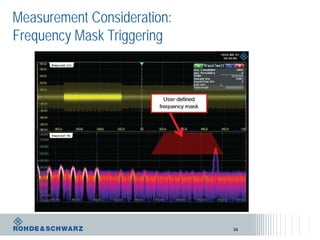
 Frequency masks for triggering on intermittent events
 Deep memory for capture of long signal sequences
ıLimitations
 Dynamic range
 No preselection
 No standard-compliant detectors (i.e CISPR)
23
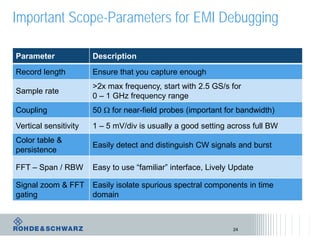
Important Scope-Parameters for EMI Debugging
Parameter Description
Record length Ensure that you capture enough
Sample rate
>2x max frequency, start with 2.5 GS/s for
0 – 1 GHz frequency range
Coupling 50 Ω for near-field probes (important for bandwidth)
Vertical sensitivity 1 – 5 mV/div is usually a good setting across full BW
Color table &
persistence
Easily detect and distinguish CW signals and burst
FFT – Span / RBW Easy to use “familiar” interface, Lively Update
Signal zoom & FFT
gating
Easily isolate spurious spectral components in time
domain
24
25
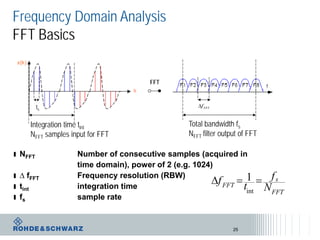
Frequency Domain Analysis
FFT Basics
ı NFFT Number of consecutive samples (acquired in
time domain), power of 2 (e.g. 1024)
ı ∆ fFFT Frequency resolution (RBW)
ı tint integration time
ı fs sample rate
FFT
s
FFT
N
f
t
f ==∆
int
1
Integration time tint
NFFT samples input for FFT
FFT
Total bandwidth fs
NFFT filter output of FFT
FFTf∆ts
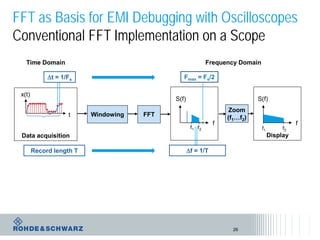
FFT as Basis for EMI Debugging with Oscilloscopes
Conventional FFT Implementation on a Scope
26
t
Time Domain
Record length T
Windowing FFT
Data acquisition
Zoom
(f1…f2)
f
Frequency Domain
∆t = 1/Fs
f
Display
f2f1
Fmax = Fs/2
S(f) S(f)
x(t)
∆f = 1/T
f1 f2
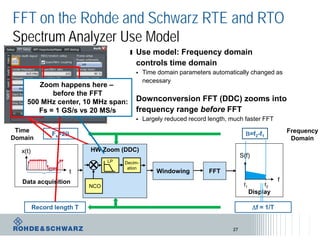
FFT on the Rohde and Schwarz RTE and RTO
Spectrum Analyzer Use Model
ı Use model: Frequency domain
controls time domain
 Time domain parameters automatically changed as
necessary
ı Downconversion FFT (DDC) zooms into
frequency range before FFT
 Largely reduced record length, much faster FFT
Time
Domain
t
Record length T
Data acquisition
Fs=2Β
x(t)
Frequency
Domain
f
Display
f2f1
Β=f2-f1
S(f)
∆f = 1/T
Windowing FFT
27
HW Zoom (DDC)
NCO
Decim-
ation
LP
Zoom happens here –
before the FFT
500 MHz center, 10 MHz span:
Fs = 1 GS/s vs 20 MS/s
Measurement Consideration
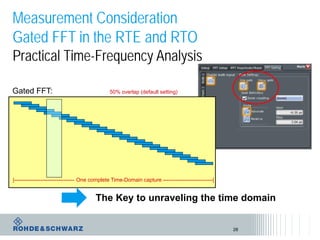
Gated FFT in the RTE and RTO
Practical Time-Frequency Analysis
50% overlap (default setting)Gated FFT:
|---------------------------------- One complete Time-Domain capture ----------------------------|
The Key to unraveling the time domain
28
FFT Gating
29
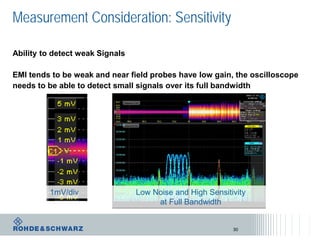
Measurement Consideration: Sensitivity
Ability to detect weak Signals
EMI tends to be weak and near field probes have low gain, the oscilloscope
needs to be able to detect small signals over its full bandwidth
Low Noise and High Sensitivity
at Full Bandwidth
1mV/div
30
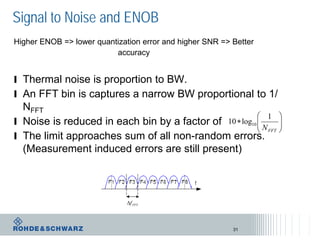
Signal to Noise and ENOB
Higher ENOB => lower quantization error and higher SNR => Better
accuracy
l Thermal noise is proportion to BW.
l An FFT bin is captures a narrow BW proportional to 1/
NFFT
l Noise is reduced in each bin by a factor of
l The limit approaches sum of all non-random errors.
(Measurement induced errors are still present)
FFTf∆






∗
FFTN
1
log10 10
31
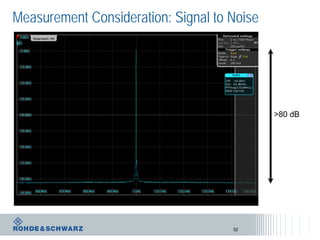
Measurement Consideration: Signal to Noise
>80 dB
32
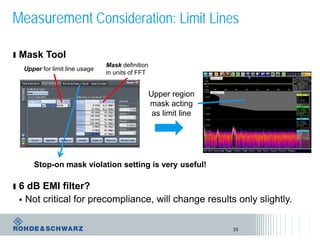
ı Mask Tool
ı 6 dB EMI filter?
 Not critical for precompliance, will change results only slightly.
Measurement Consideration: Limit Lines
33
Upper for limit line usage
Mask definition
in units of FFT
Upper region
mask acting
as limit line
Stop-on mask violation setting is very useful!
Measurement Consideration:
Frequency Mask Triggering
34
EMI debugging process
The Problem: isolating sources of EMI
ı EMI compliance is tested in the RF far field
 Compliance is based on specific allowable power levels as a function of
frequency using a specific antenna, resolution bandwidth and distance from
the DUT
 No localization of specific emitters within the DUT
ı What happens when compliance fails?
 Need to locate where the offending emitter is within the DUT
 Local probing in the near field (close to the DUT) can help physically locate
the problem
 Remediate using shielding or by reducing the EM radiation
ı How do we find the source?
 Frequency domain measurement
 Time/frequency domain measurement
 Localizing in space
36
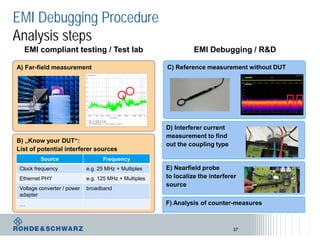
E) Nearfield probe
to localize the interferer
source
D) Interferer current
measurement to find
out the coupling type
B) „Know your DUT“:
List of potential interferer sources
37
A) Far-field measurement C) Reference measurement without DUT
Source Frequency
Clock frequency e.g. 25 MHz + Multiples
Ethernet PHY e.g. 125 MHz + Multiples
Voltage converter / power
adapter
broadband
…
EMI compliant testing / Test lab EMI Debugging / R&D
F) Analysis of counter-measures
EMI Debugging Procedure
Analysis steps
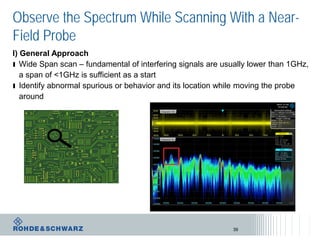
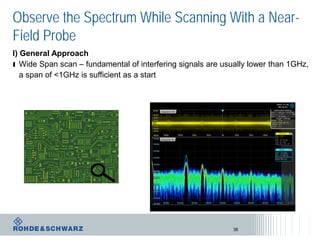
Observe the Spectrum While Scanning With a Near-
Field Probe
38
I) General Approach
ı Wide Span scan – fundamental of interfering signals are usually lower than 1GHz,
a span of <1GHz is sufficient as a start
Observe the Spectrum While Scanning With a Near-
Field Probe
39
I) General Approach
ı Wide Span scan – fundamental of interfering signals are usually lower than 1GHz,
a span of <1GHz is sufficient as a start
ı Identify abnormal spurious or behavior and its location while moving the probe
around
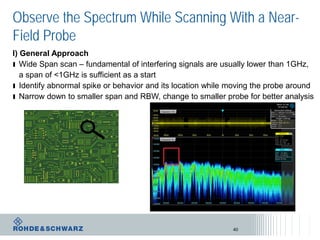
Observe the Spectrum While Scanning With a Near-
Field Probe
40
I) General Approach
ı Wide Span scan – fundamental of interfering signals are usually lower than 1GHz,
a span of <1GHz is sufficient as a start
ı Identify abnormal spike or behavior and its location while moving the probe around
ı Narrow down to smaller span and RBW, change to smaller probe for better analysis
Measurement Example
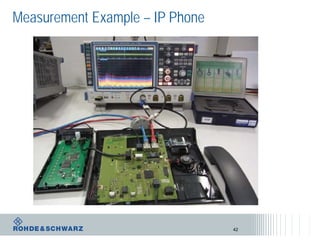
Measurement Example – IP Phone
42
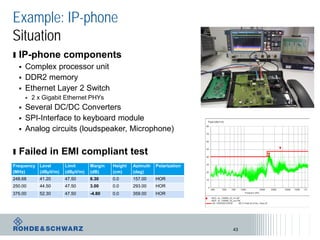
Example: IP-phone
Situation
ı IP-phone components
 Complex processor unit
 DDR2 memory
 Ethernet Layer 2 Switch
 2 x Gigabit Ethernet PHYs
 Several DC/DC Converters
 SPI-Interface to keyboard module
 Analog circuits (loudspeaker, Microphone)
ı Failed in EMI compliant test
43
Frequency
(MHz)
Level
(dBµV/m)
Limit
(dBµV/m)
Margin
(dB)
Height
(cm)
Azimuth
(deg)
Polarization
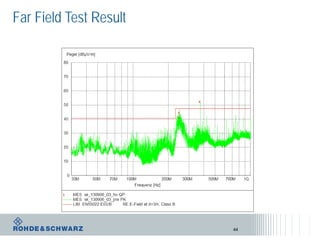
248.68 41.20 47.50 6.30 0.0 157.00 HOR
250.00 44.50 47.50 3.00 0.0 293.00 HOR
375.00 52.30 47.50 -4.80 0.0 359.00 HOR
Far Field Test Result
44
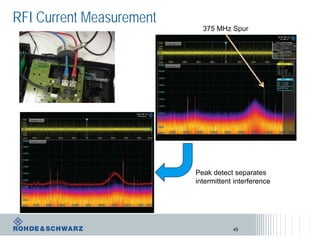
RFI Current Measurement
375 MHz Spur
Peak detect separates
intermittent interference
45
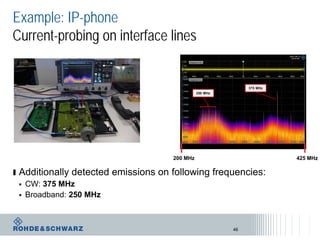
ı Additionally detected emissions on following frequencies:
 CW: 375 MHz
 Broadband: 250 MHz
46
200 MHz 425 MHz
250 MHz
375 MHz
Example: IP-phone
Current-probing on interface lines
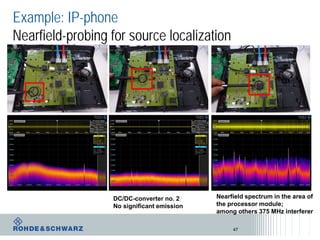
Example: IP-phone
Nearfield-probing for source localization
Lokalisierung
47
DC/DC-converter no. 2
No significant emission
Nearfield spectrum in the area of
the processor module;
among others 375 MHz interferer
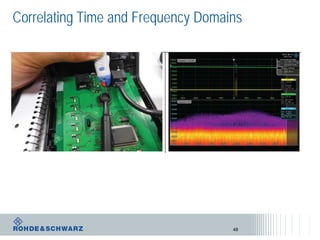
Correlating Time and Frequency Domains
48
Example: IP-phone
Results
ı Interferer signal detected on interface lines
 The interferer is probably transferred via common-mode coupling
ı Interferer sources localized
 DC/DC converter no. 1
 Processor module respectively LAN PHY interfaces
ı Analysis of layout and implementation of counter measures.
49
Debugging EMI Using a Digital Oscilloscope
Summary
ı If we can measure something in the far field, it must have an electric and
magnetic near field source.
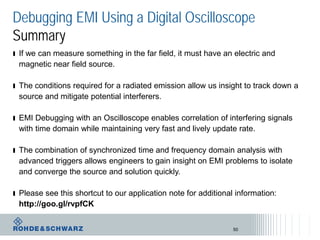
ı The conditions required for a radiated emission allow us insight to track down a
source and mitigate potential interferers.
ı EMI Debugging with an Oscilloscope enables correlation of interfering signals
with time domain while maintaining very fast and lively update rate.
ı The combination of synchronized time and frequency domain analysis with
advanced triggers allows engineers to gain insight on EMI problems to isolate
and converge the source and solution quickly.
ı Please see this shortcut to our application note for additional information:
http://goo.gl/rvpfCK
50

Updated! Debugging EMI Problems Using a Digital Oscilloscope

  • 1.
    06/2009 | Fundamentalsof DSOs | 1Nov 2010 | Scope Seminar – Signal Fidelity | 1 1 Debugging EMI Using a Digital Oscilloscope Dave Rishavy Product Manager - Oscilloscopes
  • 2.
    Debugging EMI Usinga Digital Oscilloscope 2 l Background – radiated emissions l Basics of near field probing l Frequency domain analysis using an oscilloscope l FFT computation l Dynamic range and sensitivity l Time gating l Frequency domain triggering l EMI debugging process l Measurement example
  • 3.
  • 4.
    Basic Principles: RadiatedEmissions The following conditions must exist ı An Interference source  A sufficiently high enough disturbance level  in a frequency range that is relevant for RF emissions ı A Coupling mechanism  transmits disturbance signals from the interference source to the emitting element ı An Emitting element (Antenna)  capable of radiating the energy produced by the source into the far field 4
  • 5.
    Basic Principles: RadiatedEmissions The following conditions must exist ı An Interference source  A sufficiently high enough disturbance level  in a frequency range that is relevant for RF emissions ı A Coupling mechanism  transmits disturbance signals from the interference source to the emitting element ı An Emitting element (Antenna)  capable of radiating the energy produced by the source into the far field 5
  • 6.
    Interference sources ı Fastswitching signals within digital circuits  Single-ended (asymmetrical) data signals  Switched mode power supplies - harmonics  Differential data signals with significant common mode component 6 ı High-order harmonics decrease at 20 to 40 db/decade ı Structures on the PC board can begin to resonate at harmonic frequency
  • 7.
    Inference Sources: Differential ModeRF Emissions ı Emission results when signal and return are not routed together ı Near field probe can detect this by positioning within the loop – position of probe is critical 7
  • 8.
    General steps tohelp reduce Differential Mode RF emissions ı Reduction of the loop area (i.e. closer routing of the forward and return conductors) ı Reduction of the current in the conductor loop (if possible without impacting the circuit operation.) ı Reduce the rise/fall times for the transmitted data signals ı Use filtering to eliminate higher-frequency signal components (limit the disturbance spectrum.) 8
  • 9.
    Inference Sources: Common ModeRF Emissions ı Common problem in multi- layer PC boards ı Caused by parasitic inductance in return path or asymmetrical transmission ı External cable acts as an antenna ı Rule of thumb for line length as an antenna:  λ/10 not critical  λ/6 critical 9
  • 10.
    Common Mode RFEmissions 10 Best Possible Differential mode transmission Undesired parasitic capacitance in return path Unbalanced parasitic terminating impedances
  • 11.
    General steps tohelp reduce common-mode RF emissions ı Reduce the RFI current ICM by optimizing the layout, reducing the ground plane impedances or rearranging components ı Reduce higher-frequency signal components through filtering or by reducing the rise and fall times of digital signals ı Use shielding (lines, enclosures, etc.) ı Optimize the signal integrity to reduce unwanted overshoots (ringing) 11
  • 12.
    Basic Principles: RadiatedEmissions The following conditions must exist ı An Interference source  A sufficiently high enough disturbance level  in a frequency range that is relevant for RF emissions ı A Coupling mechanism  transmits disturbance signals from the interference source to the emitting element ı An Emitting element (Antenna)  capable of radiating the energy produced by the source into the far field 12
  • 13.
    Coupling Mechanisms ı Threecoupling paths:  Direct RF emissions from the source, e.g. from a trace or an individual component  RF emissions via connected power supply, data or signal lines  Conducted emission via connected power supply, data or signal lines ı Coupling Mechanisms  Coupling via a common impedance  Electric field coupling – parasitic capacitance between source and antenna  Magnetic field coupling – parasitic inductance between source and antenna  Electromagnetic coupling – far field coupling (greater than 1 wavelength) 13
  • 14.
    Basic Principles: RadiatedEmissions The following conditions must exist ı An Interference source  A sufficiently high enough disturbance level  in a frequency range that is relevant for RF emissions ı A Coupling mechanism  transmits disturbance signals from the interference source to the emitting element ı An Emitting element (Antenna)  capable of radiating the energy produced by the source into the far field 14
  • 15.
    Emitting Elements (Antennas) ıUnintentional antennas in electronic equipment  Connected lines (power supply, data/signal/control lines)  Printed circuit board tracks and planes  Internal cables between system components  Components and heat sinks  Slots and openings in enclosures ı Main factor is the length of the antenna with respect to the wavelength of the interference. Rule of thumb – antennas with length less than λ/10 are not critical 15
  • 16.
    Basics of nearfield probing
  • 17.
    17 Near Field Definition ıSources with Low Voltage, but high current predominantly generate magnetic fields (e.g. terminated high speed signals) ı Sources with High Voltage, but low current predominantly generate electrical fields (e.g. unterminated signals) Near field Transition Far field EfieldHfield Distance from DUT r Waveimpedance r = 1.6m for f > 30 MHz
  • 18.
    18 EMI Debugging Example Oscilloscopeand accessories R&S ® RTO R&S ® RTE Nearfield probes R&S ® HZ-15 E- and H-field 30 MHz – 1 GHz Applicable from 100 kHz Optional: R&S ® HZ-16 preamplifier Current clamp R&S ® EZ-17
  • 19.
    Magnetic and ElectricalNear-Field Probes 19 ı Basically the probes are antennas that pickup the magnetic & electric field variation ı The output Depends on the position & orientation of the probe
  • 20.
    20 H-Field Probe ı Maximumresponse with probe parallel with current and closest to the current carrying conductor ı Traces with relatively high current, terminated wires and cables Current flow H field Vo
  • 21.
    21 E-Field Probe ı Maximumresponse with probe perpendicular with current and closest to the current carrying conductor ı Traces with relatively high voltage: unterminated Cables, PCB traces to high impedance logic (tri-state outputs of logic IC’s) Current flow E field Vo
  • 22.
    Frequency domain analysisusing an oscilloscope
  • 23.
    Using an Oscilloscopefor EMI Debugging ıBenefits  Wide instantaneous frequency coverage  Overlapping FFT computation with color grading  Gates FFT analysis for correlated time-frequency analysis  Frequency masks for triggering on intermittent events  Deep memory for capture of long signal sequences ıLimitations  Dynamic range  No preselection  No standard-compliant detectors (i.e CISPR) 23
  • 24.
    Important Scope-Parameters forEMI Debugging Parameter Description Record length Ensure that you capture enough Sample rate >2x max frequency, start with 2.5 GS/s for 0 – 1 GHz frequency range Coupling 50 Ω for near-field probes (important for bandwidth) Vertical sensitivity 1 – 5 mV/div is usually a good setting across full BW Color table & persistence Easily detect and distinguish CW signals and burst FFT – Span / RBW Easy to use “familiar” interface, Lively Update Signal zoom & FFT gating Easily isolate spurious spectral components in time domain 24
  • 25.
    25 Frequency Domain Analysis FFTBasics ı NFFT Number of consecutive samples (acquired in time domain), power of 2 (e.g. 1024) ı ∆ fFFT Frequency resolution (RBW) ı tint integration time ı fs sample rate FFT s FFT N f t f ==∆ int 1 Integration time tint NFFT samples input for FFT FFT Total bandwidth fs NFFT filter output of FFT FFTf∆ts
  • 26.
    FFT as Basisfor EMI Debugging with Oscilloscopes Conventional FFT Implementation on a Scope 26 t Time Domain Record length T Windowing FFT Data acquisition Zoom (f1…f2) f Frequency Domain ∆t = 1/Fs f Display f2f1 Fmax = Fs/2 S(f) S(f) x(t) ∆f = 1/T f1 f2
  • 27.
    FFT on theRohde and Schwarz RTE and RTO Spectrum Analyzer Use Model ı Use model: Frequency domain controls time domain  Time domain parameters automatically changed as necessary ı Downconversion FFT (DDC) zooms into frequency range before FFT  Largely reduced record length, much faster FFT Time Domain t Record length T Data acquisition Fs=2Β x(t) Frequency Domain f Display f2f1 Β=f2-f1 S(f) ∆f = 1/T Windowing FFT 27 HW Zoom (DDC) NCO Decim- ation LP Zoom happens here – before the FFT 500 MHz center, 10 MHz span: Fs = 1 GS/s vs 20 MS/s
  • 28.
    Measurement Consideration Gated FFTin the RTE and RTO Practical Time-Frequency Analysis 50% overlap (default setting)Gated FFT: |---------------------------------- One complete Time-Domain capture ----------------------------| The Key to unraveling the time domain 28
  • 29.
  • 30.
    Measurement Consideration: Sensitivity Abilityto detect weak Signals EMI tends to be weak and near field probes have low gain, the oscilloscope needs to be able to detect small signals over its full bandwidth Low Noise and High Sensitivity at Full Bandwidth 1mV/div 30
  • 31.
    Signal to Noiseand ENOB Higher ENOB => lower quantization error and higher SNR => Better accuracy l Thermal noise is proportion to BW. l An FFT bin is captures a narrow BW proportional to 1/ NFFT l Noise is reduced in each bin by a factor of l The limit approaches sum of all non-random errors. (Measurement induced errors are still present) FFTf∆       ∗ FFTN 1 log10 10 31
  • 32.
  • 33.
    ı Mask Tool ı6 dB EMI filter?  Not critical for precompliance, will change results only slightly. Measurement Consideration: Limit Lines 33 Upper for limit line usage Mask definition in units of FFT Upper region mask acting as limit line Stop-on mask violation setting is very useful!
  • 34.
  • 35.
  • 36.
    The Problem: isolatingsources of EMI ı EMI compliance is tested in the RF far field  Compliance is based on specific allowable power levels as a function of frequency using a specific antenna, resolution bandwidth and distance from the DUT  No localization of specific emitters within the DUT ı What happens when compliance fails?  Need to locate where the offending emitter is within the DUT  Local probing in the near field (close to the DUT) can help physically locate the problem  Remediate using shielding or by reducing the EM radiation ı How do we find the source?  Frequency domain measurement  Time/frequency domain measurement  Localizing in space 36
  • 37.
    E) Nearfield probe tolocalize the interferer source D) Interferer current measurement to find out the coupling type B) „Know your DUT“: List of potential interferer sources 37 A) Far-field measurement C) Reference measurement without DUT Source Frequency Clock frequency e.g. 25 MHz + Multiples Ethernet PHY e.g. 125 MHz + Multiples Voltage converter / power adapter broadband … EMI compliant testing / Test lab EMI Debugging / R&D F) Analysis of counter-measures EMI Debugging Procedure Analysis steps
  • 38.
    Observe the SpectrumWhile Scanning With a Near- Field Probe 38 I) General Approach ı Wide Span scan – fundamental of interfering signals are usually lower than 1GHz, a span of <1GHz is sufficient as a start
  • 39.
    Observe the SpectrumWhile Scanning With a Near- Field Probe 39 I) General Approach ı Wide Span scan – fundamental of interfering signals are usually lower than 1GHz, a span of <1GHz is sufficient as a start ı Identify abnormal spurious or behavior and its location while moving the probe around
  • 40.
    Observe the SpectrumWhile Scanning With a Near- Field Probe 40 I) General Approach ı Wide Span scan – fundamental of interfering signals are usually lower than 1GHz, a span of <1GHz is sufficient as a start ı Identify abnormal spike or behavior and its location while moving the probe around ı Narrow down to smaller span and RBW, change to smaller probe for better analysis
  • 41.
  • 42.
  • 43.
    Example: IP-phone Situation ı IP-phonecomponents  Complex processor unit  DDR2 memory  Ethernet Layer 2 Switch  2 x Gigabit Ethernet PHYs  Several DC/DC Converters  SPI-Interface to keyboard module  Analog circuits (loudspeaker, Microphone) ı Failed in EMI compliant test 43 Frequency (MHz) Level (dBµV/m) Limit (dBµV/m) Margin (dB) Height (cm) Azimuth (deg) Polarization 248.68 41.20 47.50 6.30 0.0 157.00 HOR 250.00 44.50 47.50 3.00 0.0 293.00 HOR 375.00 52.30 47.50 -4.80 0.0 359.00 HOR
  • 44.
    Far Field TestResult 44
  • 45.
    RFI Current Measurement 375MHz Spur Peak detect separates intermittent interference 45
  • 46.
    ı Additionally detectedemissions on following frequencies:  CW: 375 MHz  Broadband: 250 MHz 46 200 MHz 425 MHz 250 MHz 375 MHz Example: IP-phone Current-probing on interface lines
  • 47.
    Example: IP-phone Nearfield-probing forsource localization Lokalisierung 47 DC/DC-converter no. 2 No significant emission Nearfield spectrum in the area of the processor module; among others 375 MHz interferer
  • 48.
    Correlating Time andFrequency Domains 48
  • 49.
    Example: IP-phone Results ı Interferersignal detected on interface lines  The interferer is probably transferred via common-mode coupling ı Interferer sources localized  DC/DC converter no. 1  Processor module respectively LAN PHY interfaces ı Analysis of layout and implementation of counter measures. 49
  • 50.
    Debugging EMI Usinga Digital Oscilloscope Summary ı If we can measure something in the far field, it must have an electric and magnetic near field source. ı The conditions required for a radiated emission allow us insight to track down a source and mitigate potential interferers. ı EMI Debugging with an Oscilloscope enables correlation of interfering signals with time domain while maintaining very fast and lively update rate. ı The combination of synchronized time and frequency domain analysis with advanced triggers allows engineers to gain insight on EMI problems to isolate and converge the source and solution quickly. ı Please see this shortcut to our application note for additional information: http://goo.gl/rvpfCK 50