USB 2.0 Compliance Testing
Agenda
l Overview of USB 2.0 physical layer compliance
  l Compliance test points
  l Fixtures and probing
  l Eye pattern measurement
l USB 2.0 electircal compliance tests
  l Signal quality
  l Packet parameters
  l Chirp timing
  l J/K SE0 NAK
  l Receiver sensitivity
l Measurement example


                   2
USB 2.0 Compliance Testing
 Purpose

 Ensure that USB entities (hub, host and device) reliably communicate

 Originally performed during "plugfests"
 Electrical measurements included in USB 1.0 and expanded in version
 2.0 of the specification

 Electrical tests measure the signal quality, speed negotiation and timing
 of the interface signals


                      3
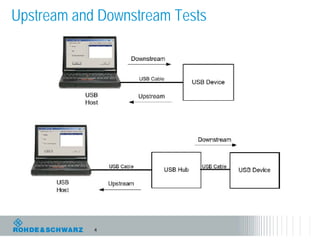
Upstream and Downstream Tests


            4
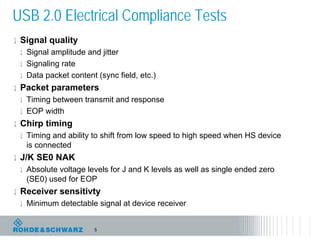
USB 2.0 Electrical Compliance Tests
l Signal quality
  l Signal amplitude and jitter
  l Signaling rate
  l Data packet content (sync field, etc.)
l Packet parameters
  l Timing between transmit and response
  l EOP width
l Chirp timing
  l Timing and ability to shift from low speed to high speed when HS device
    is connected
l J/K SE0 NAK
  l Absolute voltage levels for J and K levels as well as single ended zero
    (SE0) used for EOP
l Receiver sensitivty
  l Minimum detectable signal at device receiver


                       5
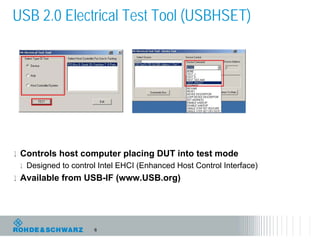
USB 2.0 Electrical Test Tool (USBHSET)


l Controls host computer placing DUT into test mode
  l Designed to control Intel EHCI (Enhanced Host Control Interface)
l Available from USB-IF (www.USB.org)


                      6
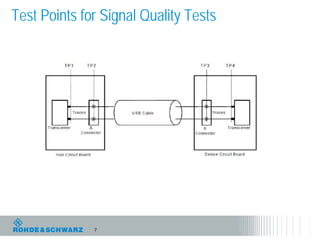
Test Points for Signal Quality Tests


              7
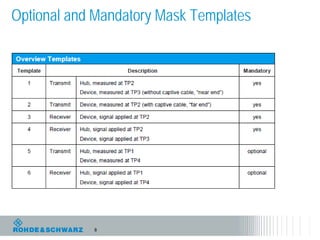
Optional and Mandatory Mask Templates


            8
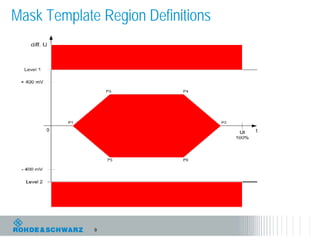
Mask Template Region Definitions


             9
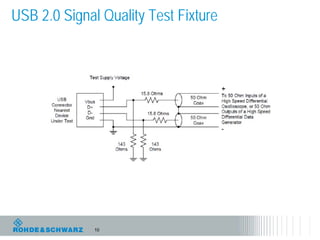
USB 2.0 Signal Quality Test Fixture


              10
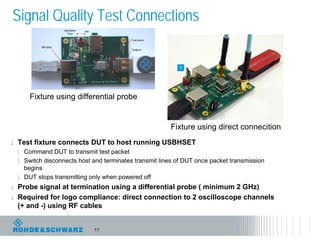
Signal Quality Test Connections


      Fixture using differential probe


                                                        Fixture using direct connecition
l Test fixture connects DUT to host running USBHSET
  l Command DUT to transmit test packet
  l Switch disconnects host and terminates transmit lines of DUT once packet transmission
    begins
  l DUT stops transmitting only when powered off
l Probe signal at termination using a differential probe ( minimum 2 GHz)
l Required for logo compliance: direct connection to 2 oscilloscope channels
  (+ and -) using RF cables


                             11
Considerations for fixture/probes

l Impedance matching is critical
  l Must be 90Ω differential impedance over the operating frequency range
  l Probe loading is also an important factor (loading increases with
    frequency)
  l Loading at 240 MHz is important for accurate amplitude measurement
l Frequency response of the measurement system
  l Fixture + probe + oscilloscope
  l High frequency loading and roll-off increases overshoot
  l Low frequency flatness impacts signal amplitude


                      12
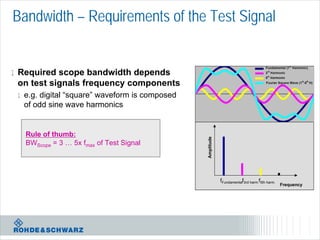
Bandwidth – Requirements of the Test Signal


l Required scope bandwidth depends
 on test signals frequency components
 l e.g. digital “square” waveform is composed
  of odd sine wave harmonics


   Rule of thumb:


                                                Amplitude
   BWScope = 3 … 5x fmax of Test Signal


                                                            fFundamentalf3rd harm.f5th harm.
                                                                                               Frequency
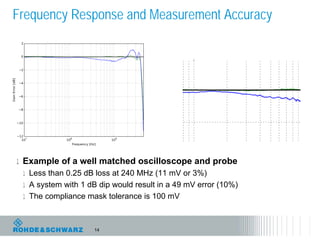
Frequency Response and Measurement Accuracy


l Example of a well matched oscilloscope and probe
  l Less than 0.25 dB loss at 240 MHz (11 mV or 3%)
  l A system with 1 dB dip would result in a 49 mV error (10%)
  l The compliance mask tolerance is 100 mV


                     14
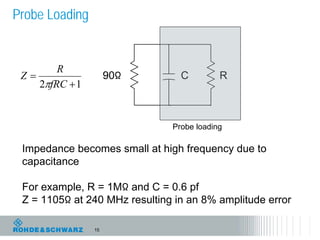
Probe Loading


        R
 Z                  90Ω         C         R
    2fRC  1


                               Probe loading

 Impedance becomes small at high frequency due to
 capacitance

 For example, R = 1MΩ and C = 0.6 pf
 Z = 1105Ω at 240 MHz resulting in an 8% amplitude error

                15
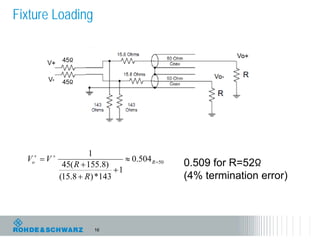
Fixture Loading


               45Ω


               45Ω


                       1
  Vo  V                         0.504 R 50
               45( R  155.8)                     0.509 for R=52Ω
                               1
              (15.8  R ) *143                    (4% termination error)


                         16
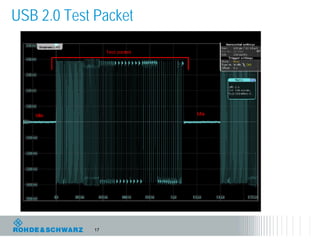
USB 2.0 Test Packet


            17
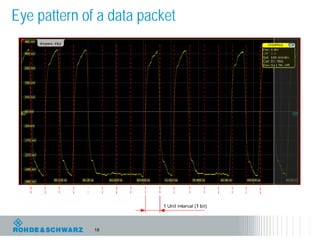
Eye pattern of a data packet


              18
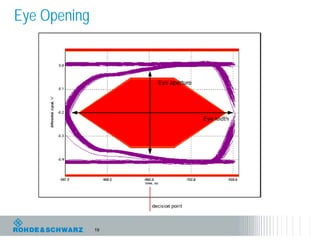
Eye Opening


              19
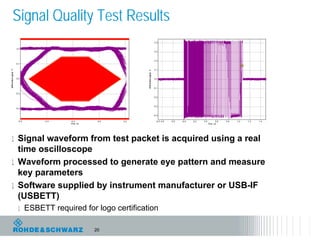
Signal Quality Test Results


l Signal waveform from test packet is acquired using a real
  time oscilloscope
l Waveform processed to generate eye pattern and measure
  key parameters
l Software supplied by instrument manufacturer or USB-IF
  (USBETT)
 l ESBETT required for logo certification

                      20
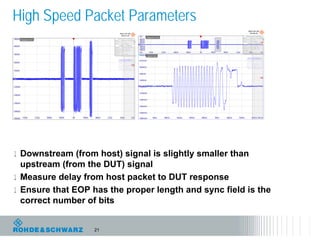
High Speed Packet Parameters


l Downstream (from host) signal is slightly smaller than
  upstream (from the DUT) signal
l Measure delay from host packet to DUT response
l Ensure that EOP has the proper length and sync field is the
  correct number of bits


                   21
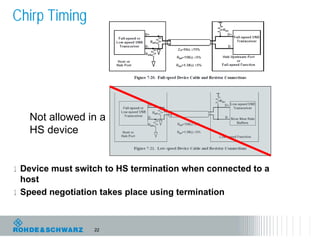
Chirp Timing


   Not allowed in a
   HS device


l Device must switch to HS termination when connected to a
  host
l Speed negotiation takes place using termination


                  22
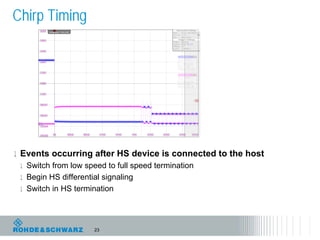
Chirp Timing


l Events occurring after HS device is connected to the host
  l Switch from low speed to full speed termination
  l Begin HS differential signaling
  l Switch in HS termination


                  23
Device J/K SE0 NAK
l J level ( 400 mV on + line 0 mV on – line)
l K level (400 mV on – line and 0 mV on + line)
l SE0 (single ended zero) both lines at 0 mV
  l Used to acknowledge receipt of packet from host
l Measured using DMM or equivalent
  l Cannot be accurately measured with a scope due to accuracy
    requirement


                       24
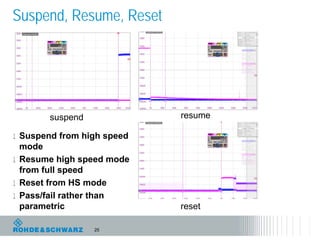
Suspend, Resume, Reset


       suspend              resume

l Suspend from high speed
  mode
l Resume high speed mode
  from full speed
l Reset from HS mode
l Pass/fail rather than
  parametric                reset

                 25
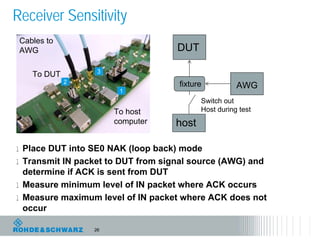
Receiver Sensitivity
 Cables to
 AWG                                DUT

    To DUT
                                    fixture           AWG
                                           Switch out
                      To host              Host during test
                      computer      host

l Place DUT into SE0 NAK (loop back) mode
l Transmit IN packet to DUT from signal source (AWG) and
  determine if ACK is sent from DUT
l Measure minimum level of IN packet where ACK occurs
l Measure maximum level of IN packet where ACK does not
  occur

                 26
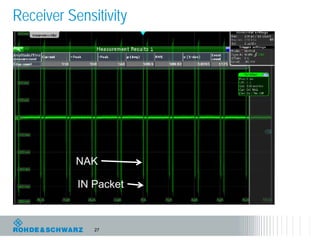
Receiver Sensitivity


           NAK

           IN Packet


              27
Conclusion
l USB 2.0 requires both electrical and interoperability tests for
  compliance
l Electrical testing requires signal integrity along with timing
  measurements and is performed using a digital oscilloscope
 l Specialized fixtures required to connect to and properly terminate the
   signal
 l Active differential probes can be used but direct connection is required
   for full compliance
 l USBHSET software is required to place the DUT into test modes
l Automation software is available to simplify the measurement
 process, step through the test sequence and report test
 results


                       28
For more information
l Visit http://rohde-schwarz-scopes.com
l Call (888) 837-8772 to speak to a local Rohde & Schwarz
 expert


                    29

USB 2.0 Compliance Testing

  • 1.
  • 2.
    Agenda l Overview ofUSB 2.0 physical layer compliance l Compliance test points l Fixtures and probing l Eye pattern measurement l USB 2.0 electircal compliance tests l Signal quality l Packet parameters l Chirp timing l J/K SE0 NAK l Receiver sensitivity l Measurement example 2
  • 3.
    USB 2.0 ComplianceTesting Purpose Ensure that USB entities (hub, host and device) reliably communicate Originally performed during "plugfests" Electrical measurements included in USB 1.0 and expanded in version 2.0 of the specification Electrical tests measure the signal quality, speed negotiation and timing of the interface signals 3
  • 4.
  • 5.
    USB 2.0 ElectricalCompliance Tests l Signal quality l Signal amplitude and jitter l Signaling rate l Data packet content (sync field, etc.) l Packet parameters l Timing between transmit and response l EOP width l Chirp timing l Timing and ability to shift from low speed to high speed when HS device is connected l J/K SE0 NAK l Absolute voltage levels for J and K levels as well as single ended zero (SE0) used for EOP l Receiver sensitivty l Minimum detectable signal at device receiver 5
  • 6.
    USB 2.0 ElectricalTest Tool (USBHSET) l Controls host computer placing DUT into test mode l Designed to control Intel EHCI (Enhanced Host Control Interface) l Available from USB-IF (www.USB.org) 6
  • 7.
    Test Points forSignal Quality Tests 7
  • 8.
    Optional and MandatoryMask Templates 8
  • 9.
    Mask Template RegionDefinitions 9
  • 10.
    USB 2.0 SignalQuality Test Fixture 10
  • 11.
    Signal Quality TestConnections Fixture using differential probe Fixture using direct connecition l Test fixture connects DUT to host running USBHSET l Command DUT to transmit test packet l Switch disconnects host and terminates transmit lines of DUT once packet transmission begins l DUT stops transmitting only when powered off l Probe signal at termination using a differential probe ( minimum 2 GHz) l Required for logo compliance: direct connection to 2 oscilloscope channels (+ and -) using RF cables 11
  • 12.
    Considerations for fixture/probes lImpedance matching is critical l Must be 90Ω differential impedance over the operating frequency range l Probe loading is also an important factor (loading increases with frequency) l Loading at 240 MHz is important for accurate amplitude measurement l Frequency response of the measurement system l Fixture + probe + oscilloscope l High frequency loading and roll-off increases overshoot l Low frequency flatness impacts signal amplitude 12
  • 13.
    Bandwidth – Requirementsof the Test Signal l Required scope bandwidth depends on test signals frequency components l e.g. digital “square” waveform is composed of odd sine wave harmonics Rule of thumb: Amplitude BWScope = 3 … 5x fmax of Test Signal fFundamentalf3rd harm.f5th harm. Frequency
  • 14.
    Frequency Response andMeasurement Accuracy l Example of a well matched oscilloscope and probe l Less than 0.25 dB loss at 240 MHz (11 mV or 3%) l A system with 1 dB dip would result in a 49 mV error (10%) l The compliance mask tolerance is 100 mV 14
  • 15.
    Probe Loading R Z 90Ω C R 2fRC  1 Probe loading Impedance becomes small at high frequency due to capacitance For example, R = 1MΩ and C = 0.6 pf Z = 1105Ω at 240 MHz resulting in an 8% amplitude error 15
  • 16.
    Fixture Loading 45Ω 45Ω 1 Vo  V   0.504 R 50 45( R  155.8) 0.509 for R=52Ω 1 (15.8  R ) *143 (4% termination error) 16
  • 17.
    USB 2.0 TestPacket 17
  • 18.
    Eye pattern ofa data packet 18
  • 19.
  • 20.
    Signal Quality TestResults l Signal waveform from test packet is acquired using a real time oscilloscope l Waveform processed to generate eye pattern and measure key parameters l Software supplied by instrument manufacturer or USB-IF (USBETT) l ESBETT required for logo certification 20
  • 21.
    High Speed PacketParameters l Downstream (from host) signal is slightly smaller than upstream (from the DUT) signal l Measure delay from host packet to DUT response l Ensure that EOP has the proper length and sync field is the correct number of bits 21
  • 22.
    Chirp Timing Not allowed in a HS device l Device must switch to HS termination when connected to a host l Speed negotiation takes place using termination 22
  • 23.
    Chirp Timing l Eventsoccurring after HS device is connected to the host l Switch from low speed to full speed termination l Begin HS differential signaling l Switch in HS termination 23
  • 24.
    Device J/K SE0NAK l J level ( 400 mV on + line 0 mV on – line) l K level (400 mV on – line and 0 mV on + line) l SE0 (single ended zero) both lines at 0 mV l Used to acknowledge receipt of packet from host l Measured using DMM or equivalent l Cannot be accurately measured with a scope due to accuracy requirement 24
  • 25.
    Suspend, Resume, Reset suspend resume l Suspend from high speed mode l Resume high speed mode from full speed l Reset from HS mode l Pass/fail rather than parametric reset 25
  • 26.
    Receiver Sensitivity Cablesto AWG DUT To DUT fixture AWG Switch out To host Host during test computer host l Place DUT into SE0 NAK (loop back) mode l Transmit IN packet to DUT from signal source (AWG) and determine if ACK is sent from DUT l Measure minimum level of IN packet where ACK occurs l Measure maximum level of IN packet where ACK does not occur 26
  • 27.
    Receiver Sensitivity NAK IN Packet 27
  • 28.
    Conclusion l USB 2.0requires both electrical and interoperability tests for compliance l Electrical testing requires signal integrity along with timing measurements and is performed using a digital oscilloscope l Specialized fixtures required to connect to and properly terminate the signal l Active differential probes can be used but direct connection is required for full compliance l USBHSET software is required to place the DUT into test modes l Automation software is available to simplify the measurement process, step through the test sequence and report test results 28
  • 29.
    For more information lVisit http://rohde-schwarz-scopes.com l Call (888) 837-8772 to speak to a local Rohde & Schwarz expert 29