UNIT IV
PART II
PHASE LOCKED LOOPS(PLL)
CH HARI PRASAD
ASST. PROFESSSOR
BAPATLA ENGINEERING COLLEGE
BAPATLA
INTRODUCTION:
• The concept of Phase Locked Loops (PLL) first emerged in the early 1930’s.But the
technology was not developed as it now, the cost factor for developing this technology was
very high. Since the advancement in the field of integrated circuits, PLL has become one of
the main building blocks in the electronics technology. In present, the PLL is available as a
single IC in the SE/NE560 series (560, 561, 562, 564, 565 and 567) to further reduce the
buying cost ,the discrete IC’s are used to construct a PLL.
• A phase-locked loop (PLL) is an electronic circuit with a voltage- or current-driven oscillator
that is constantly adjusted to match in phase (and thus lock on) the frequency of an input
signal.
• In addition to stabilizing a particular communications channel (keeping it set to a particular
frequency), a PLL can be used to generate a signal, modulate or demodulate a signal,
reconstitute a signal with less noise, or multiply or divide a frequency.
• PLLs are frequently used in wireless communication, particularly where signals are carried
using frequency modulation (FM) or phase modulation (PM). PLLs can also be used in
amplitude modulation (AM). PLLs are more commonly used for digital data transmission, but
can also be designed for analog information.
• Phase-locked loop devices are more commonly manufactured as integrated circuits (ICs)
although discrete circuits are used for microwave.
Definition.
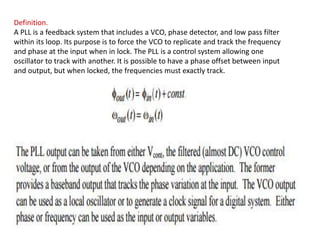
A PLL is a feedback system that includes a VCO, phase detector, and low pass filter
within its loop. Its purpose is to force the VCO to replicate and track the frequency
and phase at the input when in lock. The PLL is a control system allowing one
oscillator to track with another. It is possible to have a phase offset between input
and output, but when locked, the frequencies must exactly track.
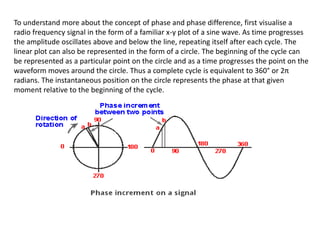
To understand more about the concept of phase and phase difference, first visualise a
radio frequency signal in the form of a familiar x-y plot of a sine wave. As time progresses
the amplitude oscillates above and below the line, repeating itself after each cycle. The
linear plot can also be represented in the form of a circle. The beginning of the cycle can
be represented as a particular point on the circle and as a time progresses the point on the
waveform moves around the circle. Thus a complete cycle is equivalent to 360° or 2π
radians. The instantaneous position on the circle represents the phase at that given
moment relative to the beginning of the cycle.
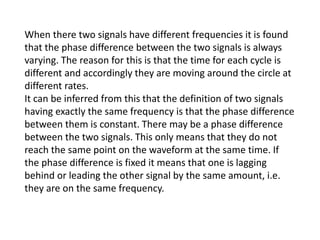
To look at the concept of phase difference, take the example of two signals. Although
the two signals have the same frequency, the peaks and troughs do not occur in the
same place. There is said to be a phase difference between the two signals. This phase
difference is measured as the angle between them. It can be seen that it is the angle
between the same point on the two waveforms. In this case a zero crossing point has
been taken, but any point will suffice provided that it is the same on both.
When there two signals have different frequencies it is found
that the phase difference between the two signals is always
varying. The reason for this is that the time for each cycle is
different and accordingly they are moving around the circle at
different rates.
It can be inferred from this that the definition of two signals
having exactly the same frequency is that the phase difference
between them is constant. There may be a phase difference
between the two signals. This only means that they do not
reach the same point on the waveform at the same time. If
the phase difference is fixed it means that one is lagging
behind or leading the other signal by the same amount, i.e.
they are on the same frequency.
PLL Applications:
Frequency Modulation (FM) stereo decoders, FM
Demodulation networks for FM operation.
Frequency synthesis that provides multiple of a
reference signal frequency.
Used in motorspeed controls, tracking filters.
Used in frequency shift keying (FSK) decodes for
demodulation carrier frequencies.
a. Clock generation
b. Frequency synthesizer
c. Clock recovery in a serial data link
DEFINATIONS:
Lock Range:
Range of input signal frequencies over which the loop remains locked once it has
captured the input signal. This can be limited either by the phase detector or the VCO
frequency range.
Capture range:
Range of input frequencies around the VCO center frequency onto which the loop
will lock when starting from an unlocked condition. Sometimes a frequency detector
is added to the phase detector to assist in initial acquisition of lock
Phase locked loop basics:
A phase locked loop, PLL, is basically of form of servo loop. Although a PLL performs
its actions on a radio frequency signal, all the basic criteria for loop stability and
other parameters are the same.
A basic phase locked loop, PLL, consists of three basic elements:
Phase comparator / detector: As the name implies, this circuit block within the PLL
compares the phase of two signals and generates a voltage according to the phase
difference between the two signals.
Loop filter: This filter is used to filter the output from the phase comparator in the
PLL. It is used to remove any components of the signals of which the phase is being
compared from the VCO line. It also governs many of the characteristics of the loop
and its stability.
Voltage controlled oscillator (VCO): The voltage controlled oscillator is the circuit
block that generates the output radio frequency signal. Its frequency can be
controlled and swung over the operational frequency band for the loop.
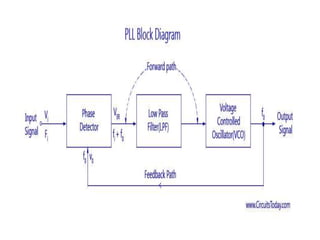
The block diagram of a basic PLL is shown in the figure below. It is basically a flip flop
consisting of a phase detector, a low pass filter (LPF),and a Voltage Controlled Oscillator
(VCO).
The input signal Vi with an input frequency fi is passed through a phase detector. A
phase detector basically a comparator which compares the input frequency fi with the
feedback frequency fo .The phase detector provides an output error voltage Ver
(=fi+fo),which is a DC voltage. This DC voltage is then passed on to an LPF. The LPF
removes the high frequency noise and produces a steady DC level, Vf (=Fi-Fo). Vf also
represents the dynamic characteristics of the PLL.
The DC level is then passed on to a VCO. The output frequency of the VCO (fo) is
directly proportional to the input signal. Both the input frequency and output
frequency are compared and adjusted through feedback loops until the output
frequency equals the input frequency. Thus the PLL works in these stages – free-
running, capture and phase lock.
As the name suggests, the free running stage refer to the stage when there is no
input voltage applied. As soon as the input frequency is applied the VCO starts to
change and begin producing an output frequency for comparison this stage is called
the capture stage. The frequency comparison stops as soon as the output frequency
is adjusted to become equal to the input frequency. This stage is called the phase
locked state.
Now let us study in detail about the various parts of a PLL – The phase detector, Low Pass
Filter and Voltage Controlled Oscillator.
1. Phase Detector:
This comparator circuit compares the input frequency and the VCO output
frequency and produces a dc voltage that is proportional to the phase difference between
the two frequencies. The phase detector used in PLL may be of analog or digital type.
Even though most of the monolithic PLL integrated circuits use analog phase detectors,
the majority of discrete phase detectors are of the digital type. One of the most
commonly used analog phase detector is the double balanced mixer circuit. Some of the
common digital type phase detectors are
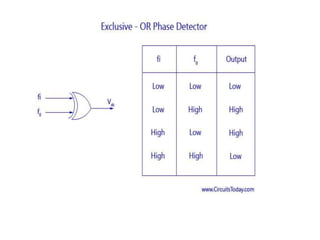
1.1 Exclusive OR Phase Detector
An exclusive OR phase detector is shown in the figure below.
It is obtained as a CMOS IC of type 4070. Both the frequencies are provided as an
input to the EX OR phase detector. Obeying the EX-OR concept the output becomes
HIGH only if either of the inputs fi or fo becomes HIGH.
All other conditions will produce a LOW output. Let us consider a waveform where
the input frequency leads the output frequency by θ degrees. That is, fi and fo has a
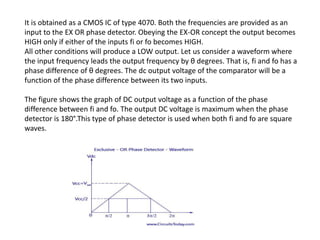
phase difference of θ degrees. The dc output voltage of the comparator will be a
function of the phase difference between its two inputs.
The figure shows the graph of DC output voltage as a function of the phase
difference between fi and fo. The output DC voltage is maximum when the phase
detector is 180°.This type of phase detector is used when both fi and fo are square
waves.
1.2 Edge Triggered Phase Detector
Edge triggered phase detector is used when fi and fo are pulse waveforms with less
than 50% duty cycles. The figure of such a phase detector using an R-S Flip Flop is
shown below. Two NOR Gate (CD4001) are cross-coupled to form an R-S Flip Flop.
The output of the phase detector changes it’s logic state by triggering of the R-S Flip
Flop. That is, the output of the phase detector changes its logic state on the positive
edge of the input fi and fo. The advantage of such a detector can be understood
from the graph below. It is clear that the DC output voltage is linear over 360°.
1.3 Monolithic Phase Detectors
The monolithic type phase detector uses a CMOS type 4044 IC ,Which is highly
advantages as the harmonic sensitivity and duty cycle problems are neglected and
the circuit will be respond only to the transition in the input signals. This is the most
preferred phase detector in the critical applications as the phase error and the
output error voltage are independent of variations in the amplitude and duty cycles
of the input waveforms.
2. Low Pass Filter (LPF)
A Low Pass Filter (LPF) is used in Phase Locked Loops (PLL) to get rid of the high
frequency components in the output of the phase detector. It also removes the high
frequency noise. All these features make the LPF a critical part in PLL and helps
control the dynamic characteristics of the whole circuit. The dynamic characteristics
include capture and lock ranges, bandwidth, and transient response. The lock range is
the tracking range where the range of frequencies of the PLL system follows the
changes in the input frequency. The capture range is the range in which the Phase
Locker Loops attains the Phase Lock.
When the filter bandwidth is reduced, the response time increases .But this reduces
the capture range. But it also helps in reducing noise and in maintaining the locked
loop through momentary losses of signal. Two types of passive filter are used for the
LPF circuit in a PLL. An amplifier is used also with LPF to obtain gain. The active filter
used in PLL is shown below.
3. Voltage Controlled Oscillator (VCO)
The main function of the VCO is to generate an output frequency that is directly
proportional to the input voltage. The connection diagram of a SE/NE 566 VCO is
shown in the figure below. The macimum frequency of the VCO is 500 KHz.
This VCO provides simultaneous square wave and triangular wave outputs as a
function of the input voltage. The frequency of oscillation is determined by the
resistor R and capacitor C along with the voltage Vc applied to the control terminal.
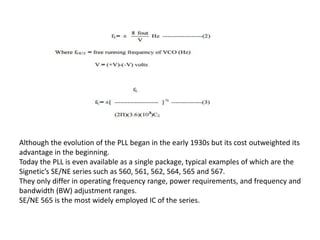
Although the evolution of the PLL began in the early 1930s but its cost outweighted its
advantage in the beginning.
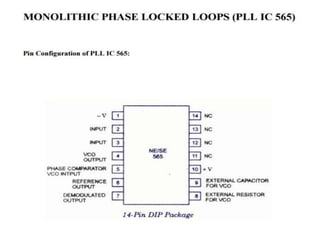
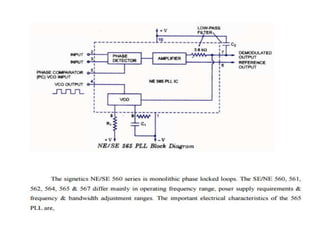
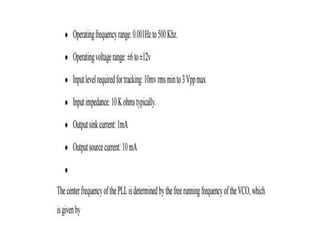
Today the PLL is even available as a single package, typical examples of which are the
Signetic’s SE/NE series such as 560, 561, 562, 564, 565 and 567.
They only differ in operating frequency range, power requirements, and frequency and
bandwidth (BW) adjustment ranges.
SE/NE 565 is the most widely employed IC of the series.

Pll

  • 1.
    UNIT IV PART II PHASELOCKED LOOPS(PLL) CH HARI PRASAD ASST. PROFESSSOR BAPATLA ENGINEERING COLLEGE BAPATLA
  • 2.
    INTRODUCTION: • The conceptof Phase Locked Loops (PLL) first emerged in the early 1930’s.But the technology was not developed as it now, the cost factor for developing this technology was very high. Since the advancement in the field of integrated circuits, PLL has become one of the main building blocks in the electronics technology. In present, the PLL is available as a single IC in the SE/NE560 series (560, 561, 562, 564, 565 and 567) to further reduce the buying cost ,the discrete IC’s are used to construct a PLL. • A phase-locked loop (PLL) is an electronic circuit with a voltage- or current-driven oscillator that is constantly adjusted to match in phase (and thus lock on) the frequency of an input signal. • In addition to stabilizing a particular communications channel (keeping it set to a particular frequency), a PLL can be used to generate a signal, modulate or demodulate a signal, reconstitute a signal with less noise, or multiply or divide a frequency. • PLLs are frequently used in wireless communication, particularly where signals are carried using frequency modulation (FM) or phase modulation (PM). PLLs can also be used in amplitude modulation (AM). PLLs are more commonly used for digital data transmission, but can also be designed for analog information. • Phase-locked loop devices are more commonly manufactured as integrated circuits (ICs) although discrete circuits are used for microwave.
  • 3.
    Definition. A PLL isa feedback system that includes a VCO, phase detector, and low pass filter within its loop. Its purpose is to force the VCO to replicate and track the frequency and phase at the input when in lock. The PLL is a control system allowing one oscillator to track with another. It is possible to have a phase offset between input and output, but when locked, the frequencies must exactly track.
  • 4.
    To understand moreabout the concept of phase and phase difference, first visualise a radio frequency signal in the form of a familiar x-y plot of a sine wave. As time progresses the amplitude oscillates above and below the line, repeating itself after each cycle. The linear plot can also be represented in the form of a circle. The beginning of the cycle can be represented as a particular point on the circle and as a time progresses the point on the waveform moves around the circle. Thus a complete cycle is equivalent to 360° or 2π radians. The instantaneous position on the circle represents the phase at that given moment relative to the beginning of the cycle.
  • 5.
    To look atthe concept of phase difference, take the example of two signals. Although the two signals have the same frequency, the peaks and troughs do not occur in the same place. There is said to be a phase difference between the two signals. This phase difference is measured as the angle between them. It can be seen that it is the angle between the same point on the two waveforms. In this case a zero crossing point has been taken, but any point will suffice provided that it is the same on both.
  • 6.
    When there twosignals have different frequencies it is found that the phase difference between the two signals is always varying. The reason for this is that the time for each cycle is different and accordingly they are moving around the circle at different rates. It can be inferred from this that the definition of two signals having exactly the same frequency is that the phase difference between them is constant. There may be a phase difference between the two signals. This only means that they do not reach the same point on the waveform at the same time. If the phase difference is fixed it means that one is lagging behind or leading the other signal by the same amount, i.e. they are on the same frequency.
  • 7.
    PLL Applications: Frequency Modulation(FM) stereo decoders, FM Demodulation networks for FM operation. Frequency synthesis that provides multiple of a reference signal frequency. Used in motorspeed controls, tracking filters. Used in frequency shift keying (FSK) decodes for demodulation carrier frequencies. a. Clock generation b. Frequency synthesizer c. Clock recovery in a serial data link
  • 8.
    DEFINATIONS: Lock Range: Range ofinput signal frequencies over which the loop remains locked once it has captured the input signal. This can be limited either by the phase detector or the VCO frequency range. Capture range: Range of input frequencies around the VCO center frequency onto which the loop will lock when starting from an unlocked condition. Sometimes a frequency detector is added to the phase detector to assist in initial acquisition of lock
  • 9.
    Phase locked loopbasics: A phase locked loop, PLL, is basically of form of servo loop. Although a PLL performs its actions on a radio frequency signal, all the basic criteria for loop stability and other parameters are the same. A basic phase locked loop, PLL, consists of three basic elements: Phase comparator / detector: As the name implies, this circuit block within the PLL compares the phase of two signals and generates a voltage according to the phase difference between the two signals. Loop filter: This filter is used to filter the output from the phase comparator in the PLL. It is used to remove any components of the signals of which the phase is being compared from the VCO line. It also governs many of the characteristics of the loop and its stability. Voltage controlled oscillator (VCO): The voltage controlled oscillator is the circuit block that generates the output radio frequency signal. Its frequency can be controlled and swung over the operational frequency band for the loop.
  • 11.
    The block diagramof a basic PLL is shown in the figure below. It is basically a flip flop consisting of a phase detector, a low pass filter (LPF),and a Voltage Controlled Oscillator (VCO). The input signal Vi with an input frequency fi is passed through a phase detector. A phase detector basically a comparator which compares the input frequency fi with the feedback frequency fo .The phase detector provides an output error voltage Ver (=fi+fo),which is a DC voltage. This DC voltage is then passed on to an LPF. The LPF removes the high frequency noise and produces a steady DC level, Vf (=Fi-Fo). Vf also represents the dynamic characteristics of the PLL. The DC level is then passed on to a VCO. The output frequency of the VCO (fo) is directly proportional to the input signal. Both the input frequency and output frequency are compared and adjusted through feedback loops until the output frequency equals the input frequency. Thus the PLL works in these stages – free- running, capture and phase lock. As the name suggests, the free running stage refer to the stage when there is no input voltage applied. As soon as the input frequency is applied the VCO starts to change and begin producing an output frequency for comparison this stage is called the capture stage. The frequency comparison stops as soon as the output frequency is adjusted to become equal to the input frequency. This stage is called the phase locked state.
  • 12.
    Now let usstudy in detail about the various parts of a PLL – The phase detector, Low Pass Filter and Voltage Controlled Oscillator. 1. Phase Detector: This comparator circuit compares the input frequency and the VCO output frequency and produces a dc voltage that is proportional to the phase difference between the two frequencies. The phase detector used in PLL may be of analog or digital type. Even though most of the monolithic PLL integrated circuits use analog phase detectors, the majority of discrete phase detectors are of the digital type. One of the most commonly used analog phase detector is the double balanced mixer circuit. Some of the common digital type phase detectors are 1.1 Exclusive OR Phase Detector An exclusive OR phase detector is shown in the figure below.
  • 14.
    It is obtainedas a CMOS IC of type 4070. Both the frequencies are provided as an input to the EX OR phase detector. Obeying the EX-OR concept the output becomes HIGH only if either of the inputs fi or fo becomes HIGH. All other conditions will produce a LOW output. Let us consider a waveform where the input frequency leads the output frequency by θ degrees. That is, fi and fo has a phase difference of θ degrees. The dc output voltage of the comparator will be a function of the phase difference between its two inputs. The figure shows the graph of DC output voltage as a function of the phase difference between fi and fo. The output DC voltage is maximum when the phase detector is 180°.This type of phase detector is used when both fi and fo are square waves.
  • 15.
    1.2 Edge TriggeredPhase Detector Edge triggered phase detector is used when fi and fo are pulse waveforms with less than 50% duty cycles. The figure of such a phase detector using an R-S Flip Flop is shown below. Two NOR Gate (CD4001) are cross-coupled to form an R-S Flip Flop. The output of the phase detector changes it’s logic state by triggering of the R-S Flip Flop. That is, the output of the phase detector changes its logic state on the positive edge of the input fi and fo. The advantage of such a detector can be understood from the graph below. It is clear that the DC output voltage is linear over 360°. 1.3 Monolithic Phase Detectors The monolithic type phase detector uses a CMOS type 4044 IC ,Which is highly advantages as the harmonic sensitivity and duty cycle problems are neglected and the circuit will be respond only to the transition in the input signals. This is the most preferred phase detector in the critical applications as the phase error and the output error voltage are independent of variations in the amplitude and duty cycles of the input waveforms.
  • 16.
    2. Low PassFilter (LPF) A Low Pass Filter (LPF) is used in Phase Locked Loops (PLL) to get rid of the high frequency components in the output of the phase detector. It also removes the high frequency noise. All these features make the LPF a critical part in PLL and helps control the dynamic characteristics of the whole circuit. The dynamic characteristics include capture and lock ranges, bandwidth, and transient response. The lock range is the tracking range where the range of frequencies of the PLL system follows the changes in the input frequency. The capture range is the range in which the Phase Locker Loops attains the Phase Lock. When the filter bandwidth is reduced, the response time increases .But this reduces the capture range. But it also helps in reducing noise and in maintaining the locked loop through momentary losses of signal. Two types of passive filter are used for the LPF circuit in a PLL. An amplifier is used also with LPF to obtain gain. The active filter used in PLL is shown below. 3. Voltage Controlled Oscillator (VCO) The main function of the VCO is to generate an output frequency that is directly proportional to the input voltage. The connection diagram of a SE/NE 566 VCO is shown in the figure below. The macimum frequency of the VCO is 500 KHz. This VCO provides simultaneous square wave and triangular wave outputs as a function of the input voltage. The frequency of oscillation is determined by the resistor R and capacitor C along with the voltage Vc applied to the control terminal.
  • 21.
    Although the evolutionof the PLL began in the early 1930s but its cost outweighted its advantage in the beginning. Today the PLL is even available as a single package, typical examples of which are the Signetic’s SE/NE series such as 560, 561, 562, 564, 565 and 567. They only differ in operating frequency range, power requirements, and frequency and bandwidth (BW) adjustment ranges. SE/NE 565 is the most widely employed IC of the series.