Synchronous Time and Frequency
Domain Analysis of Embedded
Systems
2
Agenda
l Complex Embedded Systems
l The Challenge of Debugging Embedded Systems
l Frequency domain analysis
l Time gating
l Dynamic range
l triggering
l Measurement Example: PLL locking
l SPI triggering
l Measuring settling time and transient spectrum
3
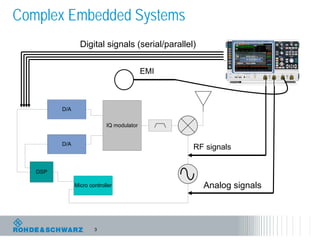
Complex Embedded Systems
D/A
D/A
DSP
Micro controller
IQ modulator
Digital signals (serial/parallel)
Analog signals
RF signals
EMI
4
The Challenge of Debugging Embedded Systems
l Baseband digital, RF and analog signals are interdependent
l Feedback control of RF by microcontroller
l Low speed serial busses
l Critical timing relationships
l Interference between RF and digital signals
l EMI
l Analyzing and debugging in the frequency domain
l Frequency domain analysis synchronized with time and digital domains
l Frequency analysis speed
l Sufficient sensitivity in both time and frequency domains
l Triggering ( time, digital and frequency)
5
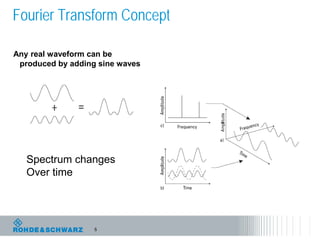
Fourier Transform Concept
Any real waveform can be
produced by adding sine waves
Spectrum changes
Over time
6
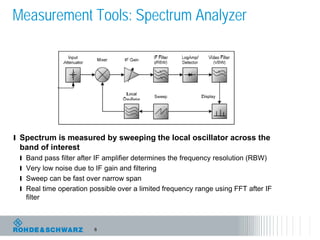
Measurement Tools: Spectrum Analyzer
l Spectrum is measured by sweeping the local oscillator across the
band of interest
l Band pass filter after IF amplifier determines the frequency resolution (RBW)
l Very low noise due to IF gain and filtering
l Sweep can be fast over narrow span
l Real time operation possible over a limited frequency range using FFT after IF
filter
7
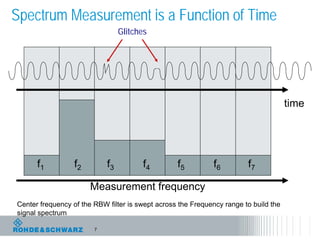
Spectrum Measurement is a Function of Time
Glitches
time
f1 f2 f3 f4 f5 f6 f7
Measurement frequency
Center frequency of the RBW filter is swept across the Frequency range to build the
signal spectrum
8
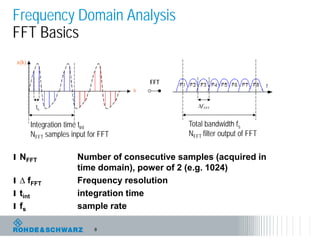
Frequency Domain Analysis
FFT Basics
l NFFT Number of consecutive samples (acquired in
time domain), power of 2 (e.g. 1024)
l ∆ fFFT Frequency resolution
l tint integration time
l fs sample rate
Integration time tint
NFFT samples input for FFT
FFT
Total bandwidth fs
NFFT filter output of FFT
FFTf∆ts
10
f1 f2 f3 f4 f5 f6
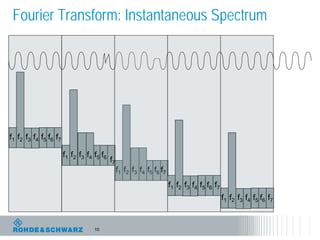
Fourier Transform: Instantaneous Spectrum
f1 f2 f3 f4 f5 f6 f7
f1 f2 f3 f4 f5 f6
f7
f1 f2 f3 f4 f5 f6 f7
f7
11
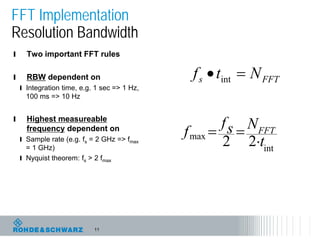
FFT Implementation
Resolution Bandwidth
l Two important FFT rules
l RBW dependent on
l Integration time, e.g. 1 sec => 1 Hz,
100 ms => 10 Hz
l Highest measureable
frequency dependent on
l Sample rate (e.g. fs = 2 GHz => fmax
= 1 GHz)
l Nyquist theorem: fs > 2 fmax
int
max
22 t
Nsf
f FFT
⋅
==
FFTs Ntf =• int
12
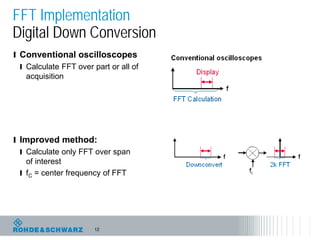
FFT Implementation
Digital Down Conversion
l Conventional oscilloscopes
l Calculate FFT over part or all of
acquisition
l Improved method:
l Calculate only FFT over span
of interest
l fC = center frequency of FFT
13
FFT Implementation
Time and Frequency Domains
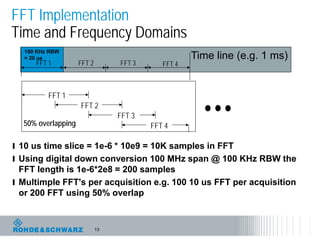
l 10 us time slice = 1e-6 * 10e9 = 10K samples in FFT
l Using digital down conversion 100 MHz span @ 100 KHz RBW the
FFT length is 1e-6*2e8 = 200 samples
l Multimple FFT's per acquisition e.g. 100 10 us FFT per acquisition
or 200 FFT using 50% overlap
Time line (e.g. 1 ms)
100 KHz RBW
= 20 us
FFT 1 FFT 2 FFT 3 FFT 4
FFT 1
FFT 2
FFT 3
FFT 450% overlapping
14
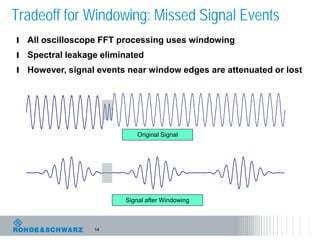
Tradeoff for Windowing: Missed Signal Events
Original Signal
Signal after Windowing
l All oscilloscope FFT processing uses windowing
l Spectral leakage eliminated
l However, signal events near window edges are attenuated or lost
15
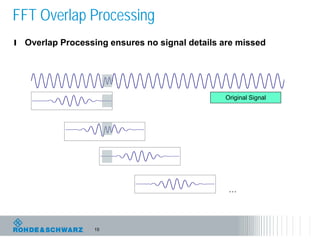
FFT Overlap Processing
l Overlap Processing ensures no signal details are missed
Original Signal
…
16
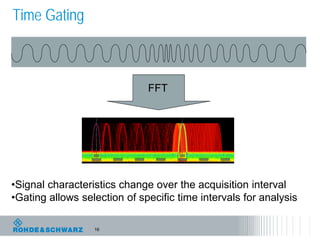
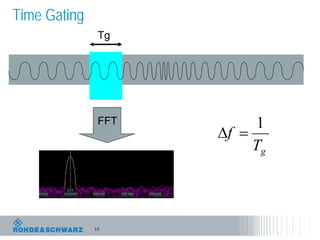
Time Gating
•Signal characteristics change over the acquisition interval
•Gating allows selection of specific time intervals for analysis
FFT
17
Time Gating
Tg
gT
f
1
=∆
FFT
18
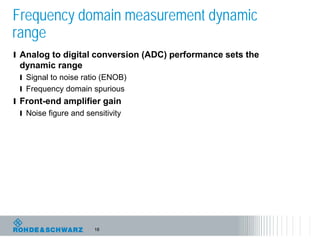
Frequency domain measurement dynamic
range
l Analog to digital conversion (ADC) performance sets the
dynamic range
l Signal to noise ratio (ENOB)
l Frequency domain spurious
l Front-end amplifier gain
l Noise figure and sensitivity
19
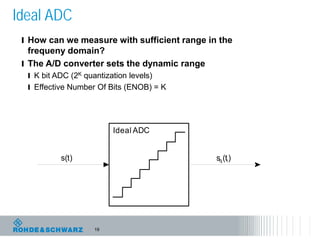
Ideal ADC
Ideal ADC
s(t) s (t)q i
l How can we measure with sufficient range in the
frequeny domain?
l The A/D converter sets the dynamic range
l K bit ADC (2K quantization levels)
l Effective Number Of Bits (ENOB) = K
20
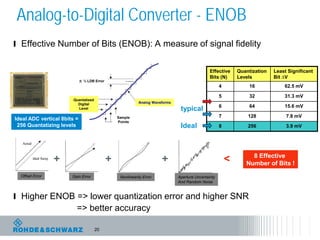
Analog-to-Digital Converter - ENOB
l Effective Number of Bits (ENOB): A measure of signal fidelity
l Higher ENOB => lower quantization error and higher SNR
=> better accuracy
Effective
Bits (N)
Quantization
Levels
Least Significant
Bit ∆V
4 16 62.5 mV
5 32 31.3 mV
6 64 15.6 mV
7 128 7.8 mV
8 256 3.9 mV
Offset Error Gain Error Nonlinearity Error Aperture Uncertainty
And Random Noise
+ + +
± ½ LDB Error
Quantatized
Digital
Level
Sample
Points
Analog Waveforms
<
Ideal ADC vertical 8bits =
256 Quantatizing levels
8 Effective
Number of Bits !
Ideal
typical
21
Signal to Noise and ENOB
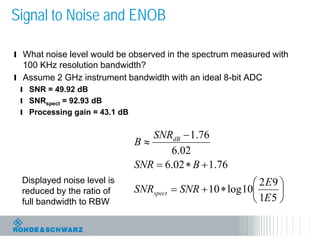
l What noise level would be observed in the spectrum measured with
100 KHz resolution bandwidth?
l Assume 2 GHz instrument bandwidth with an ideal 8-bit ADC
l SNR = 49.92 dB
l SNRspect = 92.93 dB
l Processing gain = 43.1 dB






∗+=
+∗=
−
≈
51
92
10log10
76.102.6
02.6
76.1
E
E
SNRSNR
BSNR
SNR
B
spect
dB
Displayed noise level is
reduced by the ratio of
full bandwidth to RBW
22
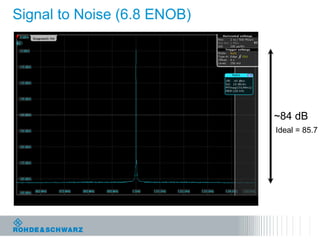
Signal to Noise (6.8 ENOB)
~84 dB
Ideal = 85.7
23
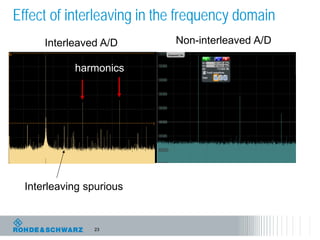
Effect of interleaving in the frequency domain
harmonics
Interleaving spurious
Interleaved A/D Non-interleaved A/D
24
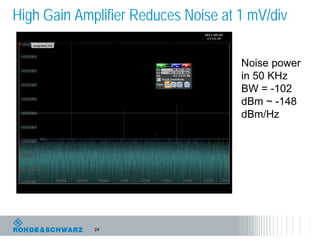
High Gain Amplifier Reduces Noise at 1 mV/div
Noise power
in 50 KHz
BW = -102
dBm ~ -148
dBm/Hz
25
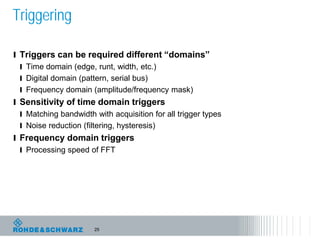
Triggering
l Triggers can be required different “domains”
l Time domain (edge, runt, width, etc.)
l Digital domain (pattern, serial bus)
l Frequency domain (amplitude/frequency mask)
l Sensitivity of time domain triggers
l Matching bandwidth with acquisition for all trigger types
l Noise reduction (filtering, hysteresis)
l Frequency domain triggers
l Processing speed of FFT
26
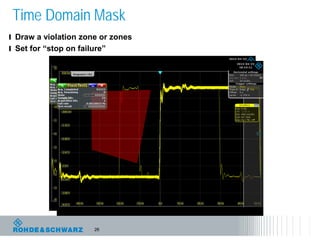
Time Domain Mask
l Draw a violation zone or zones
l Set for “stop on failure”
27
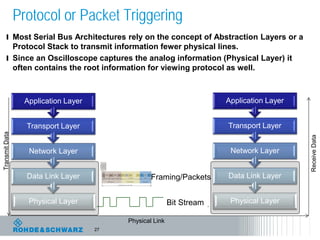
l Most Serial Bus Architectures rely on the concept of Abstraction Layers or a
Protocol Stack to transmit information fewer physical lines.
l Since an Oscilloscope captures the analog information (Physical Layer) it
often contains the root information for viewing protocol as well.
Protocol or Packet Triggering
Physical Layer
Data Link Layer
Network Layer
Transport Layer
Application Layer
Physical Layer
Data Link Layer
Network Layer
Transport Layer
Application Layer
Bit Stream
TransmitData
ReceiveData
Physical Link
Framing/Packets
28
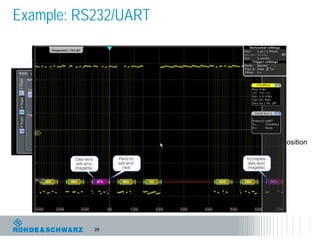
Example: RS232/UART
Trigger Types:
• Start bit
• Frame start
• Packet start
• A specified symbol
• Parity errors, and breaks
• Frame errors
• Stop errors
• A serial pattern at any or a specified position
29
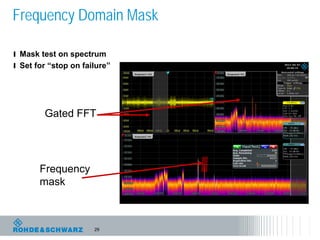
Frequency Domain Mask
l Mask test on spectrum
l Set for “stop on failure”
Frequency
mask
Gated FFT
30
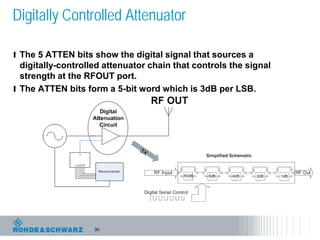
Digitally Controlled Attenuator
l The 5 ATTEN bits show the digital signal that sources a
digitally-controlled attenuator chain that controls the signal
strength at the RFOUT port.
l The ATTEN bits form a 5-bit word which is 3dB per LSB.
31
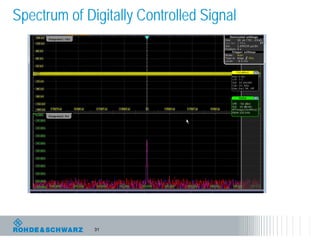
Spectrum of Digitally Controlled Signal
32
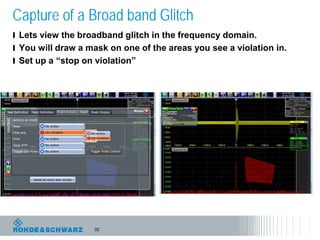
Capture of a Broad band Glitch
l Lets view the broadband glitch in the frequency domain.
l You will draw a mask on one of the areas you see a violation in.
l Set up a “stop on violation”
33
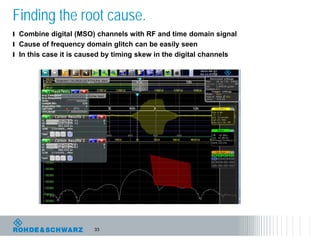
Finding the root cause.
l Combine digital (MSO) channels with RF and time domain signal
l Cause of frequency domain glitch can be easily seen
l In this case it is caused by timing skew in the digital channels
34
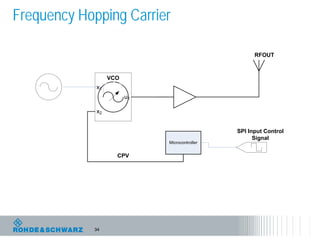
Frequency Hopping Carrier
Microcontroller
SPI Input Control
Signal
u1
x2
x1 * / *
VCO
CPV
RFOUT
35
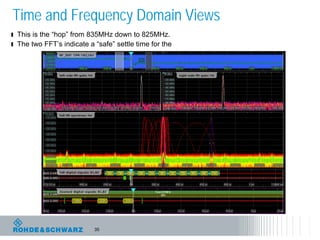
Time and Frequency Domain Views
ı This is the “hop” from 835MHz down to 825MHz.
ı The two FFT’s indicate a “safe” settle time for the
36
Summary
l FFT based spectrum analysis can be enhanced to enable
time-correlated spectrum analysis
l Improved throughput using digital down conversion
l High dynamic range A/D conversion
l High gain amplifier for small signal measurement
l Real time oscilloscope platform is ideal for digital, time and
frequency analysis
l Synchronized time and frequency domain analysis
l Serial protocol trigger and decode
l Parallel data channels

Synchronous Time / Frequency Domain Measurements Using a Digital Oscilloscope (Presented at EELive! 2014)

  • 1.
    Synchronous Time andFrequency Domain Analysis of Embedded Systems
  • 2.
    2 Agenda l Complex EmbeddedSystems l The Challenge of Debugging Embedded Systems l Frequency domain analysis l Time gating l Dynamic range l triggering l Measurement Example: PLL locking l SPI triggering l Measuring settling time and transient spectrum
  • 3.
    3 Complex Embedded Systems D/A D/A DSP Microcontroller IQ modulator Digital signals (serial/parallel) Analog signals RF signals EMI
  • 4.
    4 The Challenge ofDebugging Embedded Systems l Baseband digital, RF and analog signals are interdependent l Feedback control of RF by microcontroller l Low speed serial busses l Critical timing relationships l Interference between RF and digital signals l EMI l Analyzing and debugging in the frequency domain l Frequency domain analysis synchronized with time and digital domains l Frequency analysis speed l Sufficient sensitivity in both time and frequency domains l Triggering ( time, digital and frequency)
  • 5.
    5 Fourier Transform Concept Anyreal waveform can be produced by adding sine waves Spectrum changes Over time
  • 6.
    6 Measurement Tools: SpectrumAnalyzer l Spectrum is measured by sweeping the local oscillator across the band of interest l Band pass filter after IF amplifier determines the frequency resolution (RBW) l Very low noise due to IF gain and filtering l Sweep can be fast over narrow span l Real time operation possible over a limited frequency range using FFT after IF filter
  • 7.
    7 Spectrum Measurement isa Function of Time Glitches time f1 f2 f3 f4 f5 f6 f7 Measurement frequency Center frequency of the RBW filter is swept across the Frequency range to build the signal spectrum
  • 8.
    8 Frequency Domain Analysis FFTBasics l NFFT Number of consecutive samples (acquired in time domain), power of 2 (e.g. 1024) l ∆ fFFT Frequency resolution l tint integration time l fs sample rate Integration time tint NFFT samples input for FFT FFT Total bandwidth fs NFFT filter output of FFT FFTf∆ts
  • 9.
    10 f1 f2 f3f4 f5 f6 Fourier Transform: Instantaneous Spectrum f1 f2 f3 f4 f5 f6 f7 f1 f2 f3 f4 f5 f6 f7 f1 f2 f3 f4 f5 f6 f7 f1 f2 f3 f4 f5 f6 f7 f7
  • 10.
    11 FFT Implementation Resolution Bandwidth lTwo important FFT rules l RBW dependent on l Integration time, e.g. 1 sec => 1 Hz, 100 ms => 10 Hz l Highest measureable frequency dependent on l Sample rate (e.g. fs = 2 GHz => fmax = 1 GHz) l Nyquist theorem: fs > 2 fmax int max 22 t Nsf f FFT ⋅ == FFTs Ntf =• int
  • 11.
    12 FFT Implementation Digital DownConversion l Conventional oscilloscopes l Calculate FFT over part or all of acquisition l Improved method: l Calculate only FFT over span of interest l fC = center frequency of FFT
  • 12.
    13 FFT Implementation Time andFrequency Domains l 10 us time slice = 1e-6 * 10e9 = 10K samples in FFT l Using digital down conversion 100 MHz span @ 100 KHz RBW the FFT length is 1e-6*2e8 = 200 samples l Multimple FFT's per acquisition e.g. 100 10 us FFT per acquisition or 200 FFT using 50% overlap Time line (e.g. 1 ms) 100 KHz RBW = 20 us FFT 1 FFT 2 FFT 3 FFT 4 FFT 1 FFT 2 FFT 3 FFT 450% overlapping
  • 13.
    14 Tradeoff for Windowing:Missed Signal Events Original Signal Signal after Windowing l All oscilloscope FFT processing uses windowing l Spectral leakage eliminated l However, signal events near window edges are attenuated or lost
  • 14.
    15 FFT Overlap Processing lOverlap Processing ensures no signal details are missed Original Signal …
  • 15.
    16 Time Gating •Signal characteristicschange over the acquisition interval •Gating allows selection of specific time intervals for analysis FFT
  • 16.
  • 17.
    18 Frequency domain measurementdynamic range l Analog to digital conversion (ADC) performance sets the dynamic range l Signal to noise ratio (ENOB) l Frequency domain spurious l Front-end amplifier gain l Noise figure and sensitivity
  • 18.
    19 Ideal ADC Ideal ADC s(t)s (t)q i l How can we measure with sufficient range in the frequeny domain? l The A/D converter sets the dynamic range l K bit ADC (2K quantization levels) l Effective Number Of Bits (ENOB) = K
  • 19.
    20 Analog-to-Digital Converter -ENOB l Effective Number of Bits (ENOB): A measure of signal fidelity l Higher ENOB => lower quantization error and higher SNR => better accuracy Effective Bits (N) Quantization Levels Least Significant Bit ∆V 4 16 62.5 mV 5 32 31.3 mV 6 64 15.6 mV 7 128 7.8 mV 8 256 3.9 mV Offset Error Gain Error Nonlinearity Error Aperture Uncertainty And Random Noise + + + ± ½ LDB Error Quantatized Digital Level Sample Points Analog Waveforms < Ideal ADC vertical 8bits = 256 Quantatizing levels 8 Effective Number of Bits ! Ideal typical
  • 20.
    21 Signal to Noiseand ENOB l What noise level would be observed in the spectrum measured with 100 KHz resolution bandwidth? l Assume 2 GHz instrument bandwidth with an ideal 8-bit ADC l SNR = 49.92 dB l SNRspect = 92.93 dB l Processing gain = 43.1 dB       ∗+= +∗= − ≈ 51 92 10log10 76.102.6 02.6 76.1 E E SNRSNR BSNR SNR B spect dB Displayed noise level is reduced by the ratio of full bandwidth to RBW
  • 21.
    22 Signal to Noise(6.8 ENOB) ~84 dB Ideal = 85.7
  • 22.
    23 Effect of interleavingin the frequency domain harmonics Interleaving spurious Interleaved A/D Non-interleaved A/D
  • 23.
    24 High Gain AmplifierReduces Noise at 1 mV/div Noise power in 50 KHz BW = -102 dBm ~ -148 dBm/Hz
  • 24.
    25 Triggering l Triggers canbe required different “domains” l Time domain (edge, runt, width, etc.) l Digital domain (pattern, serial bus) l Frequency domain (amplitude/frequency mask) l Sensitivity of time domain triggers l Matching bandwidth with acquisition for all trigger types l Noise reduction (filtering, hysteresis) l Frequency domain triggers l Processing speed of FFT
  • 25.
    26 Time Domain Mask lDraw a violation zone or zones l Set for “stop on failure”
  • 26.
    27 l Most SerialBus Architectures rely on the concept of Abstraction Layers or a Protocol Stack to transmit information fewer physical lines. l Since an Oscilloscope captures the analog information (Physical Layer) it often contains the root information for viewing protocol as well. Protocol or Packet Triggering Physical Layer Data Link Layer Network Layer Transport Layer Application Layer Physical Layer Data Link Layer Network Layer Transport Layer Application Layer Bit Stream TransmitData ReceiveData Physical Link Framing/Packets
  • 27.
    28 Example: RS232/UART Trigger Types: •Start bit • Frame start • Packet start • A specified symbol • Parity errors, and breaks • Frame errors • Stop errors • A serial pattern at any or a specified position
  • 28.
    29 Frequency Domain Mask lMask test on spectrum l Set for “stop on failure” Frequency mask Gated FFT
  • 29.
    30 Digitally Controlled Attenuator lThe 5 ATTEN bits show the digital signal that sources a digitally-controlled attenuator chain that controls the signal strength at the RFOUT port. l The ATTEN bits form a 5-bit word which is 3dB per LSB.
  • 30.
    31 Spectrum of DigitallyControlled Signal
  • 31.
    32 Capture of aBroad band Glitch l Lets view the broadband glitch in the frequency domain. l You will draw a mask on one of the areas you see a violation in. l Set up a “stop on violation”
  • 32.
    33 Finding the rootcause. l Combine digital (MSO) channels with RF and time domain signal l Cause of frequency domain glitch can be easily seen l In this case it is caused by timing skew in the digital channels
  • 33.
    34 Frequency Hopping Carrier Microcontroller SPIInput Control Signal u1 x2 x1 * / * VCO CPV RFOUT
  • 34.
    35 Time and FrequencyDomain Views ı This is the “hop” from 835MHz down to 825MHz. ı The two FFT’s indicate a “safe” settle time for the
  • 35.
    36 Summary l FFT basedspectrum analysis can be enhanced to enable time-correlated spectrum analysis l Improved throughput using digital down conversion l High dynamic range A/D conversion l High gain amplifier for small signal measurement l Real time oscilloscope platform is ideal for digital, time and frequency analysis l Synchronized time and frequency domain analysis l Serial protocol trigger and decode l Parallel data channels