HIGHER DIFFERENTIAL EQUATION
PREPARED BY:
Group : B
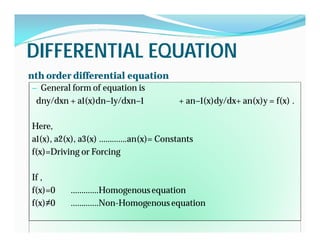
DIFFERENTIAL EQUATIONDIFFERENTIAL EQUATION
nth order differential equation
General form of equation is— General form of equation is
dny/dxn + a1(x)dn−1y/dxn−1 ・ ・ ・ + an−1(x)dy/dx+ an(x)y = f(x) .
Here,
a1(x), a2(x), a3(x) ………….an(x)= Constants
f(x)=Driving or Forcing
If ,
f(x)=0 ………….Homogenousequation
f(x)≠0 ………….Non-Homogenous equation
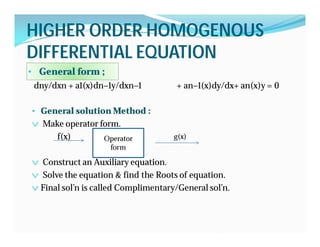
HIGHER ORDER HOMOGENOUSHIGHER ORDER HOMOGENOUS
DIFFERENTIAL EQUATIONDIFFERENTIAL EQUATION
• General form ;
dny/dxn + a1(x)dn−1y/dxn−1 ・ ・ ・ + an−1(x)dy/dx+ an(x)y = 0
• General solution Method :
v Make operator form.
f(x)
v Construct an Auxiliary equation.
v Solve the equation & find the Roots of equation.
vFinal sol’n is called Complimentary/General sol’n.
Operator
form
g(x)
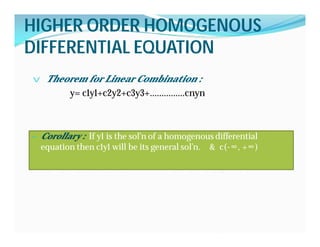
HIGHER ORDER HOMOGENOUSHIGHER ORDER HOMOGENOUS
DIFFERENTIAL EQUATIONDIFFERENTIAL EQUATION
v Theorem for Linear Combination :
y= c1y1+c2y2+c3y3+……………cnyn
— Corollary : If y1 is the sol’n of a homogenous differential
equation then c1y1 will be its general sol’n. & c(-∞, +∞)
HIGHER ORDER HOMOGENOUSHIGHER ORDER HOMOGENOUS
DIFFERENTIAL EQUATIONDIFFERENTIAL EQUATION
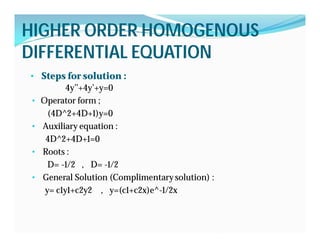
• Steps for solution :
4y’’+4y’+y=0
• Operator form ;
(4D^2+4D+1)y=0
• Auxiliary equation :
4D^2+4D+1=0
• Roots :
D= -1/2 , D= -1/2
• General Solution (Complimentary solution) :
y= c1y1+c2y2 , y=(c1+c2x)e^-1/2x
HIGHER ORDER HOMOGENOUSHIGHER ORDER HOMOGENOUS
DIFFERENTIAL EQUATIONDIFFERENTIAL EQUATION
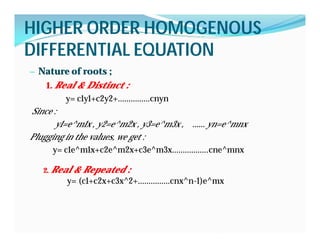
—— Nature of roots ;Nature of roots ;
1. Real & Distinct :
y= c1y1+c2y2+……………cnyn
Since :
y1=e^m1x , y2=e^m2x , y3=e^m3x , …… yn=e^mnx
Plugging in the values, we get :
y= c1e^m1x+c2e^m2x+c3e^m3x……………..cne^mnx
2. Real & Repeated :
y= (c1+c2x+c3x^2+……………cnx^n-1)e^mx
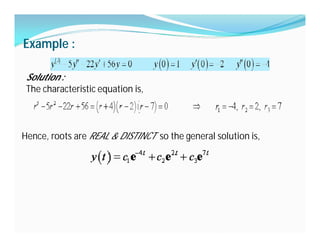
Solution :
The characteristic equation is,
Hence, roots are REAL & DISTINCTREAL & DISTINCT so the general solution is,
Example :
— Example :
Solution ;
The characteristic equation is,
So, we have two roots here,
r3= -2 r4= -2
[----y1------ ] [--------y2-----]
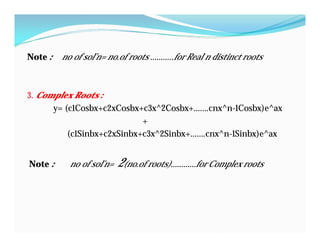
Note : no of sol’n= no.of roots ………..for Real n distinct roots
3. Complex Roots :
y= (c1Cosbx+c2xCosbx+c3x^2Cosbx+…….cnx^n-1Cosbx)e^ax
+
(c1Sinbx+c2xSinbx+c3x^2Sinbx+…….cnx^n-1Sinbx)e^ax
Note : no of sol’n= 2(no.of roots)…………for Complex roots
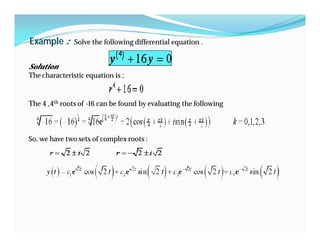
Example : Solve the following differential equation .
Solution
The characteristic equation is ;
The 4 ,4th roots of -16 can be found by evaluating the following
So, we have two sets of complex roots :
HIGHER ORDER NON HOMOGENOUSHIGHER ORDER NON HOMOGENOUS
DIFFERENT EQUATIONDIFFERENT EQUATION
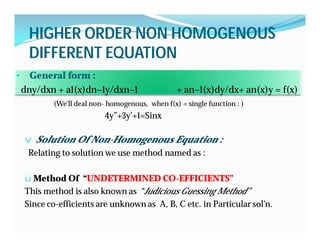
• General form :
dny/dxn + a1(x)dn−1y/dxn−1 ・ ・ ・ + an−1(x)dy/dx+ an(x)y = f(x)
(We‘ll deal non- homogenous, when f(x) = single function : )
4y”+3y’+1=Sinx
v Solution Of Non-Homogenous Equation :
Relating to solution we use method named as :
ü Method Of “UNDETERMINED CO-EFFICIENTS”
This method is also known as “ Judicious Guessing Method”“ Judicious Guessing Method”
Since co-efficients are unknown as A, B, C etc. in Particular sol’n.
METHOD OFMETHOD OF
UNDETERMINED COUNDETERMINED CO--EFFICIENTSEFFICIENTS
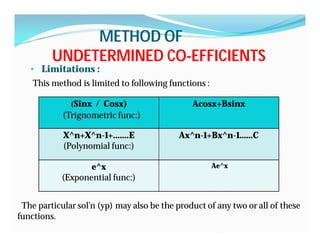
• Limitations :
This method is limited to following functions :
The particular sol’n (yp) may also be the product of any two or all of these
functions.
(Sinx / Cosx)
(Trignometric func:)
Acosx+Bsinx
X^n+X^n-1+…….E
(Polynomial func:)
Ax^n-1+Bx^n-1……C
e^x
(Exponential func:)
Ae^x
METHOD OFMETHOD OF
UNDETERMINED COUNDETERMINED CO--EFFICIENTSEFFICIENTS
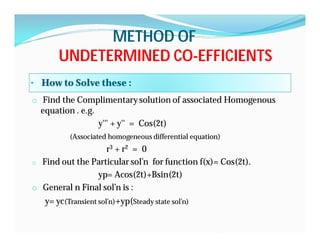
• How to Solve these :
o Find the Complimentary solution of associated Homogenous
equation . e.g.
y''' + y'' = Cos(2t)
(Associated homogeneous differential equation)
r3 + r2 = 0
o Find out the Particular sol’n for function f(x)= Cos(2t).
yp= Acos(2t)+Bsin(2t)
o General n Final sol’n is :
y= yc(Transient sol’n)+yp(Steady state sol’n)
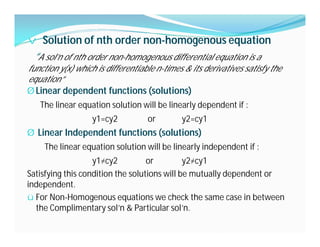
v Solution of nth order non-homogenous equation
“A sol’n of nth order non-homogenous differential equation is a
function y(x) which is differentiable n-times & its derivatives satisfy the
equation”
Ø Linear dependent functions (solutions)
The linear equation solution will be linearly dependent if :
y1=cy2 or y2=cy1
Ø Linear Independent functions (solutions)
The linear equation solution will be linearly independent if :
y1≠cy2 or y2≠cy1
Satisfying this condition the solutions will be mutually dependent or
independent.
ü For Non-Homogenous equations we check the same case in between
the Complimentary sol’n & Particular sol’n.
Solution of nth order non-homogenous equation
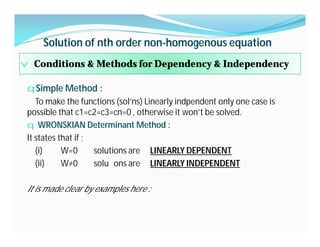
v Conditions & Methods for Dependency & Independency
qSimple Method :
To make the functions (sol’ns) Linearly indpendent only one case is
possible that c1=c2=c3=cn=0 , otherwise it won’t be solved.
q WRONSKIAN Determinant Method :
It states that if ;
(i) W=0 solutions are LINEARLY DEPENDENT
(ii) W≠0 solu ons are LINEARLY INDEPENDENT
It is made clear by examples here :
|e^x x e^x x^2 e^x |
W=| e^x e^x+ xe^x 2x ex + x2 e^x |
| e^x 2 e^x + x e^x 2 e^x + 4 x e^x + x^2 e^2 |
q (1)
s := [ex, x ex, x2 ex ]
Let's calculate the Wronskian.
Result = 2 (e^x )^3
Since the Wronskian is not zero, the given set in LINEARLY INDEPENDENT.
Solution of nth order non-homogenous equation
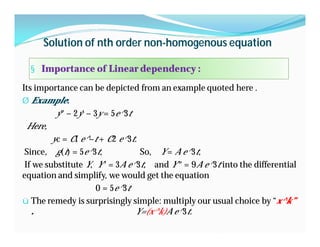
§ Importance of Linear dependency :
Its importance can be depicted from an example quoted here .
Ø Example:
y″ − 2y′ − 3y = 5e^3t
Here,
yc = C1 e^−t + C2 e^3t.
Since, g(t) = 5e^3t, So, Y = A e^3t,
If we substitute Y, Y ′ = 3A e^3t, and Y ″ = 9A e^3t into the differential
equation and simplify, we would get the equation
0 = 5e^3t
ü The remedy is surprisingly simple: multiply our usual choice by “x^k”
. Y=(x^k)A e^3t.
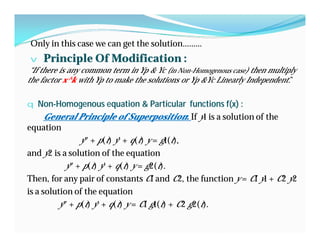
Only in this case we can get the solution………
v Principle Of Modification :
“If there is any common term in Yp & Yc (in Non-Homogenous case) then multiply
the factor x^k with Yp to make the solutions or Yp &Yc Linearly Independent.”
q Non-Homogenous equation & Particular functions f(x) :
General Principle of SuperpositionGeneral Principle of Superposition:: If y1 is a solution of the
equation
y″ + p(t) y′ + q(t) y = g1(t),
and y2 is a solution of the equation
y″ + p(t) y′ + q(t) y = g2(t).
Then, for any pair of constants C1 and C2, the function y = C1 y1 + C2 y2
is a solution of the equation
y″ + p(t) y′ + q(t) y = C1 g1(t) + C2 g2(t).
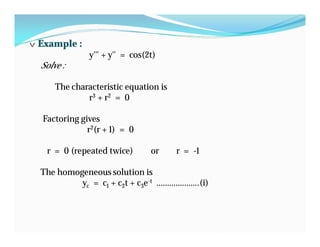
v Example :
y''' + y'' = cos(2t)
Solve :
The characteristic equation is
r3 + r2 = 0
Factoring gives
r2(r + 1) = 0
r = 0 (repeated twice) or r = -1
The homogeneous solution is
yc = c1 + c2t + c3e-t ………………..(i)
The UC-set generated by g(t) = Cos(2t) is
Notice that the UC-set does not intersect the homogeneous solution set. We can
write
yp = Acos(2t) + Bsin(2t)
yp' = -2Acos(2t) + 2Bsin(2t)
yp'' = -4Asin(2t) - 4Bcos(2t)
yp''' = -8Acos(2t) + 8Bsin(2t)
Plugging back into the original differential equation gives
[-8Acos(2t) + 8Bsin(2t)] + [-4Asin(2t) - 4Bcos(2t)] = cos(2t)
Combining like terms gives
(-8A - 4B)cos(2t) + (8B - 4A)sin(2t) = cos(2t)
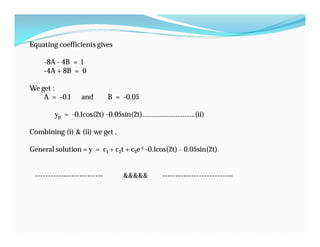
Equating coefficients gives
-8A - 4B = 1
-4A + 8B = 0
We get :
A = -0.1 and B = -0.05
yp = -0.1cos(2t) -0.05sin(2t)…………………………(ii)
Combining (i) & (ii) we get ,
General solution = y = c1 + c2t + c3e-t -0.1cos(2t) - 0.05sin(2t)
-------------------------- &&&&& ---------------------------
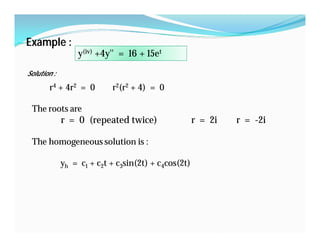
— Example :
y(iv) +4y'' = 16 + 15et
Solution :
r4 + 4r2 = 0 r2(r2 + 4) = 0
The roots are
r = 0 (repeated twice) r = 2i r = -2i
The homogeneous solution is :
yh = c1 + c2t + c3sin(2t) + c4cos(2t)
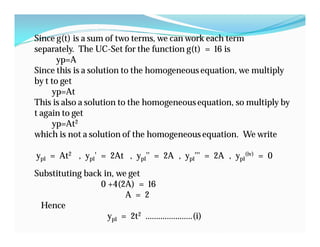
Since g(t) is a sum of two terms, we can work each term
separately. The UC-Set for the function g(t) = 16 is
yp=A
Since this is a solution to the homogeneous equation, we multiply
by t to get
yp=At
This is also a solution to the homogeneousequation, so multiply by
t again to get
yp=At2
which is not a solution of the homogeneous equation. We write
yp1 = At2 , yp1' = 2At , yp1'' = 2A , yp1''' = 2A , yp1
(iv) = 0
Substituting back in, we get
0 +4(2A) = 16
A = 2
Hence
yp1 = 2t2 ………………….(i)
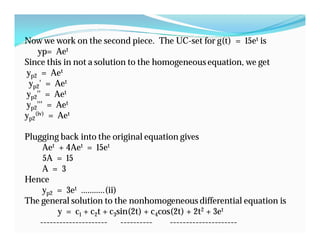
Now we work on the second piece. The UC-set for g(t) = 15et is
yp= Aet
Since this in not a solution to the homogeneous equation, we get
yp2 = Aet
yp2' = Aet
yp2'' = Aet
yp2''' = Aet
yp2
(iv) = Aet
Plugging back into the original equation gives
Aet + 4Aet = 15et
5A = 15
A = 3
Hence
yp2 = 3et ………..(ii)
The general solution to the nonhomogeneous differential equation is
y = c1 + c2t + c3sin(2t) + c4cos(2t) + 2t2 + 3et
--------------------- ---------- ---------------------

Higher Differential Equation

  • 1.
  • 2.
    DIFFERENTIAL EQUATIONDIFFERENTIAL EQUATION nthorder differential equation General form of equation is— General form of equation is dny/dxn + a1(x)dn−1y/dxn−1 ・ ・ ・ + an−1(x)dy/dx+ an(x)y = f(x) . Here, a1(x), a2(x), a3(x) ………….an(x)= Constants f(x)=Driving or Forcing If , f(x)=0 ………….Homogenousequation f(x)≠0 ………….Non-Homogenous equation
  • 3.
    HIGHER ORDER HOMOGENOUSHIGHERORDER HOMOGENOUS DIFFERENTIAL EQUATIONDIFFERENTIAL EQUATION • General form ; dny/dxn + a1(x)dn−1y/dxn−1 ・ ・ ・ + an−1(x)dy/dx+ an(x)y = 0 • General solution Method : v Make operator form. f(x) v Construct an Auxiliary equation. v Solve the equation & find the Roots of equation. vFinal sol’n is called Complimentary/General sol’n. Operator form g(x)
  • 4.
    HIGHER ORDER HOMOGENOUSHIGHERORDER HOMOGENOUS DIFFERENTIAL EQUATIONDIFFERENTIAL EQUATION v Theorem for Linear Combination : y= c1y1+c2y2+c3y3+……………cnyn — Corollary : If y1 is the sol’n of a homogenous differential equation then c1y1 will be its general sol’n. & c(-∞, +∞)
  • 5.
    HIGHER ORDER HOMOGENOUSHIGHERORDER HOMOGENOUS DIFFERENTIAL EQUATIONDIFFERENTIAL EQUATION • Steps for solution : 4y’’+4y’+y=0 • Operator form ; (4D^2+4D+1)y=0 • Auxiliary equation : 4D^2+4D+1=0 • Roots : D= -1/2 , D= -1/2 • General Solution (Complimentary solution) : y= c1y1+c2y2 , y=(c1+c2x)e^-1/2x
  • 6.
    HIGHER ORDER HOMOGENOUSHIGHERORDER HOMOGENOUS DIFFERENTIAL EQUATIONDIFFERENTIAL EQUATION —— Nature of roots ;Nature of roots ; 1. Real & Distinct : y= c1y1+c2y2+……………cnyn Since : y1=e^m1x , y2=e^m2x , y3=e^m3x , …… yn=e^mnx Plugging in the values, we get : y= c1e^m1x+c2e^m2x+c3e^m3x……………..cne^mnx 2. Real & Repeated : y= (c1+c2x+c3x^2+……………cnx^n-1)e^mx
  • 7.
    Solution : The characteristicequation is, Hence, roots are REAL & DISTINCTREAL & DISTINCT so the general solution is, Example :
  • 8.
    — Example : Solution; The characteristic equation is, So, we have two roots here, r3= -2 r4= -2 [----y1------ ] [--------y2-----]
  • 9.
    Note : noof sol’n= no.of roots ………..for Real n distinct roots 3. Complex Roots : y= (c1Cosbx+c2xCosbx+c3x^2Cosbx+…….cnx^n-1Cosbx)e^ax + (c1Sinbx+c2xSinbx+c3x^2Sinbx+…….cnx^n-1Sinbx)e^ax Note : no of sol’n= 2(no.of roots)…………for Complex roots
  • 10.
    Example : Solvethe following differential equation . Solution The characteristic equation is ; The 4 ,4th roots of -16 can be found by evaluating the following So, we have two sets of complex roots :
  • 11.
    HIGHER ORDER NONHOMOGENOUSHIGHER ORDER NON HOMOGENOUS DIFFERENT EQUATIONDIFFERENT EQUATION • General form : dny/dxn + a1(x)dn−1y/dxn−1 ・ ・ ・ + an−1(x)dy/dx+ an(x)y = f(x) (We‘ll deal non- homogenous, when f(x) = single function : ) 4y”+3y’+1=Sinx v Solution Of Non-Homogenous Equation : Relating to solution we use method named as : ü Method Of “UNDETERMINED CO-EFFICIENTS” This method is also known as “ Judicious Guessing Method”“ Judicious Guessing Method” Since co-efficients are unknown as A, B, C etc. in Particular sol’n.
  • 12.
    METHOD OFMETHOD OF UNDETERMINEDCOUNDETERMINED CO--EFFICIENTSEFFICIENTS • Limitations : This method is limited to following functions : The particular sol’n (yp) may also be the product of any two or all of these functions. (Sinx / Cosx) (Trignometric func:) Acosx+Bsinx X^n+X^n-1+…….E (Polynomial func:) Ax^n-1+Bx^n-1……C e^x (Exponential func:) Ae^x
  • 13.
    METHOD OFMETHOD OF UNDETERMINEDCOUNDETERMINED CO--EFFICIENTSEFFICIENTS • How to Solve these : o Find the Complimentary solution of associated Homogenous equation . e.g. y''' + y'' = Cos(2t) (Associated homogeneous differential equation) r3 + r2 = 0 o Find out the Particular sol’n for function f(x)= Cos(2t). yp= Acos(2t)+Bsin(2t) o General n Final sol’n is : y= yc(Transient sol’n)+yp(Steady state sol’n)
  • 14.
    v Solution ofnth order non-homogenous equation “A sol’n of nth order non-homogenous differential equation is a function y(x) which is differentiable n-times & its derivatives satisfy the equation” Ø Linear dependent functions (solutions) The linear equation solution will be linearly dependent if : y1=cy2 or y2=cy1 Ø Linear Independent functions (solutions) The linear equation solution will be linearly independent if : y1≠cy2 or y2≠cy1 Satisfying this condition the solutions will be mutually dependent or independent. ü For Non-Homogenous equations we check the same case in between the Complimentary sol’n & Particular sol’n.
  • 15.
    Solution of nthorder non-homogenous equation v Conditions & Methods for Dependency & Independency qSimple Method : To make the functions (sol’ns) Linearly indpendent only one case is possible that c1=c2=c3=cn=0 , otherwise it won’t be solved. q WRONSKIAN Determinant Method : It states that if ; (i) W=0 solutions are LINEARLY DEPENDENT (ii) W≠0 solu ons are LINEARLY INDEPENDENT It is made clear by examples here :
  • 16.
    |e^x x e^xx^2 e^x | W=| e^x e^x+ xe^x 2x ex + x2 e^x | | e^x 2 e^x + x e^x 2 e^x + 4 x e^x + x^2 e^2 | q (1) s := [ex, x ex, x2 ex ] Let's calculate the Wronskian. Result = 2 (e^x )^3 Since the Wronskian is not zero, the given set in LINEARLY INDEPENDENT.
  • 17.
    Solution of nthorder non-homogenous equation § Importance of Linear dependency : Its importance can be depicted from an example quoted here . Ø Example: y″ − 2y′ − 3y = 5e^3t Here, yc = C1 e^−t + C2 e^3t. Since, g(t) = 5e^3t, So, Y = A e^3t, If we substitute Y, Y ′ = 3A e^3t, and Y ″ = 9A e^3t into the differential equation and simplify, we would get the equation 0 = 5e^3t ü The remedy is surprisingly simple: multiply our usual choice by “x^k” . Y=(x^k)A e^3t.
  • 18.
    Only in thiscase we can get the solution……… v Principle Of Modification : “If there is any common term in Yp & Yc (in Non-Homogenous case) then multiply the factor x^k with Yp to make the solutions or Yp &Yc Linearly Independent.” q Non-Homogenous equation & Particular functions f(x) : General Principle of SuperpositionGeneral Principle of Superposition:: If y1 is a solution of the equation y″ + p(t) y′ + q(t) y = g1(t), and y2 is a solution of the equation y″ + p(t) y′ + q(t) y = g2(t). Then, for any pair of constants C1 and C2, the function y = C1 y1 + C2 y2 is a solution of the equation y″ + p(t) y′ + q(t) y = C1 g1(t) + C2 g2(t).
  • 19.
    v Example : y'''+ y'' = cos(2t) Solve : The characteristic equation is r3 + r2 = 0 Factoring gives r2(r + 1) = 0 r = 0 (repeated twice) or r = -1 The homogeneous solution is yc = c1 + c2t + c3e-t ………………..(i)
  • 20.
    The UC-set generatedby g(t) = Cos(2t) is Notice that the UC-set does not intersect the homogeneous solution set. We can write yp = Acos(2t) + Bsin(2t) yp' = -2Acos(2t) + 2Bsin(2t) yp'' = -4Asin(2t) - 4Bcos(2t) yp''' = -8Acos(2t) + 8Bsin(2t) Plugging back into the original differential equation gives [-8Acos(2t) + 8Bsin(2t)] + [-4Asin(2t) - 4Bcos(2t)] = cos(2t) Combining like terms gives (-8A - 4B)cos(2t) + (8B - 4A)sin(2t) = cos(2t)
  • 21.
    Equating coefficients gives -8A- 4B = 1 -4A + 8B = 0 We get : A = -0.1 and B = -0.05 yp = -0.1cos(2t) -0.05sin(2t)…………………………(ii) Combining (i) & (ii) we get , General solution = y = c1 + c2t + c3e-t -0.1cos(2t) - 0.05sin(2t) -------------------------- &&&&& ---------------------------
  • 22.
    — Example : y(iv)+4y'' = 16 + 15et Solution : r4 + 4r2 = 0 r2(r2 + 4) = 0 The roots are r = 0 (repeated twice) r = 2i r = -2i The homogeneous solution is : yh = c1 + c2t + c3sin(2t) + c4cos(2t)
  • 23.
    Since g(t) isa sum of two terms, we can work each term separately. The UC-Set for the function g(t) = 16 is yp=A Since this is a solution to the homogeneous equation, we multiply by t to get yp=At This is also a solution to the homogeneousequation, so multiply by t again to get yp=At2 which is not a solution of the homogeneous equation. We write yp1 = At2 , yp1' = 2At , yp1'' = 2A , yp1''' = 2A , yp1 (iv) = 0 Substituting back in, we get 0 +4(2A) = 16 A = 2 Hence yp1 = 2t2 ………………….(i)
  • 24.
    Now we workon the second piece. The UC-set for g(t) = 15et is yp= Aet Since this in not a solution to the homogeneous equation, we get yp2 = Aet yp2' = Aet yp2'' = Aet yp2''' = Aet yp2 (iv) = Aet Plugging back into the original equation gives Aet + 4Aet = 15et 5A = 15 A = 3 Hence yp2 = 3et ………..(ii) The general solution to the nonhomogeneous differential equation is y = c1 + c2t + c3sin(2t) + c4cos(2t) + 2t2 + 3et --------------------- ---------- ---------------------