
PANEL DISCUSSION Ms. JEENA  AEJY  MS(N)
 
ORIGIN Panel discussion technique was originated by Harry . A. Overstreet in 1929
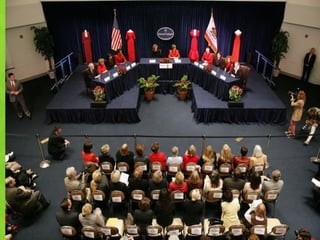
definition: PANEL DISCUSSION It is  a discussion in which few persons  ( the panel) carry on conversation in front of the audience.  At the end of the discussion audience also participates. The audience put important questions and the experts answers them and clarify the points
purpose Purpose of the panel discussion is to reproduce the features of a small discussion group for the benefit of a larger group
OBJECTIVES OF PANEL DISCUSSION To provide information and new facts. To analyze a problem from different angles To identify the values. To organize for mental recreation
TYPES OF PANEL DISCUSSIONS 1. public panel discussions 2. educational panel  discussions
PUBLIC PANEL DISCUSSIONS These are organized for common men problems. Objectives: To provide factual information regarding current problems To determine social values To recreate the common men E.g. annual budget, educated unemployment , increase in price of things.
EDUCATIONAL PANEL DISCUSSIONS Used in educational institutions to provide factual & conceptual knowledge and clarification of certain theories and principles. Some times these are organized to find out the solutions of certain problems
Objectives of educational panel discussions To provide factual information and conceptual knowledge To give awareness of theories and principles To provide solution of certain problems
Procedure of panel  discussion
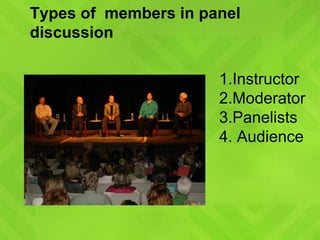
Types of  members in panel discussion Instructor Moderator Panelists Audience
1.INSTRUCTOR Plays  most important role in panel discussion Plans  how ,  where ,  when  panel discussion will be  organized Prepares the schedule for panel discussion Sometimes rehearsal is also planned
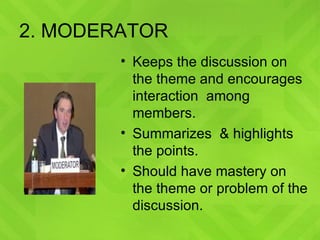
2. MODERATOR Keeps the discussion on the theme and encourages interaction  among members. Summarizes  & highlights the points. Should have mastery on the theme or problem of the discussion.
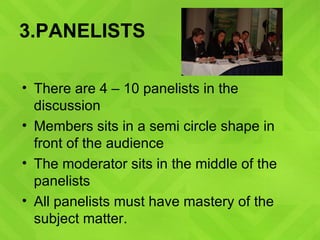
3.PANELISTS There are 4 – 10 panelists in the discussion  Members sits in a semi circle shape in front of the audience The moderator sits in the middle of the panelists  All panelists must have mastery of the subject matter.
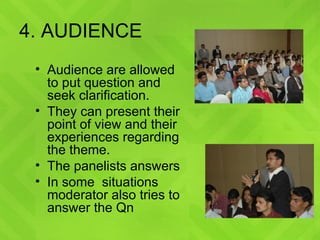
4. AUDIENCE Audience are allowed to put question and seek clarification. They can present their point of view and their experiences regarding the theme. The panelists answers  In some  situations moderator also tries to answer the Qn
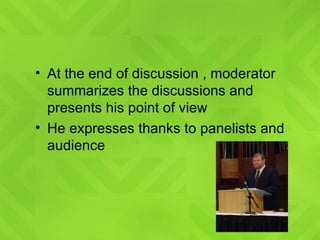
At the end of discussion , moderator summarizes the discussions and presents his point of view He expresses thanks to panelists and audience
Characteristics of panel discussion Used in university & college level to organize teaching at reflective level Develops the ability of problem solving Helps to understand nature, problem or theme of discussion Develops ability of presentation of theme and giving their point of view logically. Develops right type of attitude and ability to tolerate anti- ideas of others Helps in creative thinking Develops manners of putting Qn.s & answering them
Advantages of panel discussion Encourages social learning Higher cognitive and affective objectives are achieved Used to develop ability of problem solving and logical thinking Develops capacity to respect others ideas and feelings & ability to tolerate. It provides opportunities of assimilation of theme and content.
Topic used in panel discussion Education as an instrument of social change. Student teaching in teacher educatinon programme. Population education. Scope of educational technology in our country Examination reform
Limitations of panel discussion There are chances to deviate from the theme of discussion  some members may dominate There is possibility to split the group in to two subgroups ( for & against) If panelist belong to different groups, it may not create appropriate learning situation
How to organize effective panel discussions  There should be a rehearsal before actual panel discussions The moderator should be a matured person and should have the full understanding of theme / problem & should have full control over the situation. The seating arrangement should be such that every one should be of equal distance  & should observe each other. Moderator should encourage constructive discussion among panelists and audience
The end

PANEL DISCUSSION

  • 1.
    PANEL DISCUSSION Ms.JEENA AEJY MS(N)
  • 2.
  • 3.
    ORIGIN Panel discussiontechnique was originated by Harry . A. Overstreet in 1929
  • 4.
    definition: PANEL DISCUSSIONIt is a discussion in which few persons ( the panel) carry on conversation in front of the audience. At the end of the discussion audience also participates. The audience put important questions and the experts answers them and clarify the points
  • 5.
    purpose Purpose ofthe panel discussion is to reproduce the features of a small discussion group for the benefit of a larger group
  • 6.
    OBJECTIVES OF PANELDISCUSSION To provide information and new facts. To analyze a problem from different angles To identify the values. To organize for mental recreation
  • 7.
    TYPES OF PANELDISCUSSIONS 1. public panel discussions 2. educational panel discussions
  • 8.
    PUBLIC PANEL DISCUSSIONSThese are organized for common men problems. Objectives: To provide factual information regarding current problems To determine social values To recreate the common men E.g. annual budget, educated unemployment , increase in price of things.
  • 9.
    EDUCATIONAL PANEL DISCUSSIONSUsed in educational institutions to provide factual & conceptual knowledge and clarification of certain theories and principles. Some times these are organized to find out the solutions of certain problems
  • 10.
    Objectives of educationalpanel discussions To provide factual information and conceptual knowledge To give awareness of theories and principles To provide solution of certain problems
  • 11.
    Procedure of panel discussion
  • 12.
    Types of members in panel discussion Instructor Moderator Panelists Audience
  • 13.
    1.INSTRUCTOR Plays most important role in panel discussion Plans how , where , when panel discussion will be organized Prepares the schedule for panel discussion Sometimes rehearsal is also planned
  • 14.
    2. MODERATOR Keepsthe discussion on the theme and encourages interaction among members. Summarizes & highlights the points. Should have mastery on the theme or problem of the discussion.
  • 15.
    3.PANELISTS There are4 – 10 panelists in the discussion Members sits in a semi circle shape in front of the audience The moderator sits in the middle of the panelists All panelists must have mastery of the subject matter.
  • 16.
    4. AUDIENCE Audienceare allowed to put question and seek clarification. They can present their point of view and their experiences regarding the theme. The panelists answers In some situations moderator also tries to answer the Qn
  • 17.
    At the endof discussion , moderator summarizes the discussions and presents his point of view He expresses thanks to panelists and audience
  • 18.
    Characteristics of paneldiscussion Used in university & college level to organize teaching at reflective level Develops the ability of problem solving Helps to understand nature, problem or theme of discussion Develops ability of presentation of theme and giving their point of view logically. Develops right type of attitude and ability to tolerate anti- ideas of others Helps in creative thinking Develops manners of putting Qn.s & answering them
  • 19.
    Advantages of paneldiscussion Encourages social learning Higher cognitive and affective objectives are achieved Used to develop ability of problem solving and logical thinking Develops capacity to respect others ideas and feelings & ability to tolerate. It provides opportunities of assimilation of theme and content.
  • 20.
    Topic used inpanel discussion Education as an instrument of social change. Student teaching in teacher educatinon programme. Population education. Scope of educational technology in our country Examination reform
  • 21.
    Limitations of paneldiscussion There are chances to deviate from the theme of discussion some members may dominate There is possibility to split the group in to two subgroups ( for & against) If panelist belong to different groups, it may not create appropriate learning situation
  • 22.
    How to organizeeffective panel discussions There should be a rehearsal before actual panel discussions The moderator should be a matured person and should have the full understanding of theme / problem & should have full control over the situation. The seating arrangement should be such that every one should be of equal distance & should observe each other. Moderator should encourage constructive discussion among panelists and audience
  • 23.