SCREENING

Prepared By Dr. Anees AlSaadi
CMT-P R4
December 2013
1
SCREENING
• Outline:
– Definition of Screening.
– Differentiation between Screening and Diagnostic test?
– Uses/Purpose of Screening.
– Types and Examples of Screening test.
– Criteria for successful screening program.
– Relation ship between sensitivity and specify.
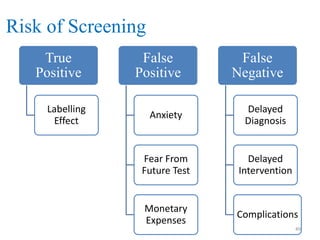
– Risk of Screening.
2
How We Can Define Screening ….?

3
Definition
The early detection of:
– Disease
– Precursors of Disease
– Susceptibility to Disease
In individuals who do not show any signs of
disease.

4
Definition
The presumptive identification of those who
probably have disease from those who do not
have

by
means of rapidly applied tests in apparently
healthy individuals.
5
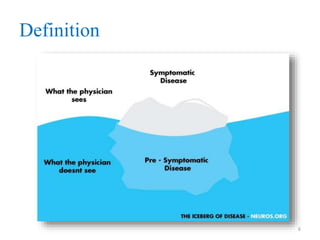
Definition

6
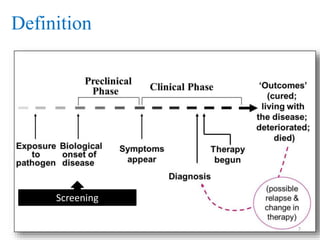
Definition

Screening
7
How we can Differentiate Between
Screening and Diagnostic Tests ….?

8
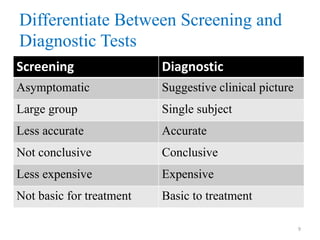
Differentiate Between Screening and
Diagnostic Tests
Screening

Diagnostic

Asymptomatic

Suggestive clinical picture

Large group

Single subject

Less accurate

Accurate

Not conclusive

Conclusive

Less expensive

Expensive

Not basic for treatment

Basic to treatment
9
What are the Uses of Screening ….?

10
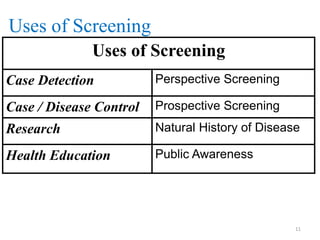
Uses of Screening
Uses of Screening
Case Detection

Perspective Screening

Case / Disease Control

Prospective Screening

Research

Natural History of Disease

Health Education

Public Awareness

11
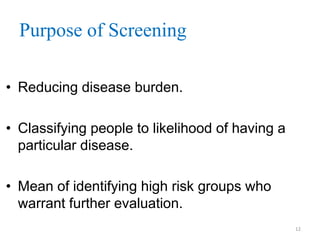
Purpose of Screening
• Reducing disease burden.

• Classifying people to likelihood of having a
particular disease.
• Mean of identifying high risk groups who
warrant further evaluation.
12
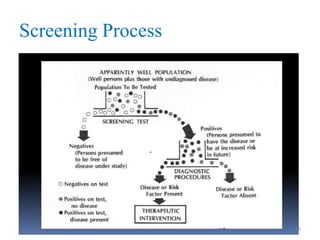
Screening Process

13
Types of Screening Test

What are the Type of Screening Tests …?

14
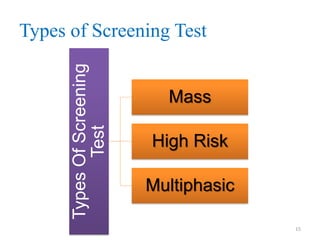
Types Of Screening
Test

Types of Screening Test
Mass
High Risk
Multiphasic
15
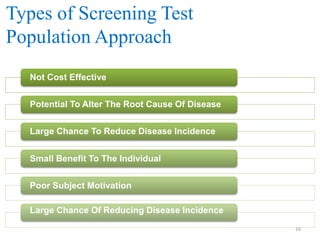
Types of Screening Test
Population Approach
Not Cost Effective
Potential To Alter The Root Cause Of Disease
Large Chance To Reduce Disease Incidence
Small Benefit To The Individual
Poor Subject Motivation
Large Chance Of Reducing Disease Incidence
16
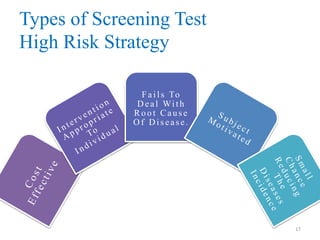
Types of Screening Test
High Risk Strategy
F a i l s To
D eal With
Root Cause
Of Disease.

17
Can You Give Some Examples For
Screening Tests … ?

18
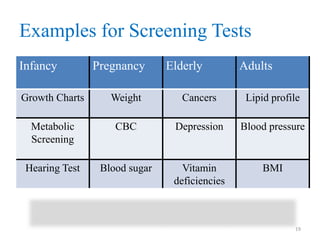
Examples for Screening Tests
Infancy

Pregnancy

Elderly

Adults

Growth Charts

Weight

Cancers

Lipid profile

Metabolic
Screening

CBC

Depression

Blood pressure

Hearing Test

Blood sugar

Vitamin
deficiencies

BMI

19
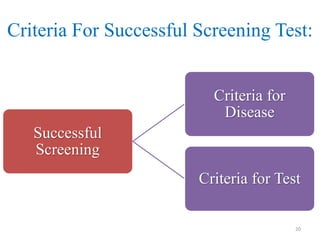
Criteria For Successful Screening Test:

Criteria for
Disease
Successful
Screening
Criteria for Test
20
Criteria For Successful Screening Test:
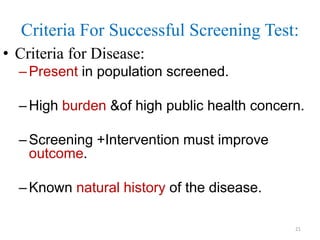
• Criteria for Disease:
– Present in population screened.
– High burden &of high public health concern.
– Screening +Intervention must improve
outcome.
– Known natural history of the disease.
21
Criteria For Successful Screening Test:
• Criteria for Test:
– Reliable.
– Valid.
– Simple and inexpensive.
– Very safe.
– Acceptable to subjects and providers.
– Cost-effective.
– Exit strategy.
22
Criteria For Successful Screening Test:
• Exit strategy:
• Facilities for diagnosis and appropriate
treatments should be available for positive
subjects.
• Ethically not acceptable to offer screening
without available management.

23
Criteria For Successful Screening Test:
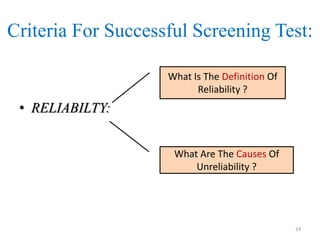
What Is The Definition Of
Reliability ?

• RELIABILTY:
What Are The Causes Of
Unreliability ?

24
Criteria For Successful Screening Test:
Definition of Reliability:
– Repeatability, Reducibility, Precision.
– Getting the same results, when the test
repeated in same target individuals in the
same settings.

25
Criteria For Successful Screening Test:
Causes of unreliability:
– Observer variation.
– Subject variation – Biological.
– Technical method error variation.

26
Criteria For Successful Screening Test:
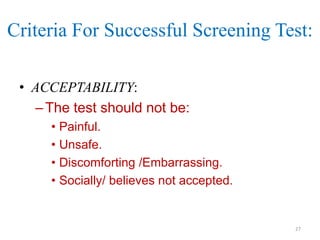
• ACCEPTABILITY:
– The test should not be:
• Painful.
• Unsafe.
• Discomforting /Embarrassing.
• Socially/ believes not accepted.

27
Criteria For Successful Screening Test:

VALIDITY:
Ability of the test to distinguish between who
has the diseases and who does not.

28
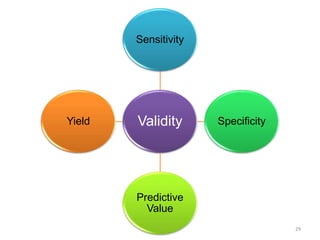
Sensitivity

Yield

Validity

Specificity

Predictive
Value
29
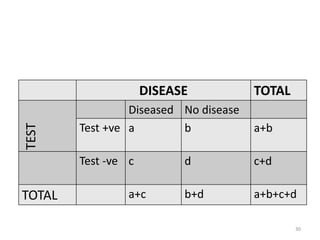
DISEASE

TOTAL

TEST

a+b

Test -ve c

TOTAL

Diseased No disease
Test +ve a
b
d

c+d

b+d

a+b+c+d

a+c

30
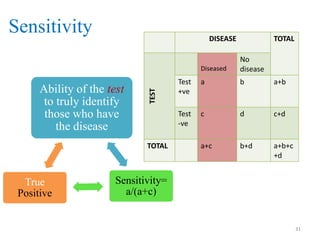
Sensitivity

DISEASE

TOTAL

Ability of the test
to truly identify
those who have
the disease

TOTAL

True
Positive

Test
+ve

a

b

a+b

Test
-ve

TEST

Diseased

No
disease

c

d

c+d

a+c

b+d

a+b+c
+d

Sensitivity=
a/(a+c)

31
Sensitivity

[[A 90% Sensitivity means that 90% of the diseased
people screened by the test will give a “true
positive” and the remaining 10% a “false negative
results”]]
Positive test
and have the
disease.

Negative test
and have the
disease.

32
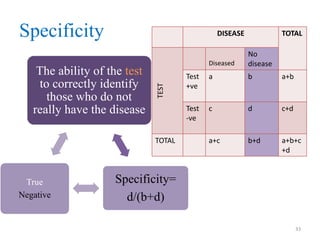
Specificity

DISEASE

Diseased

TOTAL

True
Negative

No
disease

Test
+ve

a

b

a+b

Test
-ve

TEST

The ability of the test
to correctly identify
those who do not
really have the disease

TOTAL

c

d

c+d

a+c

b+d

a+b+c
+d

Specificity=
d/(b+d)
33
Specificity

[[A 90% Specificity means that 90% of the non
diseased people screened by the test will give a “true
negative” result, and the remaining 10% a “false
negative results”]]

Negative test and do
not have the disease.

Negative test and have the
disease.
34
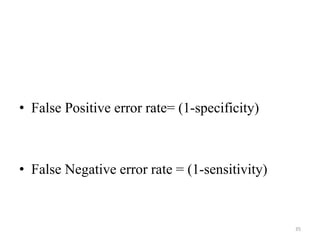
• False Positive error rate= (1-specificity)

• False Negative error rate = (1-sensitivity)

35
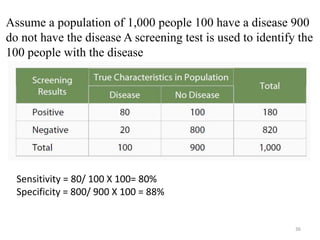
Assume a population of 1,000 people 100 have a disease 900
do not have the disease A screening test is used to identify the
100 people with the disease

Sensitivity = 80/ 100 X 100= 80%
Specificity = 800/ 900 X 100 = 88%

36
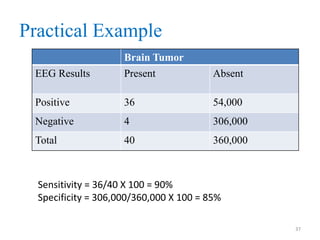
Practical Example
EEG Results

Brain Tumor
Present

Absent

Positive

36

54,000

Negative

4

306,000

Total

40

360,000

Sensitivity = 36/40 X 100 = 90%
Specificity = 306,000/360,000 X 100 = 85%
37
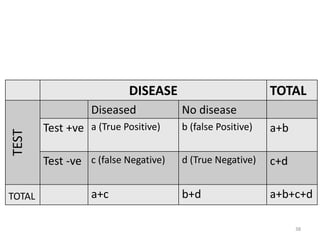
DISEASE

TEST

Diseased

TOTAL

TOTAL
No disease

Test +ve a (True Positive)

b (false Positive)

a+b

Test -ve c (false Negative)

d (True Negative)

c+d

b+d

a+b+c+d

a+c

38
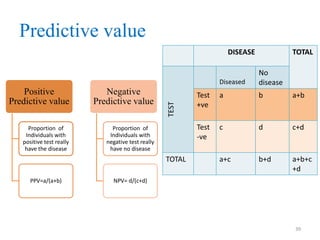
Predictive value
DISEASE

TOTAL

Diseased

Negative
Predictive value

Proportion of
Individuals with
positive test really
have the disease

TOTAL
PPV=a/(a+b)

Test
+ve

a

b

a+b

Test
-ve

Proportion of
Individuals with
negative test really
have no disease

TEST

Positive
Predictive value

No
disease

c

d

c+d

a+c

b+d

a+b+c
+d

NPV= d/(c+d)

39
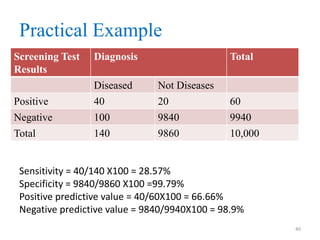
Practical Example
Screening Test
Results

Diagnosis

Total

Positive
Negative

Diseased
40
100

Not Diseases
20
9840

60
9940

Total

140

9860

10,000

Sensitivity = 40/140 X100 = 28.57%
Specificity = 9840/9860 X100 =99.79%
Positive predictive value = 40/60X100 = 66.66%
Negative predictive value = 9840/9940X100 = 98.9%
40
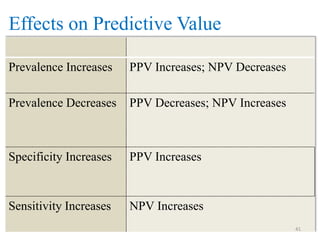
Effects on Predictive Value
Prevalence Increases

PPV Increases; NPV Decreases

Prevalence Decreases

PPV Decreases; NPV Increases

Specificity Increases

PPV Increases

Sensitivity Increases

NPV Increases
41
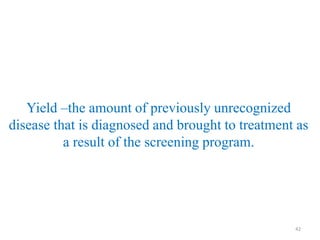
Yield –the amount of previously unrecognized
disease that is diagnosed and brought to treatment as
a result of the screening program.

42
Practical Exercise

43
What is better a test with high sensitivity
or with high specificity…?

44
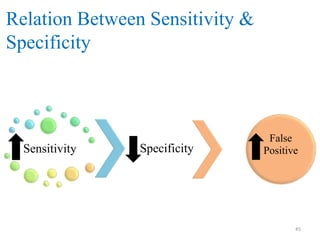
Relation Between Sensitivity &
Specificity

Sensitivity

Specificity

False
Positive

45
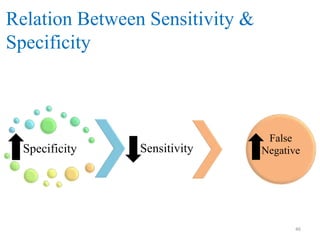
Relation Between Sensitivity &
Specificity

Specificity

Sensitivity

False
Negative

46
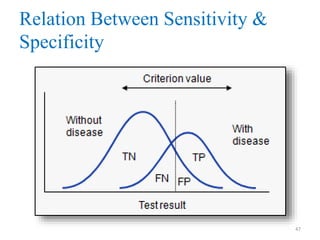
Relation Between Sensitivity &
Specificity

47
What
about
Risk of
Screening …?
48
Risk of Screening
True
Positive
Labelling
Effect

False
Positive

False
Negative

Anxiety

Delayed
Diagnosis

Fear From
Future Test

Delayed
Intervention

Monetary
Expenses

Complications
49
50

Screening