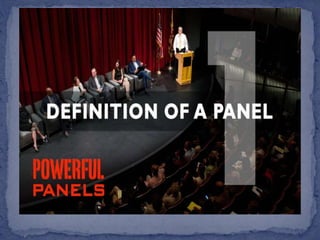
 This technique at first was used by HERRY A OBER
STREET in 1929.
 A conversation about a topic conducted by a group of
experts, usually either in the presence of an audience
or in a broadcast (both)”.
Or
 It is a discussion in which few persons (the panel)
carry on conversation in front of the audience.
-at the end of the discussion audience also participates
 Reproduce the features of a small discussion group for
the benefit of the larger group
 To provide information and new facts.
 To analyze a problem from different angles.
 To identify the values.
 To organize for mental recreation.
develops the
manners
tolerate anti ideas of
others
opportunities to
understand
problem solving
ability
used at college
and university
level
Public panel discussion
Educational panel discussion
Factual
information
Determine social
values
Recreate common
man
Factual and
conceptual
knowledge
Provide
solution to
problem
Awareness
of theories
and
principles
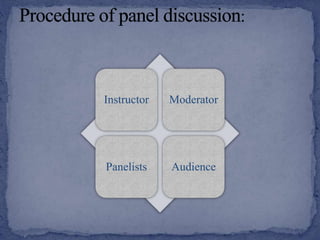
Instructor Moderator
Panelists Audience
 This technique encourages social learning.
 Develop the abilities of problem solving and logical
thinking.
 Develops the interests and right type of attitude
towards the problem.
 Develops the capacity to respect others ideas and
feelings and ability to tolerance.
 Provides the opportunities of assimilation of theme
and content
chances to deviate from theme
dominating
members
different
group panelists
possibility to
split the group
 Panel discussion must be organized well in
advance.
 Complete information about the audience.
 Panelists must be prepared with their talks.
 Follow the time limits.
 Keep calm and confident.
 Do not interfere when the other panelist is doing
his/her talk.
 Avoid questions from the audience.
 Do not fidget or slouch in your seat.
 Be honest in approach.
 Rehearsal
 Full understanding
 seating arrangement
 moderator should encourage the discussion
Panel discussion
Panel discussion
Panel discussion
Panel discussion

Panel discussion