 Definition

of symposium
 Objectives of symposium
 Purpose of symposium
 Characteristics of symposium
 Techniques of symposium
 Scope for the use of symposium
 Limitation of symposium
 Advantages of symposium
 Disadvantages of symposium
 Role of symposium in nursing education


“The symposium forum serves an excellent device for informing
an audience, crystallizing opinion and in general preparing the
listeners for arriving at decision policies, values, judgment or
understanding.”



“Symposium consists of a set of program of prepared speeches
followed by audience discussion”



“Symposium is a technique in which two or more person
under the direction of a chairman presents several speeches, which
give several aspect of one question”.
The following are main objectives of the symposium: To identify and understand two various aspects of the
theme.
 To develop the ability to decision and judgment regard a
problem.
 To develop the values and feeling regarding a problem.
 To enable the listeners to form policies regarding a theme
or problem.

The symposium has the following main characteristics: It

provides the broad understandings of a topic or a
problem.
 The opportunity is provided to the listeners to take decision
about the Problem.
 It is used for higher classes to specific theme and problem.
 It develops the feeling of co-operation and adjustment. The
objectives as
synthesis and evaluation are achieved by
employing the symposium.
 It provides the different views on the topic of the
symposium.
 Use

of television for education.

 Scope

for the distance education in our
education.

 Use

of essay and objective type of test.

 Semester
 Cause

system in education.

of student unrest.
 Quality

 Use

control of education research.

of microteaching in teacher education

.


Use of team teaching in school.

 Use

of action research in classroom teaching.

 Scope

of education technology in our education.
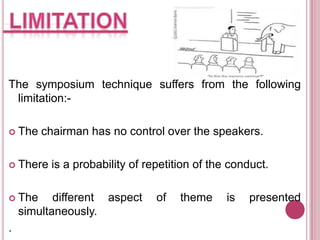
The symposium technique suffers from the following
limitation: The

chairman has no control over the speakers.

 There

 The

is a probability of repetition of the conduct.

different aspect
simultaneously.

.

of

theme

is

presented
 The

listeners remain passive in the symposium.

 The

discussion and presentation of the theme is not
summarized at the end.

 This

technique is employed to achieve the higher
objectives of cognitive domain but affective are not
emphasized properly.
 It

is suited to a large group or classes.

 This

method can be frequently used to
present broad topics for discussion at
conventions and organization meetings.

 Organization

is good because of the set
speeches prepared before hand.
 Gives

deeper insight into the topic.

 Directs

the students continuously in
dependent study.

 Hands

itself to the teaching of clinical
subjects.

 This

method can be use in political meetings.
 Inadequate

opportunity for all the students to
participate actively.
 The speeches are limited to 15-20 minutes.
 Limited audience participation.
 Question and answer limited to 3 or 4 minutes.
 Possibility of overlapping the subjects.


The symposium will provide a valuable opportunity for nurses from
different cultural background and diverse field to changing role of

nurses in community and home care from international perspective
to promote the generation and implementation of evidence based
practice in community and home nursing through sharing and
exchange of information on the latest development in the discipline
among expert from across the globe, this symposium will contribute
formulating global and regional strategies in advancing nurses role
as well as developing policy initiative in as it relates to nursing

practice, nursing education nursing management and disaster
management.
BOOKS:BASAVANTHAPPA,B.T., “COMMUNITY HEALTH
NURSING”, JAYPEE PUBLISHERS, SECOND EDITION
2008, PAGE NO. 245.
 PARS K. “TEXT BOOK OF PREVENTIVE AND SOCIAL
MEDITION” BANARSIDAS BHANNOT PUBLISHERS 2OTH
EDITION 2009.
 SHARMA KUMAR DINESH “COMMUNICATION &
EDUCATIONAL TECHNOLOGY, LOTUS PUBLISHERS 2ND
EDITION 2012, PAGE NO. 175-177.
JOURNAL: JOURNALS OF NURSING EDUCATION, JANUARY
2010, VOLUME 49.
INTERNET: www.wikepedia.com

Symposium

Symposium

  • 3.
     Definition of symposium Objectives of symposium  Purpose of symposium  Characteristics of symposium  Techniques of symposium  Scope for the use of symposium  Limitation of symposium  Advantages of symposium  Disadvantages of symposium  Role of symposium in nursing education
  • 4.
     “The symposium forumserves an excellent device for informing an audience, crystallizing opinion and in general preparing the listeners for arriving at decision policies, values, judgment or understanding.”  “Symposium consists of a set of program of prepared speeches followed by audience discussion”  “Symposium is a technique in which two or more person under the direction of a chairman presents several speeches, which give several aspect of one question”.
  • 5.
    The following aremain objectives of the symposium: To identify and understand two various aspects of the theme.  To develop the ability to decision and judgment regard a problem.  To develop the values and feeling regarding a problem.  To enable the listeners to form policies regarding a theme or problem. 
  • 7.
    The symposium hasthe following main characteristics: It provides the broad understandings of a topic or a problem.  The opportunity is provided to the listeners to take decision about the Problem.  It is used for higher classes to specific theme and problem.  It develops the feeling of co-operation and adjustment. The objectives as synthesis and evaluation are achieved by employing the symposium.  It provides the different views on the topic of the symposium.
  • 9.
     Use of televisionfor education.  Scope for the distance education in our education.  Use of essay and objective type of test.  Semester  Cause system in education. of student unrest.
  • 10.
     Quality  Use controlof education research. of microteaching in teacher education .  Use of team teaching in school.  Use of action research in classroom teaching.  Scope of education technology in our education.
  • 11.
    The symposium techniquesuffers from the following limitation: The chairman has no control over the speakers.  There  The is a probability of repetition of the conduct. different aspect simultaneously. . of theme is presented
  • 12.
     The listeners remainpassive in the symposium.  The discussion and presentation of the theme is not summarized at the end.  This technique is employed to achieve the higher objectives of cognitive domain but affective are not emphasized properly.
  • 13.
     It is suitedto a large group or classes.  This method can be frequently used to present broad topics for discussion at conventions and organization meetings.  Organization is good because of the set speeches prepared before hand.
  • 14.
     Gives deeper insightinto the topic.  Directs the students continuously in dependent study.  Hands itself to the teaching of clinical subjects.  This method can be use in political meetings.
  • 15.
     Inadequate opportunity forall the students to participate actively.  The speeches are limited to 15-20 minutes.  Limited audience participation.  Question and answer limited to 3 or 4 minutes.  Possibility of overlapping the subjects.
  • 16.
     The symposium willprovide a valuable opportunity for nurses from different cultural background and diverse field to changing role of nurses in community and home care from international perspective to promote the generation and implementation of evidence based practice in community and home nursing through sharing and exchange of information on the latest development in the discipline among expert from across the globe, this symposium will contribute formulating global and regional strategies in advancing nurses role as well as developing policy initiative in as it relates to nursing practice, nursing education nursing management and disaster management.
  • 17.
    BOOKS:BASAVANTHAPPA,B.T., “COMMUNITY HEALTH NURSING”,JAYPEE PUBLISHERS, SECOND EDITION 2008, PAGE NO. 245.  PARS K. “TEXT BOOK OF PREVENTIVE AND SOCIAL MEDITION” BANARSIDAS BHANNOT PUBLISHERS 2OTH EDITION 2009.  SHARMA KUMAR DINESH “COMMUNICATION & EDUCATIONAL TECHNOLOGY, LOTUS PUBLISHERS 2ND EDITION 2012, PAGE NO. 175-177. JOURNAL: JOURNALS OF NURSING EDUCATION, JANUARY 2010, VOLUME 49. INTERNET: www.wikepedia.com 