SURUCHI KANDEL
BSC NURSING 3RD
YEAR
ROLL NO: 11
CONTENTS
INTRODUCTION
DEFINITION
PURPOSES
PRINCIPLES
METHODS
ROLE OF TEACHER
ROLE OF STUDENTS
ADVANTAGES
LIMITATIONS
INTRODUCTION
Seminars is the method of teaching also
involves discussion but in informal way.
A group of 10-20 students take part in seminar
One student from the group prepares a paper
& reads out.
The whole seminar lasts for 1-2 hours and the
time allowed for paper presentation is about
15-20 minutes.
DEFINITION
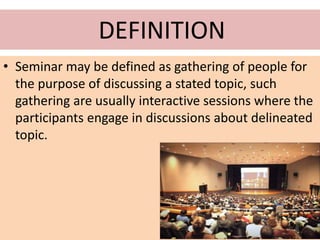
• Seminar may be defined as gathering of people for
the purpose of discussing a stated topic, such
gathering are usually interactive sessions where the
participants engage in discussions about delineated
topic.
PURPOSES
To promote the independent learning.
To get students involved in discussions.
To get students listen to one another.
To foster responsibility for one’s own learning.
To make students feel like they are part of a
group.
To provide an opportunity for arguments.
CONTD….
To promote critical engagement with areas of
uncertainty in sociology.
To present students assignments.
PRINCIPLES
Seminars operate simultaneously on
intellectual, affective and social levels while
the experienced group leader may not be
conscious of these levels all the time.
Seminars are not simply about learning in a
given subject discipline, they are also about
learning to learn
All the participants bear some share of
responsibility for the success of the individual
session or the programme as a whole.
CONTD….
The tutor/leader has a particular responsibility
to:
Structure the seminar in such a way as to
enable participation
Maintain the group’s working environment
Establish ground rules about participation and
preparation
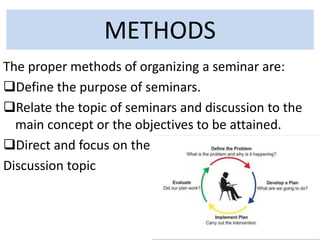
METHODS
The proper methods of organizing a seminar are:
Define the purpose of seminars.
Relate the topic of seminars and discussion to the
main concept or the objectives to be attained.
Direct and focus on the
Discussion topic
Help students to express their ideas and keep
the discussion at a high level of interest so
that the students listen attentively to those
who contribute the ideas
Plan comments and question that relate to
the subject and also guide and direct the
discussion
Set the time limitations for each person’s
contribution
Guard against monopoly of the discussion by any
member of the seminar
Plan for summary at intervals during discussion
and also at the end of the discussion and relate
the ideas expressed to the purpose of discussion
Have the discussion recorded by a student as a
recording secretary or by tape recording
Plan for teacher & student self evaluation of
progress made towards the immediate
objectives
ROLES OF TEACHERS
Select the topic
Remain in the background in the seminar, but sit
where the whole group can be seen
Prepare to help out in initial stages of using this
method in case of long silence
Be sure that essential points are not overlooked
and that gross inadequacies are corrected
Make sure that all members have a share in
discussion & that irrelevant discussion is avoided
ROLES OF STUDENTS
The student may be delegated the
responsibility of leading the seminar by the
teacher. They have to take also the
responsibility of organizing the event
themselves when it used as an assignment,
the modality of conducting the seminars Is the
same as conducting the discussion method.
ADVANTAGES
Every student participates actively in library
search or in learning
Student learns scientific approach to problem
solving through literature search
It promotes analytical thinking & creativity
among students
Students learn communication skill & become
articulate
Student gain experience of organizing an
event
LIMITATIONS
It is time consuming
It cannot be used for all level of students ,
especially for the students new to the
programme.
ANY QUESTIONS?????
Seminars

Seminars

  • 1.
    SURUCHI KANDEL BSC NURSING3RD YEAR ROLL NO: 11
  • 2.
  • 3.
    INTRODUCTION Seminars is themethod of teaching also involves discussion but in informal way. A group of 10-20 students take part in seminar One student from the group prepares a paper & reads out. The whole seminar lasts for 1-2 hours and the time allowed for paper presentation is about 15-20 minutes.
  • 4.
    DEFINITION • Seminar maybe defined as gathering of people for the purpose of discussing a stated topic, such gathering are usually interactive sessions where the participants engage in discussions about delineated topic.
  • 5.
    PURPOSES To promote theindependent learning. To get students involved in discussions. To get students listen to one another. To foster responsibility for one’s own learning. To make students feel like they are part of a group. To provide an opportunity for arguments.
  • 6.
    CONTD…. To promote criticalengagement with areas of uncertainty in sociology. To present students assignments.
  • 7.
    PRINCIPLES Seminars operate simultaneouslyon intellectual, affective and social levels while the experienced group leader may not be conscious of these levels all the time. Seminars are not simply about learning in a given subject discipline, they are also about learning to learn All the participants bear some share of responsibility for the success of the individual session or the programme as a whole.
  • 8.
    CONTD…. The tutor/leader hasa particular responsibility to: Structure the seminar in such a way as to enable participation Maintain the group’s working environment Establish ground rules about participation and preparation
  • 9.
    METHODS The proper methodsof organizing a seminar are: Define the purpose of seminars. Relate the topic of seminars and discussion to the main concept or the objectives to be attained. Direct and focus on the Discussion topic
  • 10.
    Help students toexpress their ideas and keep the discussion at a high level of interest so that the students listen attentively to those who contribute the ideas Plan comments and question that relate to the subject and also guide and direct the discussion Set the time limitations for each person’s contribution
  • 11.
    Guard against monopolyof the discussion by any member of the seminar Plan for summary at intervals during discussion and also at the end of the discussion and relate the ideas expressed to the purpose of discussion Have the discussion recorded by a student as a recording secretary or by tape recording Plan for teacher & student self evaluation of progress made towards the immediate objectives
  • 12.
    ROLES OF TEACHERS Selectthe topic Remain in the background in the seminar, but sit where the whole group can be seen Prepare to help out in initial stages of using this method in case of long silence Be sure that essential points are not overlooked and that gross inadequacies are corrected Make sure that all members have a share in discussion & that irrelevant discussion is avoided
  • 13.
    ROLES OF STUDENTS Thestudent may be delegated the responsibility of leading the seminar by the teacher. They have to take also the responsibility of organizing the event themselves when it used as an assignment, the modality of conducting the seminars Is the same as conducting the discussion method.
  • 14.
    ADVANTAGES Every student participatesactively in library search or in learning Student learns scientific approach to problem solving through literature search It promotes analytical thinking & creativity among students Students learn communication skill & become articulate Student gain experience of organizing an event
  • 15.
    LIMITATIONS It is timeconsuming It cannot be used for all level of students , especially for the students new to the programme.
  • 17.