Iceberg of DiseaseIceberg of Disease
Concepts of control andConcepts of control and
Levels of PreventionLevels of Prevention
Dr. Jai Kershan, MD, MSPHDr. Jai Kershan, MD, MSPH
(USA)(USA)
http://jaikershan.blogspot.comhttp://jaikershan.blogspot.com
We will learn in this presentationWe will learn in this presentation
 Concepts of iceberg of diseaseConcepts of iceberg of disease
 Concepts of disease controlConcepts of disease control
 Concepts of prevention, likeConcepts of prevention, like
• Primary, secondary & tertiary preventionPrimary, secondary & tertiary prevention
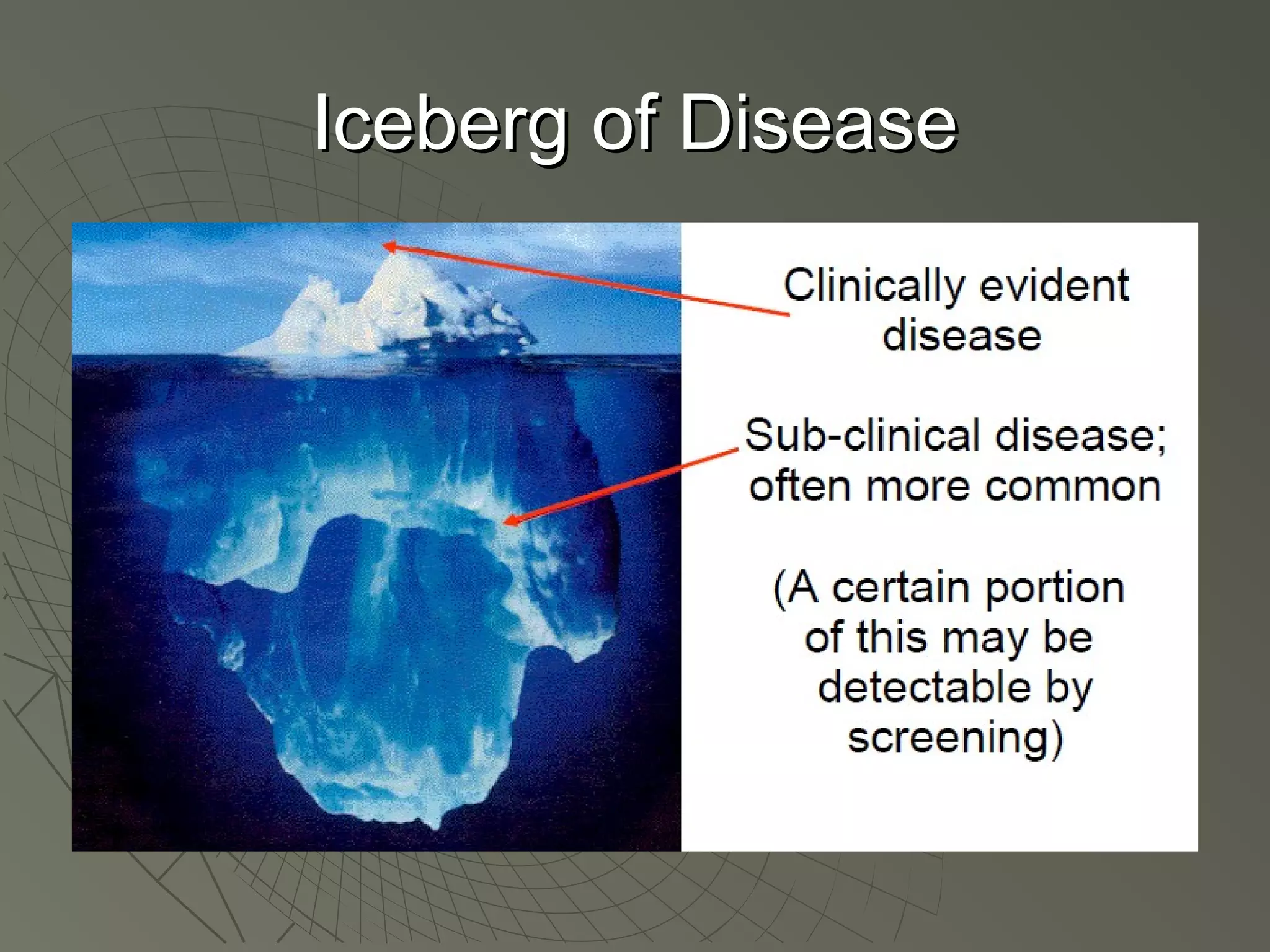
Iceberg of DiseaseIceberg of Disease
continuecontinue
 The floating tip of ice bergThe floating tip of ice berg
represents clinical casesrepresents clinical cases
 Submerge portion showsSubmerge portion shows
undiagnosed cases or hidden mass ofundiagnosed cases or hidden mass of
diseasedisease
 Undiagnosed reservoir of disease is aUndiagnosed reservoir of disease is a
challenge to modern techniques inchallenge to modern techniques in
preventive medicinepreventive medicine
Disease controlDisease control
 Aimed at reducingAimed at reducing
• Incidence of diseaseIncidence of disease
• Duration of diseaseDuration of disease
• Physical and psychological complicationsPhysical and psychological complications
• Reducing financial burden of communityReducing financial burden of community
 Activities consist of primaryActivities consist of primary
preventionprevention
 Can be secondary preventionCan be secondary prevention
Primordial preventionPrimordial prevention
 This is special in the sense ofThis is special in the sense of
preventing chronic diseases likepreventing chronic diseases like
• obesity and hypertensionobesity and hypertension
 Prevention of risk factors inPrevention of risk factors in
population which have yet notpopulation which have yet not
appearedappeared
 Smoking, eating patterns, exerciseSmoking, eating patterns, exercise
 Main intervention is mass educationMain intervention is mass education
Primary preventionPrimary prevention
 Defined as action taken prior toDefined as action taken prior to
onset of diseaseonset of disease
 Intervention in prepathogensis ofIntervention in prepathogensis of
diseasedisease
 WHO recommended two approachesWHO recommended two approaches
 Population strategyPopulation strategy
 High risk strategyHigh risk strategy
Population strategyPopulation strategy
 Directed at whole populationDirected at whole population
 Education of exerciseEducation of exercise
 Lowers serum cholesterolLowers serum cholesterol
 Lowers risk of cardiovascular diseasesLowers risk of cardiovascular diseases
 High risk strategyHigh risk strategy
 Preventive care to people at special riskPreventive care to people at special risk
 Safety and lower cost justifies its widerSafety and lower cost justifies its wider
applicationapplication
Secondary preventionSecondary prevention
 Action taken at incipient stage ofAction taken at incipient stage of
diseasedisease
 Specific interventions areSpecific interventions are
• ScreeningScreening
• Case finding programsCase finding programs
• more expensive and less effective thanmore expensive and less effective than
primary preventionprimary prevention
 Draw back is patient feels pain &Draw back is patient feels pain &
productivityproductivity
Tertiary preventionTertiary prevention
 When disease is advanced beyond itsWhen disease is advanced beyond its
early stagesearly stages
• All measures available to reduce painAll measures available to reduce pain
and diseasesand diseases
• When disability stabilized then applyWhen disability stabilized then apply
rehabilitationrehabilitation
• Consist of psychosocial, vocational andConsist of psychosocial, vocational and
medical componentsmedical components

Iceberg of disease

  • 1.
    Iceberg of DiseaseIcebergof Disease Concepts of control andConcepts of control and Levels of PreventionLevels of Prevention Dr. Jai Kershan, MD, MSPHDr. Jai Kershan, MD, MSPH (USA)(USA) http://jaikershan.blogspot.comhttp://jaikershan.blogspot.com
  • 2.
    We will learnin this presentationWe will learn in this presentation  Concepts of iceberg of diseaseConcepts of iceberg of disease  Concepts of disease controlConcepts of disease control  Concepts of prevention, likeConcepts of prevention, like • Primary, secondary & tertiary preventionPrimary, secondary & tertiary prevention
  • 3.
  • 4.
    continuecontinue  The floatingtip of ice bergThe floating tip of ice berg represents clinical casesrepresents clinical cases  Submerge portion showsSubmerge portion shows undiagnosed cases or hidden mass ofundiagnosed cases or hidden mass of diseasedisease  Undiagnosed reservoir of disease is aUndiagnosed reservoir of disease is a challenge to modern techniques inchallenge to modern techniques in preventive medicinepreventive medicine
  • 5.
    Disease controlDisease control Aimed at reducingAimed at reducing • Incidence of diseaseIncidence of disease • Duration of diseaseDuration of disease • Physical and psychological complicationsPhysical and psychological complications • Reducing financial burden of communityReducing financial burden of community  Activities consist of primaryActivities consist of primary preventionprevention  Can be secondary preventionCan be secondary prevention
  • 6.
    Primordial preventionPrimordial prevention This is special in the sense ofThis is special in the sense of preventing chronic diseases likepreventing chronic diseases like • obesity and hypertensionobesity and hypertension  Prevention of risk factors inPrevention of risk factors in population which have yet notpopulation which have yet not appearedappeared  Smoking, eating patterns, exerciseSmoking, eating patterns, exercise  Main intervention is mass educationMain intervention is mass education
  • 7.
    Primary preventionPrimary prevention Defined as action taken prior toDefined as action taken prior to onset of diseaseonset of disease  Intervention in prepathogensis ofIntervention in prepathogensis of diseasedisease  WHO recommended two approachesWHO recommended two approaches  Population strategyPopulation strategy  High risk strategyHigh risk strategy
  • 8.
    Population strategyPopulation strategy Directed at whole populationDirected at whole population  Education of exerciseEducation of exercise  Lowers serum cholesterolLowers serum cholesterol  Lowers risk of cardiovascular diseasesLowers risk of cardiovascular diseases  High risk strategyHigh risk strategy  Preventive care to people at special riskPreventive care to people at special risk  Safety and lower cost justifies its widerSafety and lower cost justifies its wider applicationapplication
  • 9.
    Secondary preventionSecondary prevention Action taken at incipient stage ofAction taken at incipient stage of diseasedisease  Specific interventions areSpecific interventions are • ScreeningScreening • Case finding programsCase finding programs • more expensive and less effective thanmore expensive and less effective than primary preventionprimary prevention  Draw back is patient feels pain &Draw back is patient feels pain & productivityproductivity
  • 10.
    Tertiary preventionTertiary prevention When disease is advanced beyond itsWhen disease is advanced beyond its early stagesearly stages • All measures available to reduce painAll measures available to reduce pain and diseasesand diseases • When disability stabilized then applyWhen disability stabilized then apply rehabilitationrehabilitation • Consist of psychosocial, vocational andConsist of psychosocial, vocational and medical componentsmedical components