DR. MAHESWARI JAIKUMAR.
maheswarijaikumar2103@gmail.com
SYMPOSIUM
DEFINITION
• Symposium is defined as a teaching
technique that serves as an
excellent method for informing the
audience, crystallizing their opinion
and preparing them for arriving at
decision regarding a particular issue
or a topic.
DEFINITION
• Symposium is a discussion
method in which different view
points on a single aspect of a
topic is discussed.
• Symposium is a series of
speeches on single aspect of a
topic.
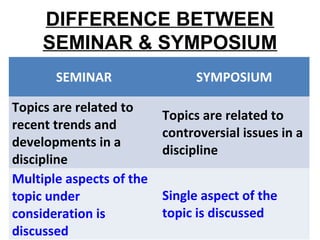
DIFFERENCE BETWEEN
SEMINAR & SYMPOSIUM
SEMINAR SYMPOSIUM
Topics are related to
recent trends and
developments in a
discipline
Topics are related to
controversial issues in a
discipline
Multiple aspects of the
topic under
consideration is
discussed
Single aspect of the
topic is discussed
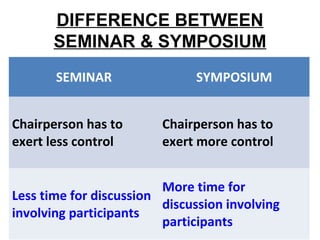
DIFFERENCE BETWEEN
SEMINAR & SYMPOSIUM
SEMINAR SYMPOSIUM
Chairperson has to
exert less control
Chairperson has to
exert more control
Less time for discussion
involving participants
More time for
discussion involving
participants
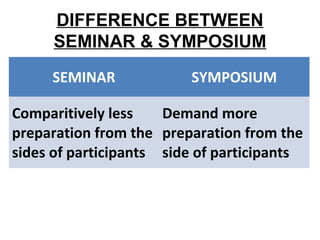
DIFFERENCE BETWEEN
SEMINAR & SYMPOSIUM
SEMINAR SYMPOSIUM
Comparitively less
preparation from the
sides of participants
Demand more
preparation from the
side of participants
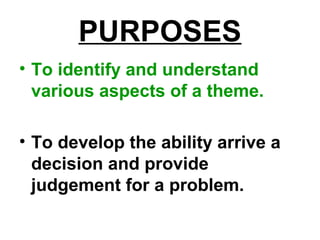
PURPOSES
• To identify and understand
various aspects of a theme.
• To develop the ability arrive a
decision and provide
judgement for a problem.
• To develop values and feelings
regarding a problem.
• To provide understanding to
the students or listerners on a
theme or problem to
specifically develop certain
values and feelings.
• To enable the listeners form
policies regarding a theme or a
problem.
• To investigate a problem from
several points of view.
• To boost students' abilities to
speak in the group.
• To encourage the students to
study independently.
CHARACTERISTICS
• Symposium provides a broad
understanding of a topic or
problem.
• The listener is provided with an
opportunity to take decisions
about a problem.
• This method is used in higher
classes for specific theme or a
problem.
• It develops a feelings of
cooperation and adjustment.
• Symposium technique helps in
acheiving the objectives of
synthesis and evaluation.
• It provides different views on
the topic of the symposuim.
PRINCIPLES
• The speeches may be
persuasive, argumentative and
informative.
• Original presentation is
objective and accurate.
INFORMATIVE SPEECH
PERSUASIVE SPEECH
ARGUMENTATIVE SPEECH
• The method always includes a
summary at conclusion.
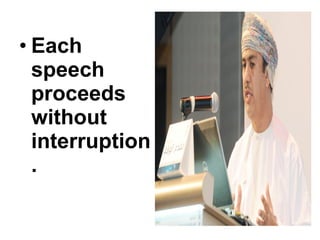
• Each speech proceeds without
interruption.
• Each
speech
proceeds
without
interruption
.
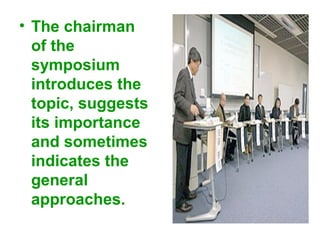
• The chairman
of the
symposium
introduces the
topic, suggests
its importance
and sometimes

indicates the
general
approaches.
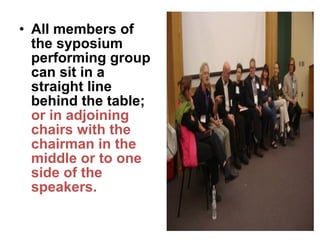
• All members of
the syposium
performing group
can sit in a
straight line
behind the table;
or in adjoining
chairs with the
chairman in the
middle or to one
side of the
speakers.
• The symposium
presents two
conflicting points of
view, the reading
arrangement can
seperate the
speakers on the
platform to indicate
differences in opinin
or to preserve
peace.
GUIDELINES
• The chairman of the
symposium introduces the
topic and suggests something
of its importance.
• Two or more speakers talk from
10 to 20 minutes.
• The speech may be persuasive,
argumentative, informative or
evocative. Each speech
proceeds without interruption.
• The speeches are followed by
questions or comments from
the audience as in the panel
form.
• The
speeches are
followed by
questions or
comments
from the
audience as
in the panel
form.
ADVANTAGES
• Symposium can be used to
address a large group or class.
• This method can be frequently
used to present broad topics
for discussion at conventions
and organization of meetings.
• In symposium, the principle of
organization is high as the
speeches are prepared
beforehand.
• It gives a deeper insight into a
topic.
• It directs the students to
continuous independent study.
• This method can be used in
political meetings.
DISADVANTAGES
• Symposium does not provide
adequate opportunity for all the
students to participate actively.It
has limited audience
participation.
• The speech is limited to 10 to 20
minutes.
• Questions
and Answer
session is
limited to 3 to
4 minutes.
• It has
possibility of
overlapping of
subjects.
• The chairman has no control
over the speakers as they have
full freedom to prepare the
theme for discussion. They can
present any aspect of the
theme or problem.
• There is a
possibility of
repetition of
content. The
different aspects of
the theme are not
prepared
separately. It
creates difficulty of
understanding for
• The different aspects of the
theme are not presented
simultaneously. Therefore the
listeners are not able to
understand the theme
correctly.
• The listeners remain passive in
the symposium because they
are not given an opportunity to
seek clarification and question
in between the symposium.
Symposium Method of Teaching

Symposium Method of Teaching

  • 1.
  • 2.
  • 4.
    DEFINITION • Symposium isdefined as a teaching technique that serves as an excellent method for informing the audience, crystallizing their opinion and preparing them for arriving at decision regarding a particular issue or a topic.
  • 5.
    DEFINITION • Symposium isa discussion method in which different view points on a single aspect of a topic is discussed. • Symposium is a series of speeches on single aspect of a topic.
  • 6.
    DIFFERENCE BETWEEN SEMINAR &SYMPOSIUM SEMINAR SYMPOSIUM Topics are related to recent trends and developments in a discipline Topics are related to controversial issues in a discipline Multiple aspects of the topic under consideration is discussed Single aspect of the topic is discussed
  • 7.
    DIFFERENCE BETWEEN SEMINAR &SYMPOSIUM SEMINAR SYMPOSIUM Chairperson has to exert less control Chairperson has to exert more control Less time for discussion involving participants More time for discussion involving participants
  • 8.
    DIFFERENCE BETWEEN SEMINAR &SYMPOSIUM SEMINAR SYMPOSIUM Comparitively less preparation from the sides of participants Demand more preparation from the side of participants
  • 9.
    PURPOSES • To identifyand understand various aspects of a theme. • To develop the ability arrive a decision and provide judgement for a problem.
  • 10.
    • To developvalues and feelings regarding a problem. • To provide understanding to the students or listerners on a theme or problem to specifically develop certain values and feelings.
  • 11.
    • To enablethe listeners form policies regarding a theme or a problem. • To investigate a problem from several points of view.
  • 12.
    • To booststudents' abilities to speak in the group. • To encourage the students to study independently.
  • 13.
    CHARACTERISTICS • Symposium providesa broad understanding of a topic or problem. • The listener is provided with an opportunity to take decisions about a problem.
  • 14.
    • This methodis used in higher classes for specific theme or a problem. • It develops a feelings of cooperation and adjustment.
  • 15.
    • Symposium techniquehelps in acheiving the objectives of synthesis and evaluation. • It provides different views on the topic of the symposuim.
  • 16.
    PRINCIPLES • The speechesmay be persuasive, argumentative and informative. • Original presentation is objective and accurate.
  • 17.
  • 18.
  • 19.
  • 20.
    • The methodalways includes a summary at conclusion. • Each speech proceeds without interruption.
  • 21.
  • 22.
    • The chairman ofthe symposium introduces the topic, suggests its importance and sometimes indicates the general approaches.
  • 23.
    • All membersof the syposium performing group can sit in a straight line behind the table; or in adjoining chairs with the chairman in the middle or to one side of the speakers.
  • 24.
    • The symposium presentstwo conflicting points of view, the reading arrangement can seperate the speakers on the platform to indicate differences in opinin or to preserve peace.
  • 25.
    GUIDELINES • The chairmanof the symposium introduces the topic and suggests something of its importance. • Two or more speakers talk from 10 to 20 minutes.
  • 26.
    • The speechmay be persuasive, argumentative, informative or evocative. Each speech proceeds without interruption. • The speeches are followed by questions or comments from the audience as in the panel form.
  • 27.
    • The speeches are followedby questions or comments from the audience as in the panel form.
  • 29.
    ADVANTAGES • Symposium canbe used to address a large group or class. • This method can be frequently used to present broad topics for discussion at conventions and organization of meetings.
  • 30.
    • In symposium,the principle of organization is high as the speeches are prepared beforehand. • It gives a deeper insight into a topic.
  • 31.
    • It directsthe students to continuous independent study. • This method can be used in political meetings.
  • 32.
    DISADVANTAGES • Symposium doesnot provide adequate opportunity for all the students to participate actively.It has limited audience participation. • The speech is limited to 10 to 20 minutes.
  • 33.
    • Questions and Answer sessionis limited to 3 to 4 minutes.
  • 34.
    • It has possibilityof overlapping of subjects.
  • 35.
    • The chairmanhas no control over the speakers as they have full freedom to prepare the theme for discussion. They can present any aspect of the theme or problem.
  • 36.
    • There isa possibility of repetition of content. The different aspects of the theme are not prepared separately. It creates difficulty of understanding for
  • 37.
    • The differentaspects of the theme are not presented simultaneously. Therefore the listeners are not able to understand the theme correctly.
  • 38.
    • The listenersremain passive in the symposium because they are not given an opportunity to seek clarification and question in between the symposium.