W 
E 
L 
C 
O 
M 
E
SHINI S.S 
B.ED MATHEMATICS 
KUCTE. KUMARAPURAM 
THIRUVANANTHAPURAM
 Basic principles of project method 
 Steps involved in project method 
 Example of project method 
 Criteria of a good project 
 Role of the teacher 
 Merits of project method 
 Demerits of project method 
 Some projects for mathematics
Project method is of American origin 
and is an outcome of Dewey’s philosophy of 
pragmatism. 
--
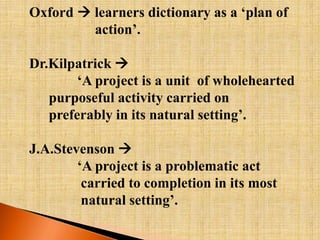
Oxford  learners dictionary as a ‘plan of 
action’. 
Dr.Kilpatrick  
‘A project is a unit of wholehearted 
purposeful activity carried on 
preferably in its natural setting’. 
J.A.Stevenson  
‘A project is a problematic act 
carried to completion in its most 
natural setting’.
Bellard  
‘ As a bit of real life that has been 
imported in to the school’. 
--
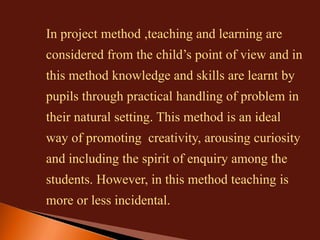
In project method ,teaching and learning are 
considered from the child’s point of view and in 
this method knowledge and skills are learnt by 
pupils through practical handling of problem in 
their natural setting. This method is an ideal 
way of promoting creativity, arousing curiosity 
and including the spirit of enquiry among the 
students. However, in this method teaching is 
more or less incidental.
Basic principles of 
project method
 Learning by doing 
 Learning by living 
 Children learn better through 
association , cooperation and 
activity.
 Law of readiness 
 Law of exercises 
 Law of effect
Principle of activity 
Activity is a significant feature of this 
method. Children select,plan,execute and 
evaluate their project themselves.
Principle of social experience 
The project is selected from real life 
situations and every project should be a 
social experience for the children.
Principle of reality 
The project can not be motivating and 
interesting for the learner unless it is 
natural and real from the learner’s 
point of view.
Principle of utility 
Knowledge is meaningful and 
worthwhile if it is practicable and 
useful.
The selected project should be 
purposeful and therefore 
motivating for the learner. 
purpose and goal make the 
project meaningful and 
significant.
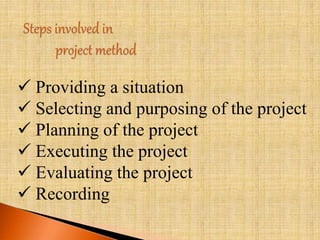
 Providing a situation 
 Selecting and purposing of the project 
 Planning of the project 
 Executing the project 
 Evaluating the project 
 Recording
PROVIDING SITUATION 
The project should arise out of the felt needs 
out of the students . The teacher should 
provide such situations to students which may 
arouse some suitable questions to which the 
students seek answer . It should look 
important must be interesting and purposeful 
for the students . The teacher can provide a 
variety of situations through discussions , 
questioning , library work ,field work etc.
Selecting and purposing 
The selection of the project is done by the students 
themselves . The teacher should refrain from 
purposing any project otherwise the whole purpose 
of the method would be defeated . However , the 
teacher can guide the students in the selection of a 
good project , keeping in mind the interest ,aptitude , 
and ability of the students. In this step the nature 
and goal of the project is determined as well as the 
limits and scope of the project is clearly defined.
Planning 
 Planning involves the section of the most 
appropriate and feasible set of activities to be 
executed. 
 The students should choose the most practical 
plan of action. 
 The students themselves should do the planning 
with the teacher as a guide.
While planning ,the points to be taken in to 
consideration are 
 The nature and scope of the project 
 The degree of complexity of project 
 Time allotted to finish the project 
 Availability of material resources 
Discussion may be held among students before the final 
draft of the plan is agreed upon.
Execution 
In this step the teacher helps the 
students in assigning work to different 
students in accordance with their 
interest , aptitude and capabilities. 
Each member of the group should be 
actively involved in execution of the 
project as per the purposed action plan.
EVALUATION 
 The students along with the teacher should 
review the progress of the project at frequent 
intervals . 
 This is to ensure that the students are 
progressing towards the realization of the 
objectives of project without evaluation , the 
project can move out of the focus .
The evaluation of the project has to be done in 
the light of 
 Proposed plan 
 Difficulties in the reaction 
 Achieved results
RECORDING 
The student are required to maintain a 
complete record of work including the 
choice of the project ,the planning , the 
discussion held and duties assigned . 
Also references and books consulted and 
readings taken, difficulties faced, 
guidance sought, details of places visited 
and surveyed and so on should be 
carefully recorded .
Celebration of ‘Republic day’ may be the project . The 
project can have the following different aspects 
 Why do we celebrate this day 
 The school program of its celebration 
 Estimated expenditure for different items; budget 
preparation 
 The account of collections from amongst the 
students, if any 
 The preparation and organization of different items 
of the program
 Keeping accounts of the expenses incurred . 
 Execution of different programs 
 Preparing the report of the program 
 Evaluation of the entire celebration . 
These are the directions for the students to carry out the 
project . An enthusiastic planned celebration will necessitate 
the learning of many valuable ideas concerned with different 
subjects . 
An soon as the students take up an aspect of the project , the 
teach will utilize the opportunity to enable the students to 
learn something .
Criteria of a good project
The project should be purposeful , useful, and 
practically applicable to the daily life of the 
students , with clear well defined objective . 
The project should help in providing useful and 
meaningful learning experiences to each member of 
the group . 
The project should be with in reach of the students 
in accordance with their interest and ability levels .
The project should be feasible in in terms of the 
availability of human and material resources and 
time limit. 
The level of complexity of the project should match 
the ability level of the students. 
The learning activities of the project should be life 
like purposeful and natural .
 Guide students in selecting the project according to 
their interest , aptitude and ability . 
 Help students in planning and allotting activities to 
each member according to the nature of abilities. 
 Help in creating a friendly and democratic 
atmosphere in the class room promoting co-operation 
and harmony. 
 Be available to the students and willing to help as and 
when it is necessary.
 Supervise and check whether the project is 
renning in time as planned. 
 Suggest extra resources , if necessary , for the 
sucessful execution of the project. 
 Check the records maintained by the students. 
 Help in the periodic assessment of the progress of 
the project.
 It is based on sound psychological principles 
and laws of teaching. 
 It provide scope for independent work and 
individual development. 
 It promotes habits of critical thinking and 
encourages the students to adopt problem 
solving methods. 
 It promotes social interaction ,inculcates spirit 
of co-operation and exchanges of experiences 
among the students.
 It encourages practical applications of the 
subject ,making the subject functional and 
meaningful to the learner. 
 It provides opportunities for children to acquire 
a lot of skills –observation ,reference, 
interpretation and so on. 
 In this method the children are active 
participants in the learning task. 
 It develops self –confidence and self –discipline 
among the students.
 It upholds the dignity of labor . 
 If widens the mental horizon of the students. 
 It makes the learning more interesting and 
facilitates better understanding of the subject 
matter as the learning is related to reality and 
world around him.
 The project is uneconomical in terms of time and is 
not possible to fit in to the regular timetable . 
 It does not provide any training in mathematical 
thinking and reasoning . 
 The learning is incomplete and uniform learning or 
balanced learning is not possible for all students as 
each student performs a different activity. 
 Textbooks and instructional materials are hardly 
available
 For the success of this method the teachers should 
be exceptionally resourceful and gifted and 
knowledgeable. 
 It is an expensive method as it makes use of a lot of 
resources which are not immediately available in 
the school. 
 Syllabus cannot be completed on time using this 
method. 
 Teaching is disorganized.
Some Projects For 
Mathematics
 Running a co-operative bank in the school 
 Running a stationary stores in the school 
 Laying out a school garden 
 Laying a road 
 Planning and estimating the construction of a 
house 
 Planning for an annual camp 
 Comparison of expenses incurred for a journey 
using different modes of transport
CONCLUSION 
This method brings life to the school atmosphere . Learning becomes a 
co-operative affair. Its approach is scientific and psychological . As it is 
not suitable for drill and continuous and systematic teaching ,it is not 
very desirable to use in freely . If the teacher can devise and plan a 
good project on something , the students will gain a lot . It leads to 
understanding and develops the ability to apply knowledge . Its 
occasional use will always remain the effective tool in the hands of the 
teacher . The teacher has to work as a careful guide during the 
execution of the project. Costly projects should be avoided . 
Unsupervised an un evaluated project work will also be of no use.
Reference 
 Teaching of mathematics-Dr. Anice James , 
Neelkamal publication pvt.ltd (2008) 
 Education method and technique –Zubair. P.P, 
Heurisco publications 
 Principles ,methods and techniques of teaching 
J.C Aggarwal ,Vikas publication
PROJECT METHOD

PROJECT METHOD

  • 1.
    W E L C O M E
  • 3.
    SHINI S.S B.EDMATHEMATICS KUCTE. KUMARAPURAM THIRUVANANTHAPURAM
  • 4.
     Basic principlesof project method  Steps involved in project method  Example of project method  Criteria of a good project  Role of the teacher  Merits of project method  Demerits of project method  Some projects for mathematics
  • 5.
    Project method isof American origin and is an outcome of Dewey’s philosophy of pragmatism. --
  • 6.
    Oxford  learnersdictionary as a ‘plan of action’. Dr.Kilpatrick  ‘A project is a unit of wholehearted purposeful activity carried on preferably in its natural setting’. J.A.Stevenson  ‘A project is a problematic act carried to completion in its most natural setting’.
  • 7.
    Bellard  ‘As a bit of real life that has been imported in to the school’. --
  • 8.
    In project method,teaching and learning are considered from the child’s point of view and in this method knowledge and skills are learnt by pupils through practical handling of problem in their natural setting. This method is an ideal way of promoting creativity, arousing curiosity and including the spirit of enquiry among the students. However, in this method teaching is more or less incidental.
  • 9.
    Basic principles of project method
  • 10.
     Learning bydoing  Learning by living  Children learn better through association , cooperation and activity.
  • 11.
     Law ofreadiness  Law of exercises  Law of effect
  • 12.
    Principle of activity Activity is a significant feature of this method. Children select,plan,execute and evaluate their project themselves.
  • 13.
    Principle of socialexperience The project is selected from real life situations and every project should be a social experience for the children.
  • 14.
    Principle of reality The project can not be motivating and interesting for the learner unless it is natural and real from the learner’s point of view.
  • 15.
    Principle of utility Knowledge is meaningful and worthwhile if it is practicable and useful.
  • 16.
    The selected projectshould be purposeful and therefore motivating for the learner. purpose and goal make the project meaningful and significant.
  • 17.
     Providing asituation  Selecting and purposing of the project  Planning of the project  Executing the project  Evaluating the project  Recording
  • 18.
    PROVIDING SITUATION Theproject should arise out of the felt needs out of the students . The teacher should provide such situations to students which may arouse some suitable questions to which the students seek answer . It should look important must be interesting and purposeful for the students . The teacher can provide a variety of situations through discussions , questioning , library work ,field work etc.
  • 19.
    Selecting and purposing The selection of the project is done by the students themselves . The teacher should refrain from purposing any project otherwise the whole purpose of the method would be defeated . However , the teacher can guide the students in the selection of a good project , keeping in mind the interest ,aptitude , and ability of the students. In this step the nature and goal of the project is determined as well as the limits and scope of the project is clearly defined.
  • 20.
    Planning  Planninginvolves the section of the most appropriate and feasible set of activities to be executed.  The students should choose the most practical plan of action.  The students themselves should do the planning with the teacher as a guide.
  • 21.
    While planning ,thepoints to be taken in to consideration are  The nature and scope of the project  The degree of complexity of project  Time allotted to finish the project  Availability of material resources Discussion may be held among students before the final draft of the plan is agreed upon.
  • 22.
    Execution In thisstep the teacher helps the students in assigning work to different students in accordance with their interest , aptitude and capabilities. Each member of the group should be actively involved in execution of the project as per the purposed action plan.
  • 23.
    EVALUATION  Thestudents along with the teacher should review the progress of the project at frequent intervals .  This is to ensure that the students are progressing towards the realization of the objectives of project without evaluation , the project can move out of the focus .
  • 24.
    The evaluation ofthe project has to be done in the light of  Proposed plan  Difficulties in the reaction  Achieved results
  • 25.
    RECORDING The studentare required to maintain a complete record of work including the choice of the project ,the planning , the discussion held and duties assigned . Also references and books consulted and readings taken, difficulties faced, guidance sought, details of places visited and surveyed and so on should be carefully recorded .
  • 26.
    Celebration of ‘Republicday’ may be the project . The project can have the following different aspects  Why do we celebrate this day  The school program of its celebration  Estimated expenditure for different items; budget preparation  The account of collections from amongst the students, if any  The preparation and organization of different items of the program
  • 27.
     Keeping accountsof the expenses incurred .  Execution of different programs  Preparing the report of the program  Evaluation of the entire celebration . These are the directions for the students to carry out the project . An enthusiastic planned celebration will necessitate the learning of many valuable ideas concerned with different subjects . An soon as the students take up an aspect of the project , the teach will utilize the opportunity to enable the students to learn something .
  • 28.
    Criteria of agood project
  • 29.
    The project shouldbe purposeful , useful, and practically applicable to the daily life of the students , with clear well defined objective . The project should help in providing useful and meaningful learning experiences to each member of the group . The project should be with in reach of the students in accordance with their interest and ability levels .
  • 30.
    The project shouldbe feasible in in terms of the availability of human and material resources and time limit. The level of complexity of the project should match the ability level of the students. The learning activities of the project should be life like purposeful and natural .
  • 32.
     Guide studentsin selecting the project according to their interest , aptitude and ability .  Help students in planning and allotting activities to each member according to the nature of abilities.  Help in creating a friendly and democratic atmosphere in the class room promoting co-operation and harmony.  Be available to the students and willing to help as and when it is necessary.
  • 33.
     Supervise andcheck whether the project is renning in time as planned.  Suggest extra resources , if necessary , for the sucessful execution of the project.  Check the records maintained by the students.  Help in the periodic assessment of the progress of the project.
  • 35.
     It isbased on sound psychological principles and laws of teaching.  It provide scope for independent work and individual development.  It promotes habits of critical thinking and encourages the students to adopt problem solving methods.  It promotes social interaction ,inculcates spirit of co-operation and exchanges of experiences among the students.
  • 36.
     It encouragespractical applications of the subject ,making the subject functional and meaningful to the learner.  It provides opportunities for children to acquire a lot of skills –observation ,reference, interpretation and so on.  In this method the children are active participants in the learning task.  It develops self –confidence and self –discipline among the students.
  • 37.
     It upholdsthe dignity of labor .  If widens the mental horizon of the students.  It makes the learning more interesting and facilitates better understanding of the subject matter as the learning is related to reality and world around him.
  • 39.
     The projectis uneconomical in terms of time and is not possible to fit in to the regular timetable .  It does not provide any training in mathematical thinking and reasoning .  The learning is incomplete and uniform learning or balanced learning is not possible for all students as each student performs a different activity.  Textbooks and instructional materials are hardly available
  • 40.
     For thesuccess of this method the teachers should be exceptionally resourceful and gifted and knowledgeable.  It is an expensive method as it makes use of a lot of resources which are not immediately available in the school.  Syllabus cannot be completed on time using this method.  Teaching is disorganized.
  • 41.
    Some Projects For Mathematics
  • 42.
     Running aco-operative bank in the school  Running a stationary stores in the school  Laying out a school garden  Laying a road  Planning and estimating the construction of a house  Planning for an annual camp  Comparison of expenses incurred for a journey using different modes of transport
  • 43.
    CONCLUSION This methodbrings life to the school atmosphere . Learning becomes a co-operative affair. Its approach is scientific and psychological . As it is not suitable for drill and continuous and systematic teaching ,it is not very desirable to use in freely . If the teacher can devise and plan a good project on something , the students will gain a lot . It leads to understanding and develops the ability to apply knowledge . Its occasional use will always remain the effective tool in the hands of the teacher . The teacher has to work as a careful guide during the execution of the project. Costly projects should be avoided . Unsupervised an un evaluated project work will also be of no use.
  • 44.
    Reference  Teachingof mathematics-Dr. Anice James , Neelkamal publication pvt.ltd (2008)  Education method and technique –Zubair. P.P, Heurisco publications  Principles ,methods and techniques of teaching J.C Aggarwal ,Vikas publication