Panel Discussion
Panel Discussion Types
• PUBLIC PANEL DISCUSSION
• EDUCATIONAL PANEL DISCUSSION
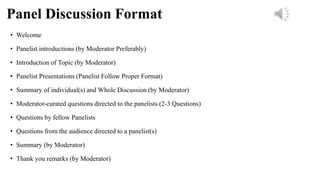
Panel Discussion Format
• Welcome
• Panelist introductions (by Moderator Preferably)
• Introduction of Topic (by Moderator)
• Panelist Presentations (Panelist Follow Proper Format)
• Summary of individual(s) and Whole Discussion (by Moderator)
• Moderator-curated questions directed to the panelists (2-3 Questions)
• Questions by fellow Panelists
• Questions from the audience directed to a panelist(s)
• Summary (by Moderator)
• Thank you remarks (by Moderator)
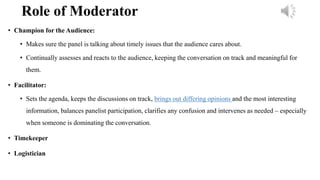
Role of Moderator
• Champion for the Audience:
• Makes sure the panel is talking about timely issues that the audience cares about.
• Continually assesses and reacts to the audience, keeping the conversation on track and meaningful for
them.
• Facilitator:
• Sets the agenda, keeps the discussions on track, brings out differing opinions and the most interesting
information, balances panelist participation, clarifies any confusion and intervenes as needed – especially
when someone is dominating the conversation.
• Timekeeper
• Logistician
Role of Moderator
• Instigator
• Probes beneath the surface, asking tough questions, building the dialogue, keeping the conversation lively and getting out of
the way when the conversation is going well.
• Pushes the panelists to talk about specifics rather than speak in generalities.
• Content Coordinator
• Works with the panelists to make sure their presentations/points do not overlap.
• Identifies the areas of debate and controversy.
• Energizer
• Models energy and enthusiasm.
• Works the room and engages the audience.
• Injects a little humor where appropriate to keep it lively.
• Neutral & Objective:
• Doesn’t show bias or favoritism toward any particular side, faction or person.
Role of Panelist
• Check Audio-Visual beforehand
• Serve the Audience
• Be Prepared
• it is your responsibility to do your homework and deliver some amazing value and insights for
the audience.
• Research the other panelist’s positions and determine what makes you/your position unique from
the others.
• Do Not Bluster
• When you are speaking, keep it short. No more than 2-3 minutes is a good goal.
Role of Panelist
• Be Additive Not Repetitive: Don’t repeat what has already been said by another
panelist. Speak up if you have a different perspective or point of view.
• Disagree Diplomatically and Positively:
• Do Not Pontificate: Don’t talk down to or lecture the audience. You are there to
have a conversation with the other panelists and audience as colleagues, not to
serve your ego.
• Remember All the While Laughter is Good: So have fun.
• Attention Span Drops After 10 Minutes:
Panelists Talk Format
• Clear 3-4 Point Thesis
• Explanation of Thesis Points
• First Provide Claim
• Give Examples
• Give Facts
• Relate things with your current context
• Conclusion
• Restate Thesis
• Provide a point of reflection for audience
Preparation
• Use Google Docs to Collaborate and Prepare your points led by Moderator
• Also keep me as collaborator through husnain.raza1@lhr.nu.edu.pk
• Every Panelist will write his points under his name
• In Google Docs Panelists will write
• Thesis
• Major Claims
• Facts supporting your claims
• Examples
• Relation with context
• Each Panelist will provide at least 4 references for his researched points
• Moderator will write his questions
Topics
• Is Adaptability a Core Property of Intelligent Models?
• Big data: new paradigm or “sound and fury, signifying nothing”?
• Can AI replace the complex medical surgeries by humans?
• Python vs R: which one is better?

Panel discussion 2

  • 1.
  • 2.
    Panel Discussion Types •PUBLIC PANEL DISCUSSION • EDUCATIONAL PANEL DISCUSSION
  • 3.
    Panel Discussion Format •Welcome • Panelist introductions (by Moderator Preferably) • Introduction of Topic (by Moderator) • Panelist Presentations (Panelist Follow Proper Format) • Summary of individual(s) and Whole Discussion (by Moderator) • Moderator-curated questions directed to the panelists (2-3 Questions) • Questions by fellow Panelists • Questions from the audience directed to a panelist(s) • Summary (by Moderator) • Thank you remarks (by Moderator)
  • 4.
    Role of Moderator •Champion for the Audience: • Makes sure the panel is talking about timely issues that the audience cares about. • Continually assesses and reacts to the audience, keeping the conversation on track and meaningful for them. • Facilitator: • Sets the agenda, keeps the discussions on track, brings out differing opinions and the most interesting information, balances panelist participation, clarifies any confusion and intervenes as needed – especially when someone is dominating the conversation. • Timekeeper • Logistician
  • 5.
    Role of Moderator •Instigator • Probes beneath the surface, asking tough questions, building the dialogue, keeping the conversation lively and getting out of the way when the conversation is going well. • Pushes the panelists to talk about specifics rather than speak in generalities. • Content Coordinator • Works with the panelists to make sure their presentations/points do not overlap. • Identifies the areas of debate and controversy. • Energizer • Models energy and enthusiasm. • Works the room and engages the audience. • Injects a little humor where appropriate to keep it lively. • Neutral & Objective: • Doesn’t show bias or favoritism toward any particular side, faction or person.
  • 6.
    Role of Panelist •Check Audio-Visual beforehand • Serve the Audience • Be Prepared • it is your responsibility to do your homework and deliver some amazing value and insights for the audience. • Research the other panelist’s positions and determine what makes you/your position unique from the others. • Do Not Bluster • When you are speaking, keep it short. No more than 2-3 minutes is a good goal.
  • 7.
    Role of Panelist •Be Additive Not Repetitive: Don’t repeat what has already been said by another panelist. Speak up if you have a different perspective or point of view. • Disagree Diplomatically and Positively: • Do Not Pontificate: Don’t talk down to or lecture the audience. You are there to have a conversation with the other panelists and audience as colleagues, not to serve your ego. • Remember All the While Laughter is Good: So have fun. • Attention Span Drops After 10 Minutes:
  • 8.
    Panelists Talk Format •Clear 3-4 Point Thesis • Explanation of Thesis Points • First Provide Claim • Give Examples • Give Facts • Relate things with your current context • Conclusion • Restate Thesis • Provide a point of reflection for audience
  • 9.
    Preparation • Use GoogleDocs to Collaborate and Prepare your points led by Moderator • Also keep me as collaborator through husnain.raza1@lhr.nu.edu.pk • Every Panelist will write his points under his name • In Google Docs Panelists will write • Thesis • Major Claims • Facts supporting your claims • Examples • Relation with context • Each Panelist will provide at least 4 references for his researched points • Moderator will write his questions
  • 10.
    Topics • Is Adaptabilitya Core Property of Intelligent Models? • Big data: new paradigm or “sound and fury, signifying nothing”? • Can AI replace the complex medical surgeries by humans? • Python vs R: which one is better?