DISCUSSION METHOD
INTRODUCTION
• Exchange of ideas between several people is the best process
of learning and teaching from one another.
In the classroom environment ,discussion is the best way of
promoting conducive learning and convenient teaching
situation
DEFINITION
• It refers to the method of instruction which give pupils an
opportunity to express their views or opinions orally on
certain issues. One person speaks at a time,while others are
listen.
• It doesn't always involve the presentation of new information
and concepts. It also involves sharing of ideas and experiences
,solving problems and promoting tolerance with
understanding
PRINCIPLES
• Clearly defined objectives understood by all the
participants.
• Leader to guide & coordinate the proceedings
• Main points should be recorded
• All should feel free to participate.
• Encourage timid persons to contribute.
• Consider all points of view.
• Discussion should keep to the point.
• Properly closed with a report, recommendation,
decision or summing up of the matters discussed.
• Members should come with a basic knowledge of
the topic to be discussed.
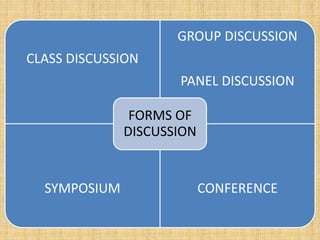
CLASS DISCUSSION
GROUP DISCUSSION
PANEL DISCUSSION
SYMPOSIUM CONFERENCE
FORMS OF
DISCUSSION
FORMS OF DISCUSSION• Kochhar(1985)identifies two major types of discussions
• Formal and Informal.
• Informal discussions are governed by pre-determined set of rules and it includes debates,panels,symposia etc.
• Formal discussions may involve whole group or small groups of people divided with the intention of discussing
themes . These are not governed by pre-determined set of rules.
• Lets focus on the informal type of discussions.
• In the classroom discussions involve a free verbal interchange of ideas for all pupils as a whole. Here the teacher
is the leader who guides the discussion . Through conducting the discussion process,ask questions and decides
on who should speak. This method can be suitably used in the first stage of child book child approach.
• Small group discussions is better than a whole class discussion. It encourages more pupils to give their own
views through open participation . Pupils are divided into small groups of ,four , five , six ,seven ,eight or nine
and given questions or task to discuss and then report back.
• Each group should have a group leader who is instructed to control the discussion process and someone who can
report back of what has be discussed.
Advantages of class discussion:
• Pools ideas & experiences from group.
• Effective after a presentation, film or experience that needs to be
analysed.
• Allows everyone to participate in an active process.
Disadvantages:
• Not practical with more than 20 people.
• Few people can dominate.
• Others may not participate.
• Is time consuming.
• Can get off the track.
Advantages:
• It teaches interpersonal skills such as understanding and
communication.
• It is child centred through provides an opportunity for
pupils to learn from each other,thus encouraging
teamwork.
• It promotes tolerance and helps pupils to understand that
they are many aspects or opinions to any one topic.
• It also helps leadership ,speaking and listening skills.
Demerits of discussion:
• Time consuming ,easily dominated by the outspoken
pupils,those perceived to have high status.
• Some pupils may not interested from listening to others
and easily get out of hand and lose direction.
• Some teachers can neglect planning and take advantage
of literally this method haphazardly
PANEL DISCUSSION
• A panel consists of a few members who come prepared to exchange
ideas, views on a particular subject under the leadership of a
chairman.
• Group of experts on the subject or may be selected by students who
have requested & have prepared the subject in advance.
• The chairman opens the discussion by introducing members & the
topic is announced. He should continue as leader & at the end should
draw together the main points & sumup the discussion.
Advantages of panel discussion:
• Allows experts to present different opinions.
• Can provoke better discussion than a one person discussion.
• Frequent change of speaker keeps attention from lagging.
Disadvantages:
• Experts may not be good speakers.
• Personalities may overshadow content.
• Subject may not be in logical order.
GROUP DISCUSSION
• Group discussion is extensively used along
with personal interviews for the final selection
of candidates. It plays a main role in selecting
the best among the best.
• It helps in choosing the socially suitable
candidate among the academically superior
acheivers.
• It is a technique used for screening candidates
as well as testing their potential.
FEATURES OF GROUP DISCUSSION
Group activity ,exchange of ideas among individuals
of a group on a specific topic.
Reliable, testing device to assess all the candidates to
select best in comparative perspective.
Informal in which participants of the same
educational standard discuss a topic of current
interest.
Also known as leaderless discussion aims to find out
the natural leadership level of the candidates.
Participants must accept responsibility, open
mindedness-willingness to consider a broad range
of ideas & suggestions from others.
Advantages of group discussion
• Allows learners to be in control, in respect of pace,
content & focus.
• Provides opportunities for learners to express
• Allows learners to validate their knowledge & skills
• Permits learners to clarify. Reflect & reconfigure
their experiences
• Helps in promoting a sense of belonging in a group
• It can be empowering if learners realize their own
ability for critical thinking & change through this
medium.
Disadvantages
• Requires facilitation
• Requires more space than for lecture
• Time consuming
• Difficult to monitor the progress of many
small groups.
CONFERENCE
• A prearranged meeting for consultation or exchan
ge of information or discussion
• Small group conferences of students-6to12 during
the clinical experience provide excellent learning
opportunity for students.
• Focused on the nursing care of the patients
• Students should be familiar with patients
• Informed consent
Symposium
A meeting or conference for the public discussion of
some topic especially one in which the participants
form an audience and make presentations.
Systematic presentation of various aspects of a topic
by a group of two or more persons with a special
knowledge of the subject.
Group consists of experts with a special knowledge of
the subject.
Advantages of symposium:
Presents a wider basis for discussion it presents
a topic from several points of view
Has greater organization because of advanced
preparation.
Disadvantages:
Lack of time- 15 to 20 minutes
Opportunity are not given for all students to
participate actively
Audience participation are also limited with one
or two questions students may not get
intended answers

Methods of Teaching

  • 1.
  • 2.
    INTRODUCTION • Exchange ofideas between several people is the best process of learning and teaching from one another. In the classroom environment ,discussion is the best way of promoting conducive learning and convenient teaching situation DEFINITION • It refers to the method of instruction which give pupils an opportunity to express their views or opinions orally on certain issues. One person speaks at a time,while others are listen. • It doesn't always involve the presentation of new information and concepts. It also involves sharing of ideas and experiences ,solving problems and promoting tolerance with understanding
  • 3.
    PRINCIPLES • Clearly definedobjectives understood by all the participants. • Leader to guide & coordinate the proceedings • Main points should be recorded • All should feel free to participate. • Encourage timid persons to contribute. • Consider all points of view. • Discussion should keep to the point. • Properly closed with a report, recommendation, decision or summing up of the matters discussed. • Members should come with a basic knowledge of the topic to be discussed.
  • 4.
    CLASS DISCUSSION GROUP DISCUSSION PANELDISCUSSION SYMPOSIUM CONFERENCE FORMS OF DISCUSSION
  • 5.
    FORMS OF DISCUSSION•Kochhar(1985)identifies two major types of discussions • Formal and Informal. • Informal discussions are governed by pre-determined set of rules and it includes debates,panels,symposia etc. • Formal discussions may involve whole group or small groups of people divided with the intention of discussing themes . These are not governed by pre-determined set of rules. • Lets focus on the informal type of discussions. • In the classroom discussions involve a free verbal interchange of ideas for all pupils as a whole. Here the teacher is the leader who guides the discussion . Through conducting the discussion process,ask questions and decides on who should speak. This method can be suitably used in the first stage of child book child approach. • Small group discussions is better than a whole class discussion. It encourages more pupils to give their own views through open participation . Pupils are divided into small groups of ,four , five , six ,seven ,eight or nine and given questions or task to discuss and then report back. • Each group should have a group leader who is instructed to control the discussion process and someone who can report back of what has be discussed.
  • 6.
    Advantages of classdiscussion: • Pools ideas & experiences from group. • Effective after a presentation, film or experience that needs to be analysed. • Allows everyone to participate in an active process. Disadvantages: • Not practical with more than 20 people. • Few people can dominate. • Others may not participate. • Is time consuming. • Can get off the track.
  • 7.
    Advantages: • It teachesinterpersonal skills such as understanding and communication. • It is child centred through provides an opportunity for pupils to learn from each other,thus encouraging teamwork. • It promotes tolerance and helps pupils to understand that they are many aspects or opinions to any one topic. • It also helps leadership ,speaking and listening skills. Demerits of discussion: • Time consuming ,easily dominated by the outspoken pupils,those perceived to have high status. • Some pupils may not interested from listening to others and easily get out of hand and lose direction. • Some teachers can neglect planning and take advantage of literally this method haphazardly
  • 8.
    PANEL DISCUSSION • Apanel consists of a few members who come prepared to exchange ideas, views on a particular subject under the leadership of a chairman. • Group of experts on the subject or may be selected by students who have requested & have prepared the subject in advance. • The chairman opens the discussion by introducing members & the topic is announced. He should continue as leader & at the end should draw together the main points & sumup the discussion.
  • 9.
    Advantages of paneldiscussion: • Allows experts to present different opinions. • Can provoke better discussion than a one person discussion. • Frequent change of speaker keeps attention from lagging. Disadvantages: • Experts may not be good speakers. • Personalities may overshadow content. • Subject may not be in logical order.
  • 10.
    GROUP DISCUSSION • Groupdiscussion is extensively used along with personal interviews for the final selection of candidates. It plays a main role in selecting the best among the best. • It helps in choosing the socially suitable candidate among the academically superior acheivers. • It is a technique used for screening candidates as well as testing their potential.
  • 11.
    FEATURES OF GROUPDISCUSSION Group activity ,exchange of ideas among individuals of a group on a specific topic. Reliable, testing device to assess all the candidates to select best in comparative perspective. Informal in which participants of the same educational standard discuss a topic of current interest. Also known as leaderless discussion aims to find out the natural leadership level of the candidates. Participants must accept responsibility, open mindedness-willingness to consider a broad range of ideas & suggestions from others.
  • 12.
    Advantages of groupdiscussion • Allows learners to be in control, in respect of pace, content & focus. • Provides opportunities for learners to express • Allows learners to validate their knowledge & skills • Permits learners to clarify. Reflect & reconfigure their experiences • Helps in promoting a sense of belonging in a group • It can be empowering if learners realize their own ability for critical thinking & change through this medium.
  • 13.
    Disadvantages • Requires facilitation •Requires more space than for lecture • Time consuming • Difficult to monitor the progress of many small groups.
  • 14.
    CONFERENCE • A prearrangedmeeting for consultation or exchan ge of information or discussion • Small group conferences of students-6to12 during the clinical experience provide excellent learning opportunity for students. • Focused on the nursing care of the patients • Students should be familiar with patients • Informed consent
  • 15.
    Symposium A meeting orconference for the public discussion of some topic especially one in which the participants form an audience and make presentations. Systematic presentation of various aspects of a topic by a group of two or more persons with a special knowledge of the subject. Group consists of experts with a special knowledge of the subject.
  • 16.
    Advantages of symposium: Presentsa wider basis for discussion it presents a topic from several points of view Has greater organization because of advanced preparation. Disadvantages: Lack of time- 15 to 20 minutes Opportunity are not given for all students to participate actively Audience participation are also limited with one or two questions students may not get intended answers