
OXYGEN THERAPY JEENA  AEJY
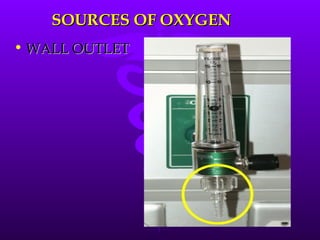
SOURCES OF OXYGEN WALL OUTLET
CYLINDER or TANK
OXYGEN FLOW RATES DETERMINES THE AMOUNT OF OXYGEN DELIVERED TO THE PATIENT. MEASURED IN LITERS PER MINUTE. RATE VARIES ACCORDING TO PATIENT’S CONDITION & ROUTE OF O2 ADMINISTRATION
TO REGULATE OXYGEN PERCENTAGE  CONCENTRATION   :- we can take the help of OXYGEN ANALYSERS ABG ANALYSIS PULSEOXYMETRY
OXYGEN DELIVERY SYSTEMS A number of systems available Choice depends on client’s O2 needs, comfort and developmental considerations
Nasal canula Nasal catheter  Trans tracheal catheter Simple mask Partial rebreather mask  Non rebreather mask  Venturi mask  Oxygen tent
NASAL CANULA  OR NASAL PRONGS
Common inexpensive device Easy to apply Does not interfere with eating or talking Relatively comfortable Permits some freedom of movement Well tolerated by clients
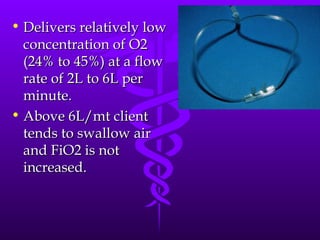
Delivers relatively low concentration of O2 (24% to 45%) at a flow rate of 2L to 6L per minute. Above 6L/mt client tends to swallow air and FiO2 is not increased.
NASAL CATHETER Nasal catheter is infrequently used as it is uncomfortable. May cause trauma It is inserted through nostril with the end of the catheter resting in the oropharynx.
Nasal catheter should be changed to another nostril every 8 hours. Gastric distention often occurs.
FACE MASKS Oxygen masks is fitted carefully to avoid leakage of O2. Shouldn’t be too tight
Commonly used types of masks are:- Simple face masks Partial re breather mask The non rebreather mask Venturi mask
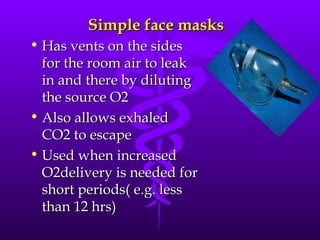
Simple face masks Has vents on the sides for the room air to leak in and there by diluting the source O2 Also allows exhaled CO2 to escape Used when increased O2delivery is needed for short periods( e.g. less than 12 hrs)
Simple face masks delivers the oxygen concentrations from  40% to 60%  At a flow rate of  5L to 8L/minute  respectively. Due to the risk of retaining CO2  never  apply a simple mask with a delivery rate of  less than 5 L/ mt .
Partial re breather mask Delivers oxygen concentration of 60% to  90% at a flow rate of 6L to 10L respectively.
O2 reservoir bag  attached allows the client to re breath about the first third of the exhaled air It increases Fio2 by recycling expired O2. It should not totally deflate.
The non rebreather mask Delivers the highest O2 concentration possible(95% to 100%) at a flow rate of 10L To 15L/Mt.
One way valves  on the mask and between the mask and the reservoir prevent the room air  and the client’s exhaled air entering the bag so only oxygen in the bag is inspired. This also should not deflate.
Venturi mask Delivers O2 concentrations varying from  24% to 40% or 50%  at  flow rates of  4L to 10L/mt.
The colour of the device reflects the delivered oxygen concentration:   24%: blue ;  28%: white ;  31%: orange ; 35%: yellow;  40%: red ;  60%: green
Face tent Designed for patients who cannot wear a mask or nasal prongs (e.g. facial surgery or trauma)  Provide varying concentration of oxygen E.g. 30% to 50 % at 4L to 8L/Mt.
Trans tracheal oxygen delivery Trans tracheal oxygen therapy is a superior method of delivering oxygen directly into the lungs by a small, flexible catheter which passes from the lower neck into the trachea . IN THIS THE CLIENT REQUIERS LESS O2 (0.5L TO 2L/Mt) as it enters directly into the lungs.
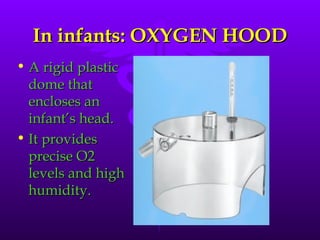
In infants: OXYGEN HOOD A rigid plastic dome that encloses an infant’s head.  It provides precise O2 levels and high humidity.
The gas should not be allowed to blow directly into infants face. And hood should not rub against infant’s neck, chin or shoulder.
In children: OXYGEN TENT
Rectangular , clear, plastic canopy with outlets that connect to oxygen which is humidified. O2 flow should be 15L/Mt for 5 mts initially and then adjust the flow meter according to the orders.  Delivers approximately 30%Of O2
THE END

Oxygen Therapy

  • 1.
  • 2.
    SOURCES OF OXYGENWALL OUTLET
  • 3.
  • 4.
    OXYGEN FLOW RATESDETERMINES THE AMOUNT OF OXYGEN DELIVERED TO THE PATIENT. MEASURED IN LITERS PER MINUTE. RATE VARIES ACCORDING TO PATIENT’S CONDITION & ROUTE OF O2 ADMINISTRATION
  • 5.
    TO REGULATE OXYGENPERCENTAGE CONCENTRATION :- we can take the help of OXYGEN ANALYSERS ABG ANALYSIS PULSEOXYMETRY
  • 6.
    OXYGEN DELIVERY SYSTEMSA number of systems available Choice depends on client’s O2 needs, comfort and developmental considerations
  • 7.
    Nasal canula Nasalcatheter Trans tracheal catheter Simple mask Partial rebreather mask Non rebreather mask Venturi mask Oxygen tent
  • 8.
    NASAL CANULA OR NASAL PRONGS
  • 9.
    Common inexpensive deviceEasy to apply Does not interfere with eating or talking Relatively comfortable Permits some freedom of movement Well tolerated by clients
  • 10.
    Delivers relatively lowconcentration of O2 (24% to 45%) at a flow rate of 2L to 6L per minute. Above 6L/mt client tends to swallow air and FiO2 is not increased.
  • 11.
    NASAL CATHETER Nasalcatheter is infrequently used as it is uncomfortable. May cause trauma It is inserted through nostril with the end of the catheter resting in the oropharynx.
  • 12.
    Nasal catheter shouldbe changed to another nostril every 8 hours. Gastric distention often occurs.
  • 13.
    FACE MASKS Oxygenmasks is fitted carefully to avoid leakage of O2. Shouldn’t be too tight
  • 14.
    Commonly used typesof masks are:- Simple face masks Partial re breather mask The non rebreather mask Venturi mask
  • 15.
    Simple face masksHas vents on the sides for the room air to leak in and there by diluting the source O2 Also allows exhaled CO2 to escape Used when increased O2delivery is needed for short periods( e.g. less than 12 hrs)
  • 16.
    Simple face masksdelivers the oxygen concentrations from 40% to 60% At a flow rate of 5L to 8L/minute respectively. Due to the risk of retaining CO2 never apply a simple mask with a delivery rate of less than 5 L/ mt .
  • 17.
    Partial re breathermask Delivers oxygen concentration of 60% to 90% at a flow rate of 6L to 10L respectively.
  • 18.
    O2 reservoir bag attached allows the client to re breath about the first third of the exhaled air It increases Fio2 by recycling expired O2. It should not totally deflate.
  • 19.
    The non rebreathermask Delivers the highest O2 concentration possible(95% to 100%) at a flow rate of 10L To 15L/Mt.
  • 20.
    One way valves on the mask and between the mask and the reservoir prevent the room air and the client’s exhaled air entering the bag so only oxygen in the bag is inspired. This also should not deflate.
  • 21.
    Venturi mask DeliversO2 concentrations varying from 24% to 40% or 50% at flow rates of 4L to 10L/mt.
  • 22.
    The colour ofthe device reflects the delivered oxygen concentration: 24%: blue ; 28%: white ; 31%: orange ; 35%: yellow; 40%: red ; 60%: green
  • 23.
    Face tent Designedfor patients who cannot wear a mask or nasal prongs (e.g. facial surgery or trauma) Provide varying concentration of oxygen E.g. 30% to 50 % at 4L to 8L/Mt.
  • 24.
    Trans tracheal oxygendelivery Trans tracheal oxygen therapy is a superior method of delivering oxygen directly into the lungs by a small, flexible catheter which passes from the lower neck into the trachea . IN THIS THE CLIENT REQUIERS LESS O2 (0.5L TO 2L/Mt) as it enters directly into the lungs.
  • 25.
    In infants: OXYGENHOOD A rigid plastic dome that encloses an infant’s head. It provides precise O2 levels and high humidity.
  • 26.
    The gas shouldnot be allowed to blow directly into infants face. And hood should not rub against infant’s neck, chin or shoulder.
  • 27.
  • 28.
    Rectangular , clear,plastic canopy with outlets that connect to oxygen which is humidified. O2 flow should be 15L/Mt for 5 mts initially and then adjust the flow meter according to the orders. Delivers approximately 30%Of O2
  • 29.