


NURSING  PROCESS Ms.JEENA AEJY
THE  NURSING  PROCESS A systematic problem-solving approach used to identify, prevent and treat actual or potential health problems and promote wellness.
Nursing process A systematic way to plan, implement and evaluate care for individuals, families, groups and communities.
Characteristics of the Nursing Process Dynamic Client-centered Planned Interpersonal and collaborative Universally applicable Can focus on problems or strengths
Open, flexible Humanistic and individualized Cyclical Outcome focused ( results oriented) Emphasizes feedback and validation
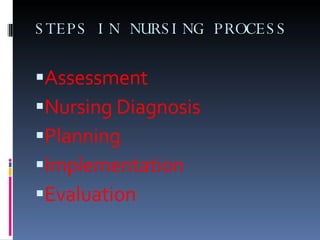
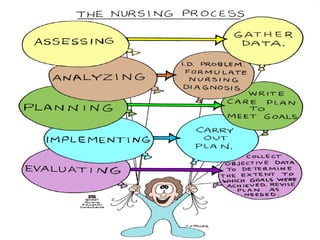
STEPS IN NURSING PROCESS Assessment Nursing Diagnosis Planning Implementation Evaluation
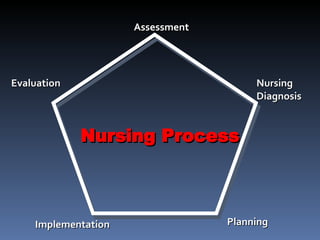
Nursing Process   Assessment Nursing Diagnosis Planning Implementation Evaluation
Benefits of using the nursing process Continuity of care Prevention of duplication Individualized care Standards of care Increased client participation Collaboration of care
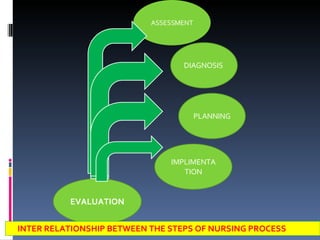
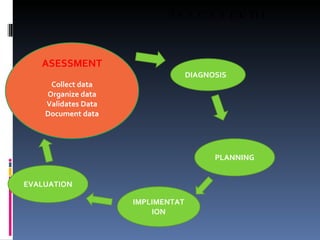
EVALUATION IMPLIMENTATION PLANNING ASSESSMENT DIAGNOSIS INTER RELATIONSHIP BETWEEN THE STEPS OF NURSING PROCESS
 
Assessment Assessing is a continuous process carried out during all phases of nursing process. All phases of the nursing process depend on the accurate and complete collection of data. Assessing is the systematic and continuous collection, organization, validation and documentation of data. - Potter and Perry( 2006)
Assessment is the deliberate and systematic collection of data to determine a clients current and past health status and to determine the clients present and past coping patterns - Carpenito 2000   Assessment is the systematic and continuous collection, validation and communication of patient data. - Carol Taylor  
Types of Assessment 1.   Initial Assessment : Performed within specified time after admission to a health care agency   Eg. Nursing Admission Assessment   2. Problem Focused Assessment : Ongoing process integrated with nursing care to determine specific problem identified in an earlier assessment and to identify new or overlooked  problems.   E.g.. Assessment of clients ability to perform self-care while assisting  client to bathe.     3. Emergency Assessment : Done during psychiatric or physiological crisis of the client to identify life threatening problems   Eg. Rapid assessment of airway, breathing and circulation during cardiac arrest   4. Time lapsed-Reassessment : Done several months after initial assessment to compare the clients status to baseline data previously obtained.
Assessment ASESSMENT Collect data Organize data Validates Data Document data DIAGNOSIS PLANNING IMPLIMENTATION EVALUATION
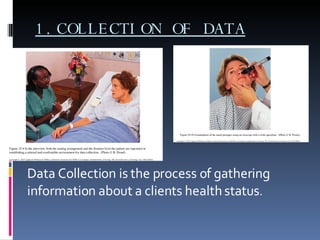
1.COLLECTION OF DATA Data Collection is the process of gathering information about a clients health status .
Collection of Data:   Data base : A data base is all information about a client. It includes the nursing health history, physical assessment, the physician’s history, physical examination, results of laboratory and diagnostic tests and material contributed by other health personnel.      
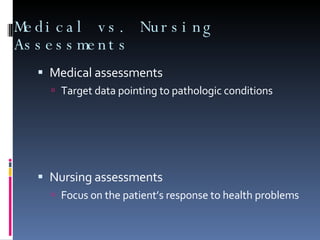
Medical vs. Nursing Assessments Medical assessments Target data pointing to pathologic conditions Nursing assessments Focus on the patient’s response to health problems
  Types of Data:   SUBJECTIVE DATA : Also referred to as symptoms or covert data are apparent only to the person affected and can be described or verified only by that person   Eg. Itching, Pain, Feelings of worry OBJECTIVE DATA : Also referred to as signs or overt data. These are detectable by an observer or can be measured or tested against an accepted standard.   They can be seen, heard, felt or smelled and they are obtained by observation or physical examination   Eg. A Blood Pressure Data Discolouration of the Skin  
Objective Data vs. Subjective Data Objective data Observable and measurable data that can be seen, heard, or felt by someone other than the person experiencing them E.g., elevated temperature, skin moisture, vomiting Subjective data Information perceived only by the affected person E.g., pain experience, feeling dizzy, feeling anxious
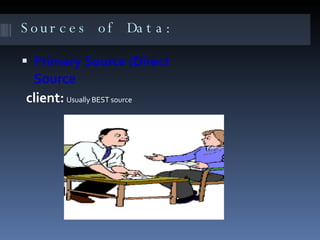
Sources of Data: Primary Source (Direct Source client:  Usually BEST source
Secondary Source (Indirect Source) Family Members Client’s records 1. Medical Records Eg. Medical History, Physical Examination, Operation  notes, Progress notes,  Consultation done by Physicians 2. Records of therapies done by other health professionals Eg. Social Workers, Dieticians, Physical Therapist 3. Laboratory Records Other health care professionals Verbal reports Literature
Data Collection Consider  time needs of patient developmental stage physical surroundings past and present coping patterns
Data Characteristics Complete Factual Accurate Relevant
Data collection methods OBSERVATION INTERVIEWING  PHYSICAL ASSESSMENT
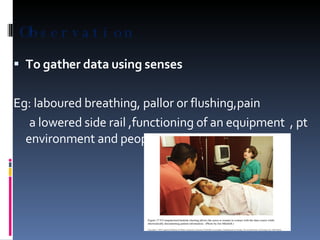
Observation To gather data using senses Eg: laboured breathing, pallor or flushing,pain  a lowered side rail ,functioning of an equipment  , pt environment and people in it etc…
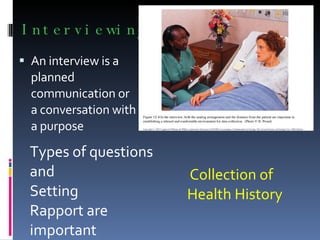
Interviewing An interview is a planned communication or a conversation with a purpose Types of questions and  Setting Rapport are important Collection of Health History
Four Phases of a Nursing Interview Preparatory phase  Introduction Working phase Termination
Interview Phases Preparatory Nurse collects background info from previous charts Ensure environment is conducive Arrange seating 3 – 4 ft apart Interviewer at 45° angle to patient Allow adequate time
Phases cont’d. Introduction Nurse introduces self Identifies purpose of interview Ensure confidentiality of information Provide for patient needs before starting
Phases cont’d. Working Nurse gathers info for  sub jective data Excellent communication skills are needed Active listening Eye contact Open-ended questions
Phases cont’d. Termination Inform patient when nearing end of interview Ensure patient knows what will happen with info Offer patient chance to add anything
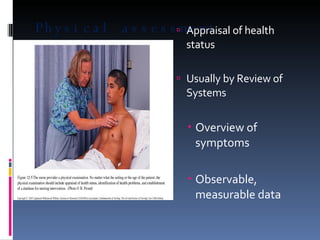
Physical assessment Appraisal of health status Usually by Review of  Systems Overview of symptoms Observable, measurable data
Objective data Possible approaches—body systems, head to toe, or functional health patterns
Methods of physical asessment Inspection  Percussion  Palpation  Auscultation
Problems Related to Data Collection Inappropriate organization of the database Omission of pertinent data Inclusion of irrelevant or duplicate data, erroneous or misinterpreted data Failure to establish rapport and partnership Recording an interpretation of data rather than observed behavior Failure to update the database
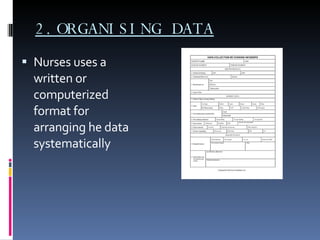
2.ORGANISING DATA Nurses uses a written or computerized format for arranging he data systematically
3.VALIDATING  DATA VALIDATING -THE ACT OF DOUBLE CHECKING Verifies understanding of information Comparison with another  source -patient or family member -record -health team member
4. DOCUMENTING  DATA Record in permanent record ASAP Use patient’s own words in subjective data – enclose in “ ___” (quotation marks) Avoid generalizations – be specific Don’t make summative statements
Thank you

NURSING PROCESS

  • 1.
    NURSING PROCESSMs.JEENA AEJY
  • 2.
    THE NURSING PROCESS A systematic problem-solving approach used to identify, prevent and treat actual or potential health problems and promote wellness.
  • 3.
    Nursing process Asystematic way to plan, implement and evaluate care for individuals, families, groups and communities.
  • 4.
    Characteristics of theNursing Process Dynamic Client-centered Planned Interpersonal and collaborative Universally applicable Can focus on problems or strengths
  • 5.
    Open, flexible Humanisticand individualized Cyclical Outcome focused ( results oriented) Emphasizes feedback and validation
  • 6.
    STEPS IN NURSINGPROCESS Assessment Nursing Diagnosis Planning Implementation Evaluation
  • 7.
    Nursing Process Assessment Nursing Diagnosis Planning Implementation Evaluation
  • 8.
    Benefits of usingthe nursing process Continuity of care Prevention of duplication Individualized care Standards of care Increased client participation Collaboration of care
  • 9.
    EVALUATION IMPLIMENTATION PLANNINGASSESSMENT DIAGNOSIS INTER RELATIONSHIP BETWEEN THE STEPS OF NURSING PROCESS
  • 10.
  • 11.
    Assessment Assessing isa continuous process carried out during all phases of nursing process. All phases of the nursing process depend on the accurate and complete collection of data. Assessing is the systematic and continuous collection, organization, validation and documentation of data. - Potter and Perry( 2006)
  • 12.
    Assessment is thedeliberate and systematic collection of data to determine a clients current and past health status and to determine the clients present and past coping patterns - Carpenito 2000   Assessment is the systematic and continuous collection, validation and communication of patient data. - Carol Taylor  
  • 13.
    Types of Assessment1. Initial Assessment : Performed within specified time after admission to a health care agency   Eg. Nursing Admission Assessment   2. Problem Focused Assessment : Ongoing process integrated with nursing care to determine specific problem identified in an earlier assessment and to identify new or overlooked problems.   E.g.. Assessment of clients ability to perform self-care while assisting client to bathe.     3. Emergency Assessment : Done during psychiatric or physiological crisis of the client to identify life threatening problems   Eg. Rapid assessment of airway, breathing and circulation during cardiac arrest   4. Time lapsed-Reassessment : Done several months after initial assessment to compare the clients status to baseline data previously obtained.
  • 14.
    Assessment ASESSMENT Collectdata Organize data Validates Data Document data DIAGNOSIS PLANNING IMPLIMENTATION EVALUATION
  • 15.
    1.COLLECTION OF DATAData Collection is the process of gathering information about a clients health status .
  • 16.
    Collection of Data:  Data base : A data base is all information about a client. It includes the nursing health history, physical assessment, the physician’s history, physical examination, results of laboratory and diagnostic tests and material contributed by other health personnel.      
  • 17.
    Medical vs. NursingAssessments Medical assessments Target data pointing to pathologic conditions Nursing assessments Focus on the patient’s response to health problems
  • 18.
    Typesof Data:   SUBJECTIVE DATA : Also referred to as symptoms or covert data are apparent only to the person affected and can be described or verified only by that person   Eg. Itching, Pain, Feelings of worry OBJECTIVE DATA : Also referred to as signs or overt data. These are detectable by an observer or can be measured or tested against an accepted standard.   They can be seen, heard, felt or smelled and they are obtained by observation or physical examination   Eg. A Blood Pressure Data Discolouration of the Skin  
  • 19.
    Objective Data vs.Subjective Data Objective data Observable and measurable data that can be seen, heard, or felt by someone other than the person experiencing them E.g., elevated temperature, skin moisture, vomiting Subjective data Information perceived only by the affected person E.g., pain experience, feeling dizzy, feeling anxious
  • 20.
    Sources of Data:Primary Source (Direct Source client: Usually BEST source
  • 21.
    Secondary Source (IndirectSource) Family Members Client’s records 1. Medical Records Eg. Medical History, Physical Examination, Operation notes, Progress notes, Consultation done by Physicians 2. Records of therapies done by other health professionals Eg. Social Workers, Dieticians, Physical Therapist 3. Laboratory Records Other health care professionals Verbal reports Literature
  • 22.
    Data Collection Consider time needs of patient developmental stage physical surroundings past and present coping patterns
  • 23.
    Data Characteristics CompleteFactual Accurate Relevant
  • 24.
    Data collection methodsOBSERVATION INTERVIEWING PHYSICAL ASSESSMENT
  • 25.
    Observation To gatherdata using senses Eg: laboured breathing, pallor or flushing,pain a lowered side rail ,functioning of an equipment , pt environment and people in it etc…
  • 26.
    Interviewing An interviewis a planned communication or a conversation with a purpose Types of questions and Setting Rapport are important Collection of Health History
  • 27.
    Four Phases ofa Nursing Interview Preparatory phase Introduction Working phase Termination
  • 28.
    Interview Phases PreparatoryNurse collects background info from previous charts Ensure environment is conducive Arrange seating 3 – 4 ft apart Interviewer at 45° angle to patient Allow adequate time
  • 29.
    Phases cont’d. IntroductionNurse introduces self Identifies purpose of interview Ensure confidentiality of information Provide for patient needs before starting
  • 30.
    Phases cont’d. WorkingNurse gathers info for sub jective data Excellent communication skills are needed Active listening Eye contact Open-ended questions
  • 31.
    Phases cont’d. TerminationInform patient when nearing end of interview Ensure patient knows what will happen with info Offer patient chance to add anything
  • 32.
    Physical assessment Appraisalof health status Usually by Review of Systems Overview of symptoms Observable, measurable data
  • 33.
    Objective data Possibleapproaches—body systems, head to toe, or functional health patterns
  • 34.
    Methods of physicalasessment Inspection Percussion Palpation Auscultation
  • 35.
    Problems Related toData Collection Inappropriate organization of the database Omission of pertinent data Inclusion of irrelevant or duplicate data, erroneous or misinterpreted data Failure to establish rapport and partnership Recording an interpretation of data rather than observed behavior Failure to update the database
  • 36.
    2.ORGANISING DATA Nursesuses a written or computerized format for arranging he data systematically
  • 37.
    3.VALIDATING DATAVALIDATING -THE ACT OF DOUBLE CHECKING Verifies understanding of information Comparison with another source -patient or family member -record -health team member
  • 38.
    4. DOCUMENTING DATA Record in permanent record ASAP Use patient’s own words in subjective data – enclose in “ ___” (quotation marks) Avoid generalizations – be specific Don’t make summative statements
  • 39.