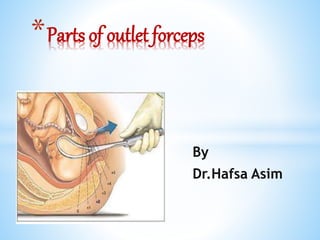

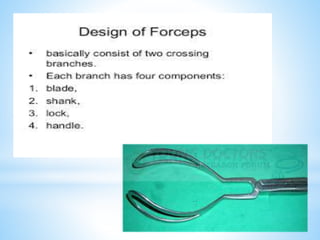
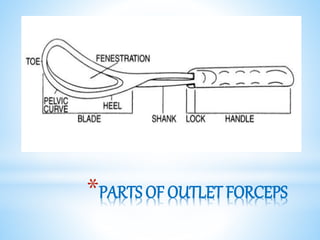

Forceps are instruments used to aid in childbirth by applying traction to the fetal head. They generally consist of two curved metal blades that cradle the fetal head, connected to handles by shanks. The blades grasp the fetus, each with a curve fitting the fetal head. The shanks connect the blades to the handles and transmit traction. A lock between the shanks allows the blades to be articulated during use.


![PERI-PROSTHETIC FRACTURE NAIL-PLATE CONSTRUCT [NPC].pptx](https://cdn.slidesharecdn.com/ss_thumbnails/drarunkumardrmohamedashrafperiprostheticfrasturenail-plateconstructnpc-260209164459-7e9d15a1-thumbnail.jpg?width=640&height=640&fit=bounds)

![ONFH[AVN HIP] -TRIPLE REGIME -A NOVAL SURGICAL CONCEPT .pptx](https://cdn.slidesharecdn.com/ss_thumbnails/onfhavnhip2026koaconcalicutdrgokuldevdrmashraf-260210064517-213ec005-thumbnail.jpg?width=640&height=640&fit=bounds)


