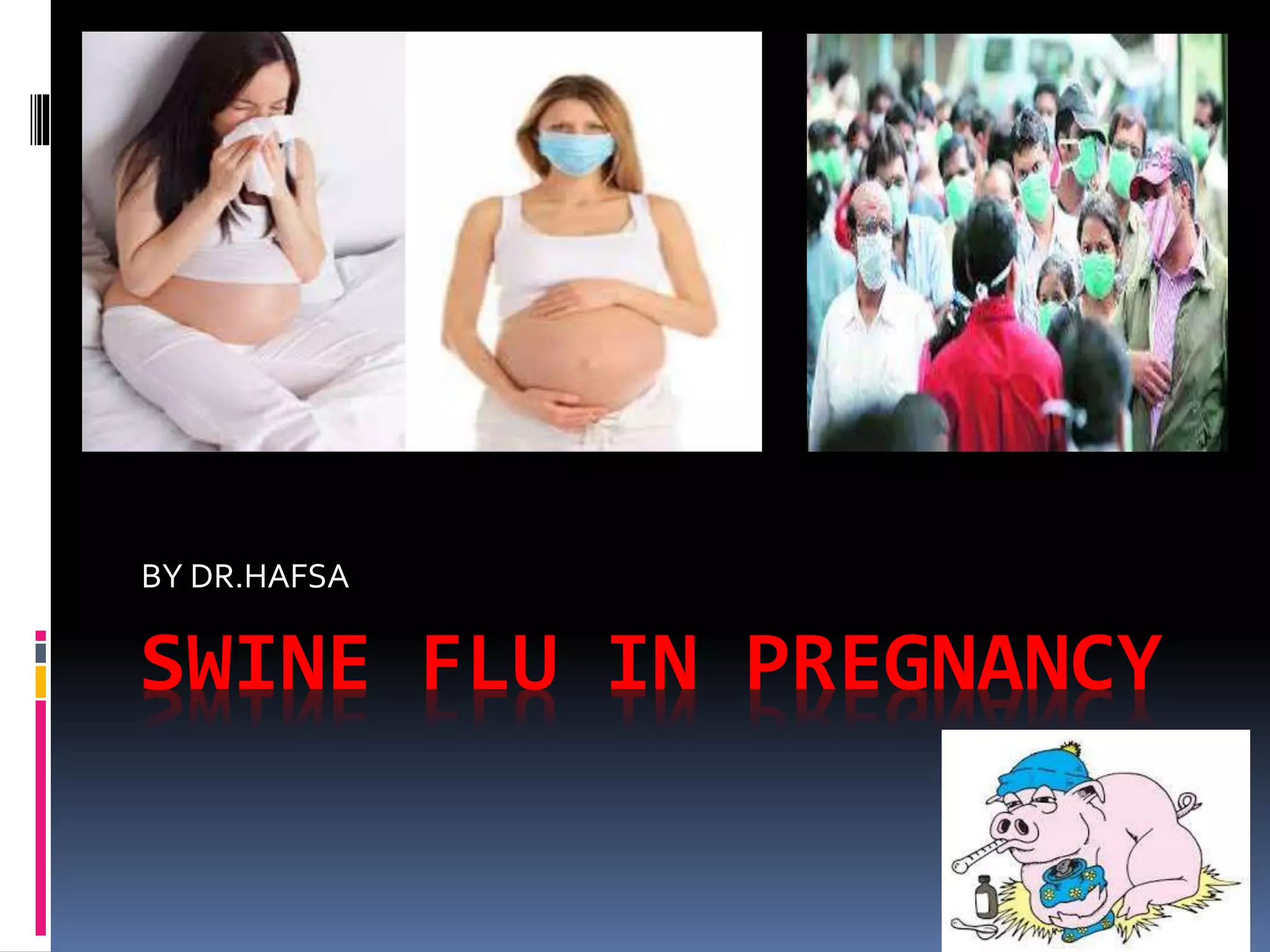
SWINE FLU IN PREGNANCY
BY DR.HAFSA
INTROUCTION
 The term “Swine flu” has recently been used
incorrectly to refer to the seasonal influenza A
(H1N1) virus which infects humans.
 Influenza A [H1N1], was reported from
Mexico on 18th March, 2009 and rapidly
spread to all the continents.
 On June, 2009 the Pakistan health ministry
confirmed the country’s first swine flu case in
a young boy of 14 years old (Dawn News).
Epidemiology
 AGENT
The Influenza A (H1N1) virus.
 Transmission
The transmission is by droplet infection and fomites.
- 70% hand to hand - 30% direct droplet
 Incubation Period
1-7 days.
 Communicability
From 1 day before to 7 days after the onset of symptoms. If illness persists
for more than 7 days, chances of communicability may persist till resolution
of illness.Children may spread the virus for a longer period.
 Seasonality
Peak during winter and temperate region.
Suspected case
 A suspected case of influenza A (H1N1) virus
infection is defined as:
A person with acute febrile illness (fever ≥ 38 C)
with sore throat, cough,headache and myalgia.
Probable case
 A probable case of influenza A (H1N1) virus
infection is defined as a person who meets
criterion of suspected case and in addition
has anyone of the followings:
 History of close contact with a person who is
a confirmed case of influenza A(H1N1) virus
infection, in last 7 days,
 Or has at least 3 of the warning signs
Confirmed case
 A confirmed case of influenza A (H1N1) virus
infection is defined as a person with an acute
febrile respiratory illness with laboratory
confirmed influenza A (H1N1) virus infection by
one or more of the following tests:
 Real Time PCR (PCR available at NIH) - During first
5 days of illness
 viral culture – during first 5 days of illness
 Four-fold rise in influenza A (H1N1) virus specific
neutralizing antibodies in a paired sample after
6th day of illness.
 The H1N1v virus tends to affect the younger
population, i.e. those below the age of 60
years, and that the majority of people who
suffer from it tend to experience mild flu
symptoms.
Risk of severe illness is highest in:
 Pregnant women especially during second &
third trimester.
 Pregnant women have been noted to have a 4
times higher risk of being hospitalized for
complications compared to the non-pregnant
population.
 Children less than 2 years of age.
 People with chronic lung disease including
asthma.
Complications
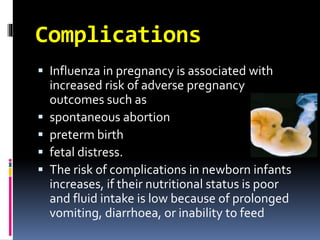
 Influenza in pregnancy is associated with
increased risk of adverse pregnancy
outcomes such as
 spontaneous abortion
 preterm birth
 fetal distress.
 The risk of complications in newborn infants
increases, if their nutritional status is poor
and fluid intake is low because of prolonged
vomiting, diarrhoea, or inability to feed
Investigations
ROUTINE INVESTIGATIONS
 CBC, LFTs, RFTs, Coagulation profile, X-ray
Chest, CT scan ( when required. )
 Diagnosis is confirmed using highly sensitive,
confirmatory real-time RT-PCR assays exist
for rapid identification of H1N1.
 Confirmation of influenza A (H1N1) infection is through: Real time RT PCR
– from onset of symptoms through day 5 or Isolation of the virus in
culture - from onset of symptoms through day 5 or Four-fold rise in virus
specific neutralizing antibodies – after 6th day of symptoms.
 For confirmation of diagnosis, clinical specimens such as nasopharyngeal
swab, throat swab, nasal swab, wash or aspirate and tracheal aspirate (for
intubated patients) are to be obtained.
 The sample should be collected by a trained physician / microbiologist
preferably before administration of the anti-viral drug.
 Keep specimens at 4°C in viral transport media until transported for
testing.
 The samples should be transported to designated laboratories within 24
hours.
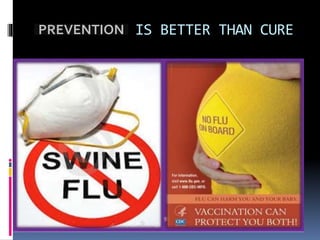
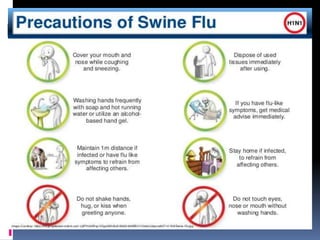
PREVSENTION IS BETTER THAN CUREPREVENTION
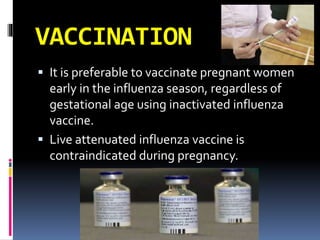
VACCINATION
 It is preferable to vaccinate pregnant women
early in the influenza season, regardless of
gestational age using inactivated influenza
vaccine.
 Live attenuated influenza vaccine is
contraindicated during pregnancy.
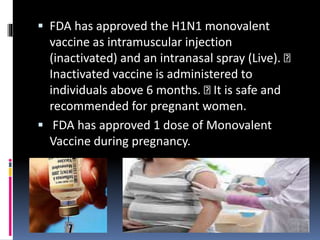
 FDA has approved the H1N1 monovalent
vaccine as intramuscular injection
(inactivated) and an intranasal spray (Live).
Inactivated vaccine is administered to
individuals above 6 months. It is safe and
recommended for pregnant women.
 FDA has approved 1 dose of Monovalent
Vaccine during pregnancy.
TREATMENT
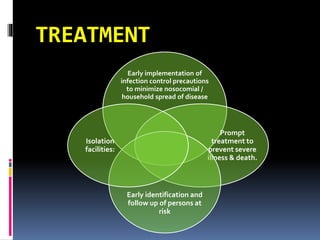
Early implementation of
infection control precautions
to minimize nosocomial /
household spread of disease
Prompt
treatment to
prevent severe
illness & death.
Early identification and
follow up of persons at
risk
Isolation
facilities:
Medication
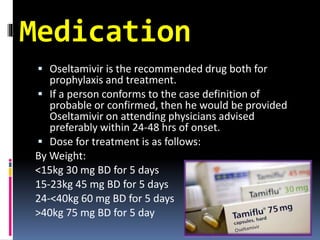
 Oseltamivir is the recommended drug both for
prophylaxis and treatment.
 If a person conforms to the case definition of
probable or confirmed, then he would be provided
Oseltamivir on attending physicians advised
preferably within 24-48 hrs of onset.
 Dose for treatment is as follows:
By Weight:
<15kg 30 mg BD for 5 days
15-23kg 45 mg BD for 5 days
24-<40kg 60 mg BD for 5 days
>40kg 75 mg BD for 5 day
Supportive therapy
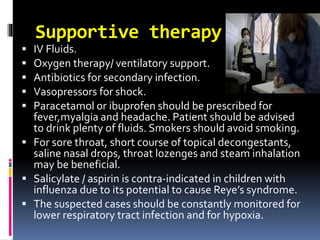
 IV Fluids.
 Oxygen therapy/ ventilatory support.
 Antibiotics for secondary infection.
 Vasopressors for shock.
 Paracetamol or ibuprofen should be prescribed for
fever,myalgia and headache. Patient should be advised
to drink plenty of fluids. Smokers should avoid smoking.
 For sore throat, short course of topical decongestants,
saline nasal drops, throat lozenges and steam inhalation
may be beneficial.
 Salicylate / aspirin is contra-indicated in children with
influenza due to its potential to cause Reye’s syndrome.
 The suspected cases should be constantly monitored for
lower respiratory tract infection and for hypoxia.
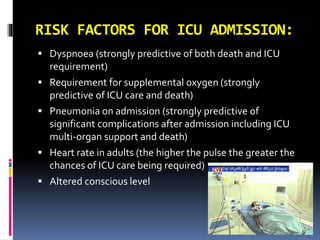
RISK FACTORS FOR ICU ADMISSION:
 Dyspnoea (strongly predictive of both death and ICU
requirement)
 Requirement for supplemental oxygen (strongly
predictive of ICU care and death)
 Pneumonia on admission (strongly predictive of
significant complications after admission including ICU
multi-organ support and death)
 Heart rate in adults (the higher the pulse the greater the
chances of ICU care being required)
 Altered conscious level
Discharge Policy
 Patients who have responded to
treatment and are clinically stable - may
be discharged 24 hours of defervesce at
the discretion of attending physician
with total 5 days of Oseltamivir
treatment.
 Chemoprophylaxis
It is advised for those contacts who are in
high risk group (with under lying systemic
diseases; extremes of age[<5 years and
65> years]
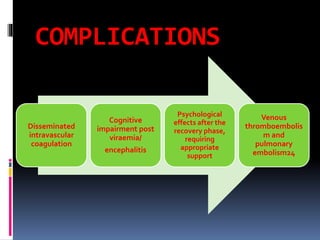
COMPLICATIONS
Disseminated
intravascular
coagulation
Cognitive
impairment post
viraemia/
encephalitis
Psychological
effects after the
recovery phase,
requiring
appropriate
support
Venous
thromboembolis
m and
pulmonary
embolism24
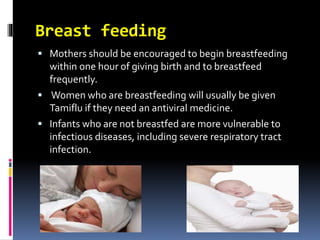
Breast feeding
 Mothers should be encouraged to begin breastfeeding
within one hour of giving birth and to breastfeed
frequently.
 Women who are breastfeeding will usually be given
Tamiflu if they need an antiviral medicine.
 Infants who are not breastfed are more vulnerable to
infectious diseases, including severe respiratory tract
infection.
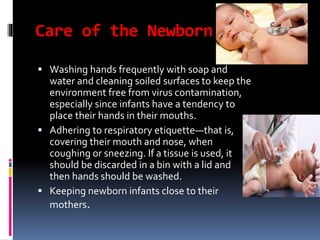
Care of the Newborn
 Washing hands frequently with soap and
water and cleaning soiled surfaces to keep the
environment free from virus contamination,
especially since infants have a tendency to
place their hands in their mouths.
 Adhering to respiratory etiquette—that is,
covering their mouth and nose, when
coughing or sneezing. If a tissue is used, it
should be discarded in a bin with a lid and
then hands should be washed.
 Keeping newborn infants close to their
mothers.
Standard Operating Procedures
on Use of PPE
 Personal Protection Equipment
PPE reduces the risk of infection if used correctly. It
includes:
• Gloves (nonsterile),
• Mask (high-efficiency mask) / surgical mask,
• Long-sleeved cuffed gown,
• Protective eyewear (goggles/visors/Face shields),
• Cap (may be used in high risk situations where
there may be increased aerosols),
• Plastic apron if splashing of blood, body fluids,
excretions and secretions is anticipated.
THANKYOU

Swine flu in pregnancy

  • 1.
    SWINE FLU INPREGNANCY BY DR.HAFSA
  • 2.
    INTROUCTION  The term“Swine flu” has recently been used incorrectly to refer to the seasonal influenza A (H1N1) virus which infects humans.  Influenza A [H1N1], was reported from Mexico on 18th March, 2009 and rapidly spread to all the continents.  On June, 2009 the Pakistan health ministry confirmed the country’s first swine flu case in a young boy of 14 years old (Dawn News).
  • 3.
    Epidemiology  AGENT The InfluenzaA (H1N1) virus.  Transmission The transmission is by droplet infection and fomites. - 70% hand to hand - 30% direct droplet  Incubation Period 1-7 days.  Communicability From 1 day before to 7 days after the onset of symptoms. If illness persists for more than 7 days, chances of communicability may persist till resolution of illness.Children may spread the virus for a longer period.  Seasonality Peak during winter and temperate region.
  • 4.
    Suspected case  Asuspected case of influenza A (H1N1) virus infection is defined as: A person with acute febrile illness (fever ≥ 38 C) with sore throat, cough,headache and myalgia.
  • 5.
    Probable case  Aprobable case of influenza A (H1N1) virus infection is defined as a person who meets criterion of suspected case and in addition has anyone of the followings:  History of close contact with a person who is a confirmed case of influenza A(H1N1) virus infection, in last 7 days,  Or has at least 3 of the warning signs
  • 6.
    Confirmed case  Aconfirmed case of influenza A (H1N1) virus infection is defined as a person with an acute febrile respiratory illness with laboratory confirmed influenza A (H1N1) virus infection by one or more of the following tests:  Real Time PCR (PCR available at NIH) - During first 5 days of illness  viral culture – during first 5 days of illness  Four-fold rise in influenza A (H1N1) virus specific neutralizing antibodies in a paired sample after 6th day of illness.
  • 8.
     The H1N1vvirus tends to affect the younger population, i.e. those below the age of 60 years, and that the majority of people who suffer from it tend to experience mild flu symptoms.
  • 9.
    Risk of severeillness is highest in:  Pregnant women especially during second & third trimester.  Pregnant women have been noted to have a 4 times higher risk of being hospitalized for complications compared to the non-pregnant population.  Children less than 2 years of age.  People with chronic lung disease including asthma.
  • 10.
    Complications  Influenza inpregnancy is associated with increased risk of adverse pregnancy outcomes such as  spontaneous abortion  preterm birth  fetal distress.  The risk of complications in newborn infants increases, if their nutritional status is poor and fluid intake is low because of prolonged vomiting, diarrhoea, or inability to feed
  • 11.
  • 12.
    ROUTINE INVESTIGATIONS  CBC,LFTs, RFTs, Coagulation profile, X-ray Chest, CT scan ( when required. )  Diagnosis is confirmed using highly sensitive, confirmatory real-time RT-PCR assays exist for rapid identification of H1N1.
  • 13.
     Confirmation ofinfluenza A (H1N1) infection is through: Real time RT PCR – from onset of symptoms through day 5 or Isolation of the virus in culture - from onset of symptoms through day 5 or Four-fold rise in virus specific neutralizing antibodies – after 6th day of symptoms.  For confirmation of diagnosis, clinical specimens such as nasopharyngeal swab, throat swab, nasal swab, wash or aspirate and tracheal aspirate (for intubated patients) are to be obtained.  The sample should be collected by a trained physician / microbiologist preferably before administration of the anti-viral drug.  Keep specimens at 4°C in viral transport media until transported for testing.  The samples should be transported to designated laboratories within 24 hours.
  • 14.
    PREVSENTION IS BETTERTHAN CUREPREVENTION
  • 16.
    VACCINATION  It ispreferable to vaccinate pregnant women early in the influenza season, regardless of gestational age using inactivated influenza vaccine.  Live attenuated influenza vaccine is contraindicated during pregnancy.
  • 17.
     FDA hasapproved the H1N1 monovalent vaccine as intramuscular injection (inactivated) and an intranasal spray (Live). Inactivated vaccine is administered to individuals above 6 months. It is safe and recommended for pregnant women.  FDA has approved 1 dose of Monovalent Vaccine during pregnancy.
  • 18.
    TREATMENT Early implementation of infectioncontrol precautions to minimize nosocomial / household spread of disease Prompt treatment to prevent severe illness & death. Early identification and follow up of persons at risk Isolation facilities:
  • 19.
    Medication  Oseltamivir isthe recommended drug both for prophylaxis and treatment.  If a person conforms to the case definition of probable or confirmed, then he would be provided Oseltamivir on attending physicians advised preferably within 24-48 hrs of onset.  Dose for treatment is as follows: By Weight: <15kg 30 mg BD for 5 days 15-23kg 45 mg BD for 5 days 24-<40kg 60 mg BD for 5 days >40kg 75 mg BD for 5 day
  • 20.
    Supportive therapy  IVFluids.  Oxygen therapy/ ventilatory support.  Antibiotics for secondary infection.  Vasopressors for shock.  Paracetamol or ibuprofen should be prescribed for fever,myalgia and headache. Patient should be advised to drink plenty of fluids. Smokers should avoid smoking.  For sore throat, short course of topical decongestants, saline nasal drops, throat lozenges and steam inhalation may be beneficial.  Salicylate / aspirin is contra-indicated in children with influenza due to its potential to cause Reye’s syndrome.  The suspected cases should be constantly monitored for lower respiratory tract infection and for hypoxia.
  • 31.
    RISK FACTORS FORICU ADMISSION:  Dyspnoea (strongly predictive of both death and ICU requirement)  Requirement for supplemental oxygen (strongly predictive of ICU care and death)  Pneumonia on admission (strongly predictive of significant complications after admission including ICU multi-organ support and death)  Heart rate in adults (the higher the pulse the greater the chances of ICU care being required)  Altered conscious level
  • 32.
    Discharge Policy  Patientswho have responded to treatment and are clinically stable - may be discharged 24 hours of defervesce at the discretion of attending physician with total 5 days of Oseltamivir treatment.  Chemoprophylaxis It is advised for those contacts who are in high risk group (with under lying systemic diseases; extremes of age[<5 years and 65> years]
  • 33.
    COMPLICATIONS Disseminated intravascular coagulation Cognitive impairment post viraemia/ encephalitis Psychological effects afterthe recovery phase, requiring appropriate support Venous thromboembolis m and pulmonary embolism24
  • 34.
    Breast feeding  Mothersshould be encouraged to begin breastfeeding within one hour of giving birth and to breastfeed frequently.  Women who are breastfeeding will usually be given Tamiflu if they need an antiviral medicine.  Infants who are not breastfed are more vulnerable to infectious diseases, including severe respiratory tract infection.
  • 35.
    Care of theNewborn  Washing hands frequently with soap and water and cleaning soiled surfaces to keep the environment free from virus contamination, especially since infants have a tendency to place their hands in their mouths.  Adhering to respiratory etiquette—that is, covering their mouth and nose, when coughing or sneezing. If a tissue is used, it should be discarded in a bin with a lid and then hands should be washed.  Keeping newborn infants close to their mothers.
  • 36.
    Standard Operating Procedures onUse of PPE  Personal Protection Equipment PPE reduces the risk of infection if used correctly. It includes: • Gloves (nonsterile), • Mask (high-efficiency mask) / surgical mask, • Long-sleeved cuffed gown, • Protective eyewear (goggles/visors/Face shields), • Cap (may be used in high risk situations where there may be increased aerosols), • Plastic apron if splashing of blood, body fluids, excretions and secretions is anticipated.
  • 37.