OPERATIVE VAGINAL DELIVERY
OPERATIVE VAGINAL
DELIVERY
• Operative vaginal delivery refers to any
delivery process which is assisted by vaginal
operations. Delivery by for forceps, ventouse
and destructive operations are generally
included.
INDICATIONS FOR OPERATIVE
VAGINAL DELIVERY
MATERNAL
■Inadequate expulsive efforts
■ Maternal distress
■ Where expulsive efforts are to be avoided
(e.g. cardiac disease, hypertensive crises,
cerebrovascular diseases, spinal cord injury)
FETAL
 fetal distress (e.g. low birthweight baby, postmaturity)
 Aftercoming head of breech
OTHERS
 Prolonged second stage of labor (nullipara >2 hour;
multipara >1 hour)
 To cut short the second stage of labor as in severe
pre-eclampsia, cardiac disease, postcesarean
pregnancy
FORCEPS
Obstetric forceps is a pair of instruments
especially designed to assist extraction of the
fetal head and thereby accomplishing delivery
of the fetus
VARIETIES OF OBSTETRIC
FORCEPS
Long curved forceps with or without axis-
traction device
Short curved forceps
 Kielland's forceps
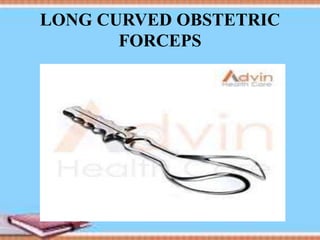
LONG CURVED OBSTETRIC
FORCEPS
• Long-curved obstetric forceps is relatively heavy and
is about 37 cm (15") long.
• In India, Das's variety (named after Sir Kedar Nath
Das) is commonly used with advantages.
• It is comparatively lighter and slightly shorter than its
Western counterpart but is quite suited for the
comparatively small pelvis and small baby of Indian
women.
LONG CURVED OBSTETRIC
FORCEPS
Measurements:
Length is 37 cm; distance in between the tips is
2.5 cm and widest diameter between the blades
Blade: The blade is fenestrated to facilitate a
good grip of the fetal head.
The blade has got two curves
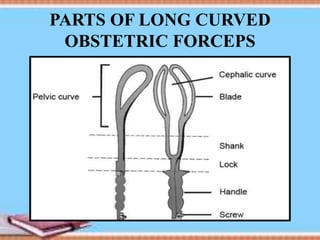
PARTS OF LONG CURVED
OBSTETRIC FORCEPS
• 1. Pelvic curve: The curve on the edge is to fit more
or less the curve on the axis of the birth canal. It
forms a part of a circle whose radius is 17.5 cm . The
front of the forceps is the concave side of the pelvic
curve. Pelvic curve permits ease of application along
the maternal pelvic axis.
• 2. Cephalic curve: It is the curve on the flat surface
which when articulated, grasps the fetal head without
compression. The radius of the curve is 11.5 cm
(4.5").
• Shank: It is the part between the blade and the lock and usually
measures 6.25 cm (2.5"). It increases the length of the
instrument and, thereby, facilitates locking of the blades outside
the vulva.
• Lock: The common method of articulation consists of a socket
system located on the shank at its junction with the handle.
• Handle: The handles are apposed when the blades are
articulated. It measures 12.5 cm (5").
• A screw is attached usually at the at the base of one blade
(commonly left). It helps to keep the blades in position.
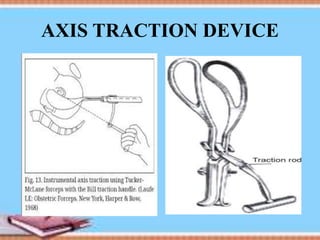
AXIS TRACTION DEVICE
It can be applied with advantage in mid forceps
operation especially following manual rotation
of the head. It provides traction in the correct
axis of the pelvic curve and as such less force
is necessary to deliver the head. It consists of:
• (1) Traction rods (two-right and left);
• (2) Traction handle
AXIS TRACTION DEVICE
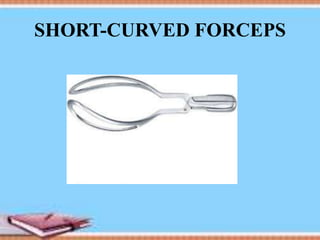
SHORT-CURVED FORCEPS
(Wrigley's Forceps) The instrument is lighter,
shorter and stubby handled. It is short due to
reduction in the length of the shanks and handles.
It has a marked cephalic curve with a slight pelvic
curve. The instrument is used for very low forceps
deliveries for the after coming head of a breech
delivery or at cesarean section.
SHORT-CURVED FORCEPS
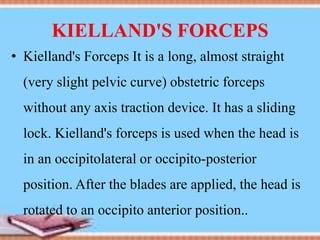
KIELLAND'S FORCEPS
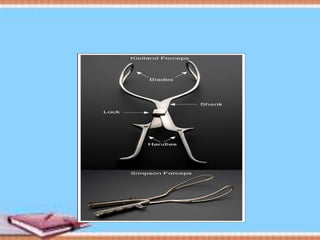
• Kielland's Forceps It is a long, almost straight
(very slight pelvic curve) obstetric forceps
without any axis traction device. It has a sliding
lock. Kielland's forceps is used when the head is
in an occipitolateral or occipito-posterior
position. After the blades are applied, the head is
rotated to an occipito anterior position..
INDICATIONS OF PROPHYLACTIC
FORCEPS DELIVERY
Eclampsia, severe pre eclampsia;
Heart disease;
Previous history of cesarean section;
postmaturity;
Low birth weight baby;
To sorten the painful second stage;
Patients under epidural analgesia
PREREQUISITES FOR OPERATIVE VAGINAL
DELIVERY
FETALAND MATERNAL CRITERIA
Fetal head engaged
The cervix must be fully dilated
The membranes must be ruptured
Fetal head position is exactly known
Pelvis deemed adequate
Bladder must be emptied
Adequate maternal analgesia (regional block
for mid-cavity or pudendal block)
Informed consent (verbal or written) with prior
clear explanation
OTHERS
• Experienced operator
• Aseptic techniques
• Back up plan and facilities in case of failure
• Presence of a neonatologist
• Willingness to abandon the procedure when
difficulties faced
COMMON CONDITIONS FOR
TRIAL OF FORCEPS DELIVERY
• Maternal obesity (BMI ≥ 30);
• Clinically big baby (Wt ≥ 3 kg);
• Occipitoposterior position;
• Mid-cavity delivery;
• When 1/5th fetal head palpable per abdomen.
LIMITATIONS OF FOCEPS
DELIVERY
• The complexity in the technique of its
application
• There are chances of injuries to the vagina or
perineum.
• Deep medio-lateral episiotomy is mandatory
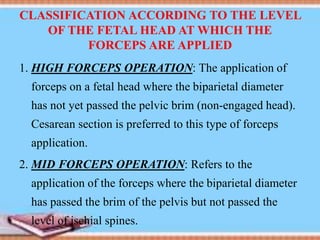
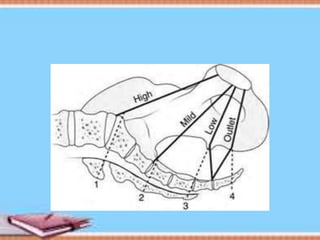
CLASSIFICATION ACCORDING TO THE LEVEL
OF THE FETAL HEAD AT WHICH THE
FORCEPS ARE APPLIED
1. HIGH FORCEPS OPERATION: The application of
forceps on a fetal head where the biparietal diameter
has not yet passed the pelvic brim (non-engaged head).
Cesarean section is preferred to this type of forceps
application.
2. MID FORCEPS OPERATION: Refers to the
application of the forceps where the biparietal diameter
has passed the brim of the pelvis but not passed the
level of ischial spines.
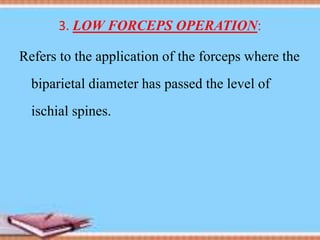
3. LOW FORCEPS OPERATION:
Refers to the application of the forceps where the
biparietal diameter has passed the level of
ischial spines.
LOW FORCEPS OPERATION
PRELIMINARIES:The following are
especially emphasized:
ANESTHESIA: Pudendal block supplemented
by perineal and labial infiltration with 1%
lignocaine hydrochloride is quite effective in
producing local anesthesia
CATHETERIZATION
INTERNAL EXAMINATION
to assess:
(a) state of the cervix,
(b) membranes status,
(c) presentation and position of the head,
(d) assessment of the pelvic outlet
EPISIOTOMY:
It is usually done during traction when the
perineum becomes bulged and thinned out by
the advancing head.
STEPS: The operation consists of the following
steps:
Identification of the blades and their application
Locking of the blades
 Traction
Removal of the blades
4. OUTLET FORCEPS:
Wrigley's forceps are used exclusively in outlet
forceps operation. Perineal and vulval
infiltration with 1% lignocaine is enough for
local anesthesia.The forceps are applied on the
fetal head lying on the perineum and is visible
at the introitus in between contractions.
The sagittal suture should lie in the antero-
posterior diameter of the outlet. In the present
day practice 90 percent of forceps applications
are the low forceps categories. All outlet
forceps are low forceps, but not all low forceps
are outlet forceps.
DIFFICULTIES OF FORCEPS
OPERATION
DURING APPLICATION OF THE BLADES:
The causes are:
(1) Incompletely dilated cervix;
(2) unrotated or nonengaged head.
DIFFICULTY IN LOCKING:
The causes are:
(1) Application in unrotated head,
(2) improper insertion of the blade not far enough
in),
(3) failure to depress the handle against the
perineum,
(4) entanglement of the cord or fetal parts inside
the blades.
DIFFICULTY IN TRACTION: The causes of
failure to deliver with traction are:
1. Undiagnosed occipitoposterior position;
2. 2 Faulty cephalic application;
3. Wrong direction of traction;
4. Mild pelvic contraction;
5. Constriction ring.
SLIPPING OF THE BLADES:
The causes are:
1. The blades are not introduced far enough in
2. Faulty application in occipitoposterior position.
COMMMON CAUSES OF FAILED
FORCEPS
• Incompletely dilated cervix;
• Unrotated occipitoposterior position;
• Cephalopelvic disproportion;
• Unrecognized malpresentation (brow) or
hydrocephalus;
• Constriction ring;
• Clinically big baby (24 kg);
• Maternal BMI ≥30;
• In a case with mid-cavity delivery.
COMPLICATIONS OF FORCEPS OPERATION
MATERNAL
IMMEDIATE COMPLICATION
Injury:
Nerve injury:
Postpartum hemorrhage
Anesthetic complications
Puerperal sepsis
maternal morbidity
REMOTE:Painful perineal scars, dyspareunia, low
backache, genital prolapse, stress, urinary
incontinence and anal sphincter dysfunction
FETAL
IMMEDIATE:
Asphyxia,
facial bruising,
intracranial hemorrhage
Cephalhematoma
facial palsy
skull fractures
REMOTE:
Cerebral palsy

OPERATIVE VAGINAL DELIVERY.pptx

  • 1.
  • 2.
    OPERATIVE VAGINAL DELIVERY • Operativevaginal delivery refers to any delivery process which is assisted by vaginal operations. Delivery by for forceps, ventouse and destructive operations are generally included.
  • 3.
    INDICATIONS FOR OPERATIVE VAGINALDELIVERY MATERNAL ■Inadequate expulsive efforts ■ Maternal distress ■ Where expulsive efforts are to be avoided (e.g. cardiac disease, hypertensive crises, cerebrovascular diseases, spinal cord injury)
  • 4.
    FETAL  fetal distress(e.g. low birthweight baby, postmaturity)  Aftercoming head of breech OTHERS  Prolonged second stage of labor (nullipara >2 hour; multipara >1 hour)  To cut short the second stage of labor as in severe pre-eclampsia, cardiac disease, postcesarean pregnancy
  • 5.
    FORCEPS Obstetric forceps isa pair of instruments especially designed to assist extraction of the fetal head and thereby accomplishing delivery of the fetus
  • 6.
    VARIETIES OF OBSTETRIC FORCEPS Longcurved forceps with or without axis- traction device Short curved forceps  Kielland's forceps
  • 7.
    LONG CURVED OBSTETRIC FORCEPS •Long-curved obstetric forceps is relatively heavy and is about 37 cm (15") long. • In India, Das's variety (named after Sir Kedar Nath Das) is commonly used with advantages. • It is comparatively lighter and slightly shorter than its Western counterpart but is quite suited for the comparatively small pelvis and small baby of Indian women.
  • 8.
  • 9.
    Measurements: Length is 37cm; distance in between the tips is 2.5 cm and widest diameter between the blades Blade: The blade is fenestrated to facilitate a good grip of the fetal head. The blade has got two curves
  • 10.
    PARTS OF LONGCURVED OBSTETRIC FORCEPS
  • 11.
    • 1. Pelviccurve: The curve on the edge is to fit more or less the curve on the axis of the birth canal. It forms a part of a circle whose radius is 17.5 cm . The front of the forceps is the concave side of the pelvic curve. Pelvic curve permits ease of application along the maternal pelvic axis. • 2. Cephalic curve: It is the curve on the flat surface which when articulated, grasps the fetal head without compression. The radius of the curve is 11.5 cm (4.5").
  • 12.
    • Shank: Itis the part between the blade and the lock and usually measures 6.25 cm (2.5"). It increases the length of the instrument and, thereby, facilitates locking of the blades outside the vulva. • Lock: The common method of articulation consists of a socket system located on the shank at its junction with the handle. • Handle: The handles are apposed when the blades are articulated. It measures 12.5 cm (5"). • A screw is attached usually at the at the base of one blade (commonly left). It helps to keep the blades in position.
  • 13.
    AXIS TRACTION DEVICE Itcan be applied with advantage in mid forceps operation especially following manual rotation of the head. It provides traction in the correct axis of the pelvic curve and as such less force is necessary to deliver the head. It consists of: • (1) Traction rods (two-right and left); • (2) Traction handle
  • 14.
  • 15.
    SHORT-CURVED FORCEPS (Wrigley's Forceps)The instrument is lighter, shorter and stubby handled. It is short due to reduction in the length of the shanks and handles. It has a marked cephalic curve with a slight pelvic curve. The instrument is used for very low forceps deliveries for the after coming head of a breech delivery or at cesarean section.
  • 16.
  • 17.
    KIELLAND'S FORCEPS • Kielland'sForceps It is a long, almost straight (very slight pelvic curve) obstetric forceps without any axis traction device. It has a sliding lock. Kielland's forceps is used when the head is in an occipitolateral or occipito-posterior position. After the blades are applied, the head is rotated to an occipito anterior position..
  • 19.
    INDICATIONS OF PROPHYLACTIC FORCEPSDELIVERY Eclampsia, severe pre eclampsia; Heart disease; Previous history of cesarean section; postmaturity; Low birth weight baby; To sorten the painful second stage; Patients under epidural analgesia
  • 20.
    PREREQUISITES FOR OPERATIVEVAGINAL DELIVERY FETALAND MATERNAL CRITERIA Fetal head engaged The cervix must be fully dilated The membranes must be ruptured Fetal head position is exactly known
  • 21.
    Pelvis deemed adequate Bladdermust be emptied Adequate maternal analgesia (regional block for mid-cavity or pudendal block) Informed consent (verbal or written) with prior clear explanation
  • 22.
    OTHERS • Experienced operator •Aseptic techniques • Back up plan and facilities in case of failure • Presence of a neonatologist • Willingness to abandon the procedure when difficulties faced
  • 23.
    COMMON CONDITIONS FOR TRIALOF FORCEPS DELIVERY • Maternal obesity (BMI ≥ 30); • Clinically big baby (Wt ≥ 3 kg); • Occipitoposterior position; • Mid-cavity delivery; • When 1/5th fetal head palpable per abdomen.
  • 24.
    LIMITATIONS OF FOCEPS DELIVERY •The complexity in the technique of its application • There are chances of injuries to the vagina or perineum. • Deep medio-lateral episiotomy is mandatory
  • 25.
    CLASSIFICATION ACCORDING TOTHE LEVEL OF THE FETAL HEAD AT WHICH THE FORCEPS ARE APPLIED 1. HIGH FORCEPS OPERATION: The application of forceps on a fetal head where the biparietal diameter has not yet passed the pelvic brim (non-engaged head). Cesarean section is preferred to this type of forceps application. 2. MID FORCEPS OPERATION: Refers to the application of the forceps where the biparietal diameter has passed the brim of the pelvis but not passed the level of ischial spines.
  • 26.
    3. LOW FORCEPSOPERATION: Refers to the application of the forceps where the biparietal diameter has passed the level of ischial spines.
  • 28.
    LOW FORCEPS OPERATION PRELIMINARIES:Thefollowing are especially emphasized: ANESTHESIA: Pudendal block supplemented by perineal and labial infiltration with 1% lignocaine hydrochloride is quite effective in producing local anesthesia CATHETERIZATION
  • 29.
    INTERNAL EXAMINATION to assess: (a)state of the cervix, (b) membranes status, (c) presentation and position of the head, (d) assessment of the pelvic outlet EPISIOTOMY: It is usually done during traction when the perineum becomes bulged and thinned out by the advancing head.
  • 30.
    STEPS: The operationconsists of the following steps: Identification of the blades and their application Locking of the blades  Traction Removal of the blades
  • 31.
    4. OUTLET FORCEPS: Wrigley'sforceps are used exclusively in outlet forceps operation. Perineal and vulval infiltration with 1% lignocaine is enough for local anesthesia.The forceps are applied on the fetal head lying on the perineum and is visible at the introitus in between contractions.
  • 32.
    The sagittal sutureshould lie in the antero- posterior diameter of the outlet. In the present day practice 90 percent of forceps applications are the low forceps categories. All outlet forceps are low forceps, but not all low forceps are outlet forceps.
  • 33.
    DIFFICULTIES OF FORCEPS OPERATION DURINGAPPLICATION OF THE BLADES: The causes are: (1) Incompletely dilated cervix; (2) unrotated or nonengaged head. DIFFICULTY IN LOCKING: The causes are: (1) Application in unrotated head, (2) improper insertion of the blade not far enough in),
  • 34.
    (3) failure todepress the handle against the perineum, (4) entanglement of the cord or fetal parts inside the blades. DIFFICULTY IN TRACTION: The causes of failure to deliver with traction are: 1. Undiagnosed occipitoposterior position; 2. 2 Faulty cephalic application;
  • 35.
    3. Wrong directionof traction; 4. Mild pelvic contraction; 5. Constriction ring. SLIPPING OF THE BLADES: The causes are: 1. The blades are not introduced far enough in 2. Faulty application in occipitoposterior position.
  • 36.
    COMMMON CAUSES OFFAILED FORCEPS • Incompletely dilated cervix; • Unrotated occipitoposterior position; • Cephalopelvic disproportion; • Unrecognized malpresentation (brow) or hydrocephalus; • Constriction ring; • Clinically big baby (24 kg); • Maternal BMI ≥30; • In a case with mid-cavity delivery.
  • 37.
    COMPLICATIONS OF FORCEPSOPERATION MATERNAL IMMEDIATE COMPLICATION Injury: Nerve injury: Postpartum hemorrhage Anesthetic complications Puerperal sepsis maternal morbidity REMOTE:Painful perineal scars, dyspareunia, low backache, genital prolapse, stress, urinary incontinence and anal sphincter dysfunction
  • 38.