OPERATIVES OBSTETRICS
NUR FARRA NAJWA BINTI ABDUL
AZIM
082015100035
OPERATIVE VAGINAL DELIVERY
• Refers to any delivery process which is
assisted by vaginal operations.
• Delivery by
– Forceps
– Ventouse
FORCEPS
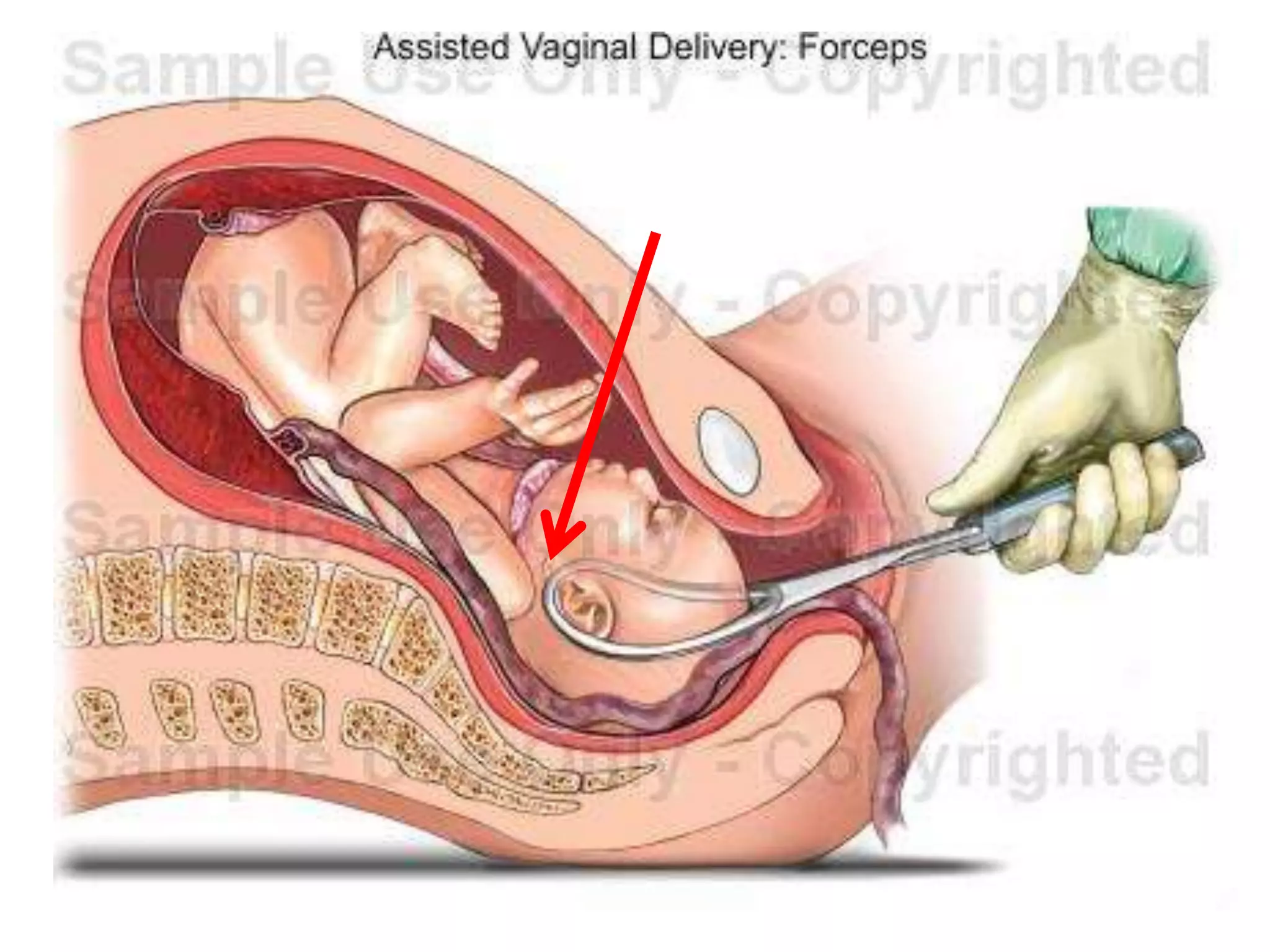
• Obstetric forceps is a pair of instruments
• Especially designed to assist extraction of the
fetal head and thereby accomplishing delivery of
the fetus.
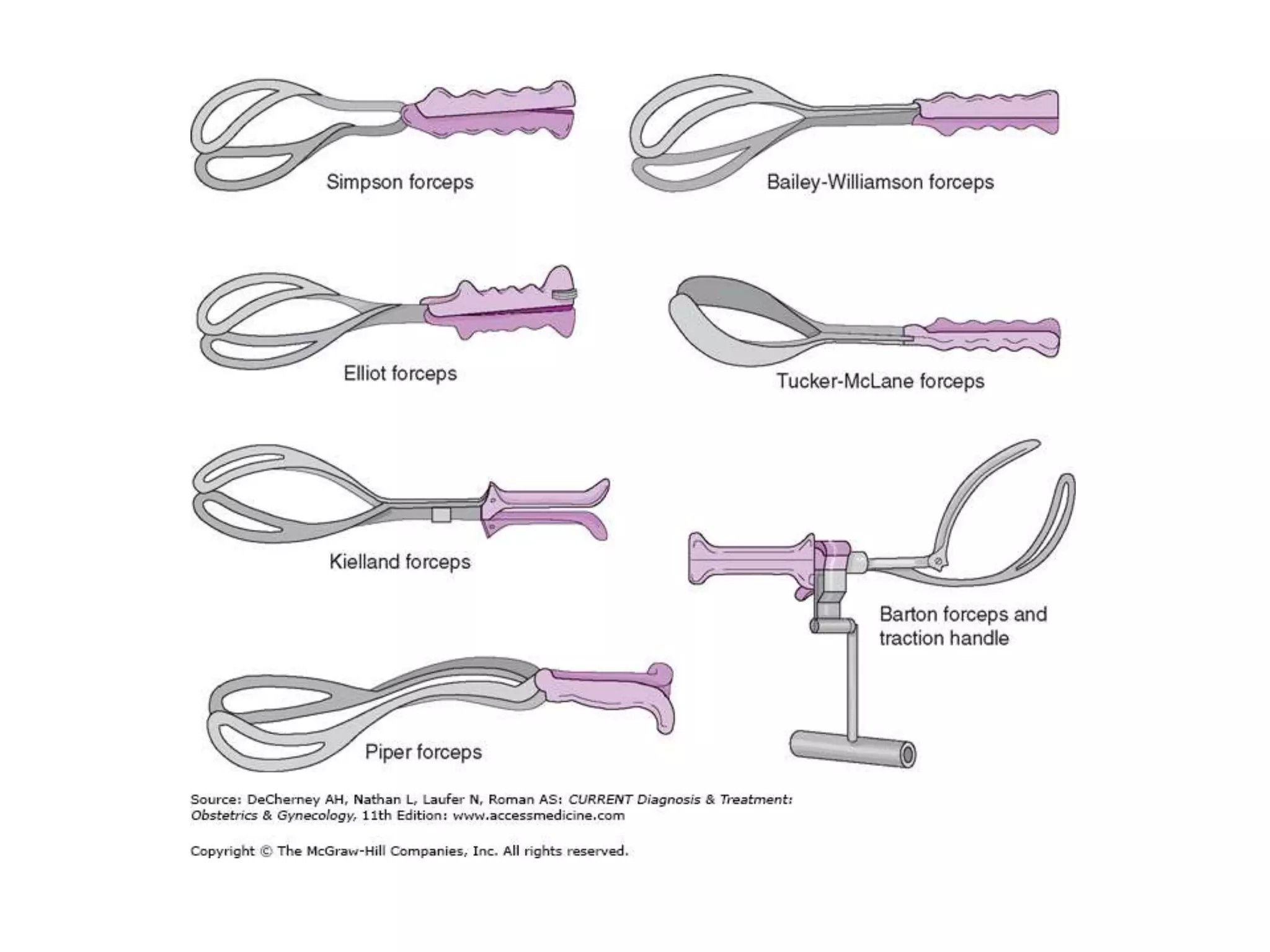
• VARIETIES OF OBSTETRIC FORCEPS:
– Long-curved forceps with or without axistraction
device
– Short-curved forceps
– Kielland’s forceps
LONG-CURVED OBSTETRIC FORCEPS
• Relatively heavy
• About 37 cm (15") long.
• Das’s variety
• It is comparatively lighter and slightly shorter
than its western counterpart
• Suited for the small pelvis and small baby of
indian women.
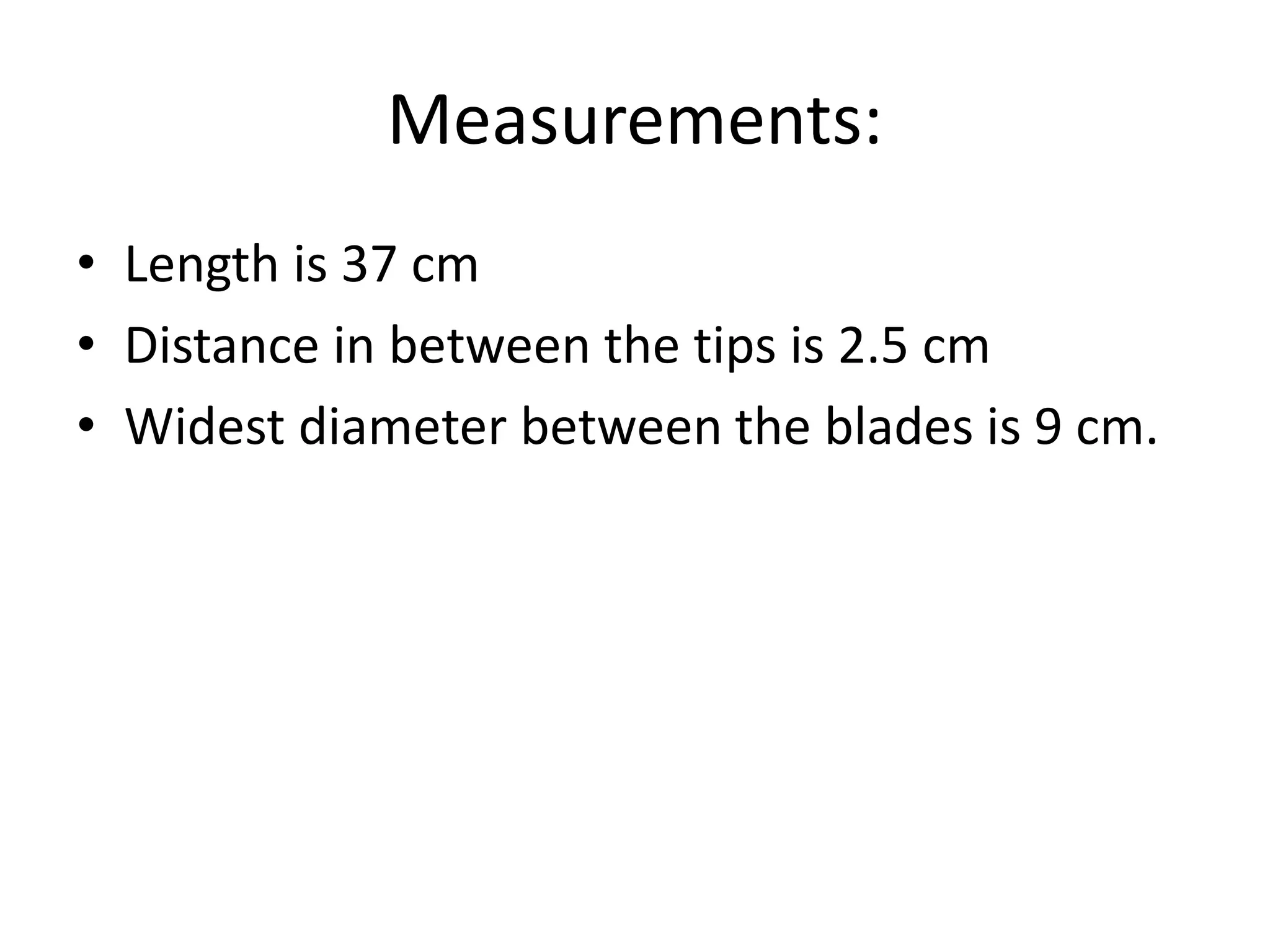
Measurements:
• Length is 37 cm
• Distance in between the tips is 2.5 cm
• Widest diameter between the blades is 9 cm.
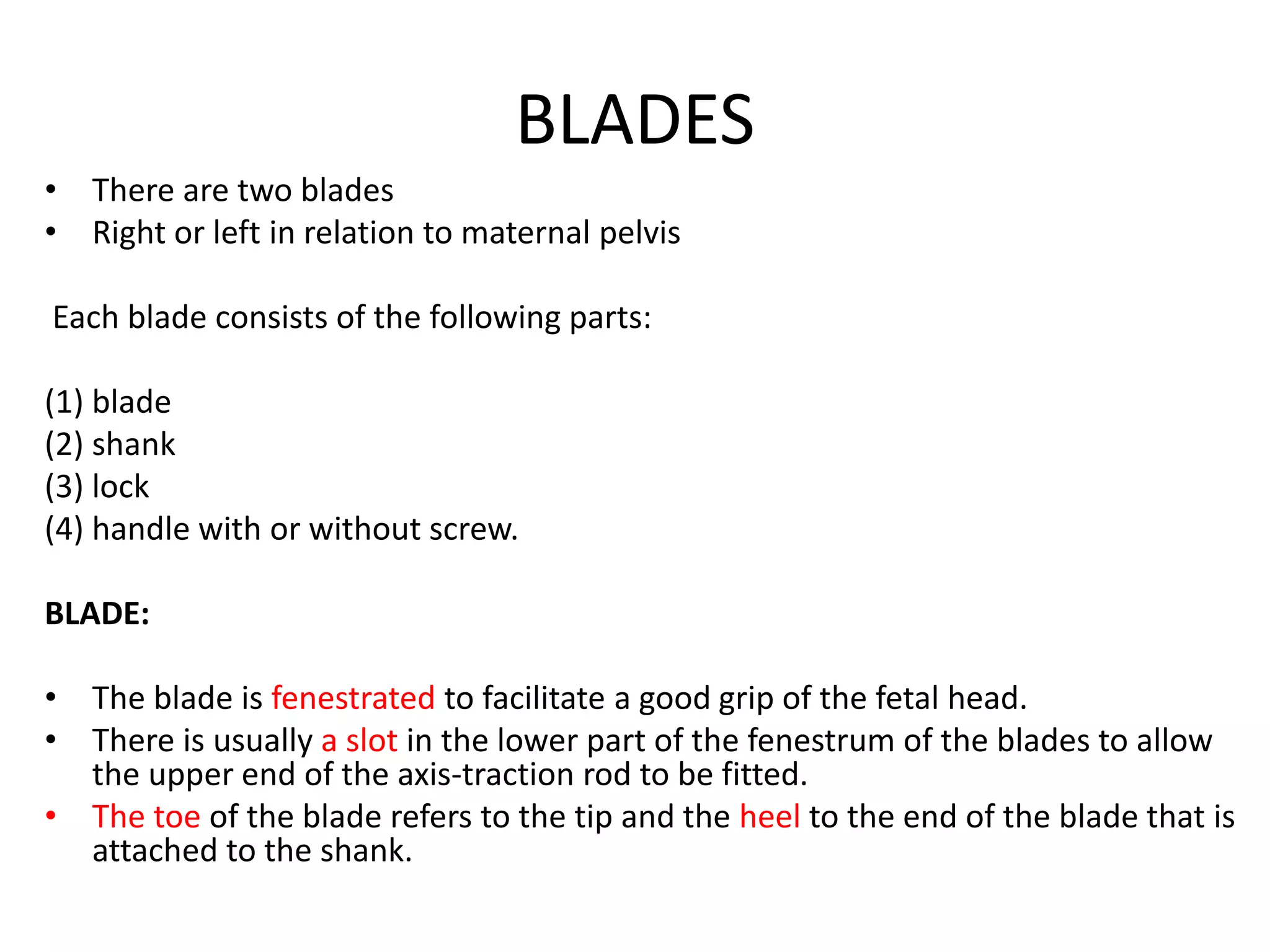
BLADES
• There are two blades
• Right or left in relation to maternal pelvis
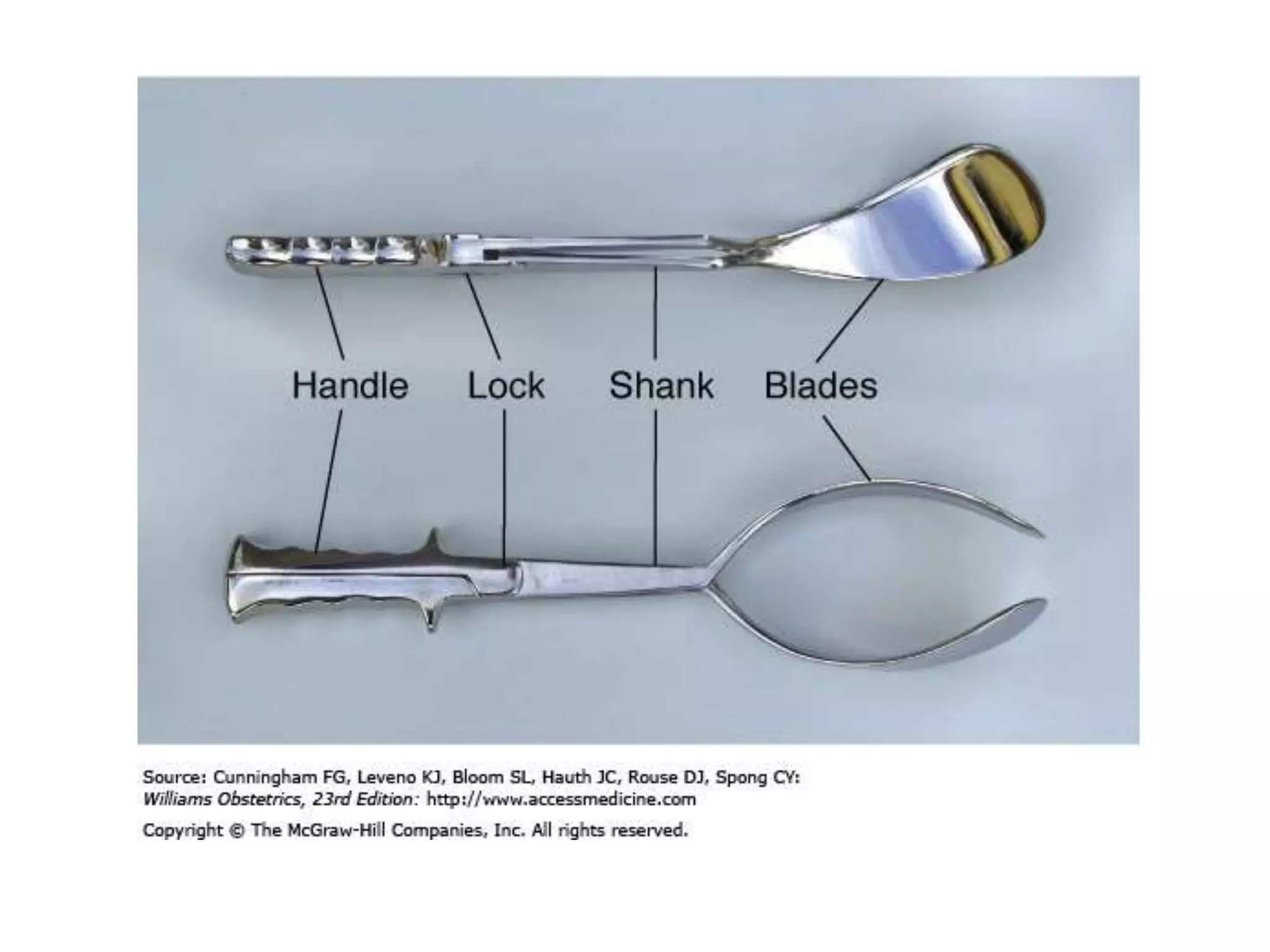
Each blade consists of the following parts:
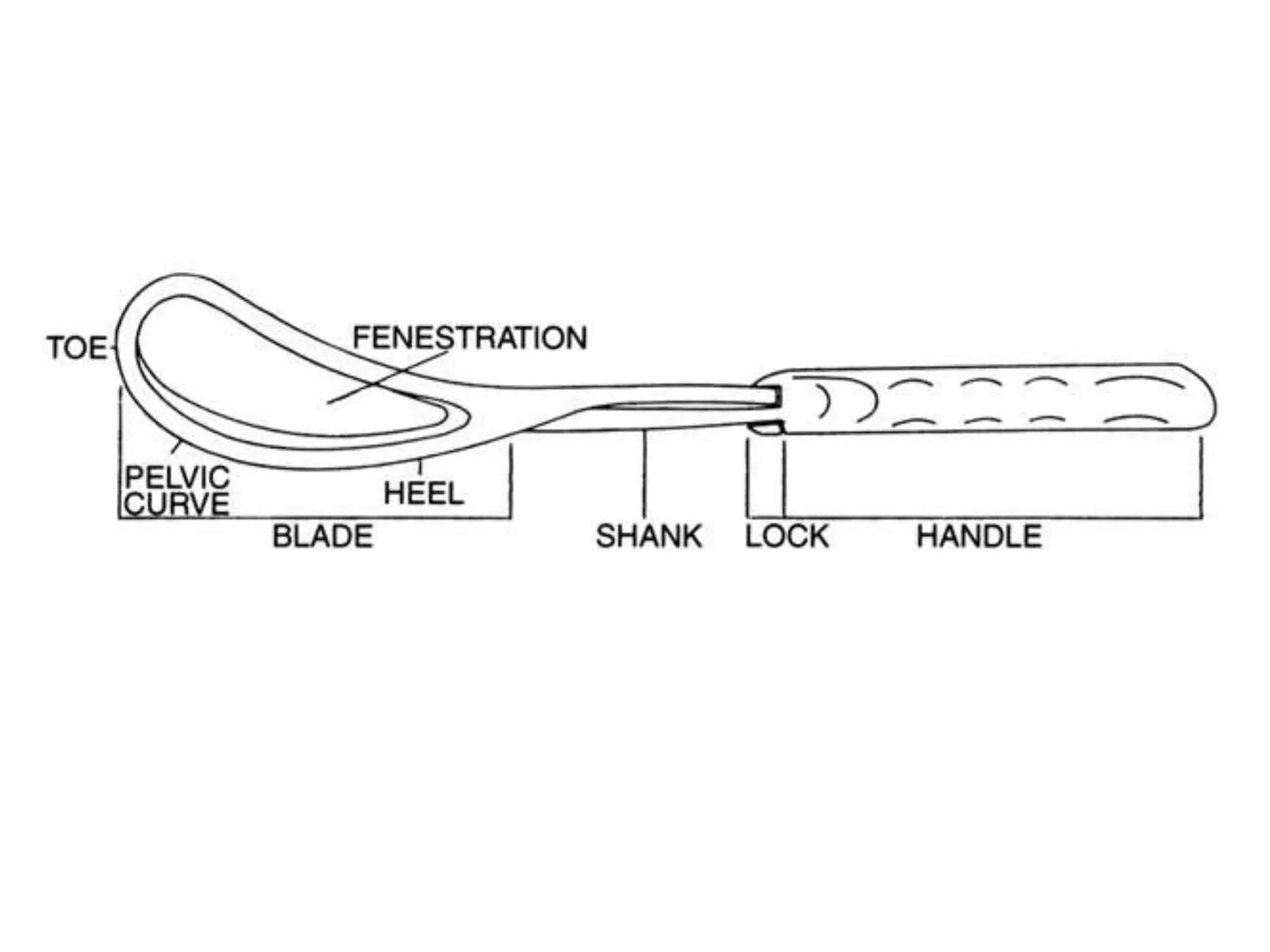
(1) blade
(2) shank
(3) lock
(4) handle with or without screw.
BLADE:
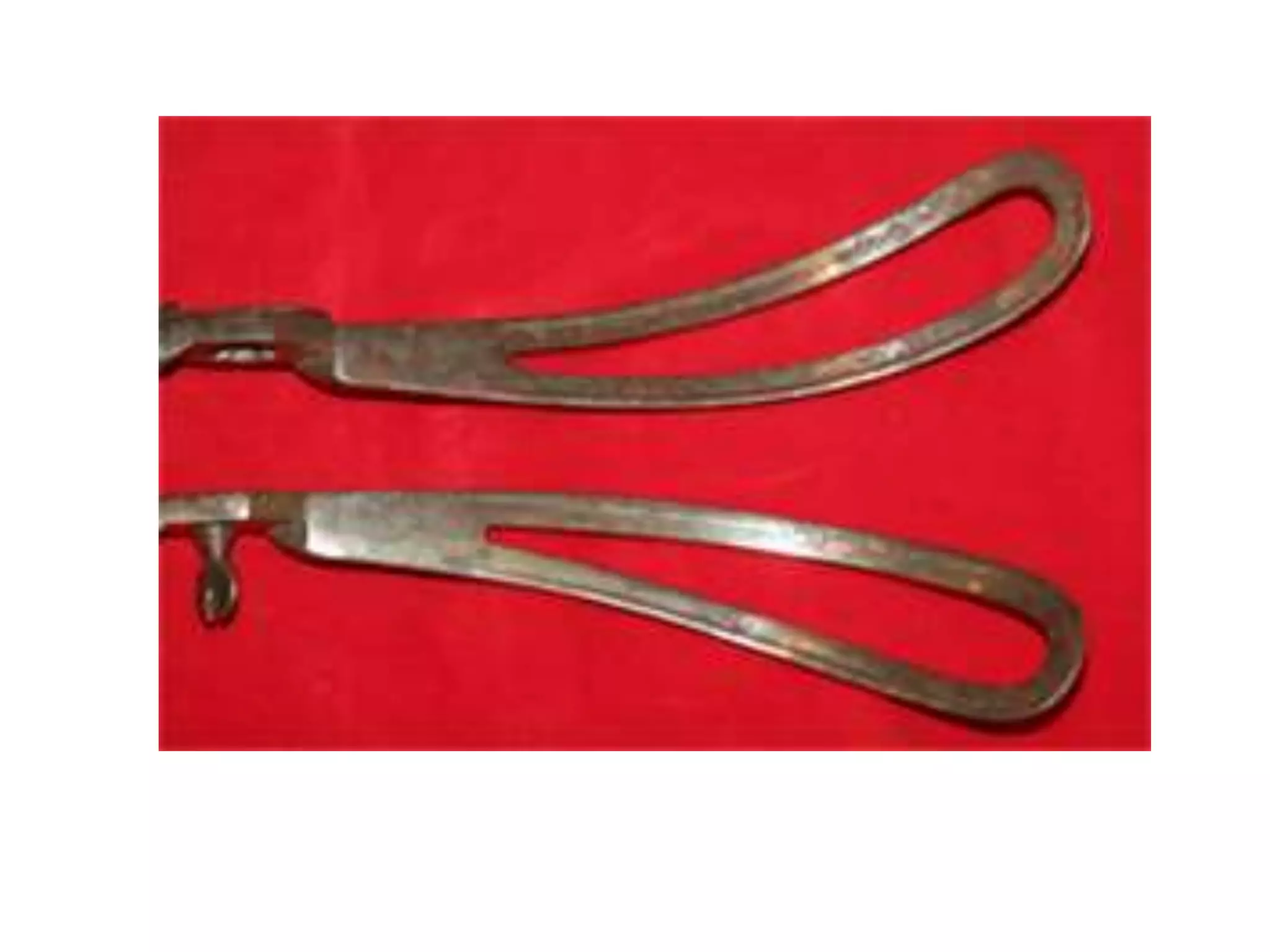
• The blade is fenestrated to facilitate a good grip of the fetal head.
• There is usually a slot in the lower part of the fenestrum of the blades to allow
the upper end of the axis-traction rod to be fitted.
• The toe of the blade refers to the tip and the heel to the end of the blade that is
attached to the shank.
CURVE
• The blade has got two curves
CURVE
CEPHALIC CURVE
• It is the curve on the flat surface which when
articulated grasps the fetal head without
compression.
• The radius of the curve is 11.5 cm (4.5").
CURVE
PELVIC CURVE
• The curve on the edge is to fit more or less the
curve on the axis of the birth canal (curve of
Carus).
• It forms a part of a circle whose radius is 17.5 cm
(7").
• The front of the forceps is the concave side of the
pelvic curve.
• Pelvic curve permits ease of application along
the maternal pelvic axis.
SHANK
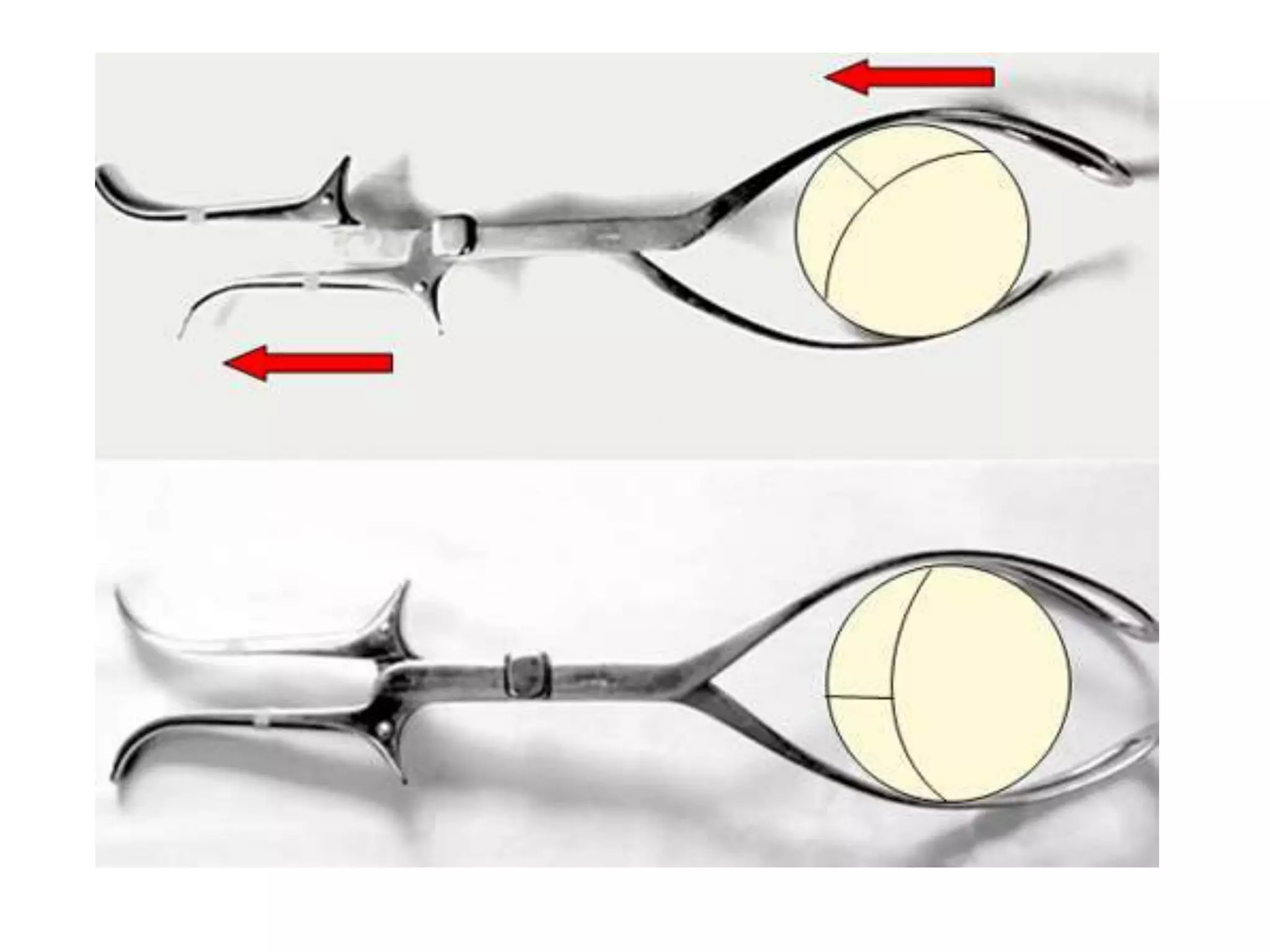
• It is the part between the blade and the lock
and usually measures 6.25 cm (2.5").
• It increases the length of the instrument and
thereby, facilitates locking of the blades
outside the vulva.
• When the blades are articulated, the shanks
are not apposed together.
LOCK
• The common method of articulation consists
of a socket system located on the shank at its
junction with the handle (English lock).
• Such type of lock requires introduction of the
left blade first.
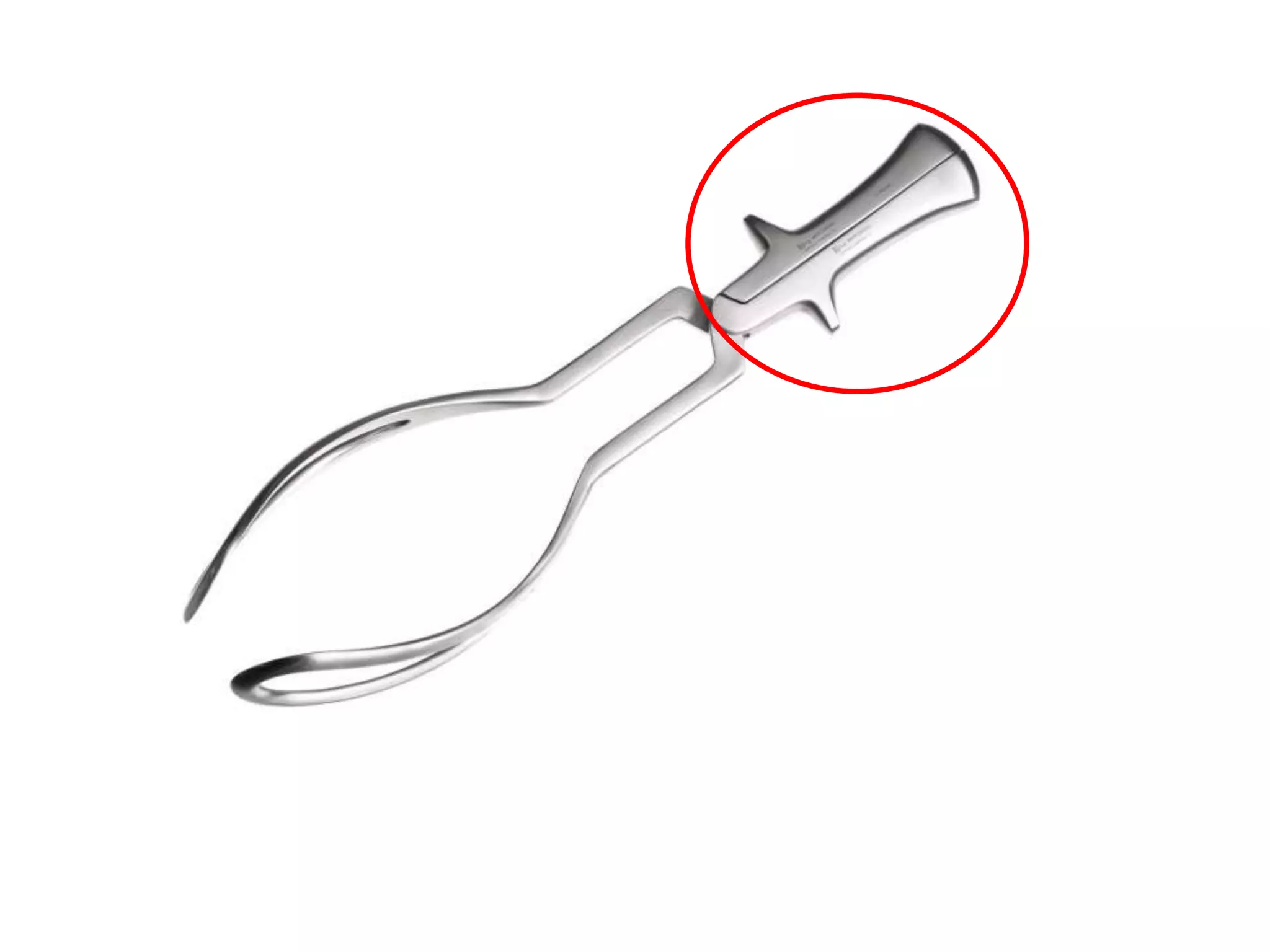
HANDLE
• The handles are apposed when the blades are
articulated. It measures 12.5 cm (5").
• There is a finger guard on which a finger can
be placed during traction.
SCREW
• A screw is attached usually at the end (or
at the base) of one blade (commonly left).
• It helps to keep the blades in position.
HOW TO IDENTIFY THE BLADES
WHEN ARTICULATED
• The blade which corresponds to the left of the
maternal pelvis is the left blade and that to
the right side is the right blade.
WHEN ISOLATED
(1) The tip should point upwards
(2) The cephalic curve is to be directed
inwards and the pelvic curve forwards.
TYPES OF APPLICATION OF FORCEPS
BLADES
CEPHALIC APPLICATION
• The blades are applied along the sides of the
head grasping the biparietal diameter in between
the widest part of the blades.
• The long axis of the blades corresponds more or
less to the occipitomental plane of the fetal head.
• It is the ideal method of application as it has got a
negligible compression effect on the cranium.
TYPES OF APPLICATION OF FORCEPS
BLADES
PELVIC APPLICATION
• When the blades of the forceps are applied
on the lateral pelvic walls ignoring the position
of the head, it is called pelvic application.
• If the head remains unrotated, this
type of application puts serious compression
effect on the cranium and thus must be
avoided.
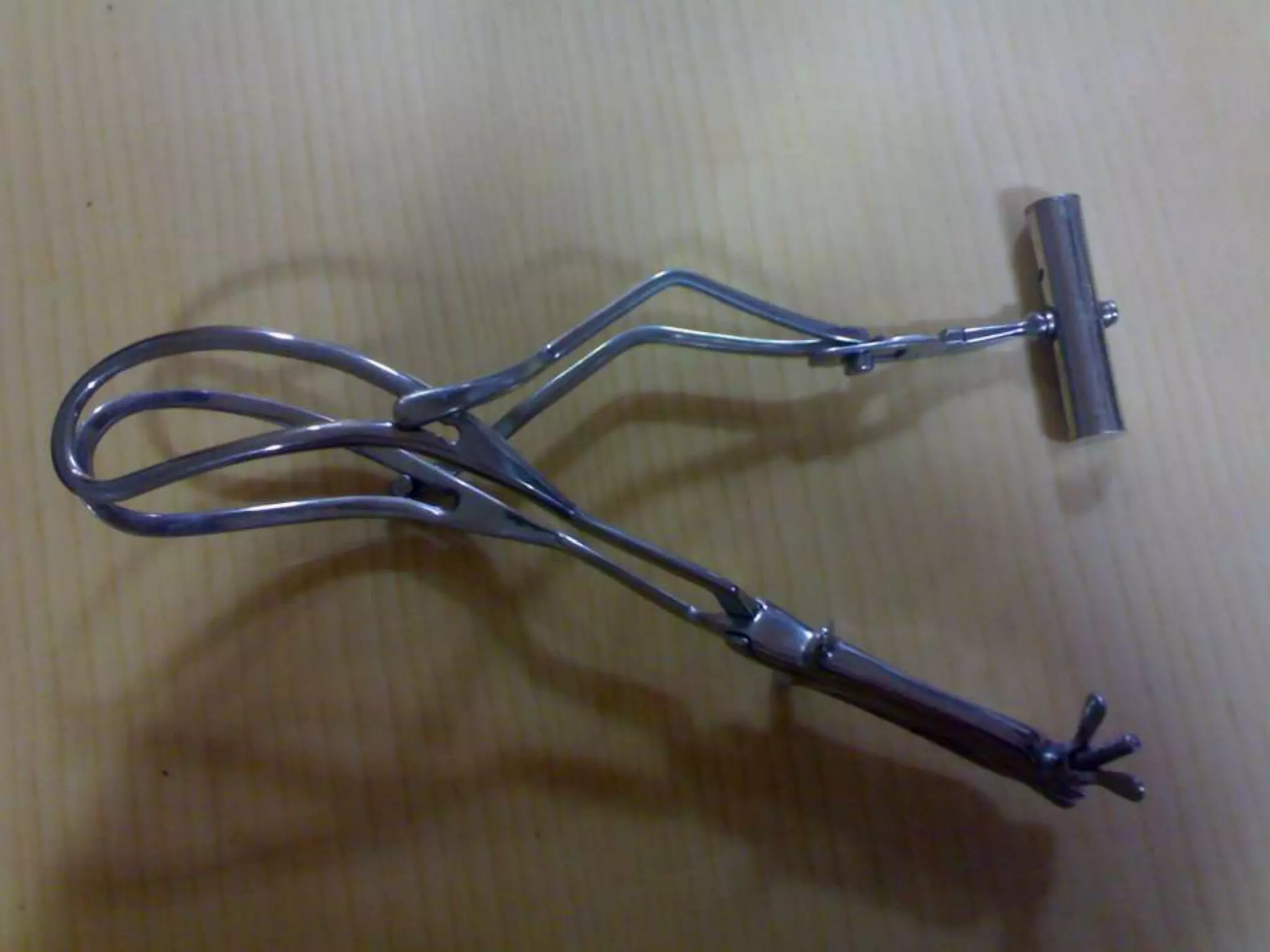
AXIS-TRACTION DEVICE
• It can be applied with advantage in midforceps
operation, especially following manual rotation of
the head.
• It provides traction in the correct axis of the
pelvic curve and as such, less force is necessary to
deliver the head.
CONSISTS OF:
(1) Traction rods (two—right and left)
(2) Traction handle
Identification of the traction rods—
right or left?
• Hold the knob pointing inwards and let the
rod hang.
• The small transverse bar at the bottom is to be
directed forward.
5
2
2
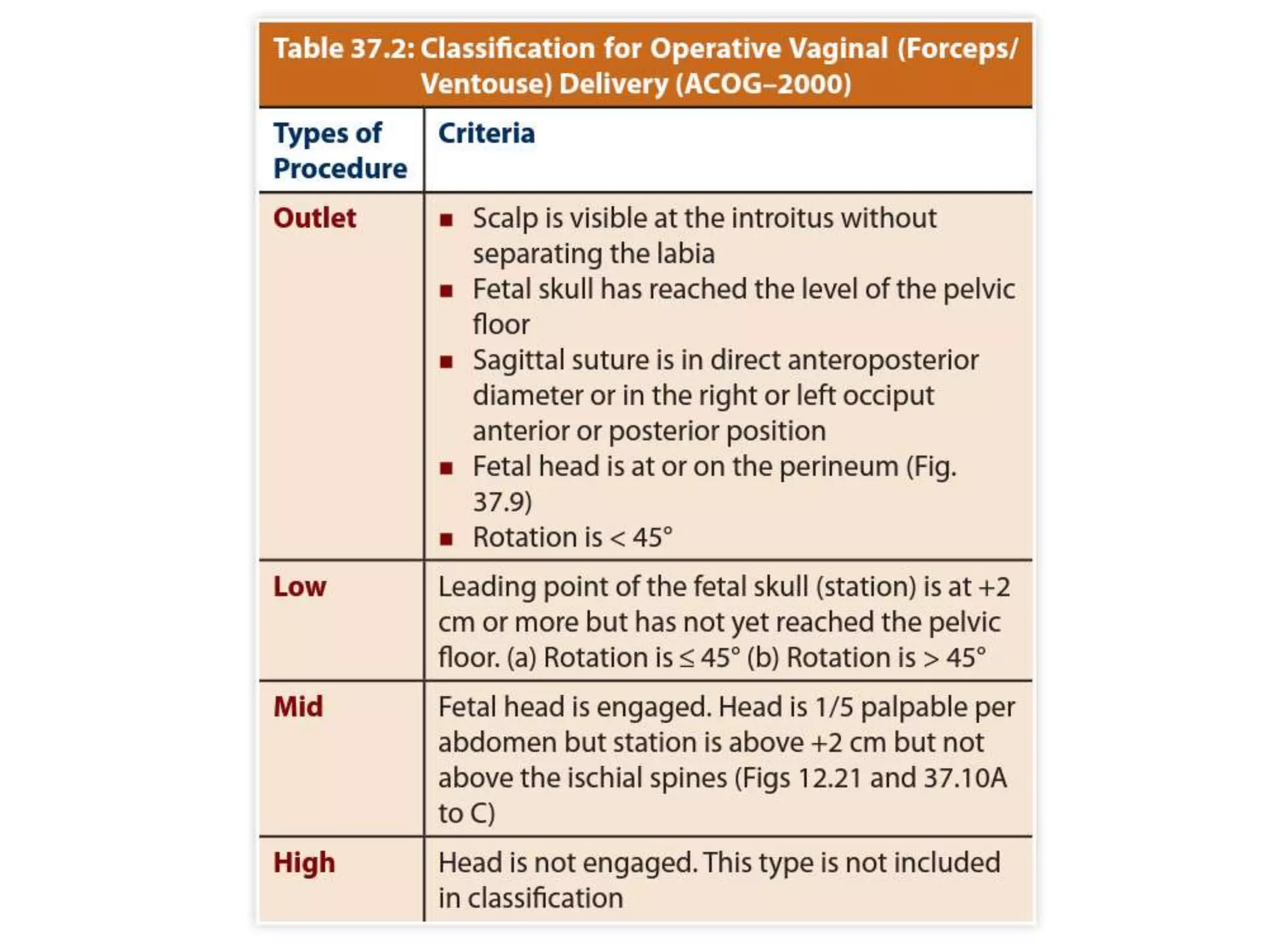
OUTLET FORCEPS • It is a variety of low forceps where the head is
on the perineum
LOW FORCEPS • The head is near the pelvic floor or even
visible at the introitus.
•It is commonly used nowadays with
advantages
MIDFORCEPS Prerequisites are:
(i) Must be associated with less maternal
morbidity than Cesarean section
(ii) should not cause any fetal damage.
Unless the prospect of successful vaginal
delivery is high midforceps delivery is best
avoided. Manual rotation may be needed
before traction.
(iii) In a selective case,
delivery by rotational forceps by an
expert is safe. Otherwise, it is better to
wait for the head descent and complete
rotation.
(iv) An oxytocin drip may be helpful if not
contraindicated.
(v) Ventouse may be an alternative.
CHOICE OF
FORCEPS
OPERATION
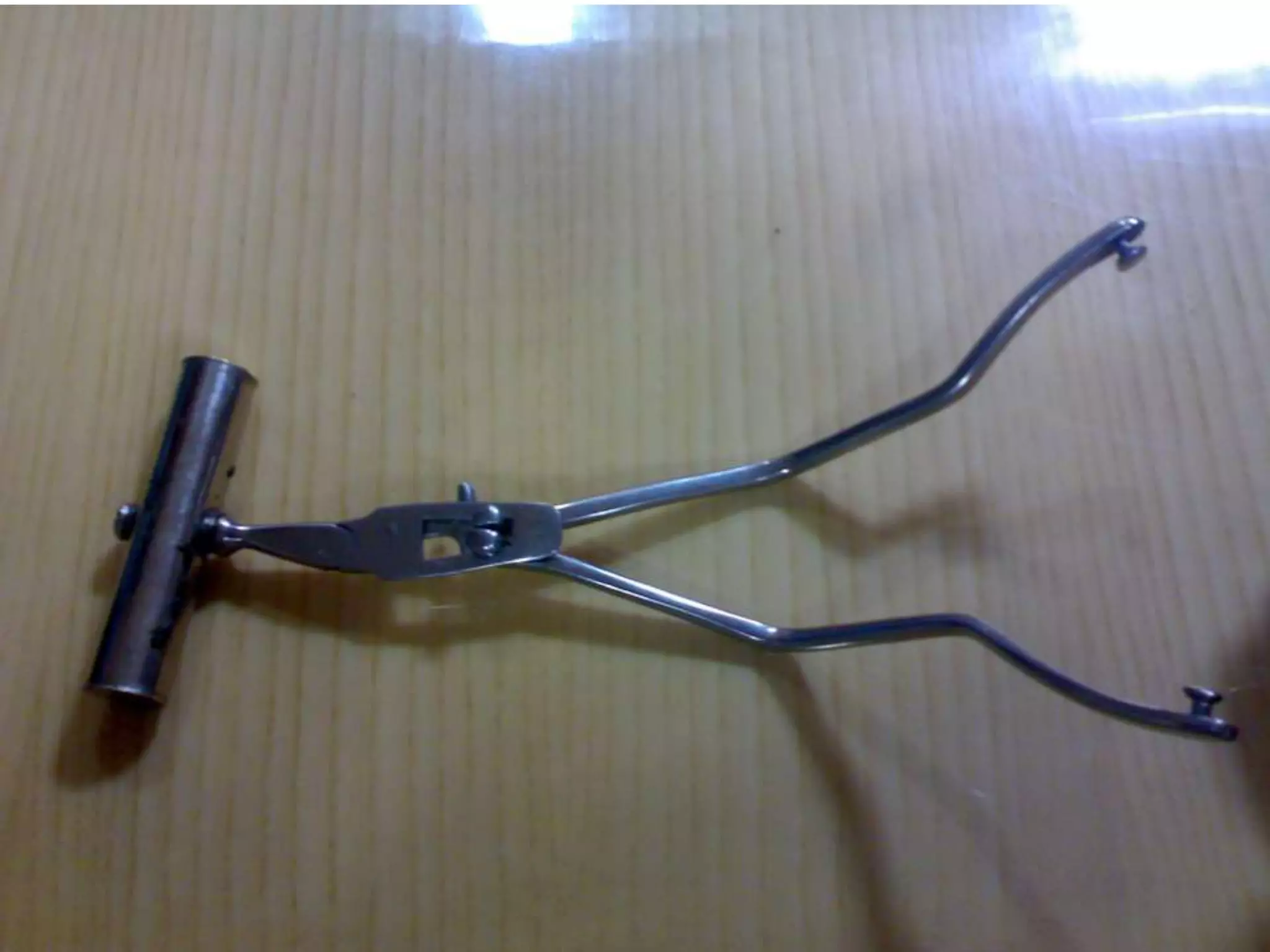
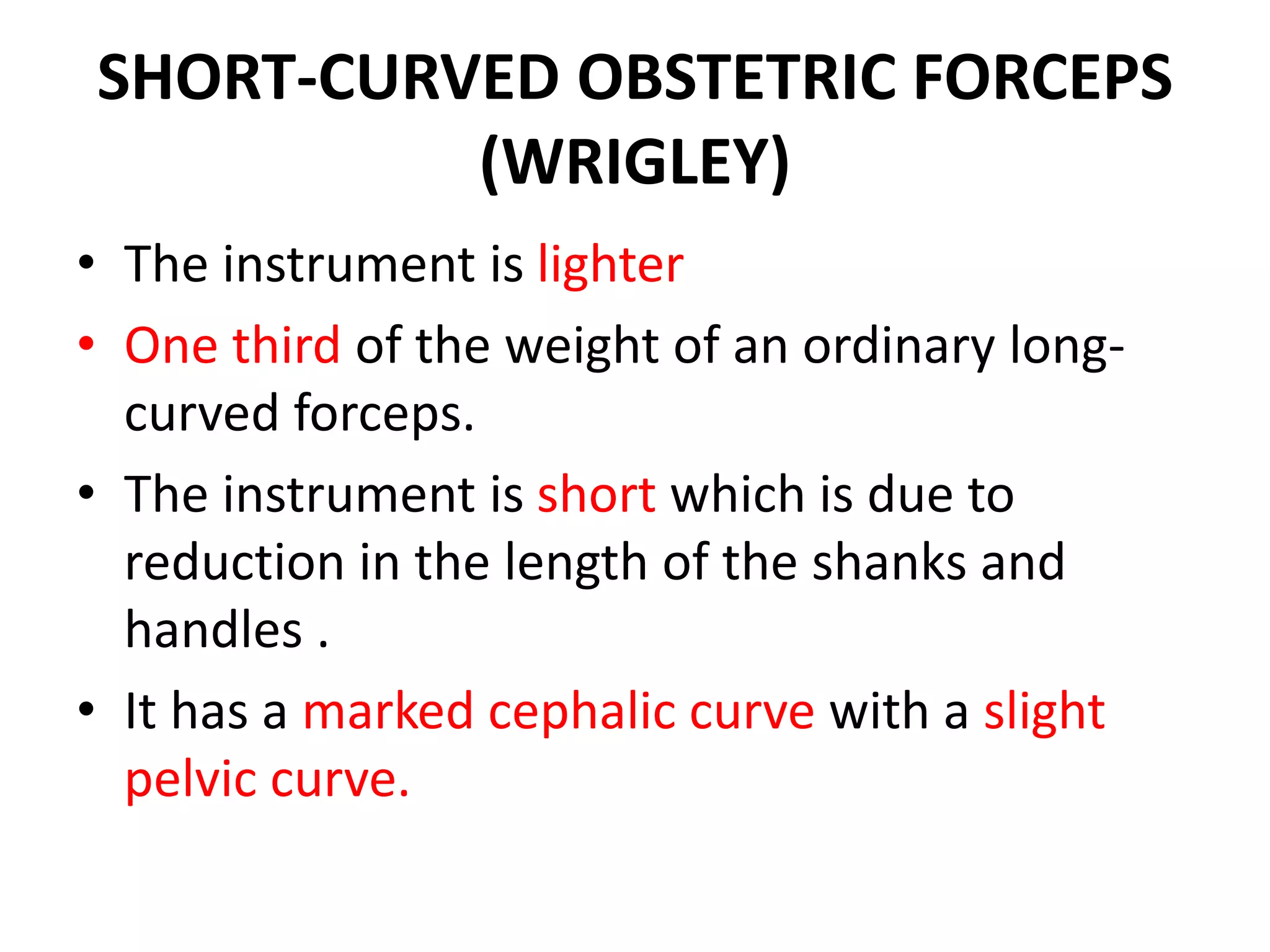
SHORT-CURVED OBSTETRIC FORCEPS
(WRIGLEY)
• The instrument is lighter
• One third of the weight of an ordinary long-
curved forceps.
• The instrument is short which is due to
reduction in the length of the shanks and
handles .
• It has a marked cephalic curve with a slight
pelvic curve.
Marked Cephalic Curve
KIELLAND’S FORCEPS
• It is a long almost straight (very slight pelvic
curve) obstetric forceps without any axis-
traction device.
• It has got a sliding lock which facilitates
correction of asynclitism of the head.
• One small knob on each blade is directed
towards the occiput.
ASYNCLITISM
FORCEPS FUNCTION
LOW FORCEPS OPERATION
PRELIMINARIES
• Same as those mentioned earlier
• The following are specially emphasized:
• Anesthesia: Pudendal block supplemented by perineal and labial infiltration with
1% lignocaine hydrochloride is quite effective in producing local anesthesia
• Catheterization
• Internal examination to assess:
(a) State of the cervix
(b) membranes status
(c) presentation and position of the head
(d) assessment of the pelvic outlet (sacro-coccygeal plateau, TDO and subpubic arch).
• Episiotomy: It is usually done during traction when the perineum becomes bulged
and thinned out by the advancing head.
PRELIMINARIES
• ANESTHESIA—either general or local is used. In some cases, the
operation may be performed with intravenous diazepam
sedation.
• LITHOTOMY position.
• Full SURGICAL ASEPSIS is to be taken:
– Surgical team is to wear sterile cap, mask, thorough hand wash and
to wear gown and gloves
– Vulva and vagina are to be swabbed with antiseptic solution
– Cervix is cleaned with povidone-iodine solution
– Leggings.
• To empty the EMPTY THE BLADDER before she is placed on
the table or catheterization
• Vaginal examination is done
Cont.
• Pudendal block or perineal infiltration with 1%
lignocaine is sufficient.
• It may be applied even without anesthesia,
especially in parous women.
• The instrument should be assembled
• The vacuum is tested prior to its application
STEPS
1. Identification of the blades and their
application
2. Locking of the blades
3. Traction
4. Removal of the blade
Step I
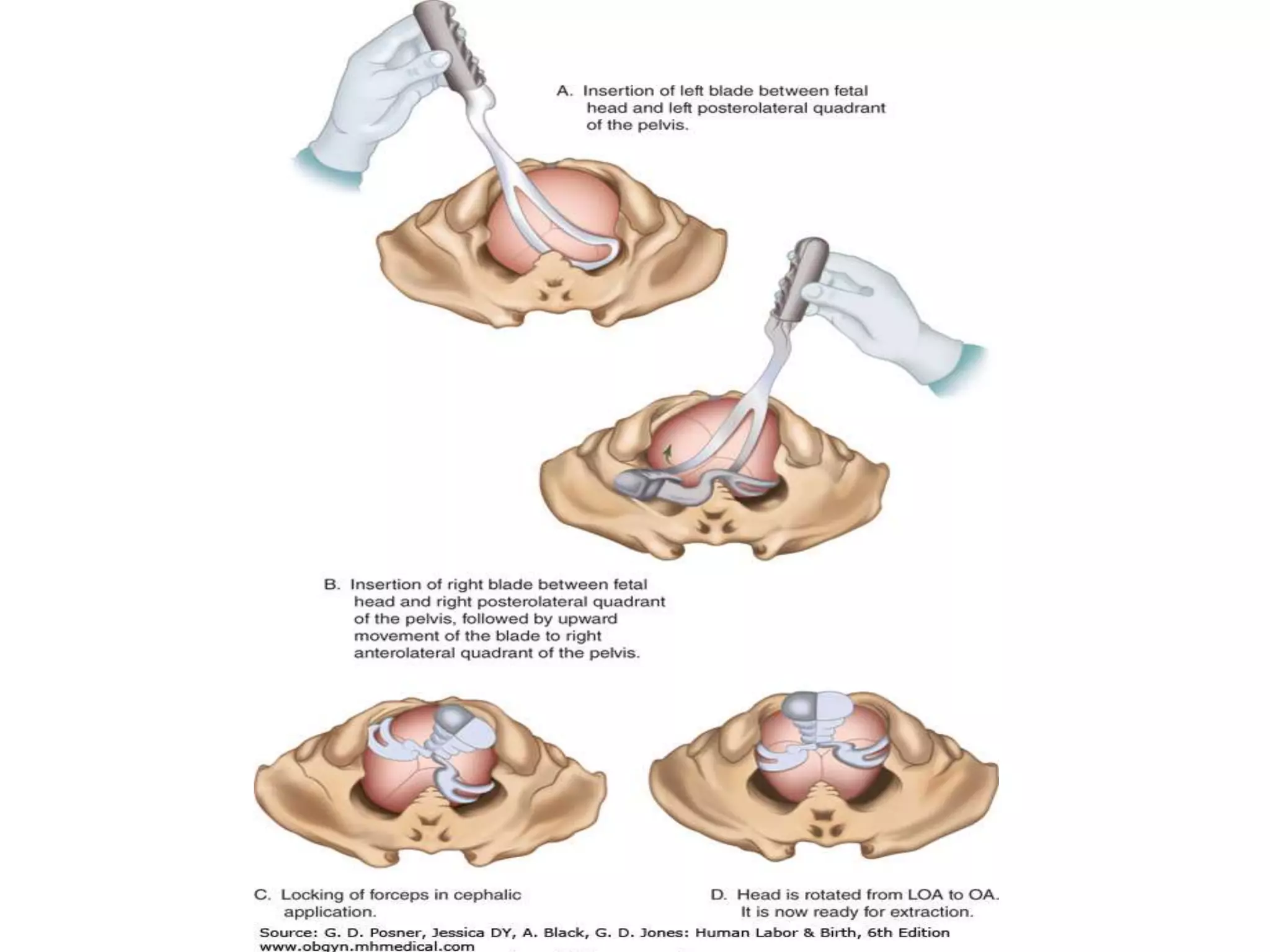
• Identification and application of the blades
• The identification of the blades is to be made after articulation as mentioned
earlier
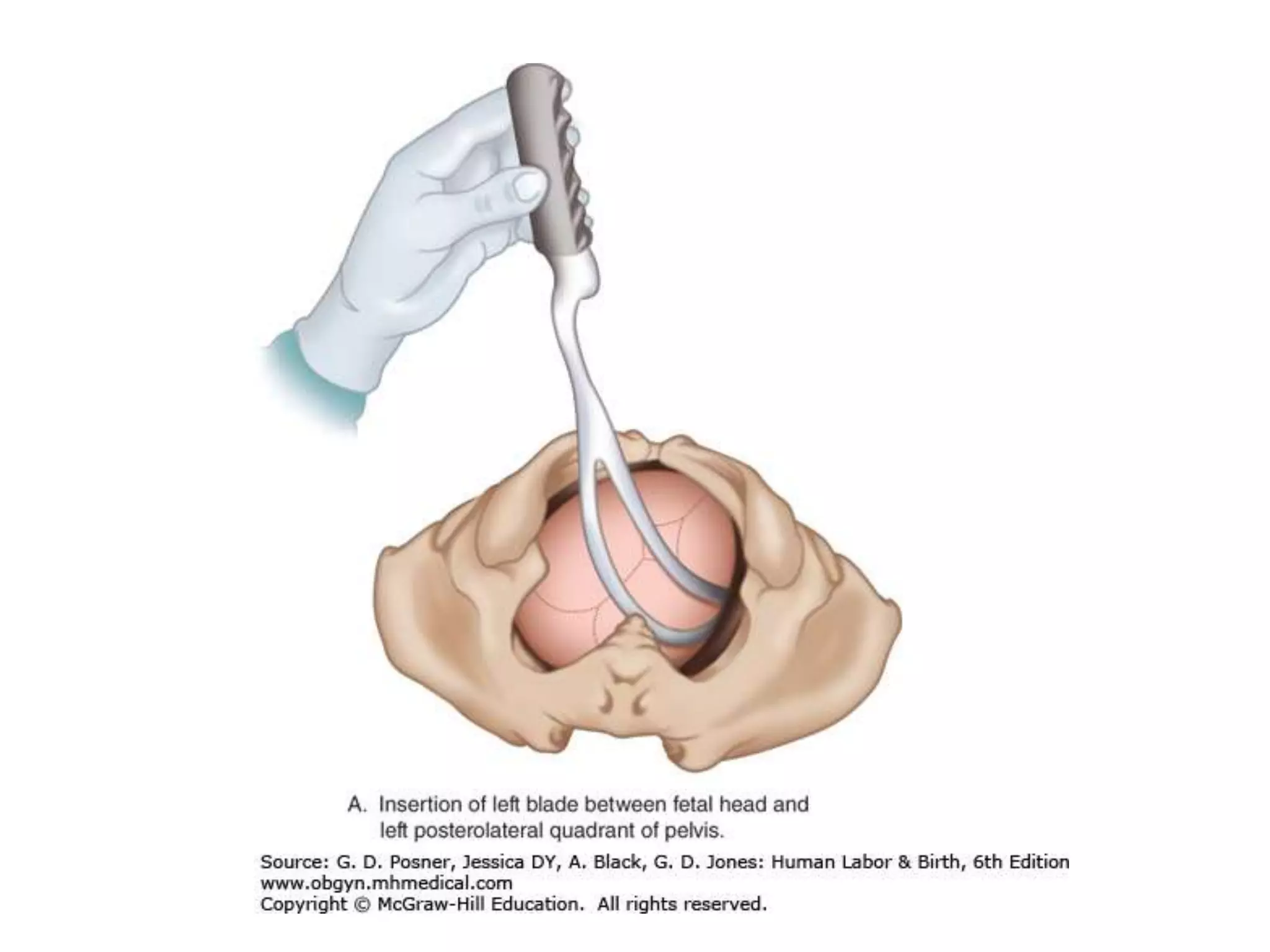
• The left or lower blade is to be introduced first
• The four fingers of the semi-supinated right hand are inserted along the left lateral
vaginal wall, the palmar surface of the fingers rest against the side of the head
• The fingers are used to guide the blade during application and to protect the
vaginal wall.
• The handle of the left blade is taken lightly by three fingers of the left hand – index,
middle and thumb in a pen holding manner and is held vertically almost parallel to
the right inguinal ligament.
• The fenestrated portion of the blade is placed on the right palm with the tip (toe)
pointing upwards.
• The right thumb is placed at the junction of the blade and the shank (heel).
• The blade is introduced between the guiding internal fingers and the fetal head,
manipulated by the thumb.
Step I
• As the blade is pushed up and up, the handle is
carried downwards and backwards, traversing wide
arc of a circle towards the left until the shank is to lie
straight on the perineum.
• Utmost gentleness is required while introducing the
blade. No assistant is usually required to hold the
handle in low forceps operation.
• When correctly applied, the blade should be over the
parietal eminence, the shank should be in contact
with the perineum and the superior surface of the
handle should be directed upwards.
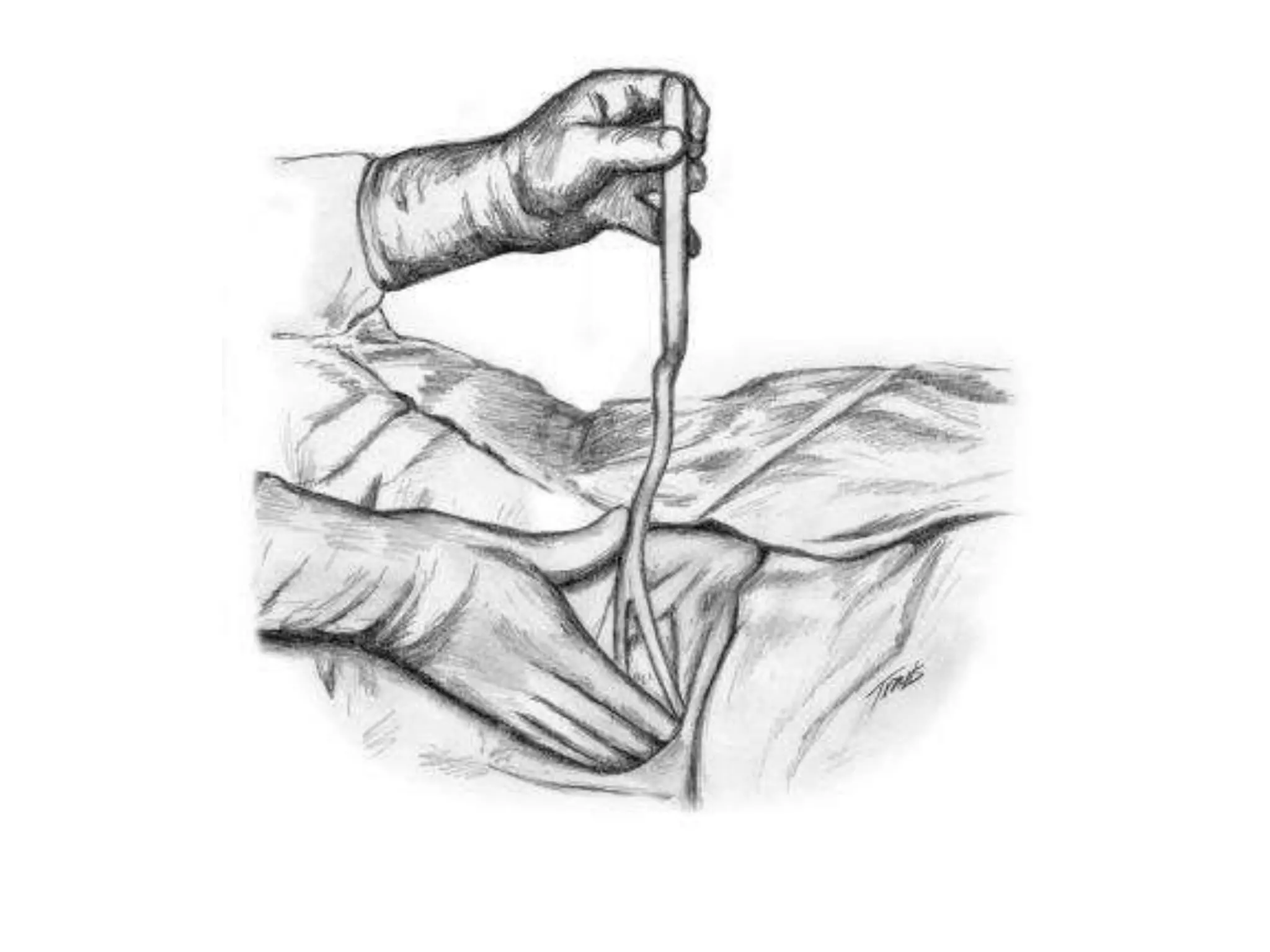
INTRODUCTION OF THE RIGHT BLADE
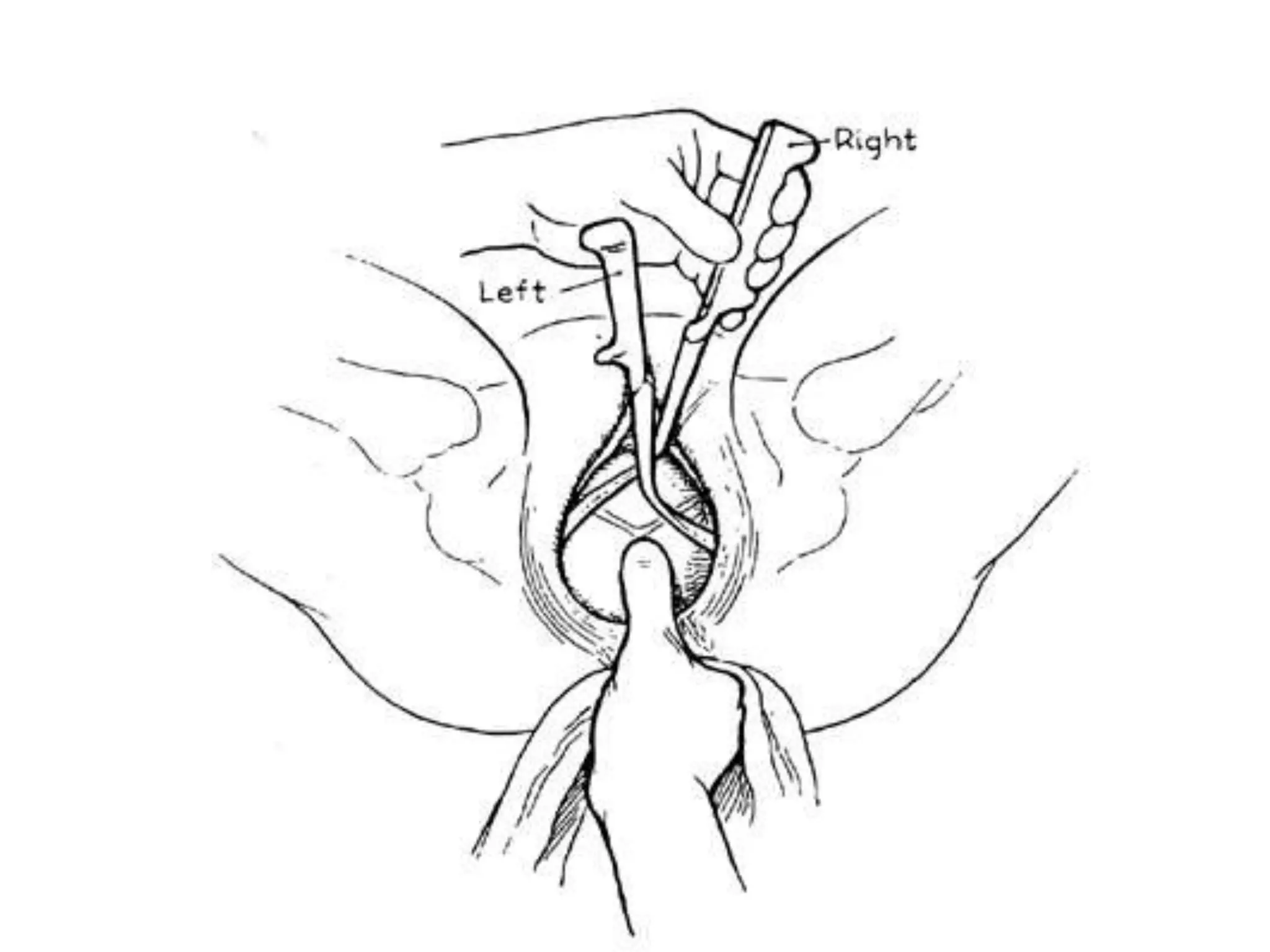
• The two fingers of the left hand are now
introduced into the right lateral wall of the
vagina alongside the baby’s head.
• The right blade is introduced in the same
manner as with left one but holding it with
the right hand.
Step II
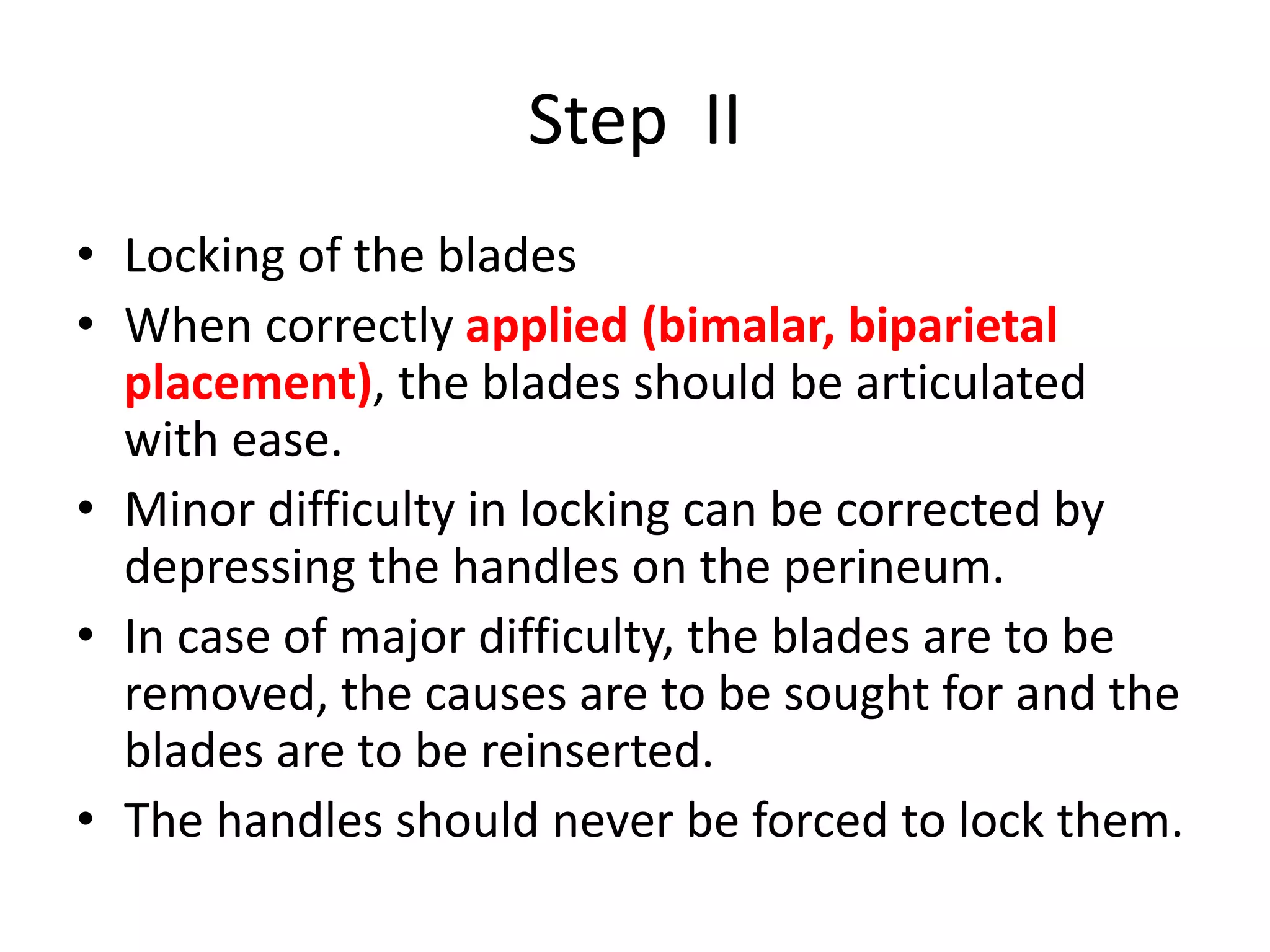
• Locking of the blades
• When correctly applied (bimalar, biparietal
placement), the blades should be articulated
with ease.
• Minor difficulty in locking can be corrected by
depressing the handles on the perineum.
• In case of major difficulty, the blades are to be
removed, the causes are to be sought for and the
blades are to be reinserted.
• The handles should never be forced to lock them.
Step III and IV
• Traction and removal of blades
• Before traction is applied, correct application of
the blades is to be ensured.
CORRECT APPLICATION IS EVIDENCED BY
(a) easy locking
(b) the blades are equidistant from the lambdoid
suture
(c) firm gripping of the head on the biparietal
diameter – as judged by a few tentative pulls.
PRINCIPLES
• Steady but intermittent traction should be
given if possible during contraction.
• However, in outlet forceps the pull may be
continuous.
• Strong traction is not needed as the only
resistance to overcome is the perineum and
the coccyx
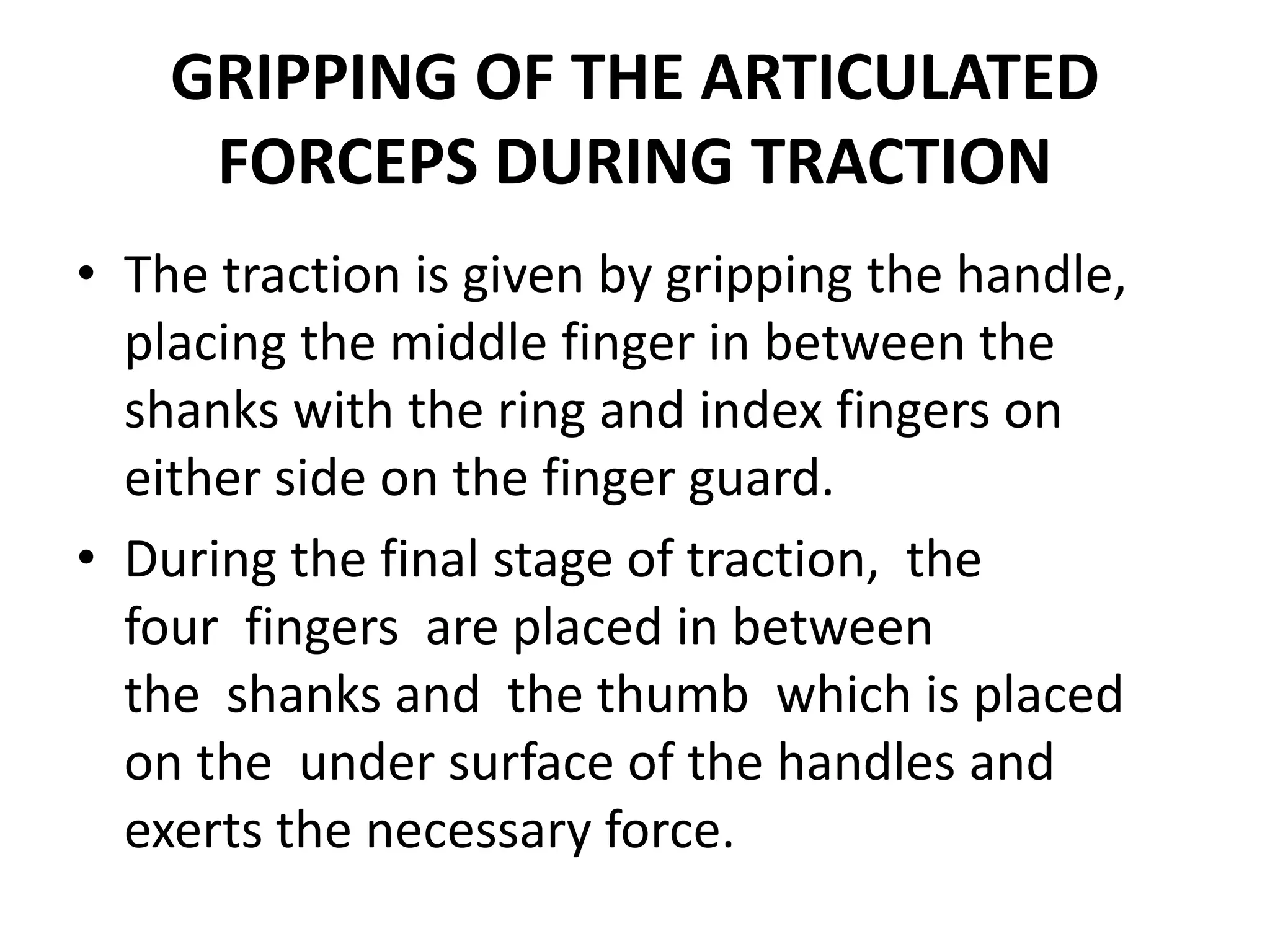
GRIPPING OF THE ARTICULATED
FORCEPS DURING TRACTION
• The traction is given by gripping the handle,
placing the middle finger in between the
shanks with the ring and index fingers on
either side on the finger guard.
• During the final stage of traction, the
four fingers are placed in between
the shanks and the thumb which is placed
on the under surface of the handles and
exerts the necessary force.
DIRECTION OF THE PULL
• The direction of the pull corresponds to the axis of the
birth canal
• In low forceps operation depending upon the station of
the head, the direction of the pull is downwards and
backwards until the head comes to the perineum.
• The pull is then directed horizontally straight towards
the operator till the head is almost crowned.
• The direction of pull is gradually changed to upwards
and forwards, towards the mother’s abdomen to
deliver the head by extension.
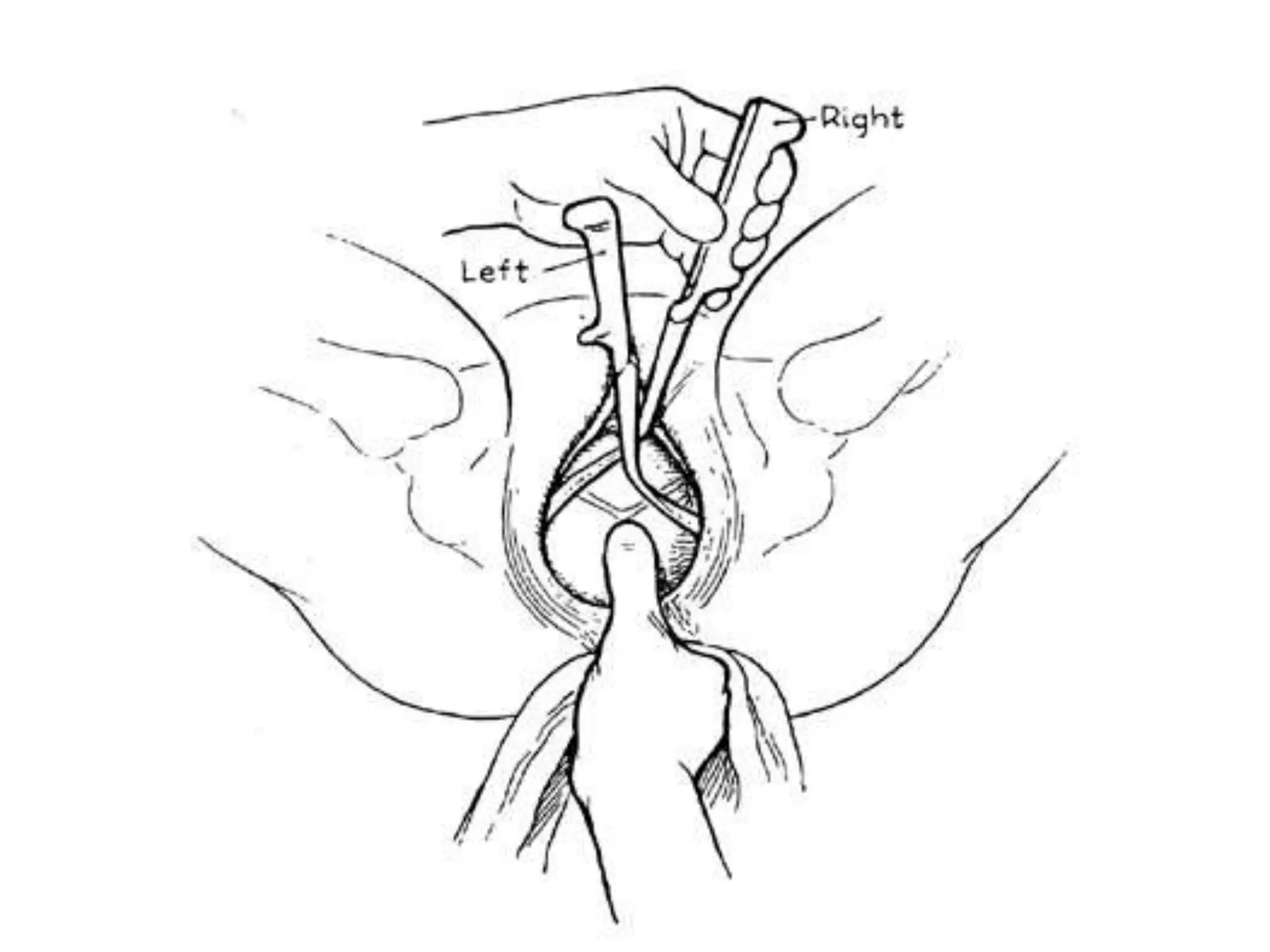
• The blades are removed one after the other, the right
one first.
FOLLOWING THE BIRTH OF THE HEAD
• Usual procedures are to be taken as in normal
delivery.
• Routine injection oxytocin 10 iu, im or
intravenous methergine 0.2 mg is to be
administered with the delivery of the baby.
• Episiotomy is repaired in the usual method .
• Lacerations on the vaginal walls or perineum
are to be excluded
OUTLET FORCEPS OPERATION
• Wrigley’s forceps
• Used exclusively in outlet forceps operation.
• Perineal and vulval infiltration with 1% lignocaine is enough
for local anesthesia.
• The blades are introduced as in the low forceps operation
with long-curved forceps except that two fingers are to be
introduced into the vagina for the application of the left
blade.
• Traction is given holding the articulated forceps with the
fingers placed in between the shanks and the thumb on the
under surface of the handles.
• The direction of the pull is straight horizontal and then
upwards and forwards
MIDFORCEPS OPERATION
• The most common indication of midforceps
operation is following manual rotation of the
head in malrotated occipitoposterior
position.
• The commonly used forceps is long curved
one with or without axis-traction device
• Kielland is useful in the hands of an expert
Procedures
• General anesthesia is preferable.
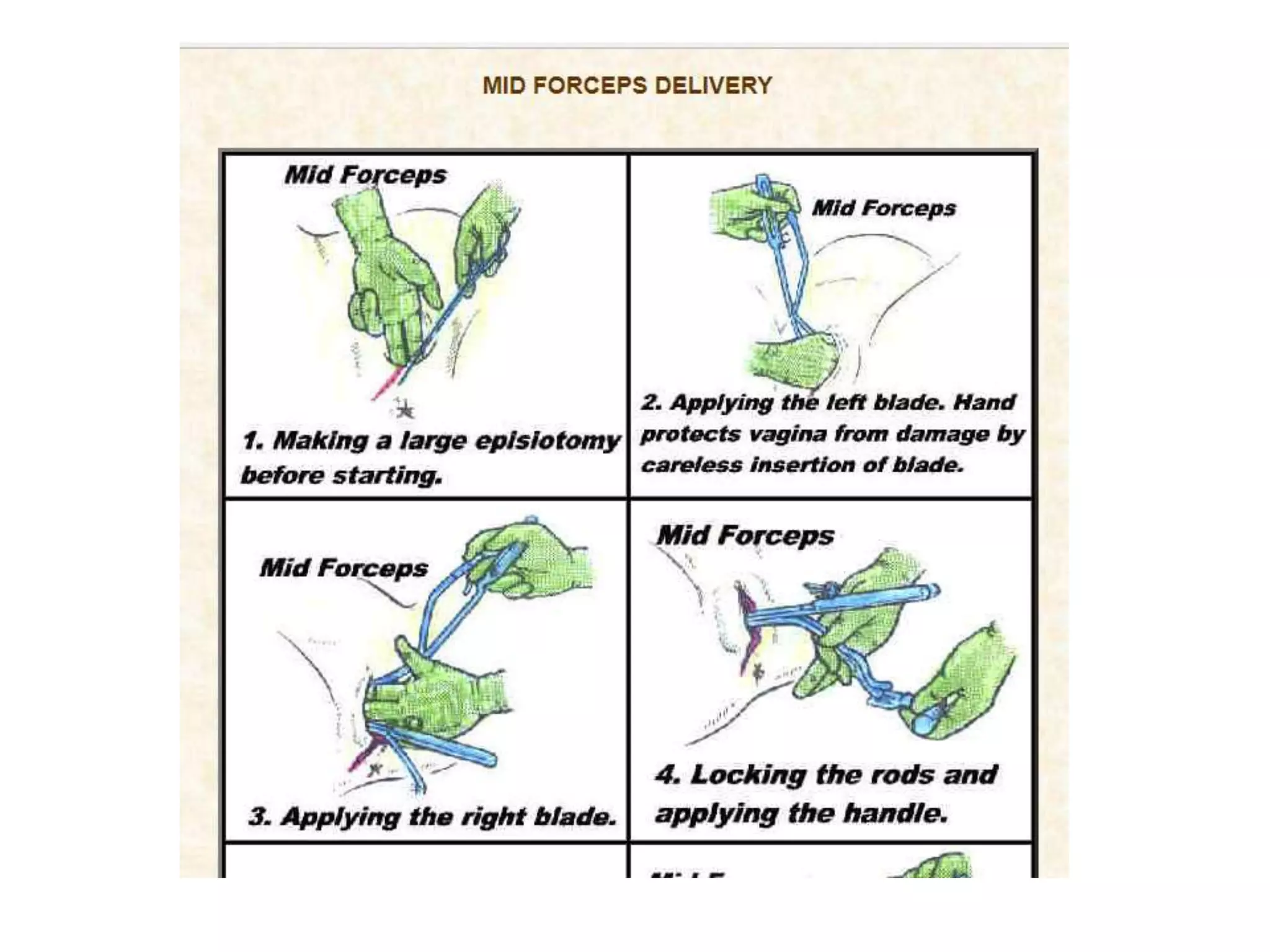
INTRODUCTION OF THE BLADES
• The introduction of the blades is to be done after
prior correction of the malrotation.
(A) WITHOUT AXIS-TRACTION DEVICE:
• The blades are introduced as in the low forceps
operation.
• An assistant is required to hold the left handle
after its introduction
Procedures
B) WITH AXIS-TRACTION DEVICE
• While applying the left blade, the traction-rod
already attached to the blade is held
backwards.
• During introduction of the right blade, the
traction-rod must be held forwards otherwise
it will prevent locking of the blades.
Procedures
TRACTION
(A) WITHOUT AXIS-TRACTION DEVICE
• The direction of pull is first downwards and backwards,
then (horizontal or straight pull) and finally upwards and
forwards
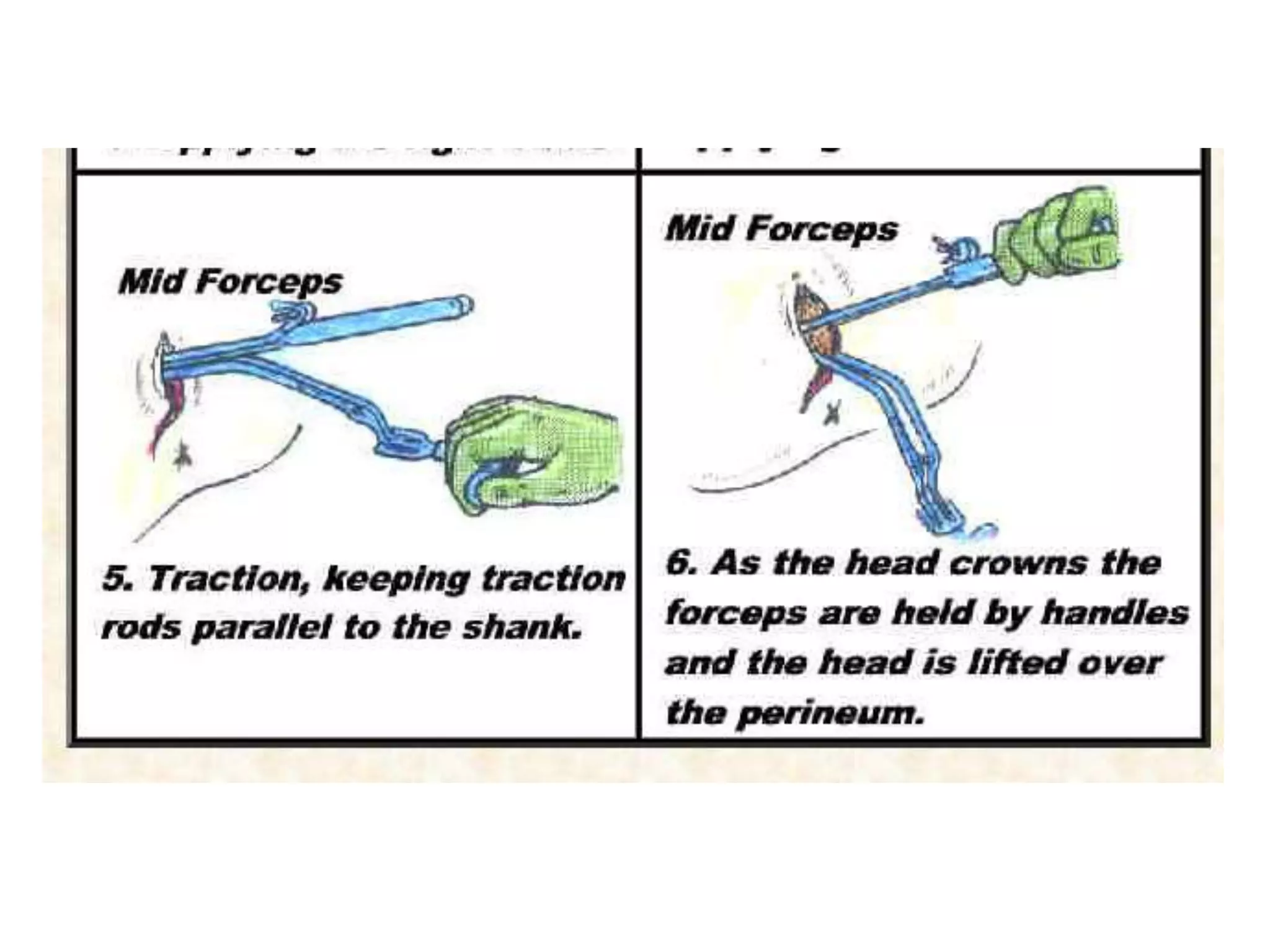
(B) WITH AXIS-TRACTION DEVICE
• The traction handle is to be attached to the traction rods.
• During traction, the traction rods should remain parallel
with the shanks.
• When the base of the occiput comes under the
symphysis pubis, the traction-rods are to be removed
FORCEPS IN OCCIPITO-SACRAL
POSITION
• Usual application of the blades as like that of
occipitoanterior position is made.
• The blades should lie equidistant from the sinciput
and occiput, otherwise the blades may slip during
traction.
• Horizontal traction is given until the root of the
nose is under the symphysis pubis.
• The direction is changed to upwards and forwards
to deliver the occiput.
• By a downward movement of the instrument, the
nose and chin are delivered.
FORCEPS IN FACE PRESENTATION
• Forceps delivery is only reserved for
mentoanterior position.
• The blades are applied as in occipitoanterior
position.
• But the handles should be kept well forward to
avoid grasping of the neck by the tips of the
blade.
• Traction is made like that of occipitoanterior to
bring the chin well below and then round the
symphysis pubis.
APPLICATION OF FORCEPS TO THE
AFTER-COMING HEAD
• The head must be in the cavity.
THE ADVANTAGES
(a) Delivery can be controlled by
giving pull directly on the head and the force
is not transmitted through the neck,
(b) Flexion is better maintained and
(c) Mucus can be sucked out from the mouth
more effectively.
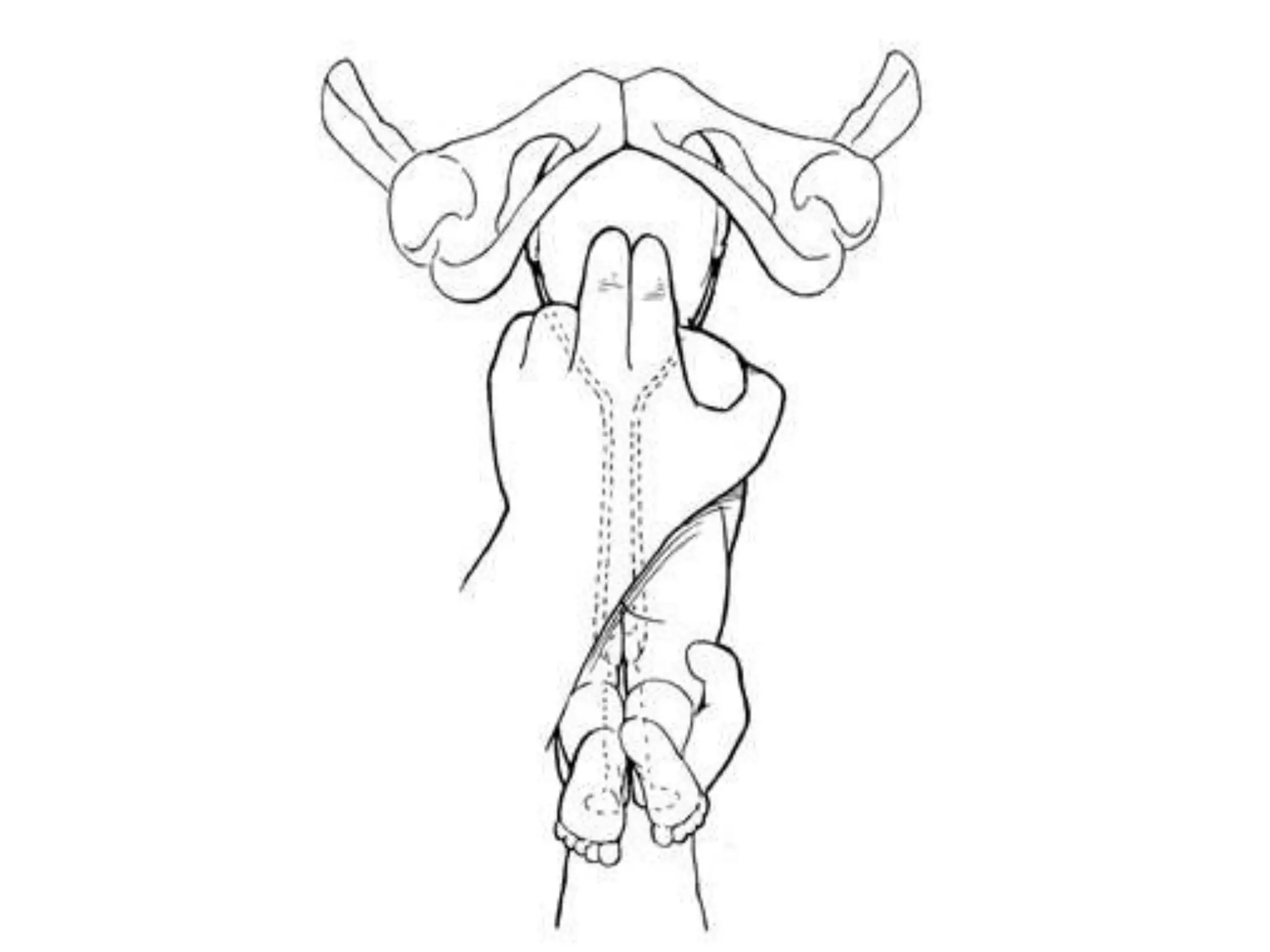
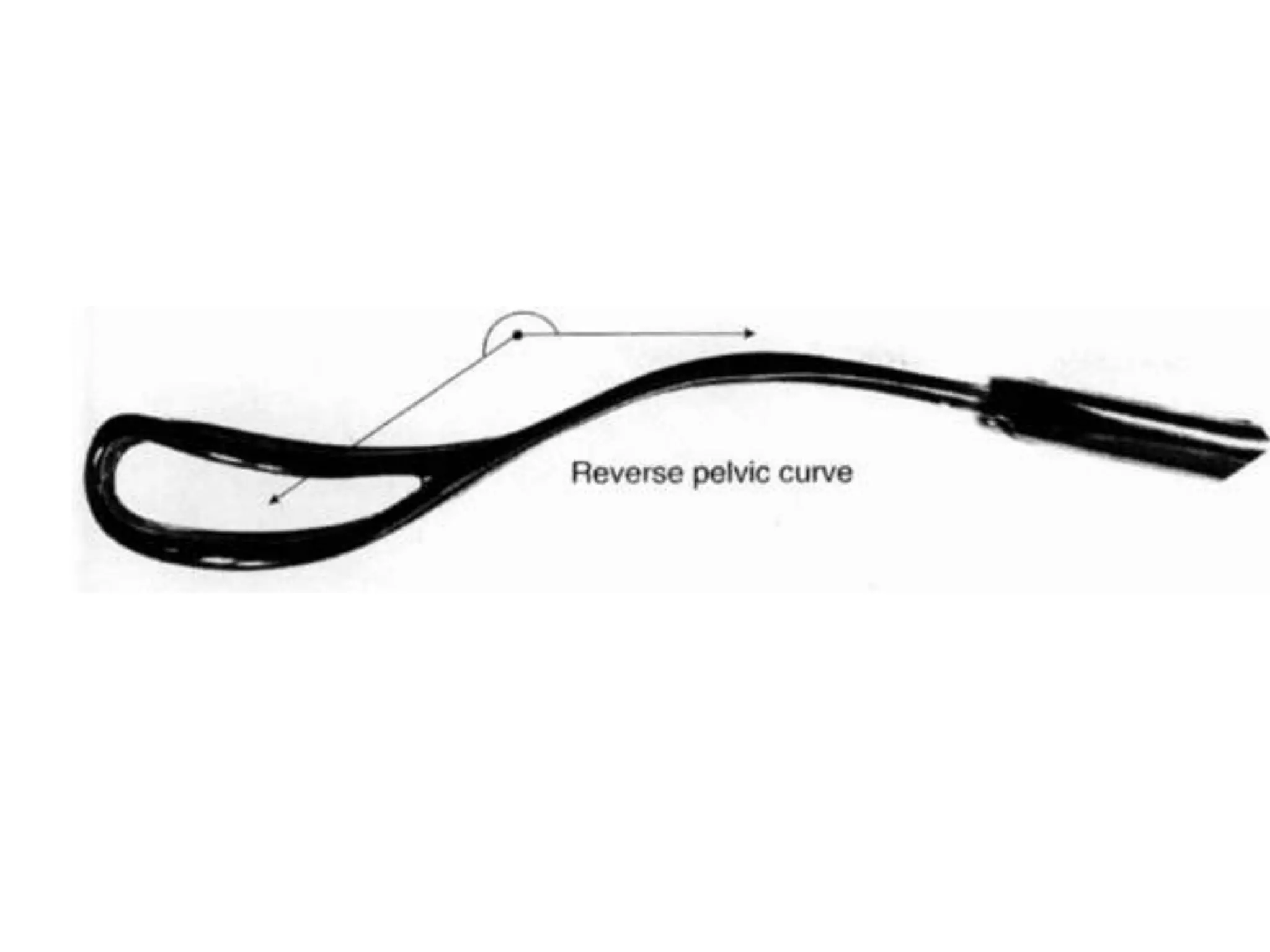
PIPER FORCEPS
• A specialized forceps,used to assist the
delivery of the after-coming head of breech.
• It has a
– cephalic curve,
– reverse pelvic curve,
– long parallel shanks that permit the baby’s body
to rest against it during head delivery.
Procedure
• The head should be brought as low down as possible by allowing the
baby to hang by its own weight aided by suprapubic pressure.
• When the occiput lies against the back of the symphysis pubis, an
assistant raises the legs of the child as much to facilitate introduction of
the blades from below.
• Too much elevation of the trunk may cause extension of the head.
• The forceps pull maintains an arc, which follows the axis of the birth canal
• Piper forceps is especially designed (absent pelvic curve) for use in this
condition.
• The head should be delivered slowly (over 1 minute) to
reduce compression-decompression forces as that may cause intracranial
bleeding
KIELLAND’S FORCEPS
• it is an useful and preferred instrument.
ITS ADVANTAGES
(1) It can be used with advantages
in unrotated vertex or face presentation
(2) facilitates grasping and correction of
asynclitic head because of its sliding lock
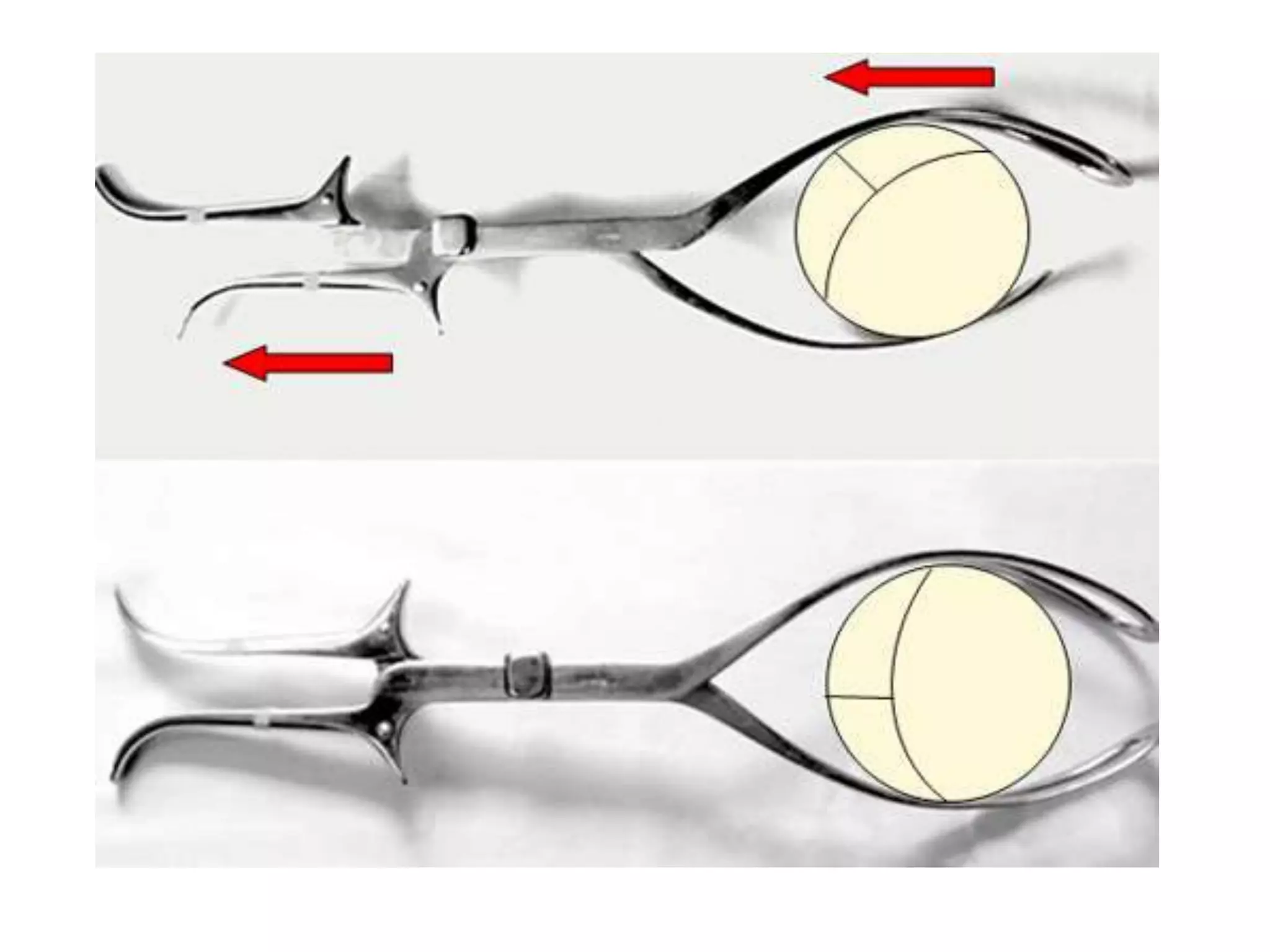
IDENTIFICATION OF THE BLADES
• The articulated blades are to be held in front
of the vulva in a position to be taken up when
applied to the head.
• The concavity of the slight pelvic curve should
correspond to the side towards which the
occiput lies
• The blades are named anterior and posterior.
• The anterior blade is to be introduced first.
METHODS OF APPLICATION
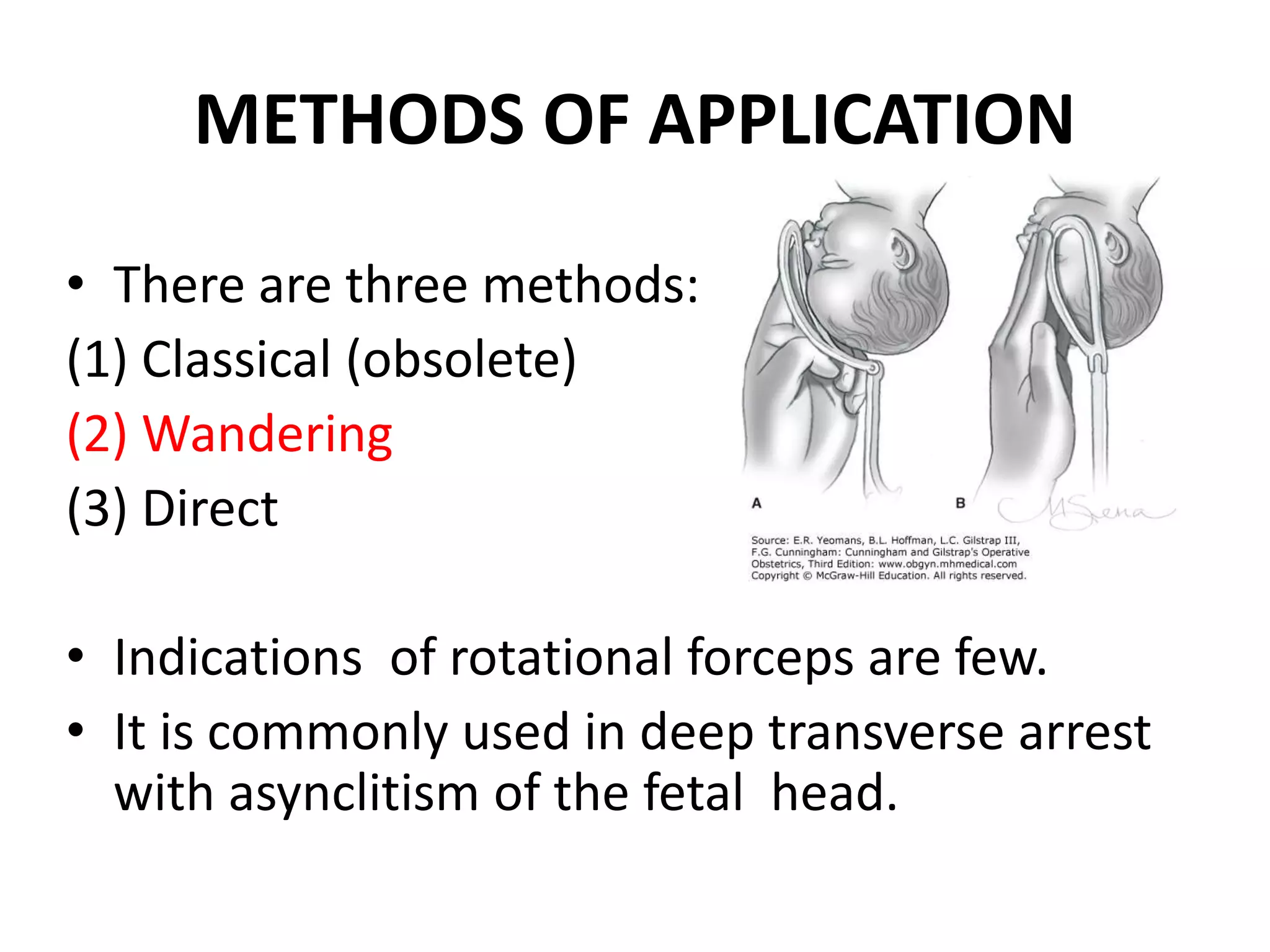
• There are three methods:
(1) Classical (obsolete)
(2) Wandering
(3) Direct
• Indications of rotational forceps are few.
• It is commonly used in deep transverse arrest
with asynclitism of the fetal head.
Wandering method is popular !
• The anterior (superior) blade is applied first.
• The blade is inserted along the side wall of the pelvis and then
wandered by swinging it round the fetal face to its anterior position.
• The posterior blade is inserted directly under guidance of the right
hand placed between the head and the hollow of the sacrum.
• The forceps handles are depressed down and the handle tips are
brought into alignment to correct the asynclitism.
• The occiput is rotated anteriorly.
• Slight upward dislodgement of the head may facilitate rotation.
• The position is rechecked and traction is applied.
• Sitting on a low foot stool or kneeling is convenient for the
operator.
LIMITATIONS
• Because of complexity in the technique of its
application, one should be sufficiently trained
before independent use.
DIFFICULTIES IN FORCEPS OPERATION
• The difficulties are encountered mainly due to
faulty assessment of the case before the
operative delivery is undertaken.
• However, there is hardly any difficulty in low
forceps operation.
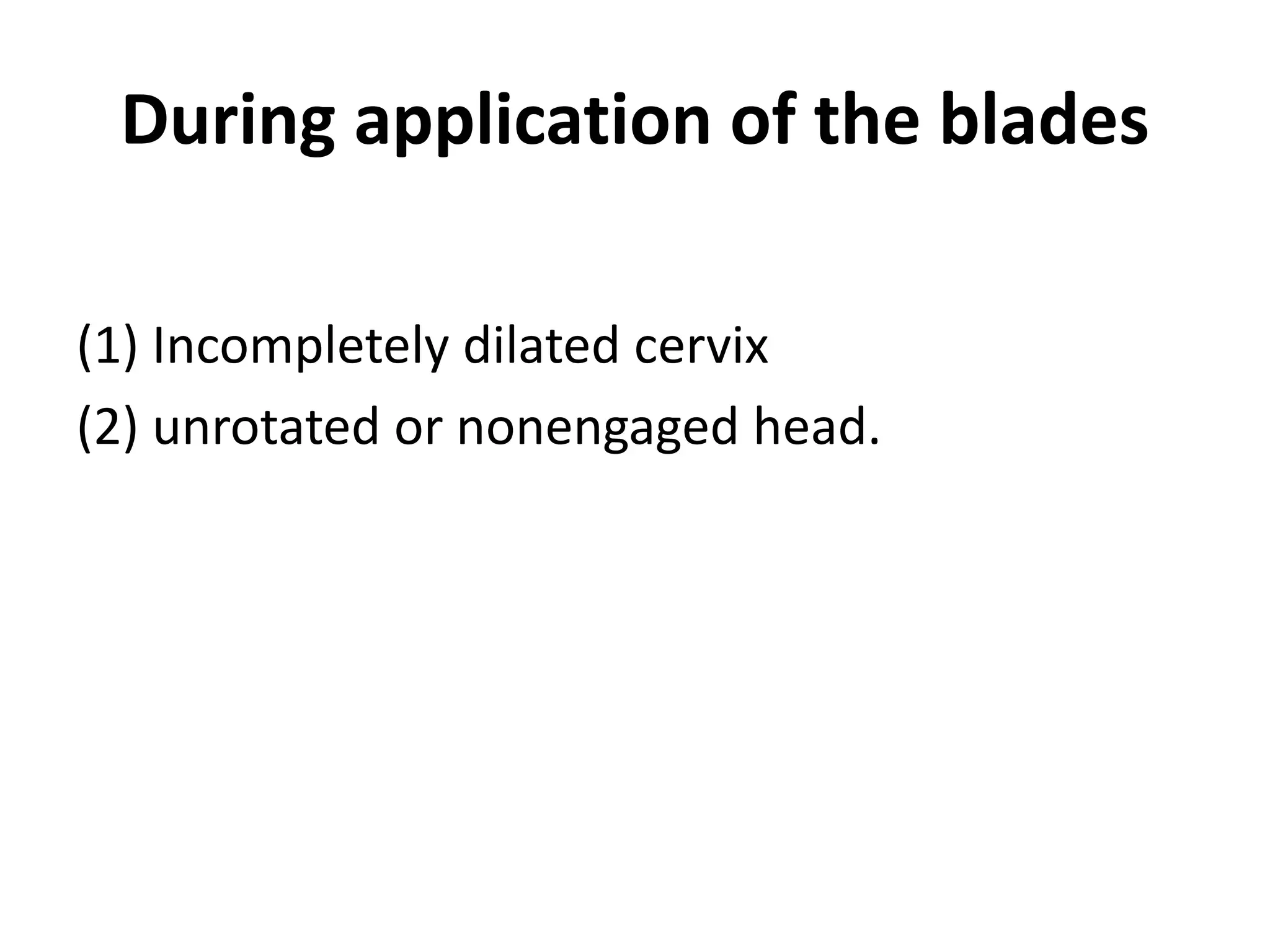
During application of the blades
(1) Incompletely dilated cervix
(2) unrotated or nonengaged head.
Difficulty in locking
(1) Application in unrotated head
(2) Improper insertion of the blade (not far
enough in)
(3) Failure to depress the handle against the
perineum and
(4) Entanglement of the cord or fetal parts inside
the blades
Difficulty in traction
(1) Undiagnosed occipitoposterior position
(2) Faulty cephalic application
(3) Wrong direction of traction
(4) Mild pelvic contraction and
(5) Constriction ring.
Slipping of the blades
(1) The blades are not introduced far enough in
(2) faulty application in occipitoposterior
position.
The blades should be equidistant from the
sinciput and occiput.
HAZARDS
FETAL
• Facial bruising,
• Laceration,
• Facial nerve palsy,
• Skull fractures,
• Intracranial hemorrhage.
HAZARDS
MATERNAL
• Perineal sulcus tear,
• Complete perineal tear.
• Deep mediolateral episiotomy is mandatory.
COMPLICATIONS OF FORCEPS
OPERATION
• The complications of the forceps
operation are mostly related to the faulty
technique and to the indication for which the
forceps are applied rather than the
instrument.
PROPHYLACTIC FORCEPS (ELECTIVE)
• It refers to forceps delivery only to shorten the second stage of labor
when maternal and/or fetal complications are anticipated.
INDICATIONS
(1) Eclampsia
(2) heart disease
(3) previous history of cesarean section
(4) postmaturity
(5) low-birth-weight baby
(6) to curtail the painful second stage and
(7) patients under epidural analgesia.
• It prevents possible fetal cerebral injury and spares the mother from the
strain of bearing down efforts.
• Prophylactic forceps should not be applied until the criteria of low
forceps are fulfilled
TRIAL FORCEPS
• It is a tentative attempt of forceps delivery
in a case of suspected midpelvic contraction
• The procedure should be conducted in an
operation theater
• The conduct of trial forceps requires great
deal of skill and judgment
• If moderate traction leads to progressive
descent of the fetal head, the delivery is
completed vaginally, if not cesarean section is
done immediately
CONDITIONS FOR TRIAL OF FORCEPS
(1) Maternal obesity (BMI ≥ 30)
(2) Clinically big baby (wt ≥ 3 kg)
(3) Occipitoposterior position
(4) Mid-cavity delivery
(5) When 1/5th fetal head palpable per
abdomen.
FAILED FORCEPS
• When a deliberate attempt in vaginal delivery
with forceps has failed to expedite the
process, it is called failed forceps.
(3 ATTEMPTS IN 15 MINUTES INTERVAL)
Causes
(1) Incompletely dilated cervix
(2) Unrotated occipitoposterior position
(3) Cephalopelvic disproportion
(4) Unrecognized malpresentation (brow) or
hydrocephalus
(5) Constriction ring
(6) Clinically big baby (≥ 4 kg)
(7) Maternal BMI ≥ 30 and
(8) In a case with midcavity delivery.
PREVENTION
• It is a preventable condition.
• Only through skill and judgment, proper
selection of the case ideal for forceps can be
identified.
• Even if applied in wrong cases, one should
resist the temptation to give forcible traction
in an attempt to hide the mistake.
MANAGEMENT
(1) To assess the effect on the mother and the fetus
(2) to start a Ringer’s solution drip and to arrange
for blood transfusion
(3) to administer parenteral antibiotic
(4) to exclude rupture of the uterus
(5) the procedure is abandoned and delivery is
done by cesarean section and
(6) laparotomy should be done in a case with
rupture of uterus.
REFERENCES
• Mudaliar and Menon’s Clinical Obstetrics, 11th
edition, Sarala Gopalan and Vanita Jain,
Ventouse
• DC Dutta’s Textbook of Obstetrics, 9th edition,
Hiralal Konar, Ventouse
• Essential Of Obstrectric, Lakshmi Seshadri,
Gita Arjun, Ventouse
Operative obstrectric

Operative obstrectric

  • 1.
    OPERATIVES OBSTETRICS NUR FARRANAJWA BINTI ABDUL AZIM 082015100035
  • 2.
    OPERATIVE VAGINAL DELIVERY •Refers to any delivery process which is assisted by vaginal operations. • Delivery by – Forceps – Ventouse
  • 3.
    FORCEPS • Obstetric forcepsis a pair of instruments • Especially designed to assist extraction of the fetal head and thereby accomplishing delivery of the fetus. • VARIETIES OF OBSTETRIC FORCEPS: – Long-curved forceps with or without axistraction device – Short-curved forceps – Kielland’s forceps
  • 5.
    LONG-CURVED OBSTETRIC FORCEPS •Relatively heavy • About 37 cm (15") long. • Das’s variety • It is comparatively lighter and slightly shorter than its western counterpart • Suited for the small pelvis and small baby of indian women.
  • 7.
    Measurements: • Length is37 cm • Distance in between the tips is 2.5 cm • Widest diameter between the blades is 9 cm.
  • 8.
    BLADES • There aretwo blades • Right or left in relation to maternal pelvis Each blade consists of the following parts: (1) blade (2) shank (3) lock (4) handle with or without screw. BLADE: • The blade is fenestrated to facilitate a good grip of the fetal head. • There is usually a slot in the lower part of the fenestrum of the blades to allow the upper end of the axis-traction rod to be fitted. • The toe of the blade refers to the tip and the heel to the end of the blade that is attached to the shank.
  • 11.
    CURVE • The bladehas got two curves
  • 14.
    CURVE CEPHALIC CURVE • Itis the curve on the flat surface which when articulated grasps the fetal head without compression. • The radius of the curve is 11.5 cm (4.5").
  • 15.
    CURVE PELVIC CURVE • Thecurve on the edge is to fit more or less the curve on the axis of the birth canal (curve of Carus). • It forms a part of a circle whose radius is 17.5 cm (7"). • The front of the forceps is the concave side of the pelvic curve. • Pelvic curve permits ease of application along the maternal pelvic axis.
  • 17.
    SHANK • It isthe part between the blade and the lock and usually measures 6.25 cm (2.5"). • It increases the length of the instrument and thereby, facilitates locking of the blades outside the vulva. • When the blades are articulated, the shanks are not apposed together.
  • 19.
    LOCK • The commonmethod of articulation consists of a socket system located on the shank at its junction with the handle (English lock). • Such type of lock requires introduction of the left blade first.
  • 24.
    HANDLE • The handlesare apposed when the blades are articulated. It measures 12.5 cm (5"). • There is a finger guard on which a finger can be placed during traction.
  • 26.
    SCREW • A screwis attached usually at the end (or at the base) of one blade (commonly left). • It helps to keep the blades in position.
  • 28.
    HOW TO IDENTIFYTHE BLADES WHEN ARTICULATED • The blade which corresponds to the left of the maternal pelvis is the left blade and that to the right side is the right blade. WHEN ISOLATED (1) The tip should point upwards (2) The cephalic curve is to be directed inwards and the pelvic curve forwards.
  • 30.
    TYPES OF APPLICATIONOF FORCEPS BLADES CEPHALIC APPLICATION • The blades are applied along the sides of the head grasping the biparietal diameter in between the widest part of the blades. • The long axis of the blades corresponds more or less to the occipitomental plane of the fetal head. • It is the ideal method of application as it has got a negligible compression effect on the cranium.
  • 32.
    TYPES OF APPLICATIONOF FORCEPS BLADES PELVIC APPLICATION • When the blades of the forceps are applied on the lateral pelvic walls ignoring the position of the head, it is called pelvic application. • If the head remains unrotated, this type of application puts serious compression effect on the cranium and thus must be avoided.
  • 33.
    AXIS-TRACTION DEVICE • Itcan be applied with advantage in midforceps operation, especially following manual rotation of the head. • It provides traction in the correct axis of the pelvic curve and as such, less force is necessary to deliver the head. CONSISTS OF: (1) Traction rods (two—right and left) (2) Traction handle
  • 35.
    Identification of thetraction rods— right or left? • Hold the knob pointing inwards and let the rod hang. • The small transverse bar at the bottom is to be directed forward.
  • 39.
  • 40.
    OUTLET FORCEPS •It is a variety of low forceps where the head is on the perineum LOW FORCEPS • The head is near the pelvic floor or even visible at the introitus. •It is commonly used nowadays with advantages MIDFORCEPS Prerequisites are: (i) Must be associated with less maternal morbidity than Cesarean section (ii) should not cause any fetal damage. Unless the prospect of successful vaginal delivery is high midforceps delivery is best avoided. Manual rotation may be needed before traction. (iii) In a selective case, delivery by rotational forceps by an expert is safe. Otherwise, it is better to wait for the head descent and complete rotation. (iv) An oxytocin drip may be helpful if not contraindicated. (v) Ventouse may be an alternative. CHOICE OF FORCEPS OPERATION
  • 41.
    SHORT-CURVED OBSTETRIC FORCEPS (WRIGLEY) •The instrument is lighter • One third of the weight of an ordinary long- curved forceps. • The instrument is short which is due to reduction in the length of the shanks and handles . • It has a marked cephalic curve with a slight pelvic curve.
  • 42.
  • 43.
    KIELLAND’S FORCEPS • Itis a long almost straight (very slight pelvic curve) obstetric forceps without any axis- traction device. • It has got a sliding lock which facilitates correction of asynclitism of the head. • One small knob on each blade is directed towards the occiput.
  • 45.
  • 46.
  • 48.
    LOW FORCEPS OPERATION PRELIMINARIES •Same as those mentioned earlier • The following are specially emphasized: • Anesthesia: Pudendal block supplemented by perineal and labial infiltration with 1% lignocaine hydrochloride is quite effective in producing local anesthesia • Catheterization • Internal examination to assess: (a) State of the cervix (b) membranes status (c) presentation and position of the head (d) assessment of the pelvic outlet (sacro-coccygeal plateau, TDO and subpubic arch). • Episiotomy: It is usually done during traction when the perineum becomes bulged and thinned out by the advancing head.
  • 49.
    PRELIMINARIES • ANESTHESIA—either generalor local is used. In some cases, the operation may be performed with intravenous diazepam sedation. • LITHOTOMY position. • Full SURGICAL ASEPSIS is to be taken: – Surgical team is to wear sterile cap, mask, thorough hand wash and to wear gown and gloves – Vulva and vagina are to be swabbed with antiseptic solution – Cervix is cleaned with povidone-iodine solution – Leggings. • To empty the EMPTY THE BLADDER before she is placed on the table or catheterization • Vaginal examination is done
  • 50.
    Cont. • Pudendal blockor perineal infiltration with 1% lignocaine is sufficient. • It may be applied even without anesthesia, especially in parous women. • The instrument should be assembled • The vacuum is tested prior to its application
  • 51.
    STEPS 1. Identification ofthe blades and their application 2. Locking of the blades 3. Traction 4. Removal of the blade
  • 52.
    Step I • Identificationand application of the blades • The identification of the blades is to be made after articulation as mentioned earlier • The left or lower blade is to be introduced first • The four fingers of the semi-supinated right hand are inserted along the left lateral vaginal wall, the palmar surface of the fingers rest against the side of the head • The fingers are used to guide the blade during application and to protect the vaginal wall. • The handle of the left blade is taken lightly by three fingers of the left hand – index, middle and thumb in a pen holding manner and is held vertically almost parallel to the right inguinal ligament. • The fenestrated portion of the blade is placed on the right palm with the tip (toe) pointing upwards. • The right thumb is placed at the junction of the blade and the shank (heel). • The blade is introduced between the guiding internal fingers and the fetal head, manipulated by the thumb.
  • 54.
    Step I • Asthe blade is pushed up and up, the handle is carried downwards and backwards, traversing wide arc of a circle towards the left until the shank is to lie straight on the perineum. • Utmost gentleness is required while introducing the blade. No assistant is usually required to hold the handle in low forceps operation. • When correctly applied, the blade should be over the parietal eminence, the shank should be in contact with the perineum and the superior surface of the handle should be directed upwards.
  • 57.
    INTRODUCTION OF THERIGHT BLADE • The two fingers of the left hand are now introduced into the right lateral wall of the vagina alongside the baby’s head. • The right blade is introduced in the same manner as with left one but holding it with the right hand.
  • 60.
    Step II • Lockingof the blades • When correctly applied (bimalar, biparietal placement), the blades should be articulated with ease. • Minor difficulty in locking can be corrected by depressing the handles on the perineum. • In case of major difficulty, the blades are to be removed, the causes are to be sought for and the blades are to be reinserted. • The handles should never be forced to lock them.
  • 62.
    Step III andIV • Traction and removal of blades • Before traction is applied, correct application of the blades is to be ensured. CORRECT APPLICATION IS EVIDENCED BY (a) easy locking (b) the blades are equidistant from the lambdoid suture (c) firm gripping of the head on the biparietal diameter – as judged by a few tentative pulls.
  • 64.
    PRINCIPLES • Steady butintermittent traction should be given if possible during contraction. • However, in outlet forceps the pull may be continuous. • Strong traction is not needed as the only resistance to overcome is the perineum and the coccyx
  • 65.
    GRIPPING OF THEARTICULATED FORCEPS DURING TRACTION • The traction is given by gripping the handle, placing the middle finger in between the shanks with the ring and index fingers on either side on the finger guard. • During the final stage of traction, the four fingers are placed in between the shanks and the thumb which is placed on the under surface of the handles and exerts the necessary force.
  • 67.
    DIRECTION OF THEPULL • The direction of the pull corresponds to the axis of the birth canal • In low forceps operation depending upon the station of the head, the direction of the pull is downwards and backwards until the head comes to the perineum. • The pull is then directed horizontally straight towards the operator till the head is almost crowned. • The direction of pull is gradually changed to upwards and forwards, towards the mother’s abdomen to deliver the head by extension. • The blades are removed one after the other, the right one first.
  • 70.
    FOLLOWING THE BIRTHOF THE HEAD • Usual procedures are to be taken as in normal delivery. • Routine injection oxytocin 10 iu, im or intravenous methergine 0.2 mg is to be administered with the delivery of the baby. • Episiotomy is repaired in the usual method . • Lacerations on the vaginal walls or perineum are to be excluded
  • 71.
    OUTLET FORCEPS OPERATION •Wrigley’s forceps • Used exclusively in outlet forceps operation. • Perineal and vulval infiltration with 1% lignocaine is enough for local anesthesia. • The blades are introduced as in the low forceps operation with long-curved forceps except that two fingers are to be introduced into the vagina for the application of the left blade. • Traction is given holding the articulated forceps with the fingers placed in between the shanks and the thumb on the under surface of the handles. • The direction of the pull is straight horizontal and then upwards and forwards
  • 72.
    MIDFORCEPS OPERATION • Themost common indication of midforceps operation is following manual rotation of the head in malrotated occipitoposterior position. • The commonly used forceps is long curved one with or without axis-traction device • Kielland is useful in the hands of an expert
  • 73.
    Procedures • General anesthesiais preferable. INTRODUCTION OF THE BLADES • The introduction of the blades is to be done after prior correction of the malrotation. (A) WITHOUT AXIS-TRACTION DEVICE: • The blades are introduced as in the low forceps operation. • An assistant is required to hold the left handle after its introduction
  • 74.
    Procedures B) WITH AXIS-TRACTIONDEVICE • While applying the left blade, the traction-rod already attached to the blade is held backwards. • During introduction of the right blade, the traction-rod must be held forwards otherwise it will prevent locking of the blades.
  • 76.
    Procedures TRACTION (A) WITHOUT AXIS-TRACTIONDEVICE • The direction of pull is first downwards and backwards, then (horizontal or straight pull) and finally upwards and forwards (B) WITH AXIS-TRACTION DEVICE • The traction handle is to be attached to the traction rods. • During traction, the traction rods should remain parallel with the shanks. • When the base of the occiput comes under the symphysis pubis, the traction-rods are to be removed
  • 78.
    FORCEPS IN OCCIPITO-SACRAL POSITION •Usual application of the blades as like that of occipitoanterior position is made. • The blades should lie equidistant from the sinciput and occiput, otherwise the blades may slip during traction. • Horizontal traction is given until the root of the nose is under the symphysis pubis. • The direction is changed to upwards and forwards to deliver the occiput. • By a downward movement of the instrument, the nose and chin are delivered.
  • 80.
    FORCEPS IN FACEPRESENTATION • Forceps delivery is only reserved for mentoanterior position. • The blades are applied as in occipitoanterior position. • But the handles should be kept well forward to avoid grasping of the neck by the tips of the blade. • Traction is made like that of occipitoanterior to bring the chin well below and then round the symphysis pubis.
  • 82.
    APPLICATION OF FORCEPSTO THE AFTER-COMING HEAD • The head must be in the cavity. THE ADVANTAGES (a) Delivery can be controlled by giving pull directly on the head and the force is not transmitted through the neck, (b) Flexion is better maintained and (c) Mucus can be sucked out from the mouth more effectively.
  • 83.
    PIPER FORCEPS • Aspecialized forceps,used to assist the delivery of the after-coming head of breech. • It has a – cephalic curve, – reverse pelvic curve, – long parallel shanks that permit the baby’s body to rest against it during head delivery.
  • 85.
    Procedure • The headshould be brought as low down as possible by allowing the baby to hang by its own weight aided by suprapubic pressure. • When the occiput lies against the back of the symphysis pubis, an assistant raises the legs of the child as much to facilitate introduction of the blades from below. • Too much elevation of the trunk may cause extension of the head. • The forceps pull maintains an arc, which follows the axis of the birth canal • Piper forceps is especially designed (absent pelvic curve) for use in this condition. • The head should be delivered slowly (over 1 minute) to reduce compression-decompression forces as that may cause intracranial bleeding
  • 87.
    KIELLAND’S FORCEPS • itis an useful and preferred instrument. ITS ADVANTAGES (1) It can be used with advantages in unrotated vertex or face presentation (2) facilitates grasping and correction of asynclitic head because of its sliding lock
  • 88.
    IDENTIFICATION OF THEBLADES • The articulated blades are to be held in front of the vulva in a position to be taken up when applied to the head. • The concavity of the slight pelvic curve should correspond to the side towards which the occiput lies • The blades are named anterior and posterior. • The anterior blade is to be introduced first.
  • 90.
    METHODS OF APPLICATION •There are three methods: (1) Classical (obsolete) (2) Wandering (3) Direct • Indications of rotational forceps are few. • It is commonly used in deep transverse arrest with asynclitism of the fetal head.
  • 91.
    Wandering method ispopular ! • The anterior (superior) blade is applied first. • The blade is inserted along the side wall of the pelvis and then wandered by swinging it round the fetal face to its anterior position. • The posterior blade is inserted directly under guidance of the right hand placed between the head and the hollow of the sacrum. • The forceps handles are depressed down and the handle tips are brought into alignment to correct the asynclitism. • The occiput is rotated anteriorly. • Slight upward dislodgement of the head may facilitate rotation. • The position is rechecked and traction is applied. • Sitting on a low foot stool or kneeling is convenient for the operator.
  • 96.
    LIMITATIONS • Because ofcomplexity in the technique of its application, one should be sufficiently trained before independent use.
  • 97.
    DIFFICULTIES IN FORCEPSOPERATION • The difficulties are encountered mainly due to faulty assessment of the case before the operative delivery is undertaken. • However, there is hardly any difficulty in low forceps operation.
  • 98.
    During application ofthe blades (1) Incompletely dilated cervix (2) unrotated or nonengaged head.
  • 99.
    Difficulty in locking (1)Application in unrotated head (2) Improper insertion of the blade (not far enough in) (3) Failure to depress the handle against the perineum and (4) Entanglement of the cord or fetal parts inside the blades
  • 100.
    Difficulty in traction (1)Undiagnosed occipitoposterior position (2) Faulty cephalic application (3) Wrong direction of traction (4) Mild pelvic contraction and (5) Constriction ring.
  • 101.
    Slipping of theblades (1) The blades are not introduced far enough in (2) faulty application in occipitoposterior position. The blades should be equidistant from the sinciput and occiput.
  • 102.
    HAZARDS FETAL • Facial bruising, •Laceration, • Facial nerve palsy, • Skull fractures, • Intracranial hemorrhage.
  • 103.
    HAZARDS MATERNAL • Perineal sulcustear, • Complete perineal tear. • Deep mediolateral episiotomy is mandatory.
  • 104.
    COMPLICATIONS OF FORCEPS OPERATION •The complications of the forceps operation are mostly related to the faulty technique and to the indication for which the forceps are applied rather than the instrument.
  • 106.
    PROPHYLACTIC FORCEPS (ELECTIVE) •It refers to forceps delivery only to shorten the second stage of labor when maternal and/or fetal complications are anticipated. INDICATIONS (1) Eclampsia (2) heart disease (3) previous history of cesarean section (4) postmaturity (5) low-birth-weight baby (6) to curtail the painful second stage and (7) patients under epidural analgesia. • It prevents possible fetal cerebral injury and spares the mother from the strain of bearing down efforts. • Prophylactic forceps should not be applied until the criteria of low forceps are fulfilled
  • 107.
    TRIAL FORCEPS • Itis a tentative attempt of forceps delivery in a case of suspected midpelvic contraction • The procedure should be conducted in an operation theater • The conduct of trial forceps requires great deal of skill and judgment • If moderate traction leads to progressive descent of the fetal head, the delivery is completed vaginally, if not cesarean section is done immediately
  • 108.
    CONDITIONS FOR TRIALOF FORCEPS (1) Maternal obesity (BMI ≥ 30) (2) Clinically big baby (wt ≥ 3 kg) (3) Occipitoposterior position (4) Mid-cavity delivery (5) When 1/5th fetal head palpable per abdomen.
  • 109.
    FAILED FORCEPS • Whena deliberate attempt in vaginal delivery with forceps has failed to expedite the process, it is called failed forceps. (3 ATTEMPTS IN 15 MINUTES INTERVAL)
  • 110.
    Causes (1) Incompletely dilatedcervix (2) Unrotated occipitoposterior position (3) Cephalopelvic disproportion (4) Unrecognized malpresentation (brow) or hydrocephalus (5) Constriction ring (6) Clinically big baby (≥ 4 kg) (7) Maternal BMI ≥ 30 and (8) In a case with midcavity delivery.
  • 111.
    PREVENTION • It isa preventable condition. • Only through skill and judgment, proper selection of the case ideal for forceps can be identified. • Even if applied in wrong cases, one should resist the temptation to give forcible traction in an attempt to hide the mistake.
  • 112.
    MANAGEMENT (1) To assessthe effect on the mother and the fetus (2) to start a Ringer’s solution drip and to arrange for blood transfusion (3) to administer parenteral antibiotic (4) to exclude rupture of the uterus (5) the procedure is abandoned and delivery is done by cesarean section and (6) laparotomy should be done in a case with rupture of uterus.
  • 113.
    REFERENCES • Mudaliar andMenon’s Clinical Obstetrics, 11th edition, Sarala Gopalan and Vanita Jain, Ventouse • DC Dutta’s Textbook of Obstetrics, 9th edition, Hiralal Konar, Ventouse • Essential Of Obstrectric, Lakshmi Seshadri, Gita Arjun, Ventouse