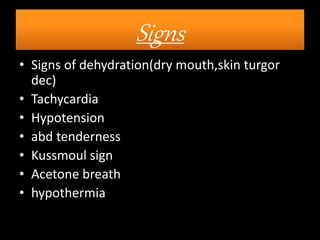
DKA is a life-threatening complication that can occur in patients with type 1 or type 2 diabetes. It results from a lack of insulin and high levels of glucose and ketones in the blood. Symptoms may include nausea, vomiting, thirst, frequent urination, and abdominal pain. Treatment involves rapid fluid replacement, administration of insulin, and monitoring of electrolytes. Goals are to rehydrate the patient and lower glucose and ketone levels. Complications can include hypoglycemia, hypokalemia, and cerebral edema. With treatment, mortality rates for DKA are now below 5%. Prevention relies on patient education about sick day management of diabetes.





![Fluid replacement:
• Average fluid deficit is abt 6L
-3L from ECC(0.9%NaCl)
-3L from ICC (0.5%DW)
However 6L is not required by every pt,it depends upon degree of
dehydration.
fluid deficit in L=(0.6*wt in kg)[(Na/140)-1]
• Scheme: isotonic saline
1L in 1/2hr
1L in 1hr then
1L in 2hr i.e 500ml/hr](https://image.slidesharecdn.com/652315634253166044960000-170329165023/85/DKA-22-320.jpg)


![Sodium:
• Initial plasma Na conc are low or normal despite
of H2O loss due to osmotic shift of H2O
• Hyponatremia occurs due to osmolar
compensation for hyperglycemia
• Add 1.6 meq to plasma Na for every 100 mg of
glucose
• Corrected Na=
[(plasma glucose-100)1.6/100]+ measured Na
Or =Na+2.4[(glucose-5.5)/5.5]](https://image.slidesharecdn.com/652315634253166044960000-170329165023/85/DKA-29-320.jpg)


![Management of diabitic_keto_acidosis[1]](https://cdn.slidesharecdn.com/ss_thumbnails/management-of-diabitic-ketoacidosis-5b1-5d-140226042211-phpapp01-thumbnail.jpg?width=640&height=640&fit=bounds)


