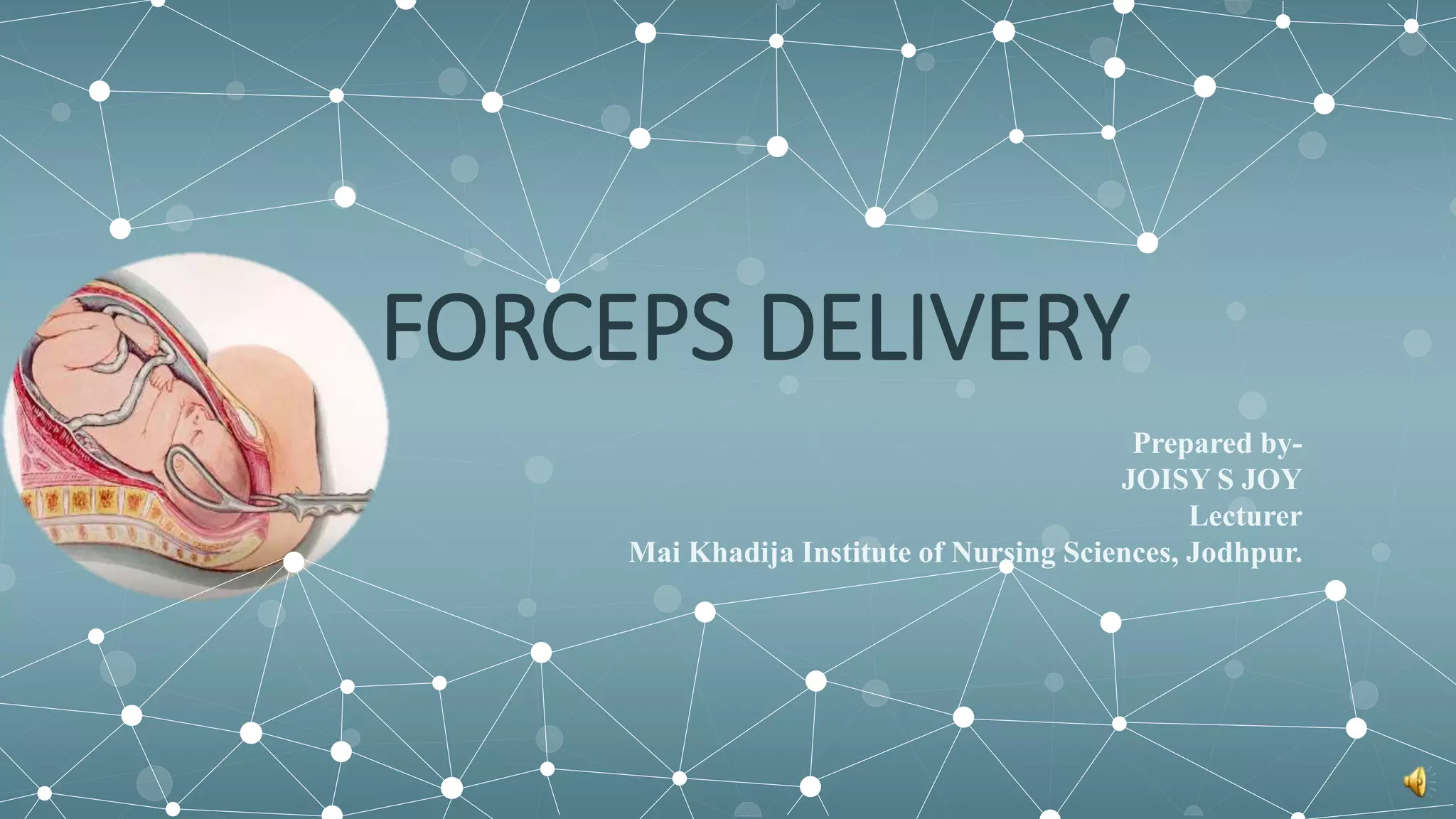
FORCEPS DELIVERY
Prepared by-
JOISY S JOY
Lecturer
Mai Khadija Institute of Nursing Sciences, Jodhpur.
Forceps delivery
Obstetric forceps is a specially designed instrument to assist in extraction of fetal head thereby accomplishing
delivery of the foetus.
There are eight main requirements to be fulfilled before forceps application:
 Delivery must be mechanically feasible as demonstrated by engagement of the head, determination of level
of presenting part and adequacy of maternal pelvis.
 Presenting part must be either vertex, face with anterior chin or after coming head in vaginal breech.
 The position of the head must be known.
 Uterine contractions must be present.
 Membranes must have ruptured.
 Cervix must be fully dilated.
 Anesthesia must be adequate (pudendal and local are acceptable for low forceps and epidural or spinal for
Kielland's forceps).
 Bladder must be empty (if necessary, bladder can be drained by urinary catheterization prior to forceps
delivery).
To extract the fetal head
To shorten the second stage of labour
To reduce maternal exhaustion
To rotate the fetal head in case of occiput
transverse, occiput posterior positions
To assist in the delivery of after coming head
of the breech
01
02
03
04
05
Purposes
06
To extract the fetal head during the cesarean
section birth
Indications
Maternal
 Inadequate expulsive efforts
 Malrotation of the head
 Maternal exhaustion
 Maternal medical conditions such as heart
disease, hypertension, severe anaemia etc
 Prolonged second stage of labour
Foetal
 Fetal distress
 Aftercoming fetal head of breech
 Low birth weight
 Postmaturity
Contraindications
 Face or brow presentation
 Cervix is not fully dilated
 Preterm less than 34 weeks or estimated fetal weight less than 2500 gram
 Suspected fetal coagulation disorder
 Fetal macrosomia
Parts of a forceps
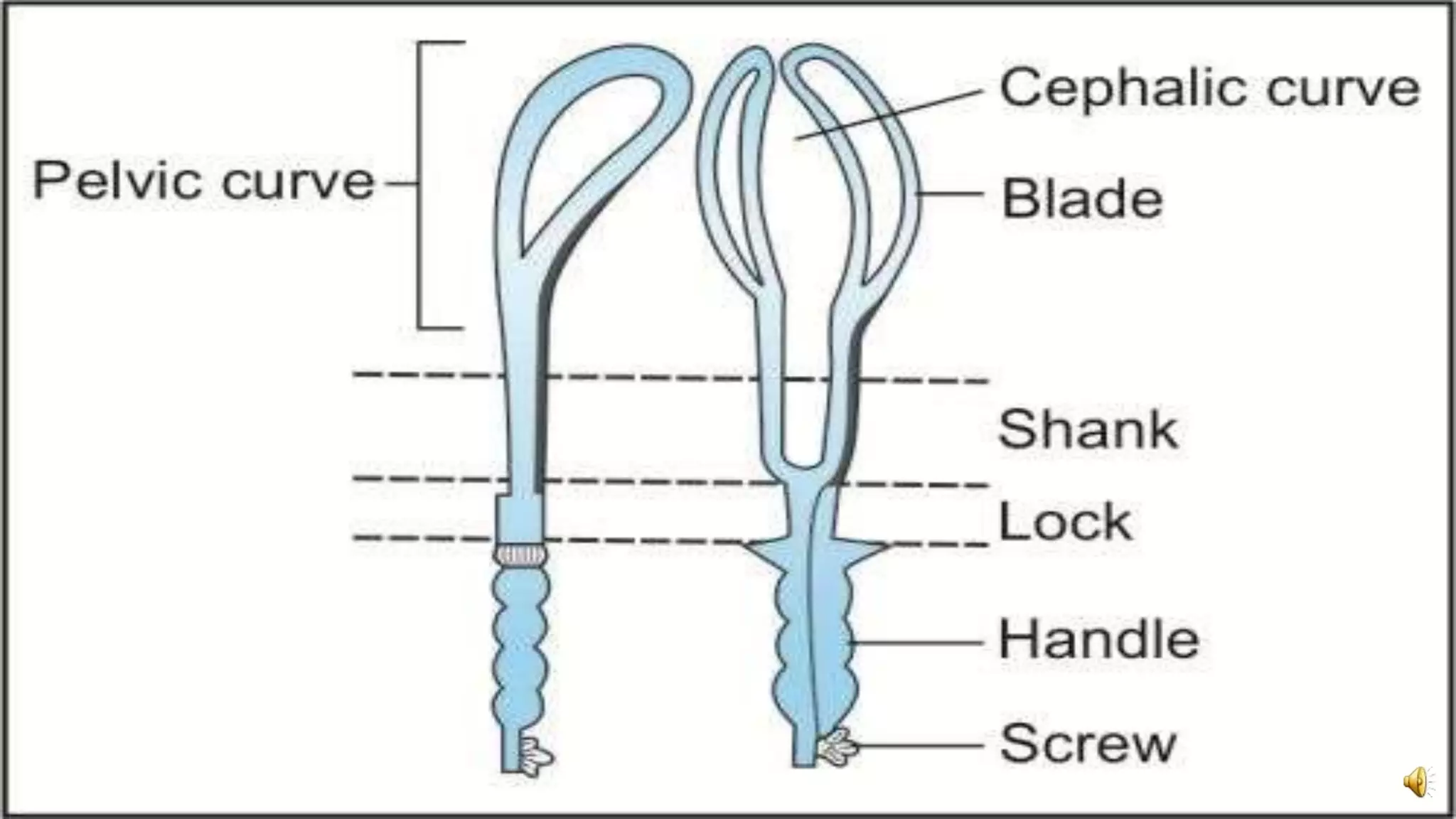
 The instrument consists of two steel parts that cross each other like a pair of scissors and lock at the
intersection. The lock maybe of a sliding type or a screw type.
 Each part consists of a handle, a lock, a shank and a blade.
 The blade is the curved portion applied to the sides of the fetal head.
 The blades of most forceps have a fenestrum, a large opening for window to enhance the grip on the fetal
head.
 The blades usually consist of two curves; a cephalic curve which conforms to the shape of the head and a
pelvic curve to follow the curve of the birth canal.
 Axis traction forceps have a mechanism attached below, that permits the pulling to be done more
directly in the axis of the birth canal.
 An axis traction handle also is available for use on standard forceps.
 The two blades of the forceps are designed as right and left.
 The left blade is introduced into the vagina on the client's left side, the right blade goes in on
the right side.
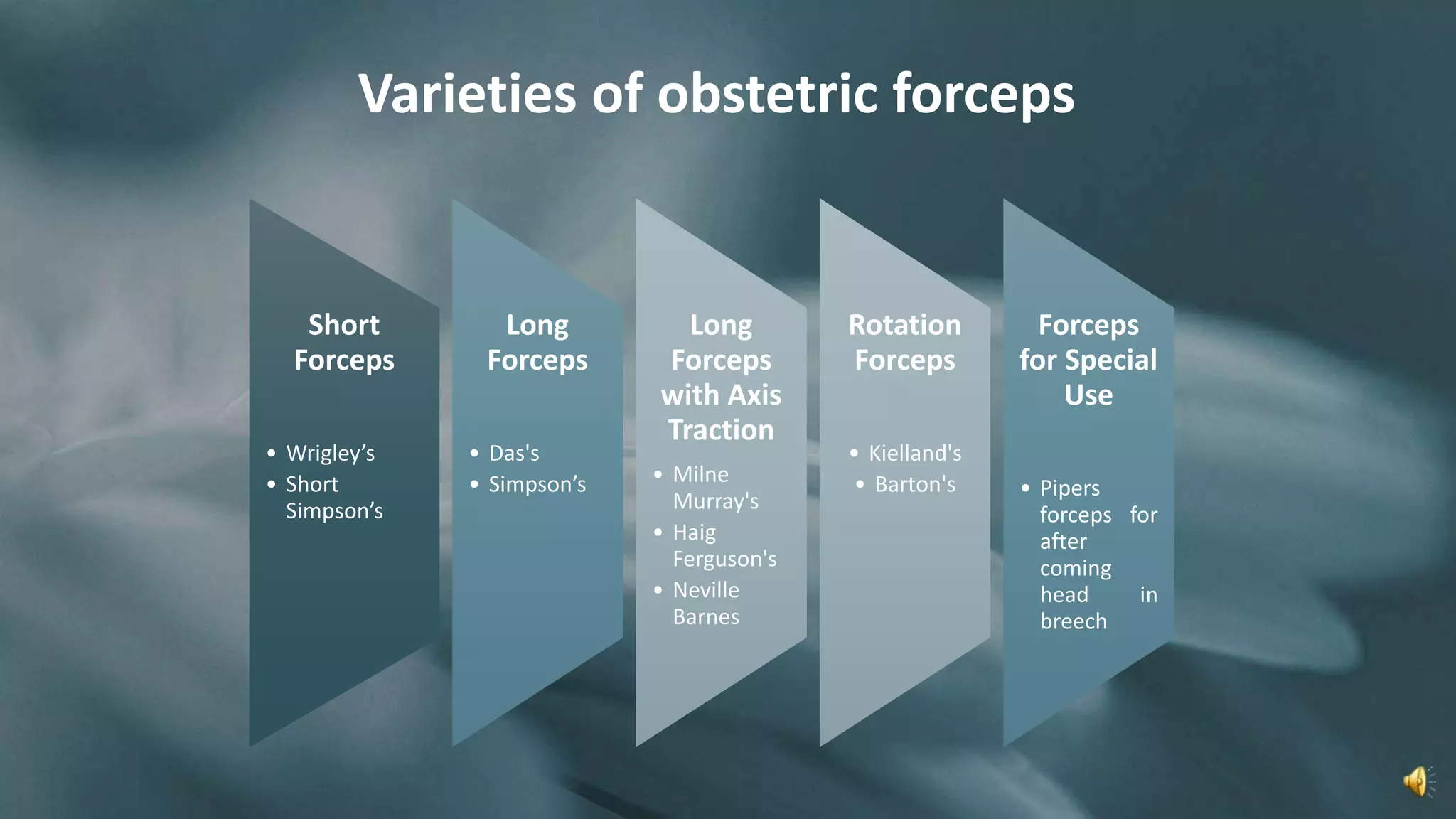
Short
Forceps
• Wrigley’s
• Short
Simpson’s
Long
Forceps
• Das's
• Simpson’s
Long
Forceps
with Axis
Traction
• Milne
Murray's
• Haig
Ferguson's
• Neville
Barnes
Rotation
Forceps
• Kielland's
• Barton's
Forceps
for Special
Use
• Pipers
forceps for
after
coming
head in
breech
Varieties of obstetric forceps
Classification of forceps application according to
the station of the head
1. Outlet forceps- 450 rotation or less required; applied when the scalp is visible at the introitus
without spreading the labia. The skull has reached the pelvic floor, the sagittal suture is in the
anteroposterior diameter or right or left anterior or posterior position and the fetal head is at the
perineum.
2. Low forceps- Rotation requiring more than 450 or less than 450; applied when the leading point of
the skull is at the station +2 or more.
3. Mid forceps- Applied when the head is engaged but the leading point of the skull is less than +2.
Note: Under no circumstances should forceps be applied to an unengaged presenting part.
Preparation of mother
 Explain the procedure and get informed consent.
 Start physical preparation including skin preparation and enema.
 Start IV line.
 Empty the bladder (catheterize if needed).
Procedure
1. After the decision is made to use forceps, select the type of instruments to be used.
2. Position the mother in lithotomy.
3. Wash hands and wear gloves.
4. Drape the mother.
5. Perform per vaginal examination.
6. Check for the prerequisites
o F- favorable head position and station
o O- open os (fully dilated cervix)
o R- ruptured membranes
o C- contractions present and verbal or written consent
o E- engaged head, empty bladder
o P- pelvimetry, no major CPD
o S- stirrups, lithotomy position
7. Infiltrate the perineum with Inj. Xylocaine.
8. Perform generous episiotomy.
9. Two or more fingers of one hand is introduced into the left side of the vagina. These fingers guide the left
blade into place and at the same time protect the maternal soft parts (vagina and cervix) from injury.
10. The other hand is used to introduce the left blade of the forceps into the left side of the vagina, gently
placing it between the fetus’ head and the fingers of the hand.
11. The same procedure is carried out on the right side.
12. Then the blades are articulated or attached together at the shank.
13. Traction is applied intermittently and not continuously.
14. Between traction, the blades are partially disarticulated to release pressure on the fetal head.
15. Instruct the woman to bear down during contraction and apply steady and intermittent traction
simultaneously.
16. Gently pull the head upward and forward towards the mother's abdomen.
17. Remove the blades one after the other.
18. Administer parenteral oxytocin.
19. Deliver the placenta by controlled cord traction.
20. Suture the episiotomy layers.
21. Document the name of the mother, age, obstetrical score, indication, types of forceps applied, date and
time of procedure and complications if any.
Aftercare
Assess the general condition of the mother
Check the vital status
Check for the contractility of the uterus
Observe for bleeding
Assess for the maternal and fetal complications
01
02
03
04
05
Complications
Maternal
 Extension of episiotomy towards rectum or
upward to the vault of vagina
 Vaginal lacerations
 Cervical tears especially when applied in the
incompletely dilated cervix
 Bruising and trauma to the urethra
 PPH due to trauma, atonic uterus related to
prolonged labour or effect of anaesthesia
 Shock due to blood loss, prolonged labour
and dehydration
 Sepsis
Foetal
 Asphyxia due to intracranial stress out of
the prolonged compression
 Intracranial hemorrhage due to
malapplication of the blades
 Cephalohematoma
 Facial palsy
 Abrasions on the soft tissue of the face
and forehead by the forceps blade, severe
bruising
 Skull fracture
THANK YOU

Forceps delivery - Copy.pptx

  • 1.
    FORCEPS DELIVERY Prepared by- JOISYS JOY Lecturer Mai Khadija Institute of Nursing Sciences, Jodhpur.
  • 2.
    Forceps delivery Obstetric forcepsis a specially designed instrument to assist in extraction of fetal head thereby accomplishing delivery of the foetus. There are eight main requirements to be fulfilled before forceps application:  Delivery must be mechanically feasible as demonstrated by engagement of the head, determination of level of presenting part and adequacy of maternal pelvis.  Presenting part must be either vertex, face with anterior chin or after coming head in vaginal breech.  The position of the head must be known.  Uterine contractions must be present.  Membranes must have ruptured.  Cervix must be fully dilated.  Anesthesia must be adequate (pudendal and local are acceptable for low forceps and epidural or spinal for Kielland's forceps).  Bladder must be empty (if necessary, bladder can be drained by urinary catheterization prior to forceps delivery).
  • 3.
    To extract thefetal head To shorten the second stage of labour To reduce maternal exhaustion To rotate the fetal head in case of occiput transverse, occiput posterior positions To assist in the delivery of after coming head of the breech 01 02 03 04 05 Purposes 06 To extract the fetal head during the cesarean section birth
  • 4.
    Indications Maternal  Inadequate expulsiveefforts  Malrotation of the head  Maternal exhaustion  Maternal medical conditions such as heart disease, hypertension, severe anaemia etc  Prolonged second stage of labour Foetal  Fetal distress  Aftercoming fetal head of breech  Low birth weight  Postmaturity
  • 5.
    Contraindications  Face orbrow presentation  Cervix is not fully dilated  Preterm less than 34 weeks or estimated fetal weight less than 2500 gram  Suspected fetal coagulation disorder  Fetal macrosomia
  • 6.
    Parts of aforceps  The instrument consists of two steel parts that cross each other like a pair of scissors and lock at the intersection. The lock maybe of a sliding type or a screw type.  Each part consists of a handle, a lock, a shank and a blade.  The blade is the curved portion applied to the sides of the fetal head.  The blades of most forceps have a fenestrum, a large opening for window to enhance the grip on the fetal head.  The blades usually consist of two curves; a cephalic curve which conforms to the shape of the head and a pelvic curve to follow the curve of the birth canal.
  • 7.
     Axis tractionforceps have a mechanism attached below, that permits the pulling to be done more directly in the axis of the birth canal.  An axis traction handle also is available for use on standard forceps.  The two blades of the forceps are designed as right and left.  The left blade is introduced into the vagina on the client's left side, the right blade goes in on the right side.
  • 9.
    Short Forceps • Wrigley’s • Short Simpson’s Long Forceps •Das's • Simpson’s Long Forceps with Axis Traction • Milne Murray's • Haig Ferguson's • Neville Barnes Rotation Forceps • Kielland's • Barton's Forceps for Special Use • Pipers forceps for after coming head in breech Varieties of obstetric forceps
  • 10.
    Classification of forcepsapplication according to the station of the head 1. Outlet forceps- 450 rotation or less required; applied when the scalp is visible at the introitus without spreading the labia. The skull has reached the pelvic floor, the sagittal suture is in the anteroposterior diameter or right or left anterior or posterior position and the fetal head is at the perineum. 2. Low forceps- Rotation requiring more than 450 or less than 450; applied when the leading point of the skull is at the station +2 or more. 3. Mid forceps- Applied when the head is engaged but the leading point of the skull is less than +2. Note: Under no circumstances should forceps be applied to an unengaged presenting part.
  • 11.
    Preparation of mother Explain the procedure and get informed consent.  Start physical preparation including skin preparation and enema.  Start IV line.  Empty the bladder (catheterize if needed).
  • 12.
    Procedure 1. After thedecision is made to use forceps, select the type of instruments to be used. 2. Position the mother in lithotomy. 3. Wash hands and wear gloves. 4. Drape the mother. 5. Perform per vaginal examination. 6. Check for the prerequisites o F- favorable head position and station o O- open os (fully dilated cervix) o R- ruptured membranes o C- contractions present and verbal or written consent o E- engaged head, empty bladder o P- pelvimetry, no major CPD o S- stirrups, lithotomy position
  • 13.
    7. Infiltrate theperineum with Inj. Xylocaine. 8. Perform generous episiotomy. 9. Two or more fingers of one hand is introduced into the left side of the vagina. These fingers guide the left blade into place and at the same time protect the maternal soft parts (vagina and cervix) from injury. 10. The other hand is used to introduce the left blade of the forceps into the left side of the vagina, gently placing it between the fetus’ head and the fingers of the hand. 11. The same procedure is carried out on the right side. 12. Then the blades are articulated or attached together at the shank. 13. Traction is applied intermittently and not continuously. 14. Between traction, the blades are partially disarticulated to release pressure on the fetal head. 15. Instruct the woman to bear down during contraction and apply steady and intermittent traction simultaneously. 16. Gently pull the head upward and forward towards the mother's abdomen.
  • 14.
    17. Remove theblades one after the other. 18. Administer parenteral oxytocin. 19. Deliver the placenta by controlled cord traction. 20. Suture the episiotomy layers. 21. Document the name of the mother, age, obstetrical score, indication, types of forceps applied, date and time of procedure and complications if any.
  • 15.
    Aftercare Assess the generalcondition of the mother Check the vital status Check for the contractility of the uterus Observe for bleeding Assess for the maternal and fetal complications 01 02 03 04 05
  • 16.
    Complications Maternal  Extension ofepisiotomy towards rectum or upward to the vault of vagina  Vaginal lacerations  Cervical tears especially when applied in the incompletely dilated cervix  Bruising and trauma to the urethra  PPH due to trauma, atonic uterus related to prolonged labour or effect of anaesthesia  Shock due to blood loss, prolonged labour and dehydration  Sepsis Foetal  Asphyxia due to intracranial stress out of the prolonged compression  Intracranial hemorrhage due to malapplication of the blades  Cephalohematoma  Facial palsy  Abrasions on the soft tissue of the face and forehead by the forceps blade, severe bruising  Skull fracture
  • 18.