BY
DR.HAFSA
INTRAUTERINE DEATH
DEFINITION
• Intrauterine fetal death refers to babies with no
signs of life in utero after 24 completed weeks of
gestation or weighing > 500gm.
INCIDENCE
• 4.5/1000 births
IMPACTS
• Emotionally challenging for:
• Doctors • Parents
• Increases medicolegal risk
• Indicator of country’s health care system
CAUSES
• The RCOG guideline NO. 55 states that parents should be
told that no specific cause is found in 50% cases.
MATERNAL CAUSES(RISK FACTORS)
• Obesity (>30kg/m2): proven, modifiable, highest ranking
• Maternal (>35yrs)/paternal age
• Smoking/Alcohol/Drug abuse
• Infections (malaria, hepatitis, influenza, syphilis, Toxoplasma, sepsis)
• Medical ds –DM,HT,Thyroid Diseases
• Pre-existing diseases (HD, Anaemia, Epilepsy)
• Autoimmune Disorders (APS, SLE)
• RH incompatibility
• Hyperpyrexia
• Thrombophilias
• Cholestasis of pregnancy
• Abruption,PPROM,multifetal gestation
• Labour related (preterm, dystocia, uterine rupture)
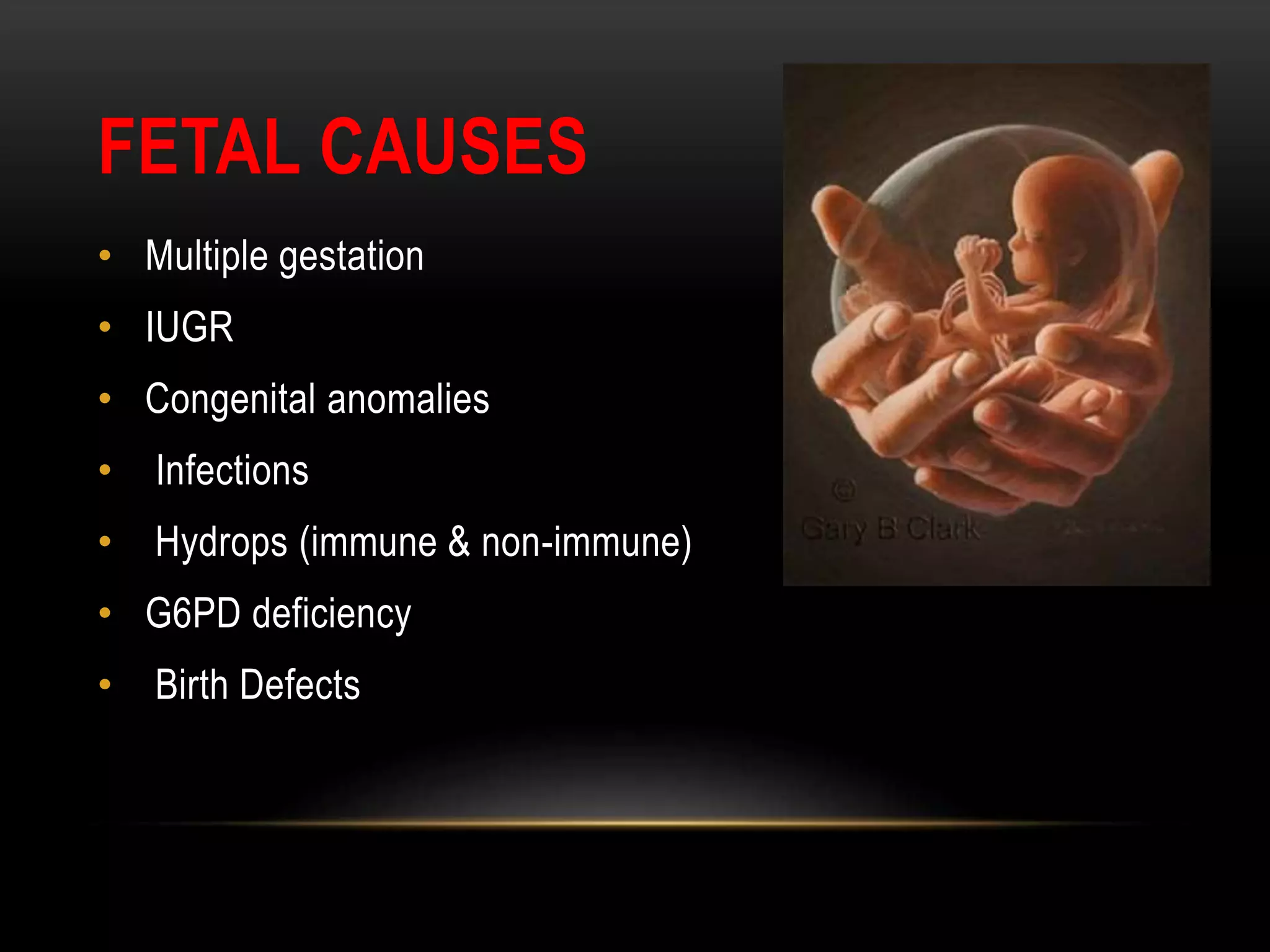
FETAL CAUSES
• Multiple gestation
• IUGR
• Congenital anomalies
• Infections
• Hydrops (immune & non-immune)
• G6PD deficiency
• Birth Defects
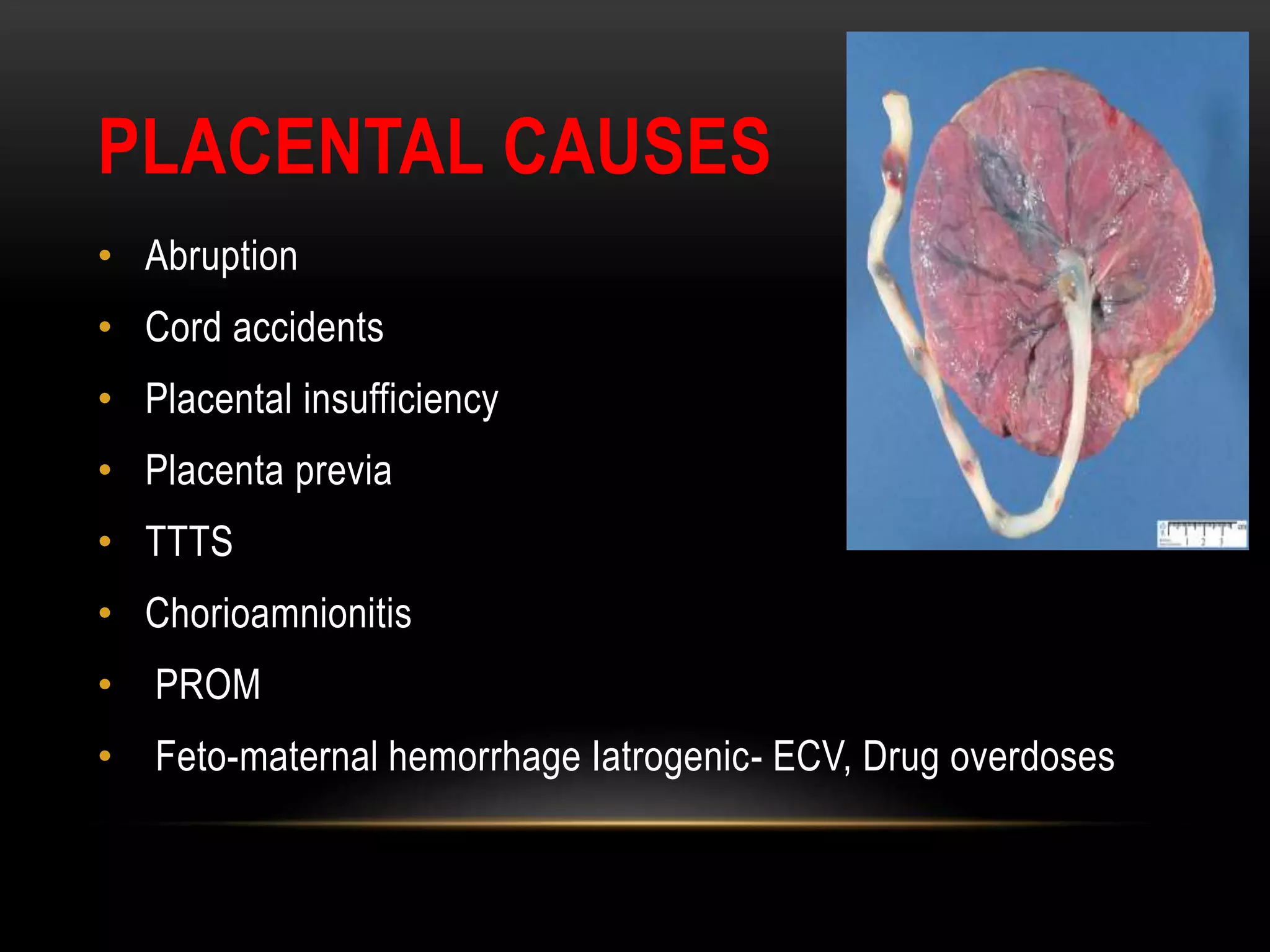
PLACENTAL CAUSES
• Abruption
• Cord accidents
• Placental insufficiency
• Placenta previa
• TTTS
• Chorioamnionitis
• PROM
• Feto-maternal hemorrhage Iatrogenic- ECV, Drug overdoses
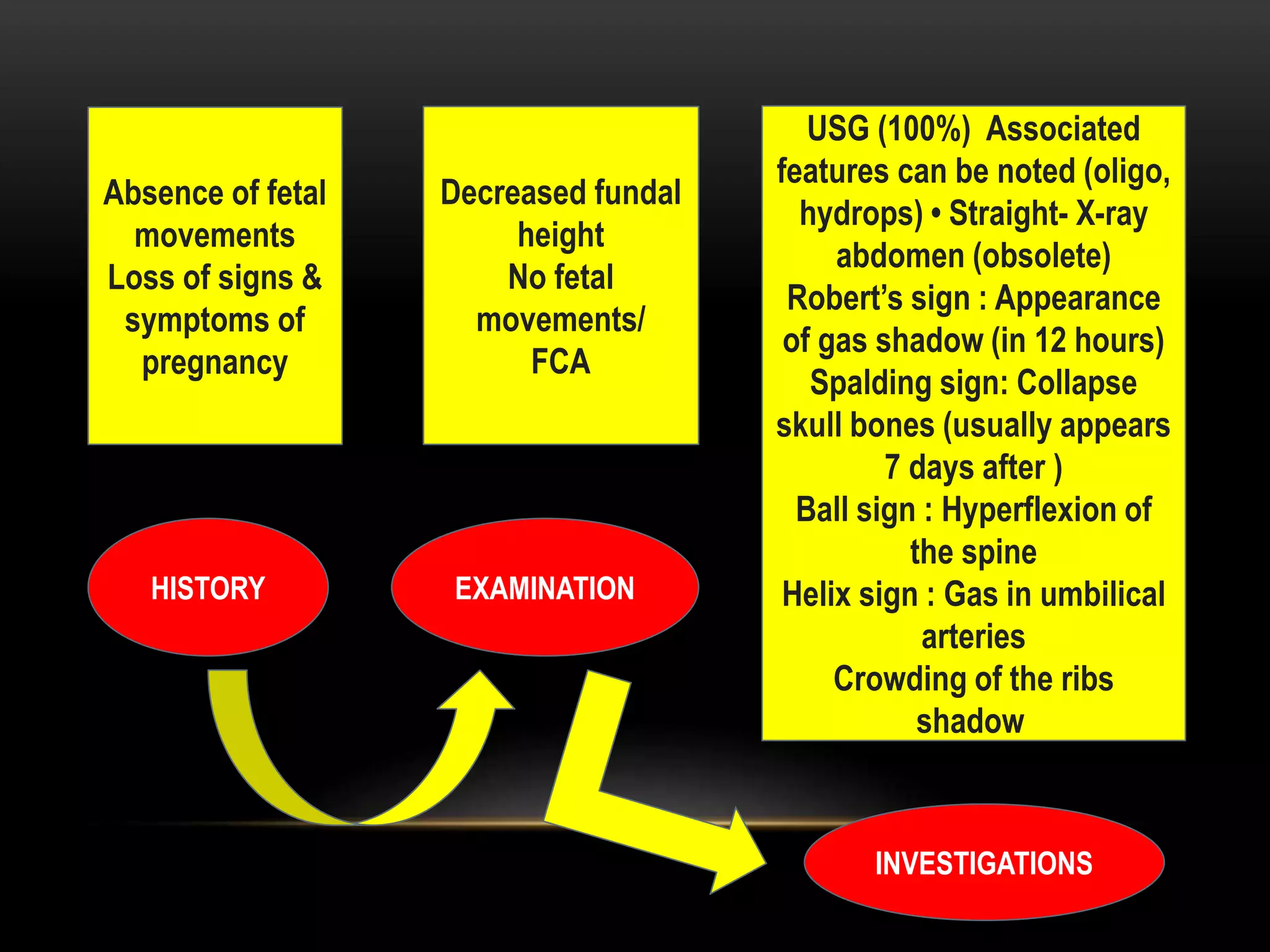
Absence of fetal
movements
Loss of signs &
symptoms of
pregnancy
Decreased fundal
height
No fetal
movements/
FCA
USG (100%) Associated
features can be noted (oligo,
hydrops) • Straight- X-ray
abdomen (obsolete)
Robert’s sign : Appearance
of gas shadow (in 12 hours)
Spalding sign: Collapse
skull bones (usually appears
7 days after )
Ball sign : Hyperflexion of
the spine
Helix sign : Gas in umbilical
arteries
Crowding of the ribs
shadow
HISTORY EXAMINATION
INVESTIGATIONS
DIAGNOSIS
• Real-time ultrasonography is essential for the accurate
diagnosis of IUFD.
• A second opinion should be obtained whenever practically
possible.
• Mothers should be prepared for the possibility of passive fetal
movement. If the mother reports passive fetal movement after
the scan to diagnose IUFD, a repeat scan should be offered.
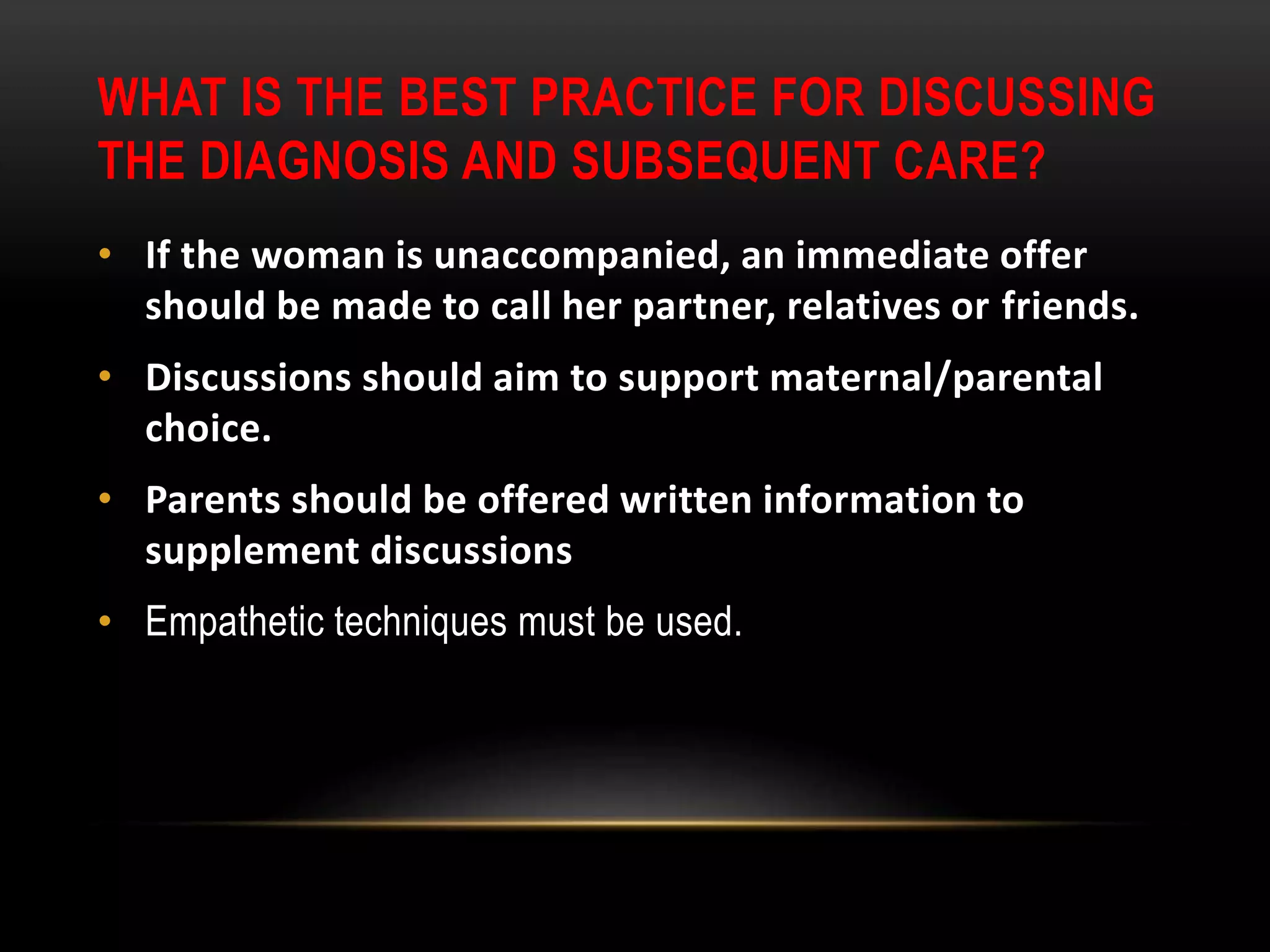
• In addition to the absence of fetal
cardiac activity, other secondary
features might be seen:
• collapse of the fetal skull with
overlapping bones,
• hydrops,
• maceration resulting in
unrecognisable fetal mass.
• Intrafetal gas (within the heart, blood
vessels and joints) is another feature
associated with IUFD that might limit
the quality of real-time images.
WHAT IS THE BEST PRACTICE FOR DISCUSSING
THE DIAGNOSIS AND SUBSEQUENT CARE?
• If the woman is unaccompanied, an immediate offer
should be made to call her partner, relatives or friends.
• Discussions should aim to support maternal/parental
choice.
• Parents should be offered written information to
supplement discussions
• Empathetic techniques must be used.
INVESTIGATION OF THE CAUSE
• Clinical assessment and laboratory tests should be
recommended to assess maternal wellbeing (including
coagulopathy) and to determine the cause of death, the
chance of recurrence and possible means of avoiding
further pregnancy complications.
TESTS RECOMMENDED FOR WOMEN
• CBC, BLOOD GROUPING, BSR
• PLSMA FIBRINOGEN
• COAGULATION PROFILE
• PIH PROFILE
• Kleihauer
• CRP
• Maternal serology
• Maternal bacteriology
• Maternal HbA1c
• Maternal thyroid function
COMPLICATIONS
• PPH
• BLOOD COAGULATION DISORDERS
• PSYCHOLOGICAL UPSET
• INFECTIONS
LABOUR AND BIRTH
• Recommendations about labour and birth should take into
account the mother’s preferences as well as her medical
condition and previous intrapartum history.
• Women should be strongly advised to take immediate steps
towards delivery if there is sepsis, preeclampsia, placental
abruption or membrane rupture, but a more flexible approach
can be discussed if these factors are not present.
• Vaginal birth is the recommended mode of delivery for most
women
• More than 85% of women with an IUFD labour spontaneously
within three weeks of diagnosis
• Vaginal birth can be achieved within 24 hours of induction of
labour for IUFD in about 90% of women
• Caesarean birth might occasionally be clinically indicated by
virtue of maternal condition.
INDUCTION OF LABOUR
• Misoprostol can be used in preference to prostaglandin
E2 because of equivalent safety and efficacy with lower
cost
• Women should be advised that vaginal misoprostol is
as effective as oral therapy but associated with fewer
adverse effects.
• Misoprostol can be safely used for induction of labour
in women with a single previous LSCS and an IUFD but
with lower doses
• Women with more than two LSCS deliveries or atypical
scars should be advised that the safety of induction of
labour is unknown
• Mechanical methods of induction might increase the
risk of ascending infection in the presence of IUFD
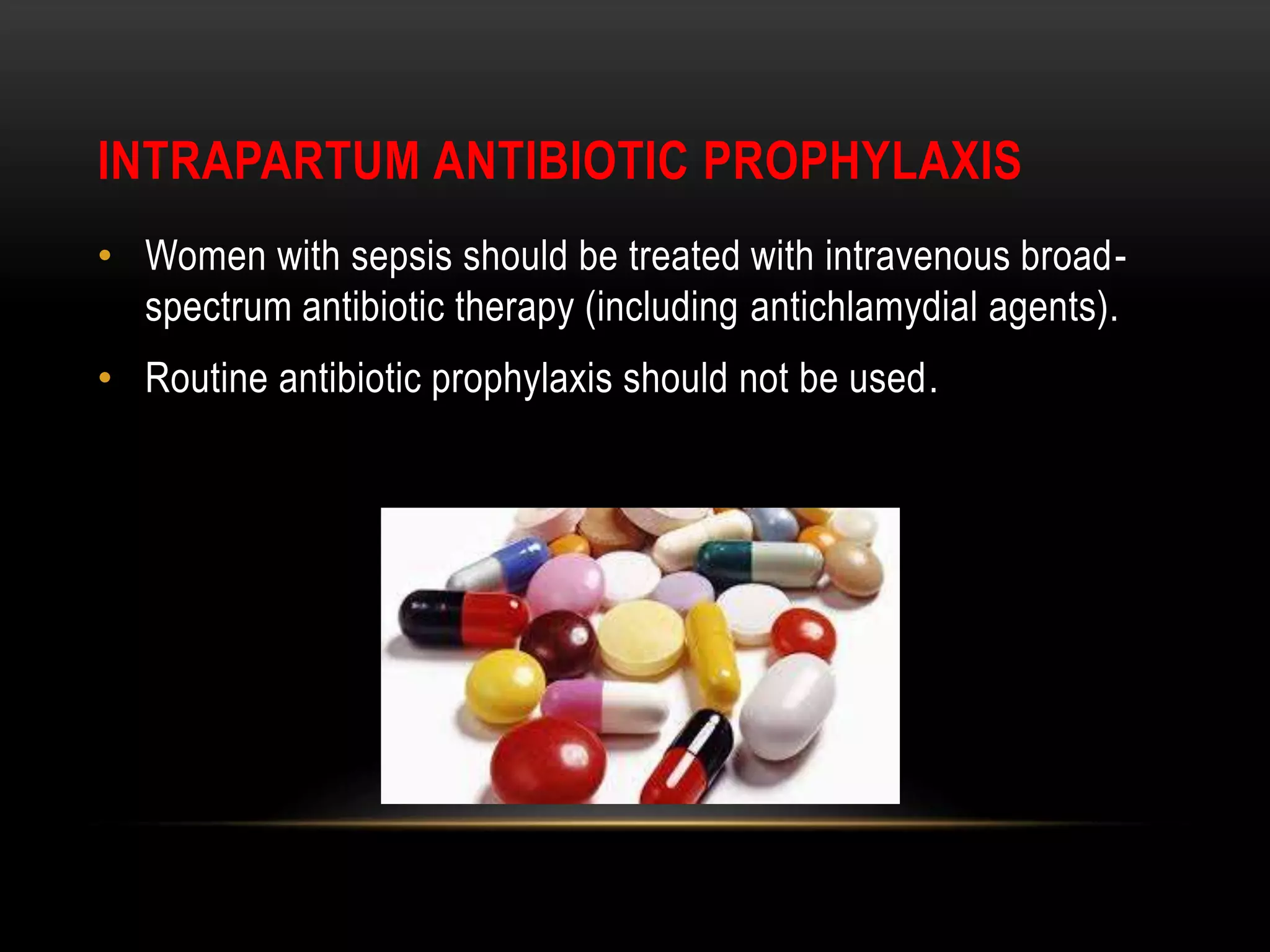
INTRAPARTUM ANTIBIOTIC PROPHYLAXIS
• Women with sepsis should be treated with intravenous broad-
spectrum antibiotic therapy (including antichlamydial agents).
• Routine antibiotic prophylaxis should not be used.
WOMEN LABOURING WITH A SCARRED UTERUS
• Women undergoing VBAC should be closely monitored for
features of scar rupture.
• Oxytocin augmentation can be used for VBAC, but the decision
should be made by a consultant obstetrician.
PUERPERIUM
• Women should be cared for in an environment that provides
adequate safety according to individual clinical circumstance
• Some women have acute medical problems after birth, e.g.
sepsis, pre-eclampsia, etc., with continuing critical care needs.
• Heparin thromboprophylaxis should be discussed with a
haematologist if the woman has DIC.
LACTATION
• Women should be advised that dopamine agonists successfully
suppress lactation in a very high proportion of women and are
well tolerated by a very large majority; cabergoline is superior to
bromocriptine.
• Dopamine agonists should not be given to women with
hypertension or pre-eclampsia.
• Estrogens should not be used to suppress lactation.
POSTMORTEM EXAMINATION
• Parents should be offered full postmortem examination to help
explain the cause of an IUFD.
• Parents should be advised that postmortem examination
provides more information than other (less invasive) tests.
• Attempts to persuade parents to choose postmortem must be
avoided; individual, cultural and religious beliefs must be
respected.
• Written consent must be obtained for any invasive procedure on
the baby including tissues taken for genetic analysis.
• Parents should be offered a description of what happens during
the procedure.
• Postmortem examination should include external examination with birth
weight, histology of relevant tissues and skeletal X-rays.
• Pathological examination of the cord, membranes and placenta should
be recommended whether or not postmortem examination of the baby is
requested. The examination should be undertaken by a specialist
perinatal pathologist.
• Parents who decline full postmortem might be offered a limited
examination (sparing certain organs)
LEGAL ISSUES
• Obstetricians and midwives should be aware of the law related
to stillbirth.
• The following practice guidance is derived from statute and
code of practice.
• Stillbirth must be medically certified by a fully registered doctor
or midwife.
• The doctor or midwife must have been present at the birth or
examined the baby after birth.
• Police should be contacted if there is suspicion of deliberate
action to cause stillbirth.
• The baby can be registered as indeterminate sex awaiting
further tests.
PSYCHOLOGICAL AND SOCIAL ASPECTS OF
CARE (BEREAVEMENT CARE)
• Perinatal death is associated with increased
rates of admission owing to postnatal
depression
• Counselling should be offered to all women and
their partners
• Debriefing services must not care for women
with symptoms of psychiatric disease in
isolation.
• Parents should be advised about support
groups.
• Bereavement officers should be appointed to
coordinate services.
FOLLOW UP
• The wishes of the woman and her partner should be considered
when arranging follow-up
• Women should be offered general prepregnancy advice
• Women should be advised to avoid weight gain
• Parents can be advised that the absolute chance of adverse
events with a pregnancy interval less than 6 months remains
low and is unlikely to be significantly increased compared with
conceiving later.
THANK YOU

Intrauterine death

  • 1.
  • 2.
    DEFINITION • Intrauterine fetaldeath refers to babies with no signs of life in utero after 24 completed weeks of gestation or weighing > 500gm.
  • 3.
  • 4.
    IMPACTS • Emotionally challengingfor: • Doctors • Parents • Increases medicolegal risk • Indicator of country’s health care system
  • 5.
    CAUSES • The RCOGguideline NO. 55 states that parents should be told that no specific cause is found in 50% cases.
  • 6.
    MATERNAL CAUSES(RISK FACTORS) •Obesity (>30kg/m2): proven, modifiable, highest ranking • Maternal (>35yrs)/paternal age • Smoking/Alcohol/Drug abuse • Infections (malaria, hepatitis, influenza, syphilis, Toxoplasma, sepsis) • Medical ds –DM,HT,Thyroid Diseases • Pre-existing diseases (HD, Anaemia, Epilepsy) • Autoimmune Disorders (APS, SLE) • RH incompatibility • Hyperpyrexia • Thrombophilias • Cholestasis of pregnancy • Abruption,PPROM,multifetal gestation • Labour related (preterm, dystocia, uterine rupture)
  • 7.
    FETAL CAUSES • Multiplegestation • IUGR • Congenital anomalies • Infections • Hydrops (immune & non-immune) • G6PD deficiency • Birth Defects
  • 8.
    PLACENTAL CAUSES • Abruption •Cord accidents • Placental insufficiency • Placenta previa • TTTS • Chorioamnionitis • PROM • Feto-maternal hemorrhage Iatrogenic- ECV, Drug overdoses
  • 9.
    Absence of fetal movements Lossof signs & symptoms of pregnancy Decreased fundal height No fetal movements/ FCA USG (100%) Associated features can be noted (oligo, hydrops) • Straight- X-ray abdomen (obsolete) Robert’s sign : Appearance of gas shadow (in 12 hours) Spalding sign: Collapse skull bones (usually appears 7 days after ) Ball sign : Hyperflexion of the spine Helix sign : Gas in umbilical arteries Crowding of the ribs shadow HISTORY EXAMINATION INVESTIGATIONS
  • 10.
    DIAGNOSIS • Real-time ultrasonographyis essential for the accurate diagnosis of IUFD. • A second opinion should be obtained whenever practically possible. • Mothers should be prepared for the possibility of passive fetal movement. If the mother reports passive fetal movement after the scan to diagnose IUFD, a repeat scan should be offered.
  • 11.
    • In additionto the absence of fetal cardiac activity, other secondary features might be seen: • collapse of the fetal skull with overlapping bones, • hydrops, • maceration resulting in unrecognisable fetal mass. • Intrafetal gas (within the heart, blood vessels and joints) is another feature associated with IUFD that might limit the quality of real-time images.
  • 12.
    WHAT IS THEBEST PRACTICE FOR DISCUSSING THE DIAGNOSIS AND SUBSEQUENT CARE? • If the woman is unaccompanied, an immediate offer should be made to call her partner, relatives or friends. • Discussions should aim to support maternal/parental choice. • Parents should be offered written information to supplement discussions • Empathetic techniques must be used.
  • 13.
    INVESTIGATION OF THECAUSE • Clinical assessment and laboratory tests should be recommended to assess maternal wellbeing (including coagulopathy) and to determine the cause of death, the chance of recurrence and possible means of avoiding further pregnancy complications.
  • 14.
    TESTS RECOMMENDED FORWOMEN • CBC, BLOOD GROUPING, BSR • PLSMA FIBRINOGEN • COAGULATION PROFILE • PIH PROFILE • Kleihauer • CRP • Maternal serology • Maternal bacteriology • Maternal HbA1c • Maternal thyroid function
  • 15.
    COMPLICATIONS • PPH • BLOODCOAGULATION DISORDERS • PSYCHOLOGICAL UPSET • INFECTIONS
  • 16.
    LABOUR AND BIRTH •Recommendations about labour and birth should take into account the mother’s preferences as well as her medical condition and previous intrapartum history. • Women should be strongly advised to take immediate steps towards delivery if there is sepsis, preeclampsia, placental abruption or membrane rupture, but a more flexible approach can be discussed if these factors are not present. • Vaginal birth is the recommended mode of delivery for most women
  • 17.
    • More than85% of women with an IUFD labour spontaneously within three weeks of diagnosis • Vaginal birth can be achieved within 24 hours of induction of labour for IUFD in about 90% of women • Caesarean birth might occasionally be clinically indicated by virtue of maternal condition.
  • 18.
    INDUCTION OF LABOUR •Misoprostol can be used in preference to prostaglandin E2 because of equivalent safety and efficacy with lower cost • Women should be advised that vaginal misoprostol is as effective as oral therapy but associated with fewer adverse effects. • Misoprostol can be safely used for induction of labour in women with a single previous LSCS and an IUFD but with lower doses • Women with more than two LSCS deliveries or atypical scars should be advised that the safety of induction of labour is unknown • Mechanical methods of induction might increase the risk of ascending infection in the presence of IUFD
  • 19.
    INTRAPARTUM ANTIBIOTIC PROPHYLAXIS •Women with sepsis should be treated with intravenous broad- spectrum antibiotic therapy (including antichlamydial agents). • Routine antibiotic prophylaxis should not be used.
  • 20.
    WOMEN LABOURING WITHA SCARRED UTERUS • Women undergoing VBAC should be closely monitored for features of scar rupture. • Oxytocin augmentation can be used for VBAC, but the decision should be made by a consultant obstetrician.
  • 21.
    PUERPERIUM • Women shouldbe cared for in an environment that provides adequate safety according to individual clinical circumstance • Some women have acute medical problems after birth, e.g. sepsis, pre-eclampsia, etc., with continuing critical care needs. • Heparin thromboprophylaxis should be discussed with a haematologist if the woman has DIC.
  • 22.
    LACTATION • Women shouldbe advised that dopamine agonists successfully suppress lactation in a very high proportion of women and are well tolerated by a very large majority; cabergoline is superior to bromocriptine. • Dopamine agonists should not be given to women with hypertension or pre-eclampsia. • Estrogens should not be used to suppress lactation.
  • 23.
    POSTMORTEM EXAMINATION • Parentsshould be offered full postmortem examination to help explain the cause of an IUFD. • Parents should be advised that postmortem examination provides more information than other (less invasive) tests. • Attempts to persuade parents to choose postmortem must be avoided; individual, cultural and religious beliefs must be respected. • Written consent must be obtained for any invasive procedure on the baby including tissues taken for genetic analysis. • Parents should be offered a description of what happens during the procedure.
  • 24.
    • Postmortem examinationshould include external examination with birth weight, histology of relevant tissues and skeletal X-rays. • Pathological examination of the cord, membranes and placenta should be recommended whether or not postmortem examination of the baby is requested. The examination should be undertaken by a specialist perinatal pathologist. • Parents who decline full postmortem might be offered a limited examination (sparing certain organs)
  • 25.
    LEGAL ISSUES • Obstetriciansand midwives should be aware of the law related to stillbirth. • The following practice guidance is derived from statute and code of practice. • Stillbirth must be medically certified by a fully registered doctor or midwife. • The doctor or midwife must have been present at the birth or examined the baby after birth. • Police should be contacted if there is suspicion of deliberate action to cause stillbirth. • The baby can be registered as indeterminate sex awaiting further tests.
  • 26.
    PSYCHOLOGICAL AND SOCIALASPECTS OF CARE (BEREAVEMENT CARE) • Perinatal death is associated with increased rates of admission owing to postnatal depression • Counselling should be offered to all women and their partners • Debriefing services must not care for women with symptoms of psychiatric disease in isolation. • Parents should be advised about support groups. • Bereavement officers should be appointed to coordinate services.
  • 27.
    FOLLOW UP • Thewishes of the woman and her partner should be considered when arranging follow-up • Women should be offered general prepregnancy advice • Women should be advised to avoid weight gain • Parents can be advised that the absolute chance of adverse events with a pregnancy interval less than 6 months remains low and is unlikely to be significantly increased compared with conceiving later.
  • 28.