FORCEPS DELIVERY
  – An Overview


             Prof. M.C.Bansal
         MBBS,MS,MICOG,FICOG
             Professor OBGY
          Ex-Principal & Controller
    Jhalawar Medical College & Hospital
  Mahatma Gandhi Medical College, Jaipur.
Introduction
 • In the last several decades, obstetrics, as a science has
   undergone phenomenal development with a proper
   understanding of the entire process of pregnancy & childbirth.
 • The present day labour management is basically influenced
   by two factors:
       – The availability of various modalities of antepartum & postpartum
         foetal monitoring that gives the obstetrician precise knowledge of the
         foetal condition, which enables him not only to terminate the
         pregnancy & labour but also document his decision.
       – The developments in the fields of anaesthesia, antibiotics, blood
         transfusion, surgical aids & techniques have made a once dreaded
         operation - "caesarean section ", very safe to-day.
12 October 2002                  Forceps Delivery - Prof.S.N.Panda            2
Introduction
 • In view of these developments, the expectations of all concerned -
   patient, relatives, attending doctors & authorities including legal system
   has undergone a sea change so that a small mishap will be viewed
   seriously.
 • In such a scenario, the practicing obstetrician of today is likely to have
   reservations about using instrumental labour management methods of
   unpredictable course & outcome. Hence today instrumental deliveries
   are becoming rarer and rarer. In the last two decades, not only very few
   developments have taken place in this field, many of the instrumental
   deliveries have become obsolete.
 • However in the present day concept of active management of labour ,
   forceps still have their own place and should be considered in suitable
   cases, particularly in developing countries like India.
12 October 2002                Forceps Delivery - Prof.S.N.Panda            3
History
• Earliest mention of instrumental delivery in Vedic era -
  "Ankush."
• Albucasis described forceps with teeth on the inner surface for
  dead foetus.
• WILLIAM CHAMBERLAIN –
     – Fled from France in 1569 & practiced forceps delivery as a family
       secret in Southampton. This was kept as a family secret for over
       100yrs and four generations.
     – He had two sons.
           • Peter I - had greater distinction & attended notable women in society. Was
             summoned by R.C.P. & Jailed in 1612. He had no sons.
           • Peter II - who had several sons, died in 1626.


12 October 2002                      Forceps Delivery - Prof.S.N.Panda                4
History
• Dr Peter III- the most prominent one studied in
  Cambridge, Oxford, and Padua. Elected a fellow of
  R.C.P. Died in 1683 in Woodham Mortimer Hall.It is
  believed that the family treasure was kept buried here,
  which was latter unearthed in 1813 by the then
  occupant Mrs.Kembell.
• Hugh- had interest in politics, was forced to flee to
  France, where in 1673 he sold the family secret to
  Mauriceau. After few years he went to Holland & again
  sold the secret (only one blade) to Roser
  Roomhuysen.
12 October 2002        Forceps Delivery - Prof.S.N.Panda   5
History
• Hugh (son of Hugh)-who was highly educated and respected had
  patients from best families including Duke of Buckingham
  allowed the family secret to leak.
• The Chamberlain family used four pairs of forceps of different sizes with
  only cephalic curve.
• Levret (1747)-introduced the pelvic curve
• Smellie (1751)- reinforced pelvic curve & introduced English lock
  and used in aftercoming head.
• Tarnier (1877)-introduced axis traction.
• Barton and Kjielland - introduced the two specialized forceps.
• Since then very few and minor developments have taken place.
  Moreover since the advent of Vacuum extractor, many of the earlier high
  forceps applications have become obsolete.

12 October 2002               Forceps Delivery - Prof.S.N.Panda           6
Classification of forceps
                application
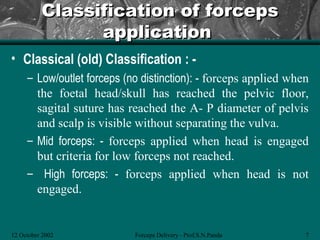
• Classical (old) Classification : -
     – Low/outlet forceps (no distinction): - forceps applied when
       the foetal head/skull has reached the pelvic floor,
       sagital suture has reached the A- P diameter of pelvis
       and scalp is visible without separating the vulva.
     – Mid forceps: - forceps applied when head is engaged
       but criteria for low forceps not reached.
     – High forceps: - forceps applied when head is not
       engaged.


12 October 2002             Forceps Delivery - Prof.S.N.Panda    7
Classification of forceps
                 application
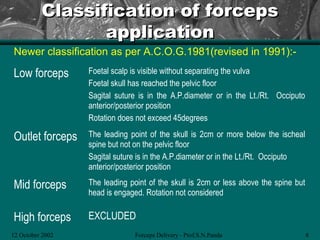
Newer classification as per A.C.O.G.1981(revised in 1991):-

Low forceps       Foetal scalp is visible without separating the vulva
                  Foetal skull has reached the pelvic floor
                  Sagital suture is in the A.P.diameter or in the Lt./Rt. Occiputo
                  anterior/posterior position
                  Rotation does not exceed 45degrees

Outlet forceps    The leading point of the skull is 2cm or more below the ischeal
                  spine but not on the pelvic floor
                  Sagital suture is in the A.P.diameter or in the Lt./Rt. Occiputo
                  anterior/posterior position

Mid forceps       The leading point of the skull is 2cm or less above the spine but
                  head is engaged. Rotation not considered

High forceps      EXCLUDED
12 October 2002                Forceps Delivery - Prof.S.N.Panda                      8
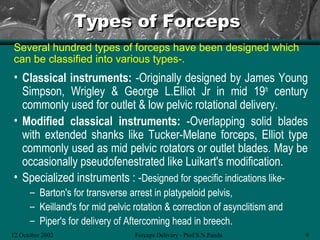
Types of Forceps
Several hundred types of forceps have been designed which
can be classified into various types-.
• Classical instruments: -Originally designed by James Young
  Simpson, Wrigley & George L.Elliot Jr in mid 19th century
  commonly used for outlet & low pelvic rotational delivery.
• Modified classical instruments: -Overlapping solid blades
  with extended shanks like Tucker-Melane forceps, Elliot type
  commonly used as mid pelvic rotators or outlet blades. May be
  occasionally pseudofenestrated like Luikart's modification.
• Specialized instruments : -Designed for specific indications like-
      – Barton's for transverse arrest in platypeloid pelvis,
      – Keilland's for mid pelvic rotation & correction of asynclitism and
      – Piper's for delivery of Aftercoming head in breech.
12 October 2002                   Forceps Delivery - Prof.S.N.Panda          9
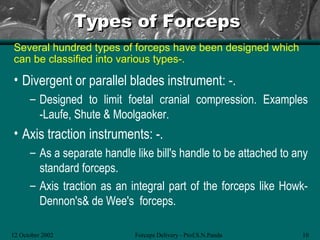
Types of Forceps
Several hundred types of forceps have been designed which
can be classified into various types-.

• Divergent or parallel blades instrument: -.
      – Designed to limit foetal cranial compression. Examples
        -Laufe, Shute & Moolgaoker.
• Axis traction instruments: -.
      – As a separate handle like bill's handle to be attached to any
        standard forceps.
      – Axis traction as an integral part of the forceps like Howk-
        Dennon's& de Wee's forceps.

12 October 2002              Forceps Delivery - Prof.S.N.Panda     10
Functions
• Traction: -This is the most important function. Pull required in a
  primigravida is 18 kgs & in a multipara it is 13 kgs.
• Compression effect: -This is minimal when properly applied & should
  not be more than necessary to grasp the head. However it has some
  pressure effect on the well-ossified base of the skull.
• Rotation of head: -This occurs with the use of Kejilland's forceps and
  also in low forceps cephalic application with the occiput in the 2 or 10 'o'
  clock position.
• Protective cage: - When applied on a premature baby it protects from
  the pressure of the birth canal. When applied on the aftercoming head it
  lessens the sudden decompression effect.
• As a vectis: - By applying one blade to deliver the head in caesarean
  section.
12 October 2002                 Forceps Delivery - Prof.S.N.Panda           11
Indications for forceps
                    delivery
• Delay in second stage: -.
     – Due to uterine inertia.
     – Failure of progress of labour- if no progress occurs for more
       than 20 to 30 minutes, with the head on the perineum.
 Definition of prolonged second stage of labour redefined by A.C.O.G.
 (1988/1991): -
       – Nullipara-
          • <3 hrs with regional anaesthesia
          • <2 hrs without regional anaesthesia
       – Multipara-
          • <2 hrs with regional anaesthesia
          • <1hr without regional anaesthesia

12 October 2002                     Forceps Delivery - Prof.S.N.Panda   12
Indications for forceps
                    delivery
• Foetal indications: -
     – Foetal distress in second stage when prospect of vaginal delivery is
       safe: -
           • Abnormal heart rate pattern
           • Passage of meconium
           • Abnormal scalp blood ph
     – Cord prolapse in second stage
     – Aftercoming head of breech
     – Low birth wt. Baby
     – Post maturity


12 October 2002                        Forceps Delivery - Prof.S.N.Panda      13
Indications for forceps
                    delivery
• Maternal indication: -
     –   Maternal distress
     –   Pre-eclampsia
     –   Post caesarian pregnancy
     –   Heart diseases
     –   Intra partum infection
     –   Neurological disorders where voluntary efforts are
         contraindicated or impossible


12 October 2002               Forceps Delivery - Prof.S.N.Panda   14
Prerequisites
    (to be fulfilled before forceps application.)

• Suitable presentation & position: -.
     – Vertex, anterior face or aftrcoming head are the ideal
       positions.
•   Cervix must be fully dilated.
•   Membranes must be ruptured.
•   Baby should be living.
•   Uterus should be contracting & relaxing.
•   Bladder must be empty.

12 October 2002              Forceps Delivery - Prof.S.N.Panda   15
Preliminaries
                  (before forceps application )
• Documentation: -
     – All instrumental deliveries should be dictated in medical record as any surgical
       procedure & it should include: Consent of the patient, indication for operation,
       anaesthesia, personnel involved, type of instrument, difficulties & remedies,
       resulting maternal & foetal complications or injuries and blood loss.
• Anaesthesia:-
     – Pudendal block or Labio-perineal infiltration for outlet forceps.
     – Regional or General anaesthesia for low & mid forceps.
• Catheterisation:-
• Internal examination: -
     – To asses the state of cervix & membranes, presentation & position, pelvic outlet,
       TDO & sub pubic angle.
• Episiotomy: -
     – Should be done either before application of forceps or during traction when the
       perineum bulges.

12 October 2002                        Forceps Delivery - Prof.S.N.Panda              16
Types of application
                      (of forceps blades )

• Cephalic application -.
     – Blades are applied along the sides of the head, grasping the biparietal
       diameter in between the widest part of the blades and the long axis of
       the blades correspond to the occiputo-mental plane.
• Pelvic application: -.
     – Blades are applied on the lateral pelvic wall ignoring the position of
       the head if the head is not rotated. Serious compression effect on the
       cranium can occur, so it should be avoided.
     – When the head is sufficiently rotated, pelvic & cephalic applications
       naturally coincide and so pelvic application is only justified in low
       forceps operations.


12 October 2002                  Forceps Delivery - Prof.S.N.Panda          17
Technique
          (of low & outlet forceps application )
1. Identification of blades & their application-
      – The instrument should be placed in front of the pelvis
        with the tip pointing upwards and pelvic curve forwards.
        First the left blade should be applied guided by the right
        hand & then the right blade with the left hand.
2. Locking of blades: -
      – The blades should articulate with ease indicting correct
        application.


12 October 2002              Forceps Delivery - Prof.S.N.Panda       18
Technique
          (of low & outlet forceps application )
3. Clinical checks for correct forceps application: -
      – Sagital suture lies in the midline of the shanks.
      – The operator is unable to place more than a fingertip
        between the fenestration of the blade and the foetal head
        on either side.
      – Posterior frontanalle is not more than one finger breadth
        above the plane of the shanks of the forceps.


12 October 2002             Forceps Delivery - Prof.S.N.Panda   19
Technique
          (of low & outlet forceps application )

4. Traction: -
      – Steady & intermittent traction to be applied during
        contraction, first downwards (horizontal), backwards,
        forwards & lastly upwards.
      – In outlet forceps - Only two fingers are to be introduced.
        Traction is applied straight horizontal, upward & then
        forwards.
      – Removal of blades - Right blade should be removed
        first.


12 October 2002              Forceps Delivery - Prof.S.N.Panda       20
Technique
          (of low & outlet forceps application )

5. In Occiputo-posterior position –
      – Blades are to be applied as usual but they should be
        equidistant from sinciput & occiput
      – Traction - Horizontal till the root of the nose is under the
        pubic symphysis, then upward till the occiput emerges
        over the perineum & finally downwards.


12 October 2002               Forceps Delivery - Prof.S.N.Panda        21
Technique
          (of low & outlet forceps application )

6. In face presentation-
      –      Blades are to be introduced along the Occiputo-mental
             diameter.
      –      Traction is applied downwards till the chin appears
             under the symphysis pubis & then upwards delivering
             the nose, eyes, brow & occiput.


12 October 2002                Forceps Delivery - Prof.S.N.Panda     22
Technique
                  (of mid forceps application )
• Forceps used are - long curved with or without axis traction
  device & Keilland’s.
• Indication - following manual rotation in occiputo posterior
  position.
• General anaesthesia is preferable.
• Blades are to be introduced only after manual correction of
  malposition of occiput.
• Traction - same as low forceps without axis traction. With axis
  traction, the traction rods should remain parallel with the
  shanks and should be removed when the base of the occiput
  comes under the symphysis.

12 October 2002             Forceps Delivery - Prof.S.N.Panda       23
Forceps for Aftercoming head

• Piper's forceps are specially designed for this purpose.
• Forceps to be applied when the occiput lies against the
  back of the symphysis
• Blades to be applied from below after raising the legs.
• Traction to be maintained in an arc, which follows the
  axis of the birth canal.


12 October 2002         Forceps Delivery - Prof.S.N.Panda   24
Keilland's forceps application
• Indication: -
     – Can be applied in unrotated vertex / face presentation and
       for correction of asynclitism.
• Application: -
     – Anterior blade is applied first followed by the posterior
       blade.
     – In Wondering method in deep transverse arrest:- The
       anterior blade is applied over the face and then moved over
       to the anterior parietal bone. The posterior blade is applied
       between the head and the sacrum.
     – Blades also can be applied directly over the parietal bones.
12 October 2002              Forceps Delivery - Prof.S.N.Panda      25
Keilland's forceps application
 • Complication: -
       – Disengagement of the head may occur leading to cord prolapse.
 • Scanzoni-Smellie maneuver: -
       – Twice application. First the posterior blade is applied posteriorly over
         the posterior ear and then the anterior blade is applied over the
         anterior ear and head is rotated for 45o towards sacrum or 135 o
         towards symphysis. Then blades are removed and reapplied.
 • Traction is applied as per Pajot's maneuver: -
       – Traction is applied horizontally with the right hand while pressing
         downward with the left hand.
 • General anaesthesia is necessary.
12 October 2002                   Forceps Delivery - Prof.S.N.Panda            26
Complications / Dangers
Complications/dangers of forceps delivery: - are mostly due to faulty
technique rather than the instrument.
  • Maternal-
     – Injury-.
              • Extension of the episiotomy involving anus & rectum or vaginal vault.
              • Vaginal lacerations and cervical tear if cervix was not fully dilated.
        – Post partum haemorrhage –.
              • Due to trauma, Atonic uterus or Anaesthetisia.
        – Shock –.
              • Due to blood loss, dehydration or prolonged labour.
        – Sepsis –.
              • Due to improper asepsis or devitalisation of local tissues.
        – Anaesthetic hazards.
        – Delayed or long-term sequel –.
              • Chronic low backache, genital prolapse & stress incontinence.

12 October 2002                            Forceps Delivery - Prof.S.N.Panda             27
Complications / Dangers
Complications/dangers of forceps delivery: - are mostly due to
faulty technique rather than the instrument.
  • Fetal-
         – Asphyxia.
         – Trauma-
                  •   Intracranial haemorrhage.
                  •   Cephalic haematoma.
                  •   Facial / Brachial palsy.
                  •   Injury to the soft tissues of face & forehead.
                  •   Skull fracture
         – Remote-cerebral palsy.
         – Foetal death-around 2%.

12 October 2002                               Forceps Delivery - Prof.S.N.Panda   28
Prophylactic/Elective forceps
Introduced by Dee Lee (1920), refers to outlet forceps delivery,
only to shorten the second stage of labour to prevent
anticipated maternal or foetal complications in -

       •   Eclampsia
       •   Heart disease
       •   Previous c.s.
       •   Post maturity
       •   Low birth wt babies
       •   During epidural anaesthesia

12 October 2002               Forceps Delivery - Prof.S.N.Panda    29
Trial                                     Failed
       forceps                                    forceps
• Knowing that a certain             • When a vigorous but
  degree of disproportion at           unsuccessful attempt is
  mid pelvis may make the              made with the forceps,
  procedure incompatible,              anticipating a successful
                                       forceps delivery.
  low/mid forceps delivery is
                                     • Mostly it is due to lack of
  attempted, abandoning it at
                                       obstetric skill and poor
  the earliest in favour of            clinical judgment
  Caesarean section.
                                     • Factors responsible are-
• So it should be done only in         Disproportion, Incomplete
  the O.T., keeping everything         cervical dilatation &
  ready for C.S.                       malposition of foetal head
12 October 2002           Forceps Delivery - Prof.S.N.Panda          30
Conclusion

• Considering all aspects, forceps delivery has still got a
  place in modern obstetric practice and should be
  considered in certain cases.
• If performed judiciously by proper selection of cases
  and careful & timely application, forceps delivery can
  be useful in reducing not only unnecessary caesarean
  sections but also foetal & maternal complications due
  to prolonged labour


12 October 2002         Forceps Delivery - Prof.S.N.Panda   31
Towards a safe motherhood


12 October 2002   Forceps Delivery - Prof.S.N.Panda   32

Forceps

  • 1.
    FORCEPS DELIVERY – An Overview Prof. M.C.Bansal MBBS,MS,MICOG,FICOG Professor OBGY Ex-Principal & Controller Jhalawar Medical College & Hospital Mahatma Gandhi Medical College, Jaipur.
  • 2.
    Introduction • Inthe last several decades, obstetrics, as a science has undergone phenomenal development with a proper understanding of the entire process of pregnancy & childbirth. • The present day labour management is basically influenced by two factors: – The availability of various modalities of antepartum & postpartum foetal monitoring that gives the obstetrician precise knowledge of the foetal condition, which enables him not only to terminate the pregnancy & labour but also document his decision. – The developments in the fields of anaesthesia, antibiotics, blood transfusion, surgical aids & techniques have made a once dreaded operation - "caesarean section ", very safe to-day. 12 October 2002 Forceps Delivery - Prof.S.N.Panda 2
  • 3.
    Introduction • Inview of these developments, the expectations of all concerned - patient, relatives, attending doctors & authorities including legal system has undergone a sea change so that a small mishap will be viewed seriously. • In such a scenario, the practicing obstetrician of today is likely to have reservations about using instrumental labour management methods of unpredictable course & outcome. Hence today instrumental deliveries are becoming rarer and rarer. In the last two decades, not only very few developments have taken place in this field, many of the instrumental deliveries have become obsolete. • However in the present day concept of active management of labour , forceps still have their own place and should be considered in suitable cases, particularly in developing countries like India. 12 October 2002 Forceps Delivery - Prof.S.N.Panda 3
  • 4.
    History • Earliest mentionof instrumental delivery in Vedic era - "Ankush." • Albucasis described forceps with teeth on the inner surface for dead foetus. • WILLIAM CHAMBERLAIN – – Fled from France in 1569 & practiced forceps delivery as a family secret in Southampton. This was kept as a family secret for over 100yrs and four generations. – He had two sons. • Peter I - had greater distinction & attended notable women in society. Was summoned by R.C.P. & Jailed in 1612. He had no sons. • Peter II - who had several sons, died in 1626. 12 October 2002 Forceps Delivery - Prof.S.N.Panda 4
  • 5.
    History • Dr PeterIII- the most prominent one studied in Cambridge, Oxford, and Padua. Elected a fellow of R.C.P. Died in 1683 in Woodham Mortimer Hall.It is believed that the family treasure was kept buried here, which was latter unearthed in 1813 by the then occupant Mrs.Kembell. • Hugh- had interest in politics, was forced to flee to France, where in 1673 he sold the family secret to Mauriceau. After few years he went to Holland & again sold the secret (only one blade) to Roser Roomhuysen. 12 October 2002 Forceps Delivery - Prof.S.N.Panda 5
  • 6.
    History • Hugh (sonof Hugh)-who was highly educated and respected had patients from best families including Duke of Buckingham allowed the family secret to leak. • The Chamberlain family used four pairs of forceps of different sizes with only cephalic curve. • Levret (1747)-introduced the pelvic curve • Smellie (1751)- reinforced pelvic curve & introduced English lock and used in aftercoming head. • Tarnier (1877)-introduced axis traction. • Barton and Kjielland - introduced the two specialized forceps. • Since then very few and minor developments have taken place. Moreover since the advent of Vacuum extractor, many of the earlier high forceps applications have become obsolete. 12 October 2002 Forceps Delivery - Prof.S.N.Panda 6
  • 7.
    Classification of forceps application • Classical (old) Classification : - – Low/outlet forceps (no distinction): - forceps applied when the foetal head/skull has reached the pelvic floor, sagital suture has reached the A- P diameter of pelvis and scalp is visible without separating the vulva. – Mid forceps: - forceps applied when head is engaged but criteria for low forceps not reached. – High forceps: - forceps applied when head is not engaged. 12 October 2002 Forceps Delivery - Prof.S.N.Panda 7
  • 8.
    Classification of forceps application Newer classification as per A.C.O.G.1981(revised in 1991):- Low forceps Foetal scalp is visible without separating the vulva Foetal skull has reached the pelvic floor Sagital suture is in the A.P.diameter or in the Lt./Rt. Occiputo anterior/posterior position Rotation does not exceed 45degrees Outlet forceps The leading point of the skull is 2cm or more below the ischeal spine but not on the pelvic floor Sagital suture is in the A.P.diameter or in the Lt./Rt. Occiputo anterior/posterior position Mid forceps The leading point of the skull is 2cm or less above the spine but head is engaged. Rotation not considered High forceps EXCLUDED 12 October 2002 Forceps Delivery - Prof.S.N.Panda 8
  • 9.
    Types of Forceps Severalhundred types of forceps have been designed which can be classified into various types-. • Classical instruments: -Originally designed by James Young Simpson, Wrigley & George L.Elliot Jr in mid 19th century commonly used for outlet & low pelvic rotational delivery. • Modified classical instruments: -Overlapping solid blades with extended shanks like Tucker-Melane forceps, Elliot type commonly used as mid pelvic rotators or outlet blades. May be occasionally pseudofenestrated like Luikart's modification. • Specialized instruments : -Designed for specific indications like- – Barton's for transverse arrest in platypeloid pelvis, – Keilland's for mid pelvic rotation & correction of asynclitism and – Piper's for delivery of Aftercoming head in breech. 12 October 2002 Forceps Delivery - Prof.S.N.Panda 9
  • 10.
    Types of Forceps Severalhundred types of forceps have been designed which can be classified into various types-. • Divergent or parallel blades instrument: -. – Designed to limit foetal cranial compression. Examples -Laufe, Shute & Moolgaoker. • Axis traction instruments: -. – As a separate handle like bill's handle to be attached to any standard forceps. – Axis traction as an integral part of the forceps like Howk- Dennon's& de Wee's forceps. 12 October 2002 Forceps Delivery - Prof.S.N.Panda 10
  • 11.
    Functions • Traction: -Thisis the most important function. Pull required in a primigravida is 18 kgs & in a multipara it is 13 kgs. • Compression effect: -This is minimal when properly applied & should not be more than necessary to grasp the head. However it has some pressure effect on the well-ossified base of the skull. • Rotation of head: -This occurs with the use of Kejilland's forceps and also in low forceps cephalic application with the occiput in the 2 or 10 'o' clock position. • Protective cage: - When applied on a premature baby it protects from the pressure of the birth canal. When applied on the aftercoming head it lessens the sudden decompression effect. • As a vectis: - By applying one blade to deliver the head in caesarean section. 12 October 2002 Forceps Delivery - Prof.S.N.Panda 11
  • 12.
    Indications for forceps delivery • Delay in second stage: -. – Due to uterine inertia. – Failure of progress of labour- if no progress occurs for more than 20 to 30 minutes, with the head on the perineum. Definition of prolonged second stage of labour redefined by A.C.O.G. (1988/1991): - – Nullipara- • <3 hrs with regional anaesthesia • <2 hrs without regional anaesthesia – Multipara- • <2 hrs with regional anaesthesia • <1hr without regional anaesthesia 12 October 2002 Forceps Delivery - Prof.S.N.Panda 12
  • 13.
    Indications for forceps delivery • Foetal indications: - – Foetal distress in second stage when prospect of vaginal delivery is safe: - • Abnormal heart rate pattern • Passage of meconium • Abnormal scalp blood ph – Cord prolapse in second stage – Aftercoming head of breech – Low birth wt. Baby – Post maturity 12 October 2002 Forceps Delivery - Prof.S.N.Panda 13
  • 14.
    Indications for forceps delivery • Maternal indication: - – Maternal distress – Pre-eclampsia – Post caesarian pregnancy – Heart diseases – Intra partum infection – Neurological disorders where voluntary efforts are contraindicated or impossible 12 October 2002 Forceps Delivery - Prof.S.N.Panda 14
  • 15.
    Prerequisites (to be fulfilled before forceps application.) • Suitable presentation & position: -. – Vertex, anterior face or aftrcoming head are the ideal positions. • Cervix must be fully dilated. • Membranes must be ruptured. • Baby should be living. • Uterus should be contracting & relaxing. • Bladder must be empty. 12 October 2002 Forceps Delivery - Prof.S.N.Panda 15
  • 16.
    Preliminaries (before forceps application ) • Documentation: - – All instrumental deliveries should be dictated in medical record as any surgical procedure & it should include: Consent of the patient, indication for operation, anaesthesia, personnel involved, type of instrument, difficulties & remedies, resulting maternal & foetal complications or injuries and blood loss. • Anaesthesia:- – Pudendal block or Labio-perineal infiltration for outlet forceps. – Regional or General anaesthesia for low & mid forceps. • Catheterisation:- • Internal examination: - – To asses the state of cervix & membranes, presentation & position, pelvic outlet, TDO & sub pubic angle. • Episiotomy: - – Should be done either before application of forceps or during traction when the perineum bulges. 12 October 2002 Forceps Delivery - Prof.S.N.Panda 16
  • 17.
    Types of application (of forceps blades ) • Cephalic application -. – Blades are applied along the sides of the head, grasping the biparietal diameter in between the widest part of the blades and the long axis of the blades correspond to the occiputo-mental plane. • Pelvic application: -. – Blades are applied on the lateral pelvic wall ignoring the position of the head if the head is not rotated. Serious compression effect on the cranium can occur, so it should be avoided. – When the head is sufficiently rotated, pelvic & cephalic applications naturally coincide and so pelvic application is only justified in low forceps operations. 12 October 2002 Forceps Delivery - Prof.S.N.Panda 17
  • 18.
    Technique (of low & outlet forceps application ) 1. Identification of blades & their application- – The instrument should be placed in front of the pelvis with the tip pointing upwards and pelvic curve forwards. First the left blade should be applied guided by the right hand & then the right blade with the left hand. 2. Locking of blades: - – The blades should articulate with ease indicting correct application. 12 October 2002 Forceps Delivery - Prof.S.N.Panda 18
  • 19.
    Technique (of low & outlet forceps application ) 3. Clinical checks for correct forceps application: - – Sagital suture lies in the midline of the shanks. – The operator is unable to place more than a fingertip between the fenestration of the blade and the foetal head on either side. – Posterior frontanalle is not more than one finger breadth above the plane of the shanks of the forceps. 12 October 2002 Forceps Delivery - Prof.S.N.Panda 19
  • 20.
    Technique (of low & outlet forceps application ) 4. Traction: - – Steady & intermittent traction to be applied during contraction, first downwards (horizontal), backwards, forwards & lastly upwards. – In outlet forceps - Only two fingers are to be introduced. Traction is applied straight horizontal, upward & then forwards. – Removal of blades - Right blade should be removed first. 12 October 2002 Forceps Delivery - Prof.S.N.Panda 20
  • 21.
    Technique (of low & outlet forceps application ) 5. In Occiputo-posterior position – – Blades are to be applied as usual but they should be equidistant from sinciput & occiput – Traction - Horizontal till the root of the nose is under the pubic symphysis, then upward till the occiput emerges over the perineum & finally downwards. 12 October 2002 Forceps Delivery - Prof.S.N.Panda 21
  • 22.
    Technique (of low & outlet forceps application ) 6. In face presentation- – Blades are to be introduced along the Occiputo-mental diameter. – Traction is applied downwards till the chin appears under the symphysis pubis & then upwards delivering the nose, eyes, brow & occiput. 12 October 2002 Forceps Delivery - Prof.S.N.Panda 22
  • 23.
    Technique (of mid forceps application ) • Forceps used are - long curved with or without axis traction device & Keilland’s. • Indication - following manual rotation in occiputo posterior position. • General anaesthesia is preferable. • Blades are to be introduced only after manual correction of malposition of occiput. • Traction - same as low forceps without axis traction. With axis traction, the traction rods should remain parallel with the shanks and should be removed when the base of the occiput comes under the symphysis. 12 October 2002 Forceps Delivery - Prof.S.N.Panda 23
  • 24.
    Forceps for Aftercominghead • Piper's forceps are specially designed for this purpose. • Forceps to be applied when the occiput lies against the back of the symphysis • Blades to be applied from below after raising the legs. • Traction to be maintained in an arc, which follows the axis of the birth canal. 12 October 2002 Forceps Delivery - Prof.S.N.Panda 24
  • 25.
    Keilland's forceps application •Indication: - – Can be applied in unrotated vertex / face presentation and for correction of asynclitism. • Application: - – Anterior blade is applied first followed by the posterior blade. – In Wondering method in deep transverse arrest:- The anterior blade is applied over the face and then moved over to the anterior parietal bone. The posterior blade is applied between the head and the sacrum. – Blades also can be applied directly over the parietal bones. 12 October 2002 Forceps Delivery - Prof.S.N.Panda 25
  • 26.
    Keilland's forceps application • Complication: - – Disengagement of the head may occur leading to cord prolapse. • Scanzoni-Smellie maneuver: - – Twice application. First the posterior blade is applied posteriorly over the posterior ear and then the anterior blade is applied over the anterior ear and head is rotated for 45o towards sacrum or 135 o towards symphysis. Then blades are removed and reapplied. • Traction is applied as per Pajot's maneuver: - – Traction is applied horizontally with the right hand while pressing downward with the left hand. • General anaesthesia is necessary. 12 October 2002 Forceps Delivery - Prof.S.N.Panda 26
  • 27.
    Complications / Dangers Complications/dangersof forceps delivery: - are mostly due to faulty technique rather than the instrument. • Maternal- – Injury-. • Extension of the episiotomy involving anus & rectum or vaginal vault. • Vaginal lacerations and cervical tear if cervix was not fully dilated. – Post partum haemorrhage –. • Due to trauma, Atonic uterus or Anaesthetisia. – Shock –. • Due to blood loss, dehydration or prolonged labour. – Sepsis –. • Due to improper asepsis or devitalisation of local tissues. – Anaesthetic hazards. – Delayed or long-term sequel –. • Chronic low backache, genital prolapse & stress incontinence. 12 October 2002 Forceps Delivery - Prof.S.N.Panda 27
  • 28.
    Complications / Dangers Complications/dangersof forceps delivery: - are mostly due to faulty technique rather than the instrument. • Fetal- – Asphyxia. – Trauma- • Intracranial haemorrhage. • Cephalic haematoma. • Facial / Brachial palsy. • Injury to the soft tissues of face & forehead. • Skull fracture – Remote-cerebral palsy. – Foetal death-around 2%. 12 October 2002 Forceps Delivery - Prof.S.N.Panda 28
  • 29.
    Prophylactic/Elective forceps Introduced byDee Lee (1920), refers to outlet forceps delivery, only to shorten the second stage of labour to prevent anticipated maternal or foetal complications in - • Eclampsia • Heart disease • Previous c.s. • Post maturity • Low birth wt babies • During epidural anaesthesia 12 October 2002 Forceps Delivery - Prof.S.N.Panda 29
  • 30.
    Trial Failed forceps forceps • Knowing that a certain • When a vigorous but degree of disproportion at unsuccessful attempt is mid pelvis may make the made with the forceps, procedure incompatible, anticipating a successful forceps delivery. low/mid forceps delivery is • Mostly it is due to lack of attempted, abandoning it at obstetric skill and poor the earliest in favour of clinical judgment Caesarean section. • Factors responsible are- • So it should be done only in Disproportion, Incomplete the O.T., keeping everything cervical dilatation & ready for C.S. malposition of foetal head 12 October 2002 Forceps Delivery - Prof.S.N.Panda 30
  • 31.
    Conclusion • Considering allaspects, forceps delivery has still got a place in modern obstetric practice and should be considered in certain cases. • If performed judiciously by proper selection of cases and careful & timely application, forceps delivery can be useful in reducing not only unnecessary caesarean sections but also foetal & maternal complications due to prolonged labour 12 October 2002 Forceps Delivery - Prof.S.N.Panda 31
  • 32.
    Towards a safemotherhood 12 October 2002 Forceps Delivery - Prof.S.N.Panda 32