RETAINED PLACENTA
Dr. Niranjan Chavan
MD, FCPS, DGO, DFP, MICOG, DICOG, FICOG
Professor and Unit Chief, L.T.M.M.C & L.T.M.G.H
Chairperson, FOGSI Oncology and TT Committee (2012-2014)
Treasurer, MOGS (2017- 2018)
Chair and Convener, FOGSI Cell- Violence against Doctors (2015-2016)
Chief Editor, AFG Times (2015-2017)
Editorial Board, European Journal of Gynecologic Oncology
Editor of FOGSI FOCUS, MOGS, AFG & IAGE Newsletters
Member, Managing Committee, IAGE (2013-2017)
Member , Oncology Committee, AOFOG (2013 -2015)
Recipient of 6 National & International Awards
Author of 15 Research Papers and 19 Scientific Chapters
Course Co-Ordinator, of 11 batches, of MUHS recognized Certificate Course of
Basic Infertility Management Including Endoscopy (BIMIE) at LTMGH
DEFINITION
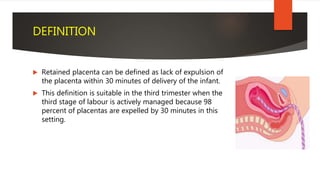
 Retained placenta can be defined as lack of expulsion of
the placenta within 30 minutes of delivery of the infant.
 This definition is suitable in the third trimester when the
third stage of labour is actively managed because 98
percent of placentas are expelled by 30 minutes in this
setting.
Natural history of retained placentas with active and physiological management.*
* The retained placenta. Best Pract Res Clin Obstet Gynaecol 2008; 22:1103.
DEFINITION
 In the second trimester and with physiological
management of the third stage, it takes about
60 minutes before 98 percent of placentas are
expelled.
 In part for these reasons, the World Health
Organization (WHO) concluded that the
length of time before making a diagnosis of
retained placenta should be “left to the
judgement of the clinician”*
* World Health Organization. WHO recommendations for the prevention and treatment
of postpartum hemorrhage. 2012.
Rate of retained placenta by gestational age
*Dombrowski, MP, Bottoms, SF, Saleh, AA, et al. Third stage of labor: analysis of duration and clinical practice. Am J Obstet
Gynecol 1995; 172:1279.
TYPES
 Trapped or incarcerated placenta: separated
placenta but not delivered spontaneously or with
light cord traction because the cervix has begun to
close.
 Placenta adherens: The placenta is adherent to the
uterine wall, but easily separated manually.
 Placenta accreta: The placenta is pathologically
invading the myometrium due to a defect in the
decidua.
PHASES OF 3RD STAGE OF LABOR*
 Latent phase – Immediately after birth, all of the myometrium
contracts except for the portion beneath the placenta.
 Contraction phase – The retroplacental myometrium
contracts.
 Detachment phase – Contraction of the retroplacental
myometrium produces horizontal (shear) stress on the
maternal surface of the placenta, causing it to detach.
 Expulsion phase – Myometrial contractions expel the
detached placenta from the uterus.
*Herman A, Weinraub Z, Bukovsky I, et al. Dynamic ultrasonographic imaging of the third stage of labor: new
perspectives into third-stage mechanisms. Am J Obstet Gynecol 1993; 168:1496.
In 2000, Krapp et al published a paper emphasizing that:
• There is no major difference on sonography between the contraction and
the detachment phase.
• Cessation of blood flow between the basal placenta and myometrium
following delivery of the baby is the sonographic hallmark of normal
placental separation. Persistent blood flow demonstrated by color Doppler
sonography is suggestive of placenta accreta.
PHASES OF 3RD STAGE OF LABOR
 A trapped placenta may be seen as a failure of the
expulsion phase.
 Placenta adherens appears to result from contractile
failure in the retroplacental area (i.e., a prolonged latent
phase of the third stage of labour).
 The pathogenesis of placenta accreta is completely
different, as it is a structural rather than a functional
abnormality.
PREVALANCE
 In a systematic review of observational studies, the
median prevalence of retained placenta at 30 minutes
is between 2.7 - 1.5%. *
 The overall prevalence of retained placenta varies
across settings and over time.
* Cheung WM, Hawkes A, Ibish S, Weeks AD. The retained placenta: historical and geographical rate variations. J Obstet
Gynaecol 2011; 31:37.
RISK FACTORS
In a series of > 91,000 singleton vaginal deliveries ≥ 24 weeks of
gestation, Following risk factors were found:
 Preterm gestational age was the most important risk factor
 Stillbirth
 Maternal age ≥30 years
 Use of ergometrine
 Uterine abnormalities
 Defective placental implantation
 Velamentous cord insertion
 Previous retained placenta
Coviello EM, Grantz KL, Huang CC, et al. Risk factors for retained placenta. Am J Obstet Gynecol 2015; 213:864.e1.
DIAGNOSIS
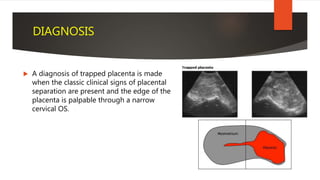
 A diagnosis of trapped placenta is made
when the classic clinical signs of placental
separation are present and the edge of the
placenta is palpable through a narrow
cervical OS.
 A diagnosis of placenta adherens or placenta
accreta is made in the absence of signs and
symptoms of placental separation.
 Ultrasound can differentiate between a detached
trapped placenta and an adherent placenta.
 On USG, the myometrium will be thickened in all
areas except where the placenta is attached,
where it will be very thin or even invisible
DIAGNOSIS
COMPLICATIONS
POST PARTUM
HAEMORRHAGE
ENDOMETRITIS
Case fatality
rate is
around 1 %
WHEN TO INTERVENE?
 Retained placenta with post partum haemorrhage is an
OBSTETRIC EMERGENCY.
 For stable 3rd Trimester Deliveries: expectant management can be
continued till 30 minutes.
 However, for 2nd trimester deliveries, waiting time can be
extended till 60 min in absence of bleeding.
 In a trial including 51 women with retained placenta at 60 minutes
and no pharmacologic intervention, 23 women (45 percent)
eventually expelled the placenta spontaneously, but 24 of the 51
women (47 percent) bled over 1000 mLs and 9 (18 percent) were
transfused.*
*van Stralen G, Veenhof M, Holleboom C, van Roosmalen J. No reduction of manual removal after misoprostol for retained placenta:
a double-blind, randomized trial. Acta Obstet Gynecol Scand 2013; 92:398.
MANAGEMENT
 CONTROLLED CORD TRACTION
 MANUAL REMOVAL OF PLACENTA
 INSTRUMENT EXTRACTION
 MANAGING UNEXPECTED PLACENTA ACCRETA
 PPH MANAGEMENT
 MANAGING THE UNDERLYING CAUSE
PREREQUSITES
 Ensuring that the mother’s bladder is
empty.
 Offering the baby the breast as it releases
oxytocin causing uterus to contract.
 Fundal massage.
MANAGING THE UNDERLYING CAUSE
EXCESSIVE CERVICAL/UTERINE CONTRACTION
 If the lower uterus/cervix is contracted, thereby preventing expulsion of
the placenta, administration of nitroglycerin will result in relaxation and
facilitate placental delivery .
 Glyceryl trinitrate two sprays (400 micrograms/spray) onto or under the
tongue.
 IV sequential bolus : 50 micrograms, maximum cumulative dose 200
micrograms, until sufficient uterine relaxation is achieved
 Sublingual tablets 0.6 to 1.0 milligrams.
 Uterine relaxation occurs within 60 seconds after the dose and lasts for
one to two minutes.
MANAGING THE UNDERLYING CAUSE
ATONY
 IV infusion of oxytocin may facilitate placental delivery in
dose is 10 to 40 units in 500 mL saline.
 Prostaglandin F2-alpha may also be of benefit if bleeding
is severe and not controlled with oxytocin.
 Ergometrine should be avoided, if possible, as it constricts
the cervix, making manual removal very difficult.
UMBILICAL VEIN OXYTOCIN INJECTION
 WHO support that a dose of 10-20 IU of oxytocin can
be administered Intraumbilically.
 It directly reaches the retroplacental myometrium.
 However, the quality of evidence is moderate.
CONTROLLED CORD TRACTION
 Gentle controlled cord traction alone may result in
successful delivery of a trapped or incarcerated
placenta or promote separation of placenta
adherens.
 In a Meta analysis of 5 RCT’s in 2013 , it was found
that Controlled cord traction appears to reduce
the risk of any postpartum hemorrhage and
manual removal of the placenta. *
*Du Y, Ye M, Zheng F. Active management of the third stage of labor with and
without controlled cord traction: a systematic review and meta-analysis of
randomized controlled trials. Acta Obstet Gynecol Scand 2014; 93:626.
BRANDT ANDREW MANEUVER
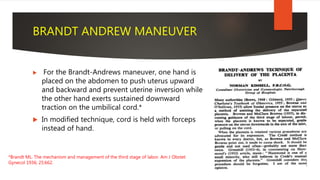
 For the Brandt-Andrews maneuver, one hand is
placed on the abdomen to push uterus upward
and backward and prevent uterine inversion while
the other hand exerts sustained downward
traction on the umbilical cord.*
 In modified technique, cord is held with forceps
instead of hand.
*Brandt ML. The mechanism and management of the third stage of labor. Am J Obstet
Gynecol 1936; 25:662.
MANUAL REMOVAL OF PLACENTA
 MROP is indicated after failed Drug therapy and controlled
cord traction.
Preparations:
• Consent
• Bladder catheterisation
• Anaesthesia
• IV access
• Routine surgical preparation
• IV Antibiotics
• In cases of excessive uterine contraction, Nitroglycerine can be
used
ROLE OF UTERINE CURETTAGE AFTER MROP?
• There is no role for routine uterine curettage after manual extraction. It has no
benefit and carries the risk of uterine perforation and Asherman syndrome. *
• However, if placental tissue is retained and the patient is bleeding excessively, then
curettage using a large blunt placental curette is reasonable to remove the remaining
placental tissue.
*The Retained Placenta. In: Progress in Obstetrics and Gynaecology 16, Studd J (Ed), Churchill Livingstone Elsevier, Edinburgh 2004.
ROLE OF ROUTINE USG AFTER MROP?
• Routine ultrasound evaluation of the uterus after manual extraction is
also unnecessary.*
*Weissbach T, Haikin-Herzberger E, Bacci-Hugger K, et al. Immediate postpartum ultrasound evaluation for suspected
retained placental tissue in patients undergoing manual removal of placenta. Eur J Obstet Gynecol Reprod Biol 2015;
192:37.
INSTRUMENT EXTRACTION
 If digital extraction is not possible, large-headed
forceps (eg, Bierer forceps, Ring forceps) can be used
to grip and extract the placenta in pieces or intact;
ultrasound guidance can be helpful.*
 The procedure requires less analgesia than digital
extraction.
*Rosenstein MG, Vargas JE, Drey EA. Ultrasound-guided instrumental removal of the retained placenta
after vaginal delivery. Am J Obstet Gynecol 2014; 211:180.e1.
INCOMPLETE EXTRACTION
 Even after manual extraction, some bits of placenta
may be left adhered to uterine wall.
 This will not lead to postpartum haemorrhage as long
as the uterus contracts well and there is no area of sub
involution at the site of the retained placental
fragments.
 Curettage should be done only in cases of bleeding, as
the myometrium may be very thin at the point of
adherence, thus increasing the risk of perforation.
UNEXPECTED ACCRETA
 Rarely, a complete placenta accreta is first
recognized at the time of manual removal of the
placenta.
 In these cases, there is no plane of dissection
between the uterus and placenta and, almost
invariably, attempts at manual removal lead to life-
threatening haemorrhage.
 Administration of uterotonic drugs and preparation
for Obstetric hysterectomy.
OBSTETRIC HYSTERECTOMY
 In most cases, it is a last resort lifesaving
procedure, undertaken when other more
conservative method to control haemorrhage
have failed.
 It is definite treatment for placenta accreta.
CONCLUSION
 Retained placenta can be defined as lack of placental expulsion
within 30 minutes of delivery of an infant.
 This time period can be extended to 90 to 120 minutes for
births in the second trimester and third stages of labour
managed without oxytocin.
 The strongest risk factor for retained placenta is gestational age
less than 26 weeks.
 Postpartum haemorrhage is the major complication of retained
placenta.
 Watchful for unexpected Placenta Accreta.
REFERENCES
 Deneux-Tharaux C, Macfarlane A, Winter C, et al. Policies for manual removal of placenta at vaginal delivery: variations in
timing within Europe. BJOG 2009; 116:119.
 World Health Organization. WHO recommendations for the prevention and treatment of postpartum hemorrhage. 2012.
http://www.who.int/reproductivehealth/publications/maternal_perinatal_health/9789241548502/en
 Endler M, Saltvedt S, Papadogiannakis N. Macroscopic and histological characteristics of retained placenta: A prospectively
collected case-control study. Placenta 2016; 41:39.
 Endler M, Saltvedt S, Cnattingius S, et al. Retained placenta is associated with pre-eclampsia, stillbirth, giving birth to a
small-for-gestational-age infant, and spontaneous preterm birth: a national register-based study. BJOG 2014; 121:1462.
 John CO, Orazulike N, Alegbeleye J. AN APPRAISAL OF RETAINED PLACENTA AT THE UNIVERSITY OF PORT HARCOURT
TEACHING HOSPITAL: A FIVE-YEAR REVIEW. Niger J Med 2015; 24:99.
 Ebbing C, Kiserud T, Johnsen SL, et al. Third stage of labor risks in velamentous and marginal cord insertion: a population-
based study. Acta Obstet Gynecol Scand 2015; 94:878.
 Ebbing C, Kiserud T, Johnsen SL, et al. Third stage of labor risks in velamentous and marginal cord insertion: a population-
based study. Acta Obstet Gynecol Scand 2015; 94:878.
Retained placenta

Retained placenta

  • 1.
  • 2.
    Dr. Niranjan Chavan MD,FCPS, DGO, DFP, MICOG, DICOG, FICOG Professor and Unit Chief, L.T.M.M.C & L.T.M.G.H Chairperson, FOGSI Oncology and TT Committee (2012-2014) Treasurer, MOGS (2017- 2018) Chair and Convener, FOGSI Cell- Violence against Doctors (2015-2016) Chief Editor, AFG Times (2015-2017) Editorial Board, European Journal of Gynecologic Oncology Editor of FOGSI FOCUS, MOGS, AFG & IAGE Newsletters Member, Managing Committee, IAGE (2013-2017) Member , Oncology Committee, AOFOG (2013 -2015) Recipient of 6 National & International Awards Author of 15 Research Papers and 19 Scientific Chapters Course Co-Ordinator, of 11 batches, of MUHS recognized Certificate Course of Basic Infertility Management Including Endoscopy (BIMIE) at LTMGH
  • 3.
    DEFINITION  Retained placentacan be defined as lack of expulsion of the placenta within 30 minutes of delivery of the infant.  This definition is suitable in the third trimester when the third stage of labour is actively managed because 98 percent of placentas are expelled by 30 minutes in this setting.
  • 4.
    Natural history ofretained placentas with active and physiological management.* * The retained placenta. Best Pract Res Clin Obstet Gynaecol 2008; 22:1103.
  • 5.
    DEFINITION  In thesecond trimester and with physiological management of the third stage, it takes about 60 minutes before 98 percent of placentas are expelled.  In part for these reasons, the World Health Organization (WHO) concluded that the length of time before making a diagnosis of retained placenta should be “left to the judgement of the clinician”* * World Health Organization. WHO recommendations for the prevention and treatment of postpartum hemorrhage. 2012.
  • 6.
    Rate of retainedplacenta by gestational age *Dombrowski, MP, Bottoms, SF, Saleh, AA, et al. Third stage of labor: analysis of duration and clinical practice. Am J Obstet Gynecol 1995; 172:1279.
  • 7.
    TYPES  Trapped orincarcerated placenta: separated placenta but not delivered spontaneously or with light cord traction because the cervix has begun to close.  Placenta adherens: The placenta is adherent to the uterine wall, but easily separated manually.  Placenta accreta: The placenta is pathologically invading the myometrium due to a defect in the decidua.
  • 8.
    PHASES OF 3RDSTAGE OF LABOR*  Latent phase – Immediately after birth, all of the myometrium contracts except for the portion beneath the placenta.  Contraction phase – The retroplacental myometrium contracts.  Detachment phase – Contraction of the retroplacental myometrium produces horizontal (shear) stress on the maternal surface of the placenta, causing it to detach.  Expulsion phase – Myometrial contractions expel the detached placenta from the uterus. *Herman A, Weinraub Z, Bukovsky I, et al. Dynamic ultrasonographic imaging of the third stage of labor: new perspectives into third-stage mechanisms. Am J Obstet Gynecol 1993; 168:1496.
  • 9.
    In 2000, Krappet al published a paper emphasizing that: • There is no major difference on sonography between the contraction and the detachment phase. • Cessation of blood flow between the basal placenta and myometrium following delivery of the baby is the sonographic hallmark of normal placental separation. Persistent blood flow demonstrated by color Doppler sonography is suggestive of placenta accreta.
  • 10.
    PHASES OF 3RDSTAGE OF LABOR  A trapped placenta may be seen as a failure of the expulsion phase.  Placenta adherens appears to result from contractile failure in the retroplacental area (i.e., a prolonged latent phase of the third stage of labour).  The pathogenesis of placenta accreta is completely different, as it is a structural rather than a functional abnormality.
  • 11.
    PREVALANCE  In asystematic review of observational studies, the median prevalence of retained placenta at 30 minutes is between 2.7 - 1.5%. *  The overall prevalence of retained placenta varies across settings and over time. * Cheung WM, Hawkes A, Ibish S, Weeks AD. The retained placenta: historical and geographical rate variations. J Obstet Gynaecol 2011; 31:37.
  • 12.
    RISK FACTORS In aseries of > 91,000 singleton vaginal deliveries ≥ 24 weeks of gestation, Following risk factors were found:  Preterm gestational age was the most important risk factor  Stillbirth  Maternal age ≥30 years  Use of ergometrine  Uterine abnormalities  Defective placental implantation  Velamentous cord insertion  Previous retained placenta Coviello EM, Grantz KL, Huang CC, et al. Risk factors for retained placenta. Am J Obstet Gynecol 2015; 213:864.e1.
  • 13.
    DIAGNOSIS  A diagnosisof trapped placenta is made when the classic clinical signs of placental separation are present and the edge of the placenta is palpable through a narrow cervical OS.
  • 14.
     A diagnosisof placenta adherens or placenta accreta is made in the absence of signs and symptoms of placental separation.  Ultrasound can differentiate between a detached trapped placenta and an adherent placenta.  On USG, the myometrium will be thickened in all areas except where the placenta is attached, where it will be very thin or even invisible DIAGNOSIS
  • 15.
  • 16.
    WHEN TO INTERVENE? Retained placenta with post partum haemorrhage is an OBSTETRIC EMERGENCY.  For stable 3rd Trimester Deliveries: expectant management can be continued till 30 minutes.  However, for 2nd trimester deliveries, waiting time can be extended till 60 min in absence of bleeding.  In a trial including 51 women with retained placenta at 60 minutes and no pharmacologic intervention, 23 women (45 percent) eventually expelled the placenta spontaneously, but 24 of the 51 women (47 percent) bled over 1000 mLs and 9 (18 percent) were transfused.* *van Stralen G, Veenhof M, Holleboom C, van Roosmalen J. No reduction of manual removal after misoprostol for retained placenta: a double-blind, randomized trial. Acta Obstet Gynecol Scand 2013; 92:398.
  • 17.
    MANAGEMENT  CONTROLLED CORDTRACTION  MANUAL REMOVAL OF PLACENTA  INSTRUMENT EXTRACTION  MANAGING UNEXPECTED PLACENTA ACCRETA  PPH MANAGEMENT  MANAGING THE UNDERLYING CAUSE
  • 18.
    PREREQUSITES  Ensuring thatthe mother’s bladder is empty.  Offering the baby the breast as it releases oxytocin causing uterus to contract.  Fundal massage.
  • 19.
    MANAGING THE UNDERLYINGCAUSE EXCESSIVE CERVICAL/UTERINE CONTRACTION  If the lower uterus/cervix is contracted, thereby preventing expulsion of the placenta, administration of nitroglycerin will result in relaxation and facilitate placental delivery .  Glyceryl trinitrate two sprays (400 micrograms/spray) onto or under the tongue.  IV sequential bolus : 50 micrograms, maximum cumulative dose 200 micrograms, until sufficient uterine relaxation is achieved  Sublingual tablets 0.6 to 1.0 milligrams.  Uterine relaxation occurs within 60 seconds after the dose and lasts for one to two minutes.
  • 20.
    MANAGING THE UNDERLYINGCAUSE ATONY  IV infusion of oxytocin may facilitate placental delivery in dose is 10 to 40 units in 500 mL saline.  Prostaglandin F2-alpha may also be of benefit if bleeding is severe and not controlled with oxytocin.  Ergometrine should be avoided, if possible, as it constricts the cervix, making manual removal very difficult.
  • 21.
    UMBILICAL VEIN OXYTOCININJECTION  WHO support that a dose of 10-20 IU of oxytocin can be administered Intraumbilically.  It directly reaches the retroplacental myometrium.  However, the quality of evidence is moderate.
  • 22.
    CONTROLLED CORD TRACTION Gentle controlled cord traction alone may result in successful delivery of a trapped or incarcerated placenta or promote separation of placenta adherens.  In a Meta analysis of 5 RCT’s in 2013 , it was found that Controlled cord traction appears to reduce the risk of any postpartum hemorrhage and manual removal of the placenta. * *Du Y, Ye M, Zheng F. Active management of the third stage of labor with and without controlled cord traction: a systematic review and meta-analysis of randomized controlled trials. Acta Obstet Gynecol Scand 2014; 93:626.
  • 23.
    BRANDT ANDREW MANEUVER For the Brandt-Andrews maneuver, one hand is placed on the abdomen to push uterus upward and backward and prevent uterine inversion while the other hand exerts sustained downward traction on the umbilical cord.*  In modified technique, cord is held with forceps instead of hand. *Brandt ML. The mechanism and management of the third stage of labor. Am J Obstet Gynecol 1936; 25:662.
  • 24.
    MANUAL REMOVAL OFPLACENTA  MROP is indicated after failed Drug therapy and controlled cord traction. Preparations: • Consent • Bladder catheterisation • Anaesthesia • IV access • Routine surgical preparation • IV Antibiotics • In cases of excessive uterine contraction, Nitroglycerine can be used
  • 26.
    ROLE OF UTERINECURETTAGE AFTER MROP? • There is no role for routine uterine curettage after manual extraction. It has no benefit and carries the risk of uterine perforation and Asherman syndrome. * • However, if placental tissue is retained and the patient is bleeding excessively, then curettage using a large blunt placental curette is reasonable to remove the remaining placental tissue. *The Retained Placenta. In: Progress in Obstetrics and Gynaecology 16, Studd J (Ed), Churchill Livingstone Elsevier, Edinburgh 2004. ROLE OF ROUTINE USG AFTER MROP? • Routine ultrasound evaluation of the uterus after manual extraction is also unnecessary.* *Weissbach T, Haikin-Herzberger E, Bacci-Hugger K, et al. Immediate postpartum ultrasound evaluation for suspected retained placental tissue in patients undergoing manual removal of placenta. Eur J Obstet Gynecol Reprod Biol 2015; 192:37.
  • 27.
    INSTRUMENT EXTRACTION  Ifdigital extraction is not possible, large-headed forceps (eg, Bierer forceps, Ring forceps) can be used to grip and extract the placenta in pieces or intact; ultrasound guidance can be helpful.*  The procedure requires less analgesia than digital extraction. *Rosenstein MG, Vargas JE, Drey EA. Ultrasound-guided instrumental removal of the retained placenta after vaginal delivery. Am J Obstet Gynecol 2014; 211:180.e1.
  • 28.
    INCOMPLETE EXTRACTION  Evenafter manual extraction, some bits of placenta may be left adhered to uterine wall.  This will not lead to postpartum haemorrhage as long as the uterus contracts well and there is no area of sub involution at the site of the retained placental fragments.  Curettage should be done only in cases of bleeding, as the myometrium may be very thin at the point of adherence, thus increasing the risk of perforation.
  • 29.
    UNEXPECTED ACCRETA  Rarely,a complete placenta accreta is first recognized at the time of manual removal of the placenta.  In these cases, there is no plane of dissection between the uterus and placenta and, almost invariably, attempts at manual removal lead to life- threatening haemorrhage.  Administration of uterotonic drugs and preparation for Obstetric hysterectomy.
  • 30.
    OBSTETRIC HYSTERECTOMY  Inmost cases, it is a last resort lifesaving procedure, undertaken when other more conservative method to control haemorrhage have failed.  It is definite treatment for placenta accreta.
  • 31.
    CONCLUSION  Retained placentacan be defined as lack of placental expulsion within 30 minutes of delivery of an infant.  This time period can be extended to 90 to 120 minutes for births in the second trimester and third stages of labour managed without oxytocin.  The strongest risk factor for retained placenta is gestational age less than 26 weeks.  Postpartum haemorrhage is the major complication of retained placenta.  Watchful for unexpected Placenta Accreta.
  • 33.
    REFERENCES  Deneux-Tharaux C,Macfarlane A, Winter C, et al. Policies for manual removal of placenta at vaginal delivery: variations in timing within Europe. BJOG 2009; 116:119.  World Health Organization. WHO recommendations for the prevention and treatment of postpartum hemorrhage. 2012. http://www.who.int/reproductivehealth/publications/maternal_perinatal_health/9789241548502/en  Endler M, Saltvedt S, Papadogiannakis N. Macroscopic and histological characteristics of retained placenta: A prospectively collected case-control study. Placenta 2016; 41:39.  Endler M, Saltvedt S, Cnattingius S, et al. Retained placenta is associated with pre-eclampsia, stillbirth, giving birth to a small-for-gestational-age infant, and spontaneous preterm birth: a national register-based study. BJOG 2014; 121:1462.  John CO, Orazulike N, Alegbeleye J. AN APPRAISAL OF RETAINED PLACENTA AT THE UNIVERSITY OF PORT HARCOURT TEACHING HOSPITAL: A FIVE-YEAR REVIEW. Niger J Med 2015; 24:99.  Ebbing C, Kiserud T, Johnsen SL, et al. Third stage of labor risks in velamentous and marginal cord insertion: a population- based study. Acta Obstet Gynecol Scand 2015; 94:878.  Ebbing C, Kiserud T, Johnsen SL, et al. Third stage of labor risks in velamentous and marginal cord insertion: a population- based study. Acta Obstet Gynecol Scand 2015; 94:878.