Forceps Deliverywww.freelivedoctor.com
Obstetric forcepsDefinition:Obstetric forceps is a double-bladed metal instrument used for extraction of the foetal head.www.freelivedoctor.com
TypesLong curved obstetric forcepsWrigley’s forcepsKielland's forcepsPiper’s forcepsBarton's forcepswww.freelivedoctor.com
Action of the Forceps Traction: is the main action. Rotation: in deep transverse arrest, persistent occipito-posterior and mento-posterior.www.freelivedoctor.com
Indications of Forceps DeliveryProlonged 2nd stageIt is prolongation for more than 1 hour in primigravidae or 30 minutes in multiparae. This may be due to:* Inertia and poor voluntary bearing down.* Large foetus. * Rigid perineum.* Malpositions: persistent occipito-posterior and deep transverse arrest.www.freelivedoctor.com
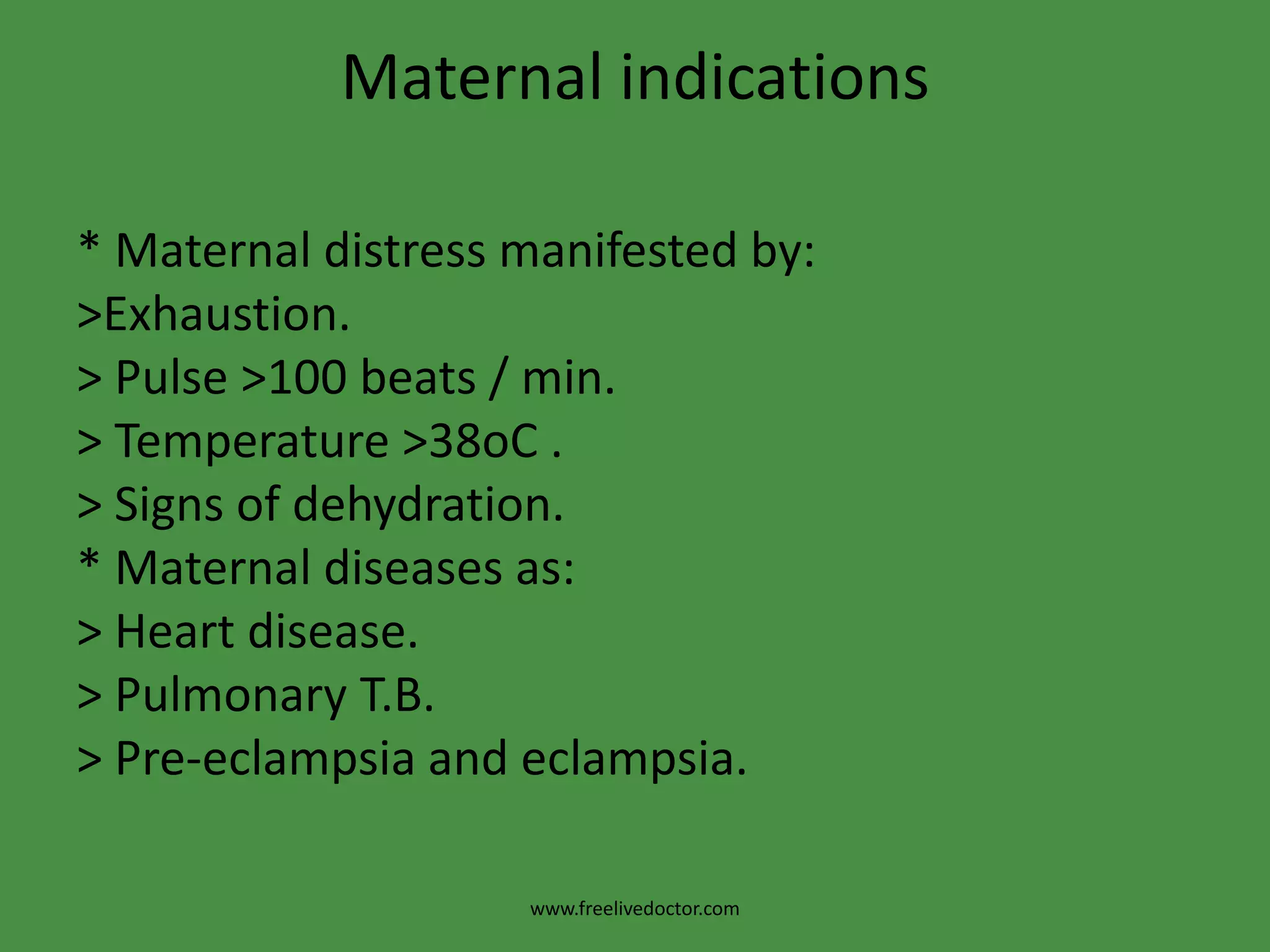
Maternal indications* Maternal distress manifested by:>Exhaustion.> Pulse >100 beats / min.   > Temperature >38oC .> Signs of dehydration.* Maternal diseases as:> Heart disease.        > Pulmonary T.B.          > Pre-eclampsia and eclampsia.www.freelivedoctor.com
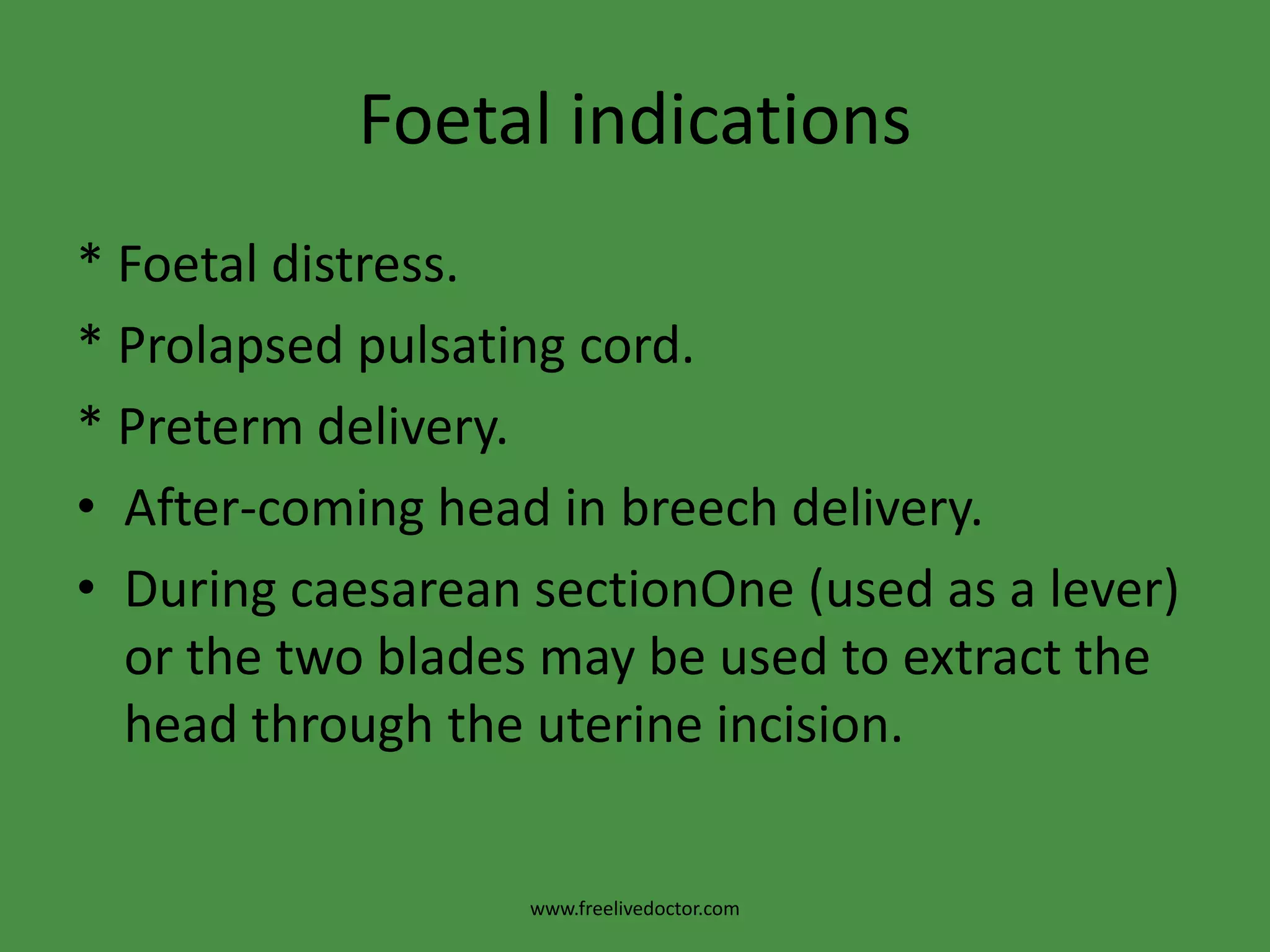
Foetal indications* Foetal distress.* Prolapsed pulsating cord.* Preterm delivery.After-coming head in breech delivery.
During caesarean sectionOne (used as a lever) or the two blades may be used to extract the head through the uterine incision.www.freelivedoctor.com
www.freelivedoctor.com
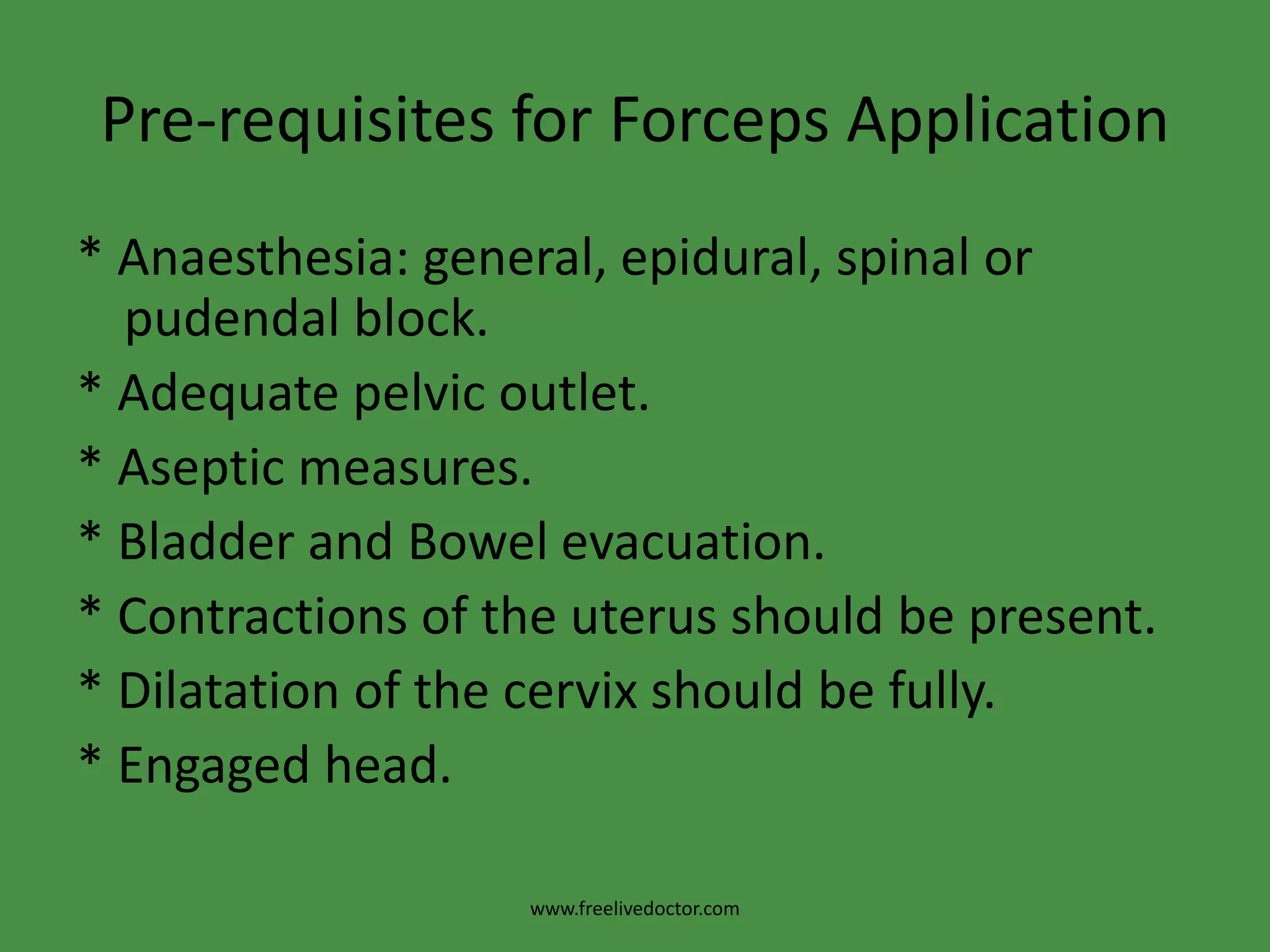
Pre-requisites for Forceps Application* Anaesthesia: general, epidural, spinal or pudendal block.* Adequate pelvic outlet.* Aseptic measures.* Bladder and Bowel evacuation.* Contractions of the uterus should be present.* Dilatation of the cervix should be fully.* Engaged head.www.freelivedoctor.com
Pre-requisites for Forceps Application* Forewater rupture.* Favourable position and presentation:>Occipito-anterior.>Occipito-posterior> Face presentation.>After-coming head in breech.www.freelivedoctor.com
Types of Forceps Application* Cephalic application: the forceps is applied on the sides of the foetal head in the mento-vertical diameter so injury of the foetal face, eyes and facial nerve is avoided .* Pelvic application: The forceps is applied along the maternal pelvic wall irrespective to the position of the head. It is easier for application but carries a great risk of foetal injuries.* Cephalo-pelvic application: It is the ideal application and possible when the occiput is directly anterior or posterior or in direct mento-anterior position.www.freelivedoctor.com
How to know Right and Left BladesPutting in consideration that the mother is in the lithotomy position, the blade will be applied with the pelvic curve directed anteriorly and the cephalic curve directed medially. If the blade will be applied to the left maternal side it is a left blade and vice versa.www.freelivedoctor.com
Technique of Forceps DeliveryIn occipito- anterior position* The left blade is applied first. It is held by its handle between the thumb and fingers of the left hand almost parallel with the right inguinal ligament and passed along the left side of the maternal pelvis between the guiding palm of the right hand and foetal head.* As the blade passes into the birth canal the handle is carried backwards and towards the midline. It is now the lower blade.www.freelivedoctor.com
Technique of Forceps Delivery* The fingers of the left hand are introduced along the right side of the pelvis and the right blade is held and passed in the same manner. It is now the upper blade.* The 2 blades should be locked easily, if not this means that they were not correctly applied and should be removed and re-assess the position of the head.www.freelivedoctor.com
Clinical checks for correct forceps application:* The sagittal suture lies in the midline of the shanks.* The operator cannot place more than a finger tip between the fenestration of the blade and the foetal head.* The posterior fontanelle is not more than one finger- breadth above the plane of the shanks.www.freelivedoctor.com
Traction should be:* gentle by the force of the arm only,* intermittent with uterine contractions only,* in correct direction i.e. downwards and backwards till the occiput appears at the vulva, then downwards and forwards.* The 2 blades are unlocked between contractions to minimise the period of head compression.www.freelivedoctor.com
Kielland forceps in deep transverse arrest The forceps is locked outside with the knobs towards the occiput to know the anterior blade. The anterior blade is applied first by one of the following methods:www.freelivedoctor.com
 The wandering method: The anterior blade is guided into the lateral side of the pelvis with the cephalic curve facing the foetal head. It is then slid over the forehead to fit against the anterior parietal eminence. The direct method: when the head is low down in the pelvis, the anterior blade is slid between the head and symphysis pubis with the cephalic curve facing the foetal head. The old (classical) method: The anterior blade is applied with the cephalic curve towards the symphysis pubis then it is rotated 1800 to fit with the head. This method is not recommended as the lower uterine segment and bladder may be injured.www.freelivedoctor.com
The posterior blade is applied along the concavity of the sacrum. The 2 blades are locked, head is rotated and extracted as occipito-anterior.www.freelivedoctor.com
Complications of Forceps DeliveryMaternal complicationsFoetal complicationswww.freelivedoctor.com
Maternal complicationsComplications of anaesthesia. Lacerations:        > Extension of the episiotomy.        > Perineal tear.        > Vaginal tears.        > Cervical lacerations.         > Bladder injury.        > Ureteric injury.> Rupture uterus.www.freelivedoctor.com
Maternal complications Bone injuries: to pelvic joints, coccyx or symphysis pubis. Pelvic nerve injuries. Postpartum haemorrhage: due to lacerations or atony. Puerperal infections. Remote effects: genital prolapse, stress incontinence, cervical incompetence and genito-urinary fistulas.www.freelivedoctor.com
Foetal complicationsFracture of the skull.Cephalohaematoma.Intracranial haemorrhage.Facial nerve palsy.Trauma to the face, eyes or scalp.Asphyxia due to:> intracranial haemorrhage or,> cord compression between the head and the forceps.www.freelivedoctor.com
FAILED FORCEPSFailure to extract the foetus by the forceps which may be due to failure to apply the forceps or to deliver the head with itwww.freelivedoctor.com
FAILED FORCEPSCauses* Cephalo-pelvic disproportion.* Contracted outlet.     * Incomplete cervical dilatation.* Constriction ring.  * Head is not engaged.* Malpositions as persistent occipito-posterior.*Malpresentations as brow.* Foetal congenital anomalies as hydrocephalus, ascitis and conjoined twins.www.freelivedoctor.com

Forceps delivery

  • 1.
  • 2.
    Obstetric forcepsDefinition:Obstetric forcepsis a double-bladed metal instrument used for extraction of the foetal head.www.freelivedoctor.com
  • 3.
    TypesLong curved obstetricforcepsWrigley’s forcepsKielland's forcepsPiper’s forcepsBarton's forcepswww.freelivedoctor.com
  • 4.
    Action of theForceps Traction: is the main action. Rotation: in deep transverse arrest, persistent occipito-posterior and mento-posterior.www.freelivedoctor.com
  • 5.
    Indications of ForcepsDeliveryProlonged 2nd stageIt is prolongation for more than 1 hour in primigravidae or 30 minutes in multiparae. This may be due to:* Inertia and poor voluntary bearing down.* Large foetus. * Rigid perineum.* Malpositions: persistent occipito-posterior and deep transverse arrest.www.freelivedoctor.com
  • 6.
    Maternal indications* Maternaldistress manifested by:>Exhaustion.> Pulse >100 beats / min. > Temperature >38oC .> Signs of dehydration.* Maternal diseases as:> Heart disease. > Pulmonary T.B. > Pre-eclampsia and eclampsia.www.freelivedoctor.com
  • 7.
    Foetal indications* Foetaldistress.* Prolapsed pulsating cord.* Preterm delivery.After-coming head in breech delivery.
  • 8.
    During caesarean sectionOne(used as a lever) or the two blades may be used to extract the head through the uterine incision.www.freelivedoctor.com
  • 9.
  • 10.
    Pre-requisites for ForcepsApplication* Anaesthesia: general, epidural, spinal or pudendal block.* Adequate pelvic outlet.* Aseptic measures.* Bladder and Bowel evacuation.* Contractions of the uterus should be present.* Dilatation of the cervix should be fully.* Engaged head.www.freelivedoctor.com
  • 11.
    Pre-requisites for ForcepsApplication* Forewater rupture.* Favourable position and presentation:>Occipito-anterior.>Occipito-posterior> Face presentation.>After-coming head in breech.www.freelivedoctor.com
  • 12.
    Types of ForcepsApplication* Cephalic application: the forceps is applied on the sides of the foetal head in the mento-vertical diameter so injury of the foetal face, eyes and facial nerve is avoided .* Pelvic application: The forceps is applied along the maternal pelvic wall irrespective to the position of the head. It is easier for application but carries a great risk of foetal injuries.* Cephalo-pelvic application: It is the ideal application and possible when the occiput is directly anterior or posterior or in direct mento-anterior position.www.freelivedoctor.com
  • 13.
    How to knowRight and Left BladesPutting in consideration that the mother is in the lithotomy position, the blade will be applied with the pelvic curve directed anteriorly and the cephalic curve directed medially. If the blade will be applied to the left maternal side it is a left blade and vice versa.www.freelivedoctor.com
  • 14.
    Technique of ForcepsDeliveryIn occipito- anterior position* The left blade is applied first. It is held by its handle between the thumb and fingers of the left hand almost parallel with the right inguinal ligament and passed along the left side of the maternal pelvis between the guiding palm of the right hand and foetal head.* As the blade passes into the birth canal the handle is carried backwards and towards the midline. It is now the lower blade.www.freelivedoctor.com
  • 15.
    Technique of ForcepsDelivery* The fingers of the left hand are introduced along the right side of the pelvis and the right blade is held and passed in the same manner. It is now the upper blade.* The 2 blades should be locked easily, if not this means that they were not correctly applied and should be removed and re-assess the position of the head.www.freelivedoctor.com
  • 16.
    Clinical checks forcorrect forceps application:* The sagittal suture lies in the midline of the shanks.* The operator cannot place more than a finger tip between the fenestration of the blade and the foetal head.* The posterior fontanelle is not more than one finger- breadth above the plane of the shanks.www.freelivedoctor.com
  • 17.
    Traction should be:*gentle by the force of the arm only,* intermittent with uterine contractions only,* in correct direction i.e. downwards and backwards till the occiput appears at the vulva, then downwards and forwards.* The 2 blades are unlocked between contractions to minimise the period of head compression.www.freelivedoctor.com
  • 18.
    Kielland forceps indeep transverse arrest The forceps is locked outside with the knobs towards the occiput to know the anterior blade. The anterior blade is applied first by one of the following methods:www.freelivedoctor.com
  • 19.
    The wanderingmethod: The anterior blade is guided into the lateral side of the pelvis with the cephalic curve facing the foetal head. It is then slid over the forehead to fit against the anterior parietal eminence. The direct method: when the head is low down in the pelvis, the anterior blade is slid between the head and symphysis pubis with the cephalic curve facing the foetal head. The old (classical) method: The anterior blade is applied with the cephalic curve towards the symphysis pubis then it is rotated 1800 to fit with the head. This method is not recommended as the lower uterine segment and bladder may be injured.www.freelivedoctor.com
  • 20.
    The posterior bladeis applied along the concavity of the sacrum. The 2 blades are locked, head is rotated and extracted as occipito-anterior.www.freelivedoctor.com
  • 21.
    Complications of ForcepsDeliveryMaternal complicationsFoetal complicationswww.freelivedoctor.com
  • 22.
    Maternal complicationsComplications ofanaesthesia. Lacerations: > Extension of the episiotomy. > Perineal tear. > Vaginal tears. > Cervical lacerations. > Bladder injury. > Ureteric injury.> Rupture uterus.www.freelivedoctor.com
  • 23.
    Maternal complications Boneinjuries: to pelvic joints, coccyx or symphysis pubis. Pelvic nerve injuries. Postpartum haemorrhage: due to lacerations or atony. Puerperal infections. Remote effects: genital prolapse, stress incontinence, cervical incompetence and genito-urinary fistulas.www.freelivedoctor.com
  • 24.
    Foetal complicationsFracture ofthe skull.Cephalohaematoma.Intracranial haemorrhage.Facial nerve palsy.Trauma to the face, eyes or scalp.Asphyxia due to:> intracranial haemorrhage or,> cord compression between the head and the forceps.www.freelivedoctor.com
  • 25.
    FAILED FORCEPSFailure toextract the foetus by the forceps which may be due to failure to apply the forceps or to deliver the head with itwww.freelivedoctor.com
  • 26.
    FAILED FORCEPSCauses* Cephalo-pelvicdisproportion.* Contracted outlet. * Incomplete cervical dilatation.* Constriction ring. * Head is not engaged.* Malpositions as persistent occipito-posterior.*Malpresentations as brow.* Foetal congenital anomalies as hydrocephalus, ascitis and conjoined twins.www.freelivedoctor.com
  • 27.
    Management* Reassessment: Theforceps is removed and the patient is re-examined to detect the cause and correct it if possible.* Caesarean section: is indicated in uncorrectable causes as cephalo-pelvic disproportion, and contracted outlet.* Exploration of the birth canal: for any injuries.www.freelivedoctor.com