Introduction
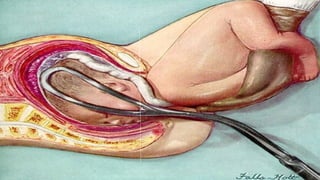
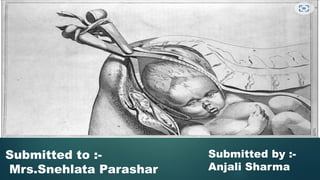
• Forcepsdelivery means using obstetric
forceps [ a pair of instruments designed to
extract fetal skull ] for delivery when the
mother is unable to deliver the baby by her
own effort .
• Forceps delivery is an assissed birth with the
aid of forceps . These are designed to cradle
the baby’s head as traction on handless assists
the baby to born.
description ofthe term ‘ forceps’
• F – favourable head position $ station .
• o – open cervical os [ the cervix must be fully
dilated .
• R – ruptured membranes .
• C - contraction must be present [ the uterus must
be contracting $ relaxing
• E – engaged fetal head .
• P - pelvis should be of appropriate size . [absence
of contracted pelvis $ cephalopelvic
disproportion] .
• S – stirrups [ provided lithotomy position] .
5.
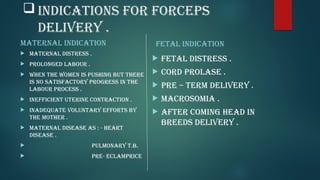
Indications forforceps
delivery .
Maternal indication
Maternal distress .
Prolonged labour .
When the women is pushing but there
is no satisfactory progress in the
labour process .
Inefficient uterine contraction .
Inadequate voluntary efforts by
the mother .
Maternal disease as : - Heart
disease .
pulmonary t.b.
pre- eclamprice
Fetal indication
Fetal distress .
Cord prolase .
Pre – term delivery .
Macrosomia .
After coming head in
breeds delivery .
8.
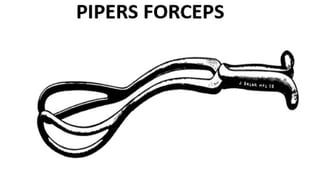
• Varieties ofobstetric forceps
Ever since either peter I or peter 2 of the chamberlen
family invented . The forceps around AD 1600 , more
than 700 varieties were invented and modified . But
only three varieties are commonly used in pregnancy .
Long curved forceps with or without axis traction
device
Short curves forceps [ Wrigley’s outlet forceps ] .
Kielland’s forceps .
The basic construction of there forceps is the
same in that each consist of two halves [ blades]
articulated by a lock .
10.
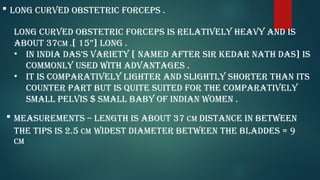
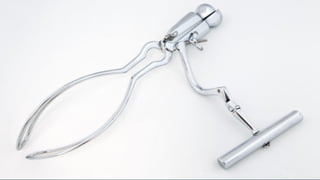
Long curvedobstetric forceps .
Long curved obstetric forceps is relatively heavy and is
about 37cm .[ 15”] long .
• In india das’s variety [ named after sir kedar nath das] is
commonly used with advantages .
• It is comparatively lighter and slightly shorter than its
counter part but Is quite suited for the comparatively
small pelvis $ small baby of Indian women .
Measurements – length is about 37 cm distance in between
the tips is 2.5 cm widest diameter between the bladdes = 9
cm
12.
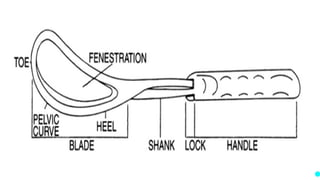
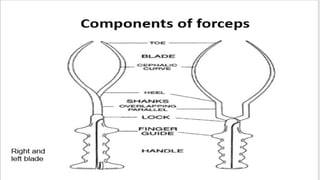
Parts offorceps :
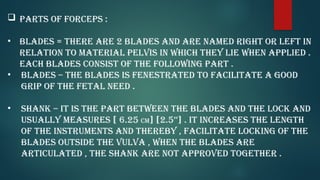
• Blades = there are 2 blades and are named right or left in
relation to material pelvis in which they lie when applied .
Each blades consist of the following part .
• Blades – the blades is fenestrated to facilitate a good
grip of the fetal need .
• Shank – it is the part between the blades and the lock and
usually measures [ 6.25 cm] [2.5’’] . It increases the length
of the instruments and thereby , facilitate locking of the
blades outside the vulva , when the blades are
articulated , the shank are not approved together .
13.
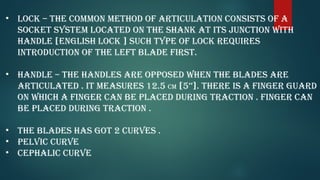
• Lock –the common method of articulation consists of a
socket system located on the shank at its junction with
handle [English lock ] such type of lock requires
introduction of the left blade first.
• Handle – the handles are opposed when the blades are
articulated . It measures 12.5 cm [5’’]. There is a finger guard
on which a finger can be placed during traction . Finger can
be placed during traction .
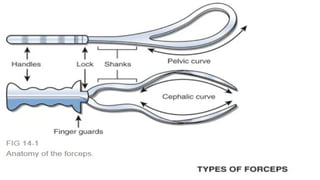
• The blades has got 2 curves .
• Pelvic curve
• Cephalic curve
14.
Pelvic curve– also known as curve of carus .
Application of forceps along the maternal pelvis
axis .
Cephalic curve – it is curve on the flat surface
which articulated graps the fetal head without
compression .
17.
Short curved obstetricforceps [ Wrigley]
The Wrigley obstetrical forceps has an overall length of 28
cm [ 15’’] .
The instrument is short which is due to reduction in the
length of the shank and handle .
Use – Wrigley forceps are used when the head is on the
perineum and only a small amount of traction is necessary
for delivery.
19.
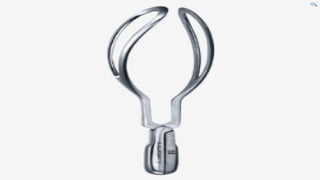
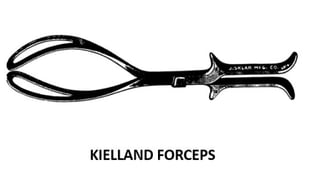
Kielland forceps[rotational forceps]
Kielland ‘s forceps are used to facilitate delivery
from the mid pelvis in cases of malrotation occipito
transverse and occipito positior position of the
fetal head.
21.
types offorceps – based on the fetal hard and
station .
Outlet forceps – outlet forceps are used , when the
baby head can be easily seen at the opening of the
women vagina . But the baby’s head is not emerging
any further . It means outlet forceps are applied
when –
Scalp is visible at the introits without seperating
the labia .
Fetal skull has reached the level of the pelvic
floor .
22.
Fetal headis at or perineum .
Most commonly used outlet forceps are wrigly’s
forceps .
23.
Low forceps
Theseare most commonly used forceps . These forceps
are used when the baby’s head is below station + 2
which is fairly low in vaginal canal . It means leading
point of fetal skull is +2 or more but has met yet
reached the pelvic floor .
Low forceps are usually able to successfully deliver
the baby .
The most commonly used low forceps is simpsons forceps
24.
Mid forceps
Midforceps are used when head is engaged and
presenting part is above +2 station . The commonly used
forceps are :
Neville braves [nb] forceps .
Haig ferguson [hf] forceps .
Rotational forceps
Along with engagement of head of baby other aspect
are considerd while selecting the forceps i.e. when the
baby needs to be turned from posterior position . As a
baby from descending down birth canal .
25.
Potational forceps commonlyused .
The commonly used forceps – kiellanel forceps
High forceps – head is not engaged this type is not
included in classification .
26.
o Pre –requisites .
Written consent .
Cervix fully dilated.
Membranes ruptured.
Engaged head and favourable position.
Adequate pelvic outlet .
Bladdes $ bowel eruptied .
Adequate analgeria .
Traineel operator.
27.
Low forcepsoperations .
Aseptic precusation .
1. Anaesthesia
2. Bladder and bowel evacuation .
3. Vaginal examination – to assess .
---- state of cervix and membranes.
---- head position .
---- assessment of public outlet .
4. episiotomy.
28.
Steps :-
1.identification $ application of blades left / lower
blade introduce first .
2. Locking of blade .
3. Traction .
Direction of pull:-
Downward $ backward – until head come on perineum .
Horizontal $ straight – till head crowned .
Upward and forward – to deliver head .
29.
4. Removal ofblade [ right blade first remove ] .
Mother’s risk :--
1. Injury to the vagina , cervix lower uterine segment $
perineum .
2. Injury to bladder $ urethra.
3. Post partum haemorrhage .
4. Infection.
Baby’s risk :--
1. Intracranial haemorrhage.
2. Skull fracture .
3. Cephalshematane.
4. Birth asphyxia.

![ description of the term ‘ forceps’
• F – favourable head position $ station .
• o – open cervical os [ the cervix must be fully
dilated .
• R – ruptured membranes .
• C - contraction must be present [ the uterus must
be contracting $ relaxing
• E – engaged fetal head .
• P - pelvis should be of appropriate size . [absence
of contracted pelvis $ cephalopelvic
disproportion] .
• S – stirrups [ provided lithotomy position] .](https://image.slidesharecdn.com/anjjjjjjjali-250804145224-0dce74fe/85/FORCEPS-DELIVERY-BSC-NURSING-4-TH-YEAR-4-320.jpg)