BY
Dr.HAFSA
INCIDENCE
 Most common endocrine disorder in pregnancy.
 Effects 1-2% pregnant women.
 Hypothyroidism- 0.05%
 Hyperthyroidism- 0.05-0.2% (Grave’s – 90%)
 Postpartum thyroiditis- 5-10%
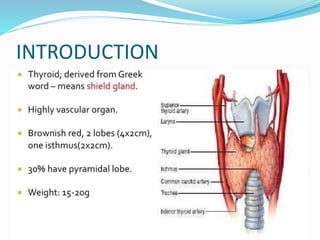
INTRODUCTION
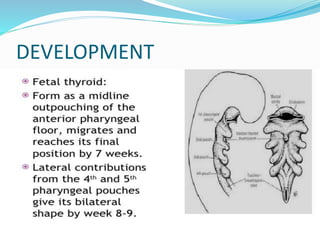
DEVELOPMENT
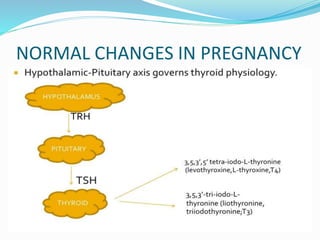
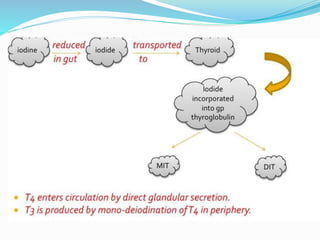
NORMAL CHANGES IN PREGNANCY
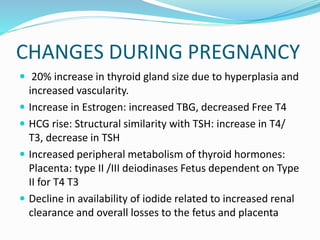
CHANGES DURING PREGNANCY
 20% increase in thyroid gland size due to hyperplasia and
increased vascularity.
 Increase in Estrogen: increased TBG, decreased Free T4
 HCG rise: Structural similarity with TSH: increase in T4/
T3, decrease in TSH
 Increased peripheral metabolism of thyroid hormones:
Placenta: type II /III deiodinases Fetus dependent on Type
II for T4 T3
 Decline in availability of iodide related to increased renal
clearance and overall losses to the fetus and placenta
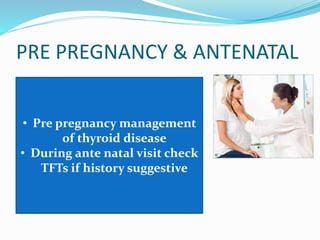
PRE PREGNANCY & ANTENATAL
• Pre pregnancy management
of thyroid disease
• During ante natal visit check
TFTs if history suggestive
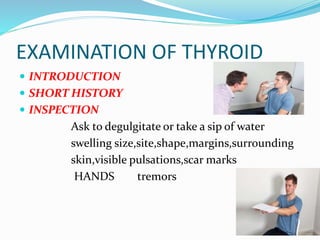
EXAMINATION OF THYROID
 INTRODUCTION
 SHORT HISTORY
 INSPECTION
Ask to degulgitate or take a sip of water
swelling size,site,shape,margins,surrounding
skin,visible pulsations,scar marks
HANDS tremors
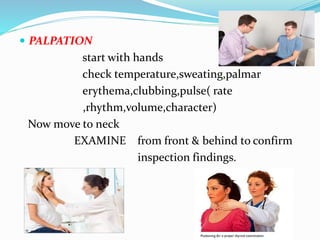
 PALPATION
start with hands
check temperature,sweating,palmar
erythema,clubbing,pulse( rate
,rhythm,volume,character)
Now move to neck
EXAMINE from front & behind to confirm
inspection findings.
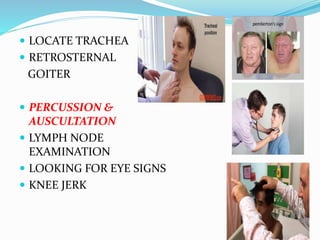
 LOCATE TRACHEA
 RETROSTERNAL
GOITER
 PERCUSSION &
AUSCULTATION
 LYMPH NODE
EXAMINATION
 LOOKING FOR EYE SIGNS
 KNEE JERK
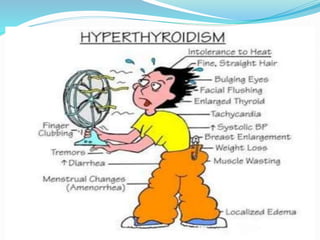
HYPERTHYROIDISM
 0.2% of pregnant women
 95% Grave’s disease
 TFTS:-elevated free T4 T3 levels and depressed TSH
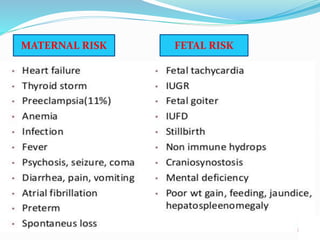
MATERNAL RISK FETAL RISK
MANAGEMENT
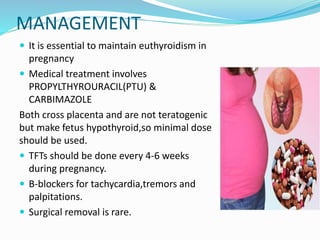
 It is essential to maintain euthyroidism in
pregnancy
 Medical treatment involves
PROPYLTHYROURACIL(PTU) &
CARBIMAZOLE
Both cross placenta and are not teratogenic
but make fetus hypothyroid,so minimal dose
should be used.
 TFTs should be done every 4-6 weeks
during pregnancy.
 B-blockers for tachycardia,tremors and
palpitations.
 Surgical removal is rare.
• The dosage of carbimazole sufficient to control
hyperthyroidism is 15-100 mg daily, administered as divided
doses 3 times daily.
• The appropriate dosage of PTU can range from 300 mg daily to
a maximum dose of 1200 mg daily in divided doses 3 times
daily.
• Once serum thyroid hormone levels return to normal, it is
necessary to decrease the dosage to 5-20 mg daily of
carbimazole or 50-300 mg daily for PTU in divided doses.
• When doses of PTU are > 300 mg/day or > 20
mg/day for carbimazole are taken long term,
fetal goiter and hypothyroidism may result.
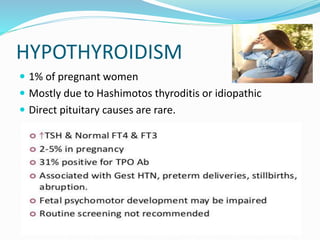
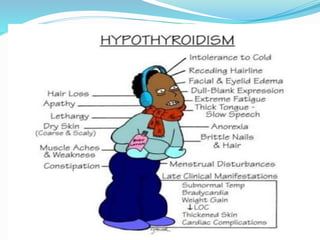
HYPOTHYROIDISM
 1% of pregnant women
 Mostly due to Hashimotos thyroditis or idiopathic
 Direct pituitary causes are rare.
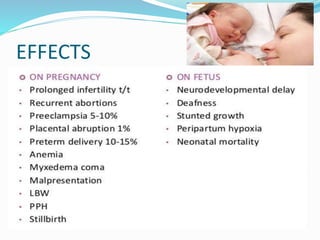
EFFECTS
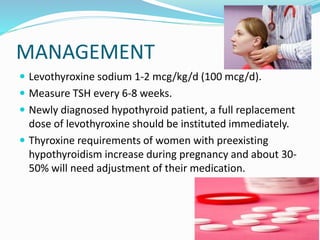
MANAGEMENT
 Levothyroxine sodium 1-2 mcg/kg/d (100 mcg/d).
 Measure TSH every 6-8 weeks.
 Newly diagnosed hypothyroid patient, a full replacement
dose of levothyroxine should be instituted immediately.
 Thyroxine requirements of women with preexisting
hypothyroidism increase during pregnancy and about 30-
50% will need adjustment of their medication.
POSTNATAL MANAGEMENT
 Care of neonate
 Breast feeding
 Watch for signs/symptoms of maternal worsening
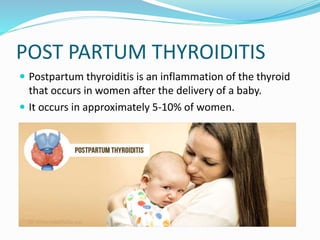
POST PARTUM THYROIDITIS
 Postpartum thyroiditis is an inflammation of the thyroid
that occurs in women after the delivery of a baby.
 It occurs in approximately 5-10% of women.
WHO IS AT RISK FOR DEVELOPING
POSTPARTUM THYROIDITIS?
Any woman with:
• Autoimmune disorders.
• Positive anti-thyroid antibodies
• History of previous thyroid dysfunction
• History of previous postpartum thyroiditis (20% of women
will have recurrence of thyroiditis with subsequent
pregnancies)
• Family history of thyroid dysfunction
HOW IS POSTPARTUM THYROIDITIS
TREATED?
• Treatment depends on the phase of thyroiditis and degree of
symptoms .
• Women presenting with thyrotoxicosis may be treated with
beta blockers to decrease palpitations and tremors.
• Antithyroid medications are not used for the thyrotoxic
phase since the thyroid is not overactive.
• The hypothyroid phase is often treated with thyroid
hormone replacement .If the hypothyroidism is mild, no
therapy.
• If thyroid hormone therapy is begun, treatment should be
continued for approximately 6-12 months and then tapered.
CASE 1
 A 28yr PG presents in antenatal clinic at 11 weeks of gestation
with swelling in front of her neck with no signs/symptoms of
thyroid disease.
Q. HOW WILL YOU MANAGE HER?
Q. WHAT ADVICE YOU WILL GIVE HER?
Q. HOW WILL YOU MANAGE HER?
 Detail history including family history
 Examination of swelling
 Investigations including TFTs
 Obstetric ultrasound
 If pt is euthyroid repeat TFTs 4-6wks after
 If hypo or hyper manage with drugs accordingly
 Strict antenatal visits
Q. WHAT ADVICE YOU WILL GIVE HER?
 Counseling and reassurance
 Proper antenatal visits
 Proper compliance
CASE 2
 A 22 yr old PG presents with hyperemesis gravidarum
and on TFTs increase T4 levels with no signs and
symptoms.
Q.WHAT WILL YOU DO?
Q.HOW WILL YOU MANAGE HER INCREASED T4 LEVELS?
 Q.WHAT WILL YOU DO?
Manage the current symptom of the patient and
reassurance, do obstetrical ultrasound, CBC , SE.
Q.HOW WILL YOU MANAGE HER INCREASED T4
LEVELS?
T4 levels are elevated due to suppression of TSH because
of increased HCG levels.
This usually resolves by 20 weeks of gestation.
Don’t give anti thyroid drugs.
THANK YOU

Thyroid disease in pregnancy

  • 1.
  • 2.
    INCIDENCE  Most commonendocrine disorder in pregnancy.  Effects 1-2% pregnant women.  Hypothyroidism- 0.05%  Hyperthyroidism- 0.05-0.2% (Grave’s – 90%)  Postpartum thyroiditis- 5-10%
  • 3.
  • 4.
  • 5.
  • 7.
    CHANGES DURING PREGNANCY 20% increase in thyroid gland size due to hyperplasia and increased vascularity.  Increase in Estrogen: increased TBG, decreased Free T4  HCG rise: Structural similarity with TSH: increase in T4/ T3, decrease in TSH  Increased peripheral metabolism of thyroid hormones: Placenta: type II /III deiodinases Fetus dependent on Type II for T4 T3  Decline in availability of iodide related to increased renal clearance and overall losses to the fetus and placenta
  • 8.
    PRE PREGNANCY &ANTENATAL • Pre pregnancy management of thyroid disease • During ante natal visit check TFTs if history suggestive
  • 9.
    EXAMINATION OF THYROID INTRODUCTION  SHORT HISTORY  INSPECTION Ask to degulgitate or take a sip of water swelling size,site,shape,margins,surrounding skin,visible pulsations,scar marks HANDS tremors
  • 10.
     PALPATION start withhands check temperature,sweating,palmar erythema,clubbing,pulse( rate ,rhythm,volume,character) Now move to neck EXAMINE from front & behind to confirm inspection findings.
  • 11.
     LOCATE TRACHEA RETROSTERNAL GOITER  PERCUSSION & AUSCULTATION  LYMPH NODE EXAMINATION  LOOKING FOR EYE SIGNS  KNEE JERK
  • 12.
    HYPERTHYROIDISM  0.2% ofpregnant women  95% Grave’s disease  TFTS:-elevated free T4 T3 levels and depressed TSH
  • 14.
  • 16.
    MANAGEMENT  It isessential to maintain euthyroidism in pregnancy  Medical treatment involves PROPYLTHYROURACIL(PTU) & CARBIMAZOLE Both cross placenta and are not teratogenic but make fetus hypothyroid,so minimal dose should be used.  TFTs should be done every 4-6 weeks during pregnancy.  B-blockers for tachycardia,tremors and palpitations.  Surgical removal is rare.
  • 17.
    • The dosageof carbimazole sufficient to control hyperthyroidism is 15-100 mg daily, administered as divided doses 3 times daily. • The appropriate dosage of PTU can range from 300 mg daily to a maximum dose of 1200 mg daily in divided doses 3 times daily. • Once serum thyroid hormone levels return to normal, it is necessary to decrease the dosage to 5-20 mg daily of carbimazole or 50-300 mg daily for PTU in divided doses. • When doses of PTU are > 300 mg/day or > 20 mg/day for carbimazole are taken long term, fetal goiter and hypothyroidism may result.
  • 18.
    HYPOTHYROIDISM  1% ofpregnant women  Mostly due to Hashimotos thyroditis or idiopathic  Direct pituitary causes are rare.
  • 20.
  • 21.
    MANAGEMENT  Levothyroxine sodium1-2 mcg/kg/d (100 mcg/d).  Measure TSH every 6-8 weeks.  Newly diagnosed hypothyroid patient, a full replacement dose of levothyroxine should be instituted immediately.  Thyroxine requirements of women with preexisting hypothyroidism increase during pregnancy and about 30- 50% will need adjustment of their medication.
  • 22.
    POSTNATAL MANAGEMENT  Careof neonate  Breast feeding  Watch for signs/symptoms of maternal worsening
  • 23.
    POST PARTUM THYROIDITIS Postpartum thyroiditis is an inflammation of the thyroid that occurs in women after the delivery of a baby.  It occurs in approximately 5-10% of women.
  • 24.
    WHO IS ATRISK FOR DEVELOPING POSTPARTUM THYROIDITIS? Any woman with: • Autoimmune disorders. • Positive anti-thyroid antibodies • History of previous thyroid dysfunction • History of previous postpartum thyroiditis (20% of women will have recurrence of thyroiditis with subsequent pregnancies) • Family history of thyroid dysfunction
  • 25.
    HOW IS POSTPARTUMTHYROIDITIS TREATED? • Treatment depends on the phase of thyroiditis and degree of symptoms . • Women presenting with thyrotoxicosis may be treated with beta blockers to decrease palpitations and tremors. • Antithyroid medications are not used for the thyrotoxic phase since the thyroid is not overactive. • The hypothyroid phase is often treated with thyroid hormone replacement .If the hypothyroidism is mild, no therapy. • If thyroid hormone therapy is begun, treatment should be continued for approximately 6-12 months and then tapered.
  • 26.
    CASE 1  A28yr PG presents in antenatal clinic at 11 weeks of gestation with swelling in front of her neck with no signs/symptoms of thyroid disease. Q. HOW WILL YOU MANAGE HER? Q. WHAT ADVICE YOU WILL GIVE HER?
  • 27.
    Q. HOW WILLYOU MANAGE HER?  Detail history including family history  Examination of swelling  Investigations including TFTs  Obstetric ultrasound  If pt is euthyroid repeat TFTs 4-6wks after  If hypo or hyper manage with drugs accordingly  Strict antenatal visits Q. WHAT ADVICE YOU WILL GIVE HER?  Counseling and reassurance  Proper antenatal visits  Proper compliance
  • 28.
    CASE 2  A22 yr old PG presents with hyperemesis gravidarum and on TFTs increase T4 levels with no signs and symptoms. Q.WHAT WILL YOU DO? Q.HOW WILL YOU MANAGE HER INCREASED T4 LEVELS?
  • 29.
     Q.WHAT WILLYOU DO? Manage the current symptom of the patient and reassurance, do obstetrical ultrasound, CBC , SE. Q.HOW WILL YOU MANAGE HER INCREASED T4 LEVELS? T4 levels are elevated due to suppression of TSH because of increased HCG levels. This usually resolves by 20 weeks of gestation. Don’t give anti thyroid drugs.
  • 30.