DR.PRIYA SAXENA
 Definition: Defined as the arrest of labor in second stage with the fetal head
descending to the level of ischial spines ( deep into the cavity) and the
sagittal suture in the transverse bispinous diameter. There is no progress in
descent of the head even after an hour following full dilatation of the cervix.
ETIOLOGY
 Distortion of bony pelvis with projecting ischial spines with reduced
bispinous diameter, straight sacrum and convergent pelvic sides like in
android pelvis and funnel-shaped pelvis.
 Persistent fetal head deflexion
 Abnormal uterine action
DIAGNOSIS
 In a known case of occipito-posterior-head not visible at the vulva after 1
hour of 2nd stage uterine contractions
 Abdominal examination- head is deeply engaged
 Vaginal examination-
o saggital suture is felt in the transverse bispinous diameter.
o Head is at or below ischial spines
o Any abnormalities of pelvis may be found on vaginal examination.
MANAGEMENT
 Careful assessment of the general maternal and fetal conditions
 Pelvic assessment is made
 In modern obs- cesarean delivery is the procedure of choice.
 If vaginal delivery is possible, any of the following methods may be
employed:
o Ventouse-ideal in all cases
o Manual rotation followed by mid forcep extraction
o Kielland forcep rotation and delivery
o Craniotomy in dead fetus
MANUAL ROTATION
 DEFINITION:
 Rotation of fetal head from occipito-posterior positions (occipito-
posterior,occipito-sacral and occipito-transverse positions) to occipito-
anterior position by introducing the hand into vagina under general
anesthesia is called manual rotation.
 There are 2 methods:
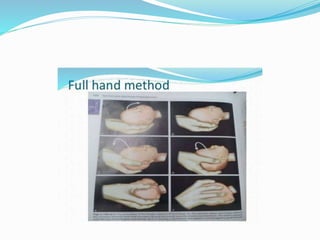
o Whole hand method
o Half hand method
 PREREQUISITES:
 There is sufficient liquor amnii remaining in the uterus
 The fetus is not disproportionately large.
 The size and shape of pelvis are adequate
WHOLE HAND METHOD
 Done by inserting one whole hand in vagina
 Right hand- inserted for ROP
 Left hand- for LOP
 Slight disimpaction of head performed before attempting rotation
o Thumb- placed on the anterior parietal bone near infant temple
o Other 4 fingers- placed over the posterior bone near infant’s other temple.
Head is thus grasped bitemporally.
 Alternatively:
o Thumb- placed on occiput
o 4 fingers- placed on sinciput
o Head is rotated to anterior by supination.
o Other hand of operator give pressure on mother’s flank promoting rotation
of trunk.
o Mid forcep applied, traction to fetal head with mid forcep and head
delivered.
 CAUSES OF FAILURE:
o Failure to employ a good sincipital grip.
o Insufficient deep anesthesia
o Failure to dislodge the head from its impacted position before the manual
rotation.
o Inability to insert the hand deep enough for a firm grip of the head.
o Contracted pelvis.
 DANGERS:
o The chief dangers are accidental slipping of the head above the pelvic brim
and prolapse of the cord.
o It is better to perform cesarean section in such a situation.
HALF HAND METHOD
 Done with only 4 fingers of one hand without inserting thumb in vagina.
o In ROP and Rt occipitotransverse: 4 fingers of right hand are put anterior to
fetal head with pressure given by the ulnar border of right hand
o In LOP and Lt occipitotransverse: fingers are put posterior to fetal head with
pressure given on parietal bone by radial border of the hand.
THANK YOU

Deep transverse arrest

  • 1.
  • 2.
     Definition: Definedas the arrest of labor in second stage with the fetal head descending to the level of ischial spines ( deep into the cavity) and the sagittal suture in the transverse bispinous diameter. There is no progress in descent of the head even after an hour following full dilatation of the cervix.
  • 3.
    ETIOLOGY  Distortion ofbony pelvis with projecting ischial spines with reduced bispinous diameter, straight sacrum and convergent pelvic sides like in android pelvis and funnel-shaped pelvis.  Persistent fetal head deflexion  Abnormal uterine action
  • 4.
    DIAGNOSIS  In aknown case of occipito-posterior-head not visible at the vulva after 1 hour of 2nd stage uterine contractions  Abdominal examination- head is deeply engaged  Vaginal examination- o saggital suture is felt in the transverse bispinous diameter. o Head is at or below ischial spines o Any abnormalities of pelvis may be found on vaginal examination.
  • 5.
    MANAGEMENT  Careful assessmentof the general maternal and fetal conditions  Pelvic assessment is made  In modern obs- cesarean delivery is the procedure of choice.  If vaginal delivery is possible, any of the following methods may be employed: o Ventouse-ideal in all cases o Manual rotation followed by mid forcep extraction o Kielland forcep rotation and delivery o Craniotomy in dead fetus
  • 6.
    MANUAL ROTATION  DEFINITION: Rotation of fetal head from occipito-posterior positions (occipito- posterior,occipito-sacral and occipito-transverse positions) to occipito- anterior position by introducing the hand into vagina under general anesthesia is called manual rotation.  There are 2 methods: o Whole hand method o Half hand method  PREREQUISITES:  There is sufficient liquor amnii remaining in the uterus  The fetus is not disproportionately large.  The size and shape of pelvis are adequate
  • 7.
    WHOLE HAND METHOD Done by inserting one whole hand in vagina  Right hand- inserted for ROP  Left hand- for LOP  Slight disimpaction of head performed before attempting rotation o Thumb- placed on the anterior parietal bone near infant temple o Other 4 fingers- placed over the posterior bone near infant’s other temple. Head is thus grasped bitemporally.  Alternatively: o Thumb- placed on occiput o 4 fingers- placed on sinciput
  • 8.
    o Head isrotated to anterior by supination. o Other hand of operator give pressure on mother’s flank promoting rotation of trunk. o Mid forcep applied, traction to fetal head with mid forcep and head delivered.  CAUSES OF FAILURE: o Failure to employ a good sincipital grip. o Insufficient deep anesthesia o Failure to dislodge the head from its impacted position before the manual rotation. o Inability to insert the hand deep enough for a firm grip of the head. o Contracted pelvis.
  • 9.
     DANGERS: o Thechief dangers are accidental slipping of the head above the pelvic brim and prolapse of the cord. o It is better to perform cesarean section in such a situation.
  • 11.
    HALF HAND METHOD Done with only 4 fingers of one hand without inserting thumb in vagina. o In ROP and Rt occipitotransverse: 4 fingers of right hand are put anterior to fetal head with pressure given by the ulnar border of right hand o In LOP and Lt occipitotransverse: fingers are put posterior to fetal head with pressure given on parietal bone by radial border of the hand.
  • 12.