ION IMPLANTATION
PRESENTED BY:
SWATHI P
1ST YEAR M.TECH- ECE
PONDICHERRY UNIVERSITY
Contents
 Ion implantation
 Impurity distribution of implanted ions
 Stopping power
 Channeling
 Advantages
 Drawbacks
 Applications
ION IMPLANTATION
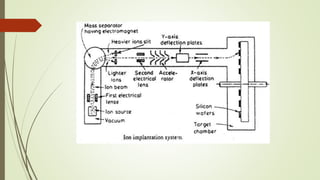
 Ion Implantation is the alternative method of diffusion and it is the
most common method and is usually done at low temperature.
 It is a method to implant impurities on a wafer.
 The impurities used here are in the form of ions.
 These ions are first generated usually by ionization of gaseous
chemical compound.
 From these ions necessary ions are separated by the appropriate
application of magnetic fields.
 This ions are then focused using electric field to form an ion-beam
and then made to target on wafer.
 If energy of ion beam is adequate the ions can penetrate the target
wafer and then collide with Si lattice atom and with surrounding
electrons and eventually comes to rest with in the wafer.
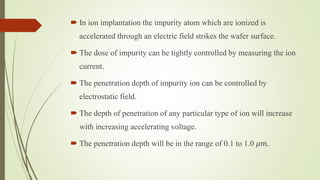
 In ion implantation the impurity atom which are ionized is
accelerated through an electric field strikes the wafer surface.
 The dose of impurity can be tightly controlled by measuring the ion
current.
 The penetration depth of impurity ion can be controlled by
electrostatic field.
 The depth of penetration of any particular type of ion will increase
with increasing accelerating voltage.
 The penetration depth will be in the range of 0.1 to 1.0 𝜇𝑚.
Impurity distribution of implanted ions
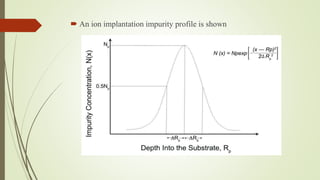
 The distribution of implanted ions as a function of distance x from
the silicon surface will be a Gaussian distribution given by
𝑁 𝑥 = 𝑁𝑝 𝑒𝑥𝑝 [
−(𝑥−𝑅𝑝)²
2∆𝑅𝑝²
]
𝑁𝑝 = Peak concentration of implanted ion
𝑅𝑝 = Projected range
𝑥 = Distance into substrate from surface
∆𝑅𝑝 = standard deviation of projected range
 An ion implantation impurity profile is shown
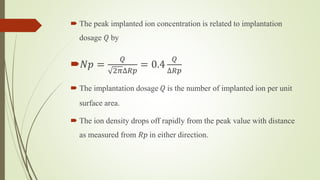
 The peak implanted ion concentration is related to implantation
dosage 𝑄 by
𝑁𝑝 =
𝑄
2𝜋∆𝑅𝑝
= 0.4
𝑄
∆𝑅𝑝
 The implantation dosage 𝑄 is the number of implanted ion per unit
surface area.
 The ion density drops off rapidly from the peak value with distance
as measured from 𝑅𝑝 in either direction.
Stopping power
 When an energetic ion enters a solid, it losses energy.
 The energy loss in the target mainly due to two mechanisms.
Ion-electron interaction [Electronic stopping power]
Ion-nucleus interaction [Nuclear stopping power]
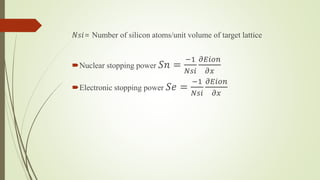
 Let 𝐸𝑖𝑜𝑛 = Energy of bombarding ion
𝑁𝑠𝑖= Number of silicon atoms/unit volume of target lattice
Nuclear stopping power 𝑆𝑛 =
−1
𝑁𝑠𝑖
𝜕𝐸𝑖𝑜𝑛
𝜕𝑥
Electronic stopping power 𝑆𝑒 =
−1
𝑁𝑠𝑖
𝜕𝐸𝑖𝑜𝑛
𝜕𝑥
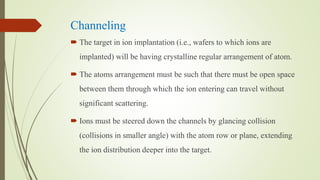
Channeling
 The target in ion implantation (i.e., wafers to which ions are
implanted) will be having crystalline regular arrangement of atom.
 The atoms arrangement must be such that there must be open space
between them through which the ion entering can travel without
significant scattering.
 Ions must be steered down the channels by glancing collision
(collisions in smaller angle) with the atom row or plane, extending
the ion distribution deeper into the target.
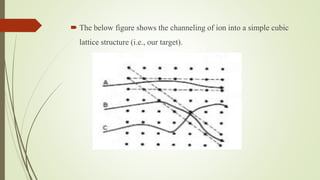
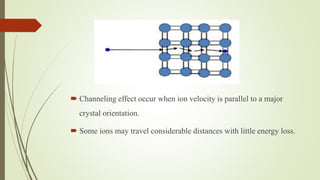
 The below figure shows the channeling of ion into a simple cubic
lattice structure (i.e., our target).
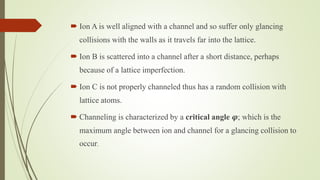
 Ion A is well aligned with a channel and so suffer only glancing
collisions with the walls as it travels far into the lattice.
 Ion B is scattered into a channel after a short distance, perhaps
because of a lattice imperfection.
 Ion C is not properly channeled thus has a random collision with
lattice atoms.
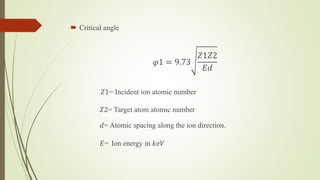
 Channeling is characterized by a critical angle 𝝋; which is the
maximum angle between ion and channel for a glancing collision to
occur.
 Critical angle
𝜑1 = 9.73
𝑍1𝑍2
𝐸𝑑
𝑍1= Incident ion atomic number
𝑍2= Target atom atomic number
𝑑= Atomic spacing along the ion direction.
𝐸= Ion energy in 𝑘𝑒𝑉
 Channeling effect occur when ion velocity is parallel to a major
crystal orientation.
 Some ions may travel considerable distances with little energy loss.
Advantages
 Much more precise control over density of dopants (𝑄) deposited
into wafer.
 Done at relatively low temperature.
 It reduces the threshold voltage of the MOSFET.
 Less sensitive to surface cleaning procedures.
 Complex profile can be achieved by multi-energy implants.
Drawbacks
 Incident ion may damage the semiconductor lattice.
 Very shallow and deep profiles are difficult or impossible.
 Equipment is very expensive.
 At high dose values, throughputs is less than diffusion.
 Masking materials can be “knocked” into the wafer creating
unwanted impurities, or even destroying the quality of the interface.
Applications
 Nitrogen or other ions can be implanted into a tool steel target
(example: drill bits).
 Metal parts on heart valves are ion implanted by carbon to make
them biocompatible.
 Radioisotopes are implanted in prosthesis for localized radiotherapy.
 Ion beam mixing, i.e., mixing up atoms of different elements at an
interface.
Ion implantation

Ion implantation

  • 1.
    ION IMPLANTATION PRESENTED BY: SWATHIP 1ST YEAR M.TECH- ECE PONDICHERRY UNIVERSITY
  • 2.
    Contents  Ion implantation Impurity distribution of implanted ions  Stopping power  Channeling  Advantages  Drawbacks  Applications
  • 3.
    ION IMPLANTATION  IonImplantation is the alternative method of diffusion and it is the most common method and is usually done at low temperature.  It is a method to implant impurities on a wafer.  The impurities used here are in the form of ions.  These ions are first generated usually by ionization of gaseous chemical compound.
  • 4.
     From theseions necessary ions are separated by the appropriate application of magnetic fields.  This ions are then focused using electric field to form an ion-beam and then made to target on wafer.  If energy of ion beam is adequate the ions can penetrate the target wafer and then collide with Si lattice atom and with surrounding electrons and eventually comes to rest with in the wafer.
  • 6.
     In ionimplantation the impurity atom which are ionized is accelerated through an electric field strikes the wafer surface.  The dose of impurity can be tightly controlled by measuring the ion current.  The penetration depth of impurity ion can be controlled by electrostatic field.  The depth of penetration of any particular type of ion will increase with increasing accelerating voltage.  The penetration depth will be in the range of 0.1 to 1.0 𝜇𝑚.
  • 7.
    Impurity distribution ofimplanted ions  The distribution of implanted ions as a function of distance x from the silicon surface will be a Gaussian distribution given by 𝑁 𝑥 = 𝑁𝑝 𝑒𝑥𝑝 [ −(𝑥−𝑅𝑝)² 2∆𝑅𝑝² ] 𝑁𝑝 = Peak concentration of implanted ion 𝑅𝑝 = Projected range 𝑥 = Distance into substrate from surface ∆𝑅𝑝 = standard deviation of projected range
  • 8.
     An ionimplantation impurity profile is shown
  • 9.
     The peakimplanted ion concentration is related to implantation dosage 𝑄 by 𝑁𝑝 = 𝑄 2𝜋∆𝑅𝑝 = 0.4 𝑄 ∆𝑅𝑝  The implantation dosage 𝑄 is the number of implanted ion per unit surface area.  The ion density drops off rapidly from the peak value with distance as measured from 𝑅𝑝 in either direction.
  • 10.
    Stopping power  Whenan energetic ion enters a solid, it losses energy.  The energy loss in the target mainly due to two mechanisms. Ion-electron interaction [Electronic stopping power] Ion-nucleus interaction [Nuclear stopping power]  Let 𝐸𝑖𝑜𝑛 = Energy of bombarding ion
  • 11.
    𝑁𝑠𝑖= Number ofsilicon atoms/unit volume of target lattice Nuclear stopping power 𝑆𝑛 = −1 𝑁𝑠𝑖 𝜕𝐸𝑖𝑜𝑛 𝜕𝑥 Electronic stopping power 𝑆𝑒 = −1 𝑁𝑠𝑖 𝜕𝐸𝑖𝑜𝑛 𝜕𝑥
  • 12.
    Channeling  The targetin ion implantation (i.e., wafers to which ions are implanted) will be having crystalline regular arrangement of atom.  The atoms arrangement must be such that there must be open space between them through which the ion entering can travel without significant scattering.  Ions must be steered down the channels by glancing collision (collisions in smaller angle) with the atom row or plane, extending the ion distribution deeper into the target.
  • 13.
     The belowfigure shows the channeling of ion into a simple cubic lattice structure (i.e., our target).
  • 14.
     Ion Ais well aligned with a channel and so suffer only glancing collisions with the walls as it travels far into the lattice.  Ion B is scattered into a channel after a short distance, perhaps because of a lattice imperfection.  Ion C is not properly channeled thus has a random collision with lattice atoms.  Channeling is characterized by a critical angle 𝝋; which is the maximum angle between ion and channel for a glancing collision to occur.
  • 15.
     Critical angle 𝜑1= 9.73 𝑍1𝑍2 𝐸𝑑 𝑍1= Incident ion atomic number 𝑍2= Target atom atomic number 𝑑= Atomic spacing along the ion direction. 𝐸= Ion energy in 𝑘𝑒𝑉
  • 16.
     Channeling effectoccur when ion velocity is parallel to a major crystal orientation.  Some ions may travel considerable distances with little energy loss.
  • 17.
    Advantages  Much moreprecise control over density of dopants (𝑄) deposited into wafer.  Done at relatively low temperature.  It reduces the threshold voltage of the MOSFET.  Less sensitive to surface cleaning procedures.  Complex profile can be achieved by multi-energy implants.
  • 18.
    Drawbacks  Incident ionmay damage the semiconductor lattice.  Very shallow and deep profiles are difficult or impossible.  Equipment is very expensive.  At high dose values, throughputs is less than diffusion.  Masking materials can be “knocked” into the wafer creating unwanted impurities, or even destroying the quality of the interface.
  • 19.
    Applications  Nitrogen orother ions can be implanted into a tool steel target (example: drill bits).  Metal parts on heart valves are ion implanted by carbon to make them biocompatible.  Radioisotopes are implanted in prosthesis for localized radiotherapy.  Ion beam mixing, i.e., mixing up atoms of different elements at an interface.