Introduction to Optoelectronic Devices G.Aarthi Assistant Professor / SENSE VIT University Email: aarthi.g@vit.ac.in
Outline What is optoelectronics? Major optoelectronic devices Current trend on optoelectronic  devices
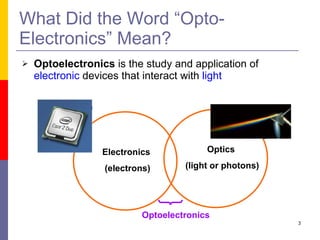
What Did the Word “Opto-Electronics” Mean? Optoelectronics  is the study and application of  electronic  devices that interact with  light Electronics  (electrons) Optics  (light or photons) Optoelectronics
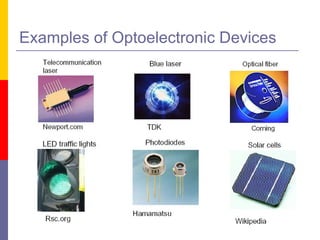
Examples of Optoelectronic Devices
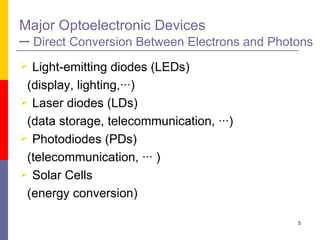
Major Optoelectronic Devices ─  Direct Conversion Between Electrons and Photons Light-emitting diodes (LEDs) (display, lighting,···) Laser diodes (LDs) (data storage, telecommunication, ···) Photodiodes (PDs) (telecommunication, ··· ) Solar Cells  (energy conversion)
Light-Emitting Diodes (LEDs) Light-emitting diode  ( LED )   is a semiconductor diode that emits incoherent narrow-spectrum light when electrically biased in the forward direction of the p-n junction.
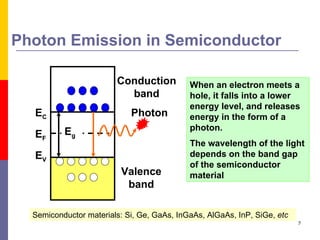
Photon Emission in Semiconductor When an electron meets a hole, it falls into a lower energy level, and releases energy in the form of a photon.  The wavelength of the light depends on the band gap of the semiconductor material   Semiconductor materials: Si, Ge, GaAs, InGaAs, AlGaAs, InP, SiGe,  etc E F E C E V Conduction band Valence band Photon E g
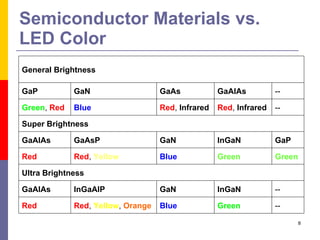
Semiconductor Materials vs.  LED Color General Brightness   GaP   GaN   GaAs   GaAIAs   --  Green ,  Red   Blue   Red ,  Infrared   Red ,  Infrared   --  Super Brightness   GaAIAs   GaAsP   GaN   InGaN   GaP   Red  Red ,  Yellow   Blue   Green  Green  Ultra Brightness   GaAIAs   InGaAIP   GaN   InGaN   --  Red  Red ,  Yellow ,  Orange   Blue   Green  --
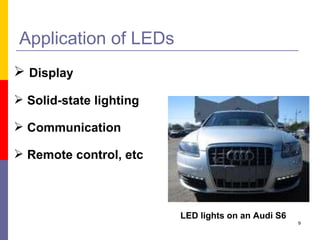
Application of LEDs Display Solid-state lighting Communication Remote control, etc LED lights on an Audi S6
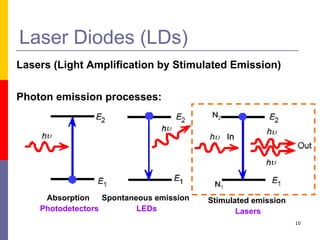
Laser Diodes (LDs) Lasers (Light Amplification by Stimulated Emission) Photon emission processes: Absorption  Photodetectors Spontaneous emission  LEDs Stimulated emission  Lasers
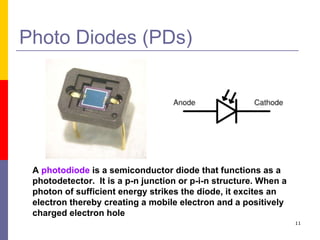
Photo Diodes (PDs) A  photodiode  is a semiconductor diode that functions as a photodetector.  It is a p-n junction or p-i-n structure. When a photon of sufficient energy strikes the diode, it excites an electron thereby creating a mobile electron and a positively charged electron hole
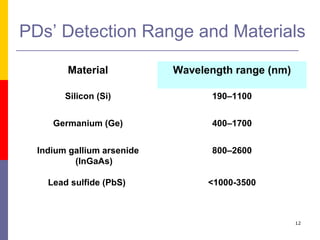
PDs’ Detection Range and Materials Material Wavelength range (nm) Silicon (Si) 190–1100 Germanium (Ge) 400–1700 Indium gallium arsenide (InGaAs) Lead sulfide (PbS)  800–2600 <1000-3500
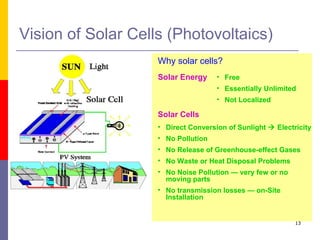
Vision of Solar Cells (Photovoltaics) Solar Energy   Free Essentially Unlimited Not Localized Solar Cells   Direct Conversion of Sunlight    Electricity No Pollution  No Release of Greenhouse-effect Gases No Waste or Heat Disposal Problems No Noise Pollution — very few or no moving parts No transmission losses  —  on-Site Installation Why solar cells?
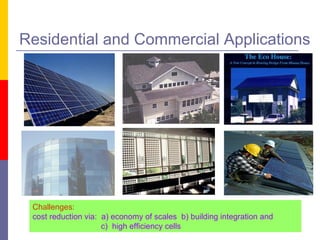
Residential and Commercial Applications Challenges:  cost reduction via:  a) economy of scales  b) building integration and    c)  high efficiency cells
Trends in optoelectronic devices Long wavelength, high power light sources or photodetectors Nanoscale devices  Low cost, easy fabricated materials High opto-electronic conversion efficiency Multi-wavelength sources
 
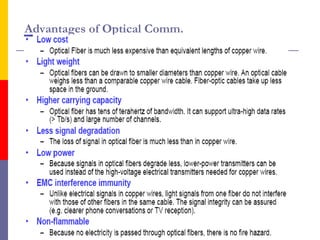
Advantages of Optical Comm.

Opto electronics devices

  • 1.
    Introduction to OptoelectronicDevices G.Aarthi Assistant Professor / SENSE VIT University Email: aarthi.g@vit.ac.in
  • 2.
    Outline What isoptoelectronics? Major optoelectronic devices Current trend on optoelectronic devices
  • 3.
    What Did theWord “Opto-Electronics” Mean? Optoelectronics is the study and application of electronic devices that interact with light Electronics (electrons) Optics (light or photons) Optoelectronics
  • 4.
  • 5.
    Major Optoelectronic Devices─ Direct Conversion Between Electrons and Photons Light-emitting diodes (LEDs) (display, lighting,···) Laser diodes (LDs) (data storage, telecommunication, ···) Photodiodes (PDs) (telecommunication, ··· ) Solar Cells (energy conversion)
  • 6.
    Light-Emitting Diodes (LEDs)Light-emitting diode ( LED ) is a semiconductor diode that emits incoherent narrow-spectrum light when electrically biased in the forward direction of the p-n junction.
  • 7.
    Photon Emission inSemiconductor When an electron meets a hole, it falls into a lower energy level, and releases energy in the form of a photon. The wavelength of the light depends on the band gap of the semiconductor material Semiconductor materials: Si, Ge, GaAs, InGaAs, AlGaAs, InP, SiGe, etc E F E C E V Conduction band Valence band Photon E g
  • 8.
    Semiconductor Materials vs. LED Color General Brightness GaP GaN GaAs GaAIAs -- Green , Red Blue Red , Infrared Red , Infrared -- Super Brightness GaAIAs GaAsP GaN InGaN GaP Red Red , Yellow Blue Green Green Ultra Brightness GaAIAs InGaAIP GaN InGaN -- Red Red , Yellow , Orange Blue Green --
  • 9.
    Application of LEDsDisplay Solid-state lighting Communication Remote control, etc LED lights on an Audi S6
  • 10.
    Laser Diodes (LDs)Lasers (Light Amplification by Stimulated Emission) Photon emission processes: Absorption Photodetectors Spontaneous emission LEDs Stimulated emission Lasers
  • 11.
    Photo Diodes (PDs)A photodiode is a semiconductor diode that functions as a photodetector. It is a p-n junction or p-i-n structure. When a photon of sufficient energy strikes the diode, it excites an electron thereby creating a mobile electron and a positively charged electron hole
  • 12.
    PDs’ Detection Rangeand Materials Material Wavelength range (nm) Silicon (Si) 190–1100 Germanium (Ge) 400–1700 Indium gallium arsenide (InGaAs) Lead sulfide (PbS) 800–2600 <1000-3500
  • 13.
    Vision of SolarCells (Photovoltaics) Solar Energy Free Essentially Unlimited Not Localized Solar Cells Direct Conversion of Sunlight  Electricity No Pollution No Release of Greenhouse-effect Gases No Waste or Heat Disposal Problems No Noise Pollution — very few or no moving parts No transmission losses — on-Site Installation Why solar cells?
  • 14.
    Residential and CommercialApplications Challenges: cost reduction via: a) economy of scales b) building integration and c) high efficiency cells
  • 15.
    Trends in optoelectronicdevices Long wavelength, high power light sources or photodetectors Nanoscale devices Low cost, easy fabricated materials High opto-electronic conversion efficiency Multi-wavelength sources
  • 16.
  • 17.

Editor's Notes

  • #4 Optoelectronics is the study area lies at combination between electronics and optics. It is based on the quantum mechanical effects of light on the semiconductor material. The optoelectronic devices functions as electrical to optical or optical to electrical transducers.
  • #7 LED is the device used to emit light when it is applied electrical bias. The condition for the emitting is that it must be applied a electric bias. The emission light color depends on the composition of the semiconductor material used. Now let’s look at how light is generated in LED. The light can be infrared, visible and UV light.
  • #8 In semicondutor, after the electron is excited to higher energy level, it can only stay in certain enregy band, range