P.RAMYA M sc Mphil.,
DEPARTMENT OF PHYSICS
BASICS OF NUCLEAR
PHYSICS
INTRODUCTION
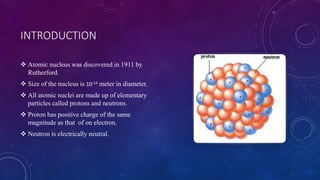
 Atomic nucleus was discovered in 1911 by
Rutherford.
 Size of the nucleus is 10-14 meter in diameter.
 All atomic nuclei are made up of elementary
particles called protons and neutrons.
 Proton has positive charge of the same
magnitude as that of on electron.
 Neutron is electrically neutral.
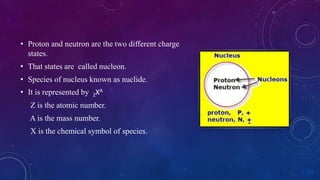
• Proton and neutron are the two different charge
states.
• That states are called nucleon.
• Species of nucleus known as nuclide.
• It is represented by ZXA
Z is the atomic number.
A is the mass number.
X is the chemical symbol of species.
HOW TO FIND OUT THE
NUMBER OF NEUTRONS
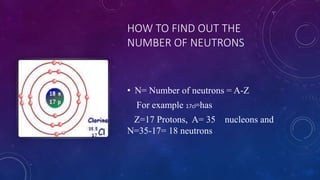
• N= Number of neutrons = A-Z
For example 17cl35has
Z=17 Protons, A= 35 nucleons and
N=35-17= 18 neutrons
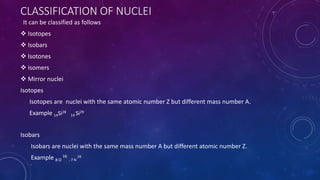
CLASSIFICATION OF NUCLEI
It can be classified as follows
 Isotopes
 Isobars
 Isotones
 Isomers
 Mirror nuclei
Isotopes
Isotopes are nuclei with the same atomic number Z but different mass number A.
Example 14Si28
14 Si29
Isobars
Isobars are nuclei with the same mass number A but different atomic number Z.
Example 8 O
16
, 7 N
16
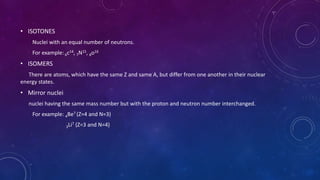
• ISOTONES
Nuclei with an equal number of neutrons.
For example: 6c14, 7N15, 8o16
• ISOMERS
There are atoms, which have the same Z and same A, but differ from one another in their nuclear
energy states.
• Mirror nuclei
nuclei having the same mass number but with the proton and neutron number interchanged.
For example: 4Be7 (Z=4 and N=3)
3Li7 (Z=3 and N=4)
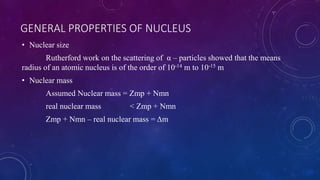
GENERAL PROPERTIES OF NUCLEUS
• Nuclear size
Rutherford work on the scattering of α – particles showed that the means
radius of an atomic nucleus is of the order of 10-14 m to 10-15 m
• Nuclear mass
Assumed Nuclear mass = Zmp + Nmn
real nuclear mass < Zmp + Nmn
Zmp + Nmn – real nuclear mass = Δm
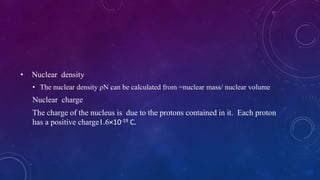
• Nuclear density
• The nuclear density ρN can be calculated from =nuclear mass/ nuclear volume
Nuclear charge
The charge of the nucleus is due to the protons contained in it. Each proton
has a positive charge1.6×10-19 C.
• Electric power generation (nuclear fission / fusion reactors)
• National Security (nuclear weapons stockpile)
• Medical Diagnosis (PET, MRI) cancer treatment with proton or heavy-ion
beams
• Radioactive dating (geology, archeology)
• Household (smoke detectors, americium-241 α-decay)
APPLICATION
Nuclear physics ppt

Nuclear physics ppt

  • 1.
    P.RAMYA M scMphil., DEPARTMENT OF PHYSICS
  • 2.
  • 3.
    INTRODUCTION  Atomic nucleuswas discovered in 1911 by Rutherford.  Size of the nucleus is 10-14 meter in diameter.  All atomic nuclei are made up of elementary particles called protons and neutrons.  Proton has positive charge of the same magnitude as that of on electron.  Neutron is electrically neutral.
  • 4.
    • Proton andneutron are the two different charge states. • That states are called nucleon. • Species of nucleus known as nuclide. • It is represented by ZXA Z is the atomic number. A is the mass number. X is the chemical symbol of species.
  • 5.
    HOW TO FINDOUT THE NUMBER OF NEUTRONS • N= Number of neutrons = A-Z For example 17cl35has Z=17 Protons, A= 35 nucleons and N=35-17= 18 neutrons
  • 6.
    CLASSIFICATION OF NUCLEI Itcan be classified as follows  Isotopes  Isobars  Isotones  Isomers  Mirror nuclei Isotopes Isotopes are nuclei with the same atomic number Z but different mass number A. Example 14Si28 14 Si29 Isobars Isobars are nuclei with the same mass number A but different atomic number Z. Example 8 O 16 , 7 N 16
  • 7.
    • ISOTONES Nuclei withan equal number of neutrons. For example: 6c14, 7N15, 8o16 • ISOMERS There are atoms, which have the same Z and same A, but differ from one another in their nuclear energy states. • Mirror nuclei nuclei having the same mass number but with the proton and neutron number interchanged. For example: 4Be7 (Z=4 and N=3) 3Li7 (Z=3 and N=4)
  • 8.
    GENERAL PROPERTIES OFNUCLEUS • Nuclear size Rutherford work on the scattering of α – particles showed that the means radius of an atomic nucleus is of the order of 10-14 m to 10-15 m • Nuclear mass Assumed Nuclear mass = Zmp + Nmn real nuclear mass < Zmp + Nmn Zmp + Nmn – real nuclear mass = Δm
  • 9.
    • Nuclear density •The nuclear density ρN can be calculated from =nuclear mass/ nuclear volume Nuclear charge The charge of the nucleus is due to the protons contained in it. Each proton has a positive charge1.6×10-19 C.
  • 10.
    • Electric powergeneration (nuclear fission / fusion reactors) • National Security (nuclear weapons stockpile) • Medical Diagnosis (PET, MRI) cancer treatment with proton or heavy-ion beams • Radioactive dating (geology, archeology) • Household (smoke detectors, americium-241 α-decay) APPLICATION