OLED TECHNOLOGY
INTRODUCTION
 Uses organic light emitting diode(OLED).
 Emerging Technology for displays in devices.
 Main principle behind OLED technology is
electroluminescence.
 Offers brighter, thinner, high contrast, flexible
displays.
WHAT IS AN OLED?
 OLEDs are solid state devices composed of thin
films of organic molecules that is100 to 500
nanometres thick.
 They emits light with the application of electricity.
 They doesn’t require any backlight. i.e., they are
self emitting.
 They are made from carbon and hydrogen.
HISTORY
 The first OLED device was developed by Eastman
Kodak in 1987.
 In 1996, pioneer produces the world’s first
commercial PMOLED.
 In 2000, many companies like Motorola, LG etc
developed various displays.
 In 2001, Sony developed world’s largest fullcolor
OLED.
HISTORY (CONTD.)
 In 2002, approximately 3.5 million passive matrix
OLED sub-displays were sold, and over 10 million
were sold in 2003.
 In 2010 and 2011, many companies announced
AMOLED displays.
 Many developments had take place in the year
2012.
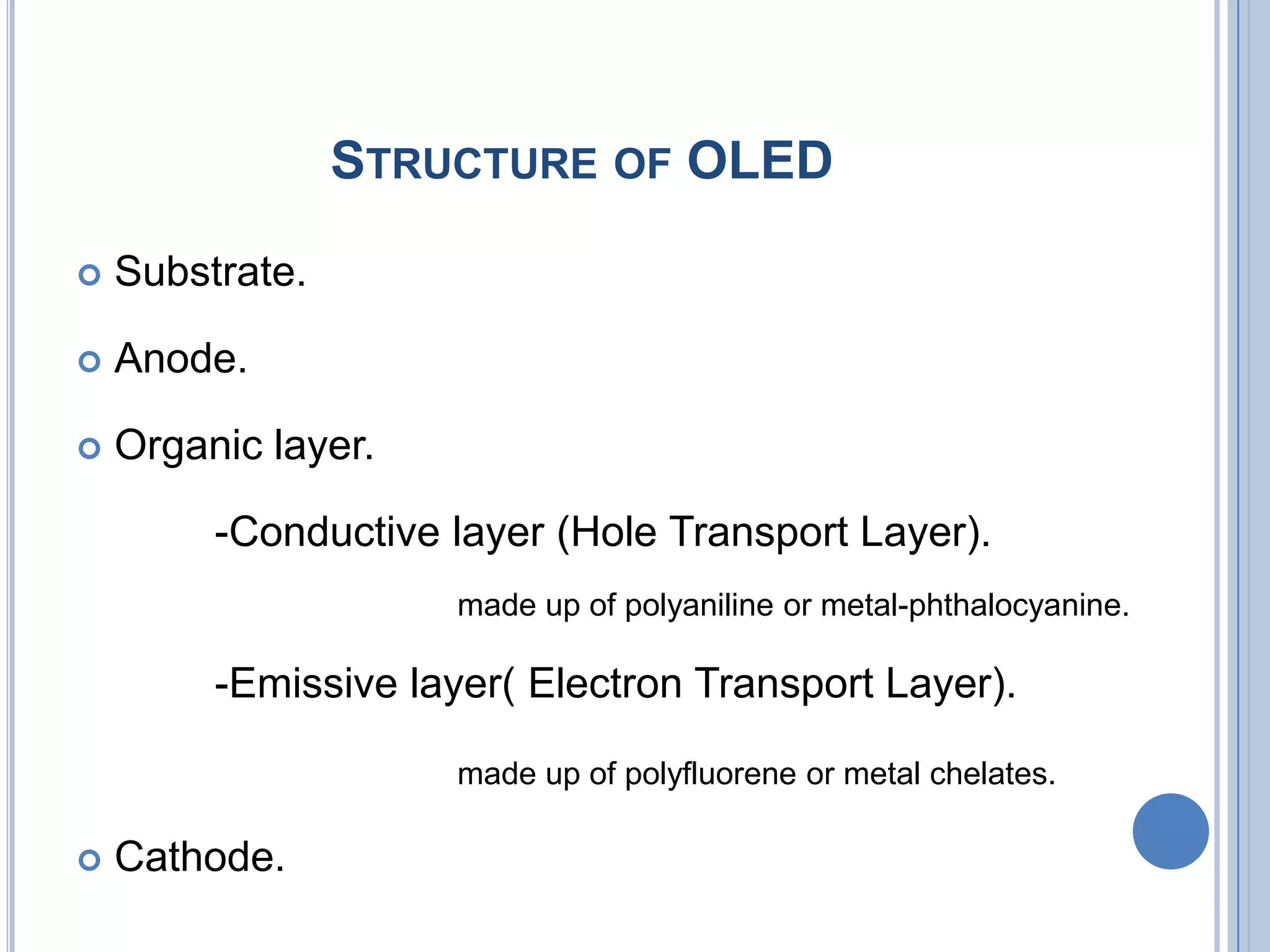
FEATURES
 Flexibility.
 Emissive Technology.
 Light weight and thin.
 Low power consumption.
 High contrast, brighter and perfect display from all
angles.
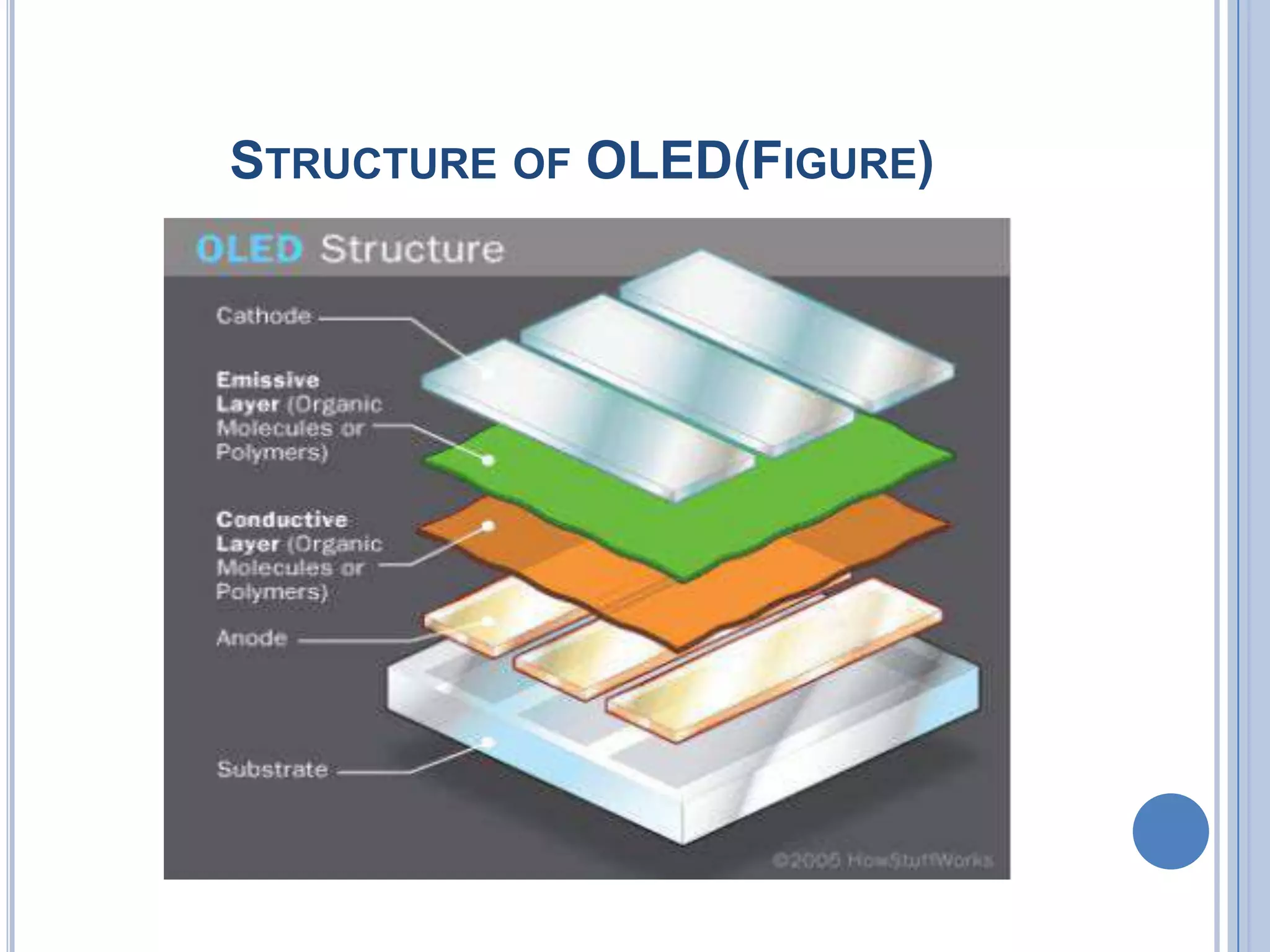
STRUCTURE OF OLED
 Substrate.
 Anode.
 Organic layer.
-Conductive layer (Hole Transport Layer).
made up of polyaniline or metal-phthalocyanine.
-Emissive layer( Electron Transport Layer).
made up of polyfluorene or metal chelates.
 Cathode.
STRUCTURE OF OLED(FIGURE)
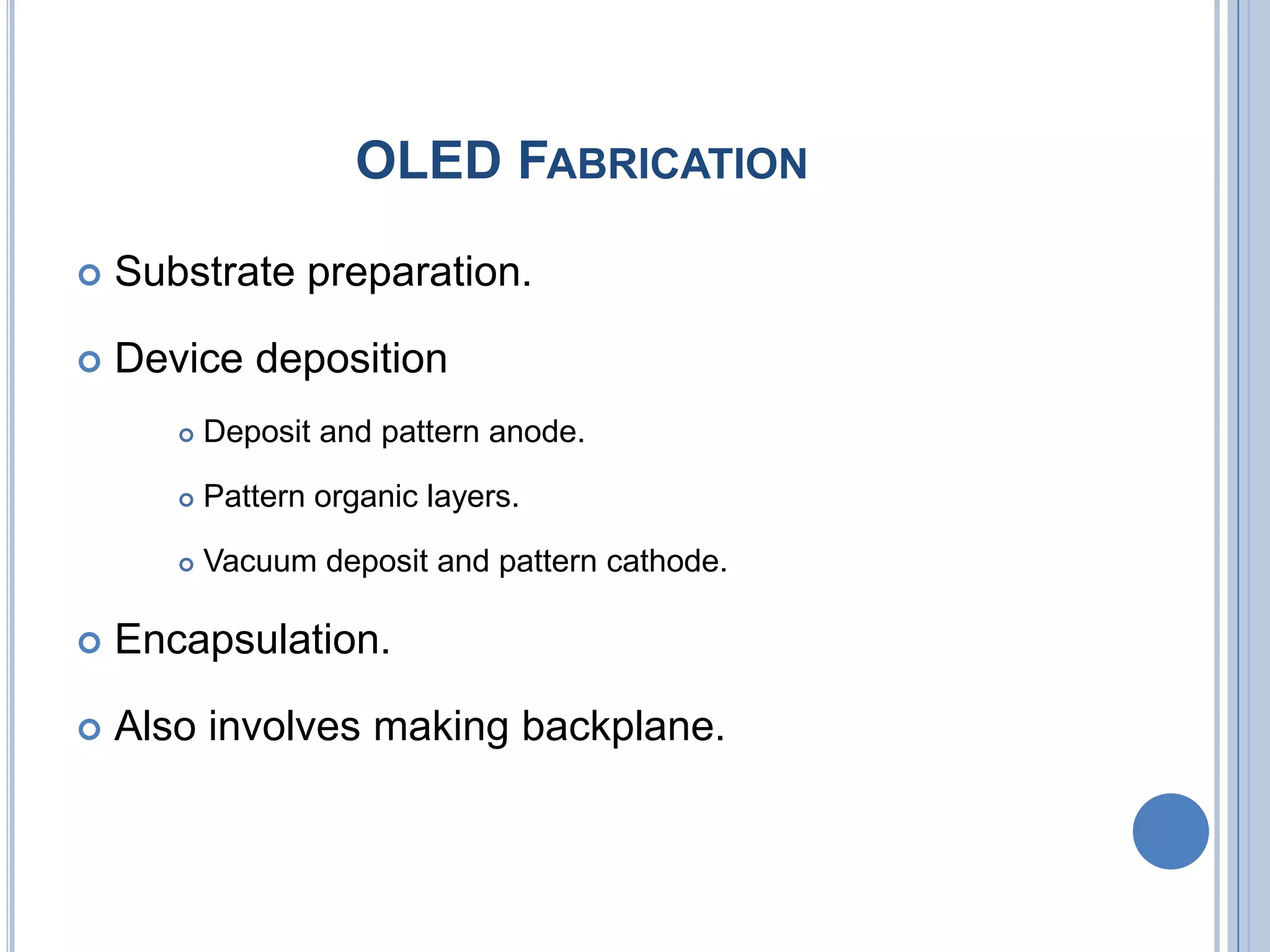
OLED FABRICATION
 Substrate preparation.
 Device deposition
 Deposit and pattern anode.
 Pattern organic layers.
 Vacuum deposit and pattern cathode.
 Encapsulation.
 Also involves making backplane.
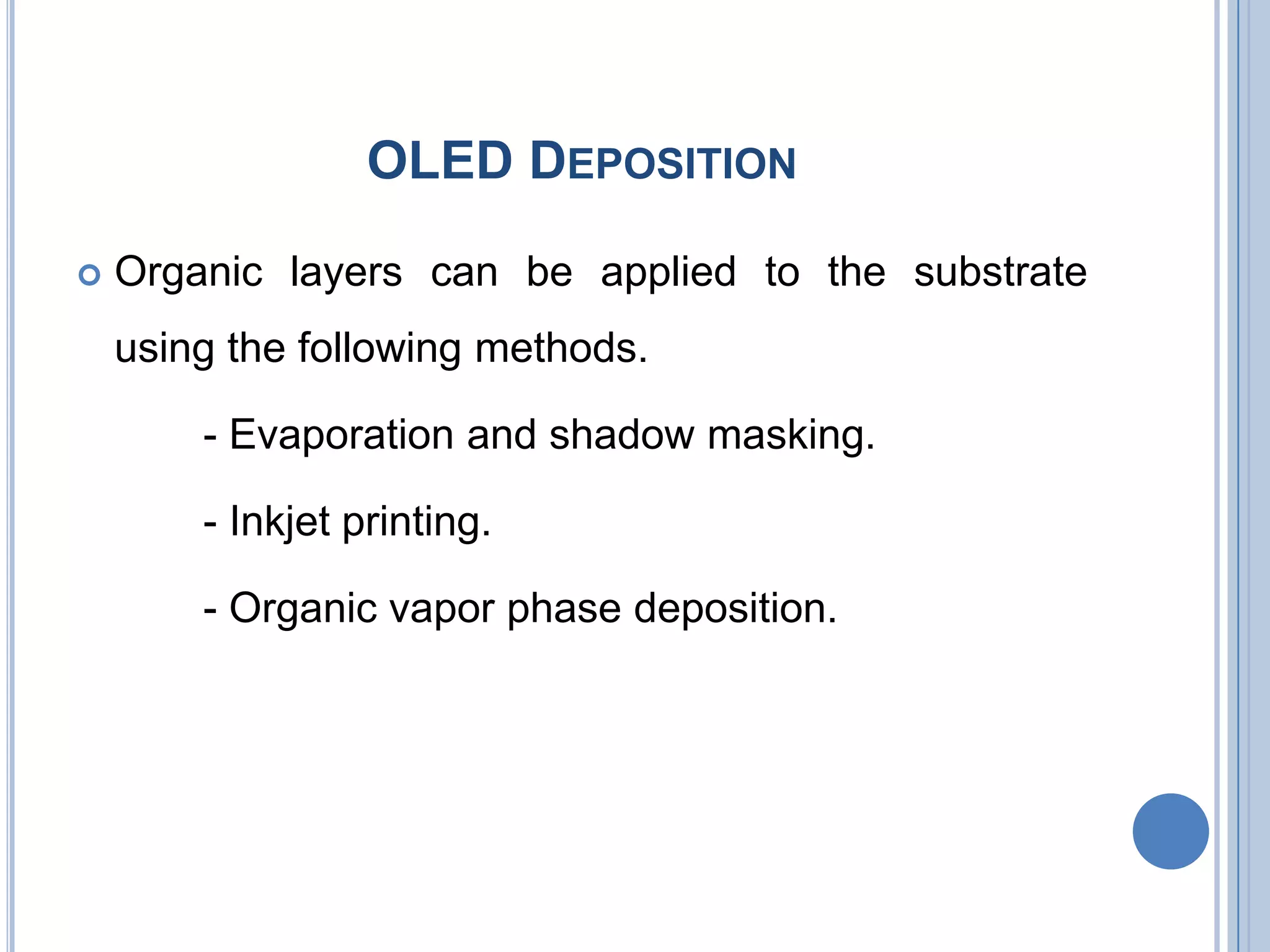
OLED DEPOSITION
 Organic layers can be applied to the substrate
using the following methods.
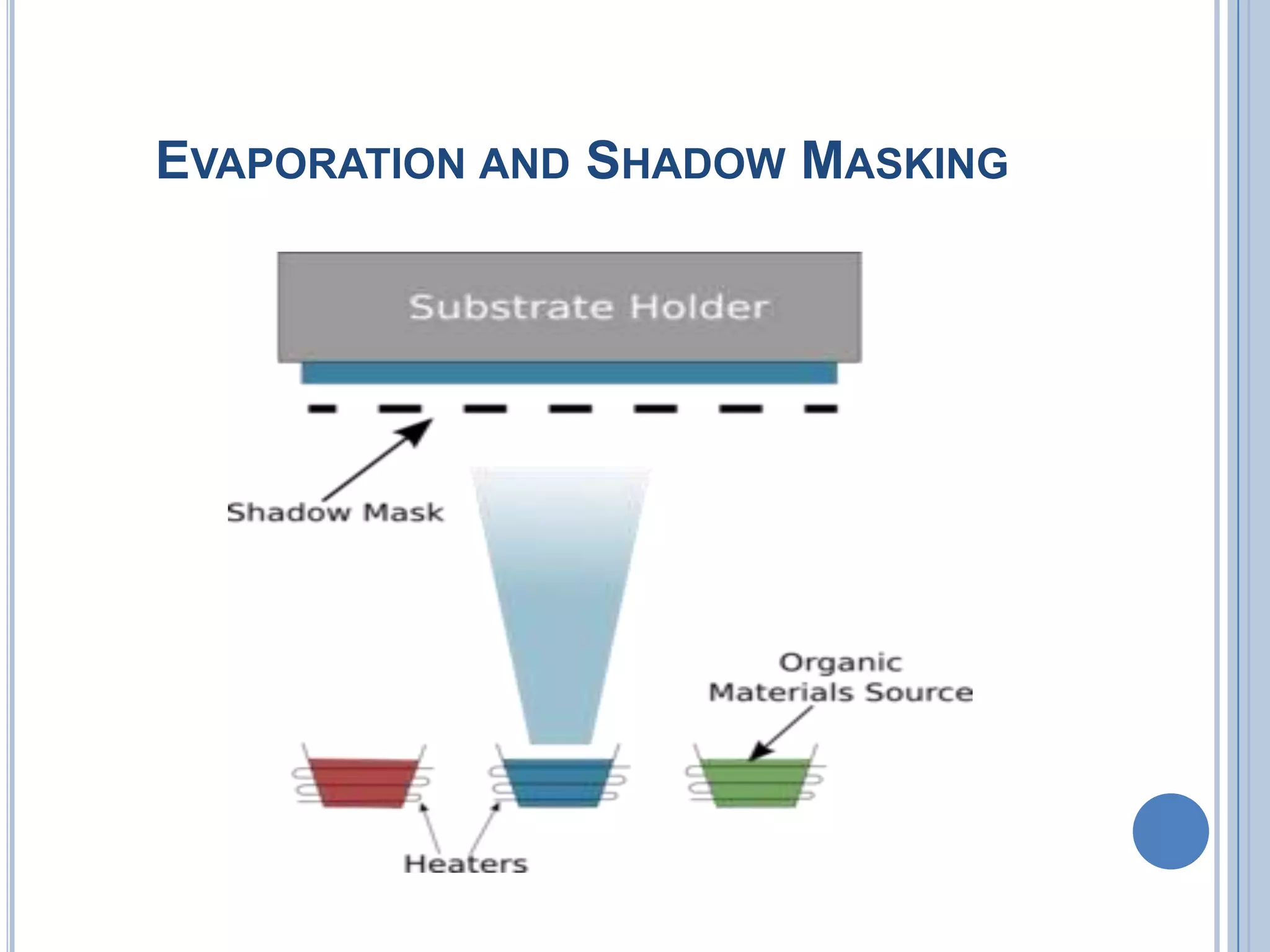
- Evaporation and shadow masking.
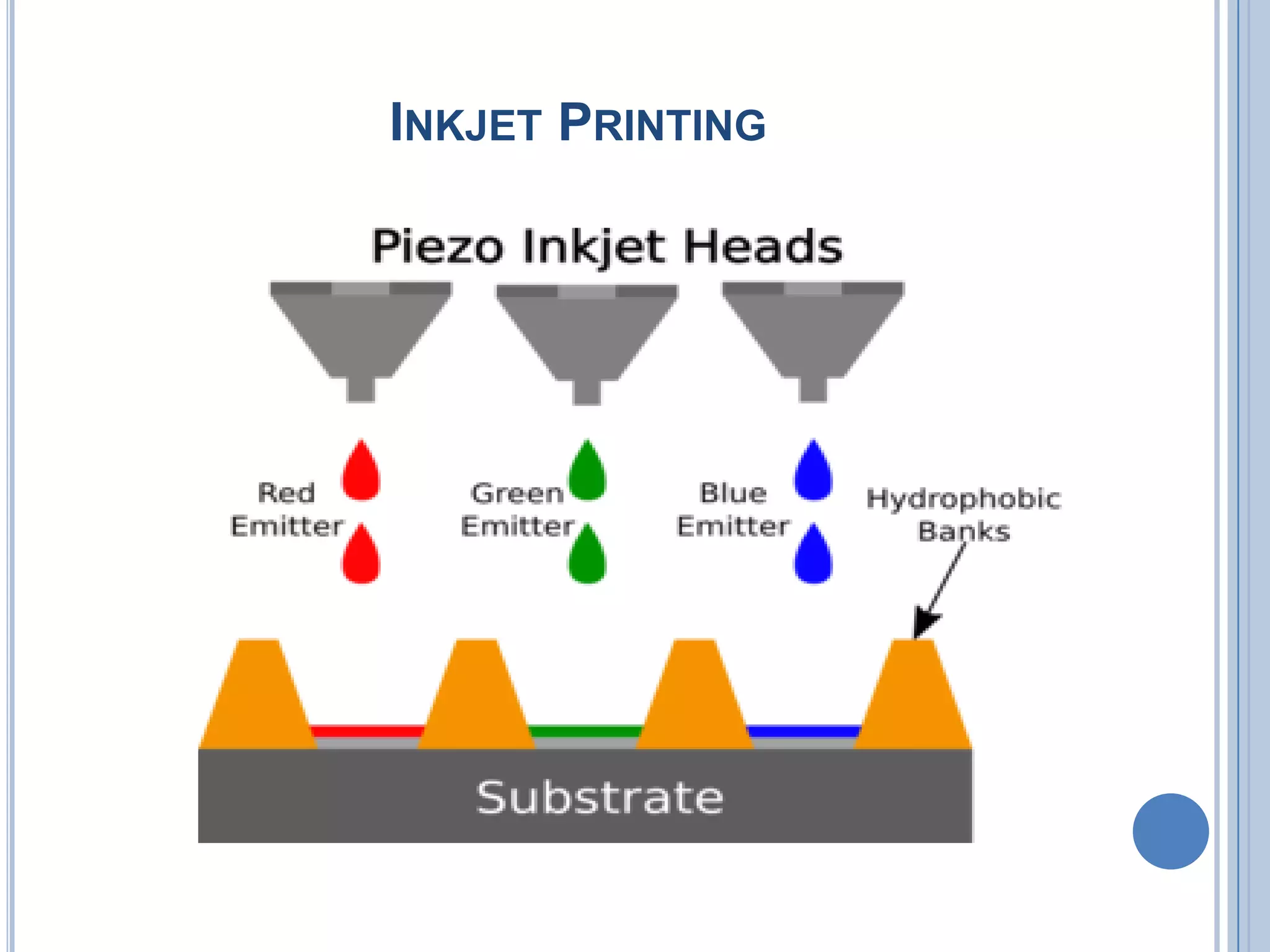
- Inkjet printing.
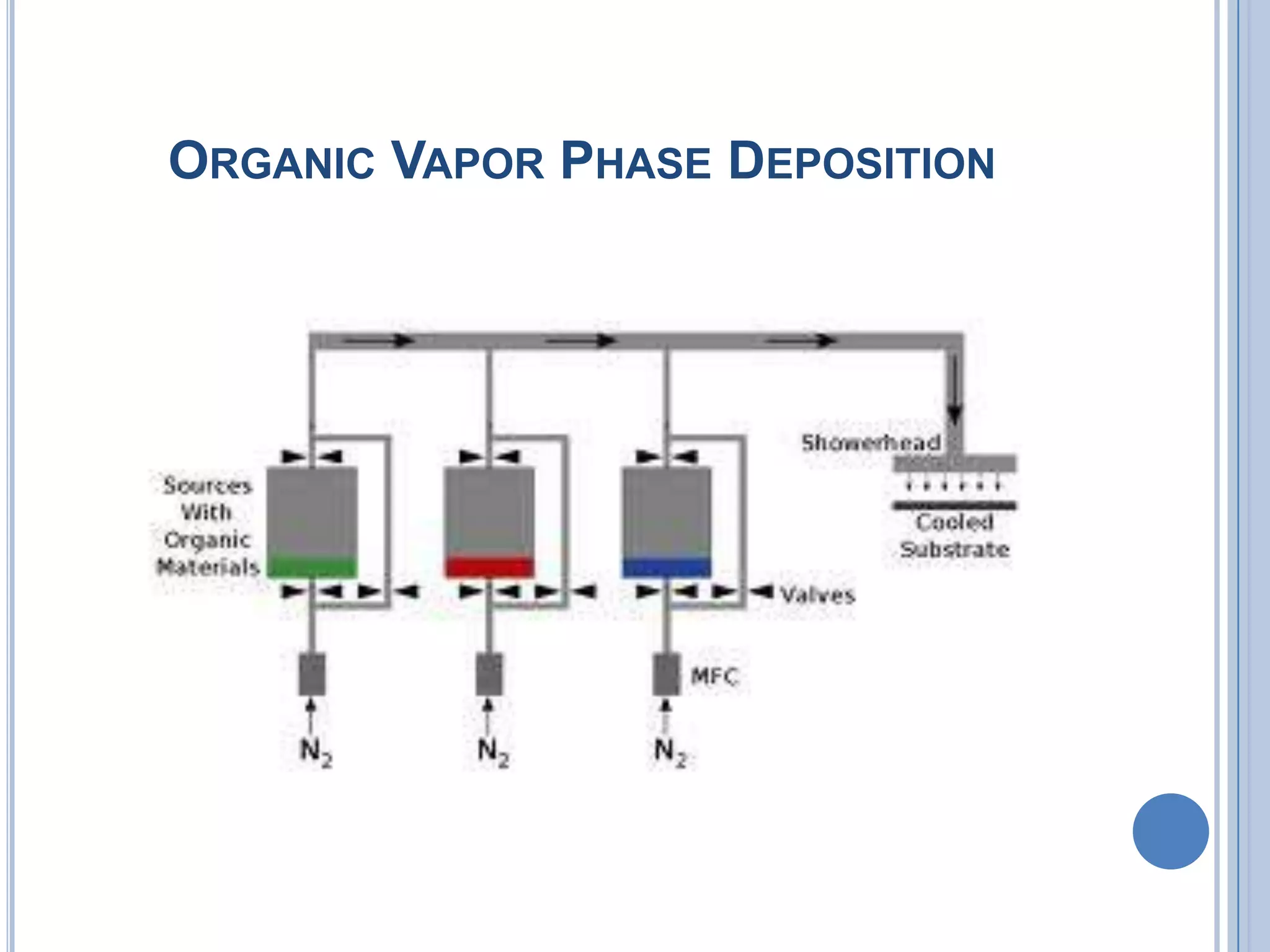
- Organic vapor phase deposition.
EVAPORATION AND SHADOW MASKING
INKJET PRINTING
ORGANIC VAPOR PHASE DEPOSITION
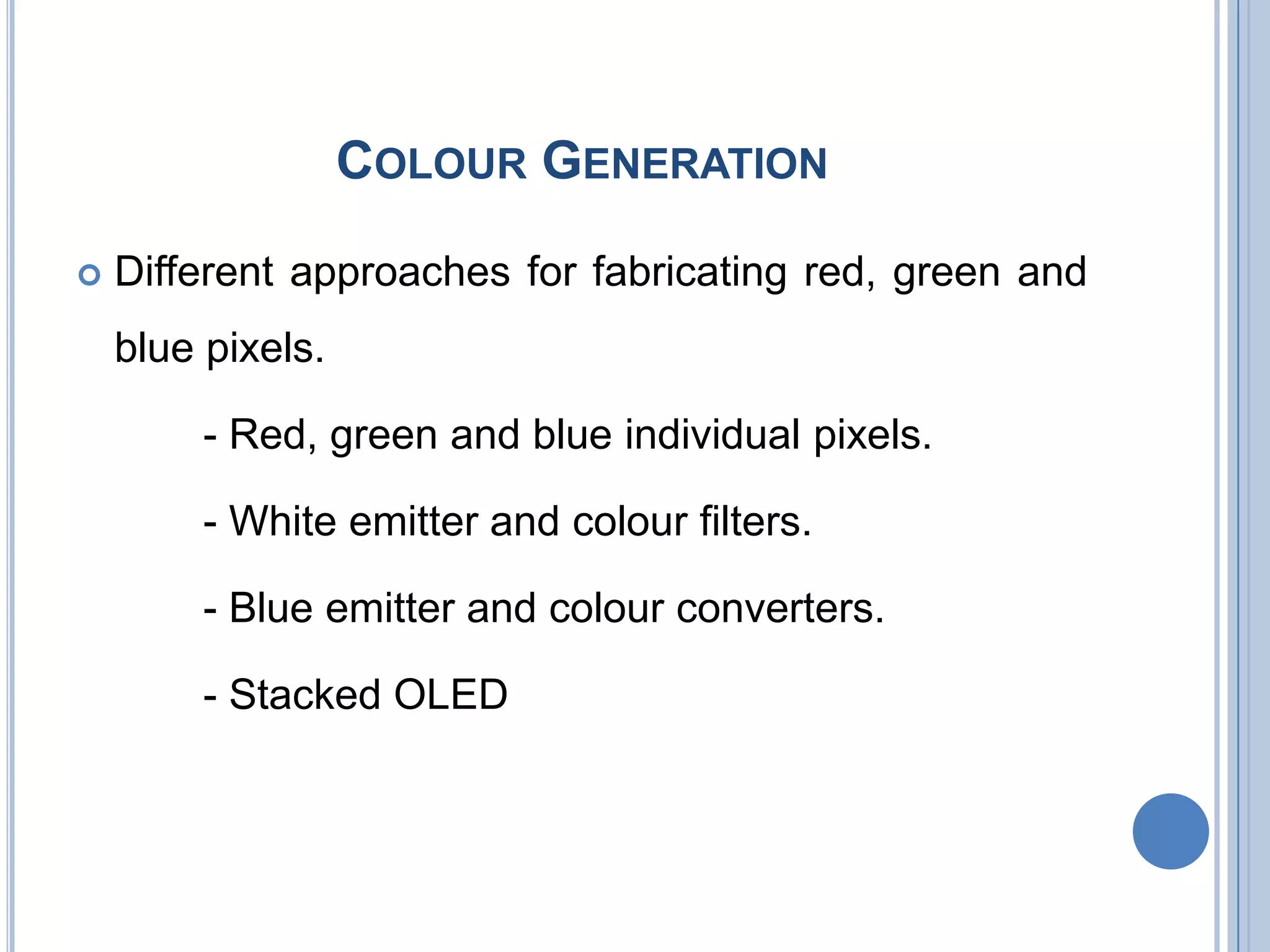
COLOUR GENERATION
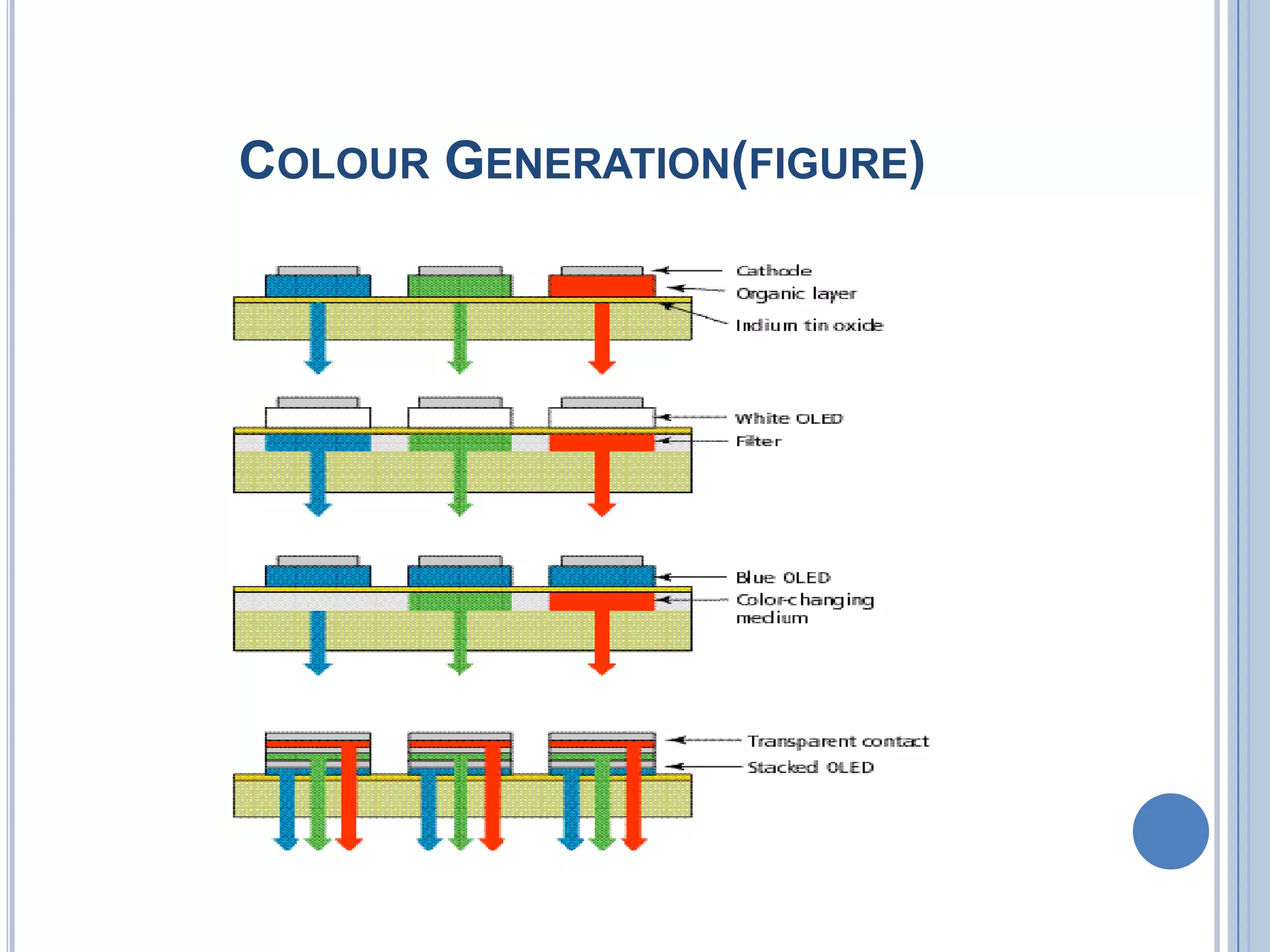
 Different approaches for fabricating red, green and
blue pixels.
- Red, green and blue individual pixels.
- White emitter and colour filters.
- Blue emitter and colour converters.
- Stacked OLED
COLOUR GENERATION(FIGURE)
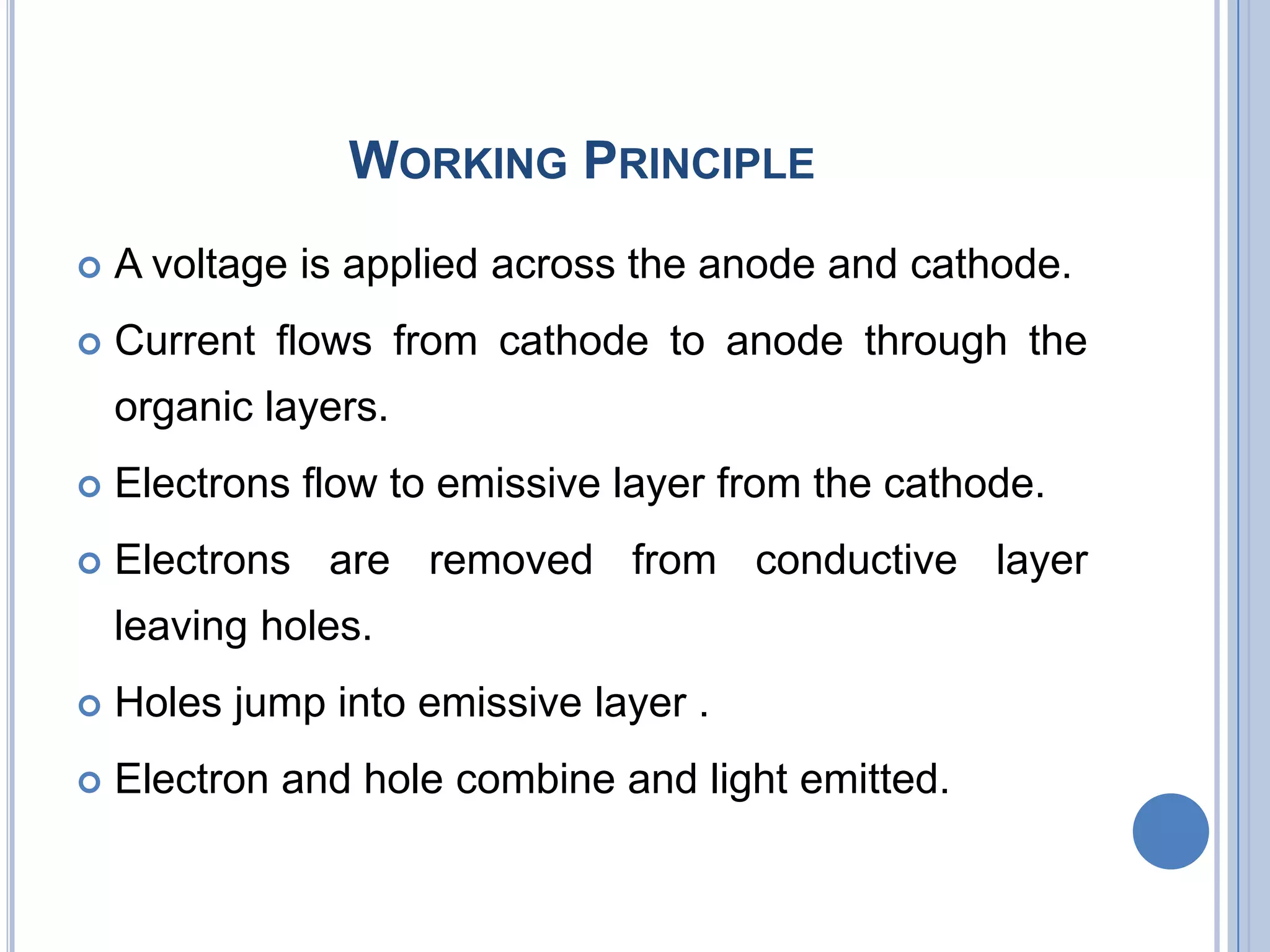
WORKING PRINCIPLE
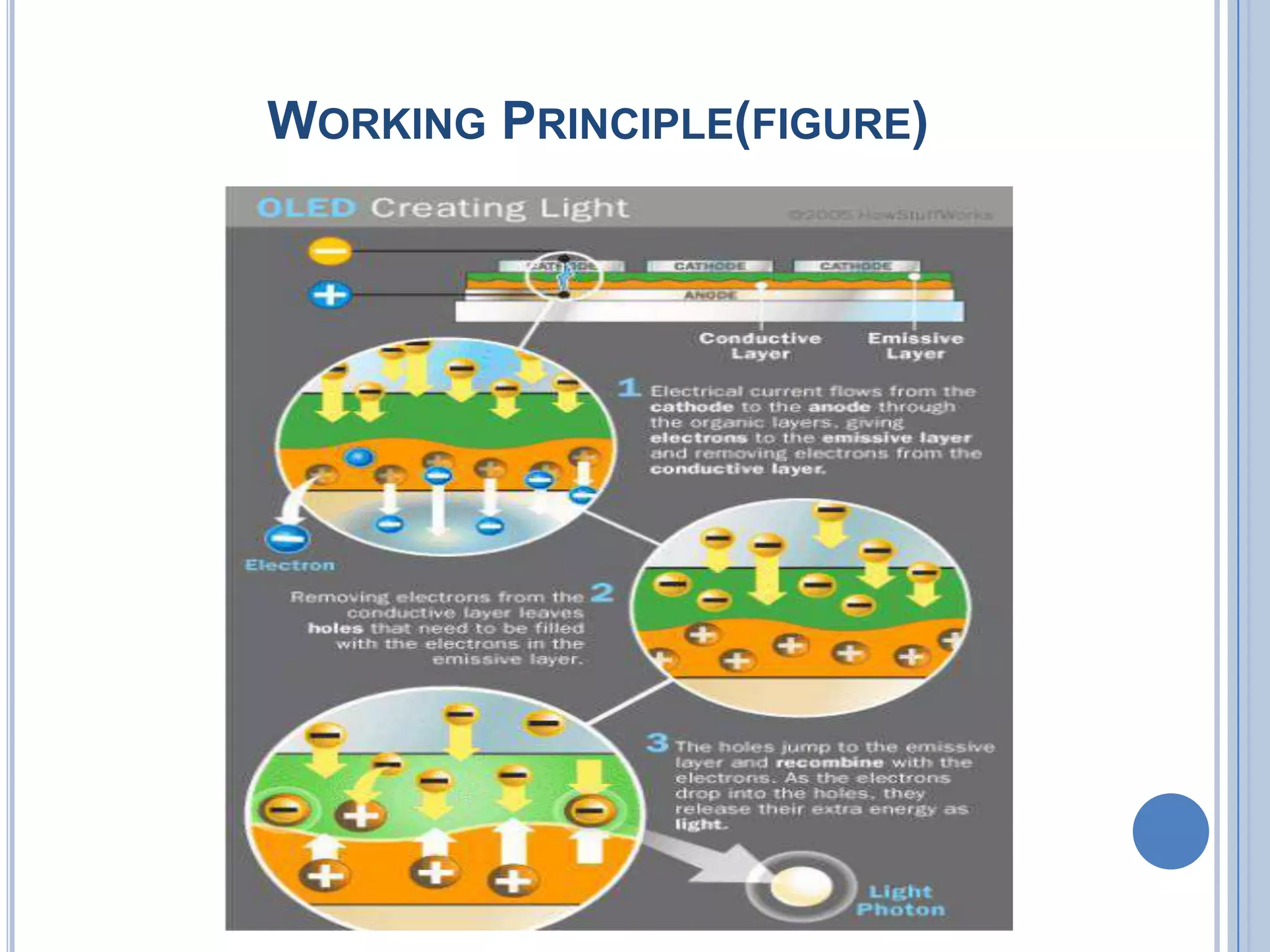
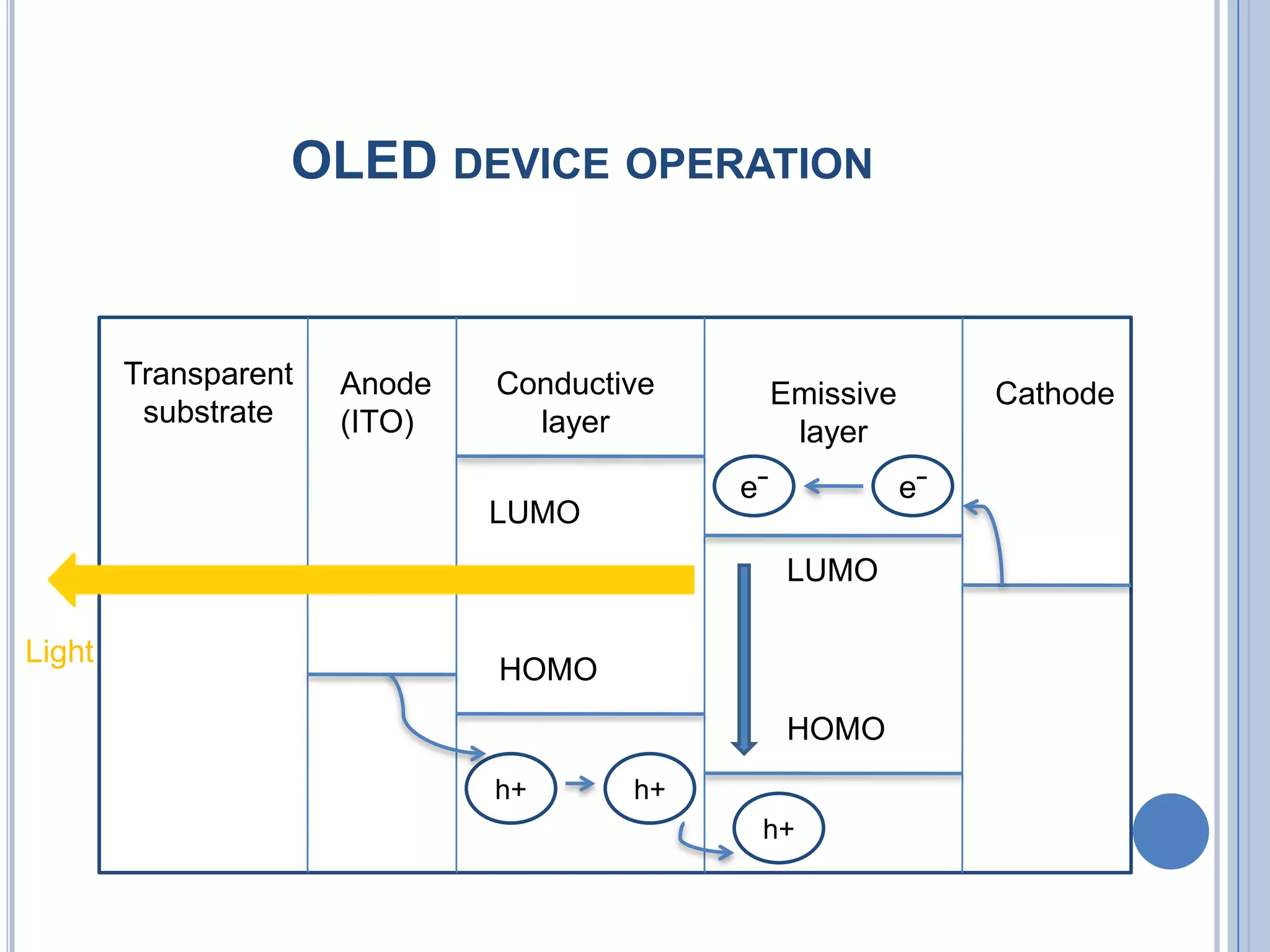
 A voltage is applied across the anode and cathode.
 Current flows from cathode to anode through the
organic layers.
 Electrons flow to emissive layer from the cathode.
 Electrons are removed from conductive layer
leaving holes.
 Holes jump into emissive layer .
 Electron and hole combine and light emitted.
WORKING PRINCIPLE(FIGURE)
OLED DEVICE OPERATION
Transparent
substrate
Anode
(ITO)
Conductive
layer
Emissive
layer
Cathode
LUMO
LUMO
HOMO
HOMO
eˉeˉ
h+
h+h+
Light
TYPES OF OLED
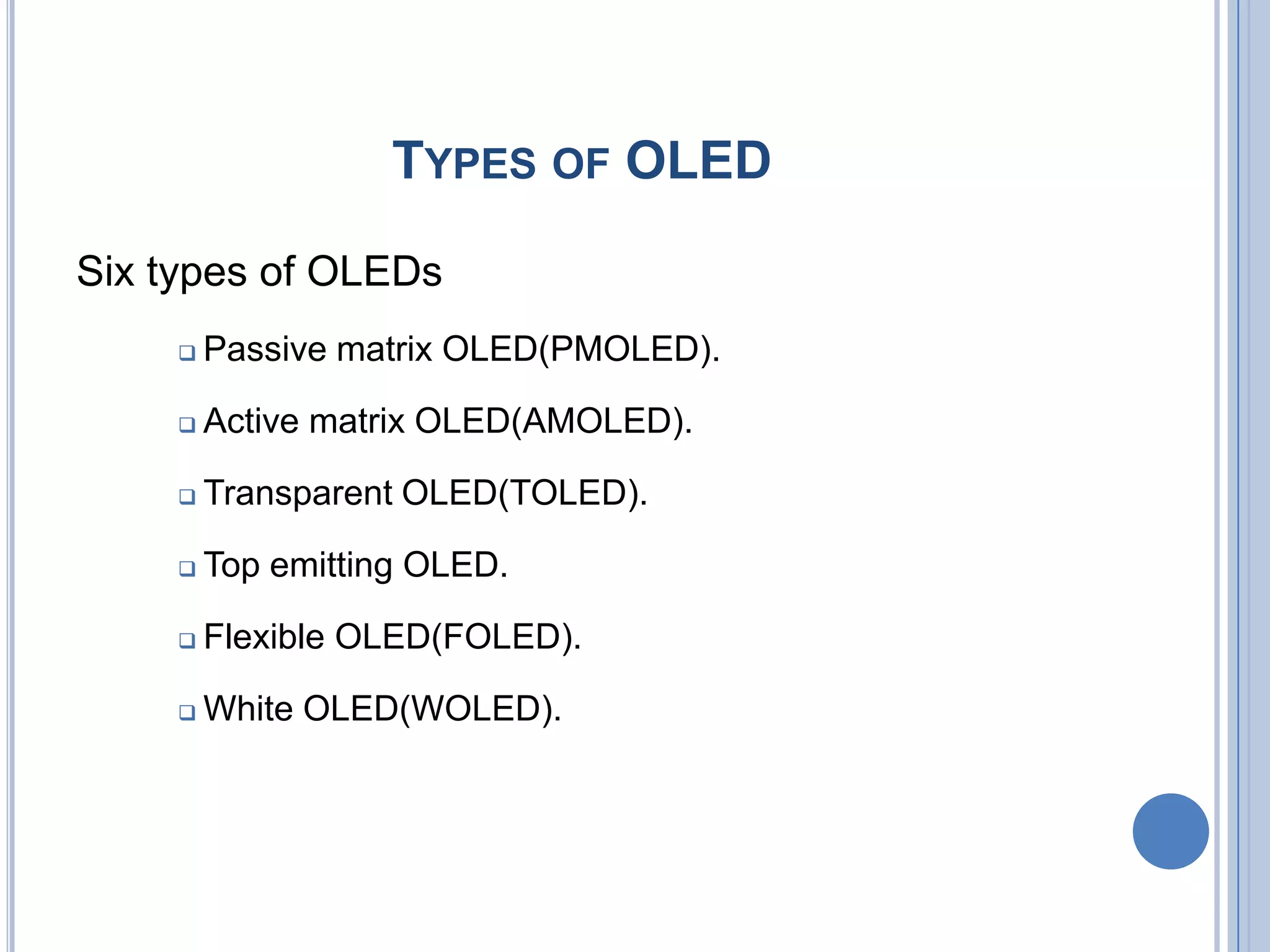
Six types of OLEDs
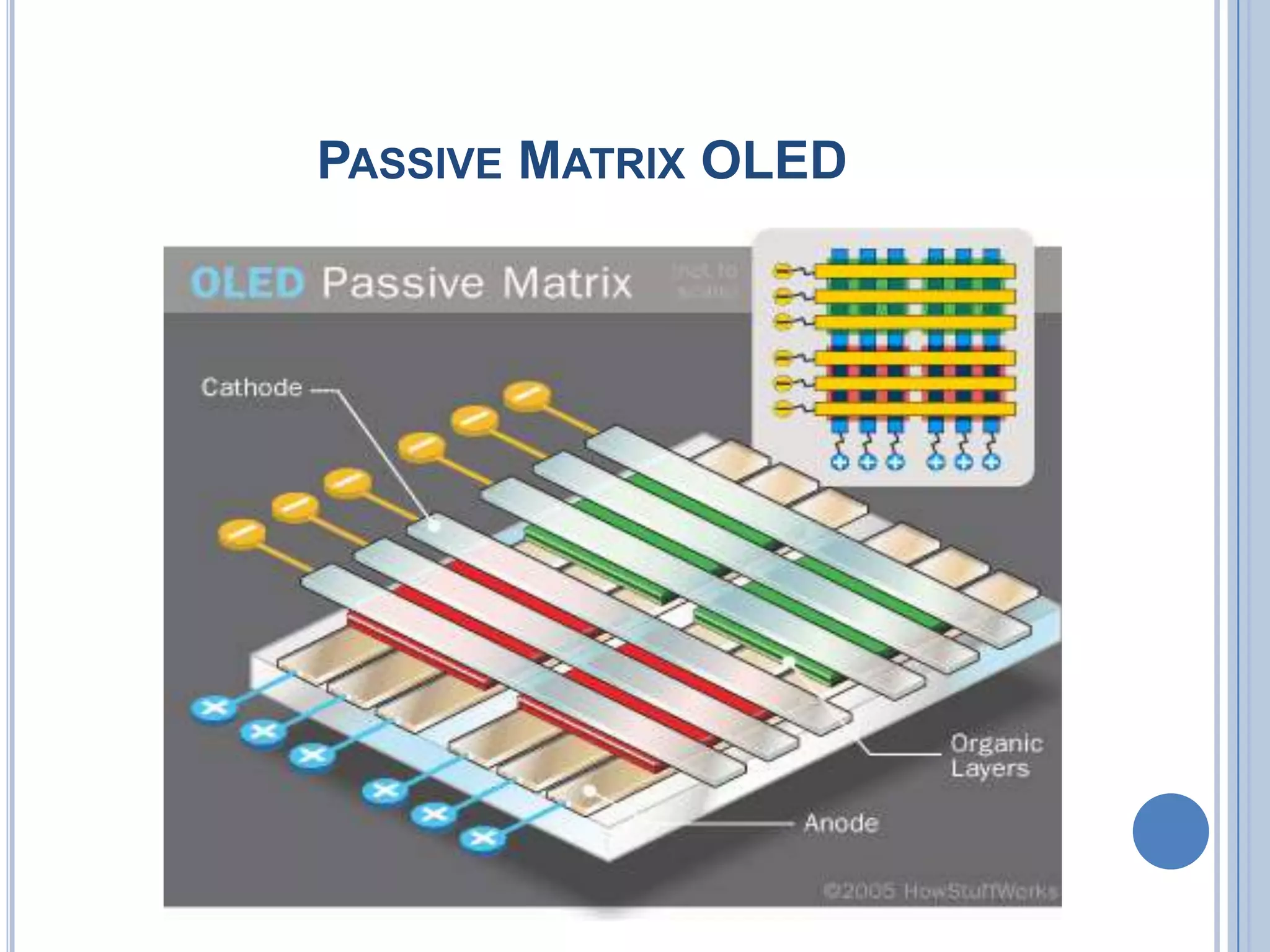
 Passive matrix OLED(PMOLED).
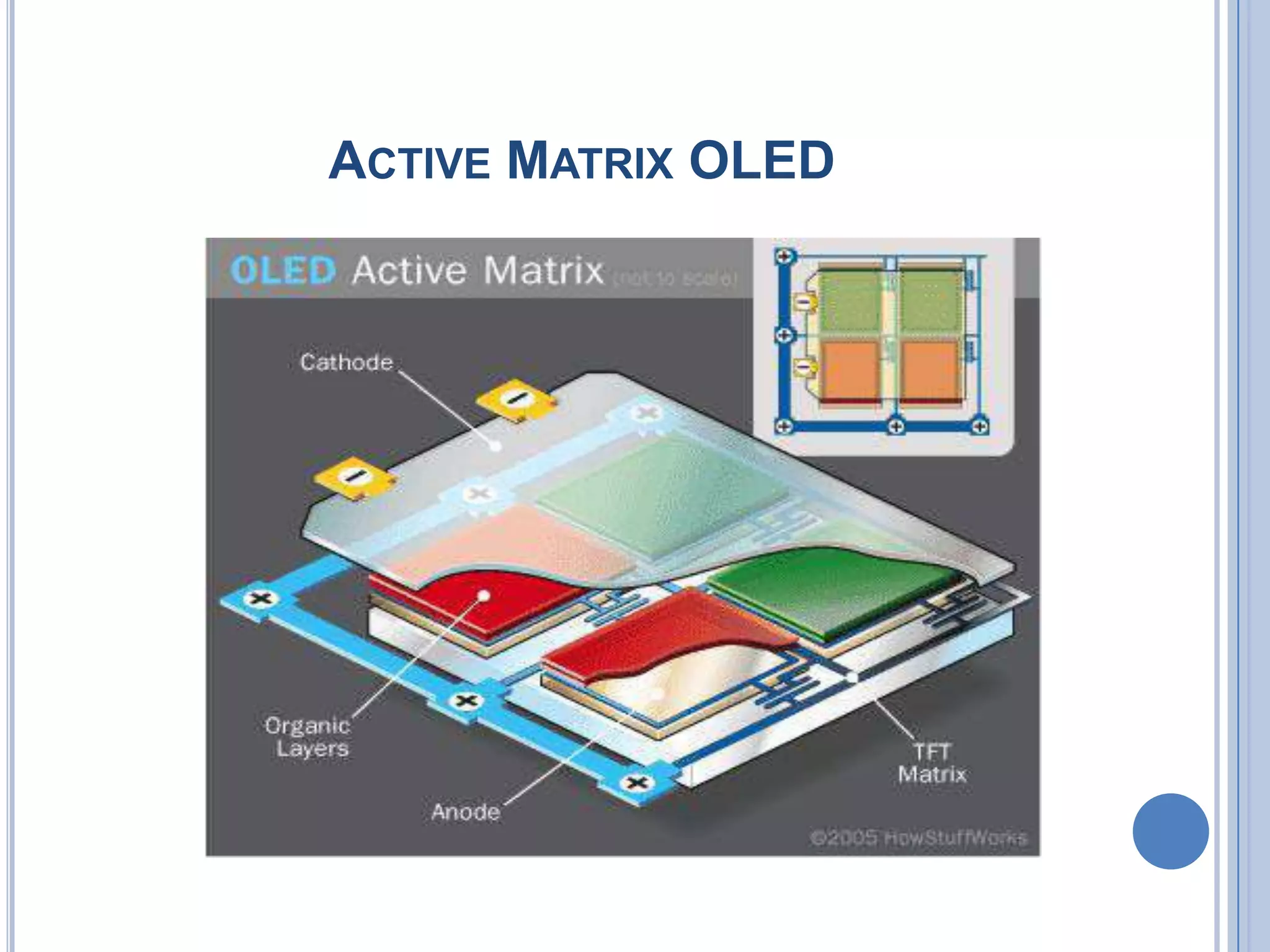
 Active matrix OLED(AMOLED).
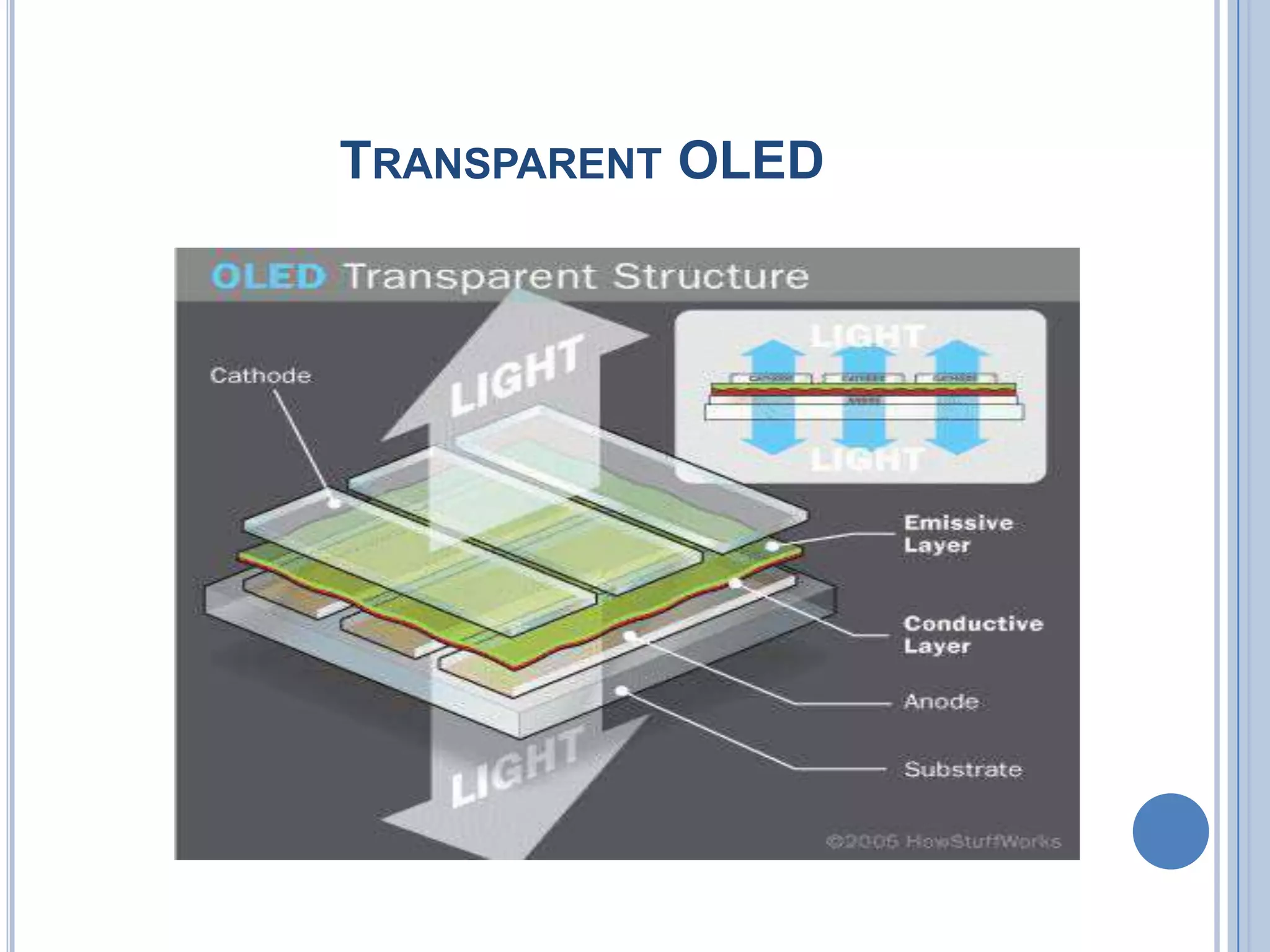
 Transparent OLED(TOLED).
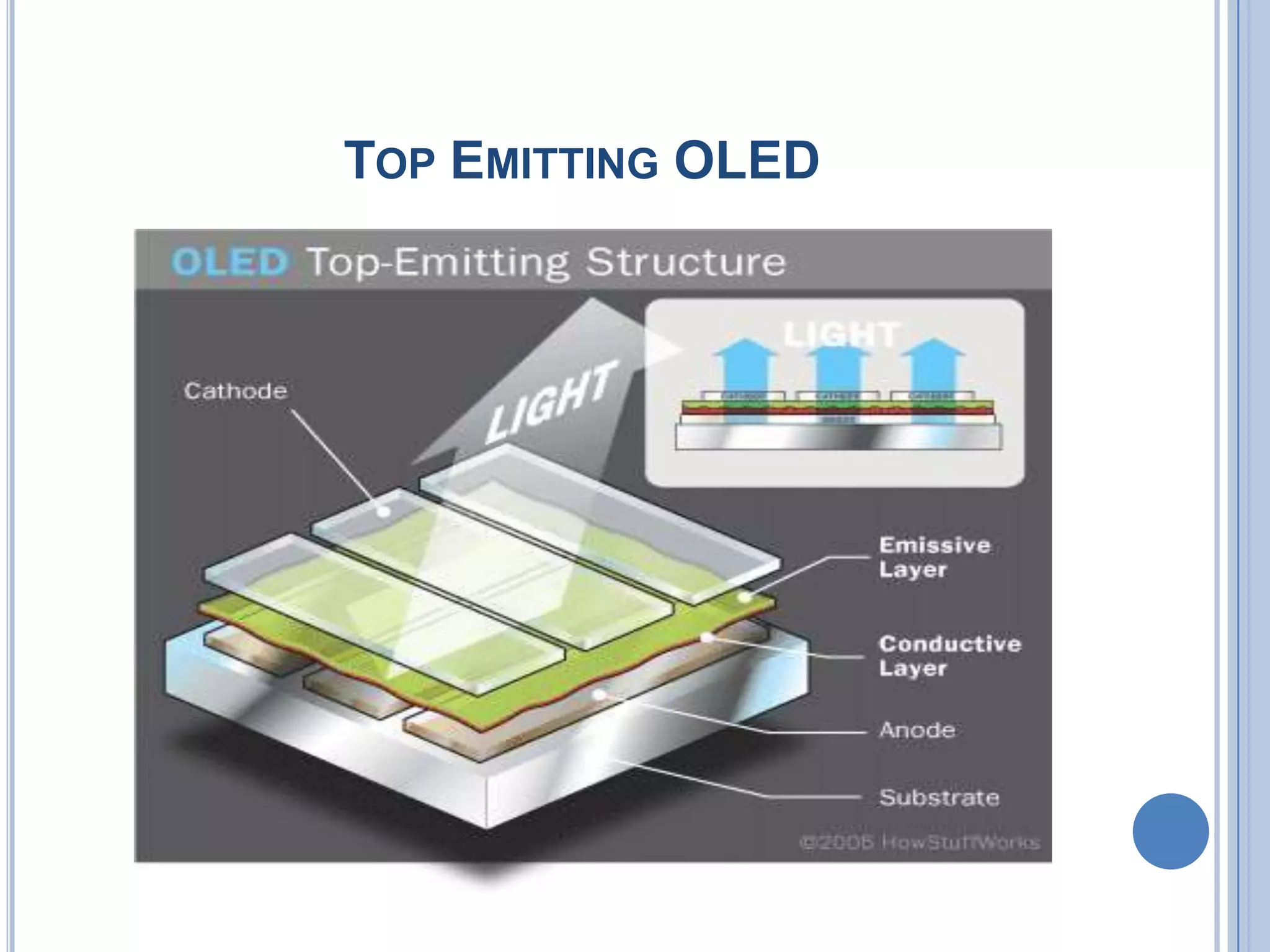
 Top emitting OLED.
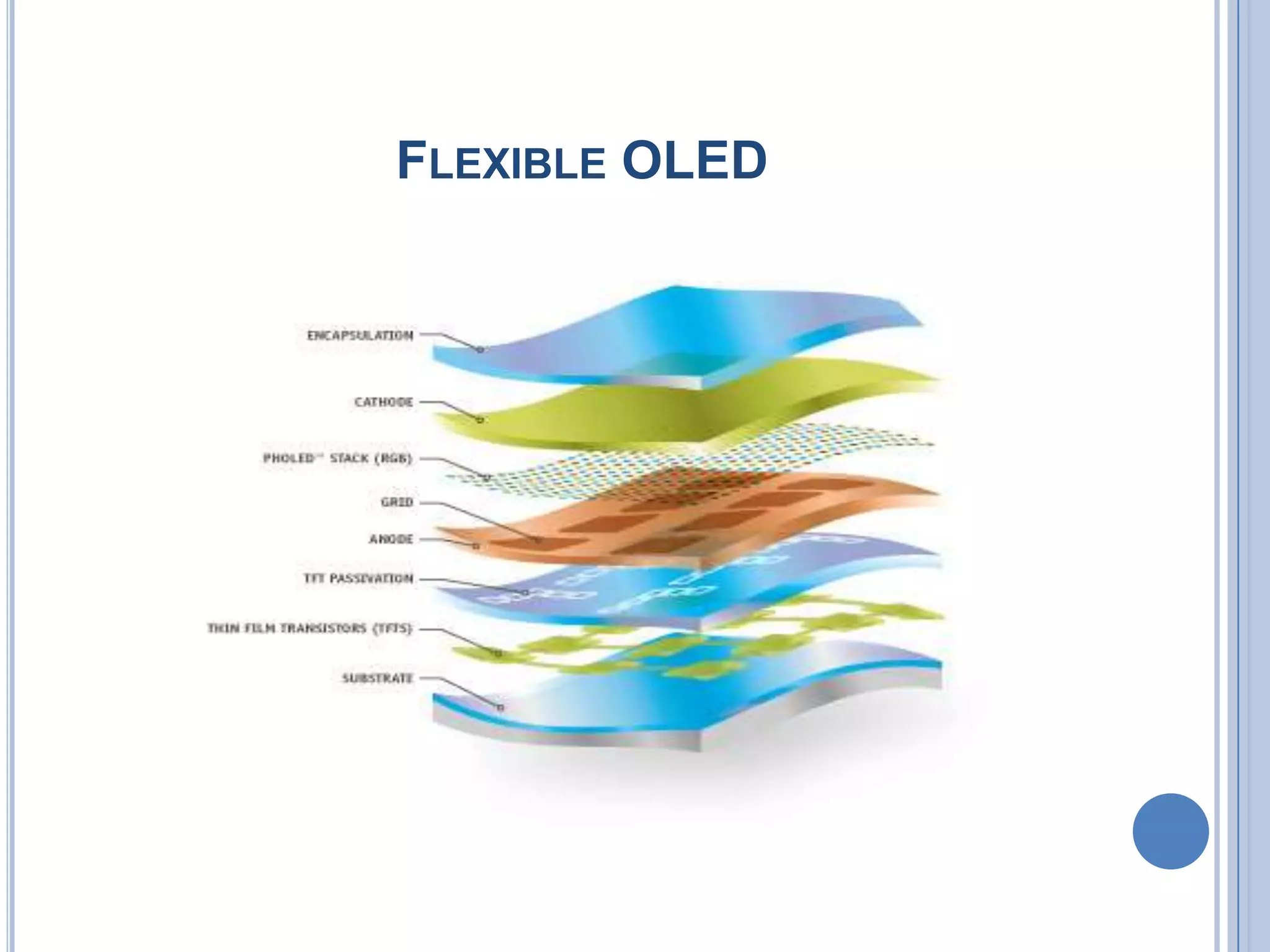
 Flexible OLED(FOLED).
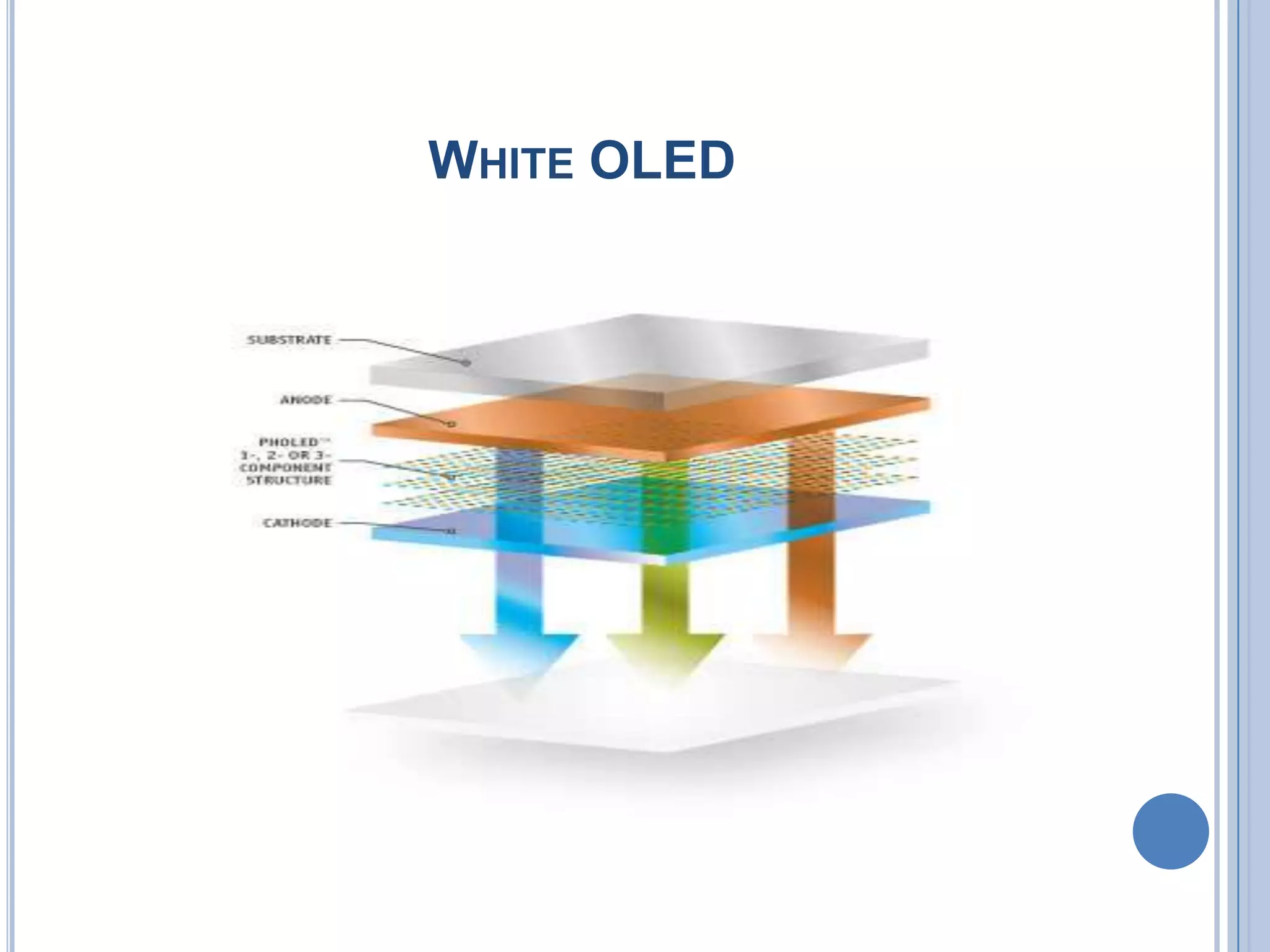
 White OLED(WOLED).
PASSIVE MATRIX OLED
ACTIVE MATRIX OLED
TRANSPARENT OLED
TOP EMITTING OLED
FLEXIBLE OLED
WHITE OLED
OLED ADVANTAGES
 Thinner, lighter and more flexible.
 Do not require backlighting like LCDs.
 Can be made to larger sizes.
 Large fields of view, about 170 degrees.
 Faster response time.
 Brighter.
 High resolution, <5μm pixel size.
OLED DISADVANTAGES
 Expensive.
 Lifespan.
 Water damage.
 Colour balance issues .
OLED VS. LCD
 Greater view angle.
 High contrast.
 Faster response time.
 Do not require
backlighting.
 Temperature(~50°C –
80°C).
 Limited view angle.
 Low contrast.
 Slow response time.
 Require backlighting.
 Temperature(~0°C-
100°C).
OLED LCD
APPLICATIONS
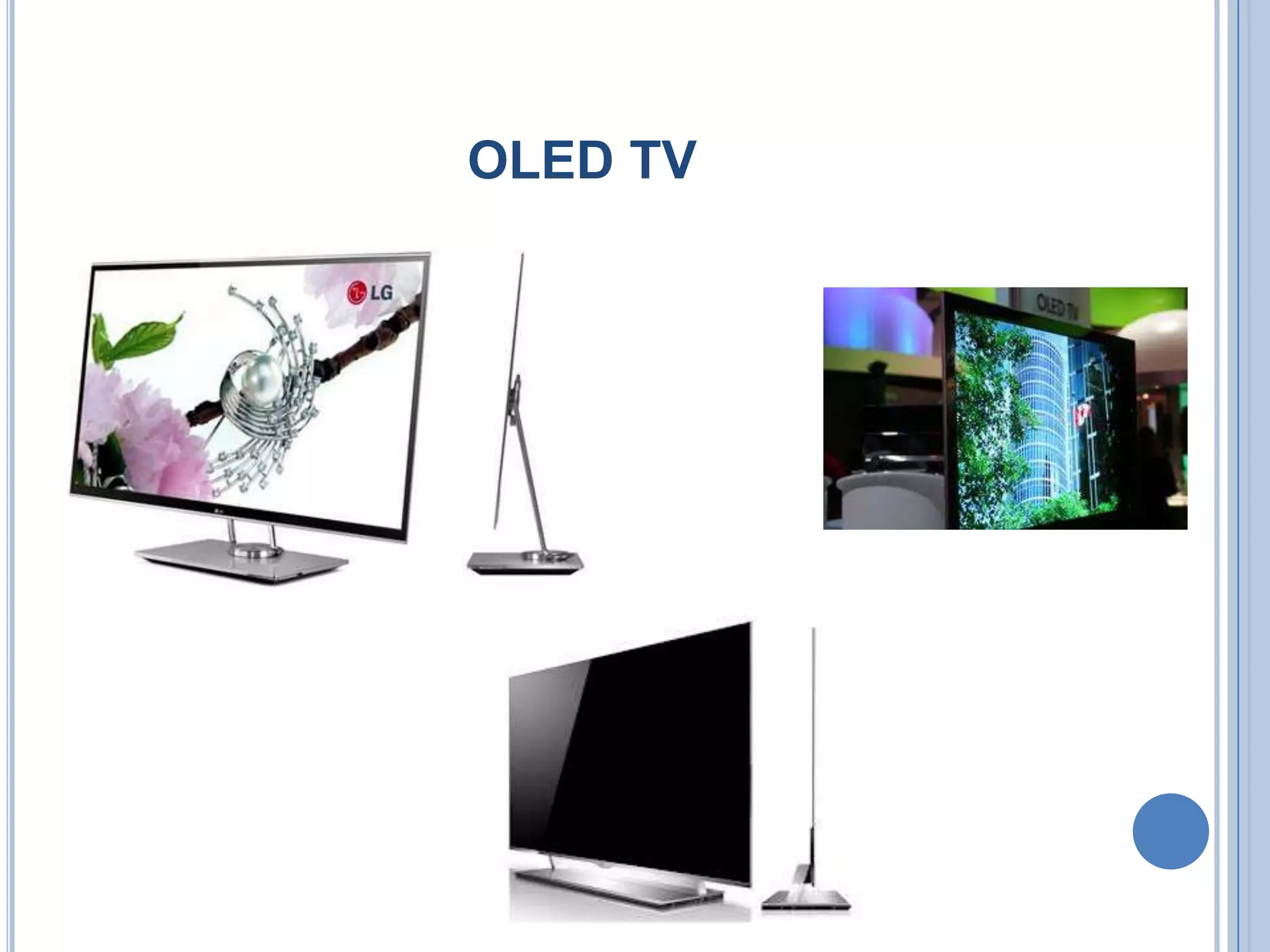
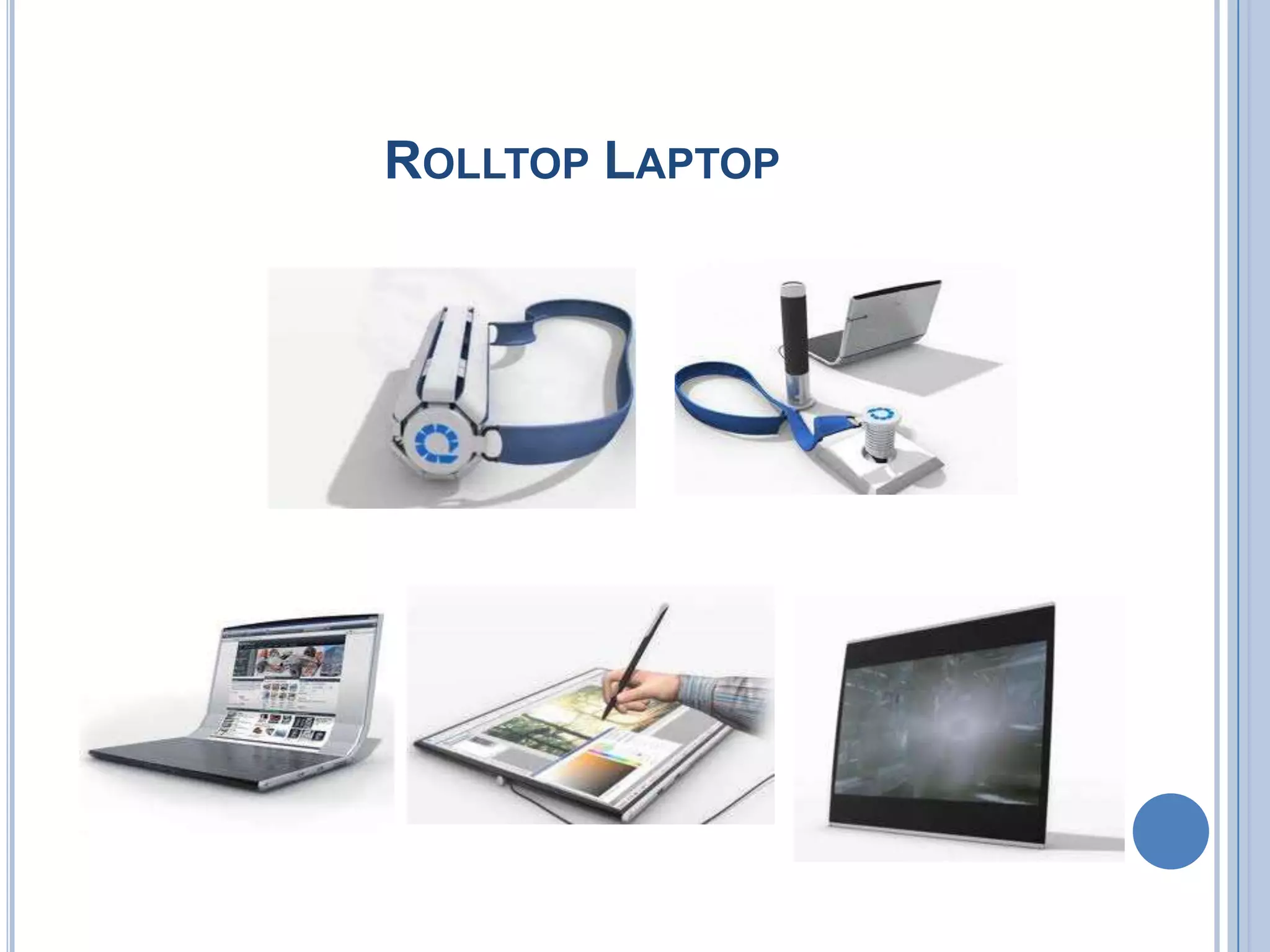
Major applications of OLED technology are
 OLED TV.
 Mobile phones with OLED screens.
 Rolltop Laptop.
OLED TV
MOBILE PHONES WITH OLED SCREEN
ROLLTOP LAPTOP
CONCLUSION
 Organic Light Emitting Diodes are evolving as the
next generation displays.
 As OLED display technology matures, it will be
better able to improve upon certain existing
limitations of LCD including
 high power consumption
 limited viewing angles
 poor contrast ratios.
OLED technology Seminar Ppt

OLED technology Seminar Ppt

  • 1.
  • 2.
    INTRODUCTION  Uses organiclight emitting diode(OLED).  Emerging Technology for displays in devices.  Main principle behind OLED technology is electroluminescence.  Offers brighter, thinner, high contrast, flexible displays.
  • 3.
    WHAT IS ANOLED?  OLEDs are solid state devices composed of thin films of organic molecules that is100 to 500 nanometres thick.  They emits light with the application of electricity.  They doesn’t require any backlight. i.e., they are self emitting.  They are made from carbon and hydrogen.
  • 4.
    HISTORY  The firstOLED device was developed by Eastman Kodak in 1987.  In 1996, pioneer produces the world’s first commercial PMOLED.  In 2000, many companies like Motorola, LG etc developed various displays.  In 2001, Sony developed world’s largest fullcolor OLED.
  • 5.
    HISTORY (CONTD.)  In2002, approximately 3.5 million passive matrix OLED sub-displays were sold, and over 10 million were sold in 2003.  In 2010 and 2011, many companies announced AMOLED displays.  Many developments had take place in the year 2012.
  • 6.
    FEATURES  Flexibility.  EmissiveTechnology.  Light weight and thin.  Low power consumption.  High contrast, brighter and perfect display from all angles.
  • 7.
    STRUCTURE OF OLED Substrate.  Anode.  Organic layer. -Conductive layer (Hole Transport Layer). made up of polyaniline or metal-phthalocyanine. -Emissive layer( Electron Transport Layer). made up of polyfluorene or metal chelates.  Cathode.
  • 8.
  • 9.
    OLED FABRICATION  Substratepreparation.  Device deposition  Deposit and pattern anode.  Pattern organic layers.  Vacuum deposit and pattern cathode.  Encapsulation.  Also involves making backplane.
  • 10.
    OLED DEPOSITION  Organiclayers can be applied to the substrate using the following methods. - Evaporation and shadow masking. - Inkjet printing. - Organic vapor phase deposition.
  • 11.
  • 12.
  • 13.
  • 14.
    COLOUR GENERATION  Differentapproaches for fabricating red, green and blue pixels. - Red, green and blue individual pixels. - White emitter and colour filters. - Blue emitter and colour converters. - Stacked OLED
  • 15.
  • 16.
    WORKING PRINCIPLE  Avoltage is applied across the anode and cathode.  Current flows from cathode to anode through the organic layers.  Electrons flow to emissive layer from the cathode.  Electrons are removed from conductive layer leaving holes.  Holes jump into emissive layer .  Electron and hole combine and light emitted.
  • 17.
  • 18.
  • 19.
    TYPES OF OLED Sixtypes of OLEDs  Passive matrix OLED(PMOLED).  Active matrix OLED(AMOLED).  Transparent OLED(TOLED).  Top emitting OLED.  Flexible OLED(FOLED).  White OLED(WOLED).
  • 20.
  • 21.
  • 22.
  • 23.
  • 24.
  • 25.
  • 26.
    OLED ADVANTAGES  Thinner,lighter and more flexible.  Do not require backlighting like LCDs.  Can be made to larger sizes.  Large fields of view, about 170 degrees.  Faster response time.  Brighter.  High resolution, <5μm pixel size.
  • 27.
    OLED DISADVANTAGES  Expensive. Lifespan.  Water damage.  Colour balance issues .
  • 28.
    OLED VS. LCD Greater view angle.  High contrast.  Faster response time.  Do not require backlighting.  Temperature(~50°C – 80°C).  Limited view angle.  Low contrast.  Slow response time.  Require backlighting.  Temperature(~0°C- 100°C). OLED LCD
  • 29.
    APPLICATIONS Major applications ofOLED technology are  OLED TV.  Mobile phones with OLED screens.  Rolltop Laptop.
  • 30.
  • 31.
    MOBILE PHONES WITHOLED SCREEN
  • 32.
  • 33.
    CONCLUSION  Organic LightEmitting Diodes are evolving as the next generation displays.  As OLED display technology matures, it will be better able to improve upon certain existing limitations of LCD including  high power consumption  limited viewing angles  poor contrast ratios.