Rectifiers, Light Emitting Diode,
Photodiode, Photocoupler and
Linear Voltage Regulators
References
1. Electronic Devices by Thomas L Floyd, Prentice Hall, 2012
2. Electronics Devices and Circuit Theory by Boylestad and Nashelsky,
Pearson Education, 2014
3. Electronic Principles by Malvino and Bates, McGraw-Hill Education,
2015
Rectifiers
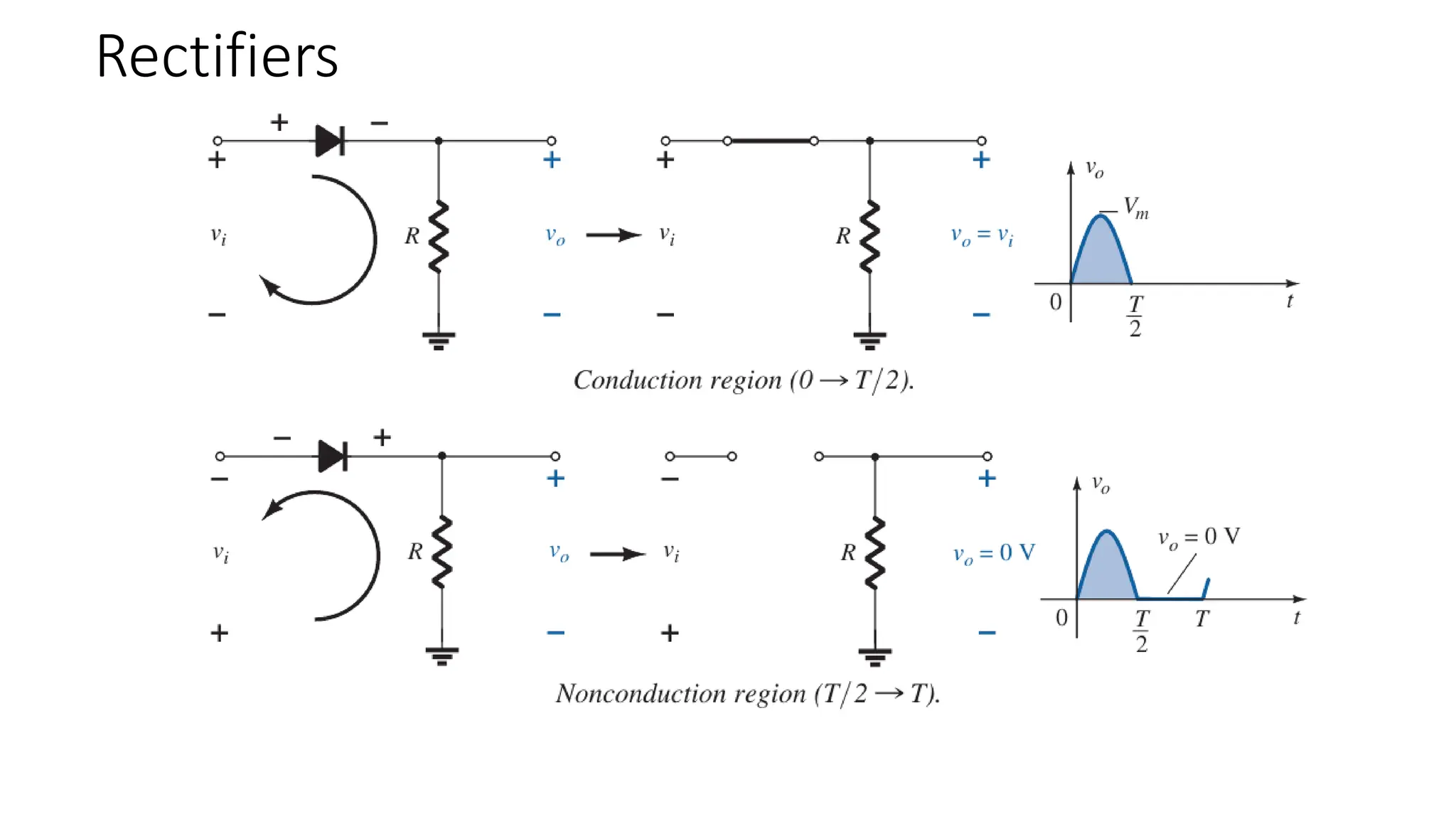
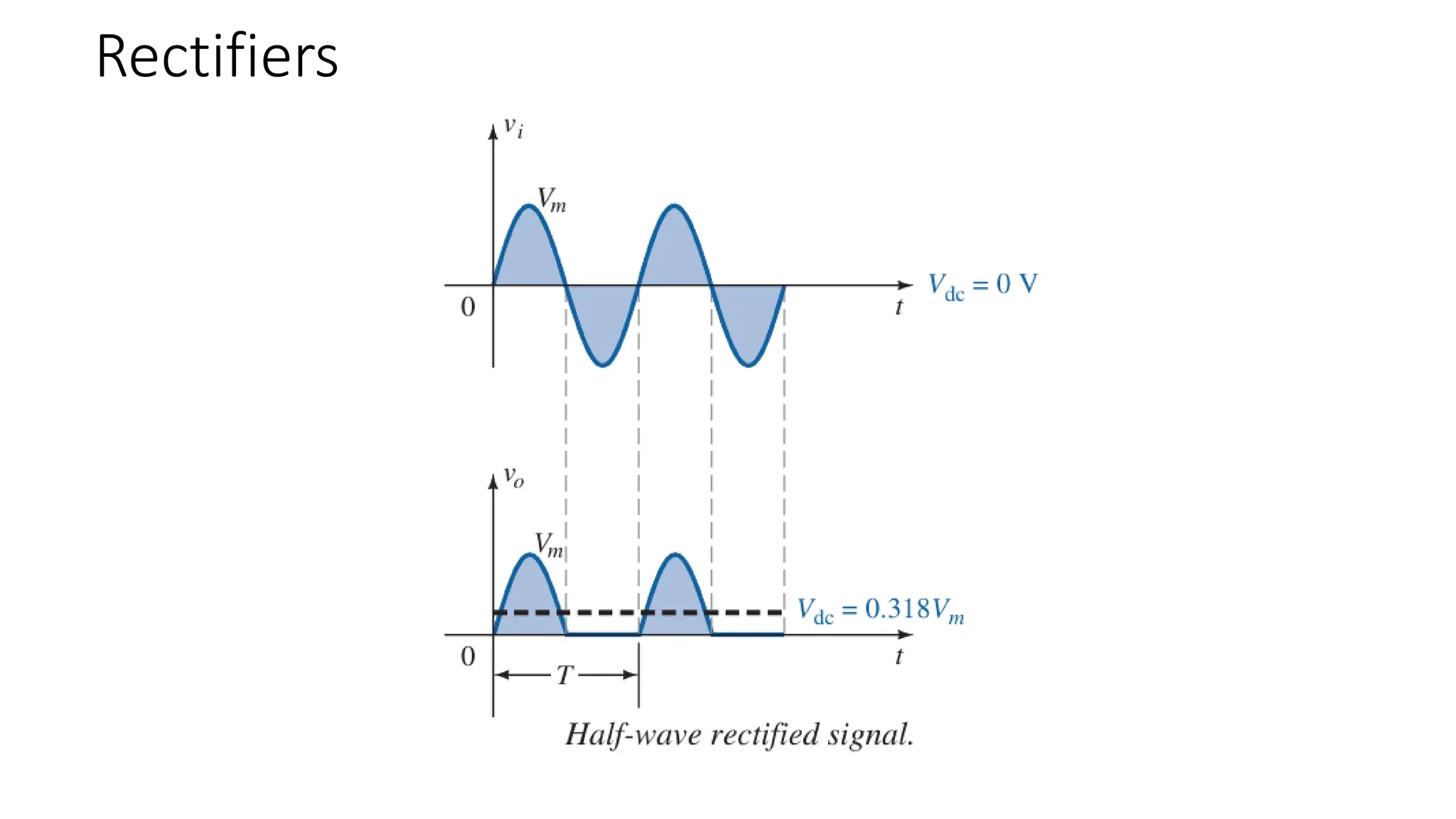
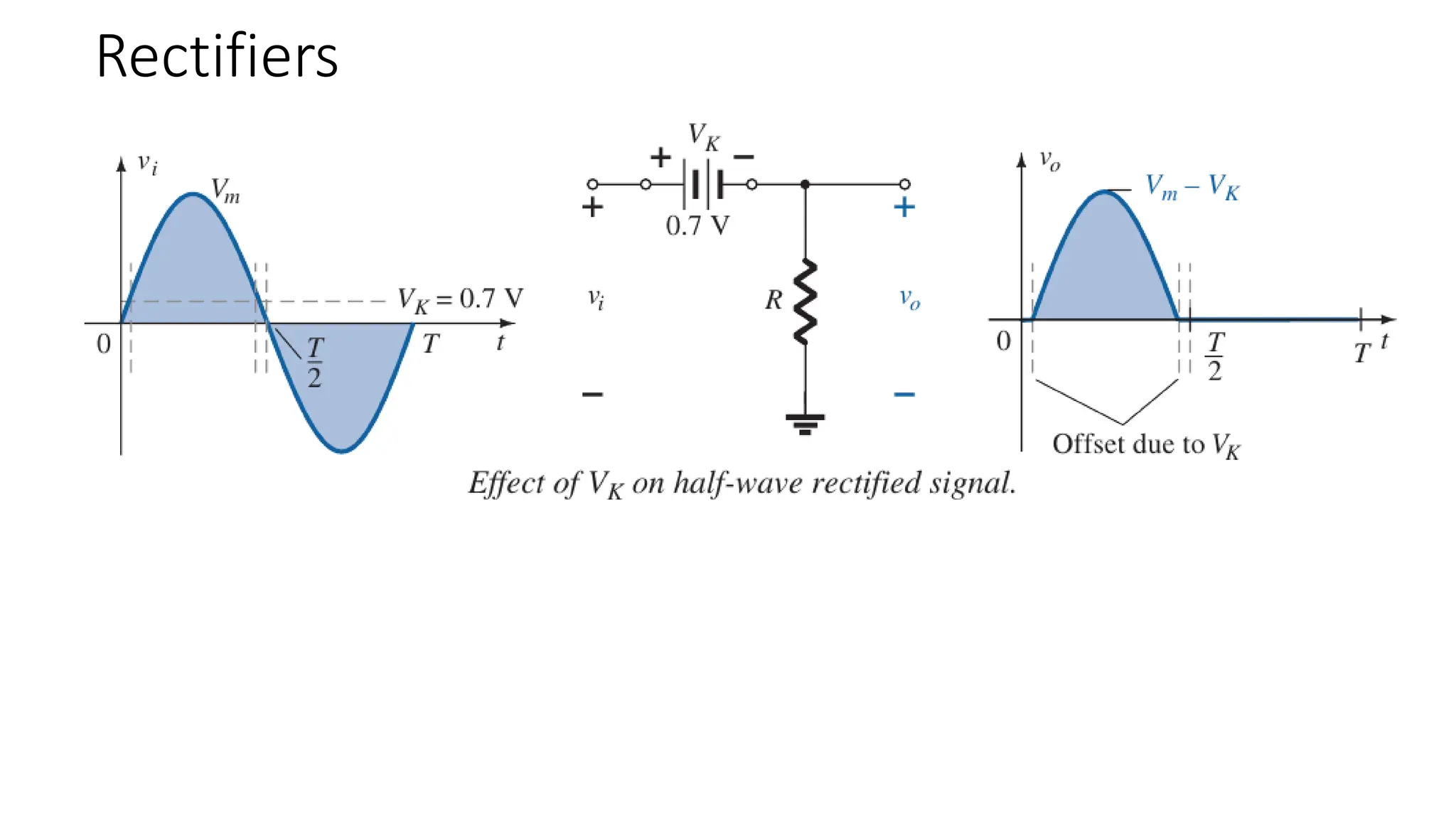
• Because of diodes’ ability to conduct current in one direction and block current in the other
direction, diodes are used in circuits called rectifiers that convert ac voltage into dc voltage.
• Rectifiers are found in all dc power supplies that operate from an ac voltage source. A power
supply is an essential part of each electronic system from the simplest to the most complex.
Half-wave rectifier
Rectifiers
Rectifiers
Rectifiers
Rectifiers
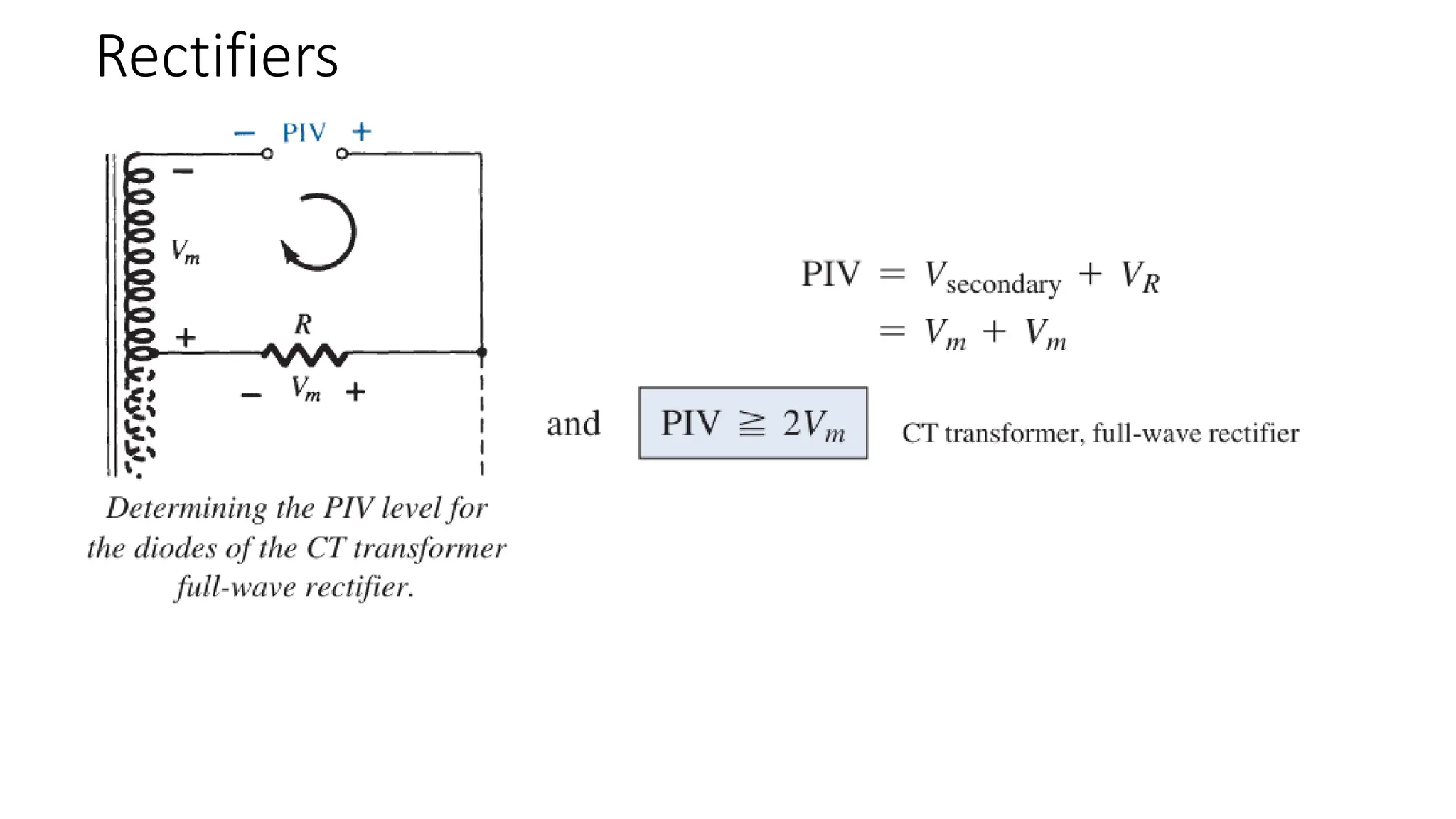
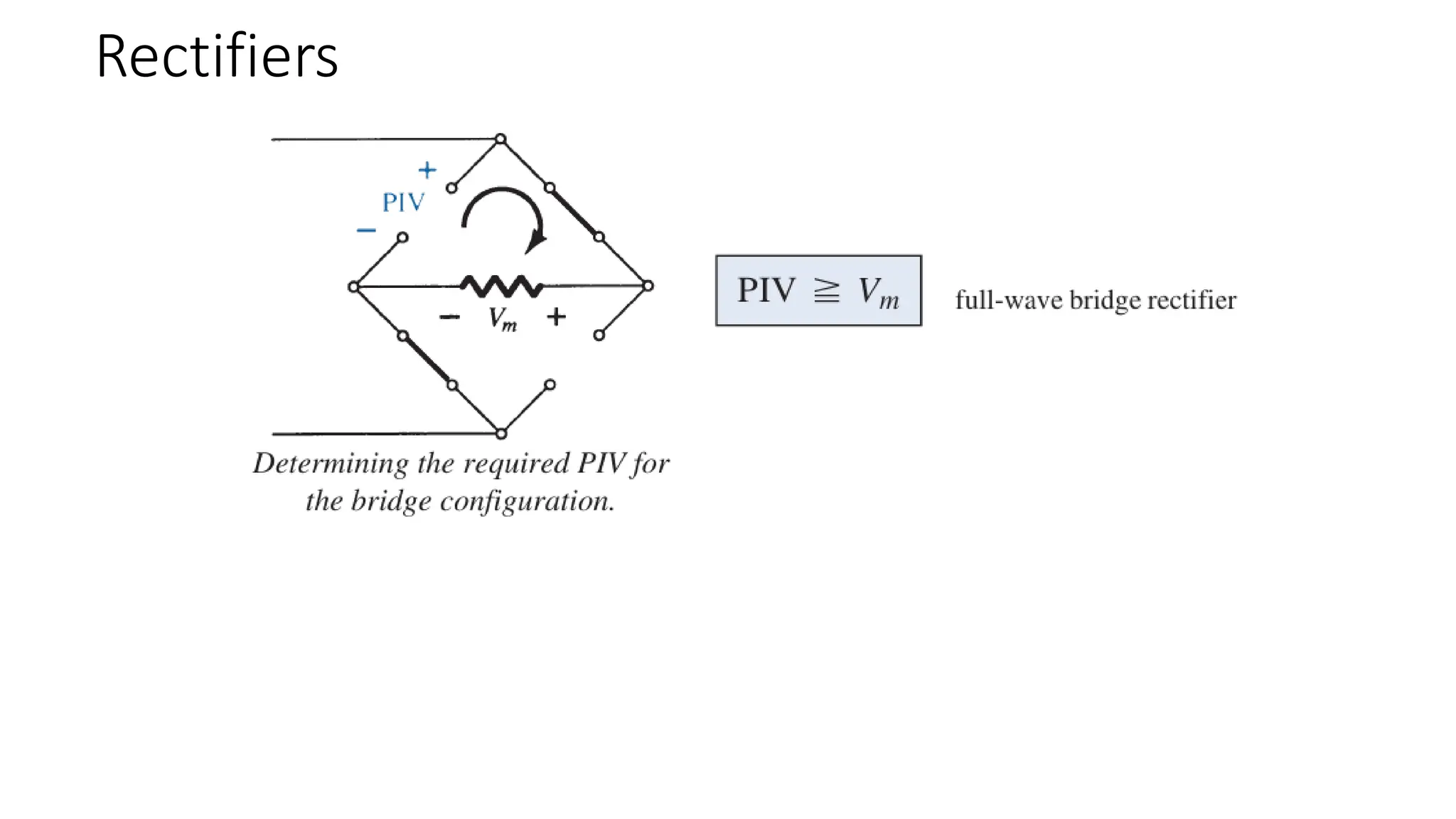
The peak inverse voltage (PIV) [or PRV (peak reverse voltage)] rating of the diode is of primary
importance in the design of rectification systems. Recall that it is the voltage rating that must
not be exceeded in the reverse-bias region or the diode will enter the Zener avalanche region.
Rectifiers
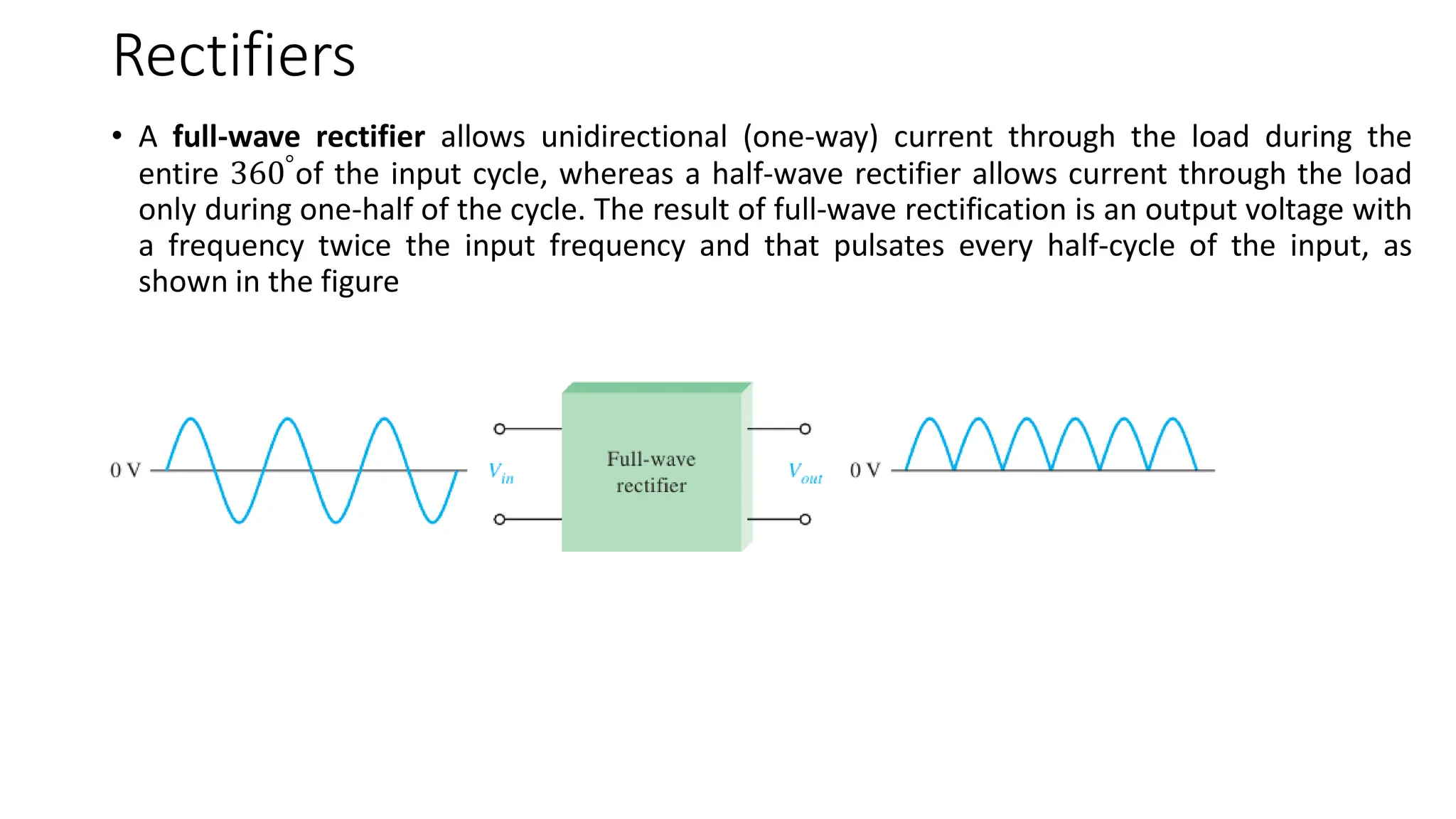
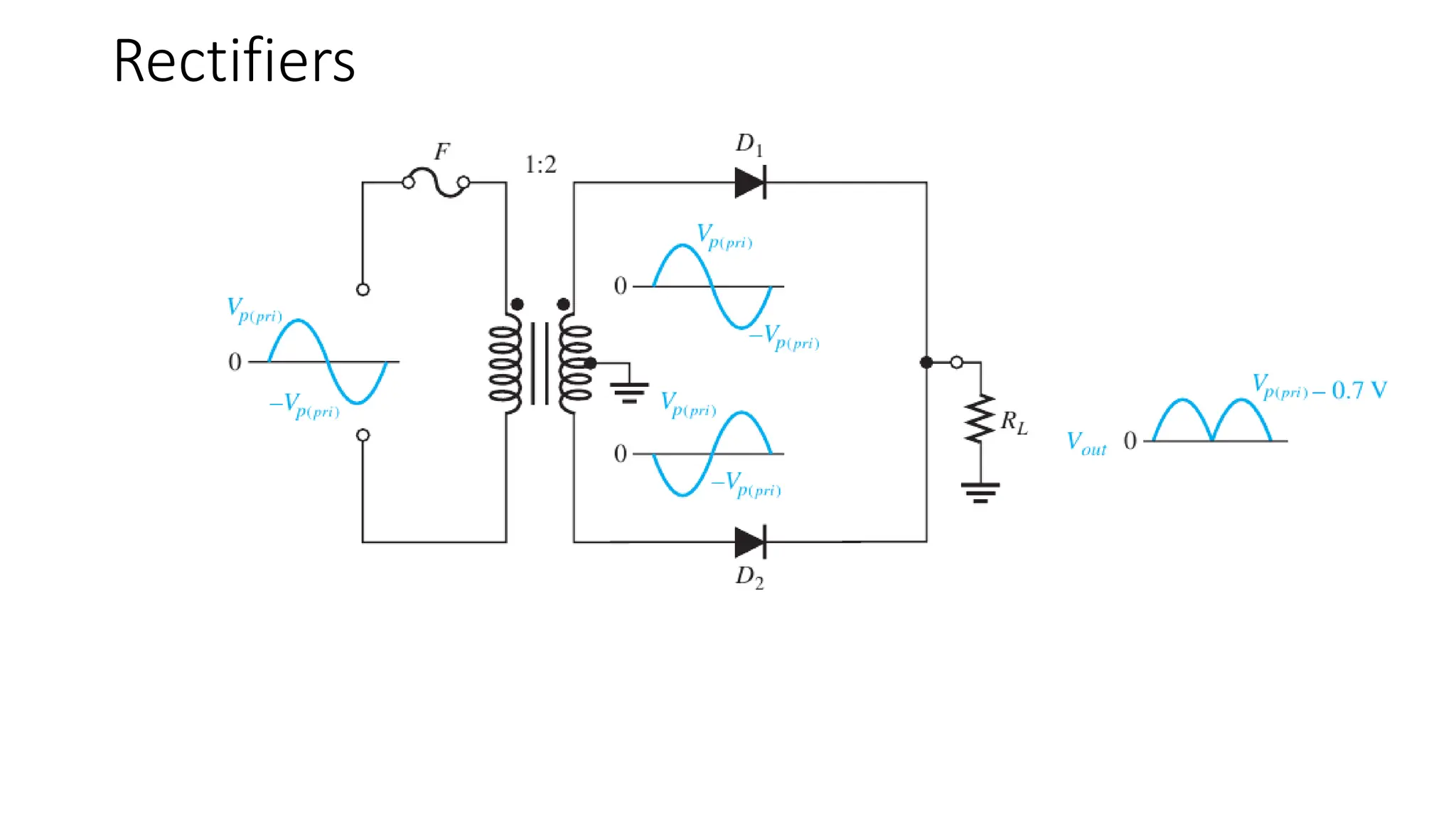
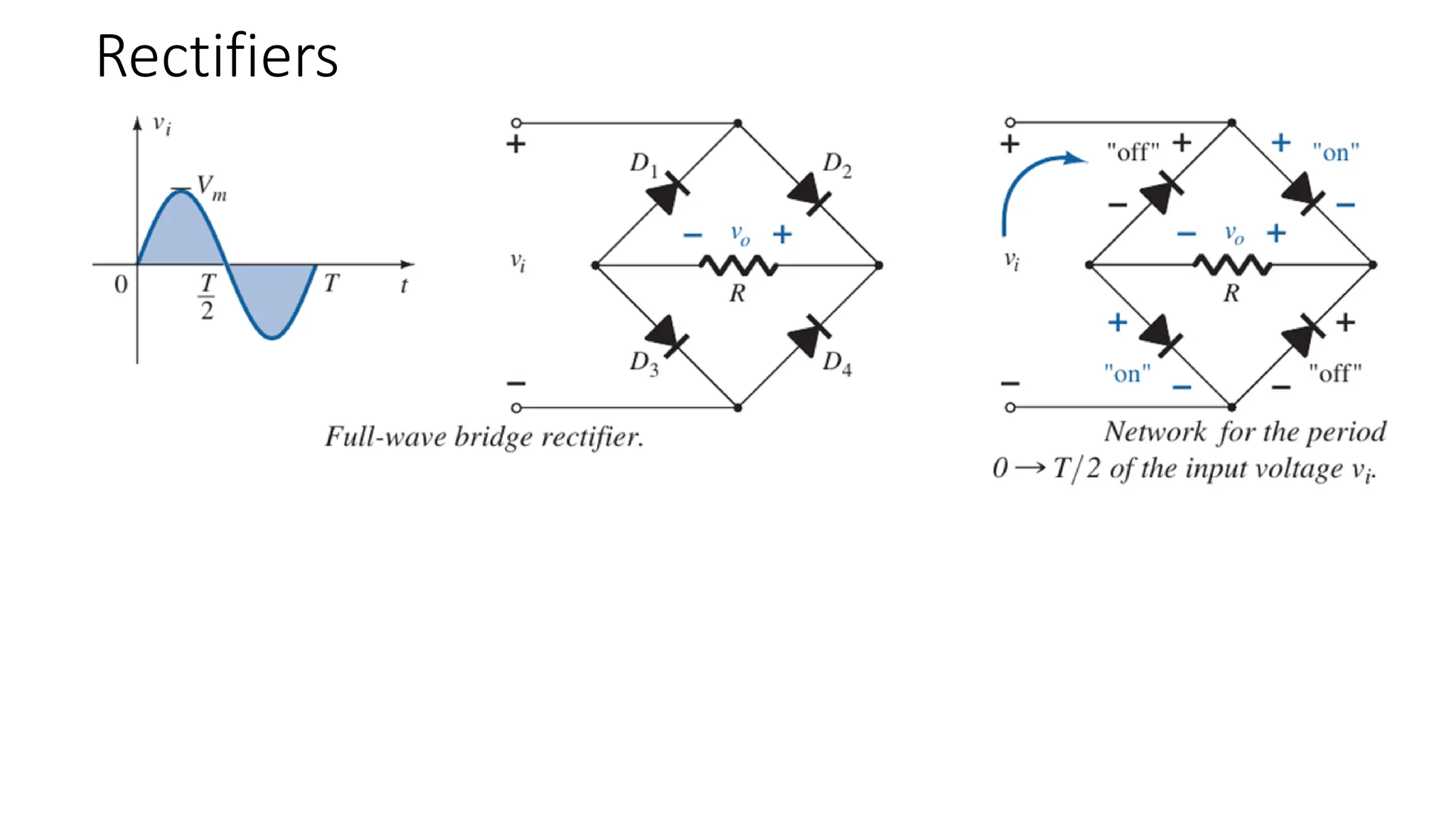
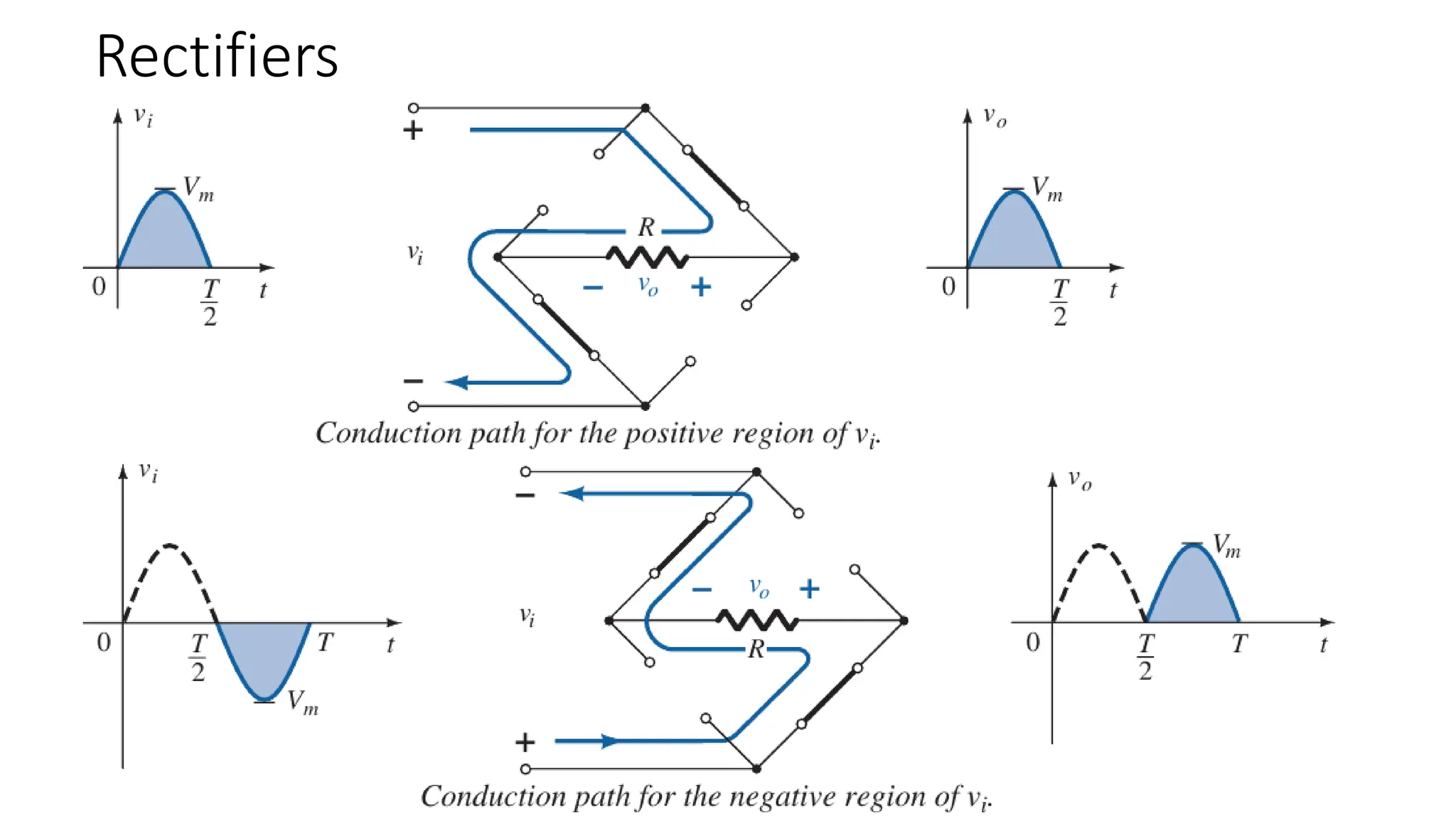
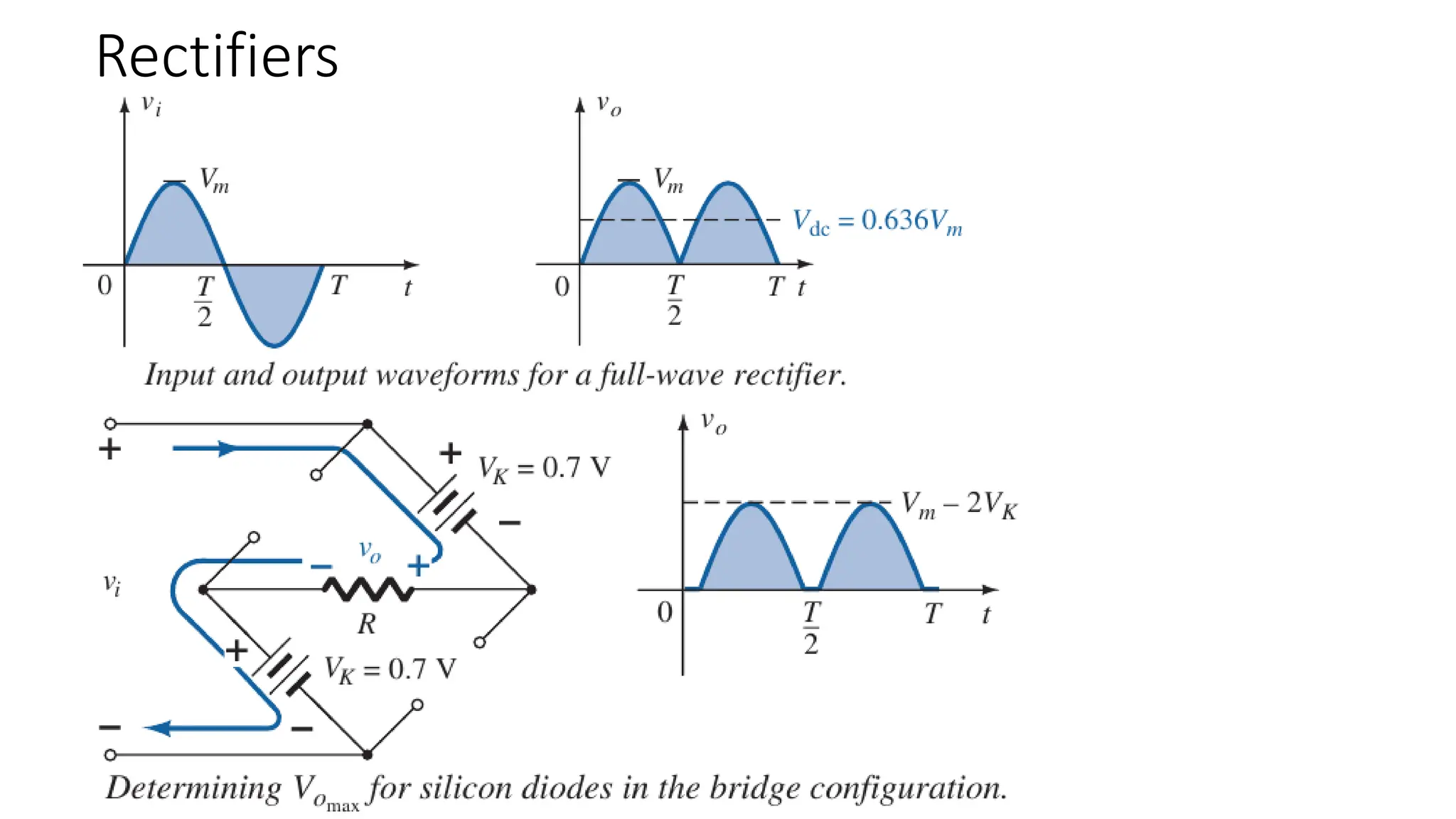
• A full-wave rectifier allows unidirectional (one-way) current through the load during the
entire 360°
of the input cycle, whereas a half-wave rectifier allows current through the load
only during one-half of the cycle. The result of full-wave rectification is an output voltage with
a frequency twice the input frequency and that pulsates every half-cycle of the input, as
shown in the figure
Rectifiers
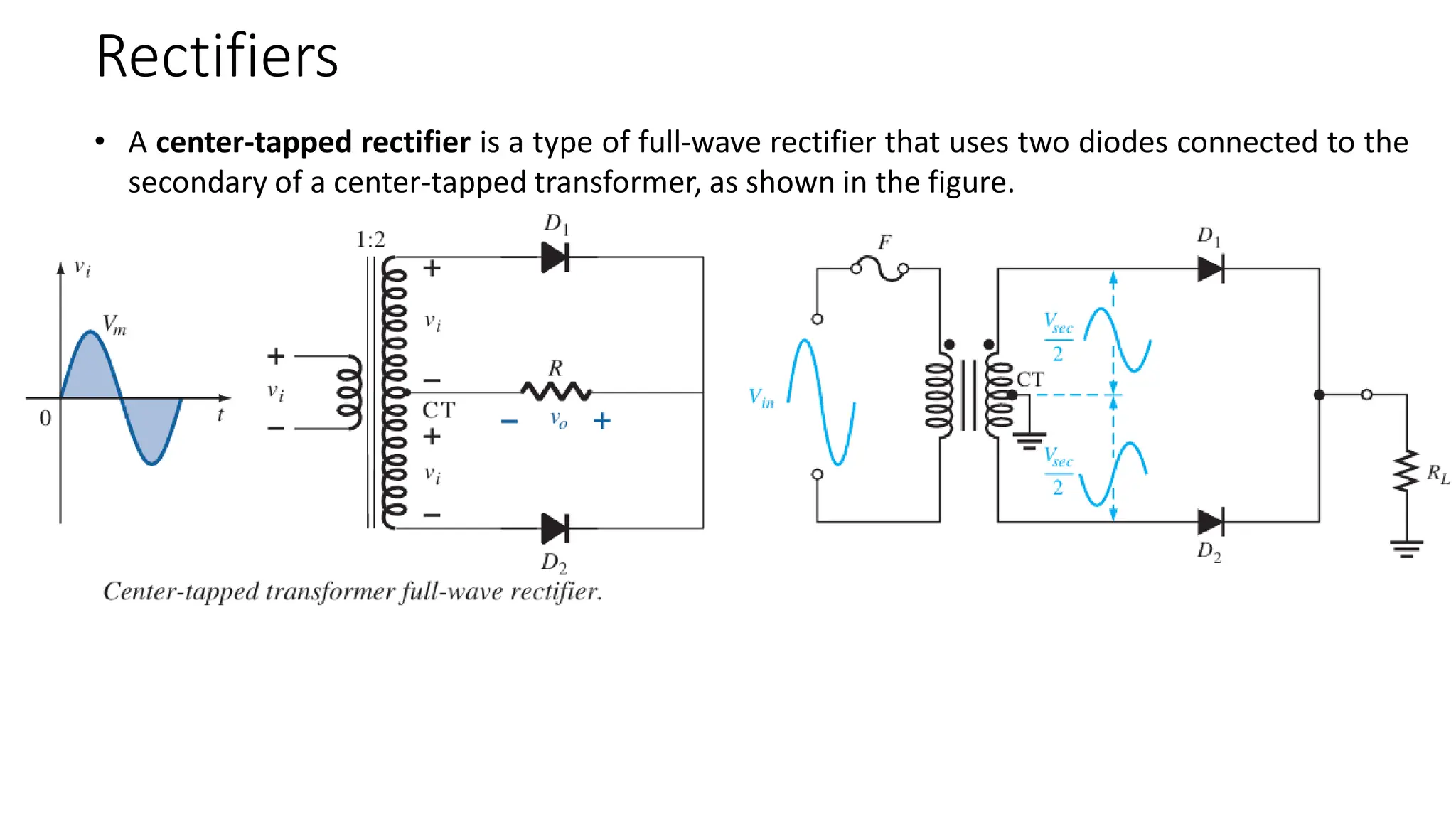
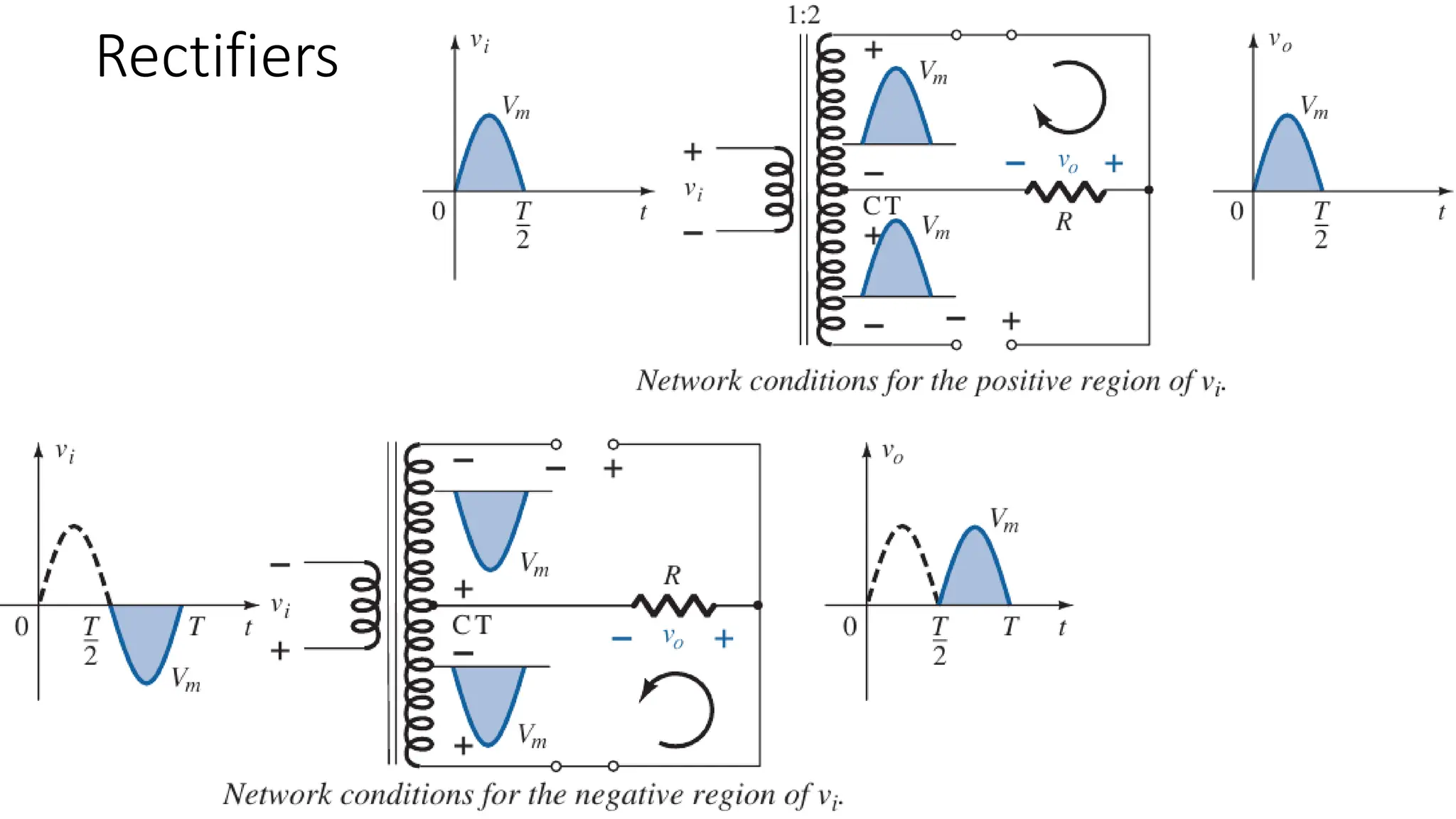
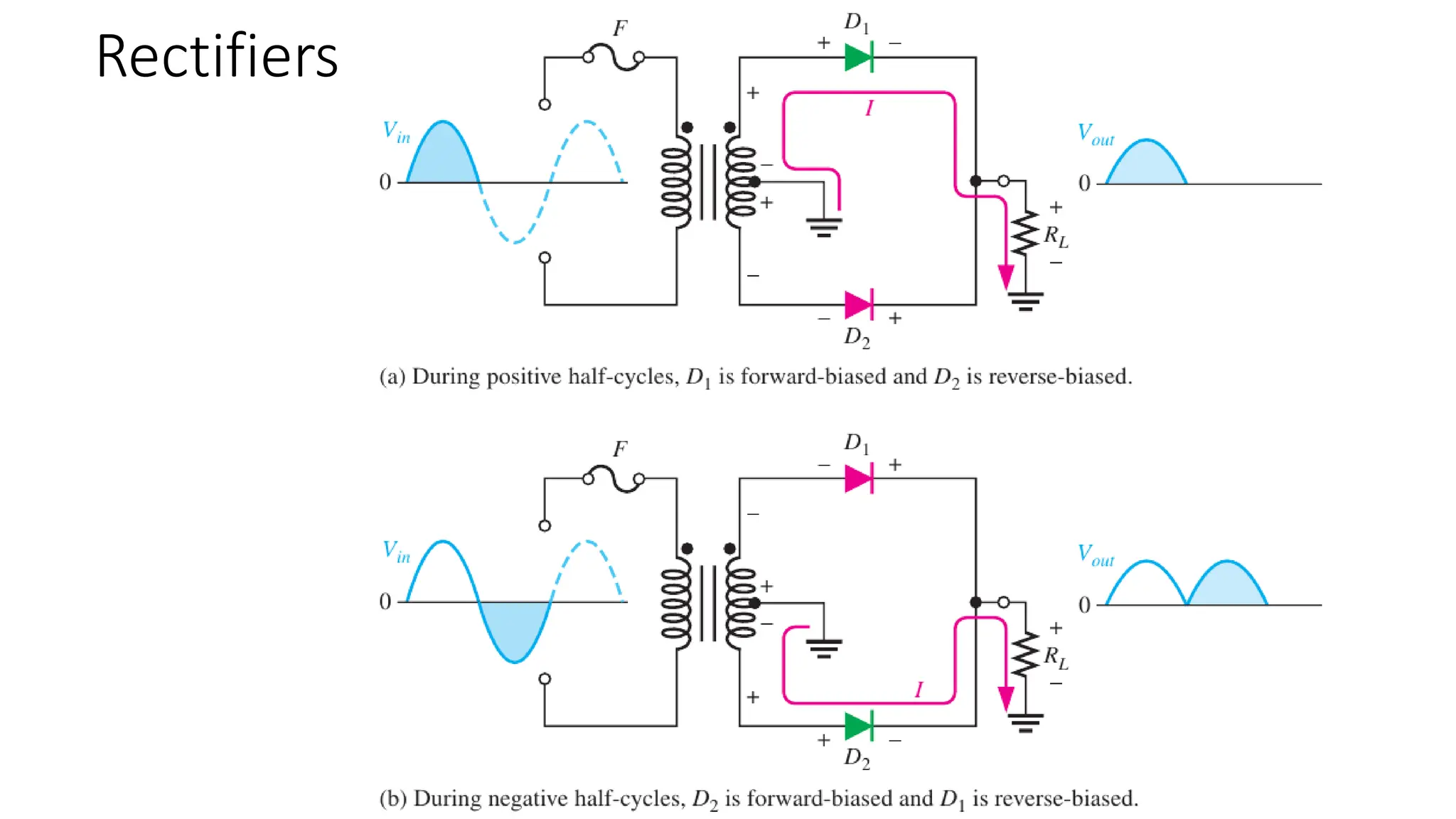
• A center-tapped rectifier is a type of full-wave rectifier that uses two diodes connected to the
secondary of a center-tapped transformer, as shown in the figure.
Rectifiers
Rectifiers
Rectifiers
Rectifiers
Rectifiers
Rectifiers
Rectifiers
Rectifiers
Rectifier with filters
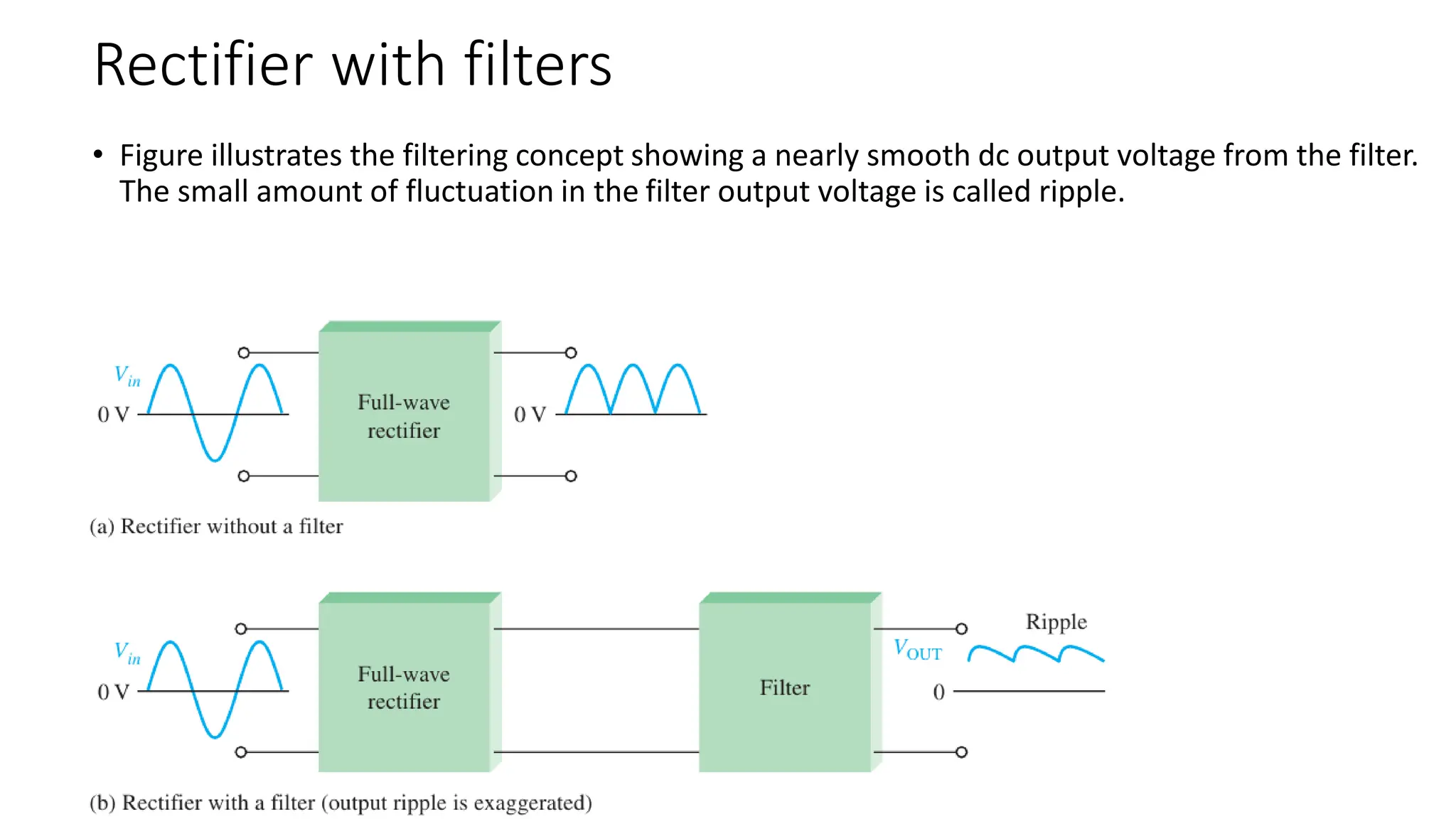
• Figure illustrates the filtering concept showing a nearly smooth dc output voltage from the filter.
The small amount of fluctuation in the filter output voltage is called ripple.
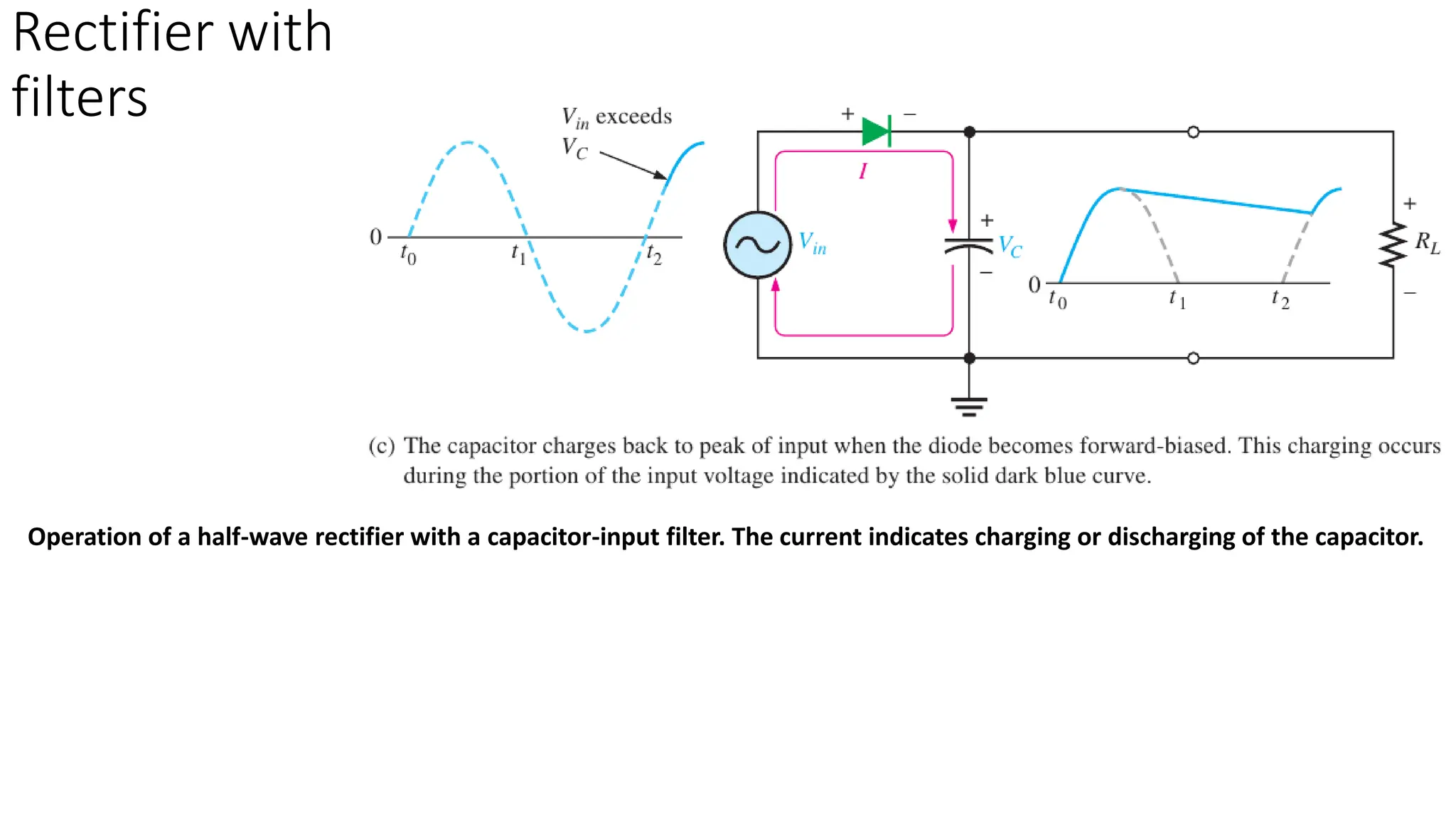
Rectifier with
filters
Rectifier with
filters
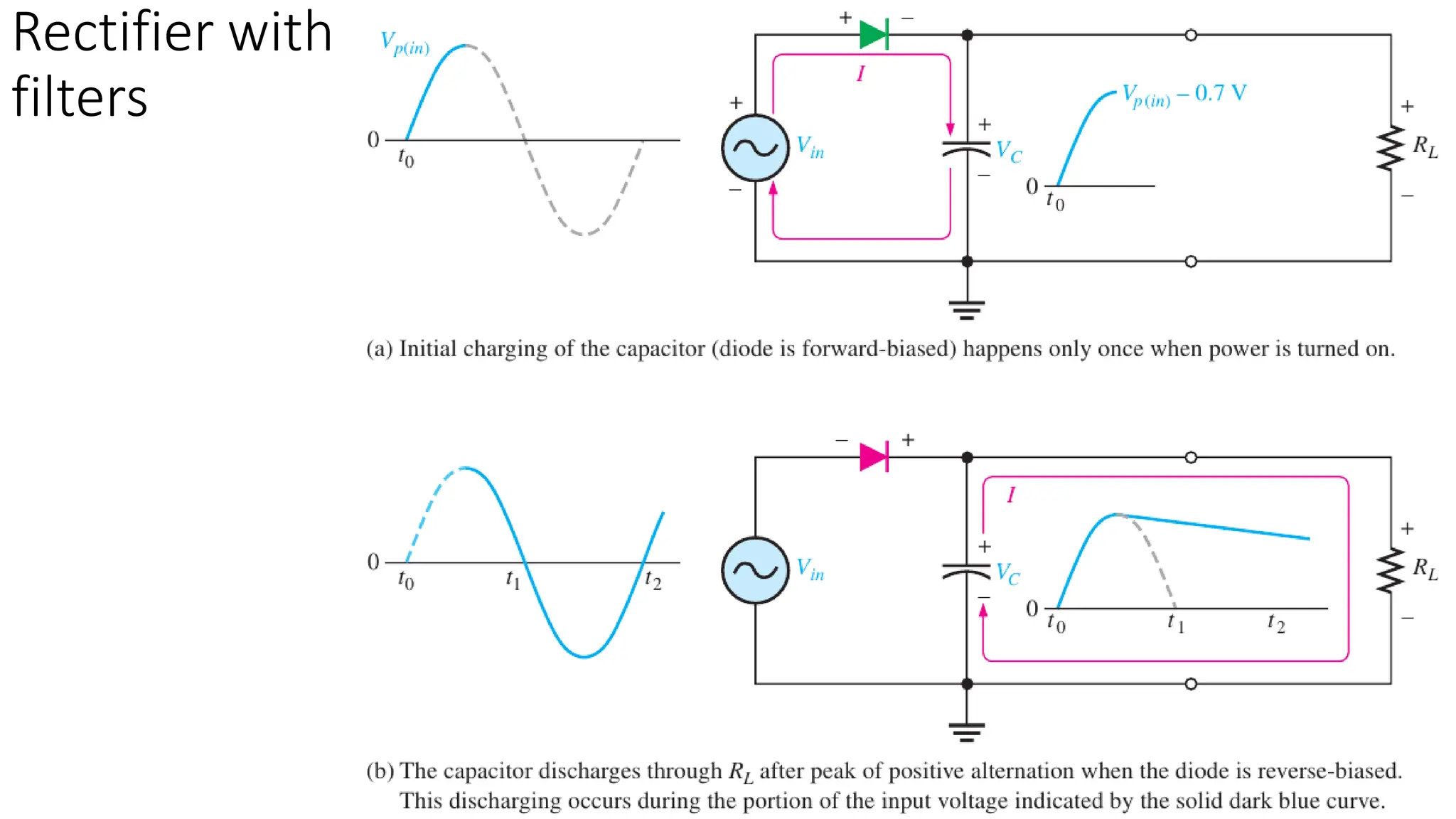
Operation of a half-wave rectifier with a capacitor-input filter. The current indicates charging or discharging of the capacitor.
Rectifier with filters
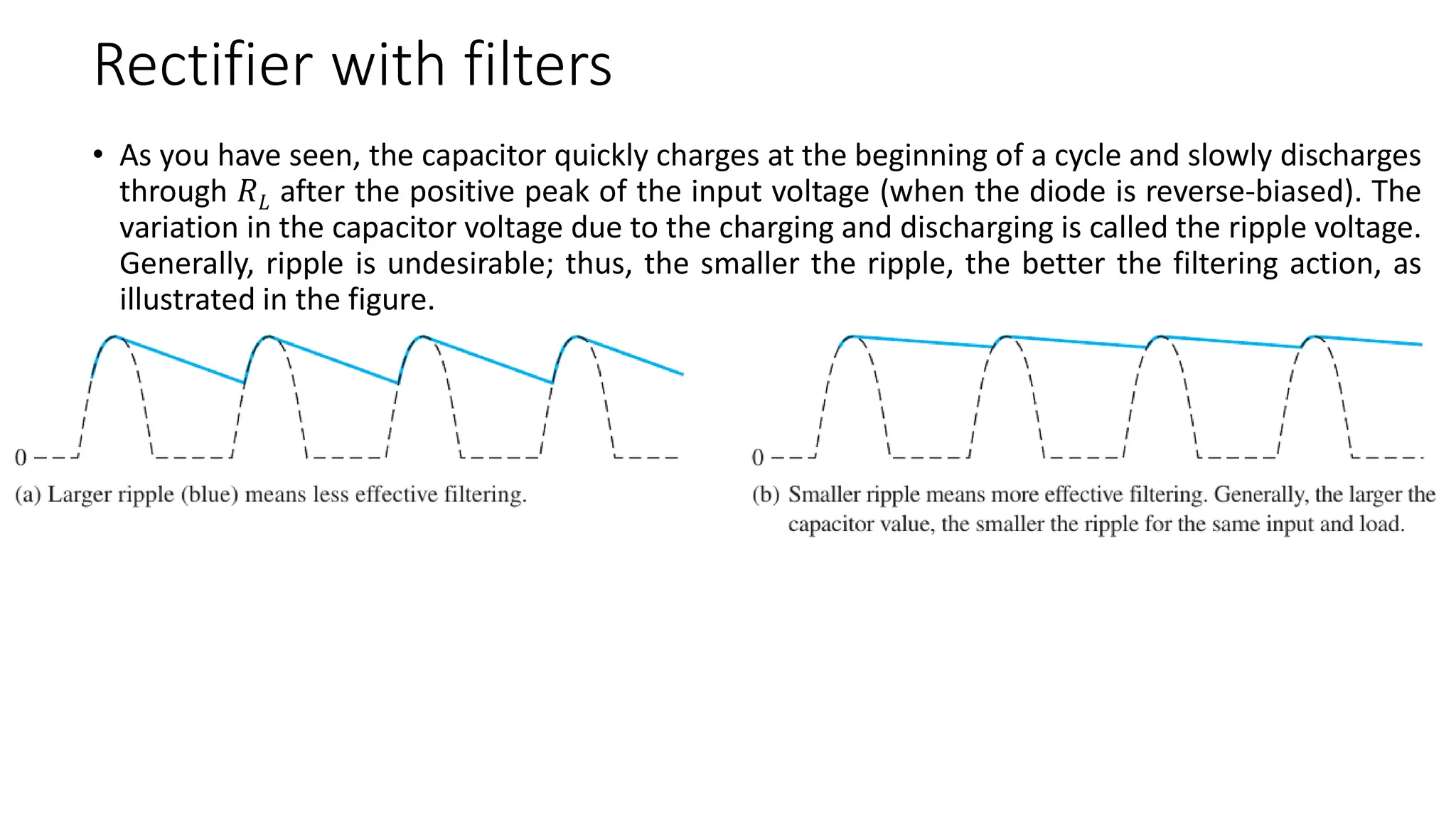
• As you have seen, the capacitor quickly charges at the beginning of a cycle and slowly discharges
through 𝑅𝐿 after the positive peak of the input voltage (when the diode is reverse-biased). The
variation in the capacitor voltage due to the charging and discharging is called the ripple voltage.
Generally, ripple is undesirable; thus, the smaller the ripple, the better the filtering action, as
illustrated in the figure.
Rectifier with filters
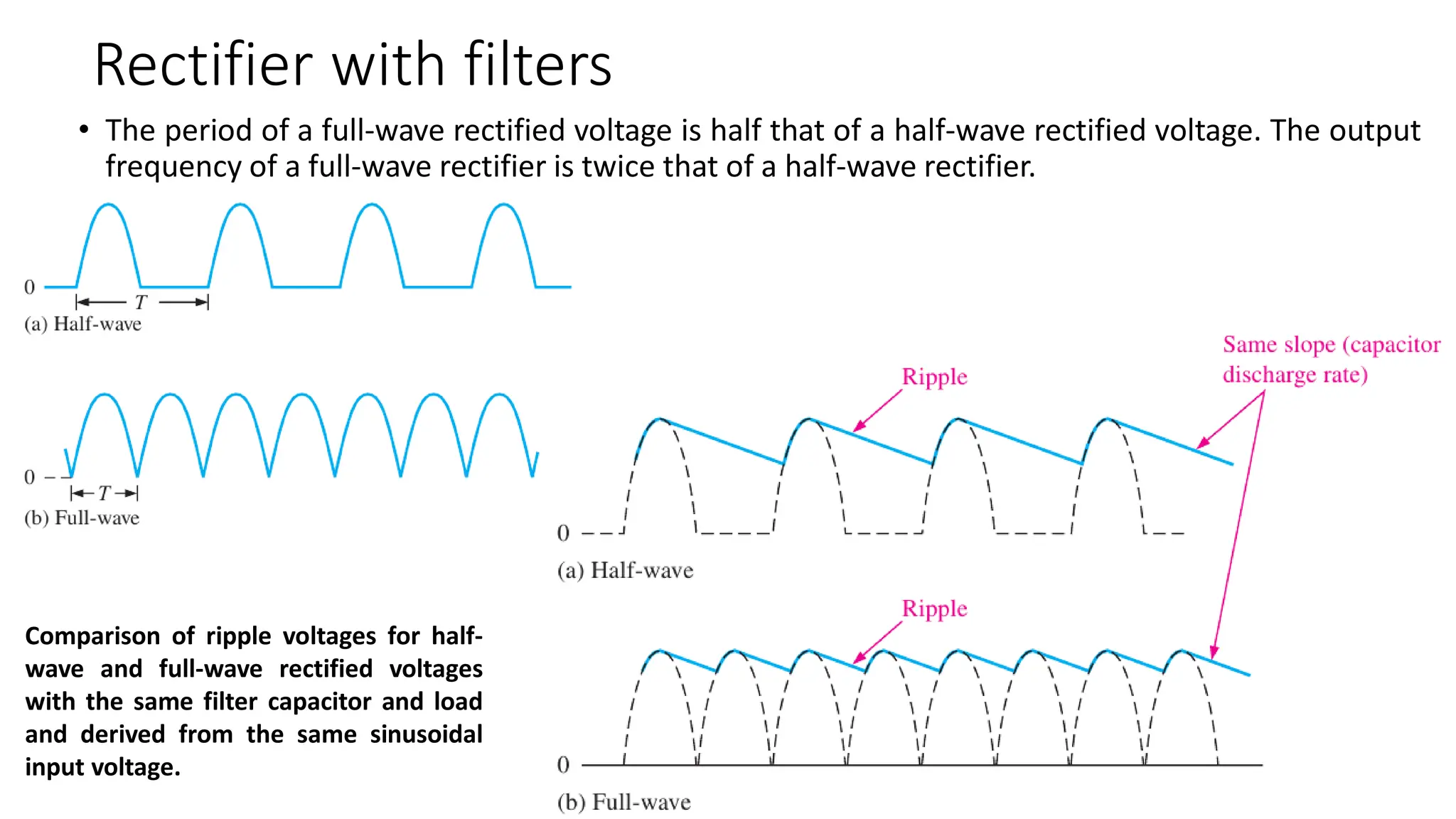
• The period of a full-wave rectified voltage is half that of a half-wave rectified voltage. The output
frequency of a full-wave rectifier is twice that of a half-wave rectifier.
Comparison of ripple voltages for half-
wave and full-wave rectified voltages
with the same filter capacitor and load
and derived from the same sinusoidal
input voltage.
The Light-Emitting Diode (LED)
• The LED is a diode that gives off visible or invisible (infrared) light when energized.
• In any forward-biased p–n junction there is, within the structure and primarily close to the
junction, a recombination of holes and electrons. This recombination requires that the energy
possessed by the unbound free electrons be transferred to another state.
• In all semiconductor p–n junctions some of this energy is given off in the form of heat and
some in the form of photons.
• In Si and Ge diodes the greater percentage of the energy converted during recombination at
the junction is dissipated in the form of heat within the structure, and the emitted light is
insignificant. For this reason, silicon and germanium are not used in the construction of LED
devices.
LED (Cont’d)
• Diodes constructed of GaAs emit light in the infrared (invisible) zone during the recombination
process at the p–n junction.
• Even though the light is not visible, infrared LEDs have numerous applications where visible
light is not a desirable effect. These include security systems, industrial processing, optical
coupling, safety controls such as on garage door openers, and in home entertainment centers,
where the infrared light of the remote control is the controlling element.
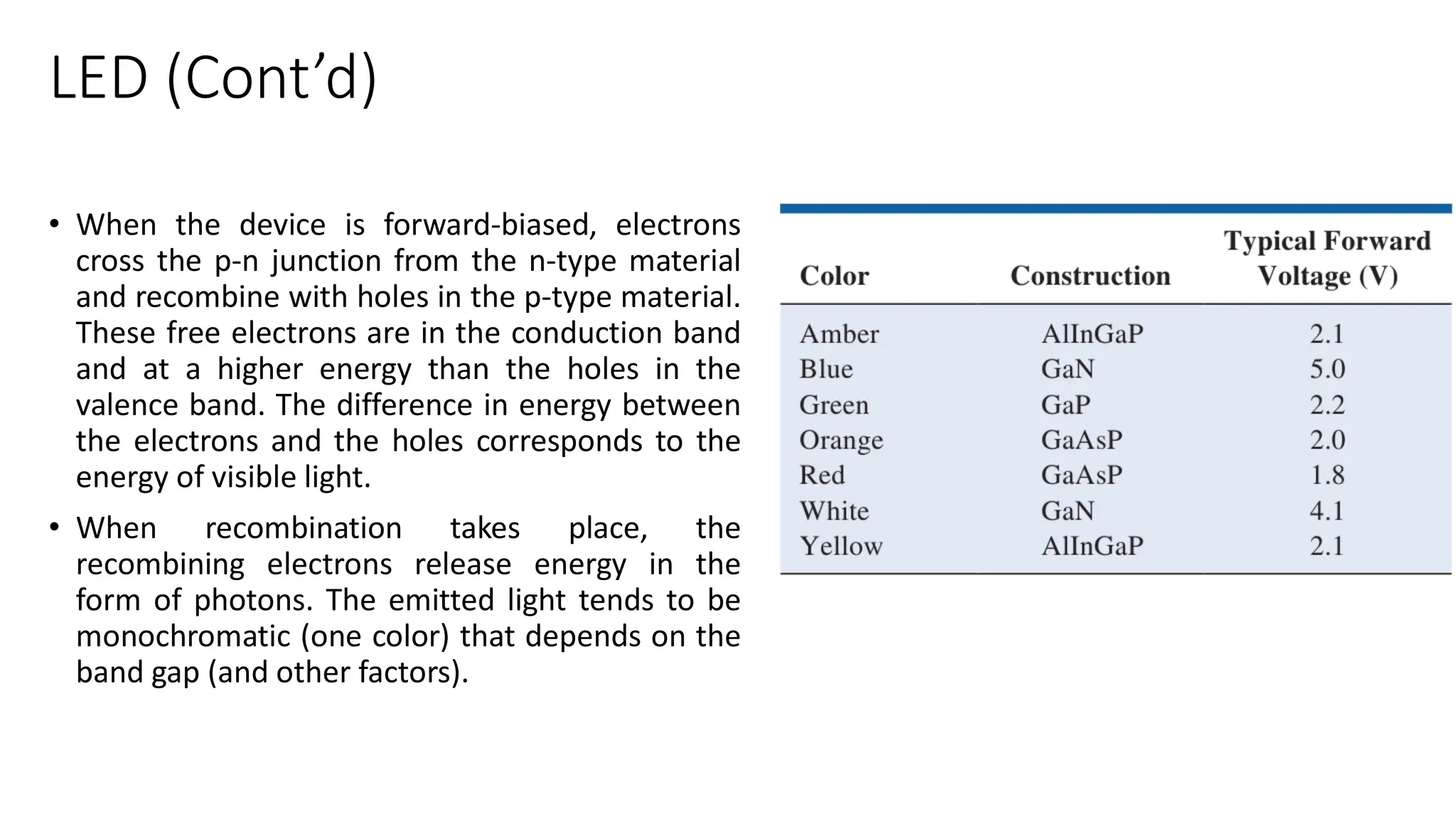
• The following table provides a list of common compound semiconductors and the light they
generate. In addition, the typical range of forward bias potentials for each is listed.
LED (Cont’d)
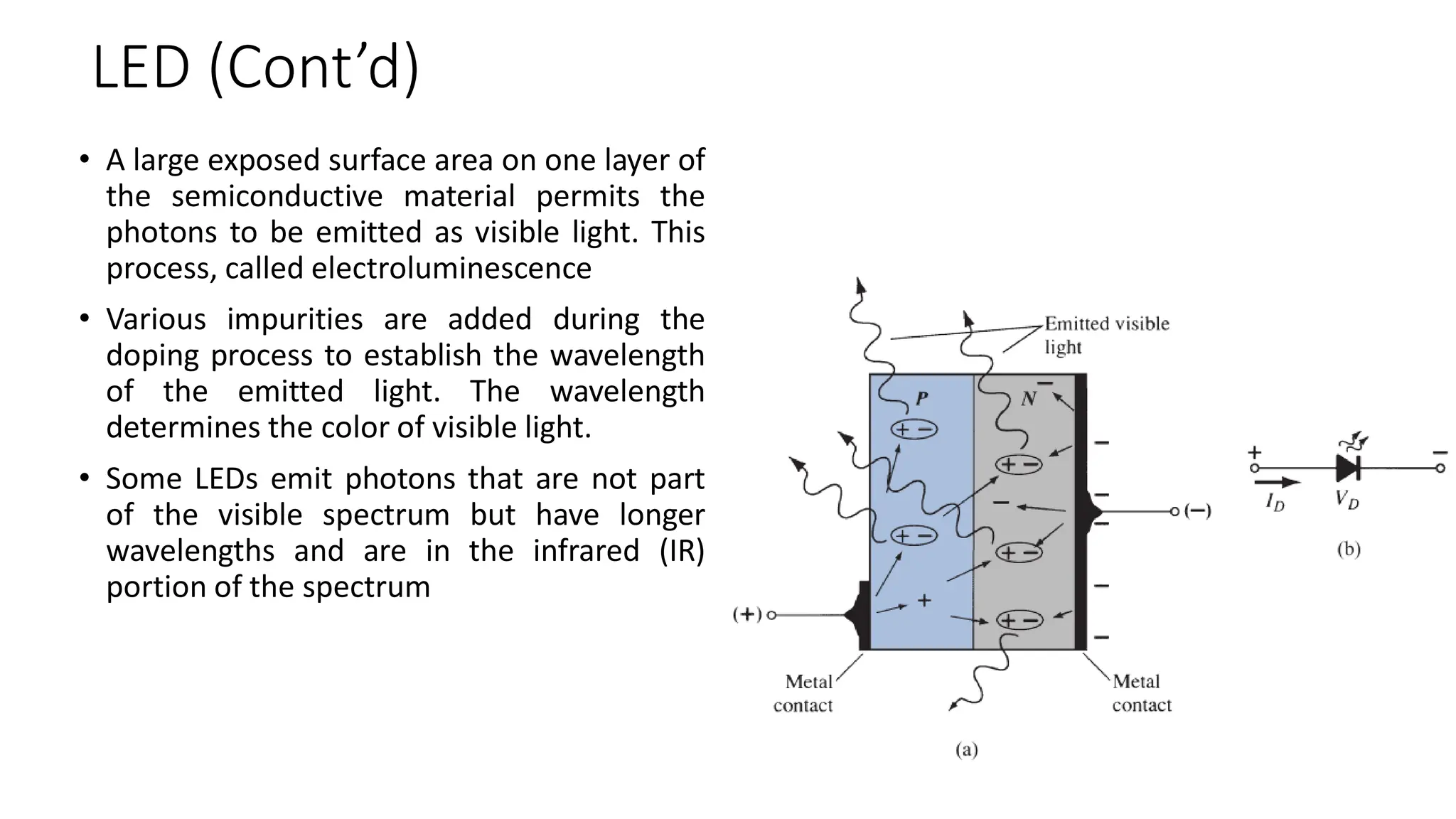
• When the device is forward-biased, electrons
cross the p-n junction from the n-type material
and recombine with holes in the p-type material.
These free electrons are in the conduction band
and at a higher energy than the holes in the
valence band. The difference in energy between
the electrons and the holes corresponds to the
energy of visible light.
• When recombination takes place, the
recombining electrons release energy in the
form of photons. The emitted light tends to be
monochromatic (one color) that depends on the
band gap (and other factors).
LED (Cont’d)
• A large exposed surface area on one layer of
the semiconductive material permits the
photons to be emitted as visible light. This
process, called electroluminescence
• Various impurities are added during the
doping process to establish the wavelength
of the emitted light. The wavelength
determines the color of visible light.
• Some LEDs emit photons that are not part
of the visible spectrum but have longer
wavelengths and are in the infrared (IR)
portion of the spectrum
LED (Cont’d)
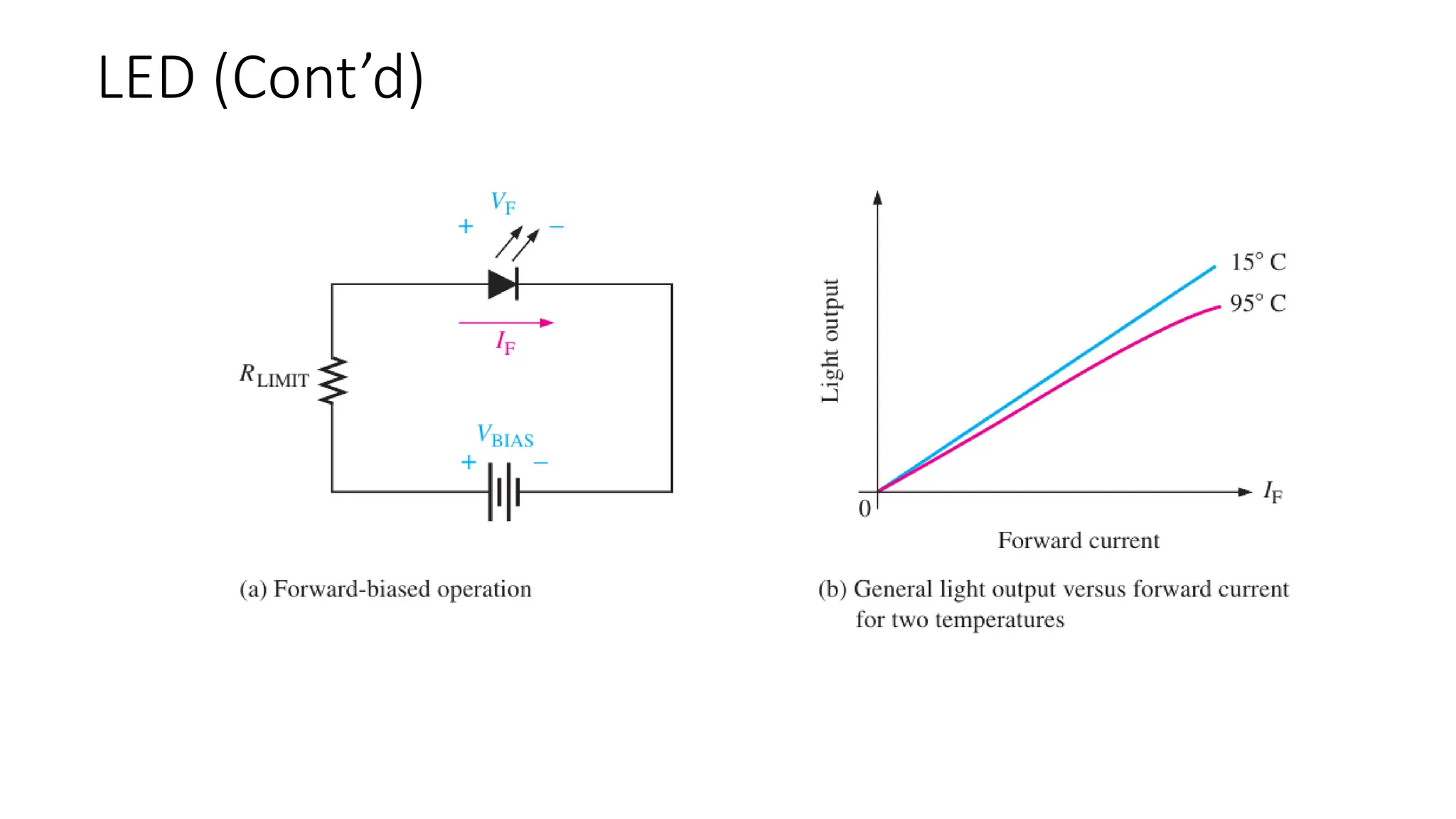
• The forward voltage across an LED is considerably greater than for a silicon diode.
• Typically, the maximum 𝑉𝐹 for LEDs is between 1.2 V and 4.1 V, depending on the material.
Reverse breakdown for an LED is much less than for a silicon rectifier diode (3 V to 10 V is
typical).
• The LED emits light in response to a sufficient forward current, as shown in the figure. The
amount of power output translated into light is directly proportional to the forward current,
as indicated in the figure.
• An increase in 𝐼𝐹 corresponds proportionally to an increase in light output. The light output
(both intensity and color) is also dependent on temperature. Light intensity goes down with
higher temperature as indicated in the figure.
LED (Cont’d)
LED (Cont’d)
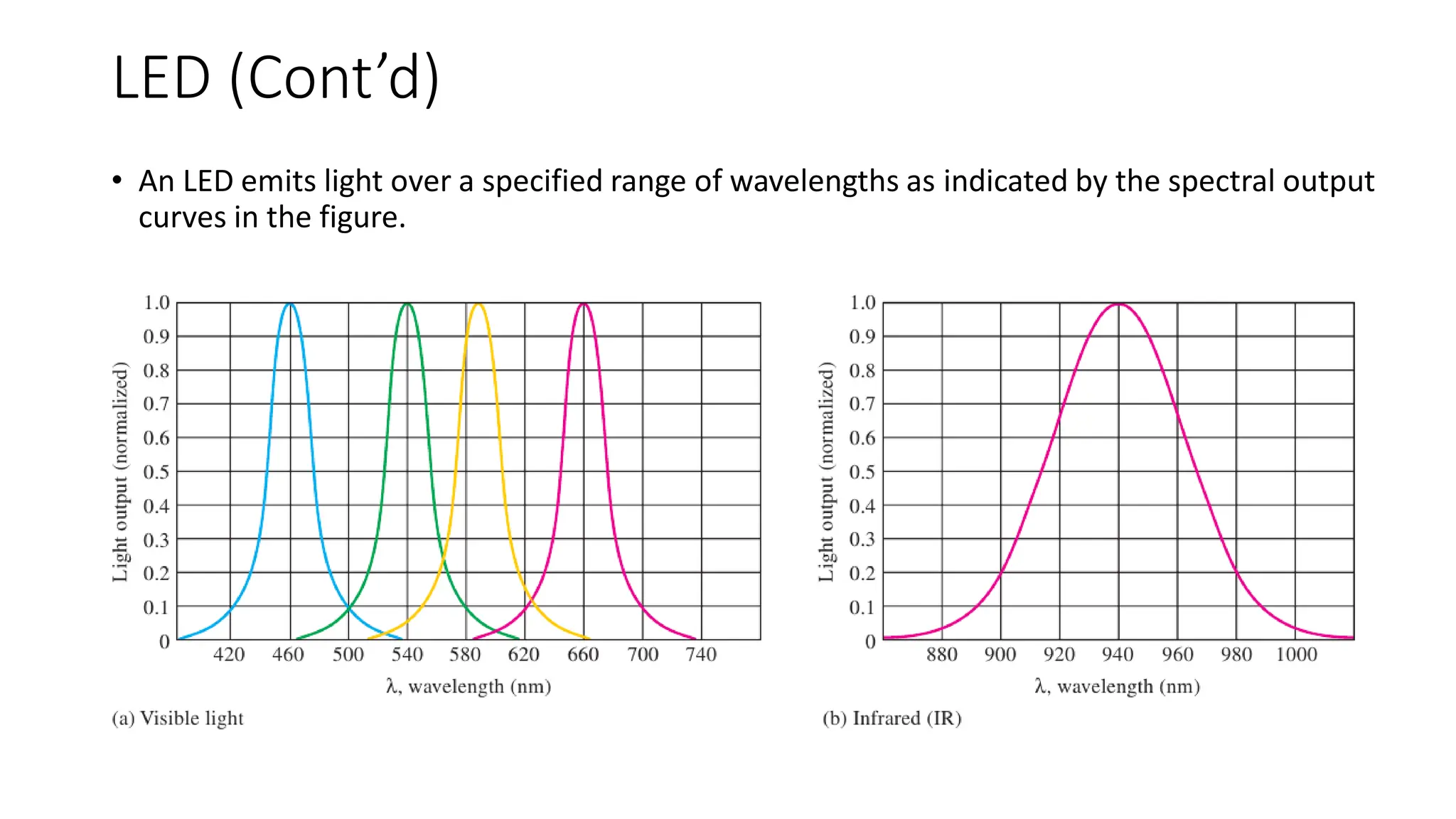
• An LED emits light over a specified range of wavelengths as indicated by the spectral output
curves in the figure.
LED (Cont’d)
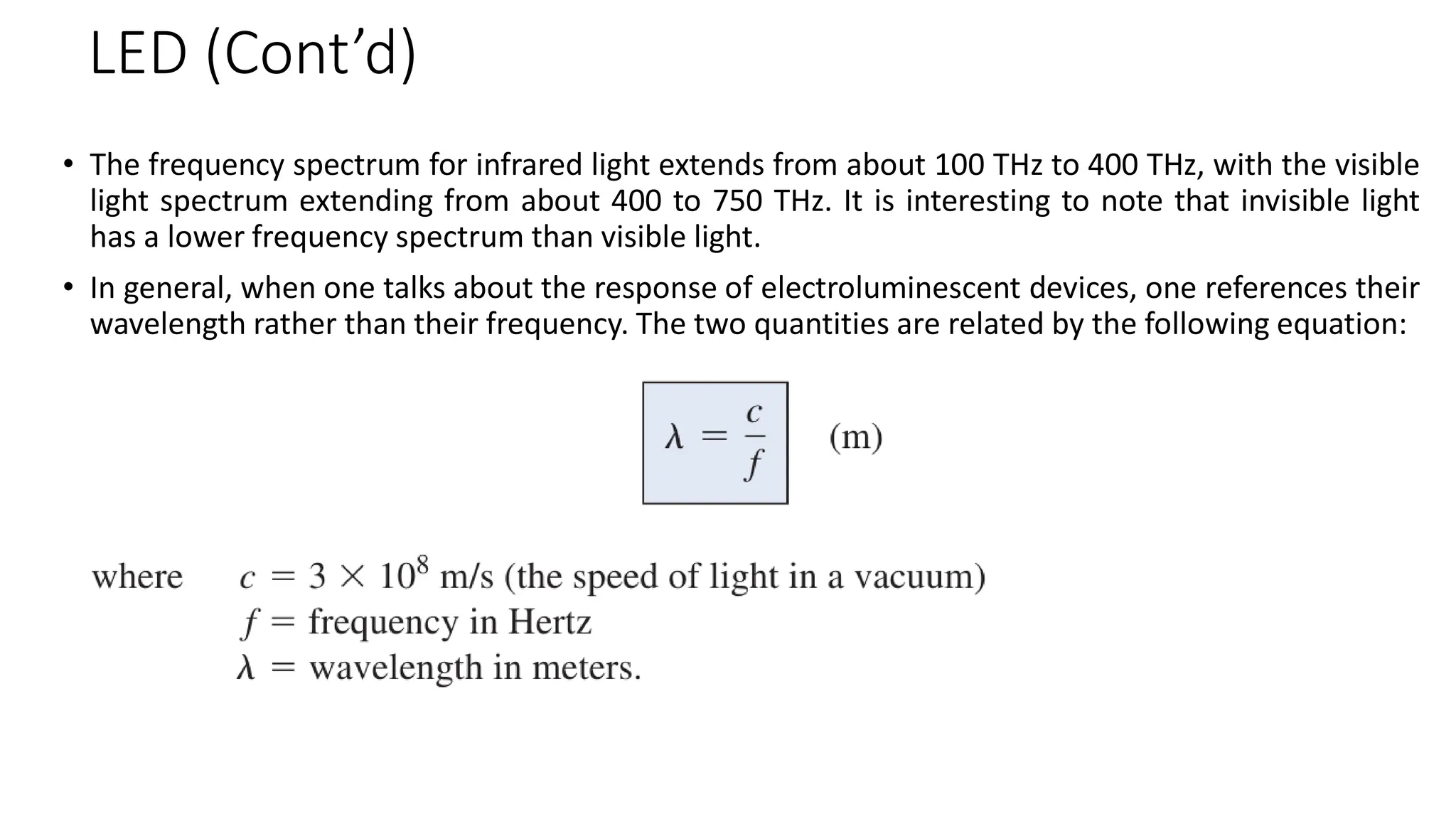
• The frequency spectrum for infrared light extends from about 100 THz to 400 THz, with the visible
light spectrum extending from about 400 to 750 THz. It is interesting to note that invisible light
has a lower frequency spectrum than visible light.
• In general, when one talks about the response of electroluminescent devices, one references their
wavelength rather than their frequency. The two quantities are related by the following equation:
LED (Cont’d)
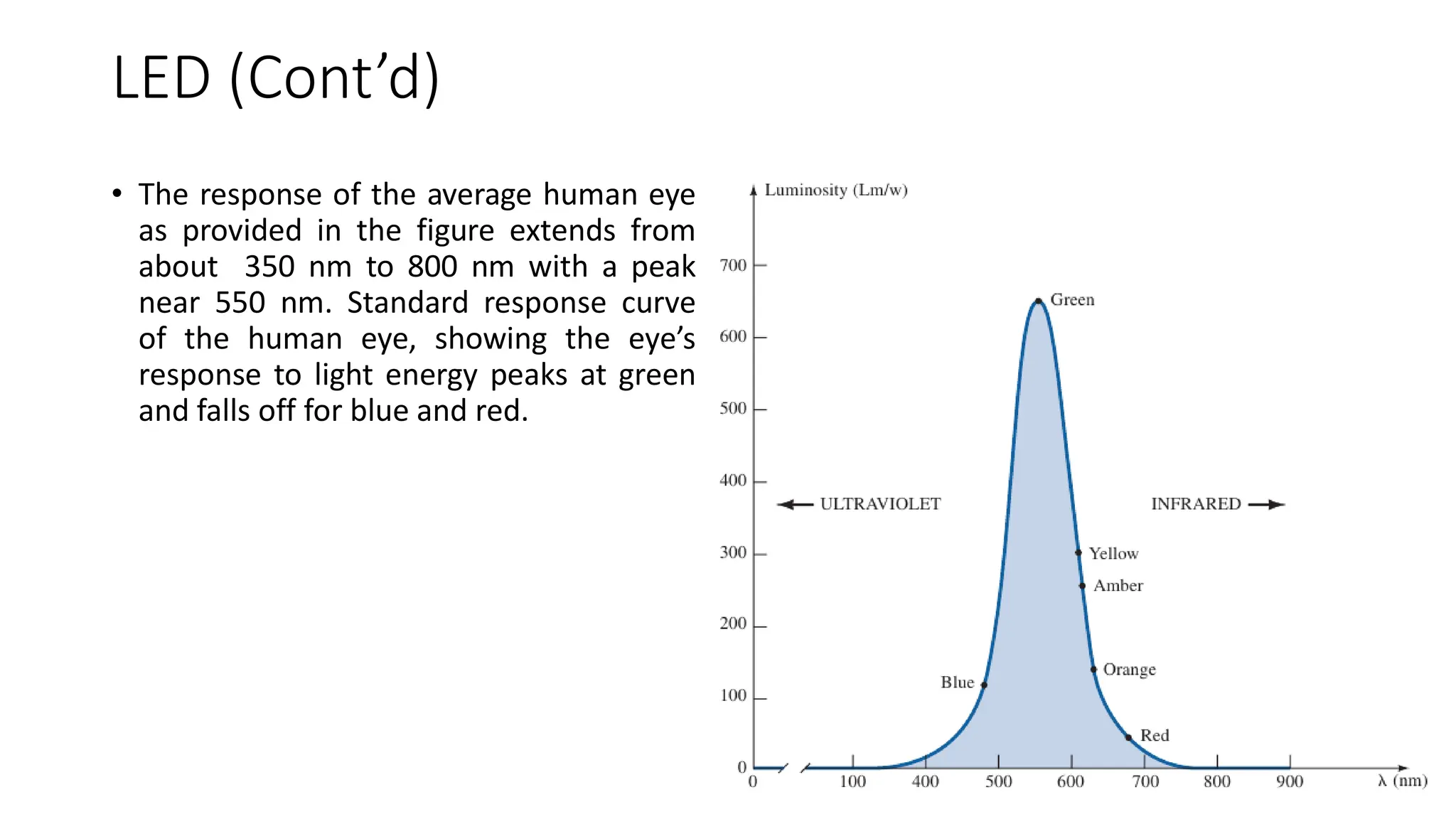
• The response of the average human eye
as provided in the figure extends from
about 350 nm to 800 nm with a peak
near 550 nm. Standard response curve
of the human eye, showing the eye’s
response to light energy peaks at green
and falls off for blue and red.
LED (Cont’d)
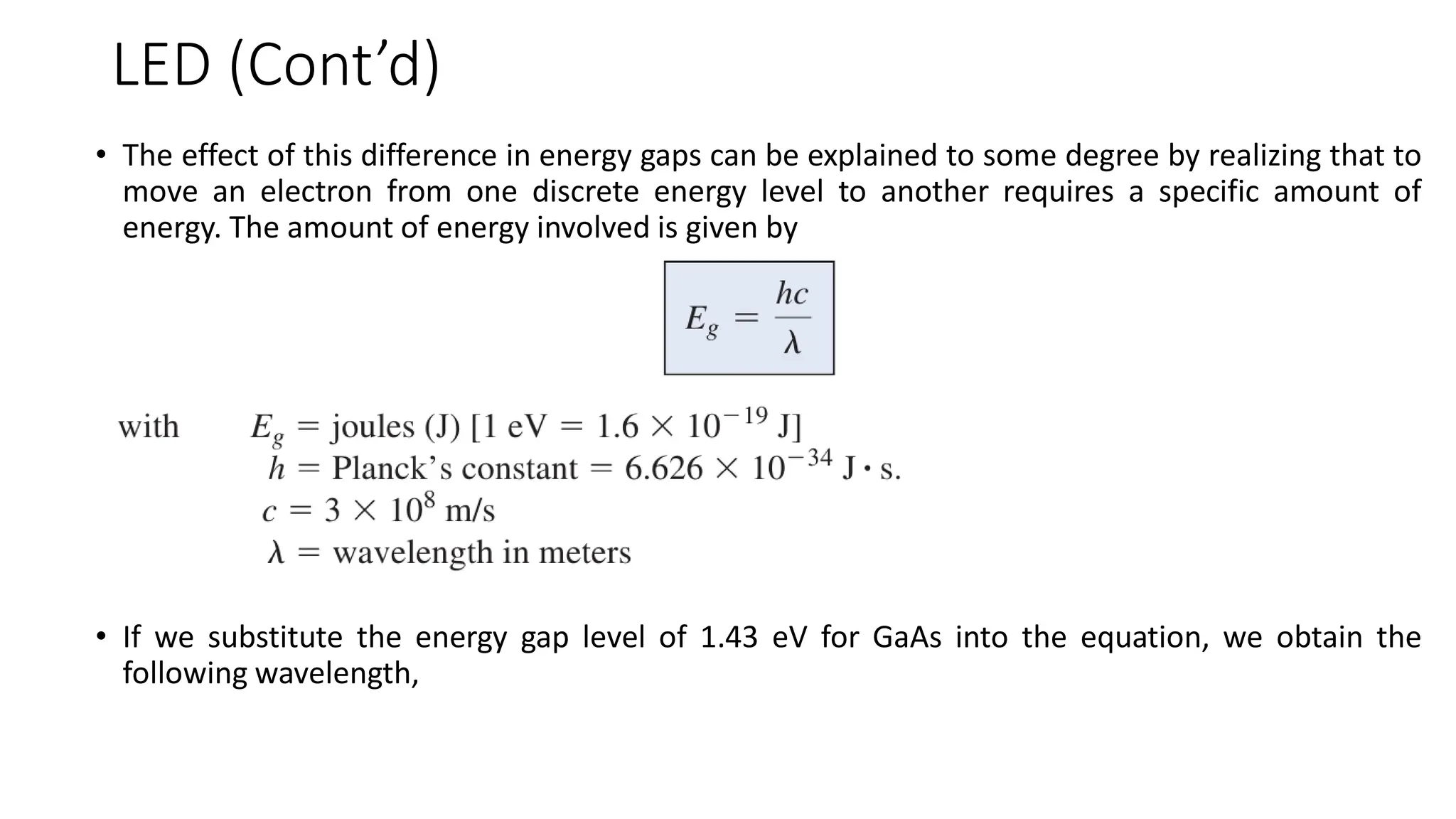
• The effect of this difference in energy gaps can be explained to some degree by realizing that to
move an electron from one discrete energy level to another requires a specific amount of
energy. The amount of energy involved is given by
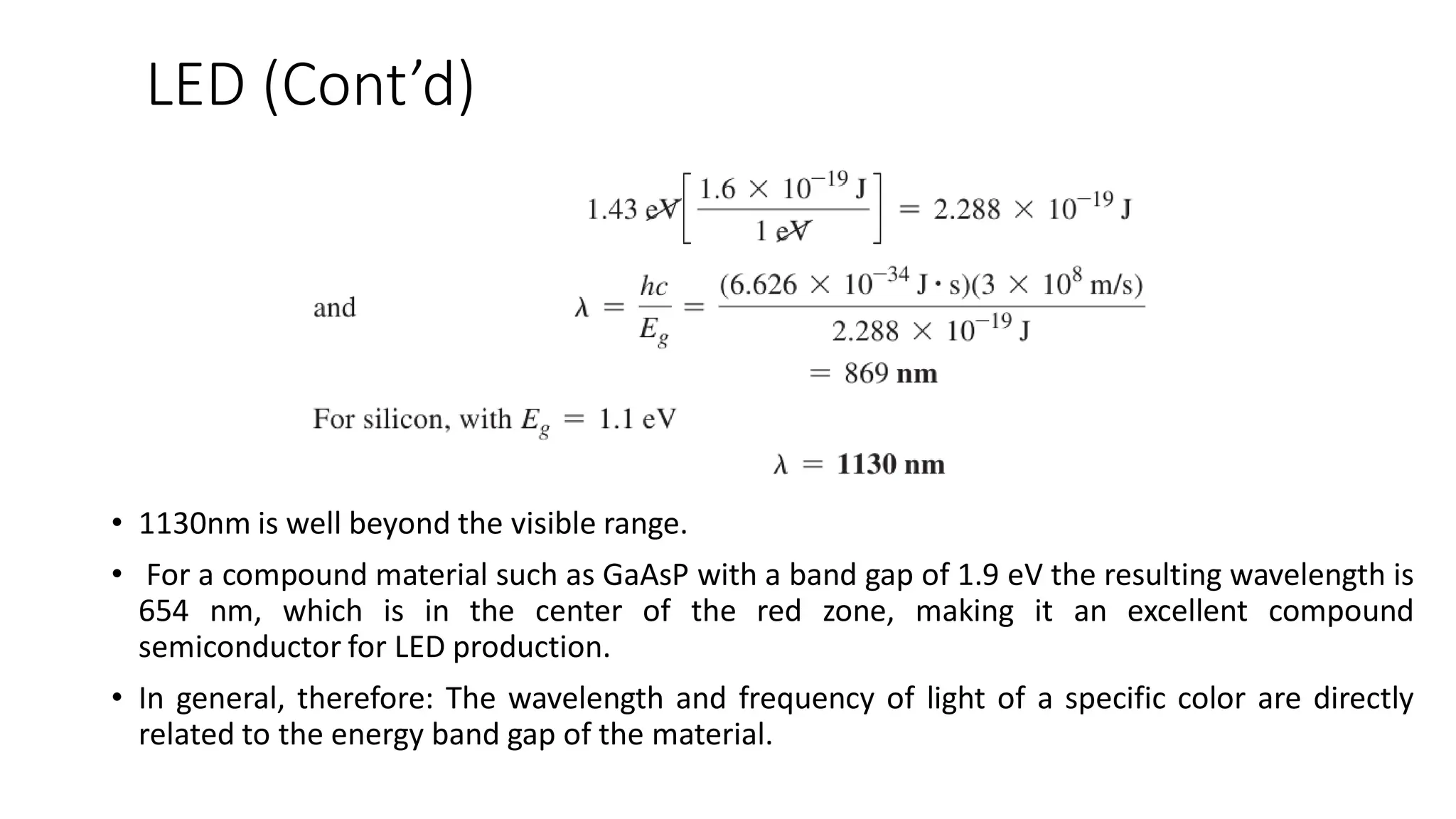
• If we substitute the energy gap level of 1.43 eV for GaAs into the equation, we obtain the
following wavelength,
LED (Cont’d)
• 1130nm is well beyond the visible range.
• For a compound material such as GaAsP with a band gap of 1.9 eV the resulting wavelength is
654 nm, which is in the center of the red zone, making it an excellent compound
semiconductor for LED production.
• In general, therefore: The wavelength and frequency of light of a specific color are directly
related to the energy band gap of the material.
LED (Cont’d)
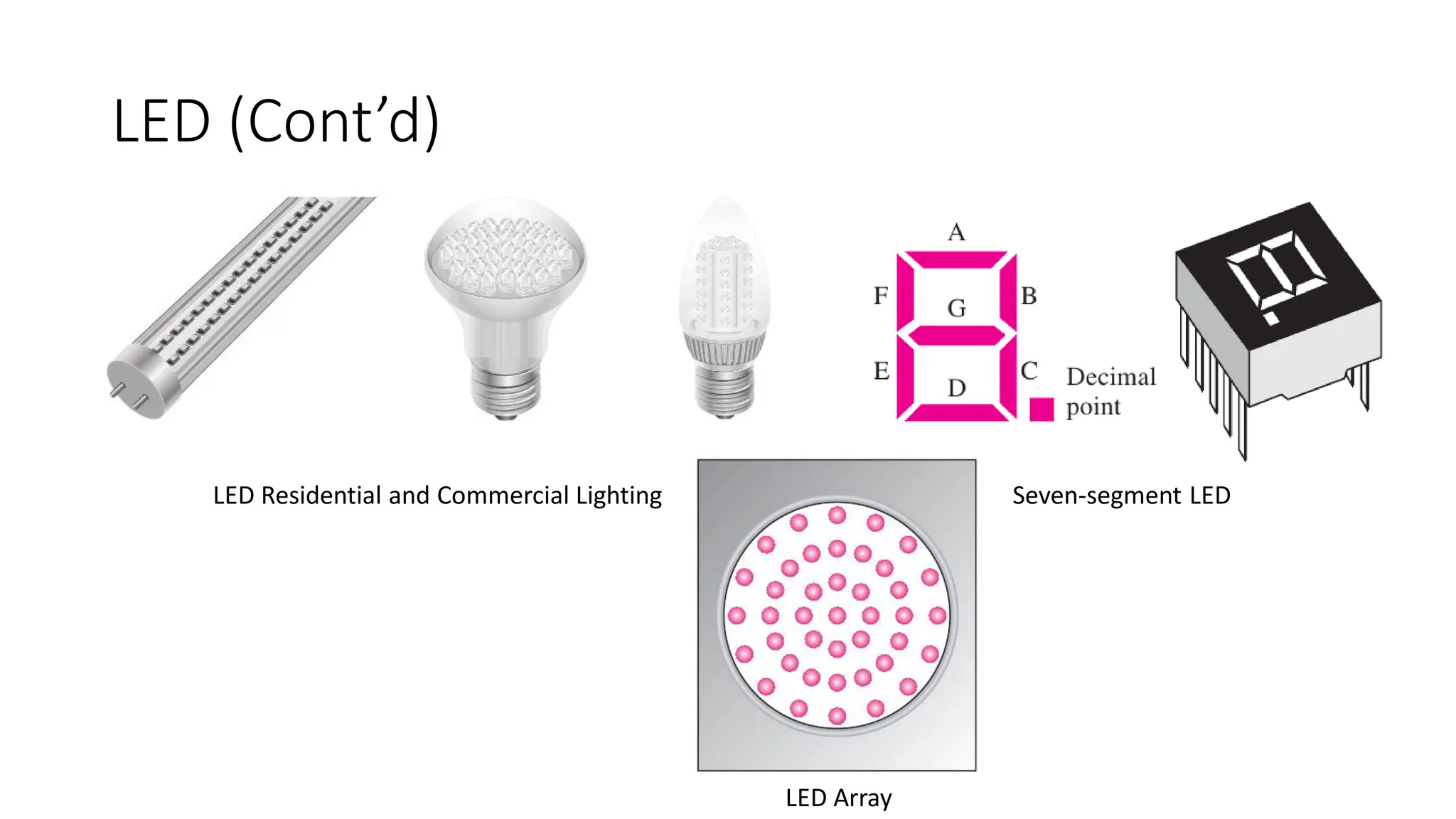
LED Residential and Commercial Lighting Seven-segment LED
LED Array
LED (Cont’d)
Photodiode
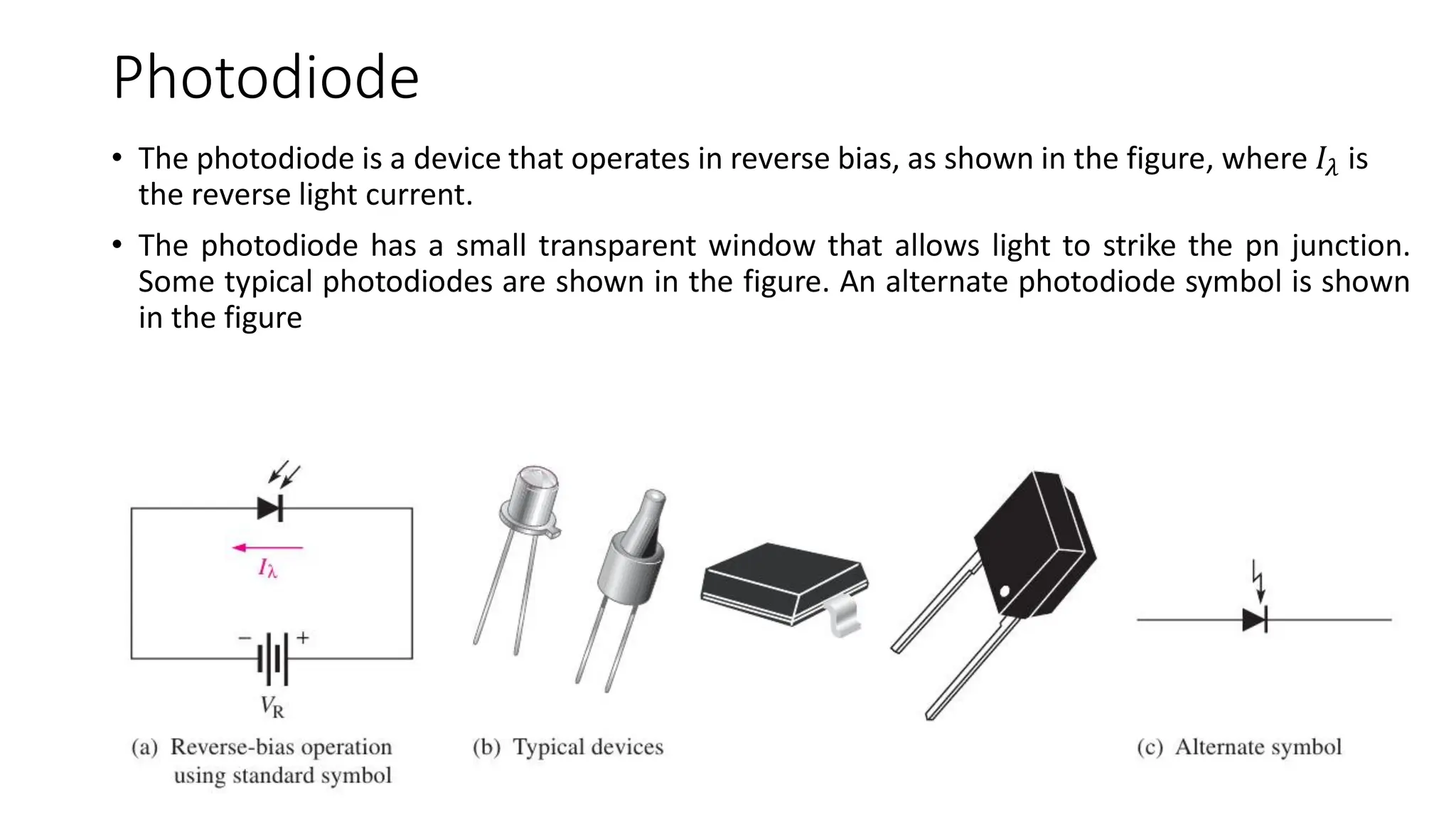
• The photodiode is a device that operates in reverse bias, as shown in the figure, where 𝐼𝜆 is
the reverse light current.
• The photodiode has a small transparent window that allows light to strike the pn junction.
Some typical photodiodes are shown in the figure. An alternate photodiode symbol is shown
in the figure
Photodiode (Cont’d)
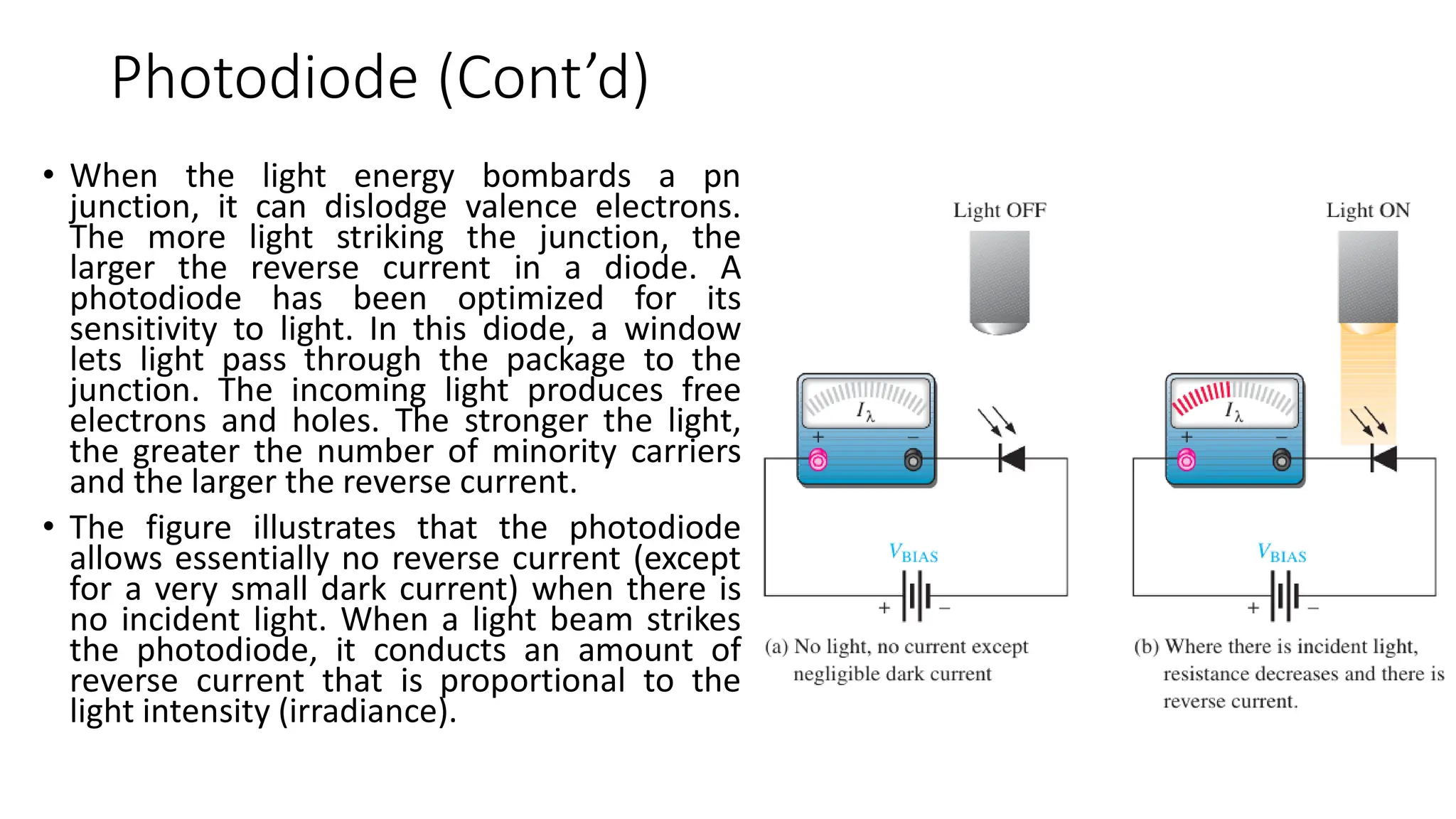
• When the light energy bombards a pn
junction, it can dislodge valence electrons.
The more light striking the junction, the
larger the reverse current in a diode. A
photodiode has been optimized for its
sensitivity to light. In this diode, a window
lets light pass through the package to the
junction. The incoming light produces free
electrons and holes. The stronger the light,
the greater the number of minority carriers
and the larger the reverse current.
• The figure illustrates that the photodiode
allows essentially no reverse current (except
for a very small dark current) when there is
no incident light. When a light beam strikes
the photodiode, it conducts an amount of
reverse current that is proportional to the
light intensity (irradiance).
Photodiode (Cont’d)
• Recall that when reverse-biased, a rectifier diode has a very small reverse leakage current.
The same is true for a photodiode. The reverse-biased current is produced by thermally
generated electron-hole pairs in the depletion region, which are swept across the pn
junction by the electric field created by the reverse voltage. In a rectifier diode, the reverse
leakage current increases with temperature due to an increase in the number of electron-
hole pairs.
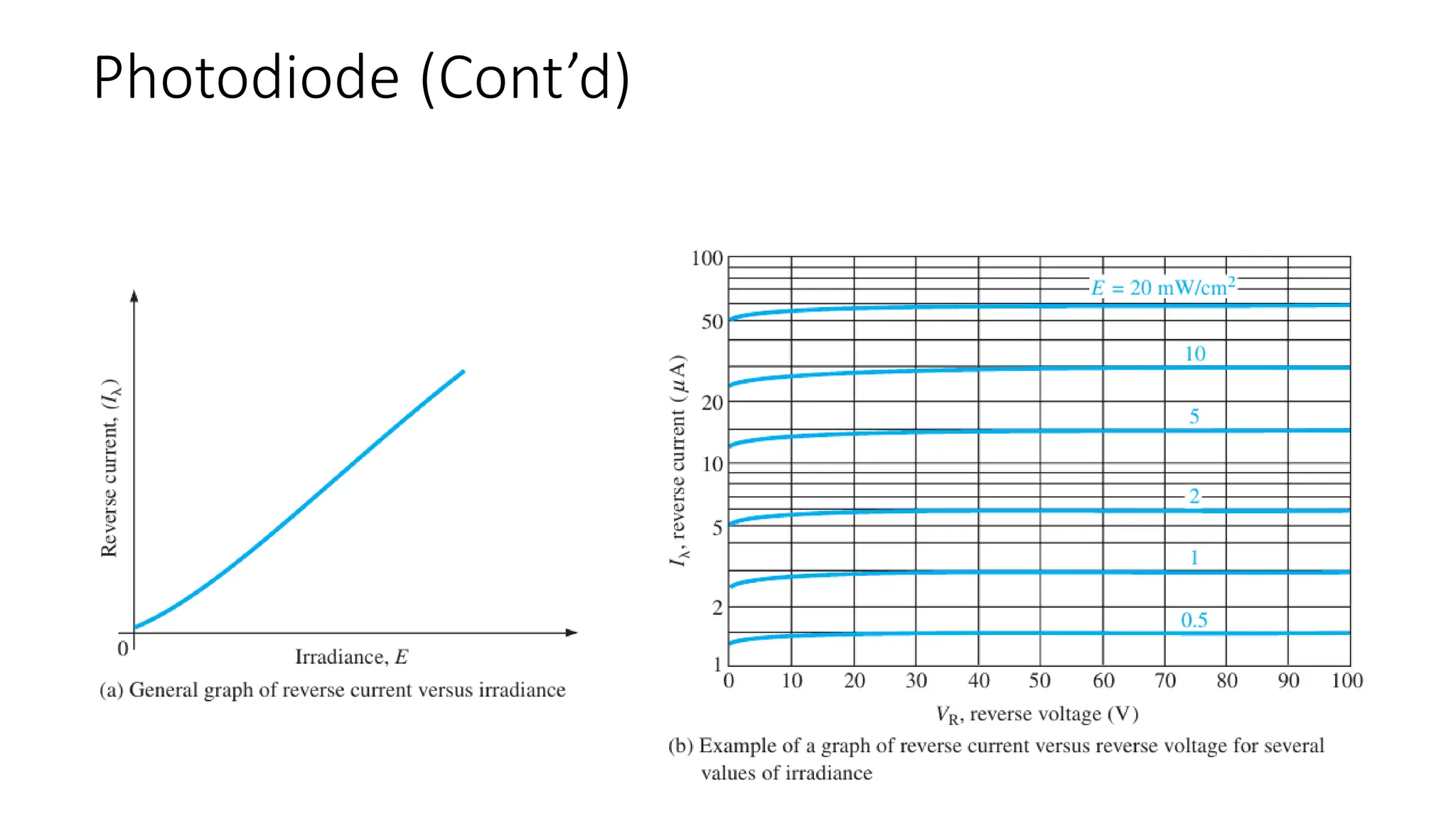
• A photodiode differs from a rectifier diode in that when its pn junction is exposed to light,
the reverse current increases with the light intensity. When there is no incident light, the
reverse current, 𝐼𝜆 is almost negligible and is called the dark current. An increase in the
amount of light intensity, expressed as irradiance (𝑚𝑊/𝑐𝑚2
), produces an increase in the
reverse current, as shown by the graph in the figure.
Photodiode (Cont’d)
Photodiode (Cont’d)
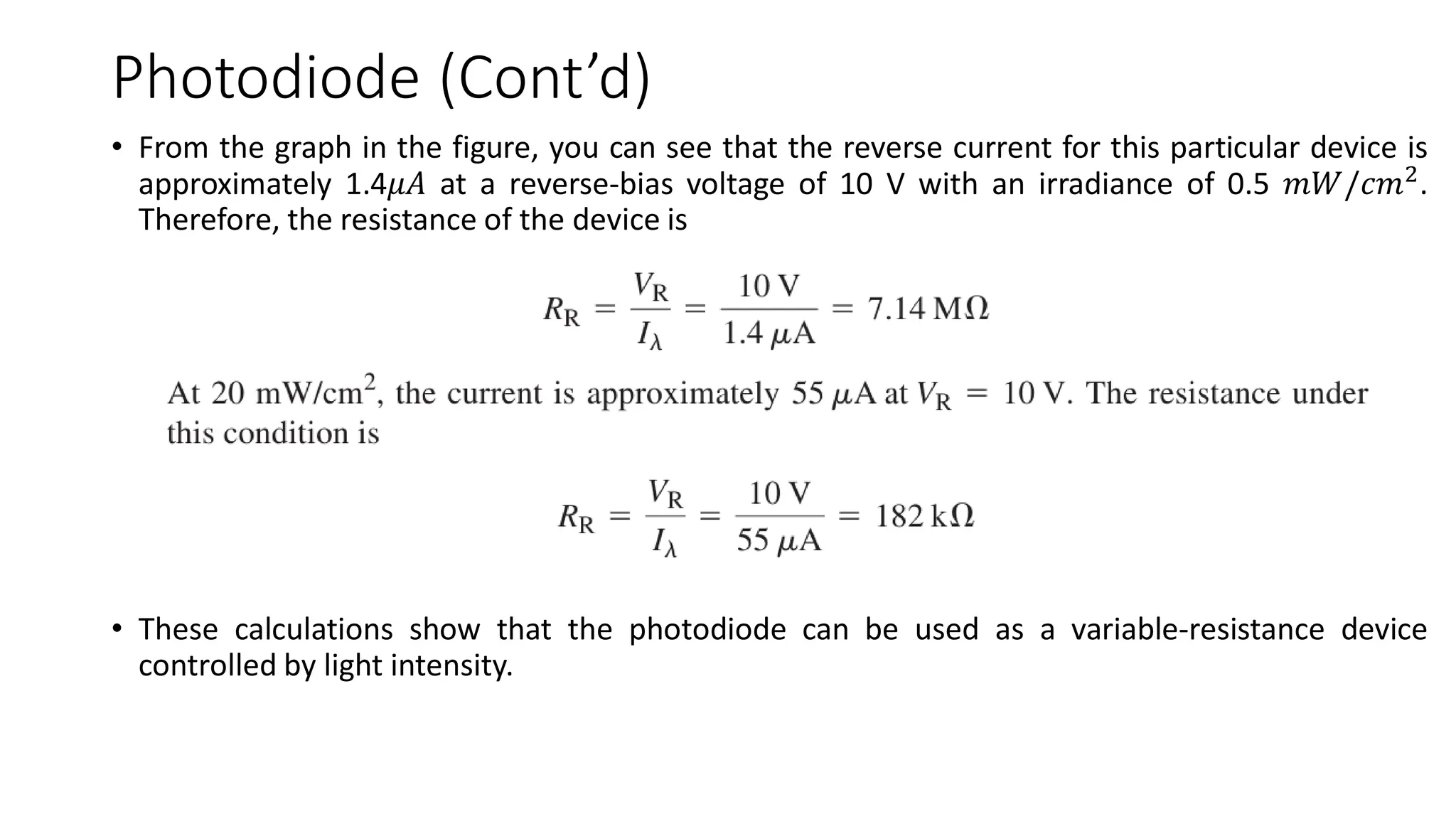
• From the graph in the figure, you can see that the reverse current for this particular device is
approximately 1.4𝜇𝐴 at a reverse-bias voltage of 10 V with an irradiance of 0.5 𝑚𝑊/𝑐𝑚2
.
Therefore, the resistance of the device is
• These calculations show that the photodiode can be used as a variable-resistance device
controlled by light intensity.
Photocoupler or Optocoupler or Optoisolator
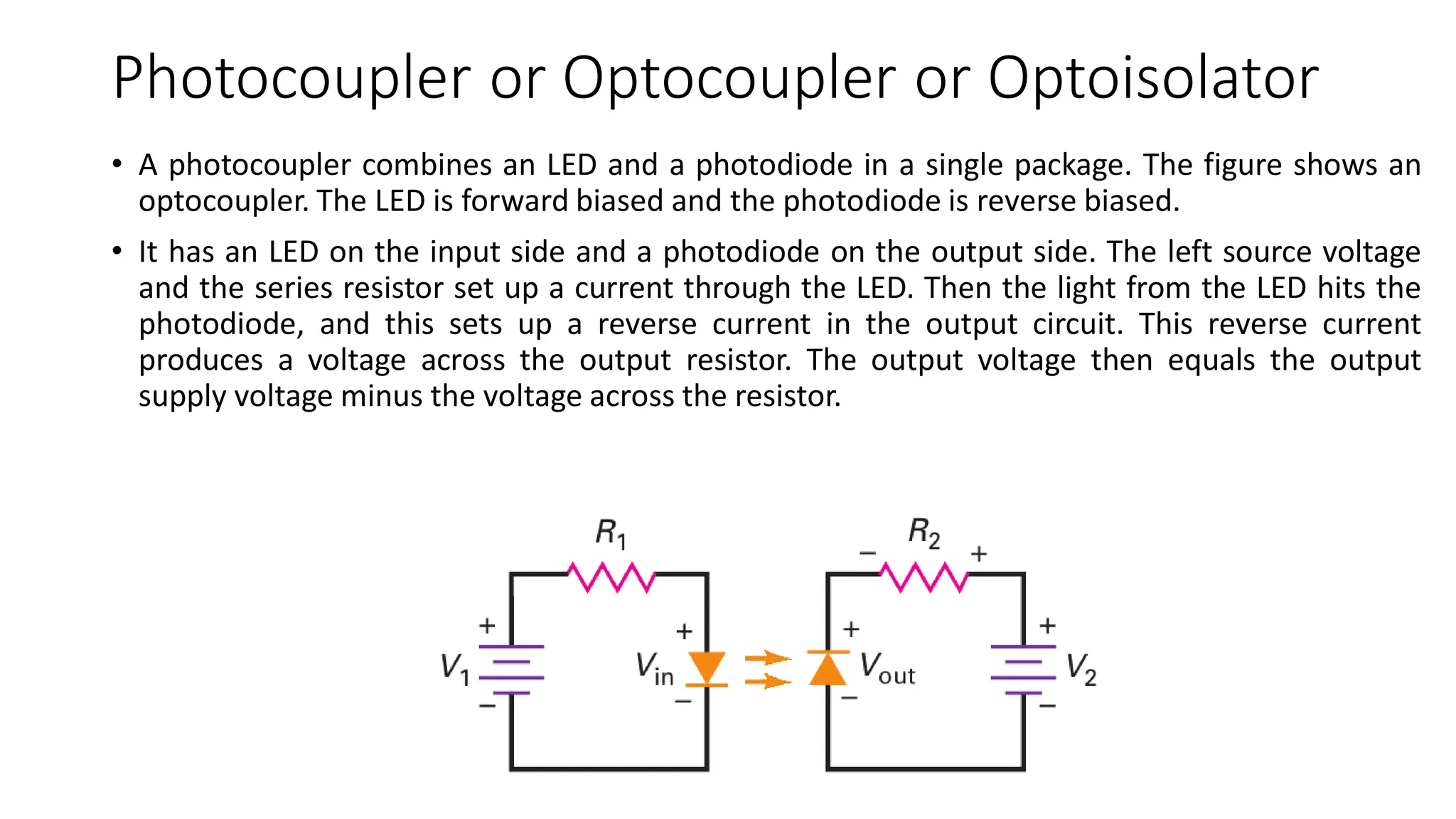
• A photocoupler combines an LED and a photodiode in a single package. The figure shows an
optocoupler. The LED is forward biased and the photodiode is reverse biased.
• It has an LED on the input side and a photodiode on the output side. The left source voltage
and the series resistor set up a current through the LED. Then the light from the LED hits the
photodiode, and this sets up a reverse current in the output circuit. This reverse current
produces a voltage across the output resistor. The output voltage then equals the output
supply voltage minus the voltage across the resistor.
Photocoupler or Optocoupler
• When the input voltage is varying, the amount of light is fluctuating. This means that the
output voltage is varying in step with the input voltage. This is why the combination of an LED
and a photodiode is called an optocoupler. The device can couple an input signal to the
output circuit.
• The key advantage of an optocoupler is the electrical isolation between the input and output
circuits. With an optocoupler, the only contact between the input and the output is a beam of
light. Because of this, it is possible to have an insulation resistance between the two circuits in
the thousands of megaohms. Isolation like this is useful in high-voltage applications in which
the potentials of the two circuits may differ by several thousand volts.
Fixed Positive Linear Voltage Regulators
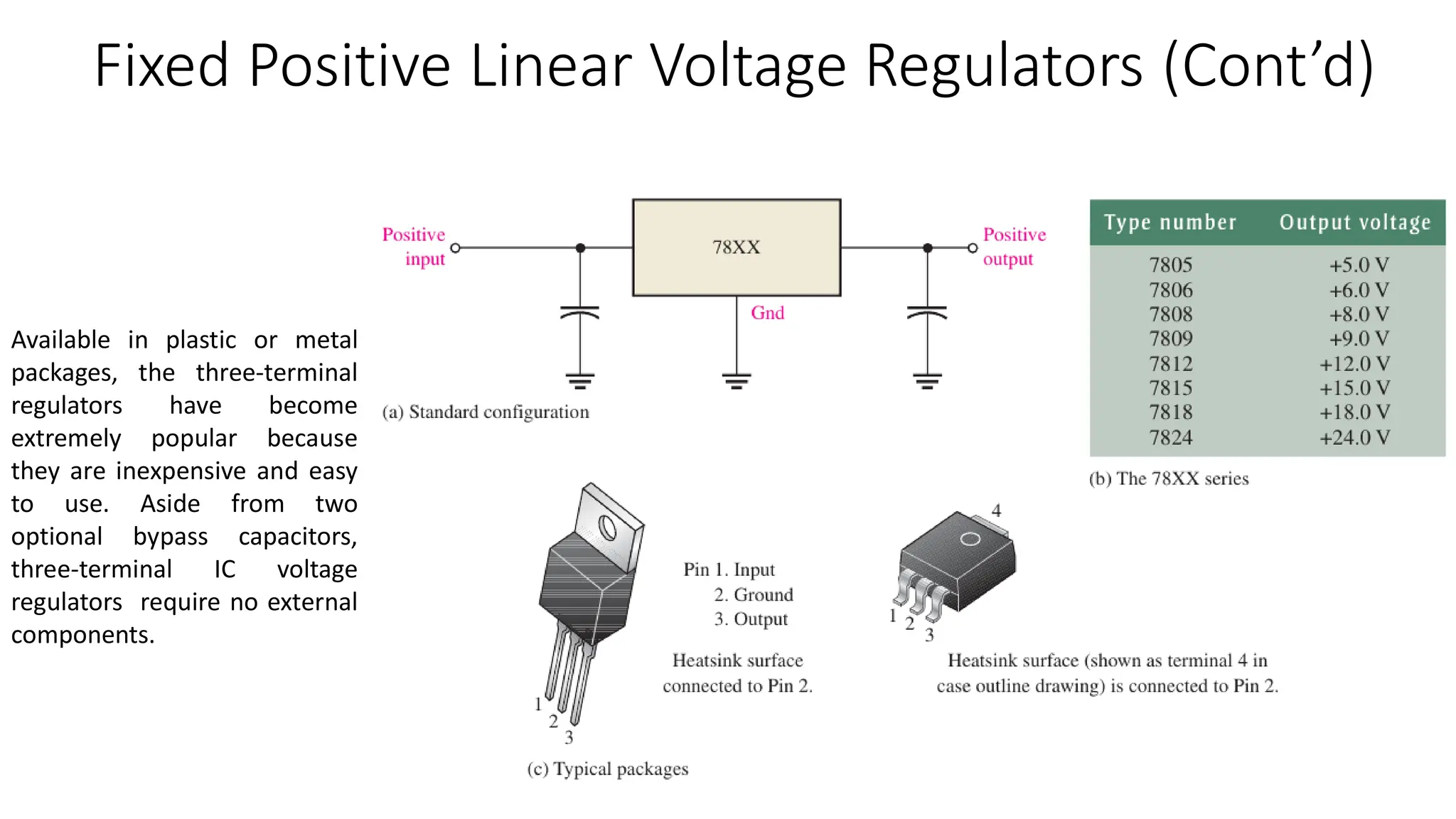
• Although many types of IC regulators are available, the 78XX series of IC regulators is
representative of three-terminal devices that provide a fixed positive output voltage.
• The three terminals are input, output, and ground as indicated in the standard fixed voltage
configuration in the figure.
• The last two digits in the part number designate the output voltage.
• For example, the 7805 is a +5.0V regulator. For any given regulator, the output voltage can be
as much as ±4% of the nominal output. Thus, a 7805 may have an output from 4.8 V to 5.2 V
but will remain constant in that range.
• Capacitors, although not always necessary, are sometimes used on the input and output as
indicated in the figure.
• The input capacitor filters the input and prevents unwanted oscillations when the regulator is
some distance from the power supply filter such that the line has a significant inductance.
• The output capacitor acts basically as a line filter to improve transient response.
Fixed Positive Linear Voltage Regulators (Cont’d)
Available in plastic or metal
packages, the three-terminal
regulators have become
extremely popular because
they are inexpensive and easy
to use. Aside from two
optional bypass capacitors,
three-terminal IC voltage
regulators require no external
components.
Fixed Positive Linear Voltage Regulators (Cont’d)
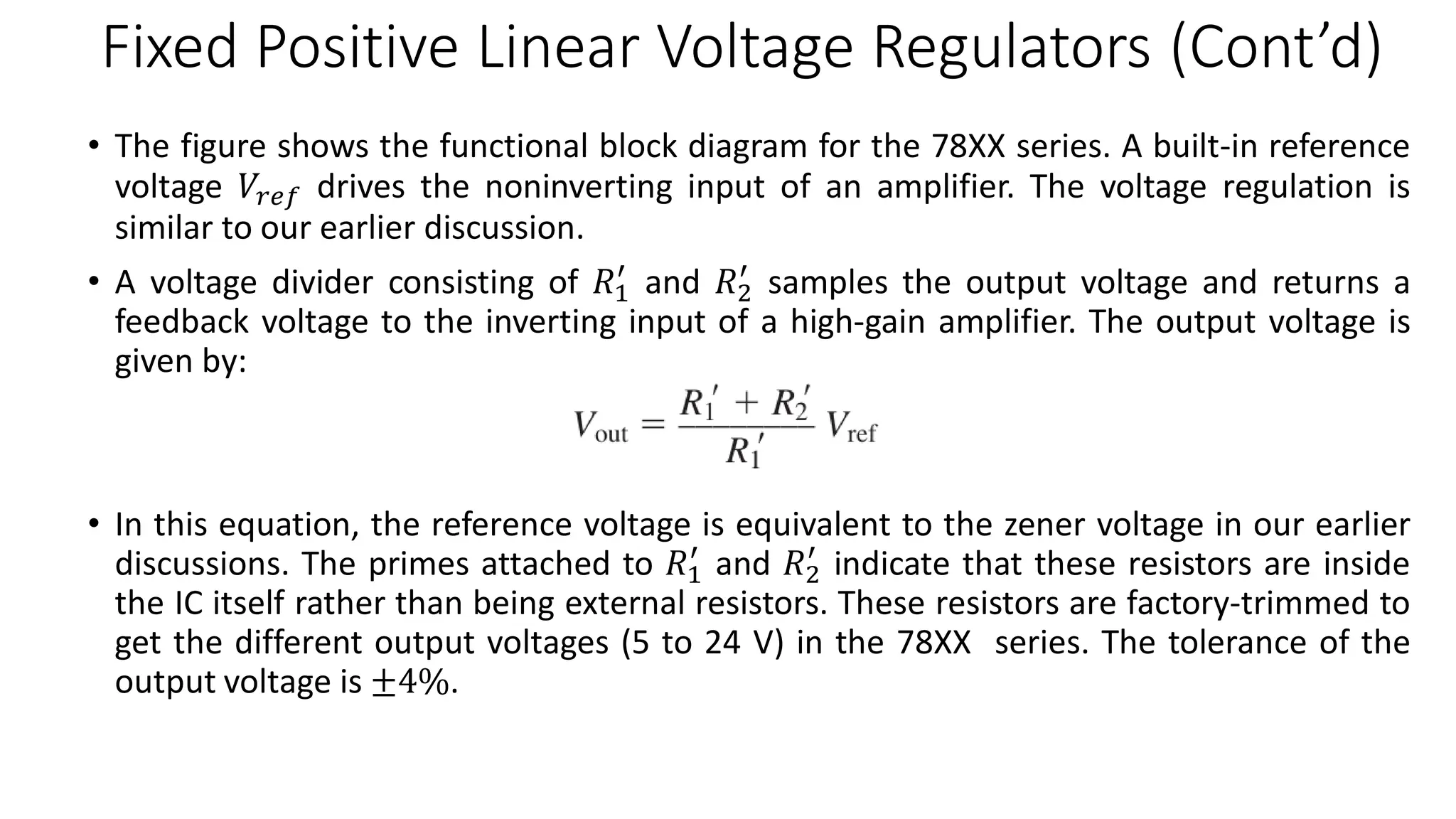
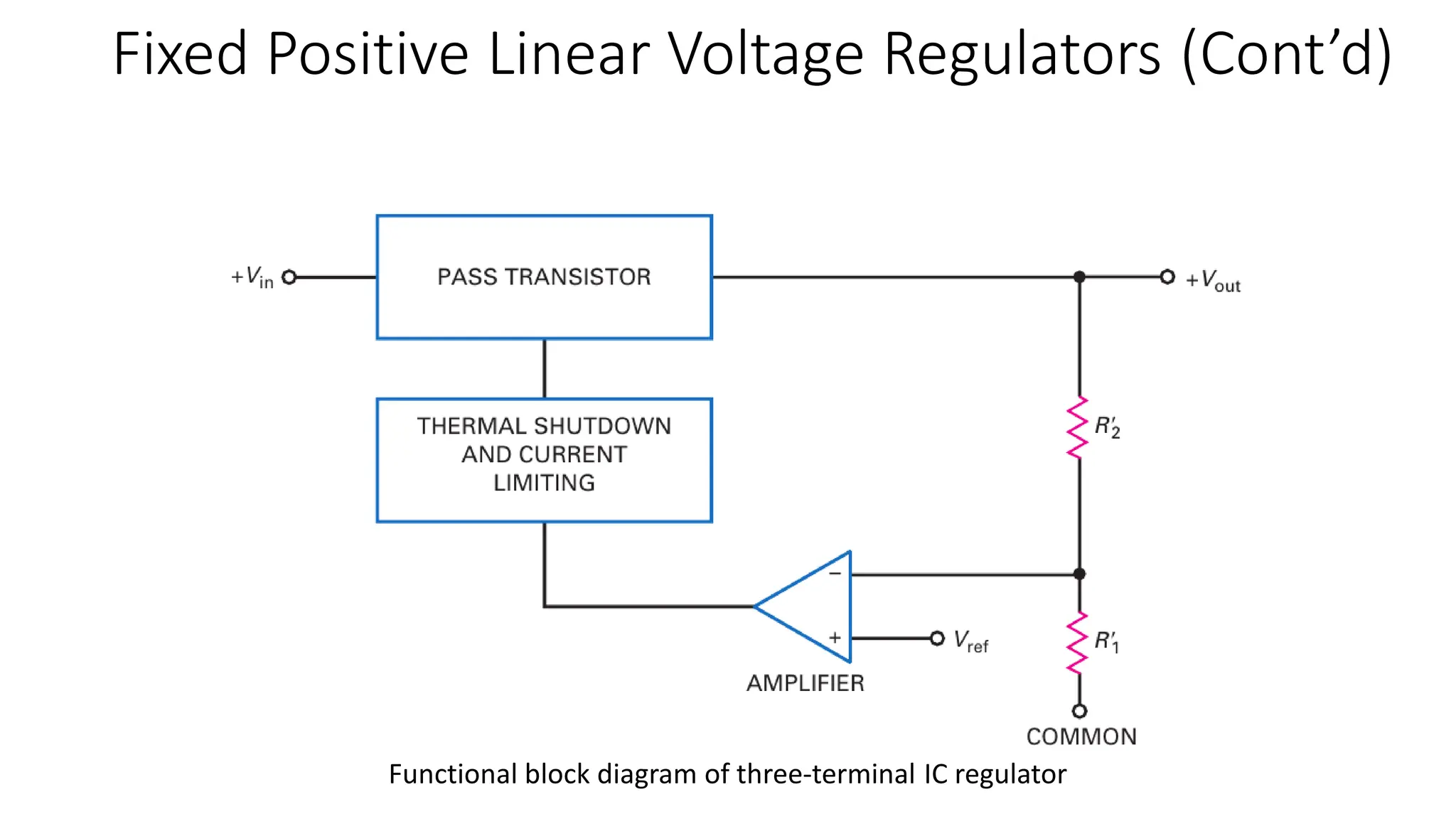
• The figure shows the functional block diagram for the 78XX series. A built-in reference
voltage 𝑉𝑟𝑒𝑓 drives the noninverting input of an amplifier. The voltage regulation is
similar to our earlier discussion.
• A voltage divider consisting of 𝑅1
′
and 𝑅2
′
samples the output voltage and returns a
feedback voltage to the inverting input of a high-gain amplifier. The output voltage is
given by:
• In this equation, the reference voltage is equivalent to the zener voltage in our earlier
discussions. The primes attached to 𝑅1
′
and 𝑅2
′
indicate that these resistors are inside
the IC itself rather than being external resistors. These resistors are factory-trimmed to
get the different output voltages (5 to 24 V) in the 78XX series. The tolerance of the
output voltage is ±4%.
Fixed Positive Linear Voltage Regulators (Cont’d)
Functional block diagram of three-terminal IC regulator
Fixed Positive Linear Voltage Regulators (Cont’d)
• The LM78XX includes a pass transistor that can handle 1 A of load current, provided that
adequate heat sinking is used.
• Also included are thermal shutdown and current limiting. Thermal shutdown means that the
chip will shut itself off when the internal temperature becomes too high, around 175°C. This is
a precaution against excessive power dissipation, which depends on the ambient temperature,
type of heat sinking, and other variables.
• Because of thermal shutdown and current limiting, devices in the 78XX series are almost
indestructible.

Rectifiers,LED, Photodiode and Photocoupler.pdf

  • 1.
    Rectifiers, Light EmittingDiode, Photodiode, Photocoupler and Linear Voltage Regulators References 1. Electronic Devices by Thomas L Floyd, Prentice Hall, 2012 2. Electronics Devices and Circuit Theory by Boylestad and Nashelsky, Pearson Education, 2014 3. Electronic Principles by Malvino and Bates, McGraw-Hill Education, 2015
  • 2.
    Rectifiers • Because ofdiodes’ ability to conduct current in one direction and block current in the other direction, diodes are used in circuits called rectifiers that convert ac voltage into dc voltage. • Rectifiers are found in all dc power supplies that operate from an ac voltage source. A power supply is an essential part of each electronic system from the simplest to the most complex. Half-wave rectifier
  • 3.
  • 4.
  • 5.
  • 6.
    Rectifiers The peak inversevoltage (PIV) [or PRV (peak reverse voltage)] rating of the diode is of primary importance in the design of rectification systems. Recall that it is the voltage rating that must not be exceeded in the reverse-bias region or the diode will enter the Zener avalanche region.
  • 7.
    Rectifiers • A full-waverectifier allows unidirectional (one-way) current through the load during the entire 360° of the input cycle, whereas a half-wave rectifier allows current through the load only during one-half of the cycle. The result of full-wave rectification is an output voltage with a frequency twice the input frequency and that pulsates every half-cycle of the input, as shown in the figure
  • 8.
    Rectifiers • A center-tappedrectifier is a type of full-wave rectifier that uses two diodes connected to the secondary of a center-tapped transformer, as shown in the figure.
  • 9.
  • 10.
  • 11.
  • 12.
  • 13.
  • 14.
  • 15.
  • 16.
  • 17.
    Rectifier with filters •Figure illustrates the filtering concept showing a nearly smooth dc output voltage from the filter. The small amount of fluctuation in the filter output voltage is called ripple.
  • 18.
  • 19.
    Rectifier with filters Operation ofa half-wave rectifier with a capacitor-input filter. The current indicates charging or discharging of the capacitor.
  • 20.
    Rectifier with filters •As you have seen, the capacitor quickly charges at the beginning of a cycle and slowly discharges through 𝑅𝐿 after the positive peak of the input voltage (when the diode is reverse-biased). The variation in the capacitor voltage due to the charging and discharging is called the ripple voltage. Generally, ripple is undesirable; thus, the smaller the ripple, the better the filtering action, as illustrated in the figure.
  • 21.
    Rectifier with filters •The period of a full-wave rectified voltage is half that of a half-wave rectified voltage. The output frequency of a full-wave rectifier is twice that of a half-wave rectifier. Comparison of ripple voltages for half- wave and full-wave rectified voltages with the same filter capacitor and load and derived from the same sinusoidal input voltage.
  • 22.
    The Light-Emitting Diode(LED) • The LED is a diode that gives off visible or invisible (infrared) light when energized. • In any forward-biased p–n junction there is, within the structure and primarily close to the junction, a recombination of holes and electrons. This recombination requires that the energy possessed by the unbound free electrons be transferred to another state. • In all semiconductor p–n junctions some of this energy is given off in the form of heat and some in the form of photons. • In Si and Ge diodes the greater percentage of the energy converted during recombination at the junction is dissipated in the form of heat within the structure, and the emitted light is insignificant. For this reason, silicon and germanium are not used in the construction of LED devices.
  • 23.
    LED (Cont’d) • Diodesconstructed of GaAs emit light in the infrared (invisible) zone during the recombination process at the p–n junction. • Even though the light is not visible, infrared LEDs have numerous applications where visible light is not a desirable effect. These include security systems, industrial processing, optical coupling, safety controls such as on garage door openers, and in home entertainment centers, where the infrared light of the remote control is the controlling element. • The following table provides a list of common compound semiconductors and the light they generate. In addition, the typical range of forward bias potentials for each is listed.
  • 24.
    LED (Cont’d) • Whenthe device is forward-biased, electrons cross the p-n junction from the n-type material and recombine with holes in the p-type material. These free electrons are in the conduction band and at a higher energy than the holes in the valence band. The difference in energy between the electrons and the holes corresponds to the energy of visible light. • When recombination takes place, the recombining electrons release energy in the form of photons. The emitted light tends to be monochromatic (one color) that depends on the band gap (and other factors).
  • 25.
    LED (Cont’d) • Alarge exposed surface area on one layer of the semiconductive material permits the photons to be emitted as visible light. This process, called electroluminescence • Various impurities are added during the doping process to establish the wavelength of the emitted light. The wavelength determines the color of visible light. • Some LEDs emit photons that are not part of the visible spectrum but have longer wavelengths and are in the infrared (IR) portion of the spectrum
  • 26.
    LED (Cont’d) • Theforward voltage across an LED is considerably greater than for a silicon diode. • Typically, the maximum 𝑉𝐹 for LEDs is between 1.2 V and 4.1 V, depending on the material. Reverse breakdown for an LED is much less than for a silicon rectifier diode (3 V to 10 V is typical). • The LED emits light in response to a sufficient forward current, as shown in the figure. The amount of power output translated into light is directly proportional to the forward current, as indicated in the figure. • An increase in 𝐼𝐹 corresponds proportionally to an increase in light output. The light output (both intensity and color) is also dependent on temperature. Light intensity goes down with higher temperature as indicated in the figure.
  • 27.
  • 28.
    LED (Cont’d) • AnLED emits light over a specified range of wavelengths as indicated by the spectral output curves in the figure.
  • 29.
    LED (Cont’d) • Thefrequency spectrum for infrared light extends from about 100 THz to 400 THz, with the visible light spectrum extending from about 400 to 750 THz. It is interesting to note that invisible light has a lower frequency spectrum than visible light. • In general, when one talks about the response of electroluminescent devices, one references their wavelength rather than their frequency. The two quantities are related by the following equation:
  • 30.
    LED (Cont’d) • Theresponse of the average human eye as provided in the figure extends from about 350 nm to 800 nm with a peak near 550 nm. Standard response curve of the human eye, showing the eye’s response to light energy peaks at green and falls off for blue and red.
  • 31.
    LED (Cont’d) • Theeffect of this difference in energy gaps can be explained to some degree by realizing that to move an electron from one discrete energy level to another requires a specific amount of energy. The amount of energy involved is given by • If we substitute the energy gap level of 1.43 eV for GaAs into the equation, we obtain the following wavelength,
  • 32.
    LED (Cont’d) • 1130nmis well beyond the visible range. • For a compound material such as GaAsP with a band gap of 1.9 eV the resulting wavelength is 654 nm, which is in the center of the red zone, making it an excellent compound semiconductor for LED production. • In general, therefore: The wavelength and frequency of light of a specific color are directly related to the energy band gap of the material.
  • 33.
    LED (Cont’d) LED Residentialand Commercial Lighting Seven-segment LED LED Array
  • 34.
  • 35.
    Photodiode • The photodiodeis a device that operates in reverse bias, as shown in the figure, where 𝐼𝜆 is the reverse light current. • The photodiode has a small transparent window that allows light to strike the pn junction. Some typical photodiodes are shown in the figure. An alternate photodiode symbol is shown in the figure
  • 36.
    Photodiode (Cont’d) • Whenthe light energy bombards a pn junction, it can dislodge valence electrons. The more light striking the junction, the larger the reverse current in a diode. A photodiode has been optimized for its sensitivity to light. In this diode, a window lets light pass through the package to the junction. The incoming light produces free electrons and holes. The stronger the light, the greater the number of minority carriers and the larger the reverse current. • The figure illustrates that the photodiode allows essentially no reverse current (except for a very small dark current) when there is no incident light. When a light beam strikes the photodiode, it conducts an amount of reverse current that is proportional to the light intensity (irradiance).
  • 37.
    Photodiode (Cont’d) • Recallthat when reverse-biased, a rectifier diode has a very small reverse leakage current. The same is true for a photodiode. The reverse-biased current is produced by thermally generated electron-hole pairs in the depletion region, which are swept across the pn junction by the electric field created by the reverse voltage. In a rectifier diode, the reverse leakage current increases with temperature due to an increase in the number of electron- hole pairs. • A photodiode differs from a rectifier diode in that when its pn junction is exposed to light, the reverse current increases with the light intensity. When there is no incident light, the reverse current, 𝐼𝜆 is almost negligible and is called the dark current. An increase in the amount of light intensity, expressed as irradiance (𝑚𝑊/𝑐𝑚2 ), produces an increase in the reverse current, as shown by the graph in the figure.
  • 38.
  • 39.
    Photodiode (Cont’d) • Fromthe graph in the figure, you can see that the reverse current for this particular device is approximately 1.4𝜇𝐴 at a reverse-bias voltage of 10 V with an irradiance of 0.5 𝑚𝑊/𝑐𝑚2 . Therefore, the resistance of the device is • These calculations show that the photodiode can be used as a variable-resistance device controlled by light intensity.
  • 40.
    Photocoupler or Optocoupleror Optoisolator • A photocoupler combines an LED and a photodiode in a single package. The figure shows an optocoupler. The LED is forward biased and the photodiode is reverse biased. • It has an LED on the input side and a photodiode on the output side. The left source voltage and the series resistor set up a current through the LED. Then the light from the LED hits the photodiode, and this sets up a reverse current in the output circuit. This reverse current produces a voltage across the output resistor. The output voltage then equals the output supply voltage minus the voltage across the resistor.
  • 41.
    Photocoupler or Optocoupler •When the input voltage is varying, the amount of light is fluctuating. This means that the output voltage is varying in step with the input voltage. This is why the combination of an LED and a photodiode is called an optocoupler. The device can couple an input signal to the output circuit. • The key advantage of an optocoupler is the electrical isolation between the input and output circuits. With an optocoupler, the only contact between the input and the output is a beam of light. Because of this, it is possible to have an insulation resistance between the two circuits in the thousands of megaohms. Isolation like this is useful in high-voltage applications in which the potentials of the two circuits may differ by several thousand volts.
  • 42.
    Fixed Positive LinearVoltage Regulators • Although many types of IC regulators are available, the 78XX series of IC regulators is representative of three-terminal devices that provide a fixed positive output voltage. • The three terminals are input, output, and ground as indicated in the standard fixed voltage configuration in the figure. • The last two digits in the part number designate the output voltage. • For example, the 7805 is a +5.0V regulator. For any given regulator, the output voltage can be as much as ±4% of the nominal output. Thus, a 7805 may have an output from 4.8 V to 5.2 V but will remain constant in that range. • Capacitors, although not always necessary, are sometimes used on the input and output as indicated in the figure. • The input capacitor filters the input and prevents unwanted oscillations when the regulator is some distance from the power supply filter such that the line has a significant inductance. • The output capacitor acts basically as a line filter to improve transient response.
  • 43.
    Fixed Positive LinearVoltage Regulators (Cont’d) Available in plastic or metal packages, the three-terminal regulators have become extremely popular because they are inexpensive and easy to use. Aside from two optional bypass capacitors, three-terminal IC voltage regulators require no external components.
  • 44.
    Fixed Positive LinearVoltage Regulators (Cont’d) • The figure shows the functional block diagram for the 78XX series. A built-in reference voltage 𝑉𝑟𝑒𝑓 drives the noninverting input of an amplifier. The voltage regulation is similar to our earlier discussion. • A voltage divider consisting of 𝑅1 ′ and 𝑅2 ′ samples the output voltage and returns a feedback voltage to the inverting input of a high-gain amplifier. The output voltage is given by: • In this equation, the reference voltage is equivalent to the zener voltage in our earlier discussions. The primes attached to 𝑅1 ′ and 𝑅2 ′ indicate that these resistors are inside the IC itself rather than being external resistors. These resistors are factory-trimmed to get the different output voltages (5 to 24 V) in the 78XX series. The tolerance of the output voltage is ±4%.
  • 45.
    Fixed Positive LinearVoltage Regulators (Cont’d) Functional block diagram of three-terminal IC regulator
  • 46.
    Fixed Positive LinearVoltage Regulators (Cont’d) • The LM78XX includes a pass transistor that can handle 1 A of load current, provided that adequate heat sinking is used. • Also included are thermal shutdown and current limiting. Thermal shutdown means that the chip will shut itself off when the internal temperature becomes too high, around 175°C. This is a precaution against excessive power dissipation, which depends on the ambient temperature, type of heat sinking, and other variables. • Because of thermal shutdown and current limiting, devices in the 78XX series are almost indestructible.