SEMICONDUCTORS
By Unsa Shakir
Electrically, all materials fall into 1
of 3 classifications:
• Conductors
• Insulators
• Semi-Conductors
Conductors:
• In general all metals are good
conductors.
• The purpose of conductors is to allow
electrical current to flow with minimum
resistance.
• Examples:
Copper, gold, silver,iron,bronze
Insulators
• Insulators are used to prevent the flow of
electricity.
• Insulating materials such as glass, rubber,
plastic, polyethylene are also called
dielectrics, meaning they can store charges.
• Dielectric materials are used in components
like capacitors which must store electric
charges
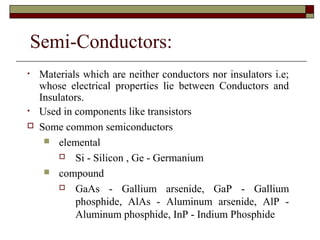
Semi-Conductors:
• Materials which are neither conductors nor insulators i.e;
whose electrical properties lie between Conductors and
Insulators.
• Used in components like transistors
 Some common semiconductors
 elemental
 Si - Silicon , Ge - Germanium
 compound
 GaAs - Gallium arsenide, GaP - Gallium
phosphide, AlAs - Aluminum arsenide, AlP -
Aluminum phosphide, InP - Indium Phosphide
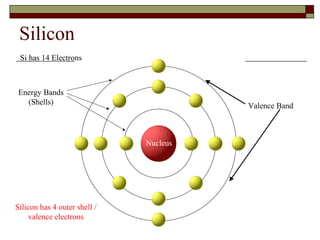
Silicon
Nucleus
Valence Band
Energy Bands
(Shells)
Si has 14 Electrons
Silicon has 4 outer shell /
valence electrons
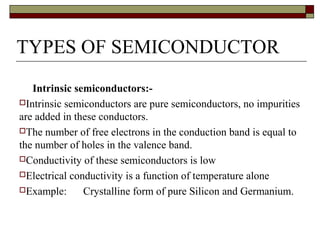
Intrinsic semiconductors:-
Intrinsic semiconductors are pure semiconductors, no impurities
are added in these conductors.
The number of free electrons in the conduction band is equal to
the number of holes in the valence band.
Conductivity of these semiconductors is low
Electrical conductivity is a function of temperature alone
Example: Crystalline form of pure Silicon and Germanium.
TYPES OF SEMICONDUCTOR
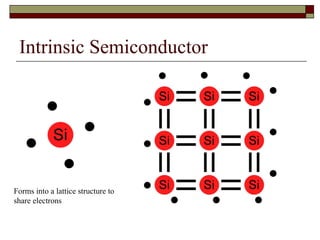
Intrinsic Semiconductor
Forms into a lattice structure to
share electrons
EXTRINSIC SEMICONDUCTORS
 An extrinsic semiconductor is a semiconductor that has
been doped, that is, into which a doping agent has been
introduced, giving it different electrical properties than the
intrinsic semiconductor.
 The number of electrons and holes are not equal. There is
excess of electrons in n-type semi-conductors and excess of
holes in p-type semi-conductors.
 Electrical conductivity is high
 Electrical conductivity depends on temperature as well as on
the amount of impurity doping in the pure semiconductor
 Examples:Impurity like As, Sb, P, In, Bi, Al etc. are dopped
with Germanium and Silicon atom
Improving Conduction by Doping
 Doping involves adding dopant atoms to an intrinsic
Semiconductor to make semiconductors better conductors, add
impurities (dopants) to contribute extra electrons or extra holes
 Dominant carrier concentrations in an extrinsic semiconductor
classify it as either an n-type or p-type semiconductor.
 elements with 5 outer electrons contribute an extra electron to
the lattice (donor dopant)
 elements with 3 outer electrons accept an electron from the
silicon (acceptor dopant)
What are P-type and N-type ?
 Semiconductors are classified in to P-type and
N-type semiconductor
 P-type: A P-type material is one in which
holes are majority carriers i.e. they are
positively charged materials (++++)
 N-type: A N-type material is one in which
electrons are majority charge carriers i.e. they
are negatively charged materials (-----)
THE P-N JUNCTION
The Junction
Diodes
Electronic devices created by bringing
together a p-type and n-type region within the
same semiconductor lattice. Used for
rectifiers.
Diodes
It is represented by the following symbol,
where the arrow indicates the direction of
positive current flow.
Characteristics of Diode
 Diode always conducts in one direction.
 Diodes always conduct current when
“Forward Biased” ( Zero resistance)
 Diodes do not conduct when Reverse Biased
(Infinite resistance)
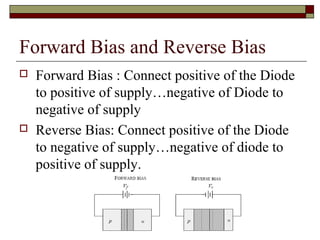
Forward Bias and Reverse Bias
 Forward Bias : Connect positive of the Diode
to positive of supply…negative of Diode to
negative of supply
 Reverse Bias: Connect positive of the Diode
to negative of supply…negative of diode to
positive of supply.
P-N Junction – Forward Bias
 positive voltage placed on p-
type material
 holes in p-type move away from
positive terminal, electrons in n-
type move further from negative
terminal
 depletion region becomes
smaller - resistance of device
decreases
 voltage increased until critical
voltage is reached, depletion
region disappears, current can
flow freely
P-N Junction – Reverse Bias
 positive voltage placed on n-
type material
 electrons in n-type move closer
to positive terminal, holes in p-
type move closer to negative
terminal
 width of depletion region
increases
 allowed current is essentially
zero (small “drift” current)
Note:
 The chief difference between germanium and
silicon diodes is the voltage at which electric
current begins to flow freely across the diode.
A germanium diode typically begins to
conduct electric current when voltage
properly applied across the diode reaches 0.3
volts. Silicon diodes require more voltage to
conduct current; it takes 0.7 volts to create a
forward-bias situation in a silicon diode

Semiconductors

  • 1.
  • 2.
    Electrically, all materialsfall into 1 of 3 classifications: • Conductors • Insulators • Semi-Conductors
  • 3.
    Conductors: • In generalall metals are good conductors. • The purpose of conductors is to allow electrical current to flow with minimum resistance. • Examples: Copper, gold, silver,iron,bronze
  • 4.
    Insulators • Insulators areused to prevent the flow of electricity. • Insulating materials such as glass, rubber, plastic, polyethylene are also called dielectrics, meaning they can store charges. • Dielectric materials are used in components like capacitors which must store electric charges
  • 5.
    Semi-Conductors: • Materials whichare neither conductors nor insulators i.e; whose electrical properties lie between Conductors and Insulators. • Used in components like transistors  Some common semiconductors  elemental  Si - Silicon , Ge - Germanium  compound  GaAs - Gallium arsenide, GaP - Gallium phosphide, AlAs - Aluminum arsenide, AlP - Aluminum phosphide, InP - Indium Phosphide
  • 6.
    Silicon Nucleus Valence Band Energy Bands (Shells) Sihas 14 Electrons Silicon has 4 outer shell / valence electrons
  • 7.
    Intrinsic semiconductors:- Intrinsic semiconductorsare pure semiconductors, no impurities are added in these conductors. The number of free electrons in the conduction band is equal to the number of holes in the valence band. Conductivity of these semiconductors is low Electrical conductivity is a function of temperature alone Example: Crystalline form of pure Silicon and Germanium. TYPES OF SEMICONDUCTOR
  • 8.
    Intrinsic Semiconductor Forms intoa lattice structure to share electrons
  • 9.
    EXTRINSIC SEMICONDUCTORS  Anextrinsic semiconductor is a semiconductor that has been doped, that is, into which a doping agent has been introduced, giving it different electrical properties than the intrinsic semiconductor.  The number of electrons and holes are not equal. There is excess of electrons in n-type semi-conductors and excess of holes in p-type semi-conductors.  Electrical conductivity is high  Electrical conductivity depends on temperature as well as on the amount of impurity doping in the pure semiconductor  Examples:Impurity like As, Sb, P, In, Bi, Al etc. are dopped with Germanium and Silicon atom
  • 10.
    Improving Conduction byDoping  Doping involves adding dopant atoms to an intrinsic Semiconductor to make semiconductors better conductors, add impurities (dopants) to contribute extra electrons or extra holes  Dominant carrier concentrations in an extrinsic semiconductor classify it as either an n-type or p-type semiconductor.  elements with 5 outer electrons contribute an extra electron to the lattice (donor dopant)  elements with 3 outer electrons accept an electron from the silicon (acceptor dopant)
  • 11.
    What are P-typeand N-type ?  Semiconductors are classified in to P-type and N-type semiconductor  P-type: A P-type material is one in which holes are majority carriers i.e. they are positively charged materials (++++)  N-type: A N-type material is one in which electrons are majority charge carriers i.e. they are negatively charged materials (-----)
  • 12.
  • 13.
  • 14.
    Diodes Electronic devices createdby bringing together a p-type and n-type region within the same semiconductor lattice. Used for rectifiers.
  • 15.
    Diodes It is representedby the following symbol, where the arrow indicates the direction of positive current flow.
  • 16.
    Characteristics of Diode Diode always conducts in one direction.  Diodes always conduct current when “Forward Biased” ( Zero resistance)  Diodes do not conduct when Reverse Biased (Infinite resistance)
  • 17.
    Forward Bias andReverse Bias  Forward Bias : Connect positive of the Diode to positive of supply…negative of Diode to negative of supply  Reverse Bias: Connect positive of the Diode to negative of supply…negative of diode to positive of supply.
  • 18.
    P-N Junction –Forward Bias  positive voltage placed on p- type material  holes in p-type move away from positive terminal, electrons in n- type move further from negative terminal  depletion region becomes smaller - resistance of device decreases  voltage increased until critical voltage is reached, depletion region disappears, current can flow freely
  • 19.
    P-N Junction –Reverse Bias  positive voltage placed on n- type material  electrons in n-type move closer to positive terminal, holes in p- type move closer to negative terminal  width of depletion region increases  allowed current is essentially zero (small “drift” current)
  • 20.
    Note:  The chiefdifference between germanium and silicon diodes is the voltage at which electric current begins to flow freely across the diode. A germanium diode typically begins to conduct electric current when voltage properly applied across the diode reaches 0.3 volts. Silicon diodes require more voltage to conduct current; it takes 0.7 volts to create a forward-bias situation in a silicon diode

Editor's Notes

  • #9 Covalent bon: Semiconductors such Si, Ge, ZnS and insulators such as diamond are formed by covalent bonding, where each atom share its valence electrons with its neighboring atoms.