Presented by:
Md. Rayid Hasan Mojumder (2003568)
Intoduction to the Epitaxial Growth
of
Semiconductor Materials
Dept. of Electrical & Electronic Engineering
Khulna University of Engineering & Technology, Khulna- 9203, Bangladesh
Course No: EE 6906
Course Title: PV Cells and Materials
2 of 22 Outline
• Introduction
• Mechanism of epitaxial growth
• Methods of epitaxial deposition
• Applications of epitaxial layers
Introduction
3 of 22
“Oh, its a standard ‘boy meets girl, boy loses
girl, boy invents a new deposition technique for ultra-
thin film semiconductors, boy gets girl back’ story”.
Thin Film Growth
Epitaxy
4 of 22
• The term Epitaxy comes from the
Greek word meaning ‘ordered
upon’.
• Epitaxy means the growth of a
single crystal film on top of a
crystalline substrate.
Epitaxial Growth
5 of 22
Deposition of a layer on a
substrate which matches the
crystalline order of the substrate
Ordered,
crystalline
growth; NOT
epitaxial
Epitaxial
growth:
• Homoepitaxy
Growth of a layer of the same material as
the substrate
-> Si on Si
• Heteroepitaxy
Growth of a layer of a different material
than the substrate
-> GaAs on Si
Why Epitaxial Growth
6 of 22
• Creating group III-V Devices
(Interface quality key, Hetero-junction Bipolar Transistor, LED,
Laser)
• High purity
• Low defect density
• Abrupt interfaces
• Controlled doping profiles
• High repeatability and uniformity
• Safe, efficient operation
7 of 22 Mechanism of Epitaxial Growth
Steps:
Absorption of ad atoms
Surface diffusion
Crystal growth
Evaporation of adatoms
Parameters:
Growth temperature
Growth pressure
Flow amount of reactants
Substrate and treatment
Methods of Epitaxial Deposition
8 of 22
• Liquid phase epitaxy
(grown from a Melt)
• Molecular beam epitaxy
(an evaporation of the elements in a Vacuum)
• Vapor Phase Epitaxy/Chemical vapor deposition
(grown from Vapor)
Liquid Phase Epitaxy (LPE)
9 of 22
⚫ Reactants are dissolved in a
molten solvent at high
temperature
⚫ Substrate dipped into solution
while the temperature is held
constant
❖ LPE involves the precipitation of a
crystalline film from a supersaturated
melt on to a substrate.
❖ The temperature is increased until a phase
transition occurs and then reduced for
precipitation.
❖ By controlling cooling rates the kinetics of
layer growth can be controlled.
Liquid Phase Epitaxy (LPE) contd.
10 of 22
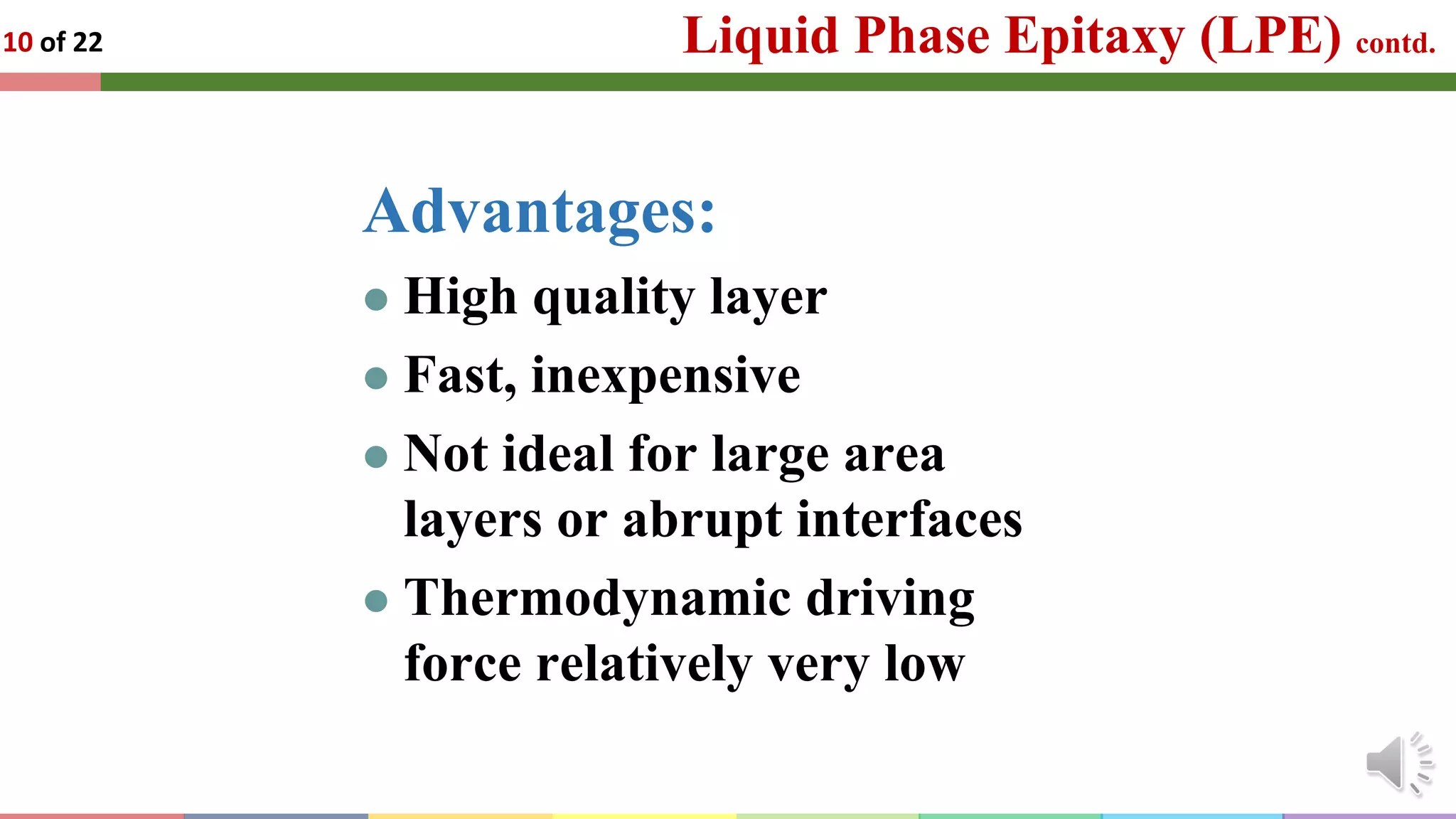
Advantages:
⚫ High quality layer
⚫ Fast, inexpensive
⚫ Not ideal for large area
layers or abrupt interfaces
⚫ Thermodynamic driving
force relatively very low
Molecular Beam Epitaxy (MBE)
11 of 22
➢Here in MBE reactants are introduced by molecular
beams.
➢Create beams by heating source of material to
melting point in an effusion (or Knudsen) cell.
➢UHV gives source molecules a large mean free path,
forming a straight beam.
➢Beam impinges on a heated substrate (600’C).
➢Incident molecules diffuse around the surface to the
proper crystal sites and form crystalline layers.
➢Both solid and gas source can be used.
Molecular Beam Epitaxy (MBE) contd.
12 of 22
Molecular Beam Epitaxy (MBE) contd.
13 of 22
Metal Organic Chemical Vapour Deposition (MOCVD)
14 of 22
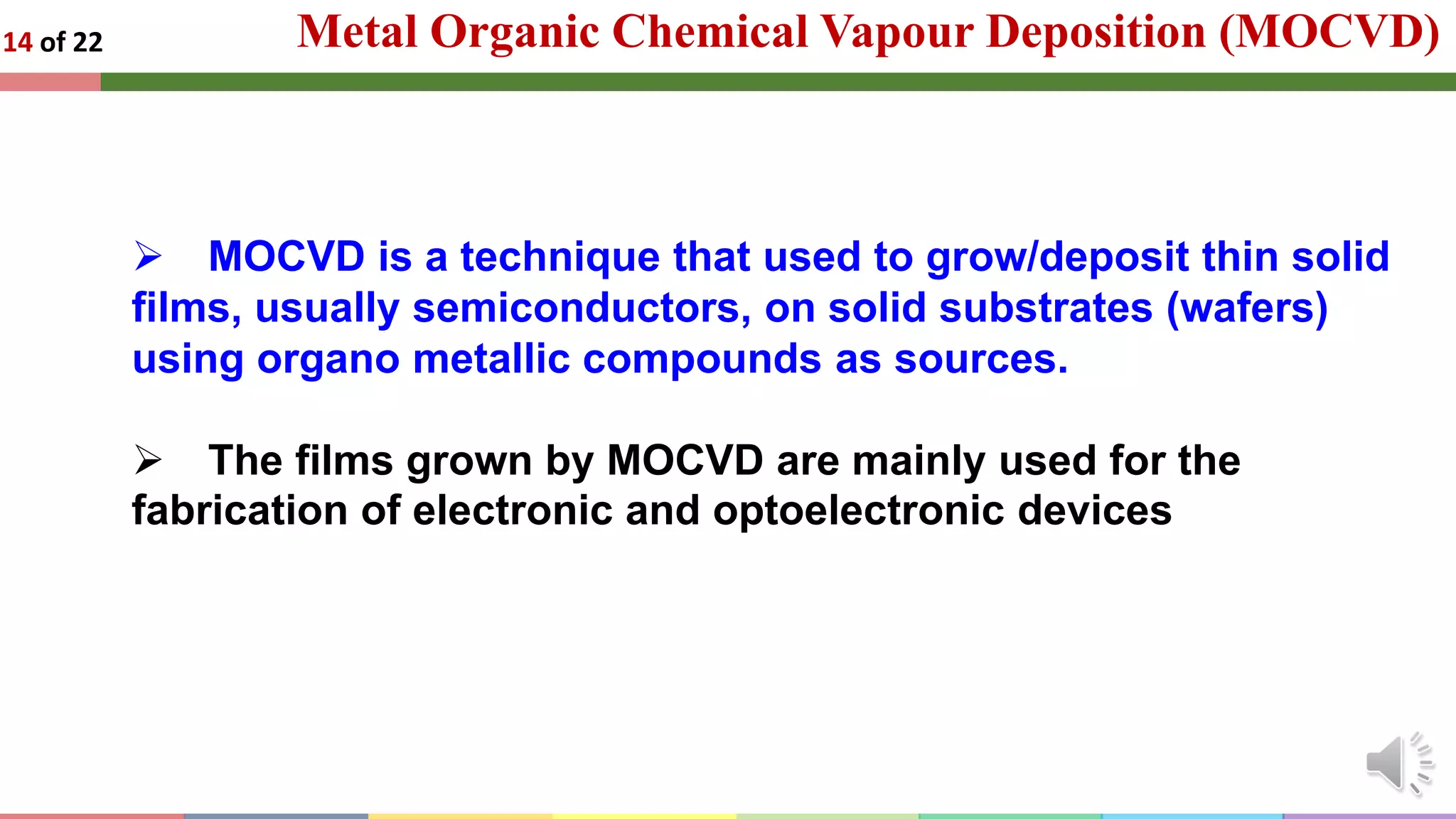
➢ MOCVD is a technique that used to grow/deposit thin solid
films, usually semiconductors, on solid substrates (wafers)
using organo metallic compounds as sources.
➢ The films grown by MOCVD are mainly used for the
fabrication of electronic and optoelectronic devices
Metal Organic Chemical Vapour Deposition (MOCVD) contd.
15 of 22
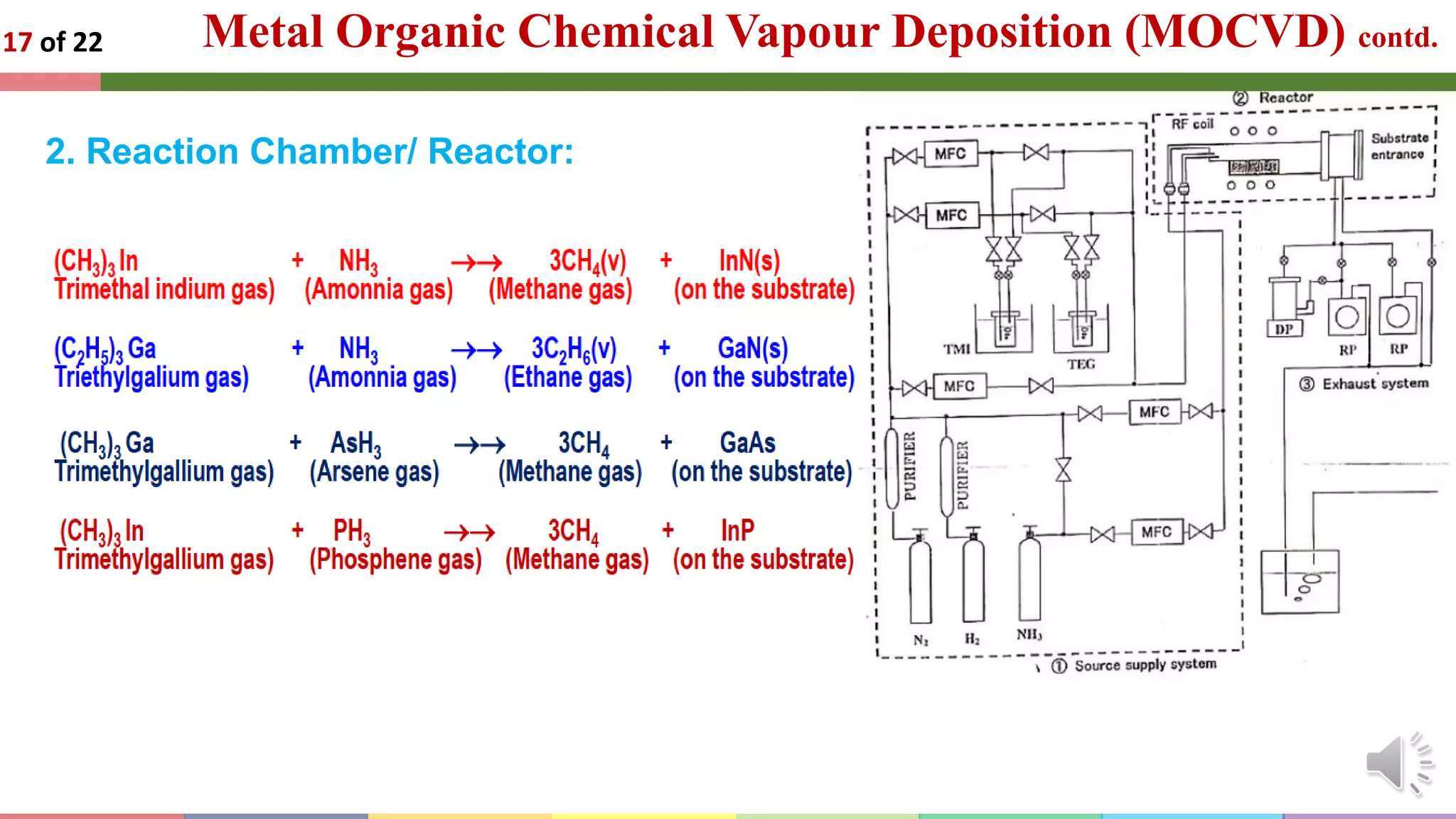
1. Source Supply System:
➢ TMI (Trimethylindium) and TEG
(Triethylgalium) are used as source material
for In and Ga respectively.
➢ NH3 is used as a source material for
nitrogen.
➢ N2 is used as a carrier gas to bring TMI
and TEG into the reactor.
➢ H2 gas is used for the thermal treatment of
the substrate.
➢ Reactive gases are fed in to the reactor
through the mass flow controllers (MFC)
Metal Organic Chemical Vapour Deposition (MOCVD) contd.
16 of 22
2. Reaction Chamber/ Reactor:
➢ Epitaxial vapor growth is made inside
the reactor at
different conditions (temperature, pressure,
gas flow).
➢ The substrates are placed on the
susceptor.
➢ Reactive gases are then fed into the
reactor and these gases react on the
substrate and form a grown film.
➢ The heating method of this reactor is RF
induction heating.
Metal Organic Chemical Vapour Deposition (MOCVD) contd.
17 of 22
2. Reaction Chamber/ Reactor:
Metal Organic Chemical Vapour Deposition (MOCVD) contd.
18 of 22
3. Exhaust System:
The exhaust system consists of rotary
and diffusion pump. When reactions are
take place, the exhaust gases
are then released to air through rotary
pump and exhaust fan.
19 of 22 Metal Organic Chemical Vapour Deposition (MOCVD)
Advantages:
➢ Epitaxial films can be grown from solid, liquid, or gas phases
➢ High grown layers quality, Highest flexibility
➢ Faster growth rate than MBE, can be a few microns per hour;
➢ Different materials can be grown in the same system.
➢ Doping uniformity/reproducibility, Economically advantageous.
➢ High throughput and no ultra high vacuum needed
➢ Precision in deposition thickness
➢ Higher temperature growth
Comparison
20 of 22
More Applications
21 of 22
•Bipolar Transistor
• Needed to produce buried layer
•III-V Devices
• Interface quality key
• Heterojunction Bipolar
Transistor
• LED
• Laser
Thank you!
Question & Answer

Epitaxial growth - Fabrication

  • 1.
    Presented by: Md. RayidHasan Mojumder (2003568) Intoduction to the Epitaxial Growth of Semiconductor Materials Dept. of Electrical & Electronic Engineering Khulna University of Engineering & Technology, Khulna- 9203, Bangladesh Course No: EE 6906 Course Title: PV Cells and Materials
  • 2.
    2 of 22Outline • Introduction • Mechanism of epitaxial growth • Methods of epitaxial deposition • Applications of epitaxial layers
  • 3.
    Introduction 3 of 22 “Oh,its a standard ‘boy meets girl, boy loses girl, boy invents a new deposition technique for ultra- thin film semiconductors, boy gets girl back’ story”. Thin Film Growth
  • 4.
    Epitaxy 4 of 22 •The term Epitaxy comes from the Greek word meaning ‘ordered upon’. • Epitaxy means the growth of a single crystal film on top of a crystalline substrate.
  • 5.
    Epitaxial Growth 5 of22 Deposition of a layer on a substrate which matches the crystalline order of the substrate Ordered, crystalline growth; NOT epitaxial Epitaxial growth: • Homoepitaxy Growth of a layer of the same material as the substrate -> Si on Si • Heteroepitaxy Growth of a layer of a different material than the substrate -> GaAs on Si
  • 6.
    Why Epitaxial Growth 6of 22 • Creating group III-V Devices (Interface quality key, Hetero-junction Bipolar Transistor, LED, Laser) • High purity • Low defect density • Abrupt interfaces • Controlled doping profiles • High repeatability and uniformity • Safe, efficient operation
  • 7.
    7 of 22Mechanism of Epitaxial Growth Steps: Absorption of ad atoms Surface diffusion Crystal growth Evaporation of adatoms Parameters: Growth temperature Growth pressure Flow amount of reactants Substrate and treatment
  • 8.
    Methods of EpitaxialDeposition 8 of 22 • Liquid phase epitaxy (grown from a Melt) • Molecular beam epitaxy (an evaporation of the elements in a Vacuum) • Vapor Phase Epitaxy/Chemical vapor deposition (grown from Vapor)
  • 9.
    Liquid Phase Epitaxy(LPE) 9 of 22 ⚫ Reactants are dissolved in a molten solvent at high temperature ⚫ Substrate dipped into solution while the temperature is held constant ❖ LPE involves the precipitation of a crystalline film from a supersaturated melt on to a substrate. ❖ The temperature is increased until a phase transition occurs and then reduced for precipitation. ❖ By controlling cooling rates the kinetics of layer growth can be controlled.
  • 10.
    Liquid Phase Epitaxy(LPE) contd. 10 of 22 Advantages: ⚫ High quality layer ⚫ Fast, inexpensive ⚫ Not ideal for large area layers or abrupt interfaces ⚫ Thermodynamic driving force relatively very low
  • 11.
    Molecular Beam Epitaxy(MBE) 11 of 22 ➢Here in MBE reactants are introduced by molecular beams. ➢Create beams by heating source of material to melting point in an effusion (or Knudsen) cell. ➢UHV gives source molecules a large mean free path, forming a straight beam. ➢Beam impinges on a heated substrate (600’C). ➢Incident molecules diffuse around the surface to the proper crystal sites and form crystalline layers. ➢Both solid and gas source can be used.
  • 12.
    Molecular Beam Epitaxy(MBE) contd. 12 of 22
  • 13.
    Molecular Beam Epitaxy(MBE) contd. 13 of 22
  • 14.
    Metal Organic ChemicalVapour Deposition (MOCVD) 14 of 22 ➢ MOCVD is a technique that used to grow/deposit thin solid films, usually semiconductors, on solid substrates (wafers) using organo metallic compounds as sources. ➢ The films grown by MOCVD are mainly used for the fabrication of electronic and optoelectronic devices
  • 15.
    Metal Organic ChemicalVapour Deposition (MOCVD) contd. 15 of 22 1. Source Supply System: ➢ TMI (Trimethylindium) and TEG (Triethylgalium) are used as source material for In and Ga respectively. ➢ NH3 is used as a source material for nitrogen. ➢ N2 is used as a carrier gas to bring TMI and TEG into the reactor. ➢ H2 gas is used for the thermal treatment of the substrate. ➢ Reactive gases are fed in to the reactor through the mass flow controllers (MFC)
  • 16.
    Metal Organic ChemicalVapour Deposition (MOCVD) contd. 16 of 22 2. Reaction Chamber/ Reactor: ➢ Epitaxial vapor growth is made inside the reactor at different conditions (temperature, pressure, gas flow). ➢ The substrates are placed on the susceptor. ➢ Reactive gases are then fed into the reactor and these gases react on the substrate and form a grown film. ➢ The heating method of this reactor is RF induction heating.
  • 17.
    Metal Organic ChemicalVapour Deposition (MOCVD) contd. 17 of 22 2. Reaction Chamber/ Reactor:
  • 18.
    Metal Organic ChemicalVapour Deposition (MOCVD) contd. 18 of 22 3. Exhaust System: The exhaust system consists of rotary and diffusion pump. When reactions are take place, the exhaust gases are then released to air through rotary pump and exhaust fan.
  • 19.
    19 of 22Metal Organic Chemical Vapour Deposition (MOCVD) Advantages: ➢ Epitaxial films can be grown from solid, liquid, or gas phases ➢ High grown layers quality, Highest flexibility ➢ Faster growth rate than MBE, can be a few microns per hour; ➢ Different materials can be grown in the same system. ➢ Doping uniformity/reproducibility, Economically advantageous. ➢ High throughput and no ultra high vacuum needed ➢ Precision in deposition thickness ➢ Higher temperature growth
  • 20.
  • 21.
    More Applications 21 of22 •Bipolar Transistor • Needed to produce buried layer •III-V Devices • Interface quality key • Heterojunction Bipolar Transistor • LED • Laser
  • 22.