By Dhruv Upadhaya
162510
Submitted to
Dr. (Mrs.) Lini
Mathew
PIN Photodiode
CONTENT
Physical Principles of PIN Photodetector
Photodetectors characteristics (Quantum efficiency,
Responsivity, S/N)
Noise in Photodetector Circuits
Photodiode Response Time
Photodiodes structures
PIN PHOTODETECTOR
The high electric field present in the depletion region causes
photo-generated carriers to separate and be collected across
the reverse –biased junction. This give rise to a current flow in
an external circuit, known as photocurrent.
ENERGY-BAND DIAGRAM FOR A PIN
PHOTODIODE
PHOTOCURRENT
Optical power absorbed, in the depletion region can be written
in terms of incident optical power:
Absorption coefficient strongly depends on wavelength. The
upper wavelength cutoff for any semiconductor can be
determined by its energy gap as follows:
Taking entrance face reflectivity into consideration, the
absorbed power in the width of depletion region, w, becomes:
)1()( )(
0
xs
ePxP 

(eV)
24.1
)m(
g
c
E

)1)(1()()1( )(
0 f
w
f RePwPR s
  
Quantum Efficiency () = number of e-h pairs generated /
number of incident photons
Responsivity measures the input–output gain of a detector
system. In the specific case of a photodetector, responsivity
measures the electrical output per optical input.
0
/
/
pI q
P h



0
pI q
P h


   mA/mW
RESPONSIVITY ()
RESPONSIVITY
c
g
hc
E
 When λ<< λc absorption is low
When λ > λc; no absorption
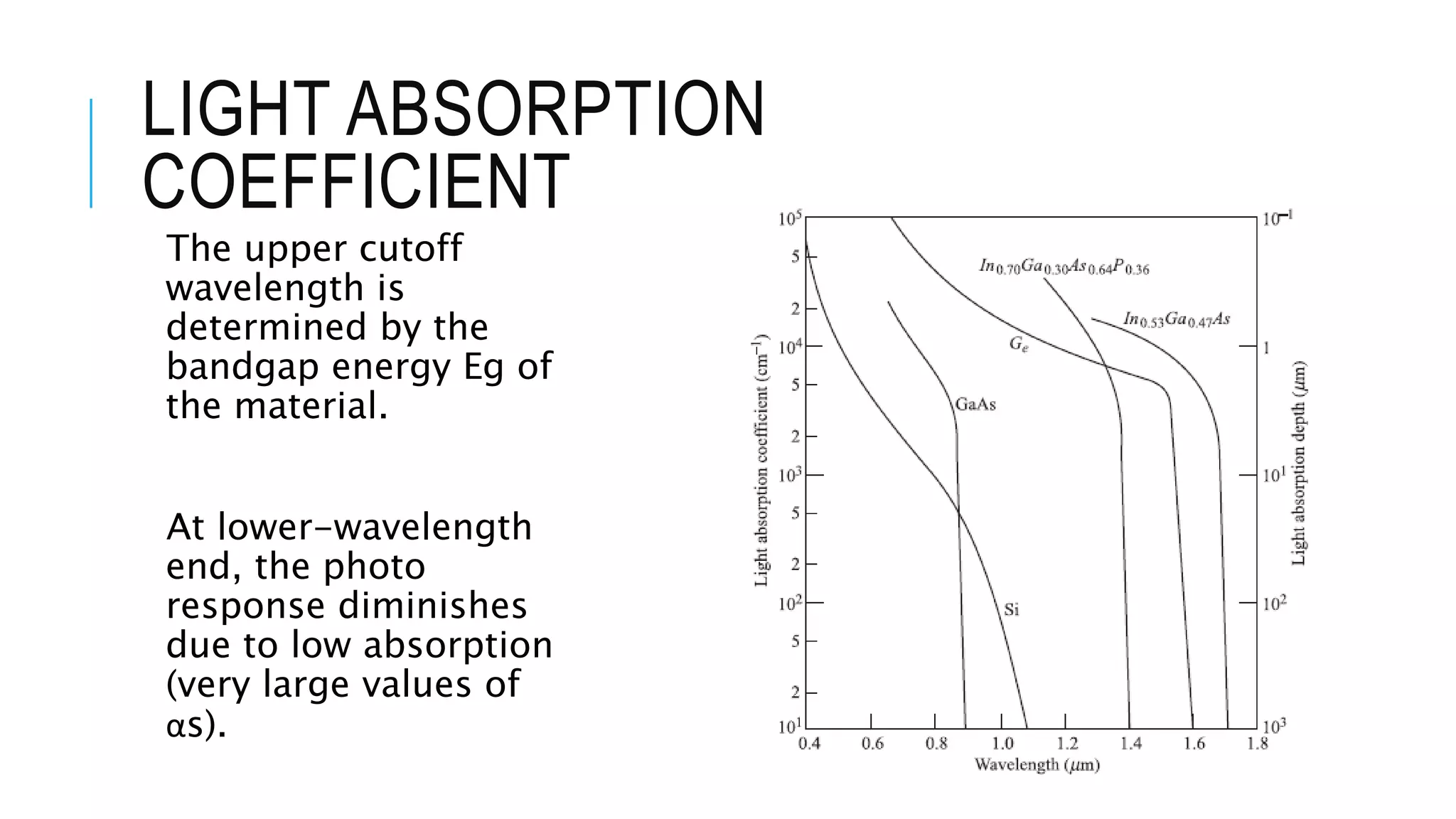
LIGHT ABSORPTION
COEFFICIENT
The upper cutoff
wavelength is
determined by the
bandgap energy Eg of
the material.
At lower-wavelength
end, the photo
response diminishes
due to low absorption
(very large values of
αs).
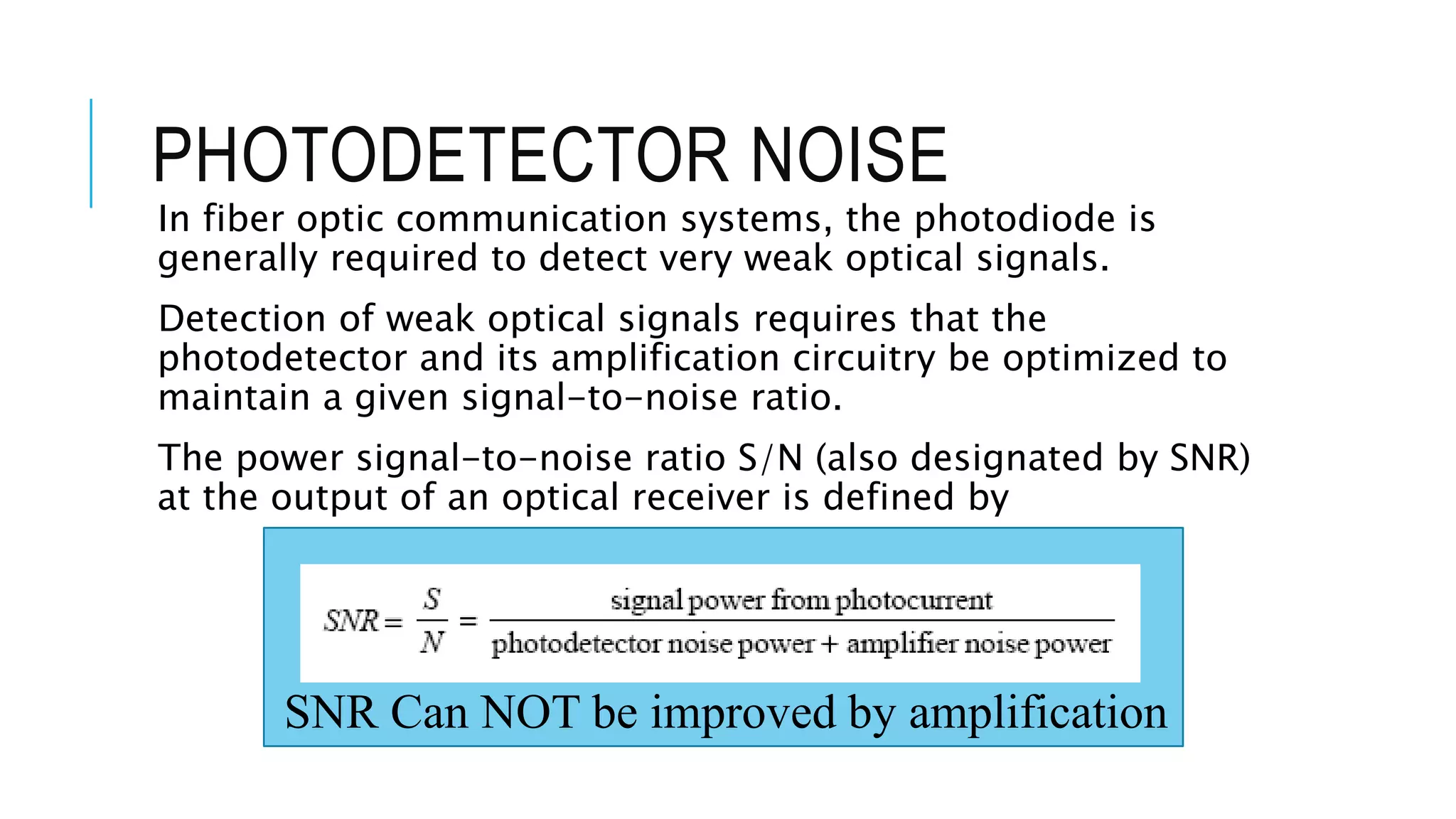
PHOTODETECTOR NOISE
In fiber optic communication systems, the photodiode is
generally required to detect very weak optical signals.
Detection of weak optical signals requires that the
photodetector and its amplification circuitry be optimized to
maintain a given signal-to-noise ratio.
The power signal-to-noise ratio S/N (also designated by SNR)
at the output of an optical receiver is defined by
SNR Can NOT be improved by amplification
QUANTUM (SHOT NOISE)
)(2 22
MFBMqIi pQ 
F(M): APD Noise Figure F(M) ~= Mx (0 ≤ x ≤ 1)
Ip: Mean Detected Current
B = Bandwidth
q: Charge of an electron
Quantum noise arises due optical power fluctuation because
light is made up of discrete number of photons
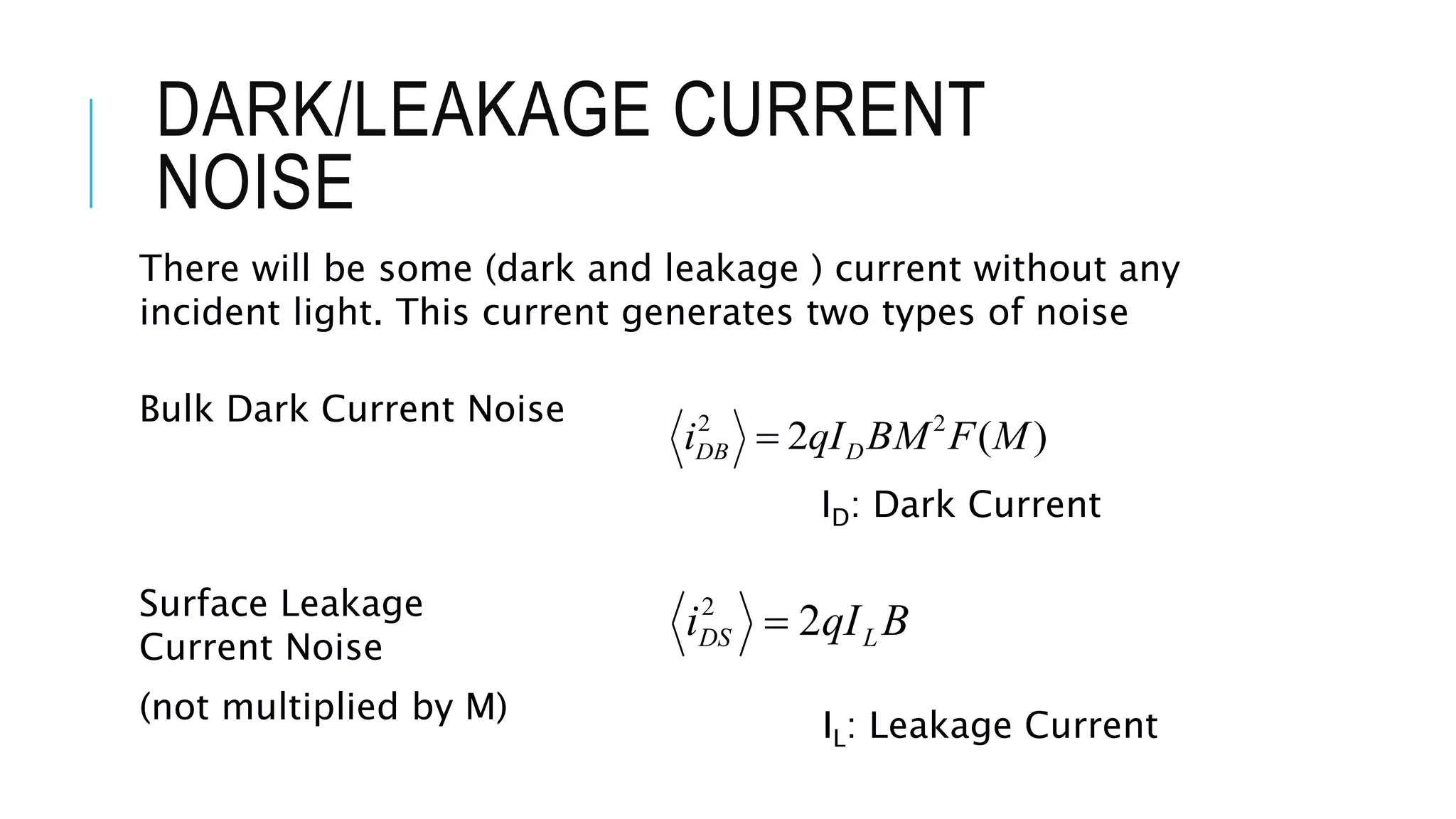
DARK/LEAKAGE CURRENT
NOISE
)(2 22
MFBMqIi DDB 
BqIi LDS 22

Bulk Dark Current Noise
Surface Leakage
Current Noise
ID: Dark Current
IL: Leakage Current
There will be some (dark and leakage ) current without any
incident light. This current generates two types of noise
(not multiplied by M)
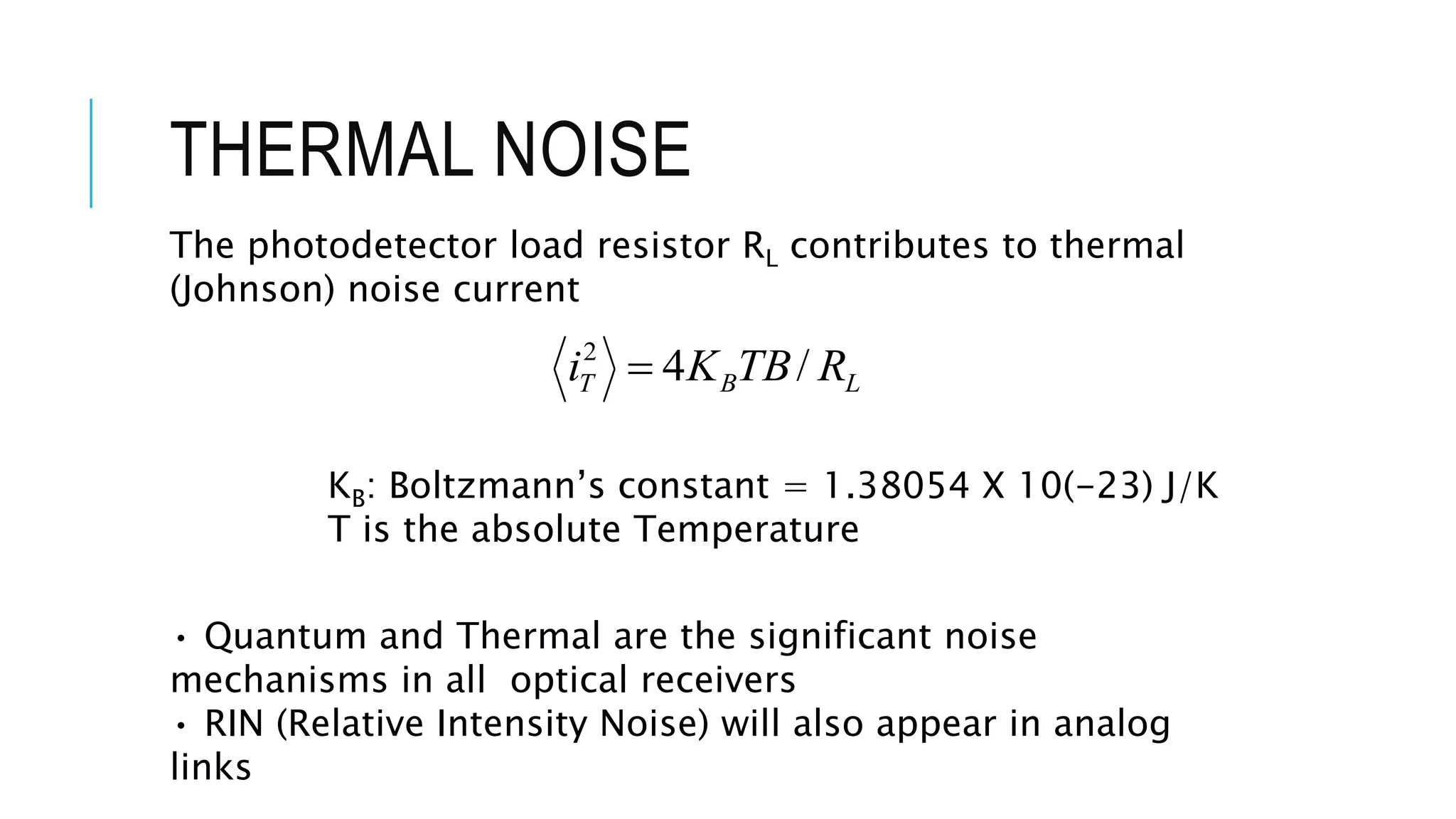
THERMAL NOISE
The photodetector load resistor RL contributes to thermal
(Johnson) noise current
LBT RTBKi /42

KB: Boltzmann’s constant = 1.38054 X 10(-23) J/K
T is the absolute Temperature
• Quantum and Thermal are the significant noise
mechanisms in all optical receivers
• RIN (Relative Intensity Noise) will also appear in analog
links
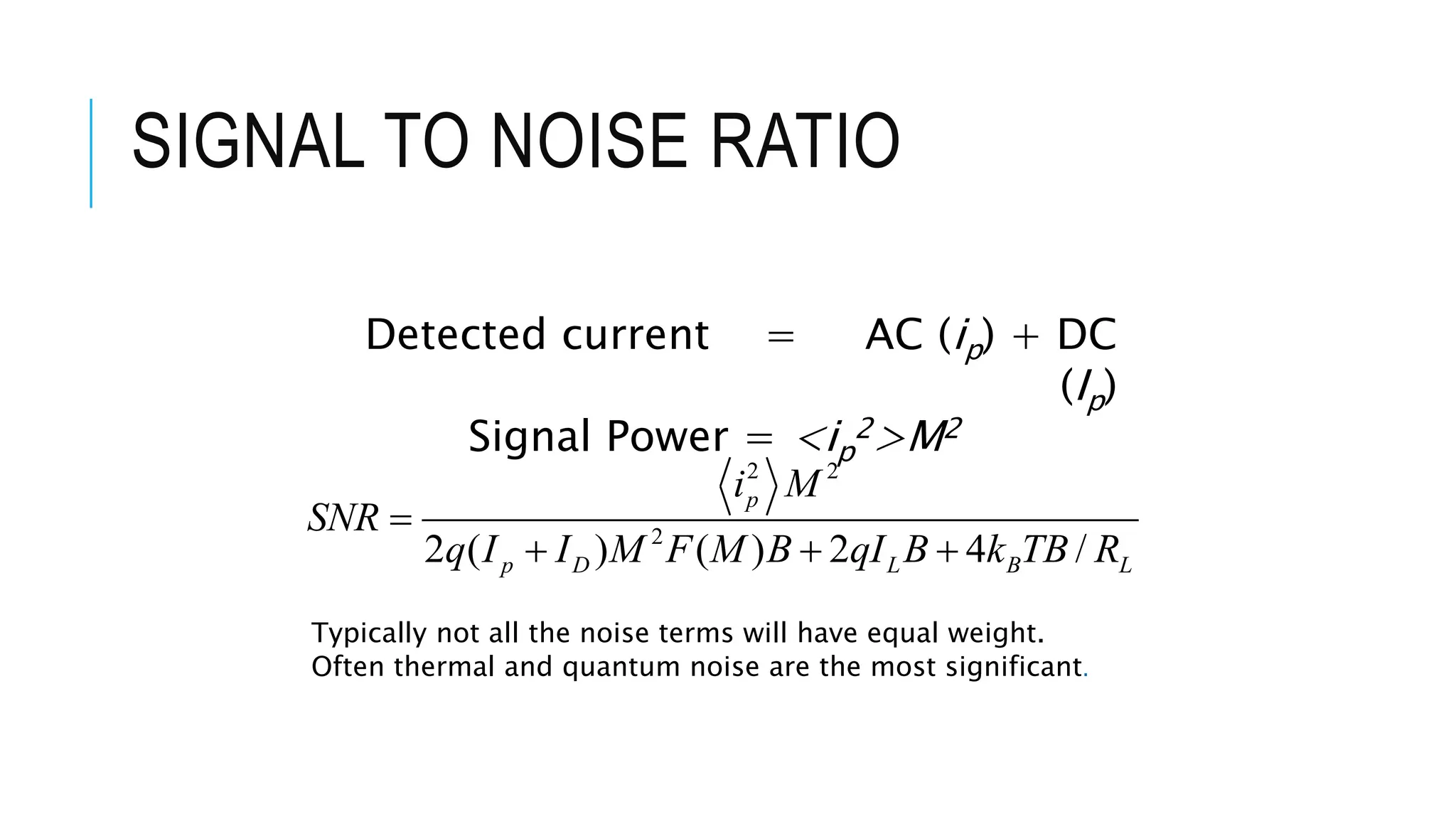
SIGNAL TO NOISE RATIO
2 2
2
2 ( ) ( ) 2 4 /
p
p D L B L
i M
SNR
q I I M F M B qI B k TB R

  
Detected current = AC (ip) + DC
(Ip)
Signal Power = <ip
2>M2
Typically not all the noise terms will have equal weight.
Often thermal and quantum noise are the most significant.
RESPONSE TIME IN PIN
PHOTODIODE
Transit time, td and carrier drift velocity vd are related by
/d dt w v For a high speed Si PD, td = 0.1 ns
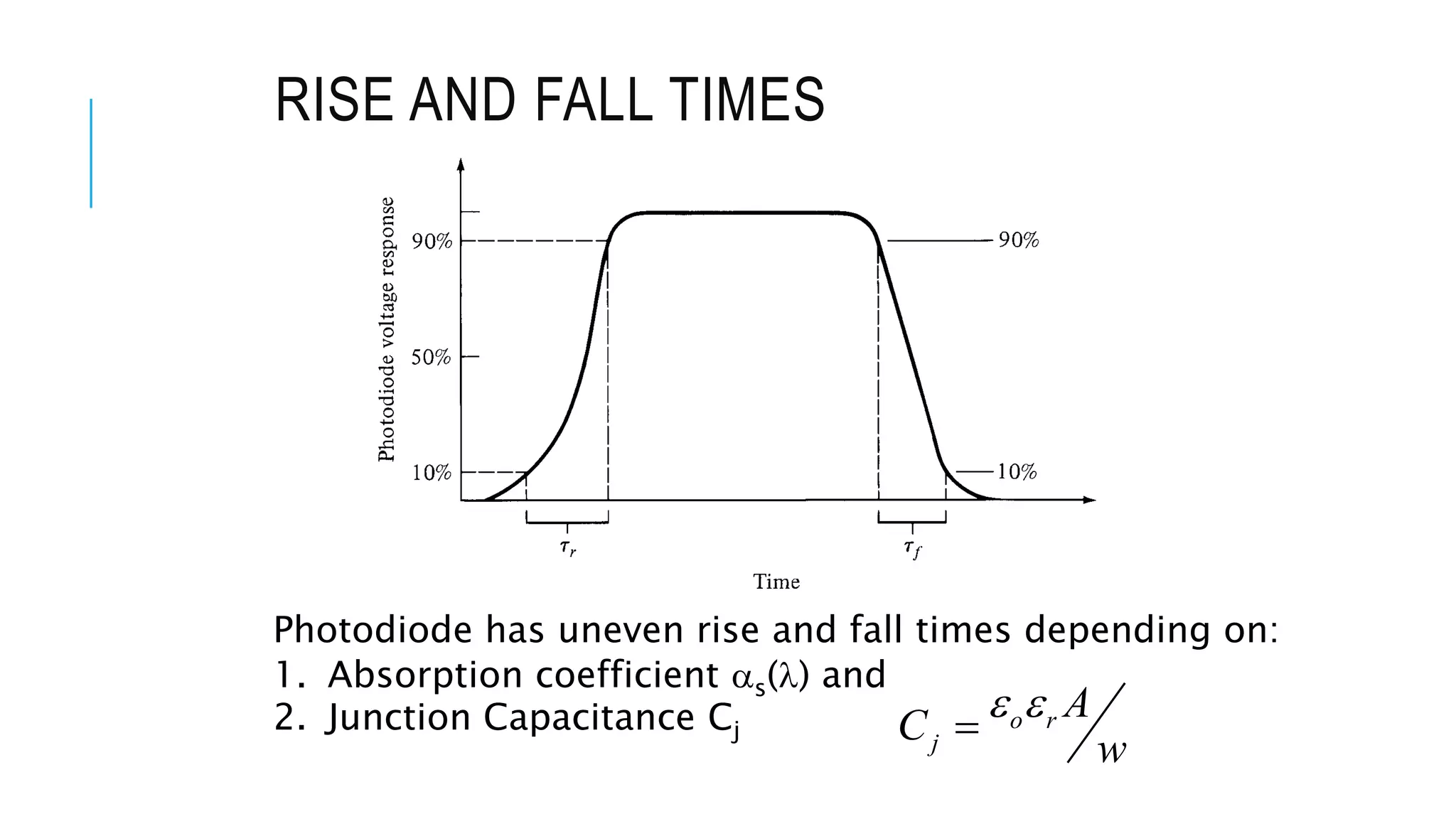
RISE AND FALL TIMES
Photodiode has uneven rise and fall times depending on:
1. Absorption coefficient s() and
2. Junction Capacitance Cj o r
j
A
C
w
 
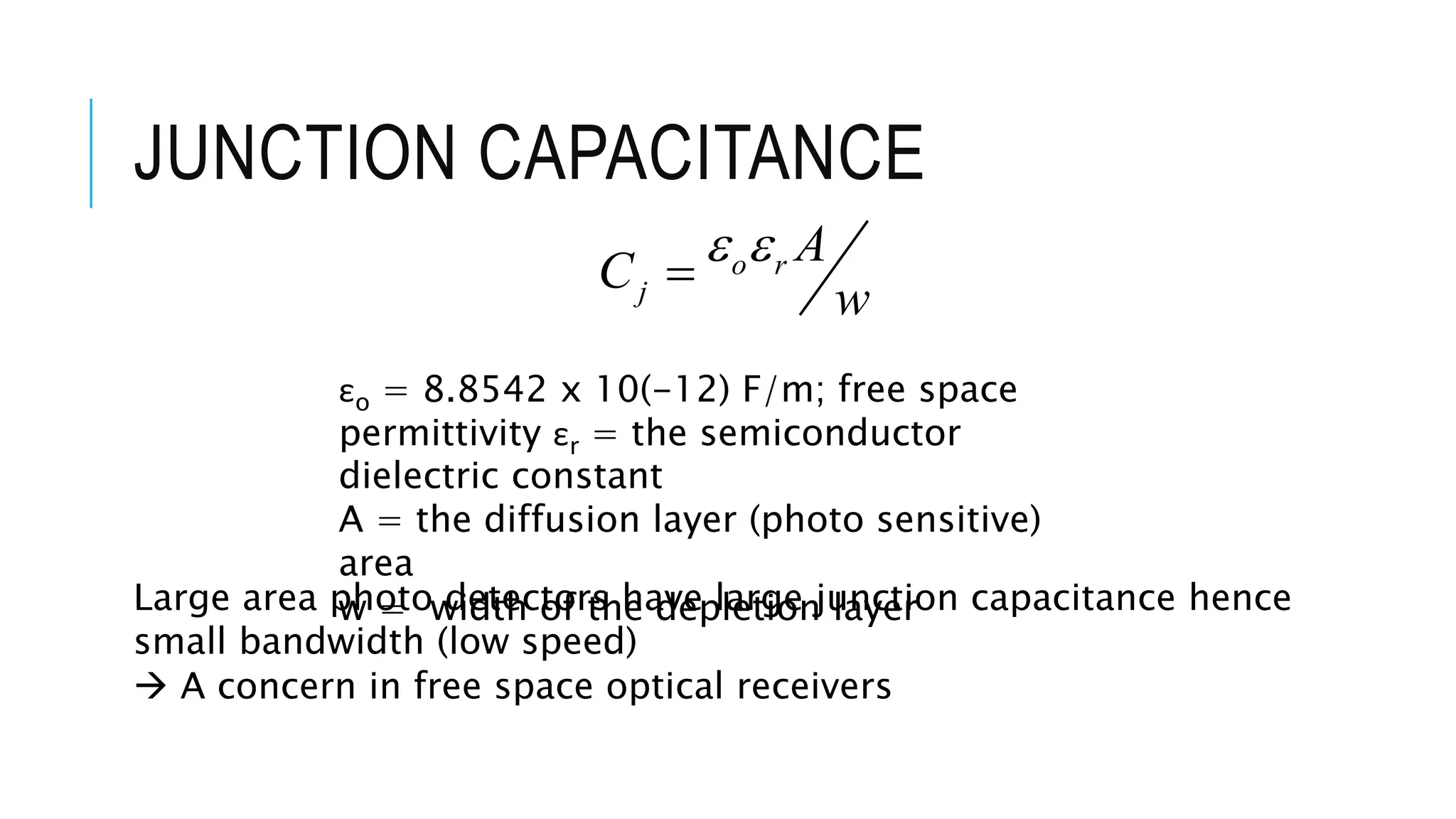
JUNCTION CAPACITANCE
o r
j
A
C
w
 
εo = 8.8542 x 10(-12) F/m; free space
permittivity εr = the semiconductor
dielectric constant
A = the diffusion layer (photo sensitive)
area
w = width of the depletion layerLarge area photo detectors have large junction capacitance hence
small bandwidth (low speed)
 A concern in free space optical receivers
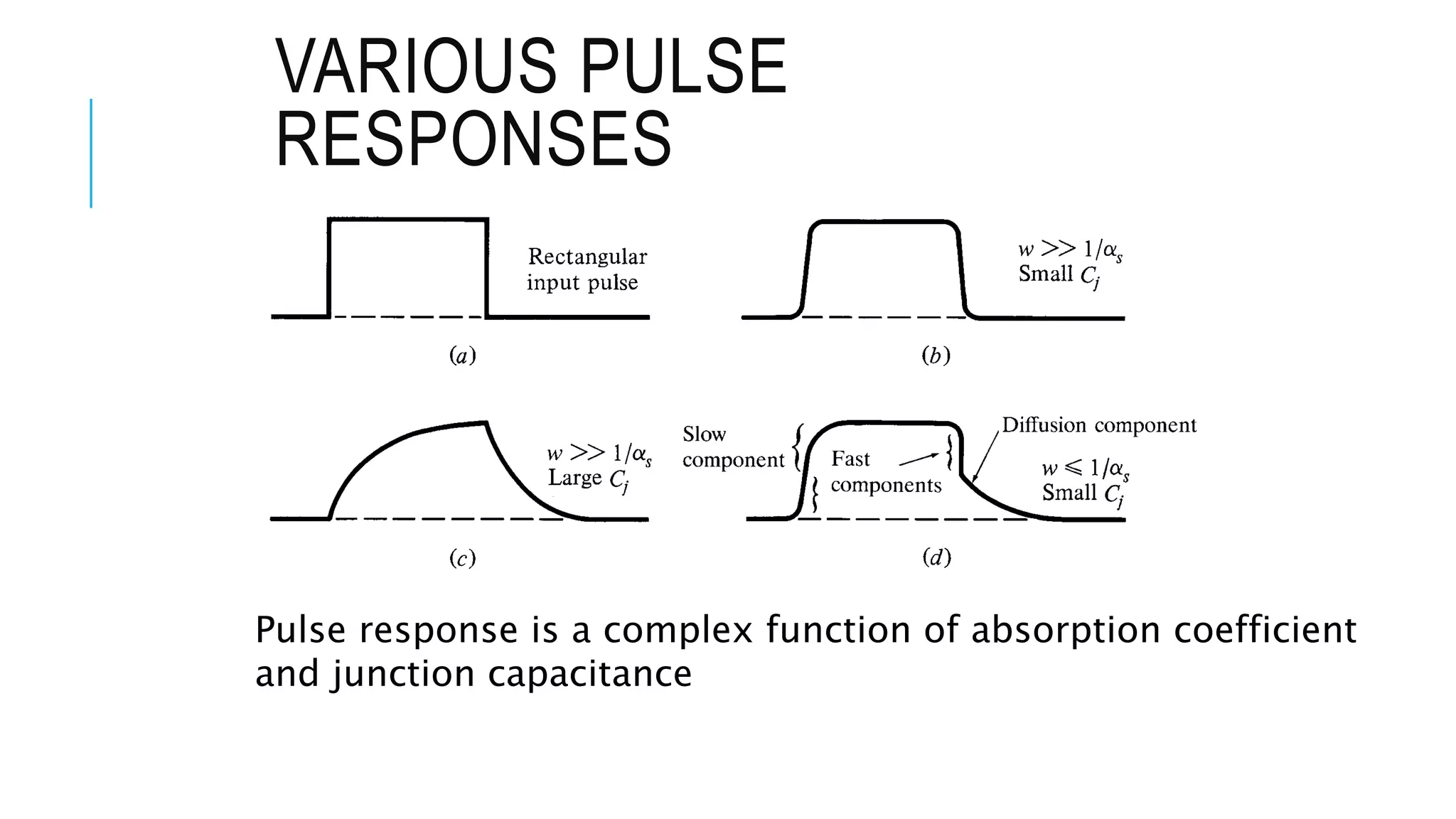
VARIOUS PULSE
RESPONSES
Pulse response is a complex function of absorption coefficient
and junction capacitance
COMPARISONS OF PIN
PHOTODIODES
BASIC PIN PHOTODIODE
STRUCTURE
Front Illuminated Photodiode
Rear Illuminated Photodiode
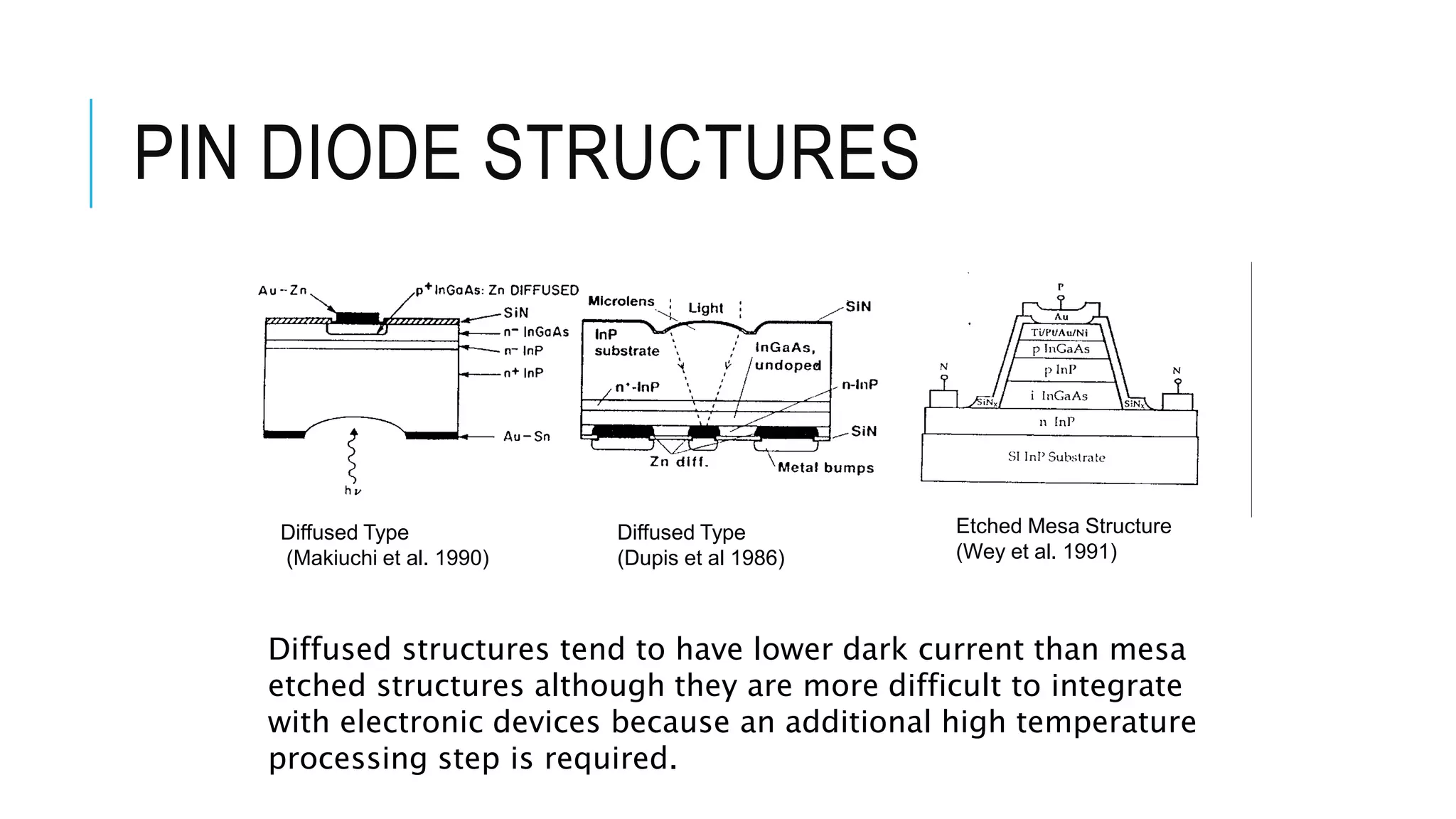
PIN DIODE STRUCTURES
Diffused Type
(Makiuchi et al. 1990)
Etched Mesa Structure
(Wey et al. 1991)
Diffused Type
(Dupis et al 1986)
Diffused structures tend to have lower dark current than mesa
etched structures although they are more difficult to integrate
with electronic devices because an additional high temperature
processing step is required.
THANK YOU
ANY QUERIES??

Optical Detector PIN photodiode

  • 1.
    By Dhruv Upadhaya 162510 Submittedto Dr. (Mrs.) Lini Mathew PIN Photodiode
  • 2.
    CONTENT Physical Principles ofPIN Photodetector Photodetectors characteristics (Quantum efficiency, Responsivity, S/N) Noise in Photodetector Circuits Photodiode Response Time Photodiodes structures
  • 3.
    PIN PHOTODETECTOR The highelectric field present in the depletion region causes photo-generated carriers to separate and be collected across the reverse –biased junction. This give rise to a current flow in an external circuit, known as photocurrent.
  • 4.
    ENERGY-BAND DIAGRAM FORA PIN PHOTODIODE
  • 5.
    PHOTOCURRENT Optical power absorbed,in the depletion region can be written in terms of incident optical power: Absorption coefficient strongly depends on wavelength. The upper wavelength cutoff for any semiconductor can be determined by its energy gap as follows: Taking entrance face reflectivity into consideration, the absorbed power in the width of depletion region, w, becomes: )1()( )( 0 xs ePxP   (eV) 24.1 )m( g c E  )1)(1()()1( )( 0 f w f RePwPR s   
  • 6.
    Quantum Efficiency ()= number of e-h pairs generated / number of incident photons Responsivity measures the input–output gain of a detector system. In the specific case of a photodetector, responsivity measures the electrical output per optical input. 0 / / pI q P h    0 pI q P h      mA/mW RESPONSIVITY ()
  • 7.
    RESPONSIVITY c g hc E  When λ<<λc absorption is low When λ > λc; no absorption
  • 8.
    LIGHT ABSORPTION COEFFICIENT The uppercutoff wavelength is determined by the bandgap energy Eg of the material. At lower-wavelength end, the photo response diminishes due to low absorption (very large values of αs).
  • 9.
    PHOTODETECTOR NOISE In fiberoptic communication systems, the photodiode is generally required to detect very weak optical signals. Detection of weak optical signals requires that the photodetector and its amplification circuitry be optimized to maintain a given signal-to-noise ratio. The power signal-to-noise ratio S/N (also designated by SNR) at the output of an optical receiver is defined by SNR Can NOT be improved by amplification
  • 10.
    QUANTUM (SHOT NOISE) )(222 MFBMqIi pQ  F(M): APD Noise Figure F(M) ~= Mx (0 ≤ x ≤ 1) Ip: Mean Detected Current B = Bandwidth q: Charge of an electron Quantum noise arises due optical power fluctuation because light is made up of discrete number of photons
  • 11.
    DARK/LEAKAGE CURRENT NOISE )(2 22 MFBMqIiDDB  BqIi LDS 22  Bulk Dark Current Noise Surface Leakage Current Noise ID: Dark Current IL: Leakage Current There will be some (dark and leakage ) current without any incident light. This current generates two types of noise (not multiplied by M)
  • 12.
    THERMAL NOISE The photodetectorload resistor RL contributes to thermal (Johnson) noise current LBT RTBKi /42  KB: Boltzmann’s constant = 1.38054 X 10(-23) J/K T is the absolute Temperature • Quantum and Thermal are the significant noise mechanisms in all optical receivers • RIN (Relative Intensity Noise) will also appear in analog links
  • 13.
    SIGNAL TO NOISERATIO 2 2 2 2 ( ) ( ) 2 4 / p p D L B L i M SNR q I I M F M B qI B k TB R     Detected current = AC (ip) + DC (Ip) Signal Power = <ip 2>M2 Typically not all the noise terms will have equal weight. Often thermal and quantum noise are the most significant.
  • 14.
    RESPONSE TIME INPIN PHOTODIODE Transit time, td and carrier drift velocity vd are related by /d dt w v For a high speed Si PD, td = 0.1 ns
  • 15.
    RISE AND FALLTIMES Photodiode has uneven rise and fall times depending on: 1. Absorption coefficient s() and 2. Junction Capacitance Cj o r j A C w  
  • 16.
    JUNCTION CAPACITANCE o r j A C w  εo = 8.8542 x 10(-12) F/m; free space permittivity εr = the semiconductor dielectric constant A = the diffusion layer (photo sensitive) area w = width of the depletion layerLarge area photo detectors have large junction capacitance hence small bandwidth (low speed)  A concern in free space optical receivers
  • 17.
    VARIOUS PULSE RESPONSES Pulse responseis a complex function of absorption coefficient and junction capacitance
  • 18.
  • 19.
    BASIC PIN PHOTODIODE STRUCTURE FrontIlluminated Photodiode Rear Illuminated Photodiode
  • 20.
    PIN DIODE STRUCTURES DiffusedType (Makiuchi et al. 1990) Etched Mesa Structure (Wey et al. 1991) Diffused Type (Dupis et al 1986) Diffused structures tend to have lower dark current than mesa etched structures although they are more difficult to integrate with electronic devices because an additional high temperature processing step is required.
  • 21.

Editor's Notes