Initialized by
Almas Akram
LIGHT EMITTING
DIODES (LED)
OPTOELECRONIC
A light emitting diode (LED) is
essentially a PN junction opto-
semiconductor that emits a
monochromatic (single color) light
when operated in a forward biased
direction.
LEDs converrt electrical energy into
light energy. They are frequently
used as "pilot" lights in electronic
appliances to indicate whether the
circuit is closed or not
HOW DOES A LED WORK?
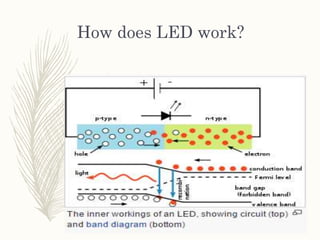
– When sufficient voltage is applied to the chip across the
leads of the LED, electrons can move easily in only one
direction across the junction between the p and n regions.
– In the p region there are many more positive than negative
charges.
– When a voltage is applied and the current starts to flow,
electrons in the n region have sufficient energy to move
across the junction into the p region
How does LED work?
How Does A LED Work?
– Each time an electron recombine swith a positive charge,
electric potential energy is converted into electromagnetic
energy.
– For each recombination of a negative and a positive charge,
a quantum of electromagnetic energy is emitted in the
form of a photon of light with a frequency characteristic of
the semi-conductor material(usually a combination of the
chemical elements gallium, arsenic and phosphorus.
How Much Energy Does an
LED Emit?
The energy (E) of the light emitted by an LED is related to the
electric charge (q) of an electron and the voltage (V)
required to light the LED by the expression: E = qv Joules.
– Finding the Energy from the Voltage Suppose you
measured the voltage across the leads of an LED , and you
wished to find the corresponding energy required to light
the LED. Let us say that you have a red LED, and the voltage
measured between the leads of is 1.71 Volts. So the Energy
required to light the LED is E = qv or E = -1.6 x 10⁻⁹
Finding the Energy from the
Voltage
– Voltage Suppose you measured the voltage across the leads of
an LED, and you wished to find the corresponding energy
required to light the LED.
– Let us say that you have a red LED, and the voltage measured
between the leads of is 1.71 Volts.
– So the Energy required to light the LED is
– E = qV or E = -1.6 x 10⁻¹⁹(1.71)
– Joule, since a Coulomb-Volt is a Joule. Multiplication of these
numbers then gives
– E = 2.74 x 10⁻¹⁹Joule.
NEXT proceeded by
MUBEEN TALHA.
LED VOLTAGE AND
CURRENT
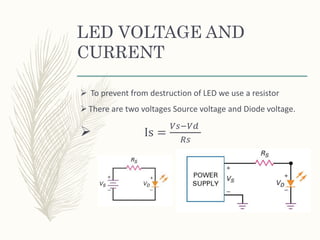
 To prevent from destruction of LED we use a resistor
 There are two voltages Source voltage and Diode voltage.
 Is =
𝑉𝑠−𝑉𝑑
𝑅𝑠
LED Brightness
 the brightness of an LED depends on the current
When Vs is much greater than Vd the brightness of LED is
approximately constant.
If Vs is only slightly more than Vd, the LED brightness will
vary noticeably.
To keep the brightness of LED constant the source current
must be constant .
Colours of LEDs
– LEDs are available in red, orange, amber, yellow, green, blue
and white. Blue and white LEDs are much more expensive
than the other colours. The colour of an LED is determined by
the semiconductor material, not by the colouring of the
package (the plastic body).
– LEDs are made from gallium-based crystals that contain one or
more additional materials such as phosphorous to produce a
distinct color. Different LED chip technologies emit light in
specific regions of the visible light spectrum and produce
different intensity levels.
BREAKDOWN VOLTAGE
– LED have very low breakdown voltage , typically between
3V and 5V
– LED destroyed if the too much voltage applied.
– It works only in farward biased
NEXT proceeded by
AQSA
Seven-Segment Display
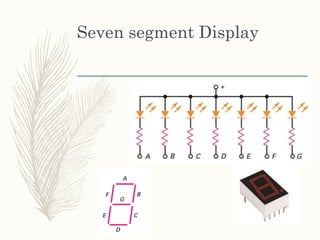
It contains seven rectangular LEDs ( A through G ) Each LED
is called a segment.
External series resistors are included to limit the current to
safe levels.
Using seven segment we can form any digit from 1 to 9 . It
can also display the capital letters(A,C,E,F) .
In seven-segment indicator all anodes are connected
together.
It is also in common cathode type in which all cathodes are
connected together
Seven segment Display
NEXT proceeded by
Zoya
Photodiode
–What is photodiode ?
 Photodiode is a reverse of led
 In photodiode input is light and the output is voltage
 It works in reverse biased.
 When the covalent bond break electrons emit and it moves
from lower to higher orbit and gain energy. When it come
back to lower energy level it emits radiation in form of
voltage .
photodiode
- Principle of photodiode
 When light energy bombarded a pn junction ,it dislodge
valance electrons
 More the light strike the pn-junction more is the reverse
current produce
 Incoming light produces free electrons and holes
 The stronger the light the larger the minority carriers and
greater the reverse current
 As the light become brighter , the reverse current increases.
NEXT proceeded by
Muneeba Nisar
optocoupler
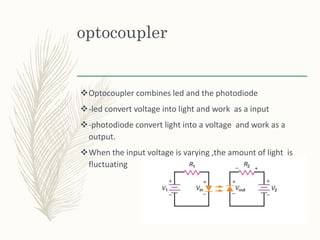
Optocoupler combines led and the photodiode
-led convert voltage into light and work as a input
-photodiode convert light into a voltage and work as a
output.
When the input voltage is varying ,the amount of light is
fluctuating
optocoupler
– Advantage of optocoupler
Easily availaible
No gas , No pollutant produce
Less area required for installation
– Disadvantage of optocoupler
Not always produce constant electricity
Due to temperature variation after some time decrease the
efficiency
Laser diode
 In a led free electrons radiate light when falling high
energy level to lower one
 A laser diode is different , it produce the coherent light
 A laser diode produce a narrow beam of light which is very
intense ,focused and pure.
 These are also known as semi-conductor laser, it can
produce visible and invisible lights.
NEXT proceeded by
M. ABDULLAH HASHMI
(GROUP leader )
Applications
– Sensor Application
– Mobile Applications
– Sign Applications
– Automobile Applications
– LED Signals
– Indicators
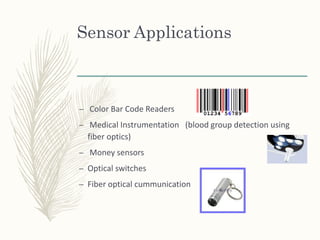
Sensor Applications
– Color Bar Code Readers
– Medical Instrumentation (blood group detection using
fiber optics)
– Money sensors
– Optical switches
– Fiber optical cummunication
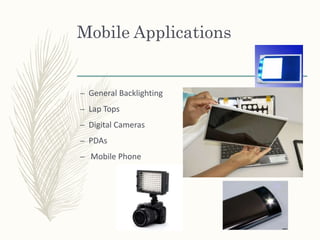
Mobile Applications
– General Backlighting
– Lap Tops
– Digital Cameras
– PDAs
– Mobile Phone
Sign Applications
– Transportation Passenger Information
– Traffic
– Monochrome Message Board
– Full color video
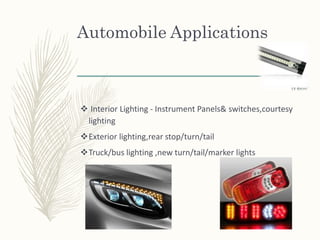
Automobile Applications
 Interior Lighting - Instrument Panels& switches,courtesy
lighting
Exterior lighting,rear stop/turn/tail
Truck/bus lighting ,new turn/tail/marker lights
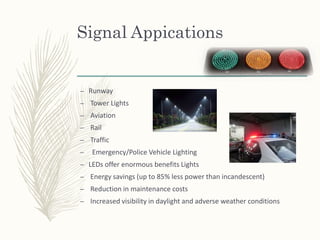
Signal Appications
– Runway
– Tower Lights
– Aviation
– Rail
– Traffic
– Emergency/Police Vehicle Lighting
– LEDs offer enormous benefits Lights
– Energy savings (up to 85% less power than incandescent)
– Reduction in maintenance costs
– Increased visibility in daylight and adverse weather conditions
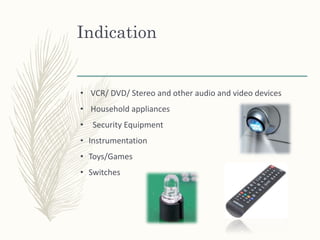
Indication
• VCR/ DVD/ Stereo and other audio and video devices
• Household appliances
• Security Equipment
• Instrumentation
• Toys/Games
• Switches
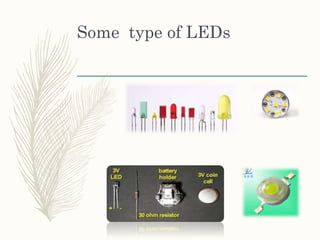
Some type of LEDs
THE END
THANKS FOR LISTENING
ANY QUESTION ?? 

Light Emitting Diode (LED)

  • 2.
  • 3.
    LIGHT EMITTING DIODES (LED) OPTOELECRONIC Alight emitting diode (LED) is essentially a PN junction opto- semiconductor that emits a monochromatic (single color) light when operated in a forward biased direction. LEDs converrt electrical energy into light energy. They are frequently used as "pilot" lights in electronic appliances to indicate whether the circuit is closed or not
  • 4.
    HOW DOES ALED WORK? – When sufficient voltage is applied to the chip across the leads of the LED, electrons can move easily in only one direction across the junction between the p and n regions. – In the p region there are many more positive than negative charges. – When a voltage is applied and the current starts to flow, electrons in the n region have sufficient energy to move across the junction into the p region
  • 5.
  • 6.
    How Does ALED Work? – Each time an electron recombine swith a positive charge, electric potential energy is converted into electromagnetic energy. – For each recombination of a negative and a positive charge, a quantum of electromagnetic energy is emitted in the form of a photon of light with a frequency characteristic of the semi-conductor material(usually a combination of the chemical elements gallium, arsenic and phosphorus.
  • 7.
    How Much EnergyDoes an LED Emit? The energy (E) of the light emitted by an LED is related to the electric charge (q) of an electron and the voltage (V) required to light the LED by the expression: E = qv Joules. – Finding the Energy from the Voltage Suppose you measured the voltage across the leads of an LED , and you wished to find the corresponding energy required to light the LED. Let us say that you have a red LED, and the voltage measured between the leads of is 1.71 Volts. So the Energy required to light the LED is E = qv or E = -1.6 x 10⁻⁹
  • 8.
    Finding the Energyfrom the Voltage – Voltage Suppose you measured the voltage across the leads of an LED, and you wished to find the corresponding energy required to light the LED. – Let us say that you have a red LED, and the voltage measured between the leads of is 1.71 Volts. – So the Energy required to light the LED is – E = qV or E = -1.6 x 10⁻¹⁹(1.71) – Joule, since a Coulomb-Volt is a Joule. Multiplication of these numbers then gives – E = 2.74 x 10⁻¹⁹Joule.
  • 9.
  • 10.
    LED VOLTAGE AND CURRENT To prevent from destruction of LED we use a resistor  There are two voltages Source voltage and Diode voltage.  Is = 𝑉𝑠−𝑉𝑑 𝑅𝑠
  • 11.
    LED Brightness  thebrightness of an LED depends on the current When Vs is much greater than Vd the brightness of LED is approximately constant. If Vs is only slightly more than Vd, the LED brightness will vary noticeably. To keep the brightness of LED constant the source current must be constant .
  • 12.
    Colours of LEDs –LEDs are available in red, orange, amber, yellow, green, blue and white. Blue and white LEDs are much more expensive than the other colours. The colour of an LED is determined by the semiconductor material, not by the colouring of the package (the plastic body). – LEDs are made from gallium-based crystals that contain one or more additional materials such as phosphorous to produce a distinct color. Different LED chip technologies emit light in specific regions of the visible light spectrum and produce different intensity levels.
  • 13.
    BREAKDOWN VOLTAGE – LEDhave very low breakdown voltage , typically between 3V and 5V – LED destroyed if the too much voltage applied. – It works only in farward biased
  • 14.
  • 15.
    Seven-Segment Display It containsseven rectangular LEDs ( A through G ) Each LED is called a segment. External series resistors are included to limit the current to safe levels. Using seven segment we can form any digit from 1 to 9 . It can also display the capital letters(A,C,E,F) . In seven-segment indicator all anodes are connected together. It is also in common cathode type in which all cathodes are connected together
  • 16.
  • 17.
  • 18.
    Photodiode –What is photodiode?  Photodiode is a reverse of led  In photodiode input is light and the output is voltage  It works in reverse biased.  When the covalent bond break electrons emit and it moves from lower to higher orbit and gain energy. When it come back to lower energy level it emits radiation in form of voltage .
  • 19.
    photodiode - Principle ofphotodiode  When light energy bombarded a pn junction ,it dislodge valance electrons  More the light strike the pn-junction more is the reverse current produce  Incoming light produces free electrons and holes  The stronger the light the larger the minority carriers and greater the reverse current  As the light become brighter , the reverse current increases.
  • 20.
  • 21.
    optocoupler Optocoupler combines ledand the photodiode -led convert voltage into light and work as a input -photodiode convert light into a voltage and work as a output. When the input voltage is varying ,the amount of light is fluctuating
  • 22.
    optocoupler – Advantage ofoptocoupler Easily availaible No gas , No pollutant produce Less area required for installation – Disadvantage of optocoupler Not always produce constant electricity Due to temperature variation after some time decrease the efficiency
  • 23.
    Laser diode  Ina led free electrons radiate light when falling high energy level to lower one  A laser diode is different , it produce the coherent light  A laser diode produce a narrow beam of light which is very intense ,focused and pure.  These are also known as semi-conductor laser, it can produce visible and invisible lights.
  • 24.
    NEXT proceeded by M.ABDULLAH HASHMI (GROUP leader )
  • 25.
    Applications – Sensor Application –Mobile Applications – Sign Applications – Automobile Applications – LED Signals – Indicators
  • 26.
    Sensor Applications – ColorBar Code Readers – Medical Instrumentation (blood group detection using fiber optics) – Money sensors – Optical switches – Fiber optical cummunication
  • 27.
    Mobile Applications – GeneralBacklighting – Lap Tops – Digital Cameras – PDAs – Mobile Phone
  • 28.
    Sign Applications – TransportationPassenger Information – Traffic – Monochrome Message Board – Full color video
  • 29.
    Automobile Applications  InteriorLighting - Instrument Panels& switches,courtesy lighting Exterior lighting,rear stop/turn/tail Truck/bus lighting ,new turn/tail/marker lights
  • 30.
    Signal Appications – Runway –Tower Lights – Aviation – Rail – Traffic – Emergency/Police Vehicle Lighting – LEDs offer enormous benefits Lights – Energy savings (up to 85% less power than incandescent) – Reduction in maintenance costs – Increased visibility in daylight and adverse weather conditions
  • 31.
    Indication • VCR/ DVD/Stereo and other audio and video devices • Household appliances • Security Equipment • Instrumentation • Toys/Games • Switches
  • 32.
  • 33.
    THE END THANKS FORLISTENING ANY QUESTION ?? 