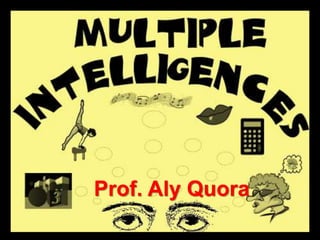
Prof. Aly Quora
Are you are smart ? How?
We are ALL smart in different
ways.
Multiple
theory
The Theory of Multiple Intelligences
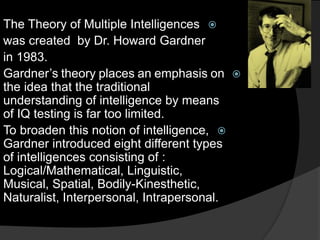
was created by Dr. Howard Gardner
in 1983.
Gardner’s theory places an emphasis on
the idea that the traditional
understanding of intelligence by means
of IQ testing is far too limited.
To broaden this notion of intelligence,
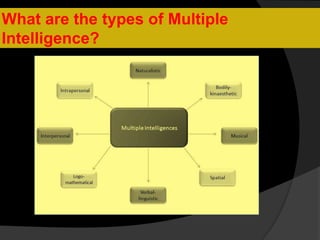
Gardner introduced eight different types
of intelligences consisting of :
Logical/Mathematical, Linguistic,
Musical, Spatial, Bodily-Kinesthetic,
Naturalist, Interpersonal, Intrapersonal.
What is intelligence?
as defined by Gardner, it is the ability to solve
problems or fashion products that are
valuable in one or more cultural settings
.
Each person may have different multiple
intelligence. Even everyone can possess
more than one of it as Gardner divided
the multiple intelligences into eight kinds
What are the types of Multiple
Intelligence?
Verbal/Linguistic Intelligence
ability to use words and
language. These learners have
highly developed auditory skills
and are generally elegant
speakers. They think in words
rather than pictures.
If you have strong linguistic
intelligence you might learn better
by
Reading
Memorizing
Playing word games (Scrabble, Anagrams, Password)
Using the internet
Logical/Mathematical
Intelligence
ability to use reason, logic and numbers.
These learners think conceptually in logical and
numerical patterns making connections between
pieces of information. Always curious about the
world around them, these learner ask lots of
questions and like to do experiments.
If you have strong logical-mathematical intelligence you
might learn better by
Recording information systematically
Playing strategy games (Chess, Checkers)
Analyzing data
Asking logical questions
Using the internet
Bodily/Kinesthetic
Intelligence
ability to control body movements and handle objects
skillfully.
These learners express themselves through movement.
They have a good sense of balance and eye-hand co-
ordination. (e.g. ball play, balancing beams). Through
interacting with the space around them, they are able to
remember and process information.
If you have strong bodily-kinesthetic intelligence you
might learn better by
Doing role plays.
Exercising while reviewing
Visiting museums, institutions, parks
Asking logical questions
Using the internet
Visual/Spatial Intelligence
ability to perceive the visual.
These learners tend to think in pictures and need
to create vivid mental images to retain
information. They enjoy looking at maps, charts,
pictures, videos, and movies.
If you have strong visual intelligence you might learn
better by
Studying pictures
Watching videos
Using visual, tangible aids
Doing mazes, puzzles
Making predictions
Using the internet.
Musical Intelligence
ability to produce and appreciate music.
These musically inclined learners think in sounds, rhythms and
patterns. They immediately respond to music either
appreciating or criticizing what they hear. Many of these
learners are extremely sensitive to environmental sounds (e.g.
crickets, bells, dripping taps).
If you have strong musical intelligence you might learn better by
Listening to recordings
Talking to yourself
Making up songs
Mentally repeating information
Reading aloud
Changing tempo
Interpersonal Intelligence
ability to relate and understand others.
These learners try to see things from other people's point
of view in order to understand how they think and feel.
They often have an uncanny ability to sense feelings,
intentions and motivations. They are great organizers.
Generally they try to maintain peace in group settings
and encourage co-operation.They use both verbal (e.g.
speaking) and non-verbal language (e.g. eye contact,
body language) to open communication channels with
others.
If you have strong interpersonal intelligence you
might learn better by
Studying in groups
Comparing information with others
Interviewing experts
Relating personal experiences
Doing cooperative projects
IntelligenceIntrapersonal
ability to self-reflect and be aware of
one's inner state of being.
These learners try to understand their
inner feelings, dreams, relationships
with others, and strengths and
weaknesses.
If you have strong intrapersonal intelligence
you might learn better by
Avoiding distractions
Establishing personal goals
Working alone
Relating personal experiences.
Naturalist Intelligence
Abilities to recognize plants and animals, to make
distinctions in the natural world, to understand
systems and define categories
If you have strong naturalistic intelligence you
might learn better by
Studying outside
Learning in the presence of plants & pets
Relating environmental issues to topics
Smelling, seeing touching, tasting,
Observing natural phenomenon
Traditional ViewfoIntelligence
vs
MI Theory
"Multiple Intelligences" Theory-Traditional View of "Intelligence"
- Short answer tests are not used
because they do not measure
disciplinary mastery or deep
understanding. They only measure
rote memorization skills and one's
ability to do well on short answer
tests.
- Intelligence can be measured by
short-answer tests
- Human beings have all of the
intelligences, but each person has a
unique combination, or profile
- People are born with a fixed amount of
intelligence.
- We can all improve each of the
intelligences, though some people
will improve more readily in one
intelligence area than in others
- Intelligence level does not change over a
lifetime.
- There are many more types of
intelligence which reflect different
ways of interacting with the world
- Intelligence consists of ability in
logic and language.
- M.I. pedagogy implies that teachers
teach and assess differently based
on individual intellectual strengths
and weaknesses.
- In traditional practice, teachers
teach the same material to
everyone.
- Teachers structure learning
activities around an issue or
question and connect subjects.
Teachers develop strategies that
allow for students to demonstrate
multiple ways of understanding and
value their uniqueness.
- Teachers teach a topic or
"subject."
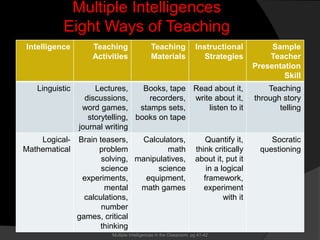
Multiple Intelligences
Eight Ways of Teaching
Intelligence Teaching
Activities
Teaching
Materials
Instructional
Strategies
Sample
Teacher
Presentation
Skill
Linguistic Lectures,
discussions,
word games,
storytelling,
journal writing
Books, tape
recorders,
stamps sets,
books on tape
Read about it,
write about it,
listen to it
Teaching
through story
telling
Logical-
Mathematical
Brain teasers,
problem
solving,
science
experiments,
mental
calculations,
number
games, critical
thinking
Calculators,
math
manipulatives,
science
equipment,
math games
Quantify it,
think critically
about it, put it
in a logical
framework,
experiment
with it
Socratic
questioning
Multiple Intelligences in the Classroom, pg 41-42
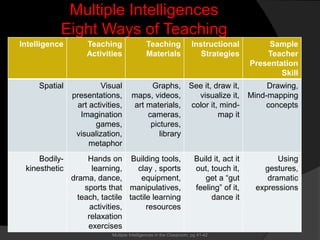
Multiple Intelligences
Eight Ways of Teaching
Intelligence Teaching
Activities
Teaching
Materials
Instructional
Strategies
Sample
Teacher
Presentation
Skill
Spatial Visual
presentations,
art activities,
Imagination
games,
visualization,
metaphor
Graphs,
maps, videos,
art materials,
cameras,
pictures,
library
See it, draw it,
visualize it,
color it, mind-
map it
Drawing,
Mind-mapping
concepts
Bodily-
kinesthetic
Hands on
learning,
drama, dance,
sports that
teach, tactile
activities,
relaxation
exercises
Building tools,
clay , sports
equipment,
manipulatives,
tactile learning
resources
Build it, act it
out, touch it,
get a “gut
feeling” of it,
dance it
Using
gestures,
dramatic
expressions
Multiple Intelligences in the Classroom, pg 41-42
Multiple Intelligences
Eight Ways of Teaching
Intelligence Teaching
Activities
Teaching
Materials
Instructional
Strategies
Sample
Teacher
Presentation
Skill
Musical Rhythmic
learning,
rapping, using
songs that
teach
Tape recorder,
tape
collection,
musical
instruments
Sing it, rap it,
listen to it
Using voice
rhythmically
Interpersonal Cooperative
learning, peer
tutoring,
community
involvement,
social
gatherings,
simulation
Board games,
party
supplies,
props for role
plays
Teach it,
collaborate on
it, interact
with respect
to it
Dynamically
interacting
with students
Multiple Intelligences in the Classroom, pg 41-42
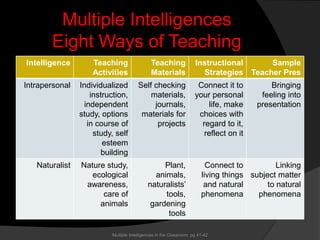
Multiple Intelligences
Eight Ways of Teaching
Intelligence Teaching
Activities
Teaching
Materials
Instructional
Strategies
Sample
Teacher Pres
Intrapersonal Individualized
instruction,
independent
study, options
in course of
study, self
esteem
building
Self checking
materials,
journals,
materials for
projects
Connect it to
your personal
life, make
choices with
regard to it,
reflect on it
Bringing
feeling into
presentation
Naturalist Nature study,
ecological
awareness,
care of
animals
Plant,
animals,
naturalists’
tools,
gardening
tools
Connect to
living things
and natural
phenomena
Linking
subject matter
to natural
phenomena
Multiple Intelligences in the Classroom, pg 41-42
multiple intelligence test
What are my Learning Strengths?
.
Multiple intelligences ppt

Multiple intelligences ppt

  • 1.
  • 2.
    Are you aresmart ? How?
  • 3.
    We are ALLsmart in different ways.
  • 4.
  • 5.
    The Theory ofMultiple Intelligences was created by Dr. Howard Gardner in 1983. Gardner’s theory places an emphasis on the idea that the traditional understanding of intelligence by means of IQ testing is far too limited. To broaden this notion of intelligence, Gardner introduced eight different types of intelligences consisting of : Logical/Mathematical, Linguistic, Musical, Spatial, Bodily-Kinesthetic, Naturalist, Interpersonal, Intrapersonal.
  • 6.
    What is intelligence? asdefined by Gardner, it is the ability to solve problems or fashion products that are valuable in one or more cultural settings
  • 7.
    . Each person mayhave different multiple intelligence. Even everyone can possess more than one of it as Gardner divided the multiple intelligences into eight kinds
  • 8.
    What are thetypes of Multiple Intelligence?
  • 9.
    Verbal/Linguistic Intelligence ability touse words and language. These learners have highly developed auditory skills and are generally elegant speakers. They think in words rather than pictures. If you have strong linguistic intelligence you might learn better by Reading Memorizing Playing word games (Scrabble, Anagrams, Password) Using the internet
  • 10.
    Logical/Mathematical Intelligence ability to usereason, logic and numbers. These learners think conceptually in logical and numerical patterns making connections between pieces of information. Always curious about the world around them, these learner ask lots of questions and like to do experiments. If you have strong logical-mathematical intelligence you might learn better by Recording information systematically Playing strategy games (Chess, Checkers) Analyzing data Asking logical questions Using the internet
  • 11.
    Bodily/Kinesthetic Intelligence ability to controlbody movements and handle objects skillfully. These learners express themselves through movement. They have a good sense of balance and eye-hand co- ordination. (e.g. ball play, balancing beams). Through interacting with the space around them, they are able to remember and process information. If you have strong bodily-kinesthetic intelligence you might learn better by Doing role plays. Exercising while reviewing Visiting museums, institutions, parks Asking logical questions Using the internet
  • 12.
    Visual/Spatial Intelligence ability toperceive the visual. These learners tend to think in pictures and need to create vivid mental images to retain information. They enjoy looking at maps, charts, pictures, videos, and movies. If you have strong visual intelligence you might learn better by Studying pictures Watching videos Using visual, tangible aids Doing mazes, puzzles Making predictions Using the internet.
  • 13.
    Musical Intelligence ability toproduce and appreciate music. These musically inclined learners think in sounds, rhythms and patterns. They immediately respond to music either appreciating or criticizing what they hear. Many of these learners are extremely sensitive to environmental sounds (e.g. crickets, bells, dripping taps). If you have strong musical intelligence you might learn better by Listening to recordings Talking to yourself Making up songs Mentally repeating information Reading aloud Changing tempo
  • 14.
    Interpersonal Intelligence ability torelate and understand others. These learners try to see things from other people's point of view in order to understand how they think and feel. They often have an uncanny ability to sense feelings, intentions and motivations. They are great organizers. Generally they try to maintain peace in group settings and encourage co-operation.They use both verbal (e.g. speaking) and non-verbal language (e.g. eye contact, body language) to open communication channels with others. If you have strong interpersonal intelligence you might learn better by Studying in groups Comparing information with others Interviewing experts Relating personal experiences Doing cooperative projects
  • 15.
    IntelligenceIntrapersonal ability to self-reflectand be aware of one's inner state of being. These learners try to understand their inner feelings, dreams, relationships with others, and strengths and weaknesses. If you have strong intrapersonal intelligence you might learn better by Avoiding distractions Establishing personal goals Working alone Relating personal experiences.
  • 16.
    Naturalist Intelligence Abilities torecognize plants and animals, to make distinctions in the natural world, to understand systems and define categories If you have strong naturalistic intelligence you might learn better by Studying outside Learning in the presence of plants & pets Relating environmental issues to topics Smelling, seeing touching, tasting, Observing natural phenomenon
  • 17.
  • 18.
    "Multiple Intelligences" Theory-TraditionalView of "Intelligence" - Short answer tests are not used because they do not measure disciplinary mastery or deep understanding. They only measure rote memorization skills and one's ability to do well on short answer tests. - Intelligence can be measured by short-answer tests - Human beings have all of the intelligences, but each person has a unique combination, or profile - People are born with a fixed amount of intelligence. - We can all improve each of the intelligences, though some people will improve more readily in one intelligence area than in others - Intelligence level does not change over a lifetime.
  • 19.
    - There aremany more types of intelligence which reflect different ways of interacting with the world - Intelligence consists of ability in logic and language. - M.I. pedagogy implies that teachers teach and assess differently based on individual intellectual strengths and weaknesses. - In traditional practice, teachers teach the same material to everyone. - Teachers structure learning activities around an issue or question and connect subjects. Teachers develop strategies that allow for students to demonstrate multiple ways of understanding and value their uniqueness. - Teachers teach a topic or "subject."
  • 20.
    Multiple Intelligences Eight Waysof Teaching Intelligence Teaching Activities Teaching Materials Instructional Strategies Sample Teacher Presentation Skill Linguistic Lectures, discussions, word games, storytelling, journal writing Books, tape recorders, stamps sets, books on tape Read about it, write about it, listen to it Teaching through story telling Logical- Mathematical Brain teasers, problem solving, science experiments, mental calculations, number games, critical thinking Calculators, math manipulatives, science equipment, math games Quantify it, think critically about it, put it in a logical framework, experiment with it Socratic questioning Multiple Intelligences in the Classroom, pg 41-42
  • 21.
    Multiple Intelligences Eight Waysof Teaching Intelligence Teaching Activities Teaching Materials Instructional Strategies Sample Teacher Presentation Skill Spatial Visual presentations, art activities, Imagination games, visualization, metaphor Graphs, maps, videos, art materials, cameras, pictures, library See it, draw it, visualize it, color it, mind- map it Drawing, Mind-mapping concepts Bodily- kinesthetic Hands on learning, drama, dance, sports that teach, tactile activities, relaxation exercises Building tools, clay , sports equipment, manipulatives, tactile learning resources Build it, act it out, touch it, get a “gut feeling” of it, dance it Using gestures, dramatic expressions Multiple Intelligences in the Classroom, pg 41-42
  • 22.
    Multiple Intelligences Eight Waysof Teaching Intelligence Teaching Activities Teaching Materials Instructional Strategies Sample Teacher Presentation Skill Musical Rhythmic learning, rapping, using songs that teach Tape recorder, tape collection, musical instruments Sing it, rap it, listen to it Using voice rhythmically Interpersonal Cooperative learning, peer tutoring, community involvement, social gatherings, simulation Board games, party supplies, props for role plays Teach it, collaborate on it, interact with respect to it Dynamically interacting with students Multiple Intelligences in the Classroom, pg 41-42
  • 23.
    Multiple Intelligences Eight Waysof Teaching Intelligence Teaching Activities Teaching Materials Instructional Strategies Sample Teacher Pres Intrapersonal Individualized instruction, independent study, options in course of study, self esteem building Self checking materials, journals, materials for projects Connect it to your personal life, make choices with regard to it, reflect on it Bringing feeling into presentation Naturalist Nature study, ecological awareness, care of animals Plant, animals, naturalists’ tools, gardening tools Connect to living things and natural phenomena Linking subject matter to natural phenomena Multiple Intelligences in the Classroom, pg 41-42
  • 24.
    multiple intelligence test Whatare my Learning Strengths? .